

After over a decade of off-grid tiny-house living, I can tell you it is not all gleaming minimalist magic. The pros and cons of living in a tiny house are both real — the freedom is genuine, and so are the compromises. I have lived every line of the ledger below, from a barely 200-square-foot cabin in the pines to the daily routines I still keep. Here is the honest weighing, before you take the plunge.
The Pros and Cons of Living in a Tiny House: At a Glance
Tiny homes are more than a trend — they are a deliberate shift in mindset, a conscious choice toward minimalism and eco-friendly living. But a movement this popular deserves a clear head, not just enthusiasm. This guide works through the pros and cons of living in a tiny house in full: what a tiny house actually is, the four big advantages (money, footprint, mobility, simplicity), the four honest drawbacks (space, law, adjustment, stereotypes), the ethics underneath it all, and the long-term questions of family and resale — ending with how to maximize the experience if you decide the life is for you.
| Topic | What It Covers | Key Fact or Figure |
|---|---|---|
| 1. The Tiny House Concept | What defines a tiny house, and how the movement went mainstream | Typically smaller than 400 square feet |
| 2. Financial Freedom and Cost Savings | Build cost, mortgages and money freed for living | $30,000–$60,000 vs a ~$430,000 median home |
| 3. Sustainable and Eco-Friendly Living | Materials, energy, off-grid systems and footprint | Roughly 45% smaller carbon footprint |
| 4. Mobility and Flexibility | Trailers, travel and following work or weather | A home that can cross the country |
| 5. Minimalist Lifestyle and Simplicity | Fewer possessions, intentional space, clarity | Essentials only — nothing more, nothing less |
| 6. Space Restrictions: The Reality Check | Hosting, privacy and daily room to move | Comfort must be genuine, not forced |
| 7. Legal and Zoning Challenges | Codes, jurisdictions, inspections and placement | Every jurisdiction writes its own rules |
| 8. Adjustment and Social Misunderstandings | The learning curve, stereotypes and other people | Adjustment is slow — and worth planning for |
| 9. Ethical Considerations | Mindful consumption and community responsibility | Ethics are a daily practice, not a label |
| 10. The Long Term and Maximizing the Experience | Family, resale value, design, upkeep | Plan for the life you will have, not just today’s |
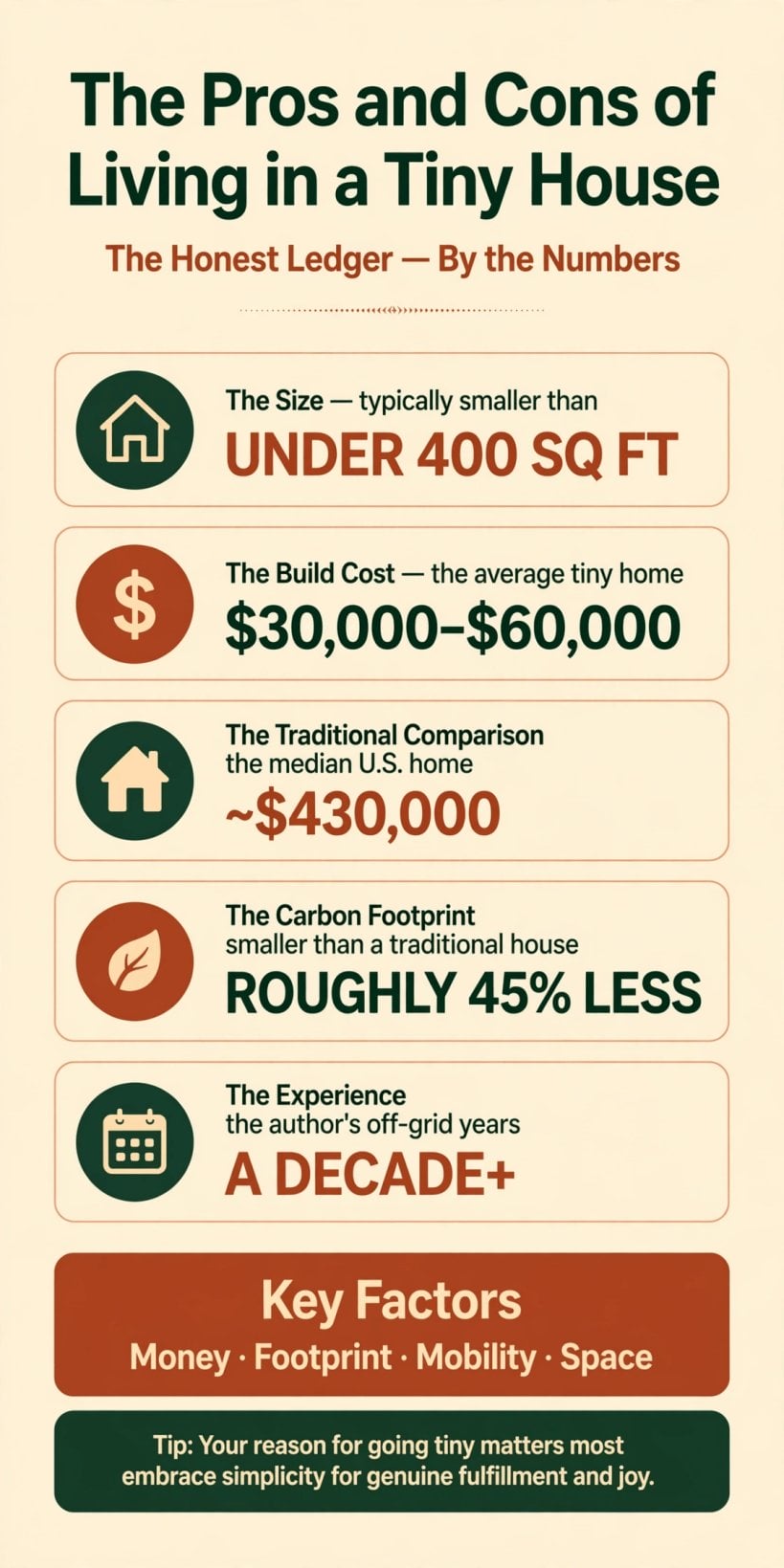
The ledger at a glance: under 400 square feet, a build cost a fraction of the median home, a footprint roughly 45% smaller — weighed after a decade of living it.
1. The Tiny House Concept: What Counts as Tiny?
Start with the definition. Typically smaller than 400 square feet, tiny houses are compact, efficient dwellings that champion minimalism. Often built on trailers, they invite mobility — but they are not simply portable homes. A tiny house merges smart design with intentional living, prioritizing sustainability, adaptability and stylish comfort in a footprint most people would call a single room.

My own first tiny cabin was barely 200 square feet — a cozy, rustic hut hidden amidst towering pines up north — yet every inch was thoughtfully planned, and it never felt like a compromise. That is the concept in one image: small on paper, complete in practice. The wider phenomenon grew from economic shifts and rising sustainability concerns; shows like “Tiny House Nation” and pioneers like Jay Shafer popularized the lifestyle and made a once-niche idea mainstream. Today, people of all age groups and demographics are genuinely intrigued by the nuances of micro-home living — and the same small-dwelling family keeps branching, as the rise of portable capsule homes shows. Understanding what “tiny” really means is the ground every pro and con below stands on.
2. Financial Freedom and Cost Savings
Let’s get real — the pros and cons of living in a tiny house start, for most people, with money, and here the pro column is heavy. According to verified data from the Tiny House Industry Association, the average tiny home typically costs between $30,000–$60,000, versus the median traditional U.S. home price hovering around $430,000. With drastically reduced mortgage requirements — or sometimes none at all — financial freedom turns from a distant dream into an attainable reality.
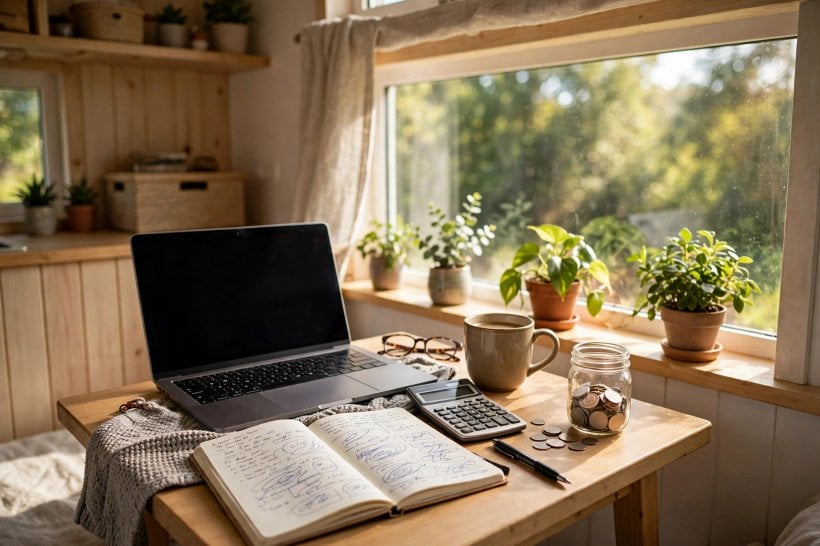
This is not theory. My close friend Mark switched to a beautifully cozy tiny cottage he built himself; now mortgage-free, he dedicates more of his resources toward travel, creativity and his expanding organic garden. That is what the cost gap buys when it lands in a real life: not just a cheaper house, but money and time redirected toward living. Lower running costs compound the effect month after month. Weigh this pro honestly, though — it is the strongest argument in this entire guide, and it deserves its weight.
3. Sustainable and Eco-Friendly Living
Sustainable living and tiny houses are deeply intertwined. Small spaces mean fewer building materials, less environmental waste and significantly reduced energy requirements. Many tiny homes feature composting toilets, solar panels, energy-efficient design and rainwater harvesting systems to support off-grid capabilities — the exact kit I have run for years.
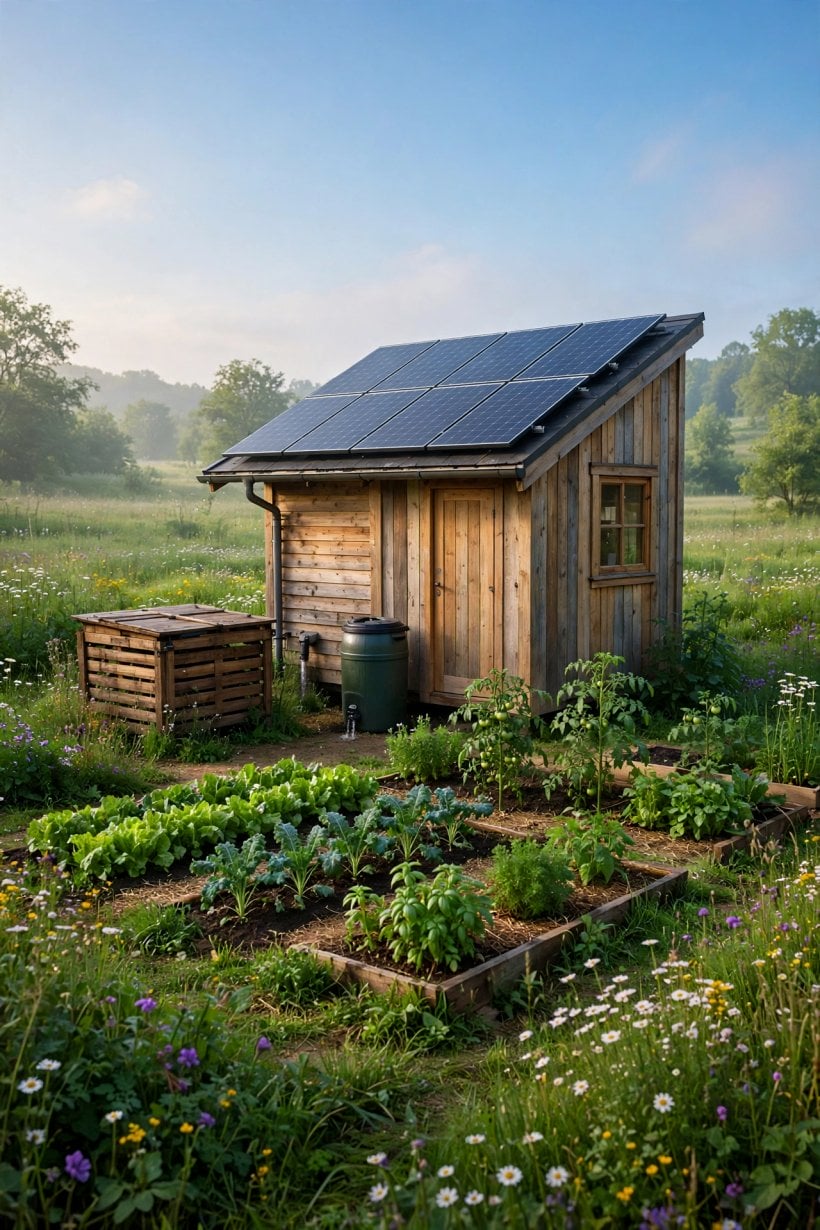
My hut’s composting toilet once raised skeptical eyebrows among friends, but it is remarkably comfortable — and ecologically effective. The numbers back the intuition: data from EcoWatch establishes that tiny homes can reduce carbon footprints by roughly 45% compared to traditional houses. Keeping a small home comfortable through the cold months is part of that same energy discipline, and our guide to heating a tiny home in winter covers the affordable, efficient methods that make it work. This lifestyle is not just trendy — it is a legitimate eco-friendly solution for conscious residents.
4. Mobility and Flexibility
Got wanderlust? Take your home wherever adventure calls. Mobility is one of the tiny house’s unique and attractive features: whether built on a trailer for easy travel or nestled onto land as a micro-cabin, a tiny house offers adaptability like no other conventional residence. The flexibility to pursue job opportunities, explore new communities, or follow the sun — quite literally — adds extraordinary appeal.
I recently met Jodie, whose mobile tiny home traveled coast-to-coast as she explored national parks. Home was never distant — even a thousand miles away. That is the pro in its purest form: the house stops being an anchor and becomes a vehicle for the life around it. The same flexibility works in smaller moves, too. A job opportunity in another state stops being a reason to sell a house and start over; a community you fall for on a road trip can become your actual address; a winter you would rather spend somewhere warmer becomes a route instead of a wish. Conventional residences simply cannot answer life this way — they are fixed by foundation, by mortgage, by the sheer cost of leaving. A tiny house on a trailer holds its value in the opposite quality: it can go. For anyone whose life is still in motion, that is not a novelty feature. It is the whole point.
The wheeled end of small living has close cousins too — a Ford Transit Connect camper conversion chases the same freedom in van form. If your work, your family or your curiosity refuses to sit still, few housing choices answer the way a house on wheels does.
5. Minimalist Lifestyle and Simplicity
Living tiny means embracing minimalism. Owning fewer possessions is not deprivation — it is clarity. Intentional space efficiency, foldable furniture, bunk lofts and under-stair storage force smart decisions: you keep essentials and love what surrounds you, nothing more, nothing less.

When I first downsized, I discovered genuine peace in owning fewer possessions. With less clutter, I stopped losing precious moments managing stuff and instead devoted quality time to gardening, meditation, friendships and meaningful experiences. If you are standing where I stood, our step-by-step guide to declutter and transition to 200 square feet walks the same path. Tiny house minimalism is not limiting — it is liberating. But it is also the pro that demands the most honesty, because the simplicity only works when it is chosen, not endured. That tension leads straight into the cons.
6. Space Restrictions: The Reality Check
Now the other side. While downsizing sounds liberating, tiny homes can feel radically compact — and the pros and cons of living in a tiny house turn on how honestly you face this one. Certainly, tiny houses are customizable and designed for maximum space efficiency. Yet living permanently within a restrictive footprint presents legitimate challenges. Hosting dinners becomes creative improvisation, personal routines shift, and couples or families navigate privacy differently.

After years surrounded by majestic nature, even I occasionally crave extra indoor roominess. Such limitations must be carefully assessed — you need genuine comfort, not forced simplicity. Test the footprint before you commit to it: live small on trial, notice what you actually reach for, and let that evidence — not the romance — make the call.
7. Legal and Zoning Challenges
Tiny house legalization remains complex in various jurisdictions. Zoning and building codes have not always caught up with the tiny trend, causing significant barriers. Each state, province and even municipal area has unique tiny home legalities, often confusing even seasoned residents. A house can be legal on one side of a county line and unplaceable on the other.
Friends of mine recently faced hurdles placing their mobile tiny home: complicated legal paperwork, inspections and zoning committees — a taxing ordeal. You must invest proper time into researching the applicable laws before building or buying tiny, ensuring regulatory compliance from the start. Do it in that order — laws first, house second. The research is unglamorous: reading the code for the exact ground you want, asking how the jurisdiction classifies a house on wheels, learning where it may park and for how long, and what inspections stand between delivery and living in it. Every hour of that homework is cheaper than one hour of the alternative — a finished home with nowhere legal to put it — and seasoned residents will tell you the confusion is normal, because the rules genuinely differ from one jurisdiction to the next.
One route around some of the friction is a factory-built home from an established manufacturer — our profile of Honomobo homes shows how one maker approaches tiny living — but no route removes the homework. The law is the least romantic section of this guide and the one that saves the most grief.
8. The Adjustment Period — and Other People
Transitioning to tiny living can seem romantic until you are actually immersed in the daily routines. Adjustments happen slowly, and there is a definitive learning curve: you are suddenly cooking with miniature appliances, planning storage dynamics, or managing limited shower capacities. For months after moving tiny, I repeatedly rearranged cupboards and reorganized spaces. Patience and a resilient sense of humor help tremendously, as does practical flexibility. You will adjust — but embrace the transitional uncertainties and bumps along your minimalist pathway.
Other people adjust too — or don’t. Tiny residents sometimes face social misconceptions: family worrying you are turning “too eccentric,” or employers misunderstanding your tiny address. Stereotypes linger, labeling tiny housers as impractical dreamers, extremists or careless drifters. I have worked to disprove them through community involvement — hosting open-house tiny tours, sharing eco-conscious ideas, organizing workshops. It is rewarding, but it requires consistently challenging misunderstandings; the stereotype battle is mapped honestly in our guide to tiny house myths. Consider carefully your comfort handling such misconceptions before fully committing.
9. Ethical Considerations: Consumption and Community
Embracing a tiny house entails a holistic commitment to ethical living. Sustainability is not superficial — decisions about building materials, energy sources, water usage and waste management weigh seriously. Pursuing LEED certification or following similar eco-friendly standards conveys genuine dedication toward minimizing environmental impact. The ethics are not a badge on the door; they are the daily arithmetic of what the house consumes and what it returns.

There is a social half, too. Tiny-house dwellers often join tiny house communities or sustainable housing networks, embracing social interdependence. This fosters significant responsibility — a collective commitment to maintaining eco-ethics, community harmony, resource sharing and respectful living conditions that fuels group sustainability efforts. Village life makes the ethic tangible: in the villages profiled in our guide to tiny house communities in Alabama, shared amenities and shared standards are the same thing. Living small, done ethically, is a practice you keep — not a purchase you finish.
10. The Long Term: Family, Value — and Maximizing the Experience
The pros and cons of living in a tiny house do not stand still — they are weighed over years, and the long term is where the balance either holds or quietly shifts. Look further ahead. If you foresee a growing family, aging parents moving in, or lifestyle changes needing extra room — plan prudently. Tiny houses demand intelligent future planning, as their effectiveness relies heavily on compatibility with life’s changing dynamics. A child, a parent, a new way of working: each asks the small floor plan a fresh question. Customizable tiny additions or expansions could solve some challenges, but careful advance consideration remains key — the time to ask whether the house can grow with you is before you need it to.

Money has a long-term caveat as well. Traditional homes typically appreciate in market value; tiny homes differ significantly here, and market resale opportunities remain limited. While communities are growing rapidly, tiny homes don’t offer the robust appreciation or retirement resource conventional dwelling investments typically provide. Carefully factor financial future planning into your tiny decision — the savings of §2 are real, but they are not the same instrument as a conventional house.
Finally, maximize what you have. Thoughtful space-saving designs — foldable furniture, multi-function cabinetry, loft spaces, skylight windows, even smart home technologies — solve many daily-life annoyances; prioritize functional aesthetics, each purchase serving multiple purposes. Connecting with established tiny house communities or resources like the Tiny House Industry Association equips you to understand zoning, legal challenges and practical home management strategies, with firsthand insights from seasoned residents. And understand proactive sustainability: routine care of solar panels, compost toilets, water systems and efficient heating and cooling mechanisms ensures longevity — seasonal upkeep like the checks in our tiny home summer prep guide is stewardship, not chores. Sustainability commitment extends beyond initial rituals — dedicate ongoing effort, education and daily intentionality toward your tiny home.

Final Considerations
In the end, tiny house living is not simply a trend or a catchphrase — it is a profound lifestyle choice. Both the meaningful advantages and the genuine challenges deserve your careful attention. Living small doesn’t limit your potential — it amplifies awareness, simplifies living, fosters ethical mindfulness and introduces constant learning. If you take one line from this weighing of the pros and cons of living in a tiny house, take the original’s own: your reason behind going tiny matters most. Embracing simplicity for genuine fulfillment and joy? That is a beautiful journey worth undertaking.


1 Comment