

Sewage is the system nobody puts on the mood board, yet it decides more about where a tiny house can live and how it feels day to day than almost any design choice. When owners compare tiny house sewage options honestly, they are really choosing between very different ways of life: connecting to a public sewer and forgetting about it, managing a septic system on their own land, avoiding flush water altogether with a composting or incinerating toilet, or living with a holding tank and a pump-out routine. Each option has its own costs, its own maintenance rhythm, and its own relationship with local rules.
This guide works through every main option in depth, attribute by attribute, so you can match a system to your land, your climate, your household, and the rules where the house will stand. Those rules are local and they change, so this guide will not quote regulations or promise that a particular arrangement is permitted anywhere; it will show you what each system involves, what it asks of you, and which questions to take to your local authority or health department before you commit. Sewage handled well is invisible. Sewage handled badly is the one problem that can make a good tiny house unliveable, which is why this decision deserves to be made early and on facts.
Quick Answers at a Glance
| Question | Short Answer |
|---|---|
| What is the simplest option where it exists? | A connection to a public sewer, where available and permitted. The house drains like any other home and treatment happens elsewhere. |
| What do most rural tiny houses use? | Commonly a septic system serving a conventional flush layout, where the land and local approval allow it. |
| Can you avoid sewage plumbing altogether? | Largely, yes. Composting and incinerating toilets handle toilet waste without a flush drain, though greywater still needs a lawful route. |
| What suits a wheeled house that moves? | Often a holding tank with pump-outs, or a waterless toilet, because both travel with the house and need no fixed ground system. |
| What is greywater? | Water from sinks, showers, and laundry. It is not toilet waste, but it still must be handled lawfully and hygienically, never simply tipped anywhere. |
| Who decides what is allowed? | Your local authority or health department, based on the land and the system. Always check before you buy land or build. |
| What matters most in choosing? | The land, the law, how permanently the house will sit, how many people use it, and how much routine maintenance you accept. |
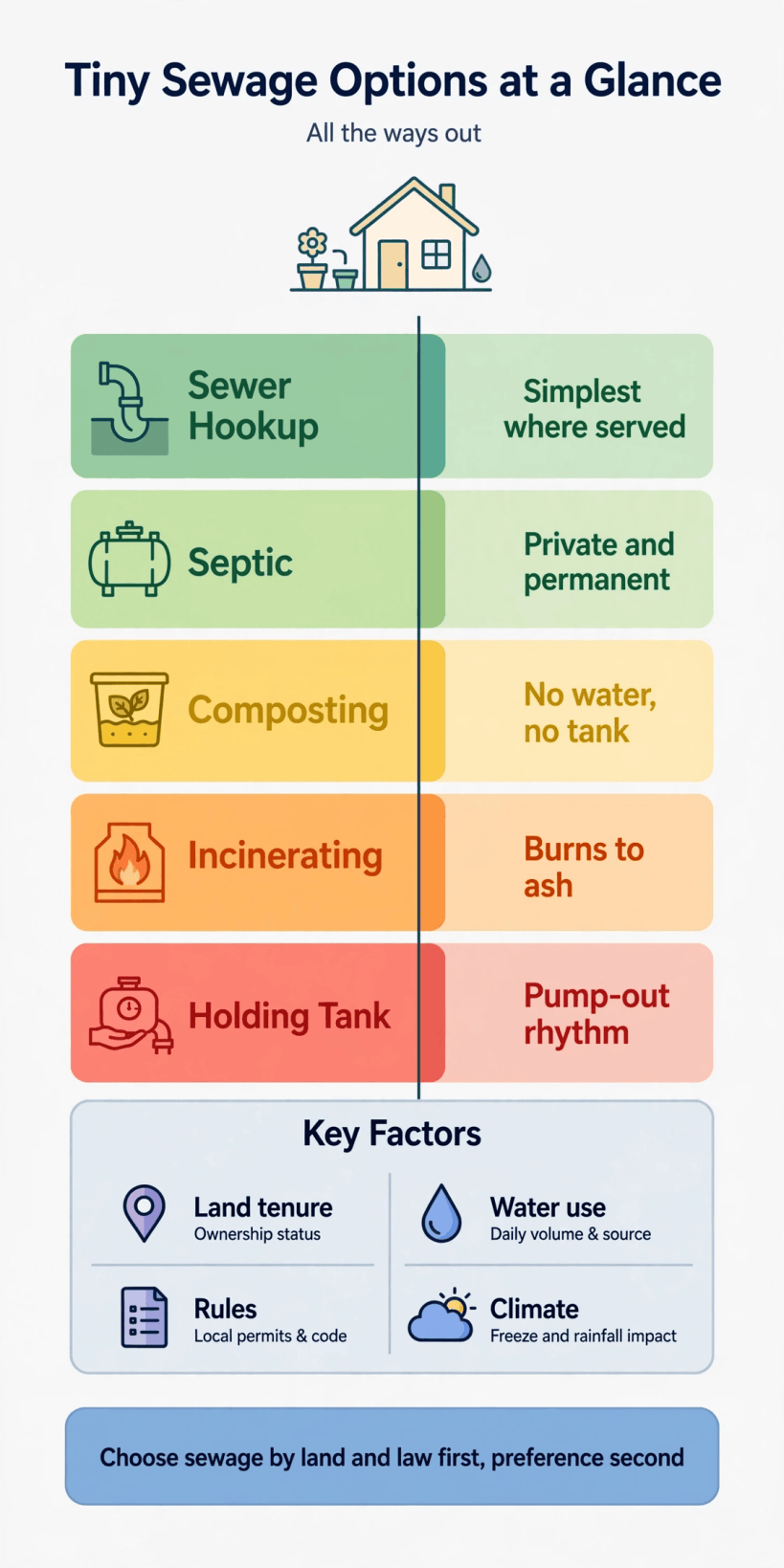
1. First, Separate Blackwater, Greywater, and the Toilet Decision
Every sewage conversation becomes clearer once three things are separated. Blackwater is toilet waste, the stream that carries the highest health risk and attracts the strictest rules. Greywater is everything else the house drains — shower, sinks, laundry — used water that is less hazardous but still far from clean, and still regulated in most places. And the toilet itself is a design decision that changes both streams: a conventional flush toilet sends blackwater into whatever system serves the house, while a composting or incinerating toilet keeps toilet waste out of the drains entirely, leaving only greywater to manage.
That separation is why two tiny houses with identical bathrooms can have completely different sewage arrangements. One flushes into a sewer connection; the other composts at the toilet and treats its greywater through a simple, approved route. Planning the plumbing with this split in mind — which fixtures drain where, and what each drain connects to — is the foundation of every later section, and it is why our guide to tiny house plumbing layout and drainage design pairs naturally with this one. Decide the toilet first, then design the drains the house actually needs, rather than copying a conventional house layout and discovering its assumptions do not fit your land.
2. Option One: Connecting to a Public Sewer
Where a public sewer is available and a connection is permitted, it is the least demanding option to live with. The house is plumbed conventionally, waste leaves through a drain to the sewer, and treatment is the utility’s problem rather than yours. Day to day there is no tank to monitor, no pump-out to book, and no system on your land to maintain beyond your own pipes. For a tiny house on a foundation in a town, or placed on a plot or park with sewer services already present, this is usually the arrangement officials understand best and neighbours question least.
The catches are availability and connection cost. A sewer must actually pass within reach of the plot, the connection itself involves fees, groundwork, and approvals that vary locally, and some situations — a wheeled home, a temporary placement, an accessory unit — are treated differently by different authorities, so permission for this specific house on this specific plot still needs confirming. Where a sewer exists but the connection charge is very high because of distance or ground conditions, a private system can occasionally compare better on cost, which is why our wider guide to tiny house utilities, power, water, and off-grid sewage treats sewer connection as one choice among several rather than an automatic answer. But where it is available on sensible terms, take its simplicity seriously: it is the only option in this guide with essentially no routine.
3. Option Two: A Septic System on Your Own Land
For a tiny house settled permanently on its own land beyond sewer reach, a septic system is the conventional answer: waste drains to a tank where solids settle and break down, and the liquid flows on to a drainage area in the soil that finishes the treatment. It is private infrastructure, wholly yours — which means its design, approval, installation, and upkeep are yours too. A well-sited, properly installed system serving a small household is quiet, largely invisible, and works away for years with periodic professional emptying and ordinary care about what goes down the drains.
The land decides whether this option exists at all. The soil must drain suitably, there must be room for the system and, in many areas, a protected reserve area for a future replacement, and separations from wells, water, and boundaries must be achievable — all assessed and approved locally, as our land guide’s discussion of septic space explains in our article on how to prepare your land for a tiny house. A tiny house produces less wastewater than a family house, which can be a point in its favour, but it does not exempt the system from local design and inspection requirements. Budget for the whole job — design, approval, tank, groundwork, and installation — and for a system built for the soil you actually have rather than the soil the brochure imagined.
4. Option Three: Composting Toilets
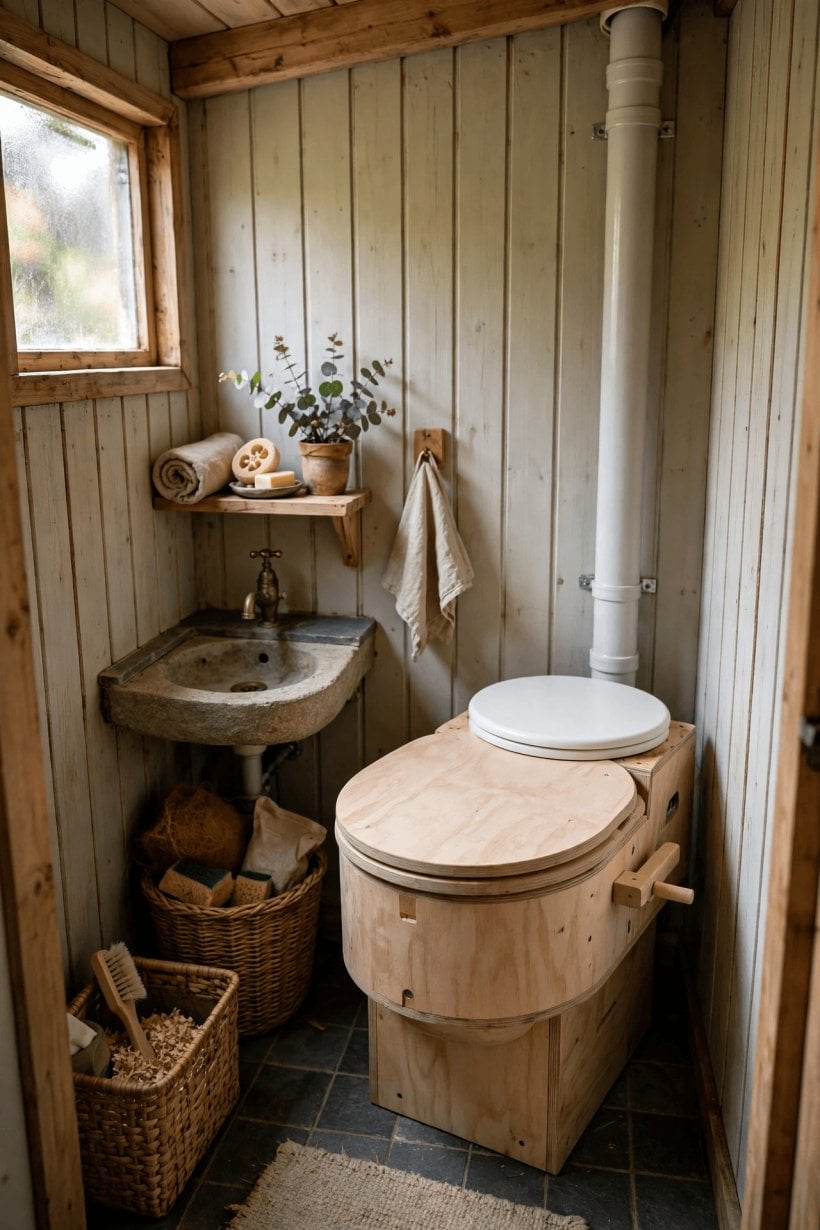
A composting toilet removes the flush from the equation. Instead of washing waste away to a system in the ground, it collects it in a contained unit where, with the right balance of moisture, airflow, and a carbon-rich cover material, it breaks down over time into a much reduced residue that is emptied periodically according to the manufacturer’s instructions and local guidance. For the house, the plumbing simplifies dramatically: no blackwater drain, no septic tank serving the toilet, and far less water used, which is why composting toilets are common in off-grid tiny houses and in places where a septic solution is impractical or not permitted.
Living with one is a routine, not a chore list from a conventional bathroom. The user adds cover material, a vent keeps air moving and odours outside, and the unit is emptied on its schedule — more often with more occupants. Done properly, a composting toilet is surprisingly inoffensive; done carelessly, with the balance wrong or the vent blocked, it will tell you so. Our comparison of tiny house composting toilets, commercial versus DIY, works through the designs and the honest pros and cons of building your own. What a composting toilet does not do is make sewage disappear as a topic: the emptied material still has to be handled in the way your local rules require, and your greywater still needs its own lawful route, which is covered in section nine.
5. Option Four: Incinerating Toilets
An incinerating toilet takes the opposite route to composting: instead of breaking waste down biologically, it burns it, at high temperature, down to a small amount of ash. The appeal for a tiny house is obvious — no water, no blackwater plumbing, no tank, and an output that is minimal and sterile. Units are powered, using electricity or a fuel supply depending on the model, and each use is followed by a burn cycle, so the toilet is as much an appliance as a fixture, with an appliance’s need for power, venting, and servicing.
The trade-offs are equally plain. The purchase price is generally at the higher end of toilet choices, running costs follow the energy it uses, and the burn cycle takes time, which shapes how a busy household queues on a winter morning. It suits particular situations well: houses where water is precious, ground conditions rule out other options, or a wheeled home that cannot rely on any ground system and whose owner wants to avoid handling compost. It suits tight budgets and fully off-grid, low-energy houses less well. As with every option here, acceptance is local: check how your authority views incinerating units for the way your house will be used, and factor the manufacturer’s servicing requirements into the running routine before you fall for the elegance of ash.
6. Option Five: Holding Tanks and Pump-Outs
The holding tank is the traveller’s solution, borrowed from the world of recreational vehicles: the house carries a sealed tank, toilet waste (and in some layouts all drainage) collects in it, and when it approaches full, the tank is emptied — at a dump point, by a pump-out service, or at a facility on the site where the house is parked. Nothing goes into the ground, nothing needs installing in the land, and the house can arrive, live, and leave with its sewage arrangements entirely its own. For a wheeled tiny house that genuinely moves, or stays on land where no ground system is permitted, this is often the workable answer.
Its discipline is arithmetic. A tank is finite, a household produces waste every day, and the interval between pump-outs is set by that simple division — with visitors, baths, and laundry shortening it briskly where greywater shares the tank. Living well with a holding tank means knowing the nearest reliable emptying options before you need them, keeping an eye on levels rather than discovering them, and winter-proofing pipes and tank arrangements where frost is a fact of life. The registration and placement side of the wheeled life that holding tanks belong to is covered in our guide to how to register a tiny house as an RV. Owners who respect the routine find it perfectly manageable; owners who hoped to forget about sewage find the tank reminds them, on its schedule rather than theirs.
7. Dry and Low-Water Alternatives in Real Life
Beyond the named systems sits a family of simpler arrangements that many tiny house owners combine: a basic separating or dry toilet that keeps liquids and solids apart to control odour and weight, bucket-style systems with cover material used in very simple or temporary set-ups, and low-flush fixtures that reduce the volume any tank or septic system must handle. These approaches share a philosophy — use less water, keep streams separate, and handle small volumes deliberately — and in the right household they work with a humility that expensive systems sometimes lack.
Honesty about their limits matters as much as enthusiasm. Simpler systems ask more of the user, more often: carrying, covering, emptying, and cleaning are part of the weekly rhythm, and guests will need the system explained rather than assumed. Local acceptance also narrows as systems get more basic, especially for a permanent dwelling, and what is tolerated for a recreational cabin may not be accepted for a full-time home. If your heart is set on a simple arrangement, have the conversation with your local authority early, describe exactly what you propose and how residues will be handled, and be ready to step up a level — to a manufactured composting unit, say — if that is what makes the arrangement acceptable where you live.
8. Greywater: The Stream Every Option Still Has to Handle
Whichever toilet option you choose, the shower, sinks, and laundry still produce greywater every day, and it is the stream most often mishandled by wishful thinking. Greywater is not sewage in the blackwater sense, but it carries soaps, grease, food particles, and microbes, it turns unpleasant quickly if stored, and in most places it must go somewhere approved — commonly into the same sewer or septic system as everything else, or, where local rules allow, through a dedicated, properly designed greywater arrangement that keeps it away from people, wells, and watercourses.
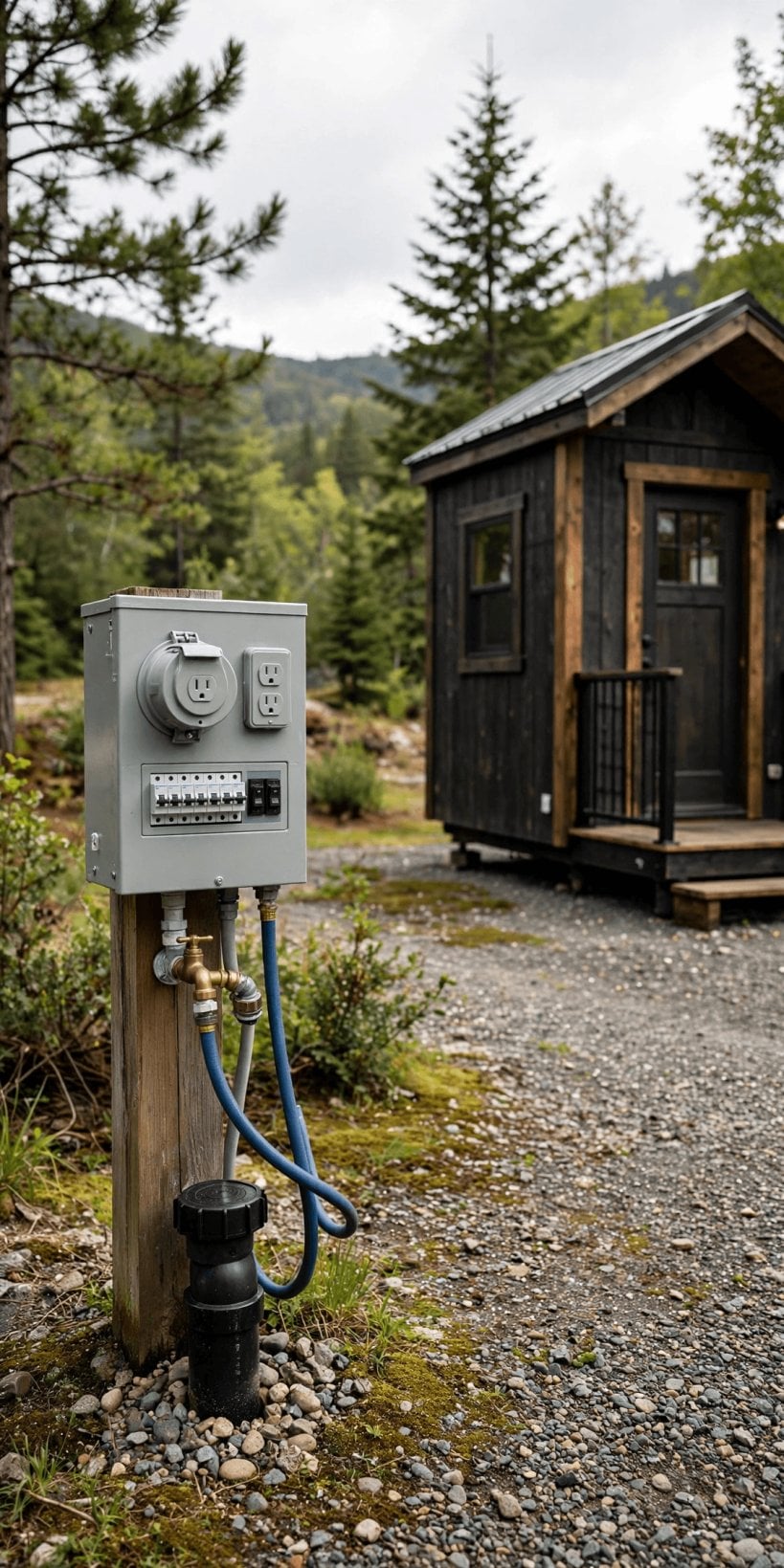
Practical greywater care starts inside the house: use products that are kinder to soil and systems where your arrangement involves the ground, keep grease out of the drains with a wipe of the pan rather than a rinse, and never let greywater pool on the surface where children, pets, or bare feet wander. In a wheeled house, greywater often joins the holding tank, which is simple but fills it faster, or has a smaller tank of its own with the same pump-out discipline. The governing rule is dull and absolute: greywater goes where your local rules say it goes, in the way they say, and a system designed with the local health office’s blessing will never be the decision you regret.
9. Choosing by Land, Law, and How the House Will Live
With the options laid out, the choice itself follows a clear order. Start with the law of the place: what does the local authority accept for this house, on this land, used this way — full-time dwelling, accessory unit, or vehicle? That answer, confirmed early and in writing where you can get it, deletes options faster than any preference can. Our guide to zoning laws for tiny houses and talking to officials shows how to run that conversation so it produces usable answers. Next, the land: sewer nearby, or soil and space for a septic system and its reserve, or neither — in which case waterless toilets and tanks move up the list by necessity, not fashion.
Then be honest about the household. A single person who travels for work can thrive with a composting toilet and a small greywater arrangement that would strain a family of four producing laundry and baths daily. A house that will move twice a year needs a different answer from one that will sit for a decade. Add climate — frost, heat, and heavy rain each push systems around — and the maintenance you will genuinely sustain in year three, not just admire in week one. The cheapest system to install can be the most expensive to live with if it mismatches the household, and the most elaborate system is wasted on a house whose life is simple. Choose for the life the house will actually lead.
10. Costs, Maintenance, and Living With Your Choice
Costs in sewage follow the usual pattern of this series: what drives them is clearer than any figure, because prices vary by place, ground, and product. A sewer connection is dominated by connection charges and groundwork distance. A septic system is a construction project with design and approval costs. A composting unit is a product purchase with small running costs in cover material and parts. An incinerating unit is a dearer product with energy and servicing costs. A holding tank is cheap to install and charges you in routine — pump-outs, facilities, and time. Compare options on install-plus-years, not install alone, and let the land you actually have narrow the field before prices do.
Maintenance is the other half of living with the choice, and every option has some: septic tanks need periodic professional emptying and drain discipline, composting units need their balance kept and their chambers emptied, incinerating units need ash removed and burn components serviced, tanks need emptying on schedule and valves and seals watched, and every system’s pipes need protection from frost and blockages. None of it is heavy by the standards of running a home, and all of it is heavier if ignored. The owners who are happiest with their sewage are not the ones who found a system with no routine; they are the ones whose routine fits their life, on land where their system is welcomed by the rules. Decide on that basis, confirm it locally, and this least glamorous of systems will quietly do its job for as long as the house does.
Final Considerations
So, how do tiny houses handle sewage? In every way conventional houses do, and in several ways they cannot: through a sewer where one is available, through a septic system where the land allows, through toilets that compost or incinerate where water and drains are best avoided, and through holding tanks where the house must carry its arrangements with it — with greywater given a lawful route in every case. There is no option that is best in the abstract. There is only the option that fits your land, satisfies your local rules, and matches the household that will live with it every day.
Make the decision in the order this guide has used: toilet first, then drains, then the land-and-law check before money is spent, then a system sized for your real household rather than your hoped-for minimalism. Keep the paperwork from approvals and installations with the rest of the house’s documents, and keep the routine — whatever you choose — small, regular, and unskipped. Do that, and sewage becomes what it should be in a well-planned tiny house: a solved problem you rarely think about, in a home that is healthy to live in and welcome where it stands.


0 Comments