

The cheapest tiny house is rarely the one with the smallest price tag on the first quote, because a build that looks cheap in week one can become expensive through rework, waste, delays, and fixes that have to be done twice. When builders search for the cheapest way to build tiny house projects without ending up with a damp, draughty, or unsafe home, the pattern that works is consistent: do more of the labour yourself, keep the shape and the systems simple, buy carefully rather than desperately, use salvage where it is genuinely sound, and plan the whole build on paper before a single board is cut. None of that is glamorous, and all of it works.
This guide works through those savings one attribute at a time, in the order they affect a budget. It is honest about the trade-offs, because saving money always costs something else — usually time, sometimes comfort, occasionally choice. Costs are discussed by what drives them, with any figures framed as illustrative examples rather than promises, because prices for trailers, timber, and labour vary widely by place and season. What does not vary is the arithmetic underneath: labour is the largest slice most builders can influence, complexity is the quiet multiplier on everything, and the cheapest build is the one that is only built once.
Quick Answers at a Glance
| Question | Short Answer |
|---|---|
| What is the single biggest saving? | Your own labour, priced honestly. Doing suitable work yourself removes paid hours, but it costs your time and must stay within your skill and local rules. |
| Which design costs least to build? | A simple rectangular shell with a simple roof, standard-size openings, and no unnecessary corners, levels, or curves. |
| Is salvage worth it? | Yes, with care. Doors, fixtures, and sound reclaimed materials can save real money; anything structural, electrical, or rotten is a false economy. |
| Which systems are cheapest to run simply? | Short, simple plumbing runs, one sensible heat source, and sewage and water arrangements that are standard rather than elaborate. |
| Where does cheap become expensive? | Rework, waste from poor measuring, rushed purchases, cheap trailers, and skimped weatherproofing that lets water in. |
| What should never be cut? | Safety and legality: structure, tie-downs, electrical safety, safe heating, sound sewage, and the approvals your area requires. |
| Does planning really save money? | Yes. A measured plan and a complete materials list prevent duplicate orders, emergency purchases, and changes made after work is covered up. |
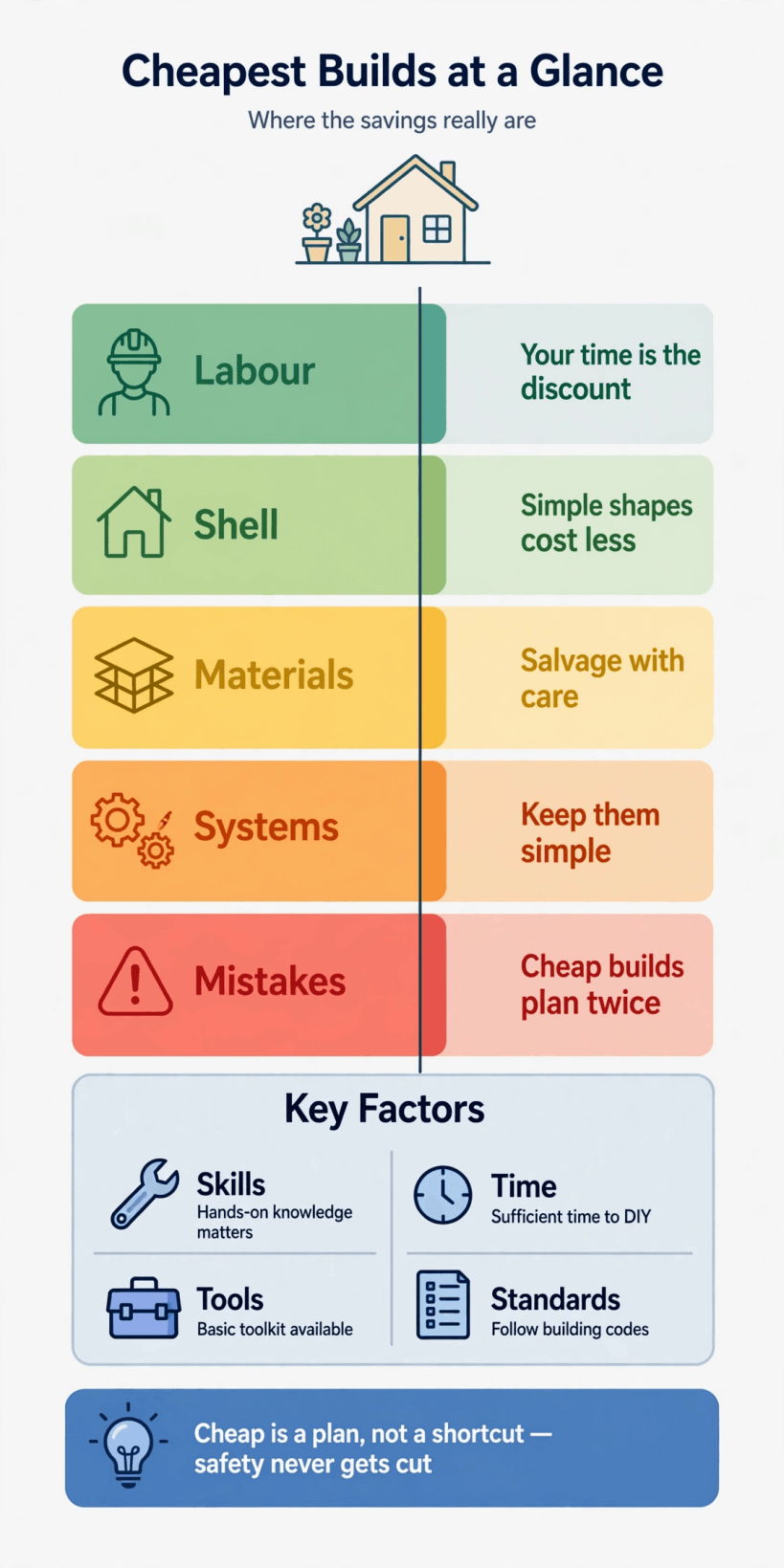
1. Start With the Total Budget, Not the Build Price
Most budget disasters begin with a number that only covers the house itself. A realistic cheap build budgets the whole project: the trailer or foundation, the shell and roof, windows and doors, insulation, interior lining, plumbing, electrics, heating, sewage arrangements, delivery or siting, land preparation, connections, and the fees and approvals your area requires. Some of those items are easy to forget precisely because they are unglamorous, yet a forgotten sewage solution or an unbudgeted driveway surface will find the money anyway, usually at the worst possible moment and at the highest possible price.
Build the budget as a list of parts with a modest contingency rather than as one hopeful lump. Where prices are unknown, use illustrative ranges from recent local quotes and label them as estimates, then replace estimates with real quotes as you gather them, because a budget that learns is a budget that holds. Our breakdown of the true cost of tiny houses, prefab versus DIY, is a useful reality check for the categories owners most often undercount. The point of the exercise is not pessimism; it is sequencing. When the whole cost is visible early, you can choose deliberately where to save, instead of discovering in month three that the savings have already been chosen for you.
2. Your Own Labour Is the Biggest Saving — If You Price It Honestly
On a professionally built tiny house, a large share of the price is hours: someone framing, cladding, wiring, plumbing, lining, and finishing, day after day. Doing suitable parts of that work yourself is therefore the largest single saving available to most builders, and it is why self-build and part-self-build routes sit at the low end of the cost range in almost every honest comparison. Framing under guidance, insulation, interior cladding, flooring, painting, cabinetry assembly, and the long tail of finishing jobs are all areas where careful owners routinely save substantial sums without taking foolish risks.
The honesty is in pricing your time and your limits. A build that takes a professional team a few weeks can take a solo owner many months of weekends, and during those months the project may be paying for storage, borrowing a workspace, or simply waiting exposed to weather. Skill limits matter just as much: work you do badly is not free, it is deferred cost plus the price of undoing it. So divide the build into three lists — work you can do well, work you can do with learning and care, and work that belongs to a qualified person or is checked locally, such as key electrical and gas or heating work — and save aggressively on the first two lists only. That is also where finance choices interact with the build, which our guide to how to finance a tiny house covers from the borrowing side.
3. Simple Shapes and a Simple Shell
Complexity is a tax on every stage of a build, and the simplest place to refuse to pay it is the shape of the house. A straightforward rectangular footprint with a simple roof form — one ridge, few or no junctions, and no decorative geometry — is faster to frame, easier to make weatherproof, cheaper to clad and flash, and simpler to insulate without gaps. Every extra corner adds framing time, cutting waste, and another junction where water can one day find a way in. Dormers, multiple roof levels, curved elements, and elaborate window arrangements can all be beautiful, but each one is a decision to buy beauty with hours and materials, and a cheap build makes those decisions rarely and on purpose.
Standard sizes are the shell’s second saving. Design walls, openings, and interior divisions around the dimensions that sheet materials, boards, and standard windows and doors actually come in, and the same materials cover more house with less cutting and less waste. A layout that fights standard sizes pays three times: in extra material bought, in offcuts thrown away, and in the hours spent cutting pieces that a tape-measure decision could have made unnecessary. Simple does not have to mean charmless — proportion, one good window where it matters, and a clean, well-finished interior read as intentional — but on a budget, charm should come from care and finish rather than from geometry.
4. Buy the Trailer and Structure Right, Even on a Budget
If the house sits on wheels, the trailer is the one purchase where cheapness is most dangerous, because everything you build stands, travels, and ages on it. A trailer that is genuinely rated for the weight of the finished house, straight, sound, and free of serious corrosion is the foundation of the whole project; a bargain trailer that is under-rated or rotten converts the saving into risk and, often, into the cost of starting again. The same logic applies on a foundation: the elements that hold the house up and hold it together are bought for strength and suitability, not for the lowest ticket price in the yard.
That does not mean buying the most expensive version of everything structural. It means spending the structural budget first and protecting it when other costs compete, using sound standard materials in the sizes the design needs, and treating fixings, membranes, and flashing as part of the structure rather than as accessories to economise on. A slightly plainer interior finish can be upgraded in a weekend years later; a marginal trailer, a weak floor, or a poorly flashed roof announces itself expensively and at the least convenient time. Cheap builds survive by knowing which parts of the house are effectively permanent and refusing to gamble on exactly those parts.
5. Salvage and Second-Hand, With Care
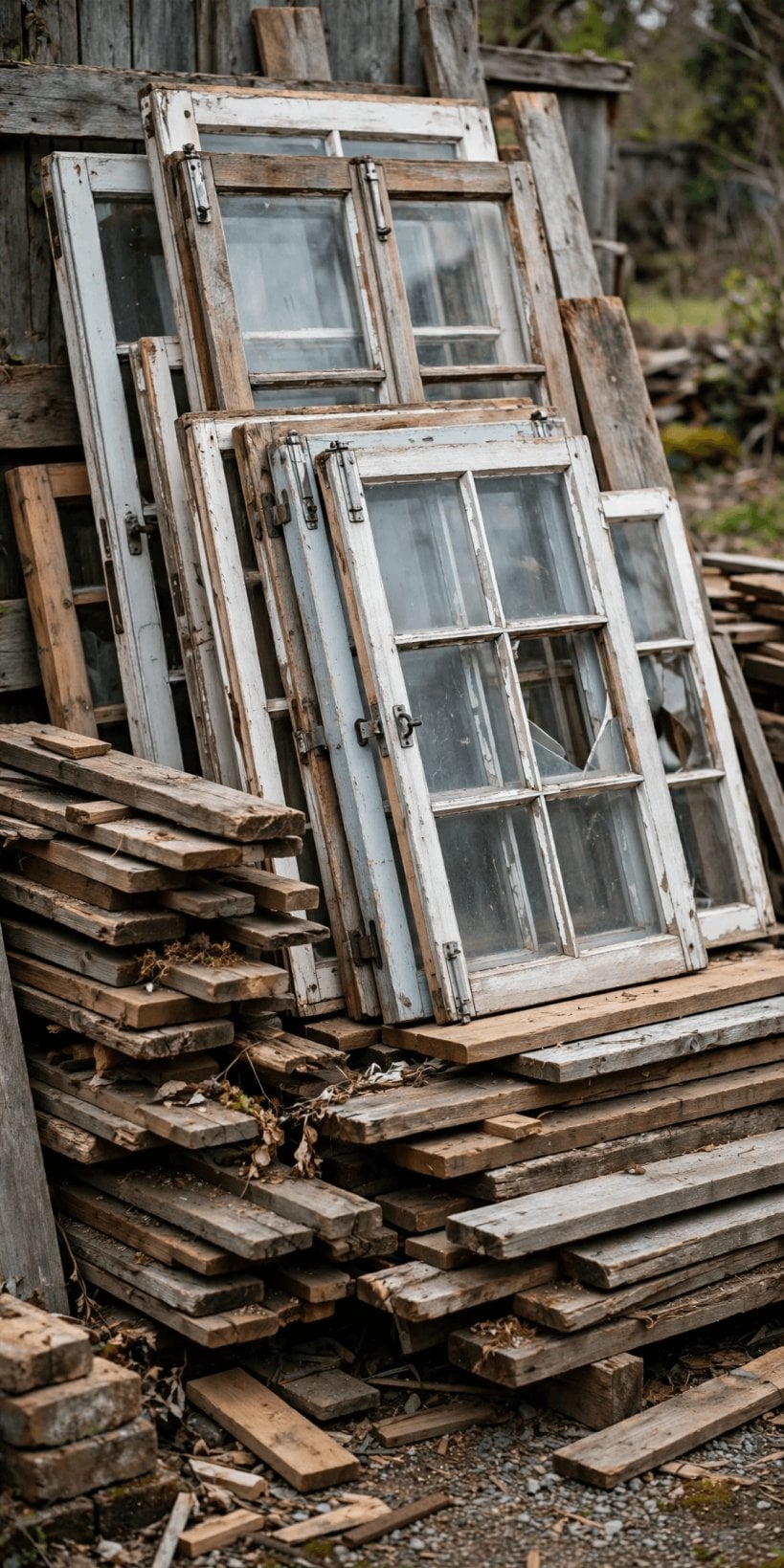
Reclaimed and second-hand materials are the romantic heart of many low-cost builds, and used well they genuinely save money: doors, sinks and bathroom fixtures, kitchen units, flooring, lighting, hardware, and sometimes windows can all be found sound and characterful for a fraction of their new price. Salvage also gives a small house instant individuality that new budget materials rarely have. The saving is real because the previous owner has absorbed the depreciation; your cost is the hunting time, the transport, and the care needed to fit pieces that were not made for your exact openings.
The care is in knowing what not to salvage. Anything whose failure would be dangerous or hidden — suspect wiring, damaged electrical items, corroded critical fittings, heaters of unknown history, and structural timber you cannot grade with confidence — should be new or professionally checked, however tempting the price. Rot, woodworm, cracked glazing seals, and warped frames turn bargains into replacements. Timing matters too: salvage rewards builders who collect pieces before the build, measured against a real plan, and punishes those who design rooms around a door they hope to find. Buy the find when it appears, store it dry, and let the plan bend a little around genuine bargains — but never let a cheap door talk you into moving a wall that carries pipes or wires.
6. Keep Systems Simple: Water, Power, Heat, Sewage
Systems are where tiny house budgets quietly balloon, because each one arrives with equipment, installation time, and maintenance, and because clever systems are always more interesting to shop for than simple ones. The economical pattern is short and shared: a bathroom and kitchen placed so plumbing runs are brief and largely in one wall, one sensible water heating approach, one primary heat source suited to the size of the space, and sewage arrangements chosen for the land and the local rules rather than for novelty. Every metre of pipe, every junction, and every additional appliance is a cost now and a possible repair later.
Plan the wet wall first and let other rooms arrange themselves around it, using our guide to tiny house plumbing layout and drainage design to see how much a compact layout simplifies both the build and later repairs. For the wider choices — grid or off-grid power, delivered water or tanks, sewer, septic, or an alternative toilet arrangement — our complete guide to tiny house utilities, power, water, and off-grid sewage compares the practical options. Insulation belongs in this simple-systems conversation too, because good insulation lets a smaller, cheaper heat source keep the house comfortable; our guide to how to insulate a tiny house compares materials with cost and effort in view. Simple systems are not a compromise version of the house; for most owners they are the version that still works, affordably, in year ten.
7. Plan Twice, Buy Once: Where Careful Planning Saves Real Money
The old workshop saying about measuring twice exists because mistakes are the most expensive material on any build. A complete plan — dimensions settled, openings placed, systems routed, and a materials list counted from the drawings — prevents the classic budget leaks: duplicate orders of things already bought, emergency full-price purchases because a stage cannot wait, delivery fees paid three times for one project, and the slow haemorrhage of small hardware bought piecemeal at the nearest shop. None of those leaks appears on a quote, yet together they routinely exceed the price of the items owners agonised over saving on.
Planning also protects the sequence. Knowing which stage follows which lets you buy in sensible batches, keep materials dry and in the order they will be used, and book any professional help or inspections for the moment they are actually needed rather than paying for idle visits. It gives salvage time to work, because you know your sizes months ahead, and it gives the budget time to be tested against real quotes. Set aside genuine planning time before the build and count it as part of the build, not as a delay to it. In cost terms, a week with drawings, lists, and phone calls is frequently the highest-earning week of the entire project.
8. Where Cheap Becomes Expensive
Every experienced builder can name the moment a saving turned: the budget trailer that needed major work before it could carry the house, the bargain windows that leaked at every seal, the skipped membrane that let condensation rot a wall from inside, the unmeasured order that left a pile of unusable boards and a second delivery bill. The pattern is always the same — the saving was taken on something whose failure is hidden, structural, or weather-facing, and the repair cost included undoing finished work to reach the problem. Cheap becomes expensive exactly where the consequence of failure is multiplied by everything built on top of it.
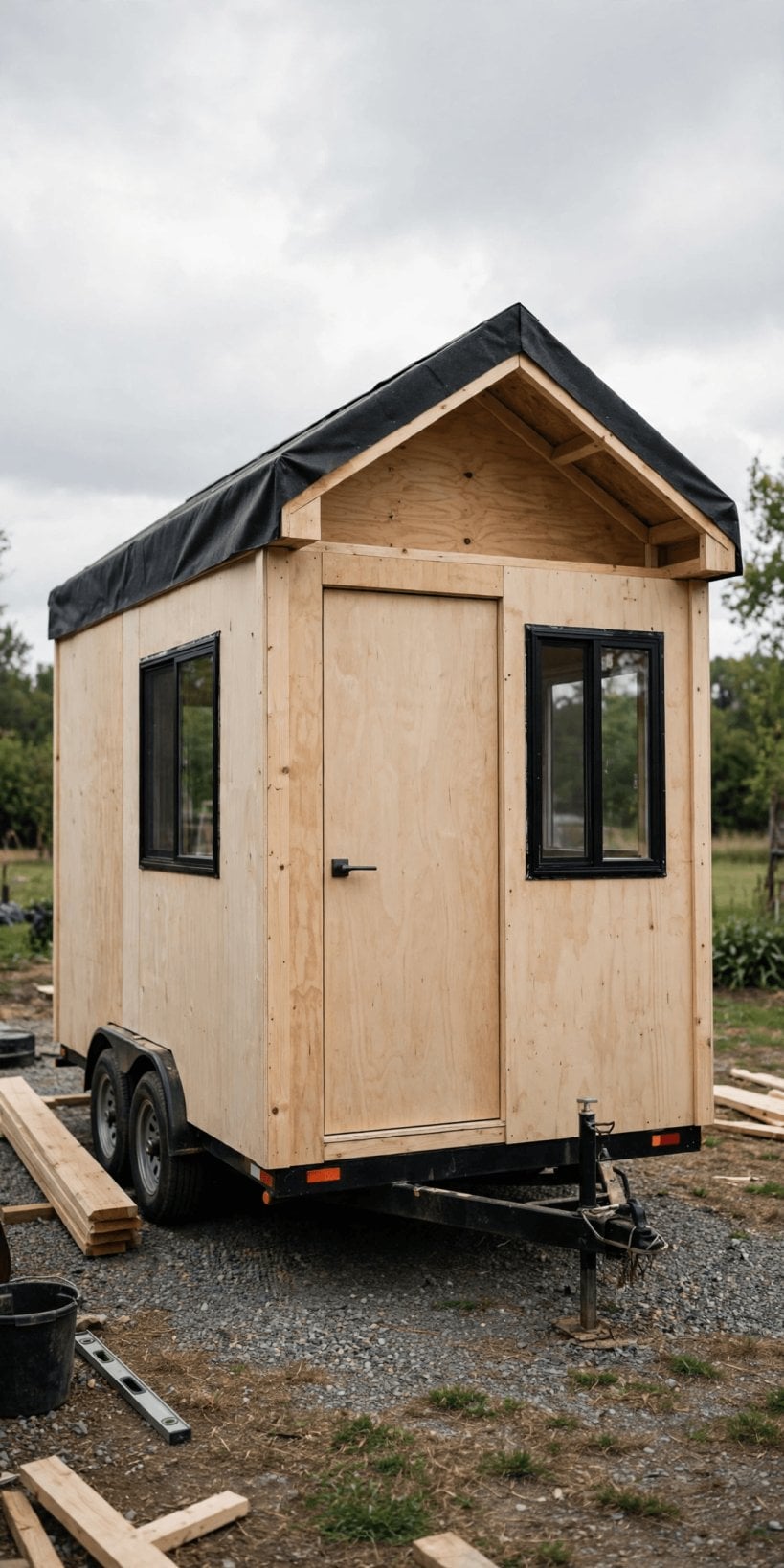
Time is the other place false economies breed. A build that drags because materials were bought in the wrong order, or because a key decision was deferred until it blocked three trades, pays in storage, in borrowed or hired workspace, in weather damage to unfinished work, and sometimes in a second season of site costs. Rushing is equally expensive: work done in a hurry gets redone at leisure, at full price. The middle pace — planned, steady, finished properly the first time — is the economical one. When a saving is offered, the useful question is never simply what it saves today, but what it costs if it is wrong; if the honest answer involves opening walls, lifting the house, or replacing a system, the saving is not a saving.
9. The Costs You Cannot Skip: Safety, Legality, Weatherproofing
Some lines of the budget are not savings opportunities at all. A structure that safely carries the house and ties it down against wind, brakes and running gear in proper order on a wheeled home, electrical work installed and checked to the standard your area expects, heating that is safely fitted and ventilated, sewage handled lawfully and hygienically, and stairs, rails, and exits that a tired person can use safely in the dark — these are the house doing its first job, which is keeping its occupants safe. Cutting them does not make a cheaper house; it makes an unfinished one carrying risks its price tag does not show.
Legality belongs on the same protected list, because an inexpensive build that cannot lawfully be placed, connected, insured, or sold is expensive in a slower way. The approvals and checks that apply to your project, and the land preparation and connections it needs, should be budgeted as fixed costs from the start, using our guides to zoning laws for tiny houses and talking to officials and how to prepare your land for a tiny house to scope them early. Weatherproofing completes the trio: a roof, flashings, membranes, and seals done properly are what allow every other saving inside the house to survive its first winter. Spend here without resentment. These are the purchases that protect all the others.
10. A Realistic Cheap Build, in Order
Put together, the economical build has a recognisable order. Settle the design while it is still paper: small, simple, rectangular, standard sizes, one wet wall, a finish level you can achieve well. Confirm where the house will live and what approvals and connections that involves, and price the whole project including those fixed costs. Buy the trailer or foundation elements for soundness, collect salvage against the plan while you finalise quotes, and order materials in planned batches as each stage approaches. Build the shell and get it weatherproof as early as possible, because a dry house protects materials, tools, and morale, and lets interior work continue in any weather.
Then work inside in system order: first fix plumbing and electrics while walls are open, insulation and lining next, then the bathroom and kitchen that the wet wall was designed for, then flooring, joinery, and finishes — the stages where your own labour saves the most and where second-hand finds can be fitted with the least disruption. Keep the contingency unspent for as long as you can; most builds need it somewhere, and the ones that planned honestly need it least dramatically. Finish with the unglamorous completions — seals, ventilation checks, certificates and paperwork filed, and the small snagging list actually finished — because a cheap build that is truly finished is worth far more, in money and in life, than one abandoned at ninety percent.
Final Considerations
The pattern behind every genuine saving in this guide is the same: substitute your time and your care for other people’s hours, and substitute simplicity for complexity at every decision where the two are offered. Labour you supply yourself, a shape that is easy to build and keep dry, systems that are short and standard, salvage chosen with judgement, and a plan thorough enough that the house is built once — those are the savings that survive contact with reality. The savings that do not survive are the ones taken on structure, safety, weatherproofing, and legality, and an honest budget refuses them no matter how tight money feels.
Approached this way, cheap stops being a warning label and becomes a discipline: a small house, deliberately simple, mostly built by the person who will live in it, on money spent in the right order. That house will not be the fastest build or the most elaborate one, and it does not need to be. It will be dry, safe, lawful, and finished — and per pound or dollar spent, it may well be the most satisfying home its owner has ever lived in.


0 Comments