
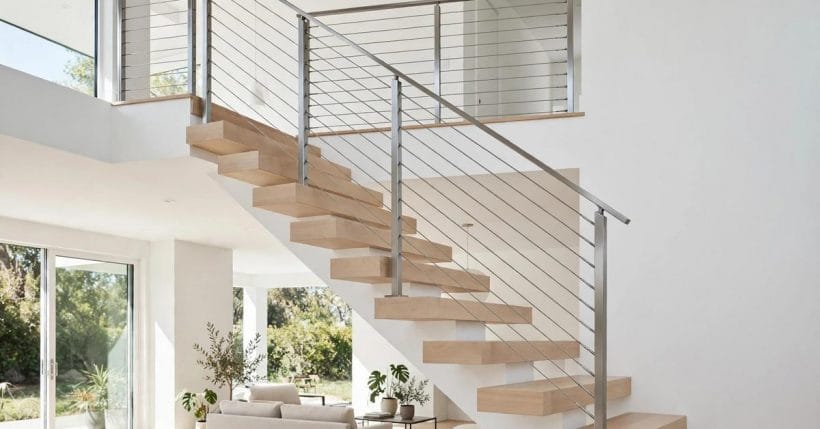
Wood whispers tradition; glass disappears. Steel does something else entirely — it draws a clean, confident line up the stairs and dares the rest of the hall to match it.
These seventy-five ideas cover stairs railing designs in steel only: cable and bar systems, finishes and colour, industrial and spiral statements, safety stated generally, and the care and cost drivers behind the shine.
1. Steel Stair Railing Ideas at a Glance
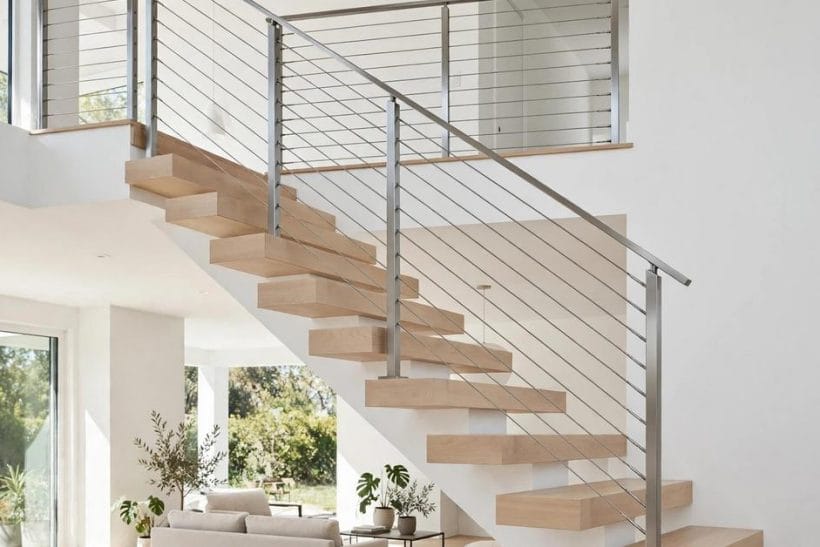
The central entity is the steel stair railing: a guard and handrail system whose attributes are its configuration — cable, bar, panel or mixed — its finish, its posts and fixings, its pairing with treads and handrails, and the safety rules it must satisfy. This post is deliberately one slice of a crowded staircase family, and the splits matter: the flight itself, in every material, lives in the staircase ideas pillar; every railing material compared lives in stair railing ideas; the forged, craft-led metalwork of wrought iron railing is a sibling with a different temperament — iron is worked and ornamented, while the steel here is drawn, brushed and precise. Within steel, the feature photograph states the modern case: slim posts, taut cables, floating timber treads, and light passing through everything. Safety and building rules are stated generally throughout — heights, spacings and loads are set by your local code, and a qualified installer works to it, not to a magazine page.
| Question | Short answer |
|---|---|
| Why choose steel? | Strength in slim sections: steel guards a stair with less visual bulk than timber, suits modern and industrial interiors, and asks for little upkeep |
| What are the main systems? | Cable runs, vertical or horizontal bars, steel-framed panels, and hybrids that pair steel with a timber handrail or glass |
| Is steel cold or stark? | Only if left alone: brushed finishes, warm treads and a wooden handrail bring it into the family quickly |
| What does it cost? | Drivers only: system and finish, length and turns, fabrication versus kit, and installation — priced locally by fabricators |
| What about safety rules? | Heights, gaps and fixings are code matters, stated generally here; your local rules and a qualified installer decide the specifics |
2. Layouts and Configurations: Steel on the Flight
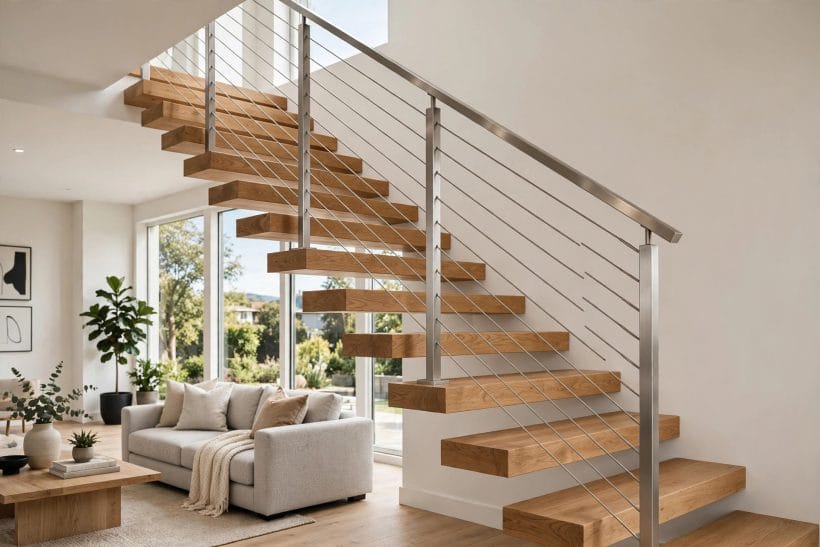
Steel’s first gift is flexibility: the same material can guard a straight flight, turn a landing, climb a wall or float beside open treads. The gallery photograph’s floating stair shows the contemporary default — and the ideas below work outward from it.
1. Floating treads with a cable guard
Open risers and cantilevered treads are steel’s home turf: the structure is metal even when the treads wear timber. A cable guard keeps the floating illusion intact while doing the guarding honestly.
2. A straight flight, drawn in one line
On a simple straight stair, a steel railing reads as a single drawn line from newel to landing — posts slim, rails continuous, nothing wasted. It is the easiest steel scheme to fabricate and the hardest to fault.
3. Landings guarded to match
Carry the same system around the landing and gallery, posts and finish unchanged. A stair that changes its railing at the top looks like two projects; continuity is what makes steel read as architecture.
4. Wall-side handrail in steel tube
Where the flight hugs a wall, a steel handrail on neat brackets gives the hand its guide without building a second balustrade. Match its finish to the open side and the two sides converse.
5. Steel on a closed, carpeted stair
Steel is not only for floating showpieces: slim spindles under a steel or timber rail smarten a traditional closed stair without rebuilding it — the renovation-friendly face of the material.
6. Dog-leg and switchback flights
Turning flights ask the railing to turn with them: mitred rails, posts at the turn, cables re-tensioned around the corner. Fabricated steel handles turns elegantly when the fabricator templates the actual stair.
7. A steel stringer as part of the design
On open stairs the stringer — the diagonal spine carrying the treads — can be steel left visible, powder-coated to match the railing. Structure and guard in one material is the industrial look at its most honest.
8. Split the guard: solid below, steel above
A half-height solid balustrade or dwarf wall below with a steel rail above suits stairs over storage or in tight halls — the solid part hides clutter, the steel part keeps the light.
9. Entry stairs and short runs
Two or three steps between levels still deserve a guard where the drop asks for one, and a short steel rail — one post, one sweep of tube — does it with more grace than a timber afterthought.
3. Vertical Bars and Spindles: The Drawn Line, Repeated
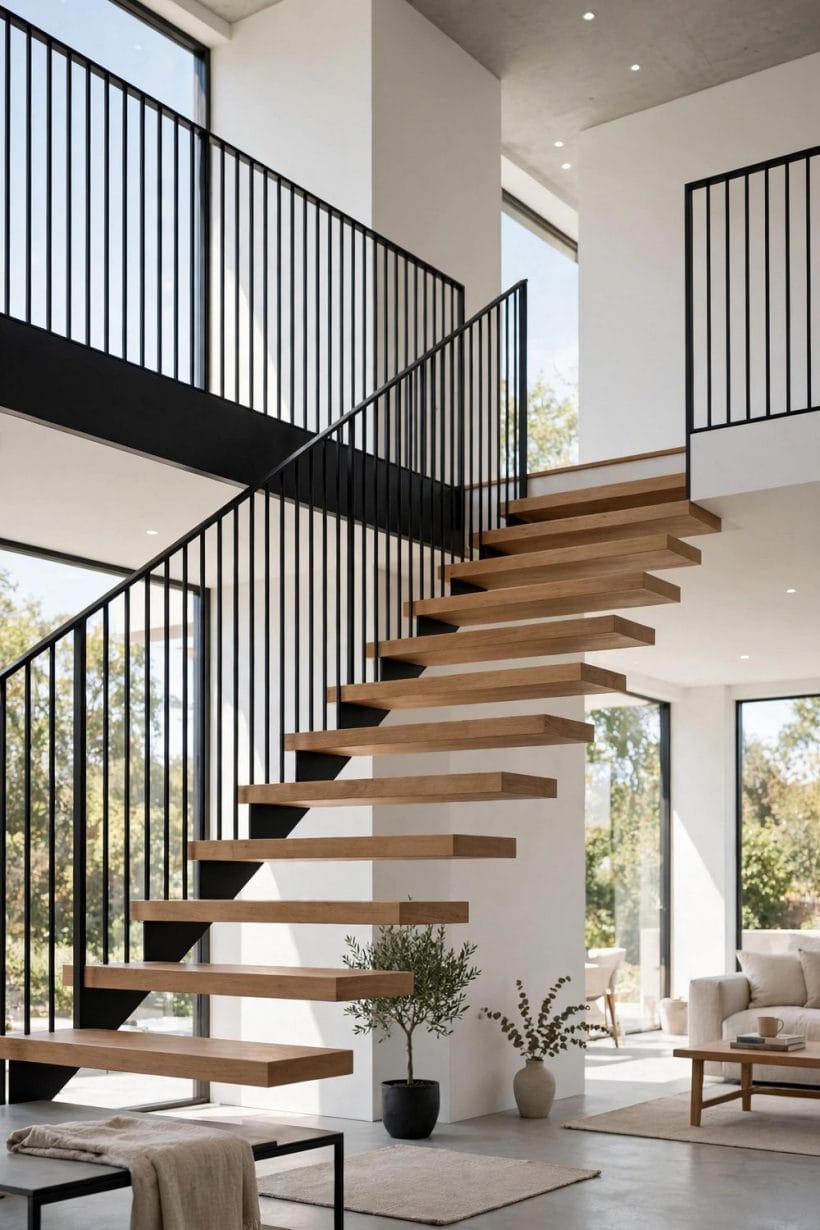
The oldest steel scheme is the newest again: slim vertical bars, evenly spaced, doing quietly what turned timber spindles did loudly. The pin photograph’s black bars over floating treads show why the pattern endures — rhythm, shadow and air.
10. Black spindles, minimal and graphic
Matte black verticals against pale walls and timber treads are the defining staircase image of the moment — graphic, calm and forgiving of fingerprints. The bars’ slimness is steel’s strength made visible.
11. Round bars for a softer rhythm
Round-section spindles catch light along their length and feel gentler in traditional halls. The spacing rhythm matters more than the section: even, unhurried, consistent around turns.
12. Square bars for an architectural beat
Square-section bars read crisper and more contemporary, their flat faces flashing as you climb. They suit angular architecture — exposed beams, steel windows, squared newels — like a rhyme in the same metre.
13. Flat-bar balusters, edge-on
Wide flat bars set edge-on nearly disappear from the front and reappear from the side — a railing that changes with viewpoint. It is a fabricator’s detail, priced accordingly, and quietly spectacular.
14. A continuous top rail, uninterrupted
Whatever the bars, the handrail above them should run unbroken from bottom to top, easing over turns. The hand believes the rail, not the brochure: continuity is comfort and safety in one line.
15. Group bars in panels for fabrication
Bars welded into panels between posts fabricate faster, install straighter and remove cleanly if a tread is ever repaired. Panelised steel brings workshop precision to a site-made stair.
16. Vary the spacing only with code in mind
Pattern experiments — grouped bars, widening rhythms — live or die by the guarding rules: gaps are regulated for safety, generally and everywhere. Let the fabricator play within the local code, never around it.
17. Steel spindles under a timber handrail
The diplomatic scheme: steel below for lightness, timber on top for warmth in the hand. It bridges modern flights in traditional houses and is the pairing renovators reach for first.
18. Powder-coated colour on bars
Bars take colour beautifully — deep green, oxblood, warm bronze tones — turning the balustrade into the hall’s accent. Sample the coating in the hall’s own light before committing the flight.
4. Finishes and Colour: Brushed, Polished, Coated
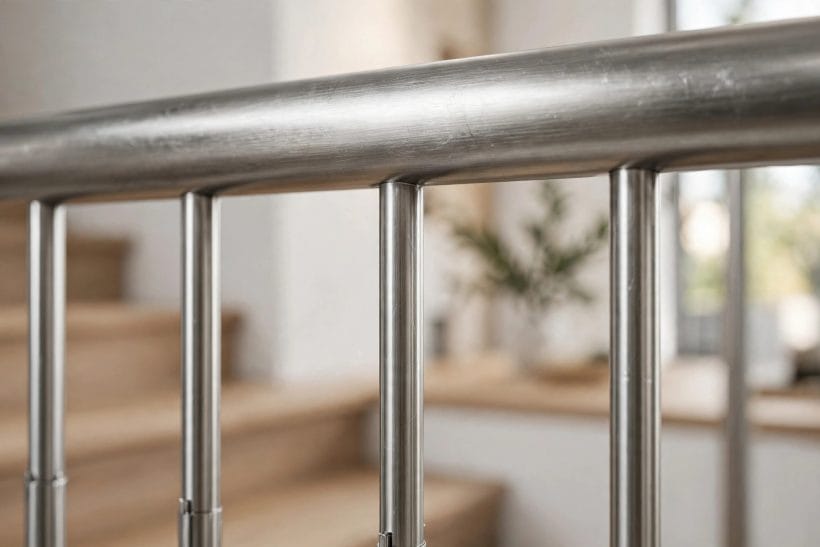
Steel is not one finish but a wardrobe. The gallery close-up’s brushed rail shows the family favourite — a soft sheen that hides the evidence of hands — and the ideas below dress the material for different houses.
19. Brushed stainless: the default done right
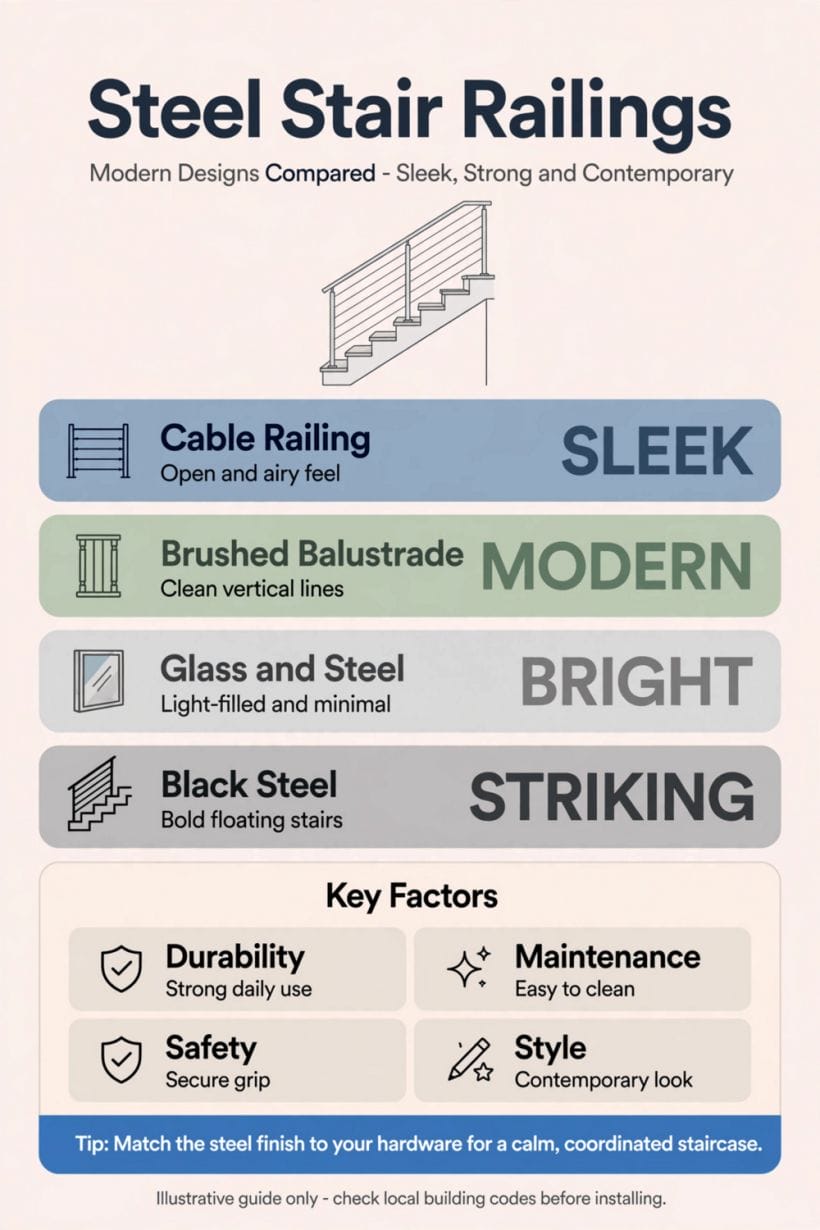
A brushed grain runs along the tube, scattering light and forgiving marks, which is why it leads the infographic’s modern family. It suits family stairs where the rail is used hourly and cleaned rarely.
20. Polished steel for formal halls
A mirror polish is jewellery for a staircase — brilliant in a formal, light hall, and honest about every fingerprint. Choose it where the stair is a showpiece and the household enjoys the theatre of upkeep.
21. Satin black: the graphic standard
Powder-coated satin black is the finish of the pin photograph’s bars — modern, matte, and the easiest steel to coordinate with door furniture and light fittings elsewhere in the house.
22. Bronze and brass-toned coatings
Warm metallic coatings give steel a period soul — the answer for halls with warm hardware and timber, where stainless would feel like an appliance that wandered in.
23. Match the hardware, calm the scheme
The infographic’s closing tip is the whole of finish coordination: railings that match the home’s handles, hinges and fittings look designed; a fourth competing metal looks collected by accident.
24. Exterior-grade thinking indoors
Near coasts and in damp halls, corrosion resistance matters even inside. Fabricators specify grades for environments; state yours honestly and let the specification follow the air, not the price list.
25. Paint-grade steel for painted schemes
Where the railing will be painted to match the woodwork, plain prepared steel under a good coating system is the economical route — the shape does the talking, the paint does the blending.
26. Raw steel, lacquered against the rust
Uncoated steel left to its natural grey, sealed under a clear lacquer, is the connoisseur’s finish — every weld and grind mark visible, the fabricator’s handwriting on show. It suits industrial schemes and honest houses; specify the sealing properly, because raw steel indoors still marks and still rusts where hands and damp reach it.
27. Two finishes on one stair
A polished handrail over brushed posts, or black bars under a satin rail, adds a designed layer — provided the pairing is deliberate, repeated at the landing, and not a stock accident.
5. Industrial and Loft Styling: Steel in Its Native Air
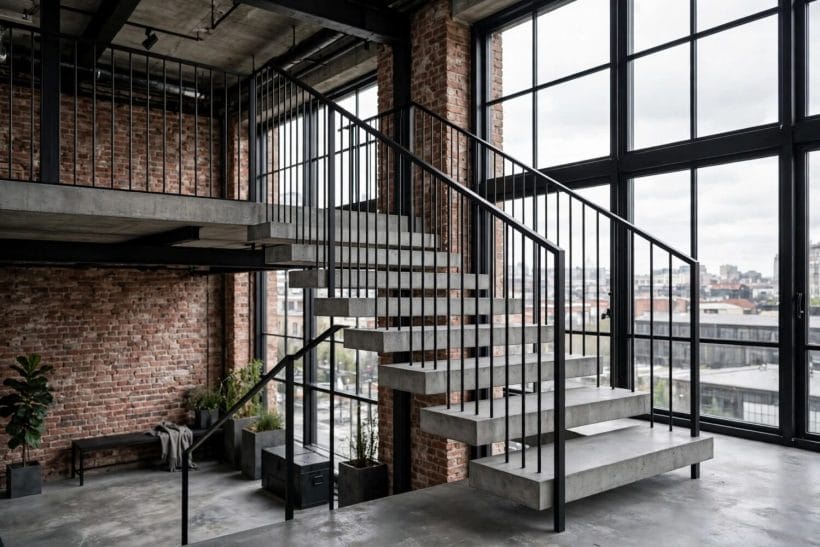
Brick, concrete, black steel and tall windows — the gallery photograph’s loft stair is the industrial scheme complete. Steel railings were born in factories and warehouses; these ideas bring that heritage home without turning the hall into a plant room.
28. Black steel against brick
Exposed brick and blackened steel are the loft’s founding couple. Keep the bars simple and the rail plain; the materials’ textures supply all the ornament the scheme can hold.
29. Concrete treads, steel guard
Cast or polished concrete treads with a steel railing give a stair monumental calm. The pairing is heavy in every sense — structure and cost both — and belongs in builds designed for it.
30. Mesh and grille infill panels
Welded mesh panels between steel posts are the factory’s own guarding, reborn as a style. They guard completely, pass light generously, and give industrial schemes their authentic grain.
31. Visible bolts and honest fixings
Industrial styling leaves its construction showing: bolted plates, visible welds tidied but not disguised. The rule is honesty, not roughness — engineered fixings, neatly made, proudly seen.
32. Steel with reclaimed timber
Old beams and worn treads against new black steel set up the tension the style lives on. Keep the timber’s story legible and the steel’s lines plain, and the stair narrates the whole loft.
33. Tall windows, slim profiles
Loft stairs climb past big glazing, and steel’s slim sections keep the railing from fencing the view. Where a timber balustrade would chunk the outlook into slices, steel merely underlines it.
34. Warm it with textiles, not paint
Industrial stairs stay industrial; warmth arrives by invitation — a runner on the treads, a bench and coats at the foot, lamplight at the turn. Dress the room, leave the railing’s character alone.
35. The mezzanine carried through
Lofts live on two levels, and the mezzanine edge is the stair railing’s second act. Same steel, same finish, same spacing — the floor above and the flight below as one continuous drawing.
6. Spiral and Sculptural Steel: The Stair as Object
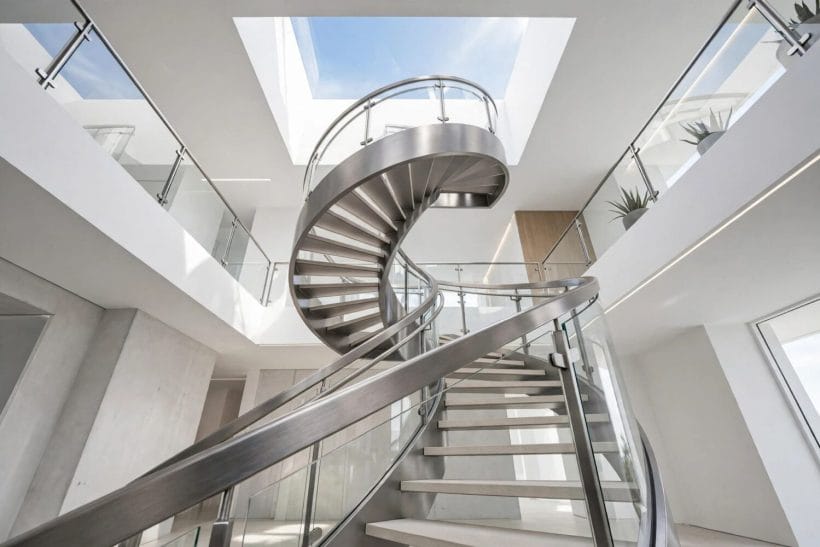
Steel is the material stairs dream in when they want to be sculpture. The gallery photograph’s spiral — steel, glass and daylight — shows the extreme; the ideas below scale the drama for real houses and real budgets.
36. A spiral in brushed steel
The spiral is steel’s party piece: a central spine, radiating treads, a rail that must bend in two directions at once. Fabricated well, it saves floor space and steals every scene it enters.
37. Helical strings on a straight flight
A curved steel stringer under a straight flight borrows the spiral’s elegance without its footprint — the railing following in one long, eased sweep that hands remember.
38. Glass panels in steel frames
The gallery’s pairing — glass guarded and edged by steel — is the luxury standard: the steel gives the glass its setting, the glass gives the steel its lightness. Fingerprints are the subscription fee.
39. A steel ribbon balustrade
Advanced fabrication can roll a flat steel plate into a continuous ribbon that is handrail and guard in one surface — the staircase as a poured gesture. It is the most bespoke idea in this post, and priced like it.
40. Curved landings and bullnose starts
Even a conventional flight gains sculpture from a curved bottom step and a rail that sweeps around it. Steel bends to the welcome where timber mostly argues — the fabricator’s template settles it.
41. White steel on white stairs
Powder-coating a sculptural rail to match a pale stair turns structure into shadow-play — form legible, colour silent. It suits galleries and minimal halls where the stair is the only ornament allowed.
42. Light the sculpture
A spiral or ribbon rail deserves its lighting: a skylight above, as in the gallery, or a pendant dropped through the well. Steel’s edges are drawn for light; give them some.
43. Commission like a client, not a shopper
Sculptural steel is commissioned, not bought: drawings, templates, a fabricator whose workshop you have seen. The ideas here are a brief to bring, not a basket to fill.
7. Cable Systems and Mixed Materials
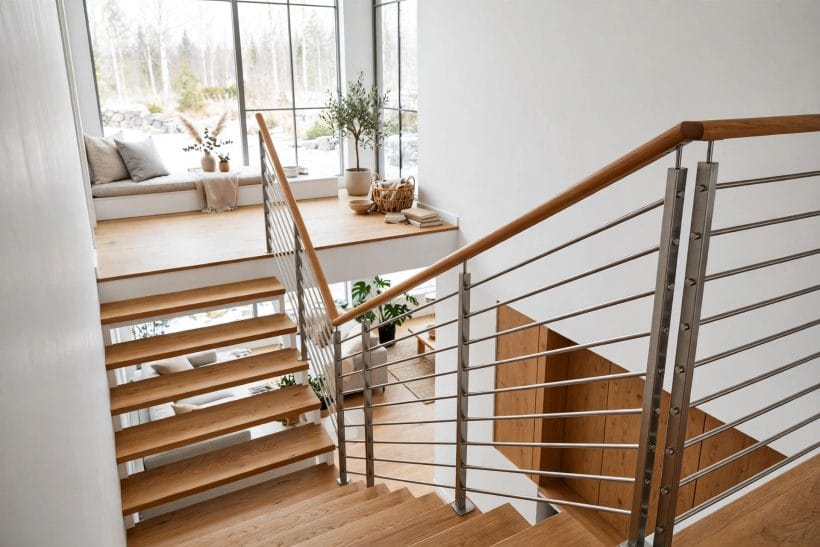
The feature photograph’s system deserves its own section: cables tensioned between steel posts, delivering guarding at the density of a whisper. The gallery’s variant adds a timber handrail — the mixed-material handshake these ideas explore.
44. Horizontal cables, tensioned true
Cable runs must be genuinely tensioned — taut lines, proper terminals, posts engineered for the pull. A slack cable railing is a harp out of tune: the system’s elegance is its tension.
45. Cables keep the view
Across a landing over a view, or beside glazing, cables guard without fencing — the reason they lead the infographic’s sleek family. For stairs over living space, they are the modern default.
46. Posts carry the engineering
In cable systems the posts do quiet heroics, resisting the combined pull of every run. Their fixing — into structure, not into tread surfaces alone — is installer’s territory, specified and inspected, never improvised.
47. Timber handrail over steel posts
The gallery’s scheme warms the system where the hand lives. Timber on top, steel below, cables between: three materials, each doing what it does best, none pretending to be another.
48. Cable on the landing, bars on the flight
Systems can change at the turn if the design intends it — cables where the view is, bars where small climbers are. State the intention in the design, and check the guarding rules for both, generally, with your installer.
49. Rod bars: cable’s sturdier cousin
Horizontal rods — slim solid bars in place of cables — give the same linear look with a rigid feel and no tensioning to maintain. They suit households that prefer their modernism maintenance-free.
50. Steel and glass on the wall side
A glass panel run can take one face while cables guard the open drop, or the reverse. Mixed guards per face let each side of the stair answer its own condition — light here, view there.
51. Re-tensioning is the upkeep
Cables relax a whisper over years; good systems allow adjustment at the terminals. A fabricator who shows you the adjustment — and the tool — at handover is selling the system honestly.
8. Safety, Grip and Guarding, Stated Generally
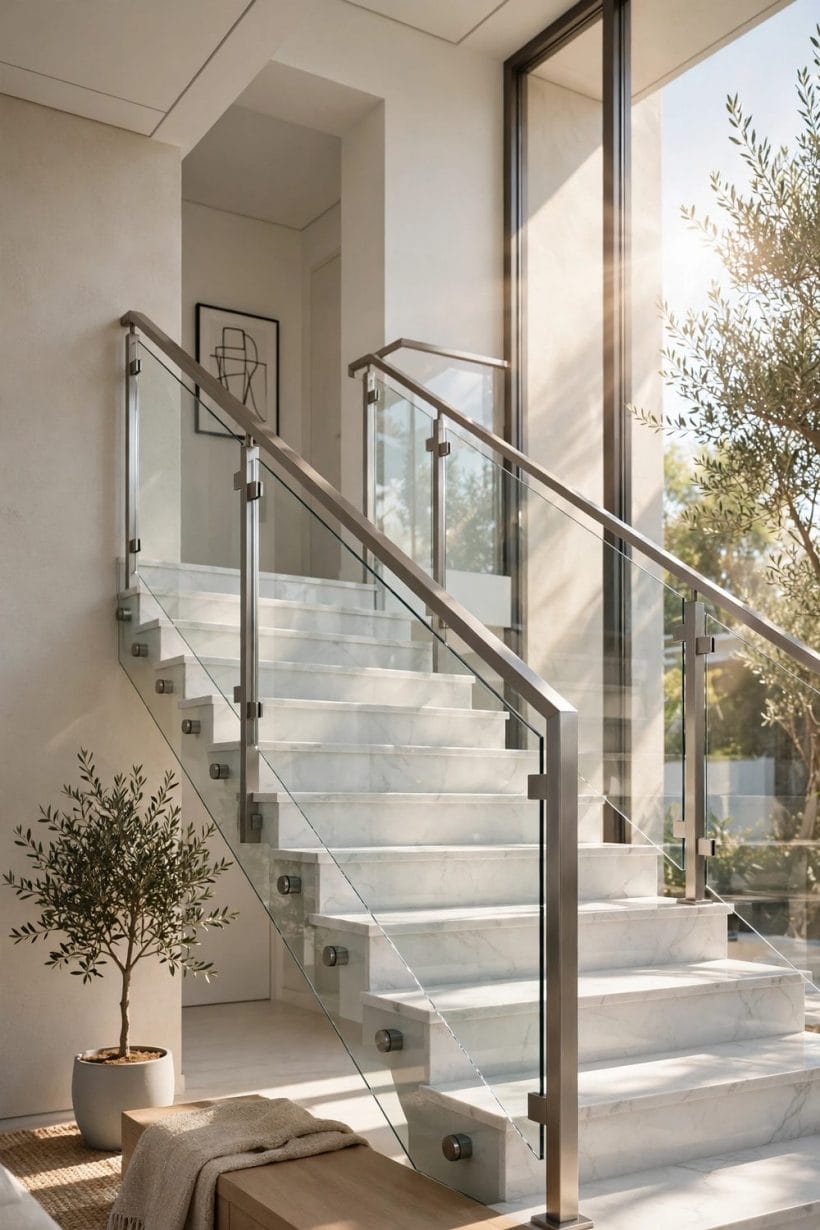
A railing is a safety device that happens to be beautiful, and this section keeps the order straight. Everything here is general principle — your local building code sets the actual requirements, and a qualified installer builds to them. The second pin’s glass-and-steel stair shows how serene compliant guarding can look.
52. The handrail must be graspable
A rail the hand can wrap and hold — continuous, at a comfortable height, returning safely at its ends — is the core safety idea of any stair. Profiles and heights are code matters; the principle is universal: the rail is for falling people, not for photographs.
53. Guard the drop, everywhere it exists
Flights, landings, galleries and stairwell edges all need guarding matched to their drop. A scheme that guards the flight and forgets the landing void has decorated the safe part.
54. Gaps are regulated for a reason
The spaces between bars, cables and panels are limited by safety rules aimed at children. Any pattern in this post is subordinate to those limits — check yours locally before falling for a wide, airy spacing.
55. Fixings decide the strength
A railing is only its anchorage: posts fixed into structure, rails joined soundly, nothing relying on plasterboard or hope. This is the deepest argument for professional fabrication and installation on guarding work.
56. Children change the brief
Climbable horizontal elements, foothold rails and toy-trapping gaps all read differently in a house with small children. Say who lives in the house at the design stage and let the system answer honestly.
57. Light the stair itself
Guarding works with eyes as much as hands: a well-lit flight — natural by day, warm and shadow-free by night — prevents the missteps no railing can fully forgive. Treat stair lighting as part of the railing budget.
58. Carpeted stairs are a different grip story
This post’s sibling, carpeted staircase ideas, covers the soft-finish flight, where the handrail carries even more of the safety load — one reason steel’s firm, continuous rail pairs so well with carpet.
59. Below-grade stairs, same rules
Basement flights obey the same guarding logic in dimmer conditions, as basement stairs ideas sets out — a steel rail’s slimness is a genuine mercy in a narrow below-grade well.
9. Outdoor and Terrace Steel: The Same Line, Outside
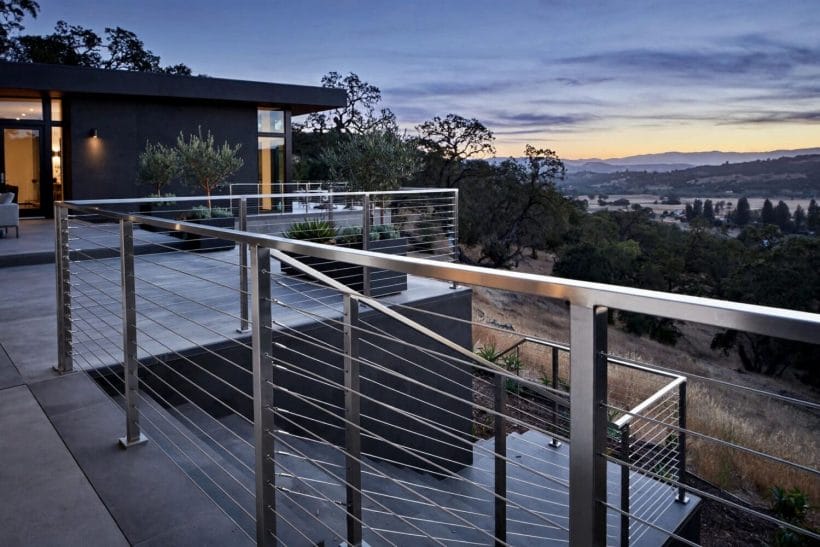
Steel railings step outside without changing their accent — the gallery’s terrace at dusk could be the feature stair’s cousin. Outdoor duty changes the specification, not the idea, and these notes keep the translation honest.
60. Specify for the weather, not the showroom
Exterior steel lives in rain, sun and — near coasts — salt air. Grades and coatings for outdoor use are a specification conversation with the fabricator, stated plainly before prices are compared.
61. Cable terraces keep the horizon
As indoors, cables guard a terrace while surrendering nothing of the view — the gallery’s valley runs uninterrupted to the rail’s line. It is the strongest argument in this whole post, made outdoors.
62. Pair outdoor steel with the gate family
A terrace railing that matches the garden’s steelwork — the thinking in modern gate design — makes the plot read as one design from street to view. One metal, one finish, everywhere.
63. Deck and balcony edges
Raised decks and balconies take the same systems as stairs, with the guarding heights and rules of their own local codes. Slim steel profiles keep small balconies feeling like platforms, not cages.
64. Drainage and detailing at the posts
Outdoor posts meet wet decks; detailing that sheds water rather than trapping it at the fixing is the difference between a railing that ages and one that stains. Fabricators who detail for weather say so early.
65. Steps in the garden
Garden stairs and terraced levels borrow the indoor language at a humbler scale — a steel handrail where the path drops, matching the terrace above. Continuity turns a slope into a composition.
66. Pool and patio edges, carefully
Around water, guarding also answers to pool-safety rules that vary by place — another local-code conversation, held before design, with specialists where the rules require them.
67. Winter is a finish test
Freeze, thaw and low sun audit every coating annually. Outdoor steel chosen and detailed well passes quietly; the upkeep is a wash, an inspection, and the occasional touch to a coating chip before it spreads.
10. Costs, Care and Choosing Well
Steel railing money divides into system, fabrication and fitting — and the care afterwards is the lightest in the railing family. This closing section holds the established discipline: drivers only, local fabricators, no invented figures.
68. Kits versus bespoke fabrication
Component systems and kits price lower and suit straight runs; a fabricator’s bespoke work follows turns, spirals and old stairs exactly. Most houses land between — kit bones, fabricated turns — and honest quotes say which is which.
69. Length, turns and landings drive the quote
Steel is priced by the run and complicated by its corners: every turn, landing return and level change adds fabrication. A measured drawing of your actual stair is the beginning of every meaningful quote.
70. Finish moves the figure
Powder-coating, brushed stainless and polished work sit at different points of effort and price. Decide the finish before quoting, not after — changing it mid-comparison makes every figure meaningless.
71. Treads and structure are neighbours, not strangers
Open-tread and floating schemes involve the stair’s structure itself, which is engineering with its own cost line. Keep the railing quote and the structure quote distinct, and know which professional owns each.
72. Care is a cloth, mostly
Brushed and coated steel ask for a wipe with a soft cloth and mild cleaner; polished finishes ask more often. No sanding, no oiling, no repainting cycles — the maintenance dividend is steel’s quiet financial argument.
73. Fingerprints and honesty
Glossy steel in a family hall will carry the day’s handprints; brushed and satin finishes forgive them. Choose with the household you have — the railing serves daily, and daily peace outranks showroom gleam.
74. Get the template made
For anything beyond a straight run, a site template — the fabricator measuring and patterning your stair — is where accuracy is bought. It costs a visit; it saves a remake, which costs a railing.
75. One stair, one system, start to finish
The choosing rule that outranks the rest: commit to one system, one finish and one fabricator for flight, landing and gallery. Steel rewards decisiveness with the long, unbroken line this post began with.
Final Considerations
Before the fabricator is chosen, walk your stair the way the railing will: hand hovering where the rail will run, eye travelling the line it will draw from the hall floor to the landing’s end. Notice where the light falls at the hour you climb most, where small hands will reach, where the turn asks the rail to ease. A steel railing is a permanent drawing on the house’s most travelled room, and an hour spent walking its line in imagination is the cheapest design work in the whole project — cheaper than any remake, and the moment the scheme stops being a catalogue choice and becomes your stair’s own answer.
A steel railing earns its place by being drawn once and drawn well: one system, one finish, a handrail that never abandons the hand, and guarding that satisfies your local code without advertising the fact. Keep the family splits clean — the flight in the staircase pillar, all materials in the railing survey, forged ornament with wrought iron — and let steel be steel here: slim, taut, brushed or black, warming itself against timber treads and a wooden rail where the house asks for softness. Chosen that way, it is the railing a house grows more modern around, quietly, for decades.

0 Comments