

Beams overhead, flowers on the sofa, a fire doing its slow work — a country cottage interior is comfort you can see from the doorway.
These seventy-five ideas cover the sitting room, kitchen, bedrooms and bathrooms, colour, textiles and the small lived-in details — a cottage interior built room by room, for real cottages and for any home borrowing their warmth.

1. Country Cottage Interior Ideas at a Glance
A country cottage interior is an inside, and this post never leaves it: rooms arranged around comfort, natural materials worn honestly, floral and checked textiles layered without anxiety, and furniture that looks gathered over years rather than delivered in a day. It is distinct from the small-cottage question of compact houses and their exteriors, which is covered in small cottage ideas; here, whether your cottage is old, new, large or tiny, the subject is how its rooms should feel and function. The palette is soft, the wood is visible, the lighting is warm, and nothing — nothing — matches too exactly.
| Question | Short answer |
|---|---|
| What defines a country cottage interior? | Natural wood and stone, soft colours, floral and woven textiles, gathered furniture and a fire or stove at the heart |
| Which rooms matter most? | The sitting room and the kitchen — the two rooms where cottage life actually happens |
| What colours belong? | Cream, sage, blush and soft blues, warmed by wood tones and grounded by one deeper note |
| Does it suit a new or small home? | Yes — it is a furnishing and materials language, and small rooms often carry it best of all |
| What is the biggest mistake? | Buying the whole look at once in matching sets — cottage character is accumulated, not installed |

2. The Sitting Room: Fire, Seating and Softness

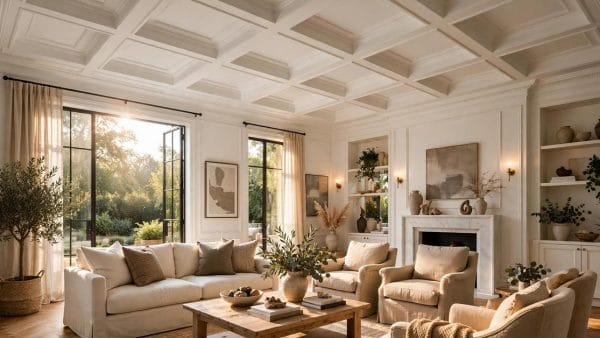
The sitting room is the cottage interior’s headquarters: the fire, the deep sofa, the low table with a mug going cold on it.
1. A sofa you can sink into, in a washable floral or check
The cottage sofa is deep, soft and unprecious — loose covers in a faded floral, a worn check or plain linen that can be washed and forgiven.
2. The fireplace or stove as the room’s anchor
Arrange seating to the fire, not to the walls. A stone surround, a plain timber beam for a mantel and a hearth that takes a basket of logs give the room its gravity; where no fire exists, a stove or even a candle-filled grate can hold the centre honestly.
3. Exposed beams and honest ceiling timbers
Where beams exist, clean and keep them; where they do not, resist gluing fake ones to a flat modern ceiling. Cottage character comes from truth — a plain ceiling with good light beats a theatrical one every time.
4. A low, scarred wooden coffee table
The centre table should look like it has survived decades of mugs, feet and board games — because ideally it has. Solid wood, low enough for the sofa, large enough for the teapot: this is furniture as a member of the household.
5. Armchairs that do not match the sofa
One armchair in a different fabric, another in worn leather or plain wool — the mismatch is the style. Gathered seating looks inherited and relaxed; a three-piece suite in identical fabric looks like a showroom that happens to have a fire in it.
6. Throws and cushions in layered natural fibres
Wool throws, linen cushions, one knitted blanket with a family history — layer them by texture more than by colour. The infographic’s fabric rule in section one says it exactly: one floral, one plain, one textured, in every room.
7. A rug that warms the boards
Over wood or stone floors, a woven or patterned rug in softened colours defines the seating pool and saves bare feet in winter.
8. Books, baskets and the evidence of life
A basket of logs, a basket of wool, books stacked on the table and the hearth — cottage rooms display the household’s actual pursuits.
9. Low, warm lighting from shaded lamps
Table lamps with fabric shades, a standard lamp behind the reading chair, candles on the mantel — light pooled low and warm, never a single ceiling glare.
3. The Cottage Kitchen and Dining Space

The cottage kitchen is a workshop and a dining room in one: a table that is also a workbench, open shelves instead of secrets, and everything within a cook’s turn.
10. A farmhouse table as the room’s centre
One generous wooden table for prep, meals, homework and harvest — scarred, scrubbed and utterly central. In a cottage kitchen the table outranks the island; it is where the house gathers, works and eats in a single piece of furniture.
11. Open shelves with everyday crockery
Plates, bowls and jugs on open wooden shelves, used daily and washed back onto them — the cottage kitchen hides nothing it uses.
12. A dresser or hutch for the good pieces
The traditional dresser stores the overflow, displays the treasures and gives the kitchen its tall furniture note. Painted in the room’s soft colour or left in warm wood, it is the piece visitors ask about.
13. Freestanding pieces over fitted runs, where possible
A butcher’s block, a separate larder cupboard, a sink unit with legs — freestanding furniture keeps the kitchen gathered rather than installed, and can move house with you.
14. A deep farmhouse sink under the window
The wide ceramic sink beneath the garden window is the cottage kitchen’s workstation and its best view in one. Pair it with simple bridge or lever taps in a warm metal and a wooden draining board that can be oiled back to life.
15. A range-style cooker or a simple hob, kept unfussy
The cooking heart can be a traditional range or a plain modern hob and oven — what matters is that it is not a wall of stainless technology.
16. Herbs, jars and produce kept visible
Pots of herbs on the sill, onions in a basket, preserves in glass jars on the shelf — the kitchen’s ingredients are its decoration.
17. Chairs that gather, a bench that squeezes
Mismatched wooden chairs around the table, with a bench along one side for squeezing in one more — cottage dining furniture assumes company. Cushions in checks and stripes keep the wood kind through long evenings.
18. A peg rail for aprons, pans and baskets
A rail of sturdy pegs by the door or the cooker takes aprons, brushes, baskets and the good pan. It is the kitchen’s version of the hallway hooks of section eight of the craftsman bathroom’s family thinking — honest storage, worn on the wall.
4. Bedrooms: Calm, Layered and Unguarded

Cottage bedrooms are the softest rooms in the house: iron or wood beds, quilts with histories, and mornings that start with garden light through thin curtains. These ideas keep them restful rather than themed.
19. An iron, brass or simple wooden bedstead
The bed should have a silhouette — rails, spindles or a plain wooden headboard — rather than an upholstered slab. Painted iron in cream or black is the classic; what matters is that the bed reads as furniture with bones.
20. Quilts and coverlets layered over plain linen
A quilt — patchwork, floral or plain wholecloth — folded over white or natural linen is the cottage bed’s entire formula. Add blankets by season and let the layers show; the bed should look slept in beautifully, not ironed for inspection.
21. Painted furniture in soft, chalky colours
A wardrobe, chest or bedside table painted in cream, sage or pale blue, its edges gently worn, carries the room’s colour without shouting.
22. Flowers by the bed and a jug for a vase
A small jug of garden flowers on the bedside table is the cheapest luxury in this entire post. In winter, dried stems or a sprig of something evergreen does the same work — the point is a living note, not a floral budget.
23. Sheer and floral curtains that move with the breeze
Bedroom windows take the lightest treatment in the house: unlined florals, simple sheers, curtains that stir when the window opens. Privacy here is softened rather than sealed — blackout linings can hide behind the prettiness where sleep demands them.
24. A chair for clothes, honestly admitted
Every cottage bedroom has the chair that holds tomorrow’s clothes, and the style is wise enough to plan it: a pretty chair, deliberately placed, instead of a shameful one that happens.
25. Rugs beside the bed for first footsteps
Small woven rugs where feet land first make cold floors a rumour rather than a rude awakening. Natural fibres, washable weaves, softened colours — the same rug rules as the sitting room, at bedside scale.
26. Low beams and sloping ceilings embraced
Attic bedrooms under the eaves are the cottage’s gift rooms: white-painted slopes, the bed tucked under the lowest line where only sleeping happens, storage built into the dead corners.
27. A dressing table or washstand corner
A small table, a mirror, a jug and bowl or their modern equivalents in one composed corner gives the bedroom its ritual place.
5. Bathrooms and the Smallest Rooms

Cottage bathrooms translate the same language into the wettest room: painted wood, a proper tub, and storage in baskets rather than mirrored cabinets. The principles travel well, as the tiny-bathroom thinking across the site — from tiny stone cottages onward — keeps showing.
28. A roll-top or deep freestanding tub
Where the room allows, the tub is the bathroom’s sitting-room sofa: deep, comfortable and placed to be enjoyed. A painted exterior in the room’s colour and feet with a little age to them complete the period ease.
29. Painted tongue-and-groove panelling
Wood panelling painted in sage, cream or soft blue protects the walls, warms the room and carries the cottage language below shoulder height.
30. A washstand basin instead of a fitted vanity
A basin on a wooden washstand, a marble slab or a converted small table keeps the bathroom furnished rather than fitted. Plumbing on show, neatly done in a warm metal, suits the honesty of the whole approach.
31. Baskets, shelves and a stool for storage
Towels on open shelves, necessities in baskets, a small stool beside the tub for the towel and the book — the bathroom borrows the sitting room’s storage family and loses nothing by it.
32. Small windows dressed simply
A café curtain, a simple blind in linen-look fabric or frosted lower panes keep privacy without sealing the garden out. Cottage bathrooms should smell of the garden after rain; a window that opens is a feature, not a problem to be curtained shut.
33. The smallest room given the same care
A downstairs cloakroom in a cottage deserves the full treatment in miniature: one floral wallpaper or deep colour above panelling, a tiny basin, a good mirror.
34. Herbs and flowers on the bathroom sill
A pot of something green and forgiving, cut stems in a jam jar — the bathroom joins the house’s living decoration. Choose plants that genuinely tolerate steam and shade, and let one thriving pot replace three apologetic ones.
35. Wooden floors or their honest alternatives
Where boards exist and can be sealed properly, they warm a cottage bathroom like nothing else; where they cannot, stone-look or small patterned floors in muted tones keep the palette.
36. A chair-back towel rail and hooks, not chrome bars
Towels over a painted chair, hooks in a row, a wooden rail — the bathroom’s hardware in the cottage language is furniture, not fittings.
6. Colour, Paint and Pattern

The cottage palette is the one the infographic in section one lays out: warm colours, soft florals, one deeper note to keep the softness honest. This section turns that palette into working decisions.
37. Cream and warm white as the base
Walls in cream, clotted cream or warm white give every room its daylight softness and let wood and textiles carry the colour.
38. Sage and soft greens for woodwork and calm rooms
Sage on panelling, doors and kitchen furniture is the cottage interior’s signature mid-tone — the feature room’s lower walls wear it exactly.
39. Blush, faded rose and dusty pinks in textiles
Pink in a cottage is faded, dusty and floral — cushions, quilts, curtain sprigs — never a whole wall of sweetness. Used as the accent it was born to be, it warms greens and creams into the palette everyone recognises as cottage.
40. Soft blues as the cool counterpoint
A pale, greyed blue in a bedroom or bathroom cools the palette the way shade cools a garden. It pairs with cream as naturally as sky pairs with stone, and it is the traditional colour of cottage pottery for a reason.
41. One deeper note per room: berry, plum or forest
A single deep colour — a chair, a cushion pair, a painted dresser — keeps the pastels from floating away. Cottage softness needs its shadows; rooms without one deep note read as washed rather than restful.
42. Florals in varied scales, never one print repeated
Large cabbage roses on the sofa, a small sprig on the curtains, a stripe or check between them — cottage pattern mixing works by scale, not by matching.
43. Checks, stripes and gingham as the plain between flowers
The geometric patterns rest the eye between florals and give cushions and table linen their structure. A checked throw over a floral sofa is the cottage interior’s most reliable single composition, repeated happily in the styling of cottagecore tiny house rooms as well.
44. Limewash and chalky finishes over flat modern paint
Where walls are uneven or old, chalky, breathable finishes forgive what flat emulsion exposes. The soft, slightly varied surface is itself a cottage texture — the wall becomes a material, not just a background.
45. Colour tested in the room’s real light
Cottage windows are small and their light is green-filtered and changeable. Every colour in this section should be lived with as a sample through a full day before it covers a room — the oldest advice in decorating, and the most skipped in cottages precisely because their light lies so charmingly.
7. Materials, Texture and the Gathered Look

Strip the colour away and a cottage interior is a texture argument: rough wood, smooth stone, woven fibre, soft wool. This section assembles the material kit that every room in the house draws from.
46. Wood worn, waxed and visibly grained
Beams, boards, tables and dressers in wood that shows its grain and its years. New wood can be waxed and toned toward mellowness; what it cannot be is glossy, orange or pretending to be plastic — the cottage eye forgives wear and never forgives shine.
47. Stone at the hearth and the doorstep
Stone belongs where fire and feet test materials most: hearths, fireplace surrounds, thresholds, a slab in the porch. Its coolness balances the wood’s warmth, and its honesty underwrites the whole house’s material story — the same principle the builders in construct tiny stone cottage masonry apply at whole-house scale.
48. Linen, cotton and wool as the textile trio
Curtains in linen, bedding in cotton, throws in wool — natural fibres in the rooms they suit, ageing by softening. Synthetics can imitate the look at arm’s length, but the cottage hand knows the difference at the first touch, and so will yours.
49. Wicker, willow and rush for lightness
Baskets, a wicker chair, a rush-seated stool — the woven plant fibres lighten rooms that wood and stone can make heavy. They are also the style’s portable storage, moving from room to room as the house’s needs wander.
50. Pottery, enamel and cast iron for the useful objects
Jugs, bowls, baking dishes and pans in pottery, enamelware and iron — objects that are used daily and displayed by being used.
51. Furniture gathered over time, mended and kept
The gathered look cannot be bought in a weekend; it is assembled — inherited, found, mended, re-covered. Start with the best old pieces you can find, add slowly, and let a room be unfinished for a while rather than finished falsely.
52. Imperfection kept where it is honest
The uneven plaster, the beam with its saw marks, the dresser door that swells in winter — these are the cottage’s credentials, not its flaws.
53. Scent and sound counted as materials
Woodsmoke, beeswax, baking, a ticking clock, floorboards that announce the cat — the cottage interior is composed for all the senses. When a room looks right but feels silent and scentless, a lit fire, an opened window or a loaf in the oven usually completes it.
54. The garden brought inside, daily
Cut flowers, a bowl of windfalls, herbs drying from a beam, muddy boots at the door — the boundary between cottage and garden is deliberately porous.
8. Small Cottages and Borrowed Interiors

Most real cottages are small, and many cottage interiors live in houses that are not cottages at all. These ideas scale the style down and transplant it honestly — the approach explored at miniature scale in scandi cottages, whose pale calm is this style’s northern cousin.
55. Scale furniture to the room, keep one generous piece
Small rooms take small chairs, narrow tables and beds without footboards — but keep one generous piece, usually the sofa or the kitchen table, as the room’s comfort anchor.
56. Pale walls and ceilings to borrow light
In low, small-windowed rooms, the cream base of section six should climb the walls and cross the ceiling unbroken. Dark beams can stay; dark wall colours in a small cottage room should be spent in the one tiny room of section five, where they delight instead of dimming.
57. Furniture with legs, floors that show
Chairs, sofas and dressers raised on legs let the floor run visibly beneath them, and small rooms read larger for it. Skirted, boxy bases belong to bigger rooms; the cottage small room floats its furniture and breathes underneath.
58. Storage in the architecture: window seats and eaves cupboards
A window seat with a lift-up base, cupboards in the eaves’ dead angles, shelves in the chimney breast’s alcoves — small cottages store in their bones.
59. One pattern hero per small room
The floral can star on the curtains or the bedding or the sofa — in a small room, one stage at a time.
60. Doors left open, sightlines kept long
Small cottages feel largest when rooms borrow from each other: doors standing open, the same floor running through, a glimpse of garden at the end of the hall.
61. The style transplanted to a flat or townhouse
No beams, no inglenook, no problem: the textile layers, gathered furniture, soft palette and living details of this post furnish any small home with cottage warmth.
62. A single cottage corner where budget is tight
Start with one corner — a chair, a lamp, a quilt, a small table and flowers — done completely in the style.
63. Sleeping lofts and tiny bedrooms in the cottage spirit
Where a small cottage sleeps guests in a loft or a box room, the formula still holds: white bedding, one quilt, flowers in a jar, a hook for clothes. The floor-plan thinking in rustic tiny stone cottage floor plans shows how little floor a proper cottage bedroom actually needs when the layers do the work.
9. Light, Windows and the Finishing Touches

The last layer is light and the small objects that finish a room’s sentence. Cottage finishing is famously more about arrangement than acquisition — most of it can be done with what the house already owns.
64. Window seats where the wall allows
A cushioned seat in a deep window reveal is the cottage interior’s most envied square metre: reading light by day, a spare seat by night, storage beneath.
65. Curtains hung simply, puddling never
Cottage curtains hang from plain poles or rods, in unlined linen or floral cotton, ending at the sill or just at the floor.
66. Lamps in pairs and singles, shades in fabric
A pair on the dresser, a single by the reading chair, all with fabric shades that warm the light. Bare bulbs and paper globes are other houses’ languages; the shaded lamp is as much a cottage signature as the quilt.
67. Candles and firelight as the evening layer
Candles on the mantel and the table, the fire lit whenever the evening is even slightly cool — moving light is the cottage’s oldest decoration.
68. Pictures hung low, in mixed wooden frames
Small landscapes, botanical prints, a family photograph wall — hung at sitting eye height, in frames that share wood tones rather than identical profiles.
69. A welcome at the inside of the door
Hooks for coats, a bench or chair for boots, a mat that works and a mirror for the last look — the cottage hall in miniature, however small the actual hall.
70. Seasonal swaps instead of redecorating
The quilt changes, the cushion covers rotate, the flowers follow the garden, a heavier throw arrives with autumn — the cottage interior renews itself by editing textiles, not by repainting.
71. Nothing too precious to use
The final test of every object in this section: can it be used, washed, mended and enjoyed by children, dogs and guests with muddy boots? If not, it belongs to a different style.
10. Costs as Drivers and Building the Look Over Time
A country cottage interior is among the most forgiving styles to build on a modest budget, precisely because its materials are old, its furniture is second-hand-friendly and its perfection is measured in comfort.
There is also a saving built into the style itself: a cottage interior does not expire. Because nothing in it was bought to match a season’s catalogue, nothing in it needs replacing when the catalogue changes — curtains are re-hung, covers are washed, a chair is re-covered, and the room continues. Owners who build this way often find their decorating spending falls year by year, not because the house is finished, but because it has stopped asking to be redone. That patience dividend is worth counting alongside the drivers below, since it is the reason the gathered approach so often proves the cheapest route of all over a decade of living in a house.
72. What actually drives the cost
The honest drivers are structural and servicing work first — heating, plumbing, electrics and roof or damp repairs by qualified local trades, always quoted properly — then any building work like panelling or a window seat, then the big furniture, then textiles, then objects.
73. Where second-hand serves better than new
Tables, dressers, chairs, quilts, pottery and pictures are all better gathered used — cheaper, softer-edged and instantly at home. Spend new money where hygiene and safety argue for it: mattresses, upholstery fillings, electricals and anything a child sleeps against.
74. Textiles: the high-impact, low-cost layer
Curtains, cushion covers, quilts and throws change a room’s whole temperature for the smallest outlay in this post — and they can be sewn, found and rotated season by season.
75. The order to build it in
Bones and comfort first: heating, seating, beds, light. Palette second: walls, woodwork colours, the deep note. Textiles third, gathered furniture fourth, objects last and forever.
Final Considerations
A country cottage interior asks very little that is expensive and a great deal that is patient: natural materials, soft colour, layers of honest textiles, furniture gathered rather than matched, and rooms arranged around comfort and firelight.
Begin with the sitting room’s sofa and fire, or the kitchen’s table, and let the house accumulate its character at the speed of real life.


0 Comments