

A white bedroom is the oldest promise in decorating: a room scrubbed of noise, where sleep comes first and everything else is garnish. It is also the easiest room to get quietly wrong — too cold, too bare, too much like a hospital corridor — which is why the good ones are built on texture, tone and light rather than on white alone.
This page is the canonical white lane of the bedroom cluster, linked up to the bedroom ideas pillar that parents them all. Where the pillar surveys every colour and mood, this lane works one palette in depth: how a white bedroom is laid out, layered, stored and lit so it reads as restful rather than empty — the same discipline the white living room ideas lane applies downstairs, tuned here for sleep.
1. White Bedroom Ideas at a Glance
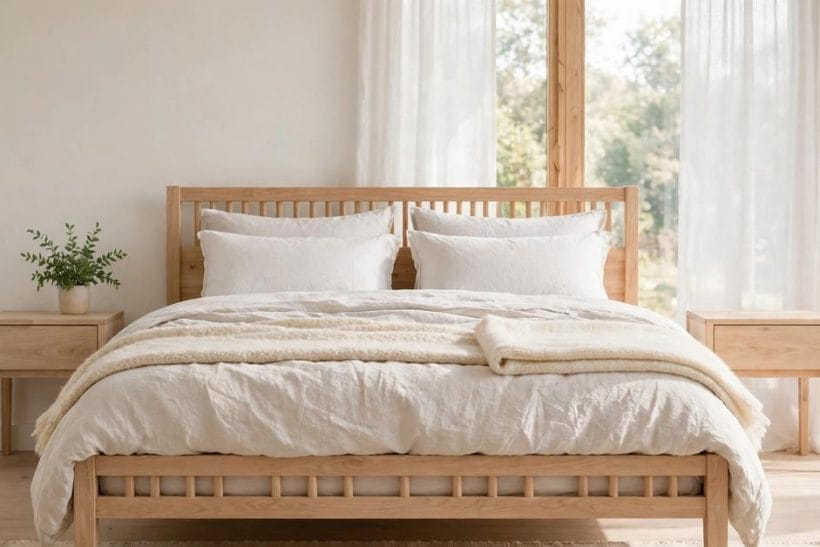
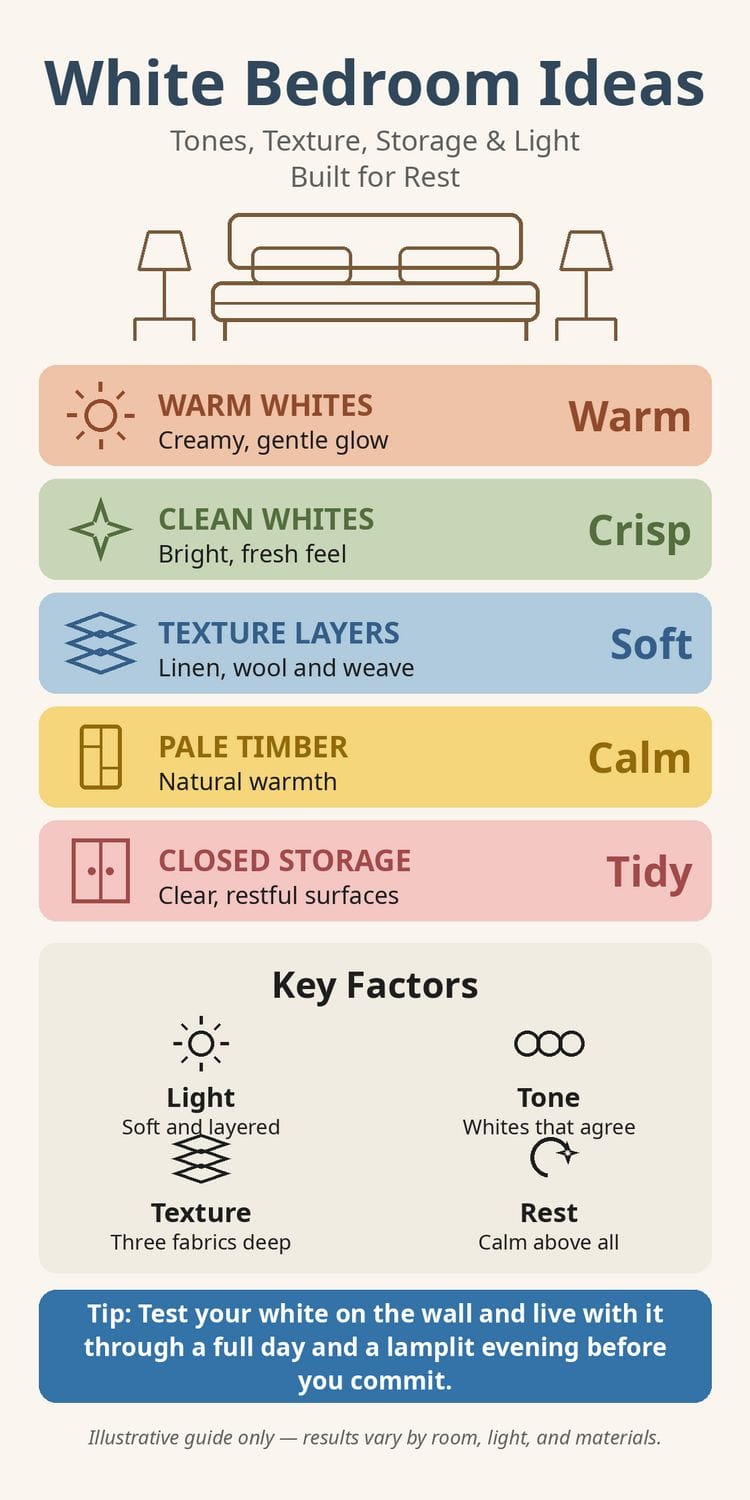
A white bedroom is a sleeping room built on a white palette carried by texture instead of colour: walls in a chosen white — warm, clean or chalky — bedding in layered natural fibres, furniture in pale timber, painted wood or upholstered neutrals, and interest supplied by weave, grain and shadow rather than by hue. Its system is tonal: several whites, deliberately not matching, over a structure of warm materials, with colour admitted in small, changeable doses. It is the calmest register a bedroom can take, and the one most dependent on light, because white shows the room’s daylight exactly as it is.
| Question | Short answer |
|---|---|
| Why does a white bedroom feel restful? | Because it removes visual argument. With colour quiet, the eye stops sorting and the room’s remaining signals — soft textures, low contrast, a made bed — all point the same way: towards rest. The calm is not emptiness; it is every element agreeing to be background so the sleeper can be the only event in the room. |
| Which white should the walls be? | The one your light flatters. North-facing rooms warm a white up with creamy, yellow-leaning whites; bright south-facing rooms can take cleaner, cooler whites without turning blue. The fixed rule is to test on the wall and live with it through a full day — whites are the most light-sensitive colours in the house. |
| Does a white bedroom have to be all white? | No — and the best are not. Pale timber, natural linen, a charcoal throw, a green plant: the companions keep white from sterility. The discipline is proportion, not purity: white carries the room’s large surfaces while wood, fibre and one or two muted accents carry its warmth. |
| What is the biggest white-bedroom mistake? | Matching everything to one flat white and adding nothing with a hand. A single clinical white, smooth surfaces throughout and hard light make a ward, not a bedroom. The cure is layering: several whites, matte against sheen, rough against smooth, and textiles doing the work colour does elsewhere. |
2. Layouts: The White Room’s Floor Plan
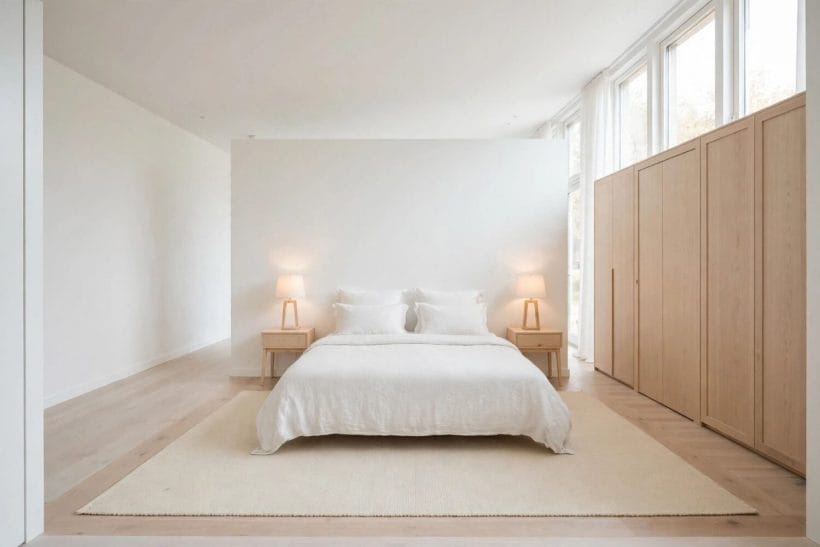
Layout in a white bedroom matters more than in a coloured one, because there is no hue to distract from an awkward plan. This section sets the bones: the bed’s position, the room’s breathing space, and the discipline of keeping the pale field uncluttered.
1. Give the bed the wall it deserves
The bed is the room’s whole subject; give it the longest, plainest wall and centre it there.
2. Keep the floor visible around the bed
A border of pale floor showing on three sides is what makes a white room feel serene rather than stored.
3. Let symmetry do the calming
Matched bedside tables and lamps are the white bedroom’s oldest device because symmetry reads as order at a glance.
4. Float nothing; ground everything
White rooms punish visual floaters.
5. Plan the dressing route as part of the layout
Wardrobe to mirror to door should be a clear path that crosses no one’s side of the bed.
6. Keep the window wall light
Whatever stands against the window wall is seen as silhouette all day.
7. Use a rug to draw the room’s inner boundary
A pale rug under and around the bed defines the sleeping zone inside the room and gives bare feet their first kindness of the day.
8. Leave one wall deliberately plain
A white scheme needs a resting place for the eye: one wall with nothing on it but light and shadow.
9. Put the mirror where it doubles light, not clutter
A mirror opposite or beside the window multiplies the room’s daylight and its sense of space.
10. Size the bedside to the life actually lived there
Books, water, spectacles, a lamp: the bedside table’s cargo is known, so choose its surface and drawer for that cargo exactly.
11. Audit the layout from the pillow
Lie down and look. The view from the pillow is the room’s real portrait: what is seen last at night and first in the morning should be the calmest composition in the house.
3. Beds and Bedding: White on White, Texture on Texture
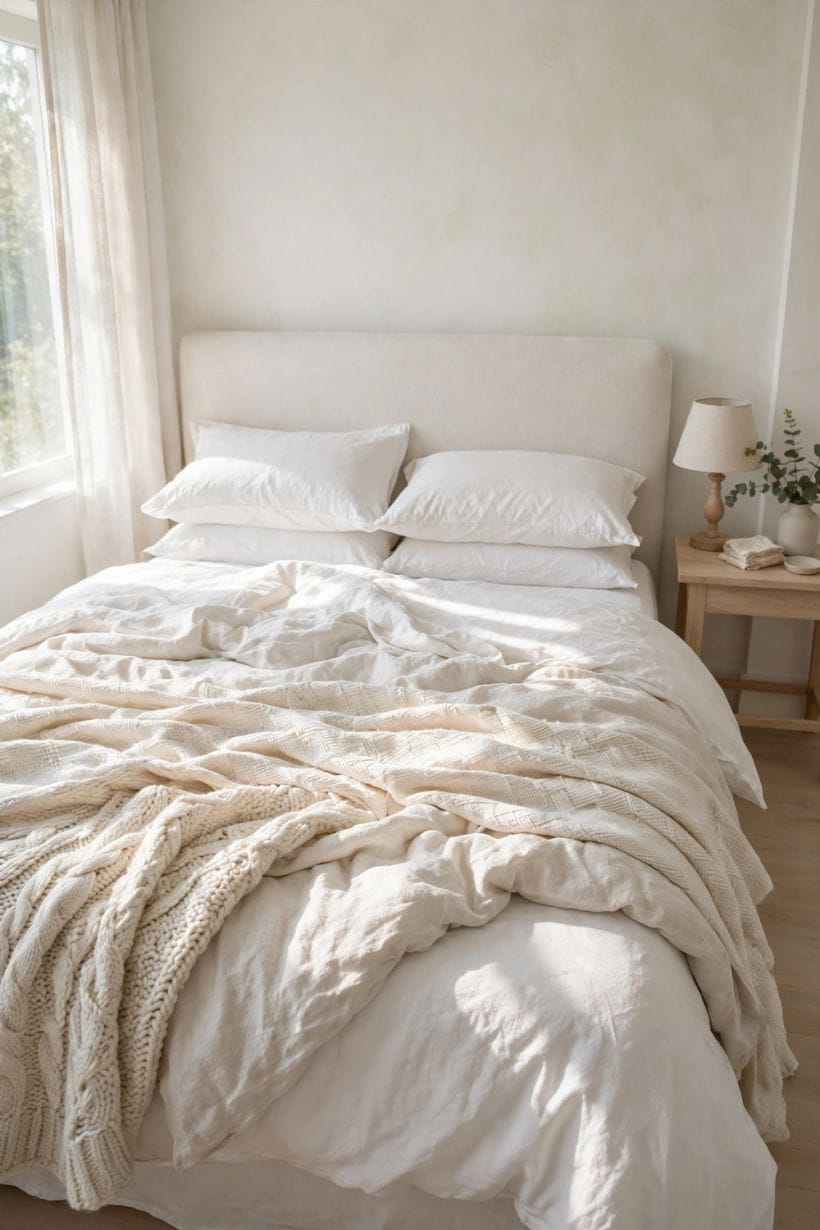
The bed is where a white bedroom succeeds or fails, and its language is textile. Beside it stands the master bedroom ideas survey, which treats the bed as the main room’s anchor; here the treatment narrows to one palette. This section layers the bed: fibres, weaves and weights doing the work that colour does in other rooms.
12. Start with the sheet, not the show layer
The layer against the skin sets the bed’s honesty.
13. Layer three textures before any colour
Smooth sheet, nubby blanket, open-weave throw: three distinct hands on one bed give the eye its journey across the white.
14. Let linen be the room’s workhorse
Linen’s rumple is the white bedroom’s friend — it reads as ease rather than mess, softens with every wash and photographs like a holiday.
15. Keep a wool or knitted layer for the cold half of the year
Weight is a texture too. A chunky knit or a woven wool blanket at the foot changes the bed’s register from summer to winter in one move, and gives the all-white stack its necessary shadow and depth.
16. Mix the whites on purpose
Bright white sheets, ivory blanket, chalk-white throw: whites that nearly match look like a mistake, whites that clearly differ look like a palette.
17. Use the pillow stack as architecture
Two sleeping pillows, two sitting pillows, one small cushion: the stack builds the bed’s skyline.
18. Give the bed a skirt, a throw line or a clean base — and commit
The bed’s bottom edge sets its manners. A valance softens, a folded throw line tailors, a bare upholstered base modernises. Any of the three works in white; the failure is the accidental tangle of all of them.
19. Choose the headboard for silhouette
Against white walls, the headboard is a drawing in one line: arched, winged, slatted, upholstered. Pick the line that suits the room’s architecture and let its shape, in timber or pale upholstery, be the bed’s signature.
20. Wash whites together and let them age together
Whites kept in one wash stay one family; stray coloured washes grey them unevenly, and a greyed patch in a white bed shows like a stain. The palette’s upkeep is laundry discipline more than decorating.
21. Add one coloured or dark object — then stop
A single cushion in washed indigo, a charcoal throw, a timber tray: one accent gives the white its scale, the way one dark note sets a melody.
22. Make the bed loosely, every day
The white bed’s beauty is a made bed’s beauty, but made with ease — duvet folded back, pillows plumped not karate-chopped, throw draped not arranged.
4. Colour: The Many Whites and Their Companions

White is not one colour but a family, and a white bedroom is coloured by choosing within it. This section works the palette: the undertones of white itself, the materials that warm it, and the few companions allowed to sit beside it.
23. Learn white’s undertones before buying a tin
Every white leans somewhere: towards yellow and cream, towards grey, towards pink, towards blue. Hold the swatch against the room’s fixed points — flooring, window light, existing furniture — because the lean only shows in company.
24. Match the white to the room’s aspect
Cool daylight from north windows makes blue-leaning whites look colder still; warm whites correct it. Sun-drenched rooms forgive cooler whites and are soured by creamy ones at noon.
25. Build the palette in three steps of tone
Wall white, bedding white, textile white — three distinguishable steps, like shades of one chord.
26. Bring timber in as the palette’s warmth
Pale oak, ash, pine or rattan give white its temperature.
27. Use black the way cooks use pepper
A black lamp stem, picture frames, a door handle: tiny dark punctuation keeps white awake and gives the eye its bearings.
28. Let plants be the room’s permitted green
A plant is colour that nobody has to commit to: living, changeable, and gone without a decorator if it fails.
29. Borrow colour from books, art and the view
The coloured objects a life contains — book spines, one picture, the garden through the window — are the white room’s rotating exhibition. Keeping the architecture white lets those small colours arrive as events rather than as scheme.
30. Keep metals quiet and warm
Brushed brass, aged bronze or soft nickel sit kindly beside white; chrome’s blue shine can chill it. Hardware, lamp bases and mirror frames in one warm metal family give the palette its faint jewellery without a shout.
31. Test the whole palette at night as well as noon
Whites change shift with the light: the warm white that glowed at breakfast can turn dingy under a cold bulb at night.
32. Carry the chosen white through every surface decision
Paint, bedding, upholstery, ceramics: each new white that enters the room should be checked against the palette’s family before it is bought, not after.
33. Respect the whites you cannot change
Sanitary ware, window frames, a landlord’s ceiling: most rooms contain fixed whites that will not be repainted.
5. Storage: Keeping White Clutter-Free
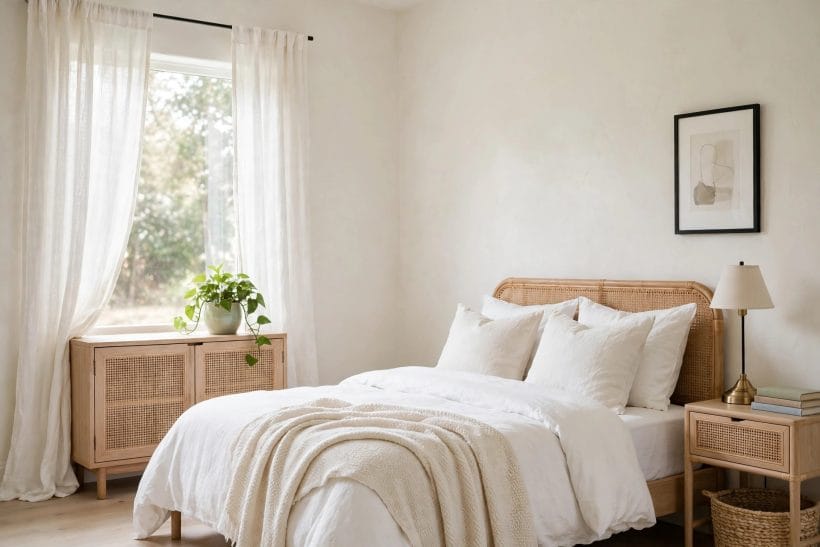
White is the least forgiving background in the house: every object left out is on stage. The CSV’s promise of storage is therefore structural, not decorative — this section builds the cupboards, drawers and habits that keep the pale field clear.
34. Close the storage wherever you can
Doors and drawers are the white bedroom’s peace treaty with real life. Behind them, clutter may live as it likes; in front of them, the room keeps its composure.
35. Give the wardrobe’s interior the same care as its face
A white room’s calm collapses the moment a wardrobe door opens on chaos. Interiors in pale finishes, with the family’s real categories — long hang, short hang, shelves, drawers — keep the closed-door promise true on both sides.
36. Use the bed’s base as the room’s cellar
Drawers under the bed or a lift-up base swallow the bulky, seasonal and seldom-used: spare bedding, winter layers, the suitcase. What lives under the bed never has to be seen against the white, which is the whole point.
37. Keep bedside storage to one drawer and a surface rule
The surface rule is simple: lamp, book, water, nothing else overnight. The drawer takes the chargers, creams and clutter of the bedtime hour.
38. Choose a laundry solution that hides its contents
A lidded basket in woven fibre or a cupboard in the dressing area: laundry in a white room is the one pile that cannot be styled.
39. Build a landing strip by the door
Every bedroom needs one surface where the day’s arrivals — post, pockets, the jumper worn twice — may land without colonising the room.
40. Store bedding in white’s own logic
Spare sets folded in the wardrobe or under the bed, kept as complete sets, washed as one family. The white bedroom’s linen press discipline is what makes the three-tone palette survive contact with an actual laundry rota.
41. Let a bench or trunk take the foot of the bed
A trunk or upholstered bench earns its footprint three ways: seat for dressing, surface for the folded throw, and storage for everything the room refuses to display.
42. Keep children’s and guests’ overflow out of the scheme
The white bedroom fails by annexation — toys migrating, gym bags settling, the ironing pile taking root. Give each category a home elsewhere in the house, because the pale room has no camouflage to offer any of them.
43. Hide the technology, or give it a uniform
Chargers, cables, speakers and screens are the white room’s visual grit: dark, tangled and impossible to ignore against the pale field.
44. Finish with a five-minute evening reset
The storage system only has to hold until the nightly reset: surfaces cleared, clothes away, the bed’s throw restored.
6. Windows, Light and the Restful Layer
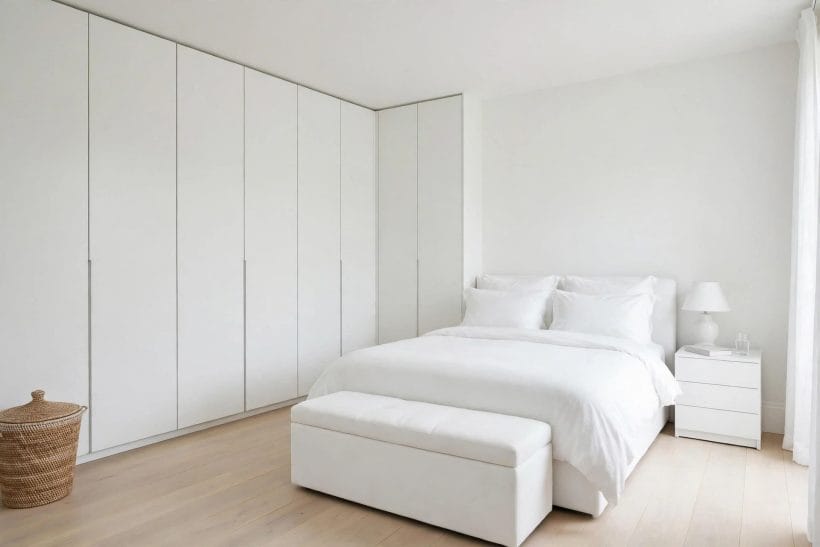
A white bedroom lives by its light: daylight gives the palette its colour and lamplight gives it its evening soul. This section dresses the windows, layers the lamps and finishes the soft details that make the room feel held rather than shown.
45. Dress windows for sleep first, looks second
The white bedroom’s window treatment has one job before beauty: darkness. Lined curtains or a proper blackout layer behind the sheer is what lets the pale room perform at dawn in summer.
46. Use sheers to make daylight soft
A voile or linen sheer turns hard sun into the diffused glow white was invented for. The room brightens without glare, the whites stop shouting, and privacy arrives as a by-product of the light itself being filtered.
47. Layer the lamps in three heights
Bedside lamps for reading, a low lamp on the dresser for dressing, and the ceiling’s general light dimmed or shaded: three heights make three rooms of one — bright for morning, pooled and warm for evening, near-dark for the last page.
48. Put bedside light at the sleeper’s shoulder, not above it
A lamp whose shade ends near shoulder height lights the book and spares the eyes. Wall lights free the bedside surface entirely — in a white room, that cleared surface is worth more than the lamp’s decoration.
49. Choose warm bulbs and keep them consistent
Mixed bulb temperatures make whites argue: one lamp turns the wall cream, another turns it grey.
50. Add candlelight’s register without the hazard
A candle on the dresser, used awake and never overnight, gives the white room its oldest light — flickering, golden, forgiving. Where flames are unwelcome, modern warm-glow alternatives sit in the same register.
51. Plan blackout and morning light as a pair
The room that can be truly dark at midnight and gently bright at seven is the white bedroom’s whole brief.
52. Soften the floor’s contribution to sound
White rooms are often hard-surfaced, and hard rooms sound awake. The rug, the upholstered headboard, lined curtains and a well-filled bed are acoustic softening as much as decoration — quiet is a material, and this palette needs it.
53. Give the room a scent register as quiet as its colours
Linen spray, a cedar block in the wardrobe, one candle’s fragrance: the white bedroom’s scent should be a whisper in the same family as its palette.
54. Shade every light source the sleeper can see
A bare bulb in a white room is a small sun in a pale sky — the eye cannot avoid it and the palette cannot soften it.
55. Finish with the objects of the last hour
The carafe of water, the book, the spectacles case, the hand cream: arrange the final hour’s kit beautifully, because in a white room these small things are the still life the sleeper actually sees.
7. Style Registers: From Coastal Calm to Hotel Crisp
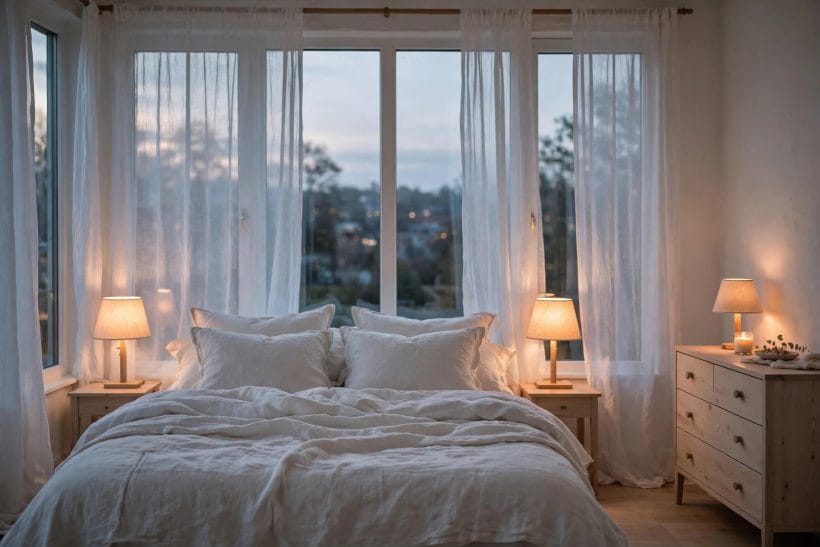
White is a palette, not a style — and the same whites can be tuned to very different rooms. Two of its friendliest registers are surveyed by the coastal bedroom ideas and farmhouse bedroom ideas lanes; this section maps the registers and what tunes each one.
56. Coastal white: bleached, woven and breezy
The seaside register leans on sun-bleached timber, woven grasses, rumpled linen and a whisper of blue-grey in its accents. Its white is the white of painted beach houses — matte, salt-worn and relaxed about perfection.
57. Farmhouse white: warm, worked and inherited
Farmhouse white is creamy rather than bright, and it keeps company with scrubbed pine, iron bedsteads, patchwork and objects that look earned. Its calm comes from honesty of materials; nothing in it is pretending to be new.
58. Hotel white: crisp, stacked and serviced
The boutique register runs on precision: high white cotton, a bed made like a drum skin, symmetry exact, surfaces cleared to the lamp and the carafe.
59. Scandinavian white: light-hungry and spare
The northern register pairs bright whites with pale wood, functional furniture and almost no ornament, hoarding daylight as its chief luxury.
60. Cottage white: layered, floral and forgiving
Cottage white welcomes pattern at the edges — a floral cushion, a checked throw, painted furniture with its brush marks showing.
61. Modern white: architectural and unbroken
The contemporary register uses white to describe form: flat-fronted storage, a platform bed, one sculptural lamp, shadow gaps instead of cornices. It needs the best light and the tidiest habits, and repays both with gallery calm.
62. Rustic white: limewash, beams and rough plaster
Where the rustic bedroom ideas lane works in timber’s browns, its white cousin limewashes the walls, leaves beams dark for contrast and lets texture go frankly rough. White here is a coating with a past, not a finish.
63. Transitional white: tailored shapes, softened palette
The middle register mixes an upholstered headboard’s formality with relaxed fabrics and warm-toned whites — the treaty style in the bedroom’s calmest colours. It is the register least likely to date, because it never fully joined a fashion.
64. Eclectic white: the gallery for a gathered life
Some households need white precisely because their possessions are not quiet: travel textiles, inherited furniture, art with opinions. White walls and bedding give the collection one calm field to perform on — the palette as stage, not costume.
65. Choose the register by the sleeper, not the photograph
Every register photographs well; they sleep differently. The hotel register delights the orderly and oppresses the relaxed; the cottage forgives and the modern demands.
8. Small White Bedrooms and Tricky Rooms
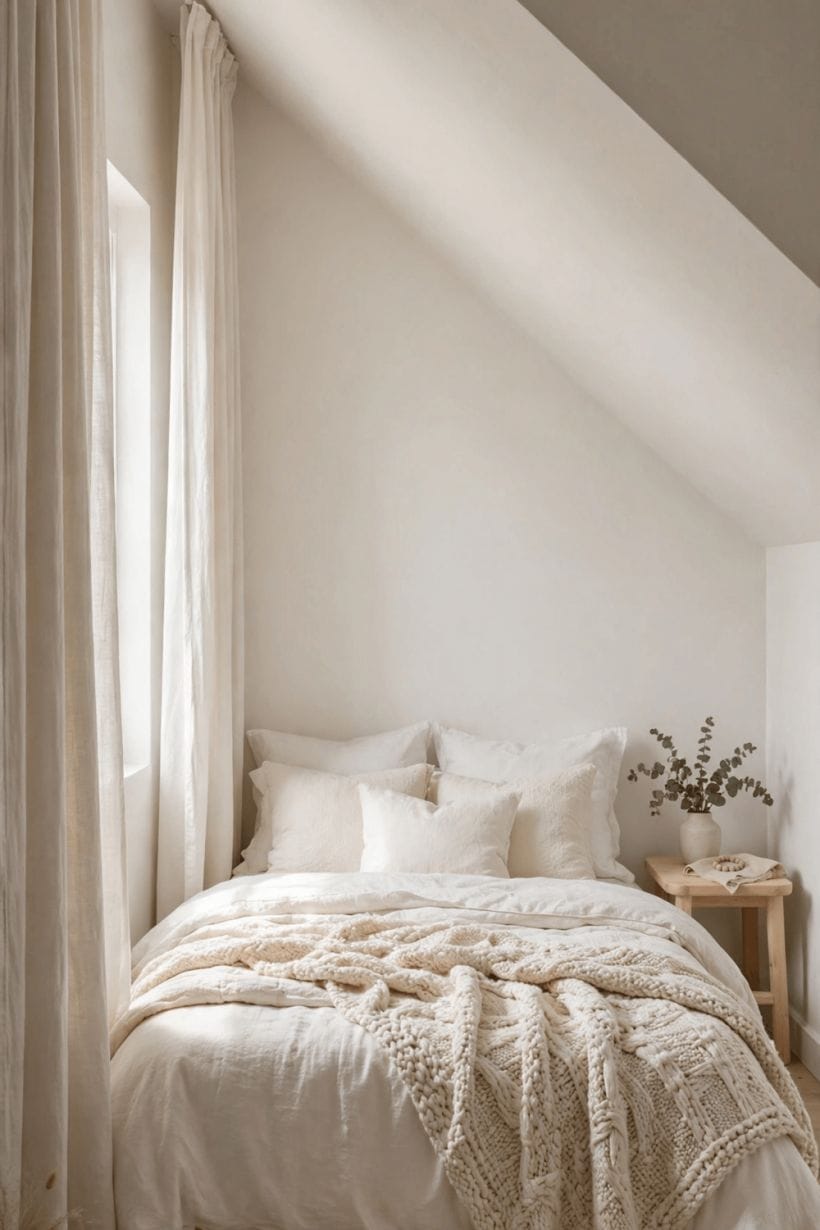
White is the small room’s oldest ally and the awkward room’s best negotiator, but it is not magic — it needs the plan adjusted to the room’s actual faults. This section works the small, the dark, the low and the oddly shaped.
66. Let white do its one trick honestly
White reflects the light a small room has and blurs the corners where walls meet, so the boundary is harder to read.
67. Keep a small white room’s palette tighter, not emptier
Fewer, closer whites read as intention; many whites in a small space read as indecision at close range. Two tones and one texture family, repeated, give the small room the coherence that substitutes for size.
68. Use the vertical in small rooms
Shelves and pictures hung higher, curtains mounted above the frame, a tall headboard: the small white room gains by drawing the eye up the walls it cannot widen.
69. Choose furniture by footprint, then by looks
In a small white room the bedside that fits is better than the beautiful one that crowds, because white exposes every squeeze. Legs that show floor beneath them keep the plan feeling open even at close quarters.
70. Give the dark room the warmest whites you dare
A north-facing or window-poor bedroom needs whites with real warmth in them and lamps planned like daylight’s understudies. Cool whites in a dark room do not look clean; they look unlit, which is the opposite of the intention.
71. Soften a low ceiling with uninterrupted walls
Run the wall white straight to the ceiling line with no contrasting band, keep curtains and pictures below the room’s visual horizon, and let the bed’s horizontal calm dominate.
72. Take the sloping ceiling as a feature, not a fault
Attic bedrooms in white gain a tent-like serenity: paint slope and wall in the same white so the geometry reads as intentional, keep the bed low under the high part, and let the low edges take storage rather than furniture with ambitions.
73. Handle the box room with a single bold texture
The smallest bedrooms need one generous gesture — a deeply textured throw, a woven wall hanging, a dramatic headboard — because a room furnished entirely in safe small pieces reads as a corridor with a bed in it.
74. Borrow light from the landing where you can
A glazed or part-glazed door, a borrowed fanlight, pale flooring continuing through the doorway: the small dark bedroom can import some of the house’s light. White multiplies whatever it is given, so give it something to multiply.
75. Accept the room and finish it properly
The last small-room idea is an attitude: a tiny white bedroom finished with the same care as a grand one — real curtains, a proper rug, lamps that flatter — sleeps better than a big room done carelessly.
9. Checks and Mistakes: Before the First Purchase or the First Stone
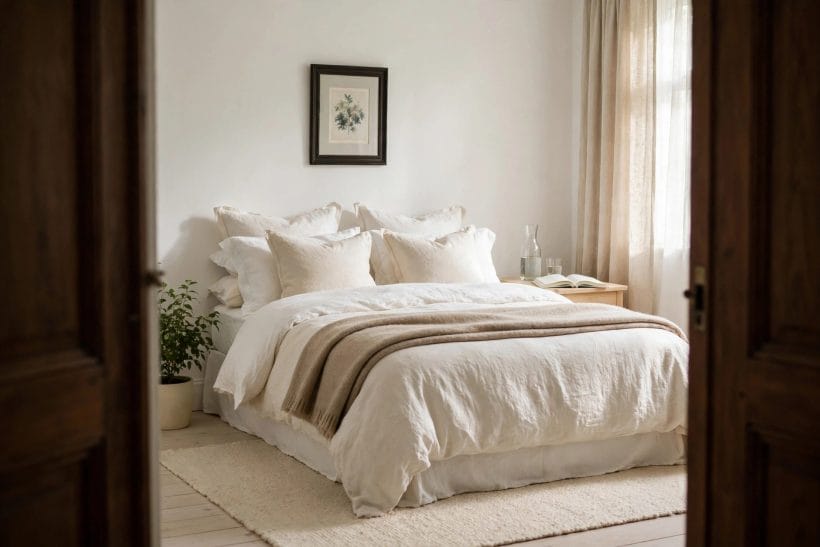
A white bedroom’s checks happen before the whites are bought, because white forgives nothing bought in haste. The first check is light: live with the chosen white on a board in the room for a full day and a lamplit evening, because a white is two colours — the noon one and the ten-o’clock one — and both must be welcome.
The second check is texture. Lay the bed’s fabrics together — sheet, blanket, throw, cushion — and demand three distinct hands among them. If the pile could be mistaken for one material, the room will read flat however good each piece is separately; texture is the palette’s only ornament and it must be present in force.
Then the storage audit: count the room’s residents — clothes, books, laundry, chargers, the morning’s cup — and give each a closed home before the first white is hung or spread. The commonest white-bedroom failure is not a wrong white; it is a right white asked to background a life with nowhere to go. The plan for where things live is the design.
The mistakes repeat across every register: matching all the whites to one tin and one fabric until the room turns clinical; choosing cool whites for a cold room; lighting the pale field with a single hard ceiling bulb; and letting one coloured object in without a plan, so it sits like a rumour. Each is cured by the same medicine — tone, texture, layers, intention.
10. Costs and Pulling It Together
Costs in a white bedroom concentrate where the skin meets the room: in the bed’s textiles, the mattress beneath them and the window’s lined curtains. The palette itself is cheap — white paint and plain cotton are the market’s most ordinary goods — and the scheme’s jewellery (lamps, a plant, one picture, a timber stool) can be gathered slowly, because white waits gracefully for additions and matches all of them.
Pulling it together: choose the whites by the room’s own light; build the bed in three textures and three tones; close the storage so the pale field stays clear; layer the light for morning and midnight; and let one accent — a plant, a throw, a dark frame — give the calm its scale. The room then stands as this cluster’s reference point for the palette, beside the gray bedroom ideas lane’s cooler register: white as the bedroom’s native quiet, kept warm by fibre, timber and habit.
Final Considerations
A white bedroom asks more of its keeper than any other colour — and pays more. It demands the made bed, the cleared surface, the laundry kept in its family; in exchange it gives back the rarest thing a modern house contains: a room with nothing in it competing with sleep.
Begin with the whites and the bed. Get those two right — the tones by your light, the layers by your hand — and the room’s calm is already built; everything after is garnish on a dish that was already cooked.


0 Comments