
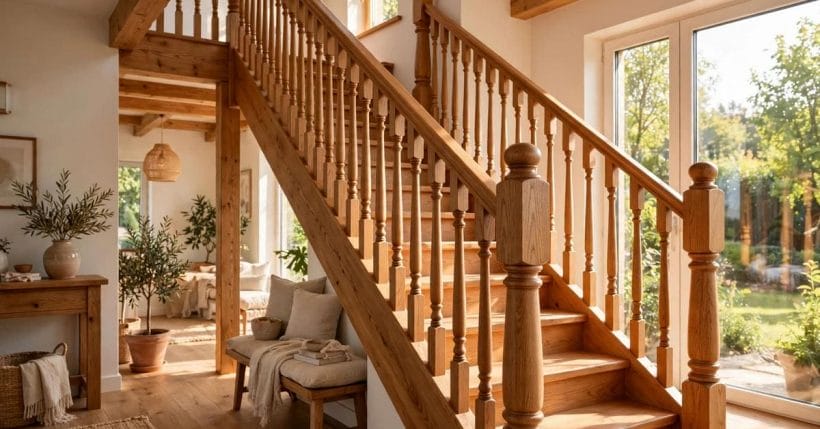
Steel draws a clean line and iron curls a flourish; wood does something warmer. It meets the hand like furniture, forgives daily knocks, and turns the staircase into the best-made object in the hall.
These seventy-five ideas cover wooden railing designs for stairs only: balusters, handrails, newels, timbers, rustic and modern readings, landings and outdoor runs — safety stated generally, costs kept to honest drivers.
1. Wood Stair Railing Ideas at a Glance
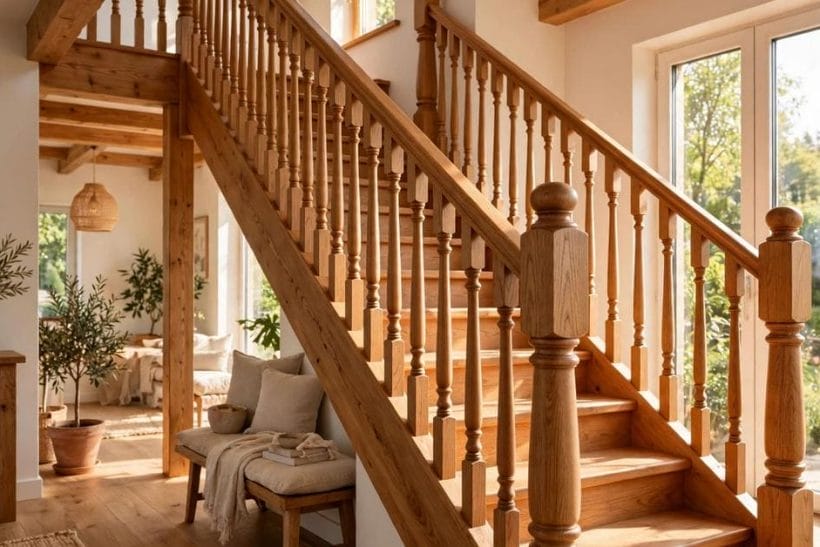
The central entity is the wooden stair railing: a guard and handrail system built from timber, whose attributes are its baluster pattern, handrail profile, newel posts, species and finish, and its pairing with treads and the hall around it. This post is one slice of a crowded staircase family, and the splits matter: the flight itself lives in the staircase ideas pillar; every railing material compared side by side lives in stair railing ideas; the forged ornament of wrought iron railing and the drawn precision of stairs railing designs in steel are siblings with different temperaments, while this page keeps faith with timber alone. Wooden rails on the porch, standing outside in the weather, belong to front porch railing ideas, and the contemporary flights themselves are gathered in modern staircase ideas. Within wood, the feature photograph makes the traditional case: turned oak balusters, a ball-capped newel, beams overhead, sunlight doing the polishing. Safety rules are stated generally here — heights, spacings and fixings are set by your local code.
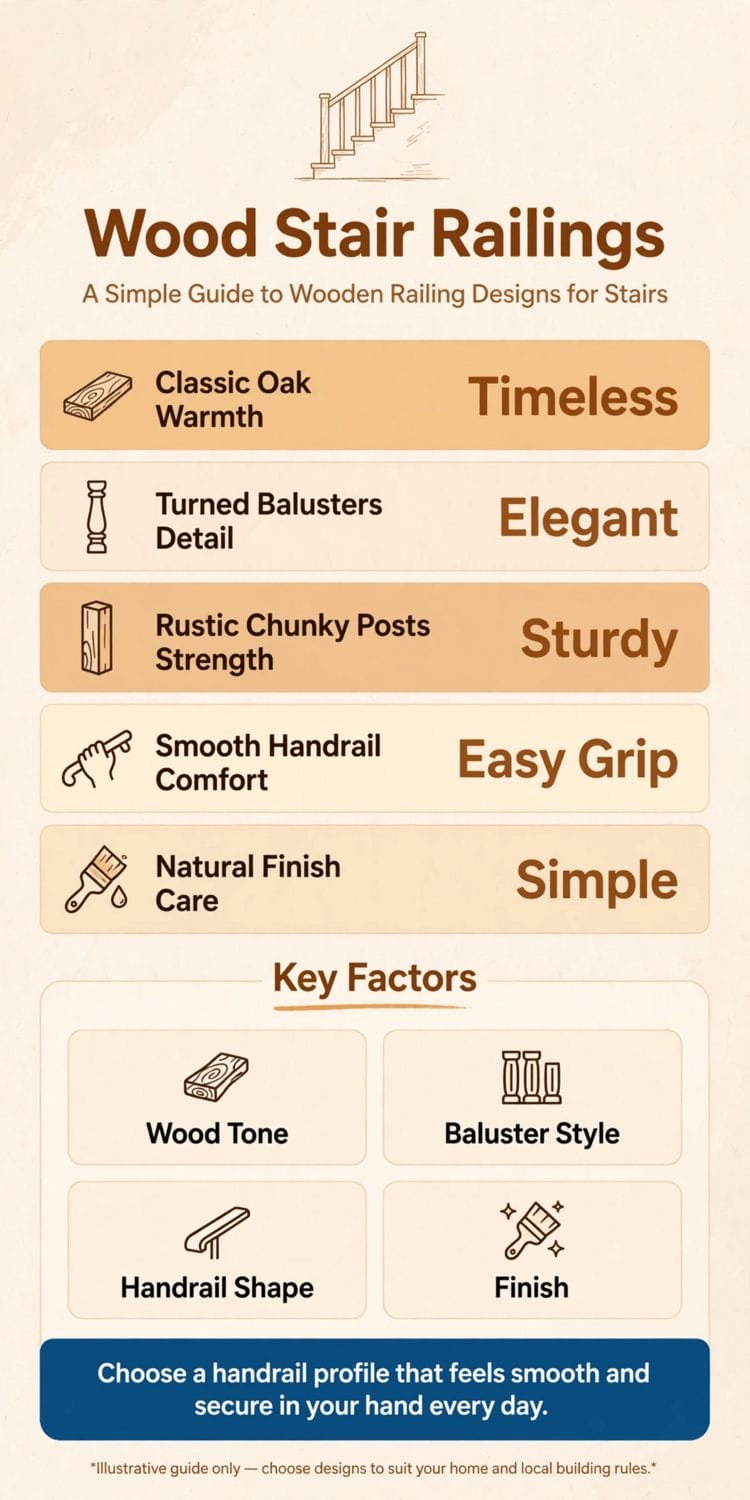
| Question | Short answer |
|---|---|
| Why choose wood? | Warmth and repairability: timber feels kind to the hand, suits period and modern halls alike, and can be sanded, stained or repainted as the house changes around it |
| What are the main styles? | Turned traditional balusters, slim square modern spindles, chunky rustic posts, and painted country schemes — all from the same honest material |
| Which timber suits stairs? | Hardwoods such as oak and walnut take daily handling best; pine and other softwoods cost less and paint beautifully |
| What does it cost? | Drivers only: species, turning and joinery time, length and turns, finish, and whether the work is bespoke or from stock patterns |
| What about safety rules? | Heights, gaps and fixings are code matters, stated generally here; your local rules and a qualified installer decide the specifics |
2. Layouts and Configurations: Wood on the Flight
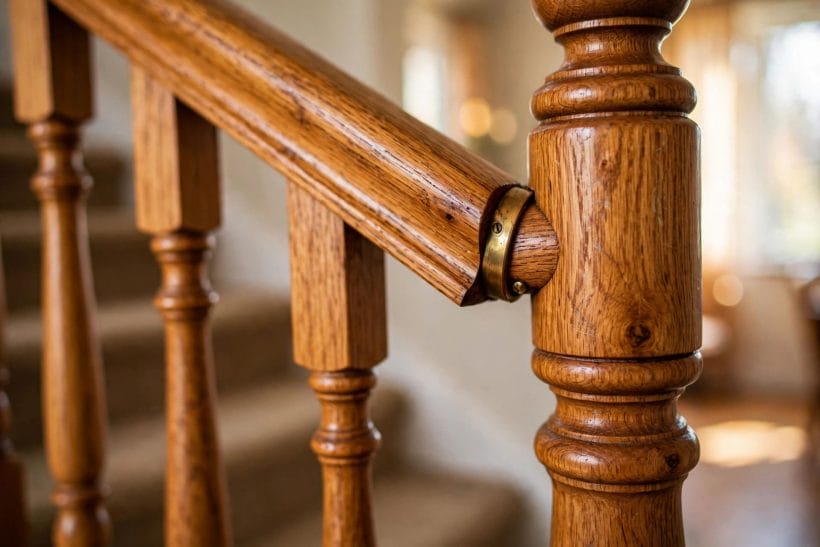
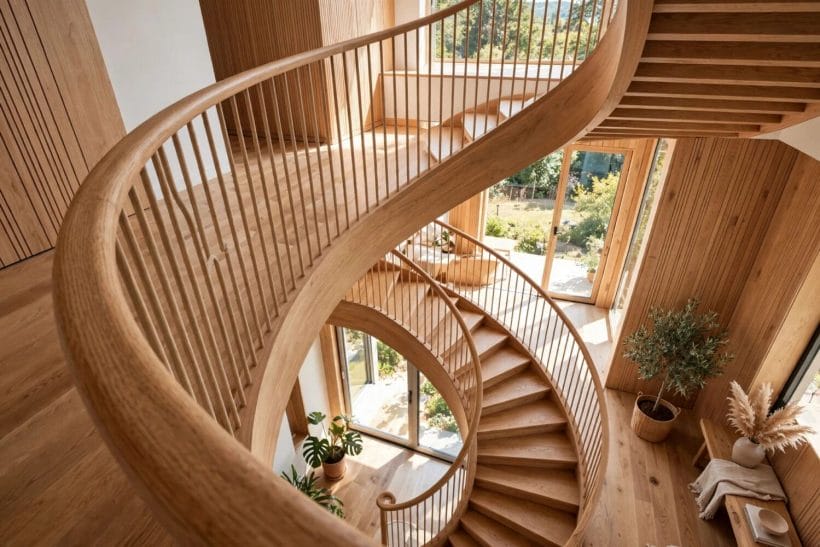
Before style comes shape: the railing must follow the flight the house already has, and timber can be persuaded around almost any turn. The close photograph shows the craft at joint level — a handrail easing into its newel, grain unbroken.
1. A straight flight with a continuous handrail
The simplest and often most satisfying arrangement: one unbroken rail from newel to newel, balusters marching in even rhythm. The eye reads the whole system at once, so proportion does the talking.
2. An L-shaped stair with a landing turn
Where the flight turns on a landing, the railing turns with it, and the landing newel becomes the composition’s pivot. Give that post presence — a cap, a finial, a grander section — because every journey pauses its eye there.
3. A U-shaped return flight
Two parallel flights and a half landing ask the railing to perform twice and turn twice. Matching the baluster pattern on both runs keeps the stairwell calm, and a continuous handrail rewards the hand at every step.
4. A winder turn eased in timber
Winders save space where a landing will not fit, and the handrail must twist and rise to follow them — the joiner’s showpiece, worth commissioning properly.
5. An open-string staircase with exposed tread ends
Where the string is cut away and tread ends show, balusters sit directly on each tread and the staircase reads as joinery end to end. A stained rail over painted tread ends is a classic, forgiving combination.
6. A closed-string flight with a wall-side rail
On a closed-string stair the balustrade rides the string’s top edge in a neat traditional line, and a slim wall-side handrail serves anyone who prefers a rail on both sides. Painted strings with a stained handrail keep the line crisp.
7. A gallery landing balustrade
The landing guard is the railing’s second act: continue the flight’s baluster pattern along the gallery so the hall reads as one composition from below. A bolder newel cap can mark the top of the climb.
8. A half-flight to a split-level room
Short flights between split levels still deserve a proper rail — a hand climbs them as often as the main stair. A simple square-baluster run in the main stair’s timber ties the levels together quietly.
9. A double-width statement staircase
Generous stairs can carry a grander system: deeper handrails, paired newels, balusters grouped for rhythm. Timber keeps the grandeur warm rather than monumental; a wide oak rail polished by hands soon out-glistens any catalogue photograph.
3. Balusters and Spindles: Turned, Square and Slim
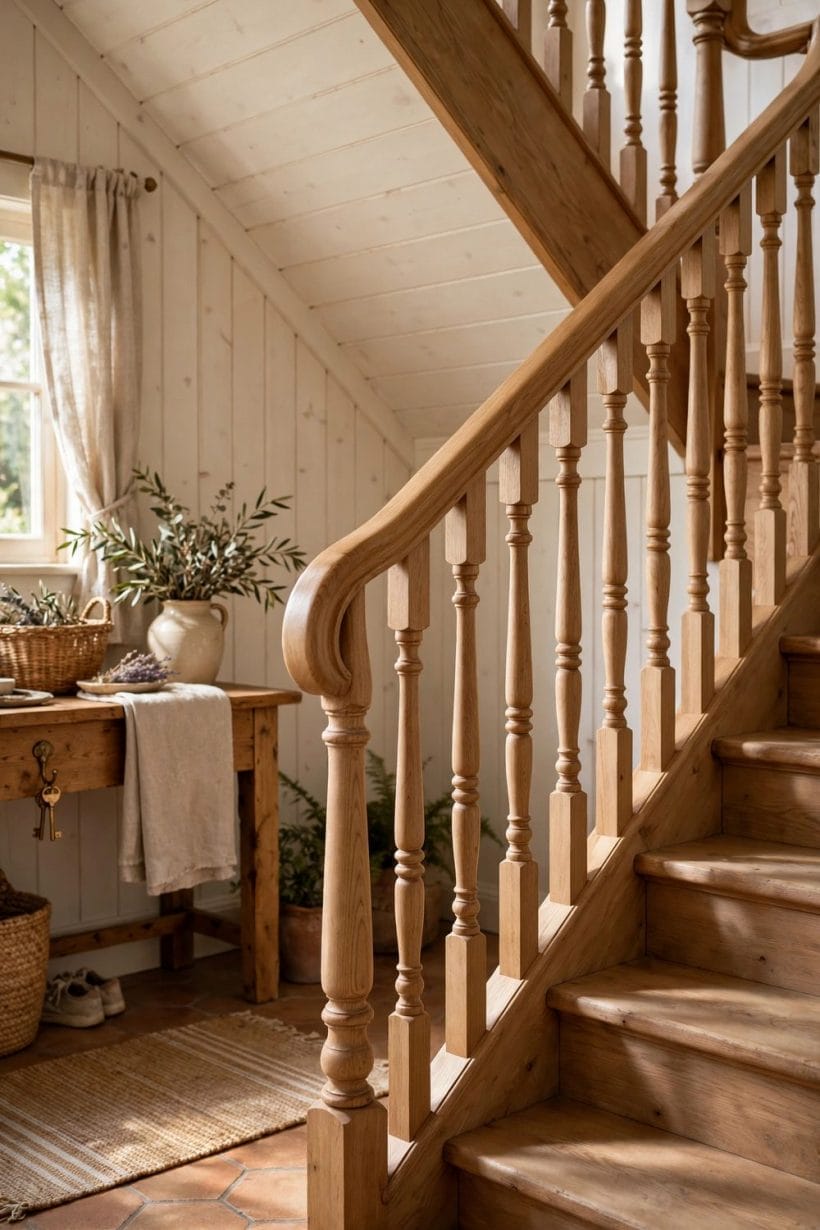
The balusters are the railing’s rhythm section — small decisions repeated until they read as one gesture. Turning, squaring or slimming them changes the staircase’s accent more than any other single choice, so choose the pattern before the paint chart.
10. Classic turned balusters
The vase-shaped turning of the feature stair is the pattern most houses picture first. It suits period halls and farmhouse schemes alike, and its shadows give a plain stairwell quiet, moving decoration all day.
11. Slim tapered spindles
A gentler turning — or a plain taper — lightens the whole flight. Slim spindles suit cottages and smaller halls where a full traditional baluster would crowd the treads, and they let more light pass between rooms.
12. Square-section balusters
Square spindles are the modern and Shaker answer: straight, honest, easy to dust, happy in paint or clear finish. Grouped closely they read contemporary; spaced traditionally they read crafted and calm, and they are the simplest pattern to replicate.
13. Alternating two patterns
Alternate a turned baluster with a square one and the flight gains a syncopation that holds the eye. The trick is restraint — two patterns only, evenly alternated, in the same timber and finish, so the rhythm reads as design rather than indecision.
14. Fluted and reeded balusters
Fine vertical grooves catch light along each spindle and lend a neoclassical crispness to formal halls and painted schemes — subtle at stair distance, rewarding at close view.
15. Twist and barley-sugar turnings
A spiral-turned baluster brings movement to a straight flight and Jacobean richness to darker timbers. Use it where the hall can carry theatre — a wide entrance stair — and keep everything else simple so the twist stays the soloist.
16. Chunky farmhouse spindles
Oversized square or softly turned balusters give a farmhouse stair its sturdiness, in feel as much as fact. They pair with wide treads, deep newels and a handrail gripped like a fence rail — a staircase built for busy households.
17. Painted white balusters under a stained rail
The hardest-working combination in the book: white or cream spindles brighten the stairwell and hide scuffs in repaintable paint, while the stained handrail above takes the handling and shows the grain.
18. Balusters grouped in pairs and threes
On wide treads, balusters placed in pairs or threes per step make the pattern architectural — a colonnade climbing the flight. It is a traditional device on grand stairs and fills a generous staircase without chunkier parts.
4. Timbers and Tones: Oak, Walnut, Pine and Paint
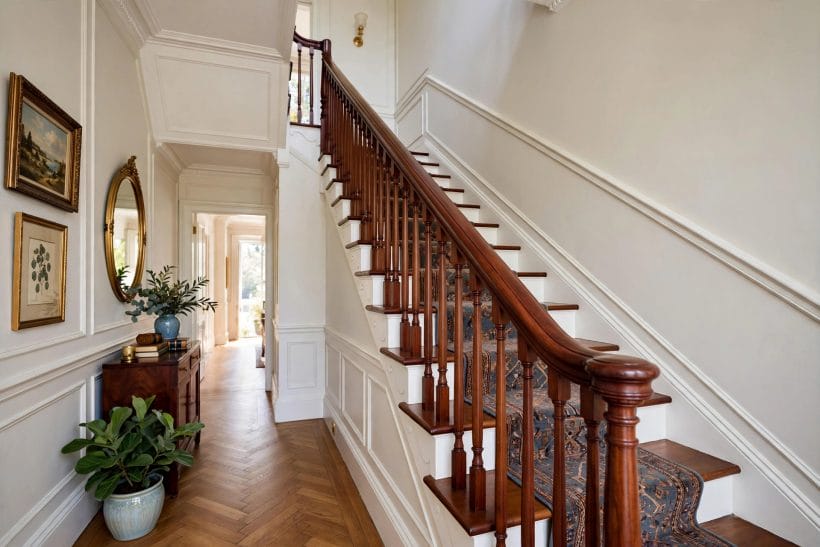
Species is destiny: the timber decides the colour before any stain is opened, the hardness under decades of hands, and much of the joiner’s bill. These ideas walk the palette from pale and painted to dark and dramatic.
19. Natural oak, oiled
Oak is the benchmark — hard, characterful, happy under oil that deepens its grain each year. An oiled oak rail suits the beamed, sunlit stair in the feature photograph and any hall leaning warm or traditional.
20. Walnut for depth
Walnut brings chocolate depth no stain can fake, and a walnut handrail over pale balusters is among the most elegant contrasts a staircase can wear. Reserve it for the parts the hand touches, where its quality shows.
21. Pine painted in a soft colour
Pine is the painter’s timber: affordable, easy to work, content under coats of colour. Painted in soft sage or cream, it gives a cottage stair its calm.
22. Ash and other pale timbers
Ash, maple and similar pale hardwoods keep a stairwell bright and read Scandinavian-calm against white walls and pale floors. Their grain is quieter than oak’s, suiting slim modern balusters and houses that want the railing present but never loud.
23. Two-tone: dark rail, pale spindles
A dark-stained or ebonised handrail floating over pale painted balusters draws the flight’s line like ink. The contrast works practically too — eye and hand find the rail instantly, which is what a handrail is for.
24. Stain matched to the floor
Carry the hall floor’s tone up the handrail and the staircase joins the room instead of interrupting it. Take a floor sample to the finisher; matching stain across timbers is a craft judgement, not a tin-label promise.
25. Weathered and limed finishes
Liming wax dragged through oak’s open grain, or a grey-washed stain, gives timber a coastal softness. It suits seaside houses and relaxed schemes, and hides the small marks of family life kindly.
26. Ebonised and near-black timber
Stain a hardwood railing almost black and the staircase turns graphic — a dark ribbon against pale walls, at home in a Victorian hall or a minimal new build. Keep balusters black for sculpture, or pale beneath for contrast.
27. Reclaimed timber with a past
Old beams and salvaged joinery bring nail holes, saw marks and stories no new wood can imitate. A reclaimed newel or handrail, honestly finished, anchors a rustic scheme; keep sound faces outward and let the history show where hands will not catch.
5. Handrails and Newel Posts: The Parts the Hand Meets
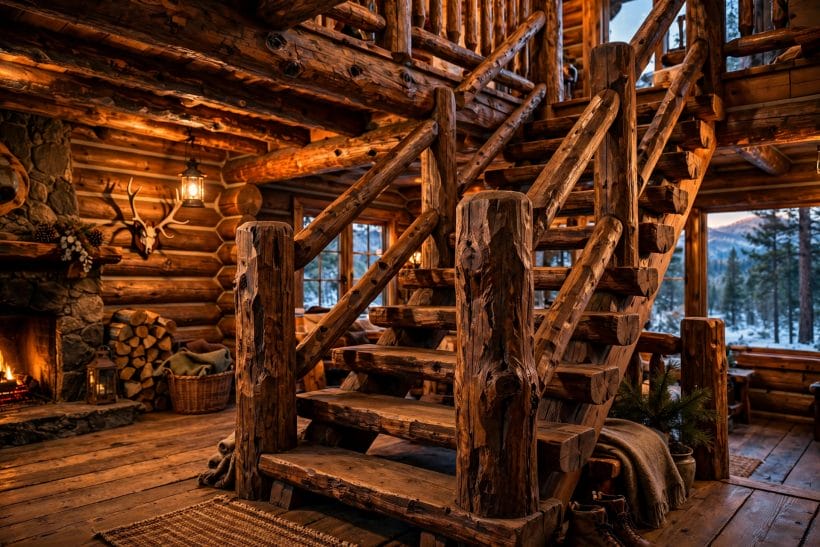
Balusters dress the stair, but the handrail and newels are the parts the body knows — gripped in the dark, polished by ten thousand palms. Their shapes deserve the closest choosing of all.
28. A rounded mopstick handrail
The near-circular profile is the hand’s oldest friend: comfortable for every grip, kind to children and older hands, unfussy in any company. In oak or painted pine it disappears into tradition — exactly its charm.
29. A wide, flat-topped rail
A broader, flatter profile reads more architectural and gives the balustrade a ledge-like calm. It suits square balusters and modern-traditional halls, its top face catching light along the flight.
30. A pig’s-ear wall handrail
Where a wall-side rail is wanted, the pig’s-ear profile fixes directly to the wall with no brackets interrupting the grip — the tidy answer for narrow stairs and basement flights.
31. Ball-capped newel posts
The turned ball cap of the feature stair is the classic full stop at a flight’s end: friendly to the palm, satisfying to the eye, endlessly traditional. Scale it honestly — a grand stair earns a grand ball.
32. Flat and chamfered caps
A flat or softly chamfered cap keeps a modern or Shaker scheme clean where a ball would fuss. It still earns its place, protecting the post’s end grain and giving the hand a finished landing point.
33. Box newels with panelled faces
A hollow box newel, panelled or plain, brings furniture presence to the foot of the stair and hides its fixings. Box newels suit painted schemes and Craftsman halls.
34. A volute or monkey’s-tail scroll
Where a handrail ends over the bottom step, a carved scroll is joinery’s signature flourish. It asks for a craftsman’s hand and a traditional hall, and repays both every time a palm rounds it.
35. Continuous rails over the newels
In an over-the-post system the handrail flows continuously across the newels on shaped fittings, never breaking the grip from bottom to top. It is the most graceful arrangement a wooden stair can have, and rewards skilled setting-out.
6. Rustic and Farmhouse Wood: Chunky and Weathered
At the rustic end of the family the joinery gets bigger, surfaces keep their texture, and perfection is politely shown the door. These are railings for houses with dogs on the landing and boots by the door.
36. Oversized square posts and rails
Scale everything up — posts like fence posts, a handrail deep enough to rest a forearm on — and the staircase gains farmhouse backbone. Keep the balusters simple squares so the mass reads as honesty, not heaviness.
37. A rough-sawn, hand-hewn character
Timber finished to keep its saw marks and adze texture brings instant age to a new stair. It belongs with limewashed walls, stone flags and wool runners, and the hand learns its landscape within a week.
38. Branch and natural-form rails
A handrail shaped from a naturally curved limb is part railing, part sculpture — for mountain cabins and woodland houses, fitted by someone who works with found timber.
39. Barn-style X-bracing on landings
Crossed timber braces borrowed from barn doors give a landing guard a bold, agricultural rhythm — use them there rather than on the flight, where the diagonals can be enjoyed whole.
40. Dark-stained country oak
A mid-dark stain on oak or pine, worn a little at the grip, is the farmhouse shortcut: instant maturity without reclaimed prices. Pair it with cream walls so the dark rail reads as an accent line.
41. Pegged and wedged joinery left visible
Draw-bored pegs and through-tenons left proudly visible turn construction into ornament. Joiners have signed their work this way for centuries; on a rustic stair the honesty is the whole point.
42. A rope-and-timber country hybrid
On short flights and gallery edges, a stout rope threaded through timber posts guards with farmhouse wit — best kept to low, supervised runs and landings, and always as a complement to a proper handrail, never a substitute.
43. Painted country colours
Deep green, oxblood, slate blue — a boldly painted railing gives a country stair its character in a weekend. Satin finishes forgive the knocks.
7. Modern and Minimal Wood: Clean Lines in Timber
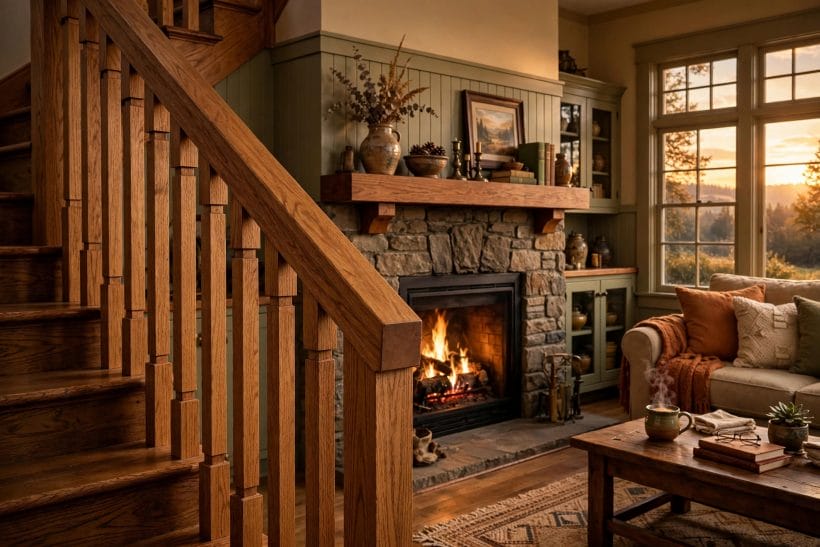
Wood is not obliged to look old. Stripped of ornament, timber becomes the warm register in a minimal interior — the one natural note among white walls, pale floors and glass.
44. Slim square balusters, closely spaced
Thin square spindles set close together read as a timber screen — a slatted wall that happens to climb. The effect is architectural and calm in pale ash or oak, throwing striped shadows across the treads.
45. A floating wall-mounted handrail
Where the stair runs against glass or open treads, a lone timber handrail on discreet brackets carries the modern scheme. The wood warms what steel and glass chill, and the grip stays continuous.
46. Slatted timber screens as the guard
Floor-to-ceiling vertical slats guard flight and landing in one gesture, filtering light between floors — the boldest modern use of wood on stairs, part railing, part architecture.
47. Pale ash with white treads
An all-pale scheme — ash rail, white treads, pale walls — makes a small stairwell feel twice its size, the grain providing the only pattern.
48. A single dark rail in a white stairwell
One walnut or ebonised handrail, its line unbroken where a wall or glass does the guarding, is minimalism with a heartbeat. The dark wood becomes the stair’s signature and the hall’s only necessary ornament.
49. Square newels with flush caps
Modern timber railings finish their posts flush — no ball, no finial, just a crisp square cap. The restraint suits square balusters and lets proportion, not turning, carry the design.
50. Wood paired with glass panels
A timber handrail riding above clear glass guards gives a modern stair warmth without surrendering light. The wood should be the best the budget allows — it is the only part of the system the hand ever meets.
51. Wood paired with black metal
Blackened steel spindles beneath an oak handrail marry metal discipline to wood’s warmth. It is the defining mixed railing of current halls, flattering period and new-build stairs alike.
8. Safety, Grip and Guarding, Stated Generally
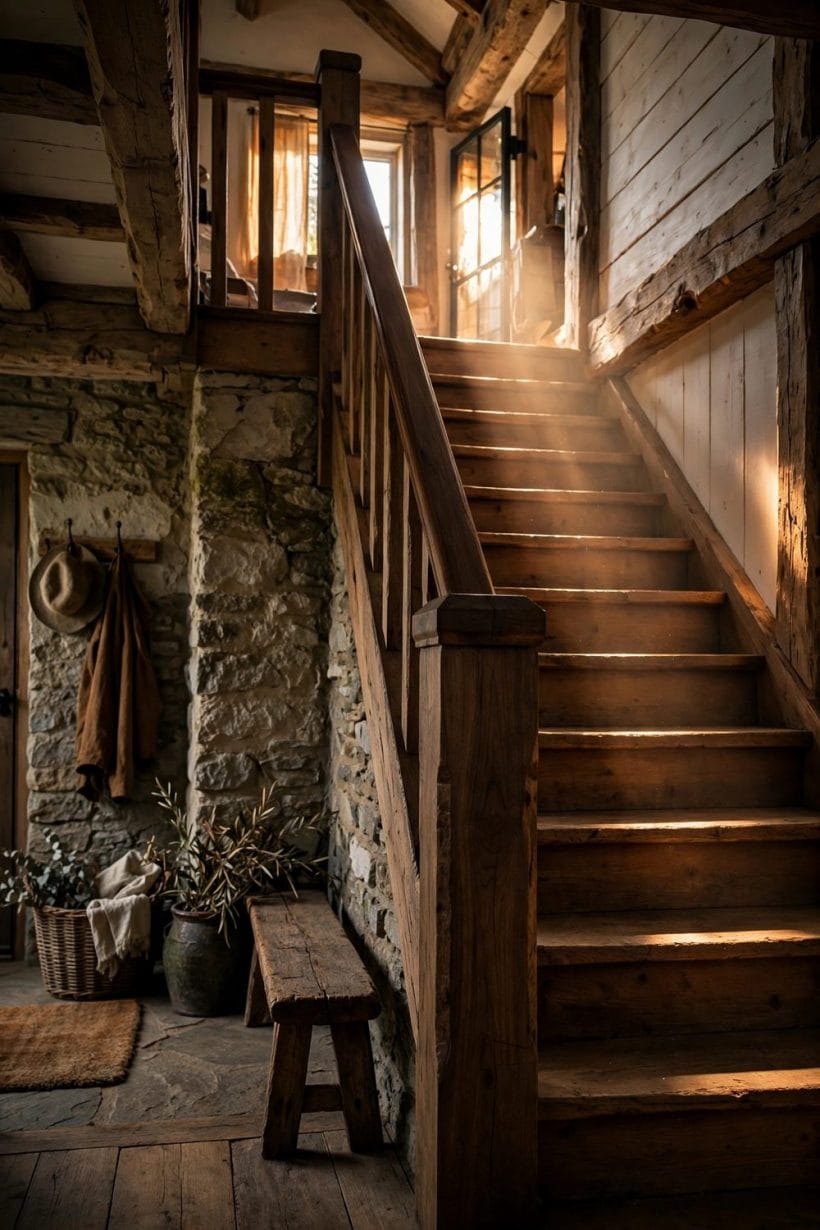
A railing’s first job is not beauty but faithfulness: solid and grippable every time a hand reaches for it. Timber serves that job well when its few rules are respected — and the rules belong to your local code, not this page.
52. A handrail that never abandons the hand
The grip should run continuously from first step to last, turning corners on easings rather than stopping at newels wherever the design allows. A rail the hand must hunt for will be missed once too often.
53. Baluster spacing that minds small children
Gaps between balusters are governed by local codes written with small children in mind, and a qualified installer works to them as a matter of course. Let the spacing rule shape the pattern’s rhythm rather than fighting it afterwards.
54. Newels anchored like furniture, fixed like structure
A newel that rocks undermines the whole system’s trust. Posts should be fixed with proper structural fixings into the stair’s frame — hidden bolts, housed joints, sound joinery — and checked whenever the stair is redecorated.
55. Grip profiles for every hand
Very wide or sharply edged rails defeat small and arthritic hands. Rounded or gently oval profiles, sized so fingers can close around them, are the kind choice — the mopstick’s centuries of service prove it.
56. A second rail where the household needs one
Children, grandparents and anyone recovering from a knee gladly earn the wall-side second rail. Fitted at the height your household needs, it is hospitality expressed in timber.
57. Smooth finishes where palms slide
Rough-sawn charm has its places, but the gripping surface is not one of them. Sand the handrail splinter-free whatever the style, and renew worn finish before the wood roughens.
58. Landing guards given flight-level respect
The gallery guard protects against a full-storey fall, so build it with the flight’s own balusters and fixing discipline — never as leftover trim.
59. Outdoor timber guarded against weather
Exterior wooden rails live harder lives: choose durable species or properly treated timber, detail fixings to shed water, and expect a maintenance rhythm of cleaning and refinishing. Porch and deck runs reward the same care the porch-railing posts describe for outdoor wood generally.
9. Landings, Balconies and Outdoor Wood
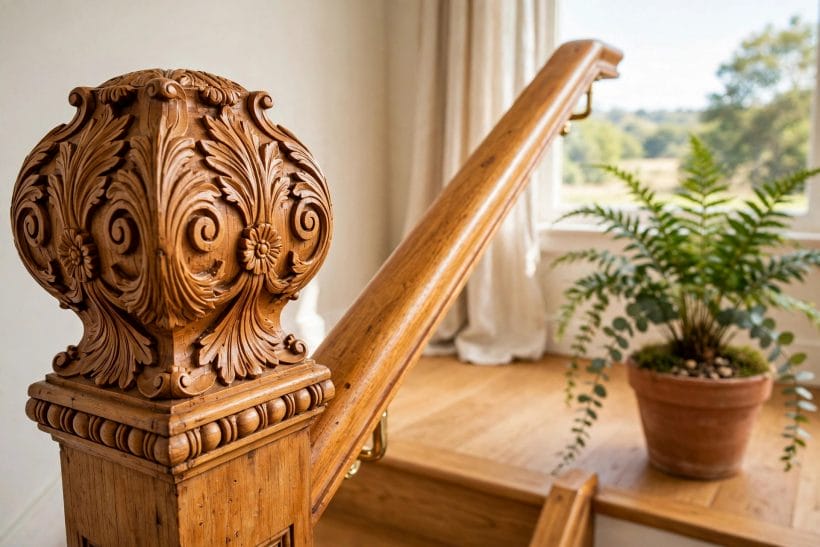
The railing’s work does not end at the top step. Landings, balconies, mezzanines and the short outdoor runs to porches and decks all ask timber to guard with the flight’s own character.
60. A landing balustrade matching the flight
Carry the flight’s exact baluster and rail along the landing and the hall below sees one unbroken composition. From the hall floor, the landing run is the part of the railing most often looked at.
61. A window-seat landing with a low rail
Where a wide landing holds a window seat or reading chair, a balustrade in matching timber frames the pause like a balcony seat. Keep the guarding full-height and code-true whatever the furniture suggests.
62. A mezzanine edge in slatted timber
In barn conversions and double-height rooms, a slatted timber guard along the mezzanine repeats the modern flight’s language at gallery scale, filtering views between levels while keeping the big room feeling connected.
63. Juliet-style balcony rails indoors
Full-height internal windows and stairwell voids sometimes ask for a shallow guard rail rather than a balustrade. A simple timber rail with slim balusters, echoing the flight, guards the opening without pretending to be a balcony.
64. Basement and attic flights in painted pine
Secondary stairs deserve sound rails, not afterthoughts: painted pine balusters and an honest handrail serve cellar and attic flights perfectly, and can borrow the main stair’s cap or colour for family resemblance.
65. Deck steps with a chunky timber rail
Short outdoor flights to a deck take the farmhouse end of the family — chunky posts, a broad rail, durable or treated timber. Match the deck’s own balustrade so the steps read as part of the terrace.
66. Porch steps in painted wood
A few painted wooden balusters and a sturdy handrail give porch steps their welcome and their safety in one gesture. Sound exterior paint, regularly renewed, keeps them honest.
67. Garden and terrace stair rails
On garden steps, weathered oak or chestnut rails age gracefully into the planting, silvering a little each year. Keep the profile simple; the garden rewards understatement, and the hand still finds its rail at dusk.
10. Costs, Care and Choosing Well
The last attributes are practical: what the money actually buys, how little care timber asks, and how to commission work that still feels right when the grandchildren lean on it.
68. Cost driver: species and section size
Walnut costs more than oak, oak more than pine, and extra thickness multiplies through posts, rails and balusters alike. Spend the species budget where hands and eyes go — handrail and newels first.
69. Cost driver: turning and handwork
Lathe time is money: elaborate turnings, carved volutes and eased wreaths are hours of skilled work, while square balusters are sawn and planed swiftly. Choose the one flourish the stair deserves.
70. Cost driver: length, turns and landings
Every turn asks for fittings, easings and setting-out; every landing adds a second run of guarding. An honest quote prices the geometry, not just the metres — why two stairs of equal length rarely cost the same.
71. Bespoke joinery versus stock patterns
Merchant stock balusters and rails, well chosen, serve most houses handsomely at friendly cost. Reserve the bespoke commission for odd geometry, listed character or the one statement stair the house has been waiting for.
72. Care: dusting, waxing and small repairs
Timber asks little: a dust along the balusters, occasional wax on the handrail, prompt attention to any loose spindle. Wood also accepts local repair invisibly.
73. Refinishing instead of replacing
A tired wooden railing is a refinishing project, not a replacement: sand, re-stain or repaint, and the system looks commissioned yesterday. This renewability is wood’s deepest economy.
74. Choosing a joiner and checking the work
Ask to see stairs the joiner has actually built, grip their handrails, and check how the rail turns its corners. Agree timber, pattern and finish on a sample length first — a metre of finished rail settles every argument.
75. Matching the railing to the house’s age
Let the building vote first: turned tradition for period halls, honest squares for cottages, slim modern lines for new architecture. A railing in the house’s own accent never dates.
Final Considerations
Before the pattern is chosen, walk your stair the way the handrail will: palm hovering where the rail will run, eye following the balusters’ rhythm from hall floor to landing. Notice where the light falls at the hour you climb most, where small hands reach up, where the turn asks the rail to ease. An hour spent walking its line in imagination is the cheapest design work in the project — the moment a catalogue pattern becomes your stair’s own answer.
A wooden railing earns its place by being chosen once and chosen kindly: one timber with the grain showing, one baluster pattern repeated without apology, a handrail shaped for the hands that will hold it, guarding that satisfies your local code without advertising the fact. Keep the family splits clean — the flight in the staircase pillar, all materials in the railing survey, forged ornament with the iron, drawn precision with the steel — and let wood be wood here: warm, repairable, renewable. Chosen that way, it is the railing the house will miss most if it ever goes.

0 Comments