
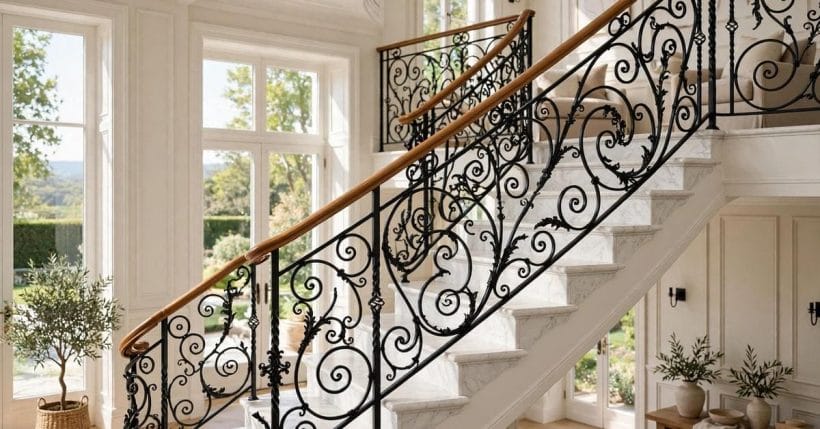
Black iron curls up the staircase like handwriting — scrolls, twists and leaves hammered hot and left to cool into the strongest decoration a house can wear.
These seventy-five wrought iron railing ideas cover staircase scrollwork and straight-bar designs, balconies and porches, gates and garden rails, handrails and posts, finishes and colour, pairings with wood and stone, and the safety, care and cost drivers that come with real iron.
1. Wrought Iron Railing at a Glance
Wrought iron railing is railing as craft: bars, scrolls and panels worked from iron — traditionally hand-forged, today often fabricated from mild steel in the same vocabulary — assembled into balustrades for stairs, balconies, porches and gates. This post is the wrought-iron material story only. The full material survey lives in stair railing ideas, the flights themselves in staircase ideas; the steel and metal railing angle has its own later post, as does the wood railing one, and neither is re-taught here. What iron alone offers — thin bars with great strength, ornament that is structure rather than appliqué, and a working life measured in generations — is the whole subject below.
| Question | Short answer |
|---|---|
| What is wrought iron railing? | Railing built from worked iron bars and scrolls, forged or fabricated into panels, balusters and handrails |
| Where is it used? | Staircases, landings, balconies, porches, terraces, gates and garden edges, inside and out |
| What styles exist? | Two great families — ornamental scrollwork and plain straight bars — with every mixture between |
| Is it strong enough for safety? | Yes, when designed and fixed properly; heights, gaps and fixings follow local building rules |
| Does it rust? | Iron needs its finish maintained outdoors; sound paint or coating, promptly touched in, is the whole defence |
| Who makes it? | Blacksmiths and metal fabricators; bespoke work is drawn, sampled and approved before forging begins |
2. Staircase Railings: Scrollwork Classics
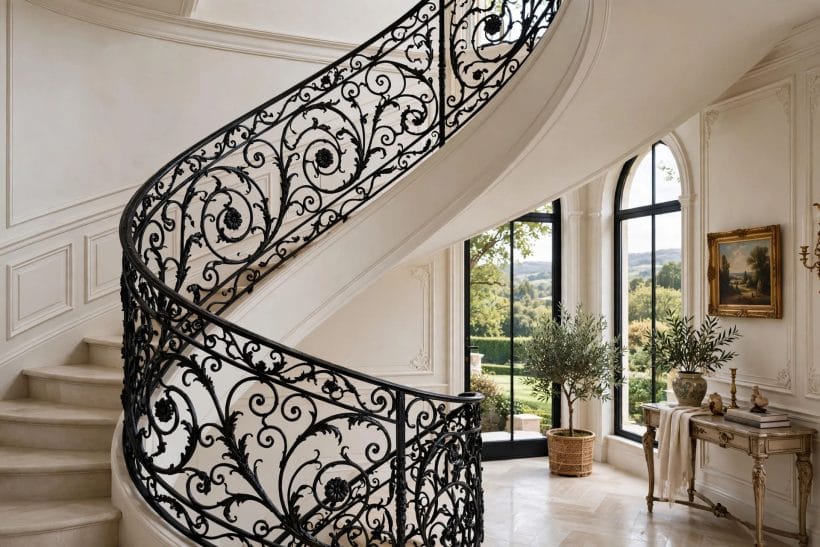
The scroll is iron’s signature: a bar heated, bent and scrolled into spirals that carry the eye — and the hand’s expectation — up the flight. The nine ideas here are the classic vocabulary, from the full baroque panel of the feature photograph to the single motif repeated with restraint along a plain flight.
1. The full scrollwork panel
Scrolls, leaves and curls fill the whole balustrade panel in a continuous composition, made as one piece for the flight. It is the grandest treatment a staircase can wear, and it suits wide, light halls where the ironwork can be read like a drawing.
2. The repeated S-scroll baluster
One elegant S-curve, repeated at every tread, gives ornament with rhythm instead of density. The repetition is quicker to make than a full panel, calmer in a smaller hall, and unmistakably wrought in character.
3. Scrolls at the volute only
Keep the flight plain and concentrate the craft at the bottom, where the handrail curls into a scrolled volute over the starting step. A single gesture of ornament at the threshold reads as luxury precisely because the rest is restrained.
4. Twisted bars between plain rails
Bars twisted hot into a barley-sugar spiral catch light along their length and feel wonderful under a passing hand. Mixed with plain bars in an alternating rhythm, they give texture without a single applied ornament.
5. Leaf and vine motifs climbing the flight
Forged leaves on a wandering stem turn the balustrade into a frozen garden, the motif growing naturally with the stair’s rise. It is the blacksmith’s showpiece — ask to see a sample length before commissioning a whole flight of it.
6. Basket and cage balusters
Small woven-looking cages or baskets swell the middle of otherwise plain bars, a traditional detail that catches lamplight beautifully. Spaced singly among straight bars, they punctuate a flight the way buttons punctuate a coat.
7. The lyre and harp pattern
Curved verticals bowing out and back form a lyre shape, repeated along the flight — a Georgian favourite that feels musical and light. It encloses the stair’s side generously while keeping the ironwork visually weightless.
8. Scrollwork with a timber handrail
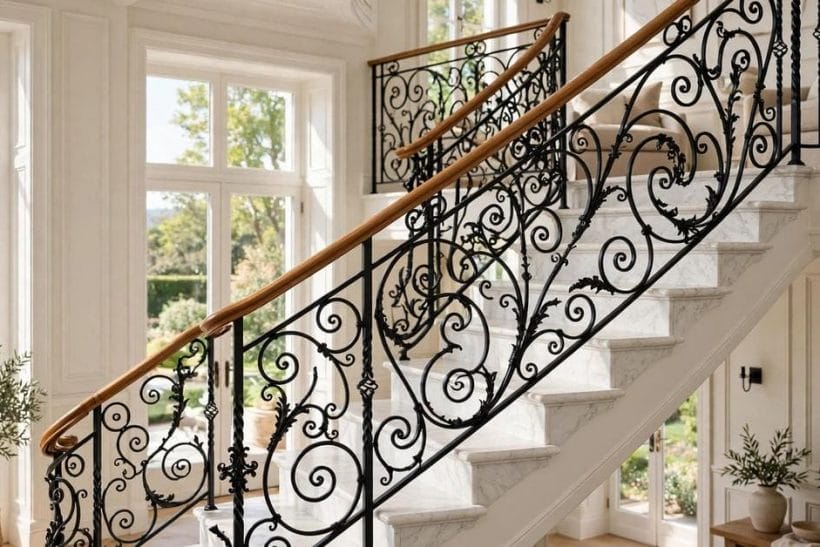
The feature photograph’s own pairing: black forged panels under a warm wooden rail. The timber warms the hand and the room, the iron carries the craft, and the contrast between them is the oldest and easiest luxury in this whole post.
9. A matching scroll panel on the landing
Carry the staircase motif across the landing balustrade in the same scroll pattern, so the flight’s composition completes itself at the top. Landings are where cheap substitutions show; matching work here makes the whole stair feel commissioned, not assembled.
3. Staircase Railings: Straight Bars and Simple Lines
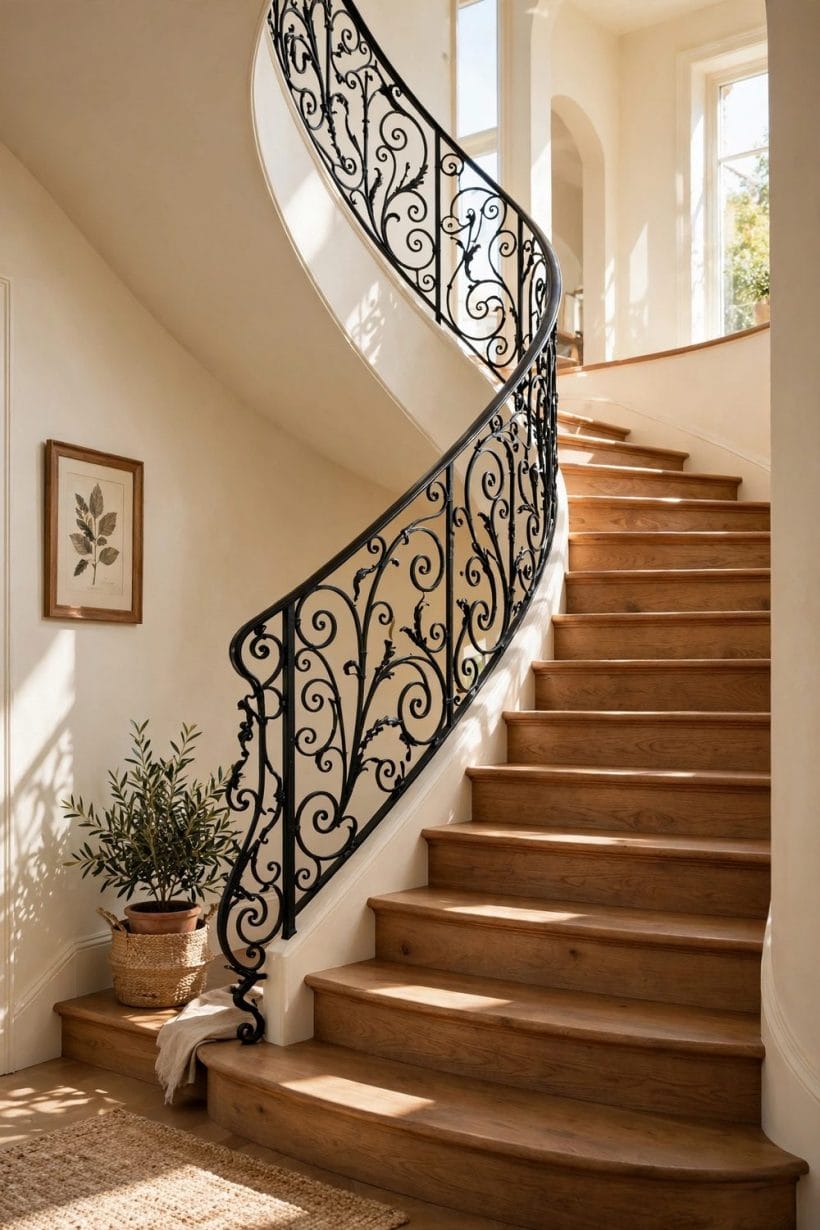
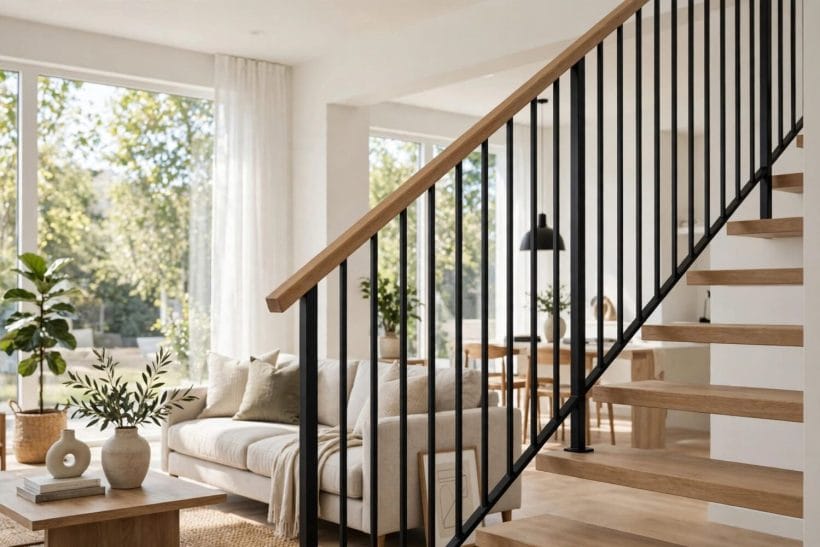
Iron does not need curls to be beautiful. The straight-bar family — plain verticals, honest posts, one good handrail — suits modern rooms, small halls and anyone who wants the material’s strength without its theatre. These nine versions run from the purist’s grid to bars warmed by a single traditional detail.
10. Plain vertical bars, evenly spaced
The archetype: slim square or round bars at even spacing between a handrail and the stringer. Nothing to date, nothing to tire of, and the flight’s own shape becomes the design — the treatment that suits more houses than any other in this post.
11. Bars with a single collar detail
A forged collar — a wrapped band around each bar at mid-height or at the base — adds one shadow line of craft to plain bars. It is the smallest possible nod to the forge, and from the hall it reads as richness.
12. Square bars on the diagonal
Turning square-section bars so a corner faces out gives a diamond profile that catches light differently on every tread. The fabricator’s trick costs nothing in material and makes plain bars look deliberately, expensively chosen.
13. Alternating plain and twisted bars
One twisted bar in every three or four builds a slow rhythm up the flight — ornament you feel rather than stare at. It is the natural compromise for households divided between the scroll and the straight line.
14. A grid panel of bars and rails
Horizontal rails crossing the verticals make a grid panel with a faintly industrial, loft-like character. Where local rules govern the gaps a child could pass through or climb, the grid’s horizontals need the fabricator’s careful reading of those rules.
15. Black bars in a white stairwell
The high-contrast classic: matte black iron against white walls and pale treads. The railing becomes a line drawing of the staircase, and the whole hall feels edited, bright and deliberate with no colour anywhere.
16. Slim bars for a narrow flight
On tight stairs every centimetre of width matters; slim iron bars steal less of it than timber balusters and let light cross the flight. The narrow stair is where iron’s strength-to-thinness quietly outperforms every other material.
17. Bars that follow a curved flight
Fabricated panels can be bent to a stair’s curve in a way timber never forgives. A plain-bar balustrade sweeping around a curved flight is modern, calm and quietly virtuosic — the curve itself is the ornament.
18. The minimalist wall rail companion
Many stairs want a second rail on the wall side; a simple forged wall rail on stand-off brackets, in the same finish, completes the flight honestly. It is the unglamorous piece elderly hands and young climbers will bless daily.
4. Balconies, Landings and Mezzanines
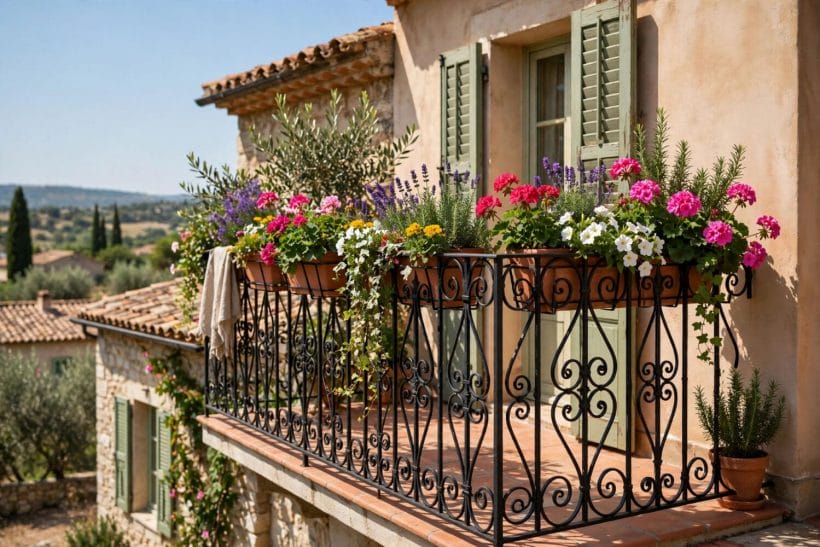
Wherever a floor edge needs guarding — a landing, a mezzanine, a Juliet balcony — iron gives safety with the least visual weight, which is why galleries and double-height rooms love it. The patterns below guard edges without closing rooms down, and every one of them answers to local rules on height and gaps that the maker will know and must follow.
19. The landing balustrade in scrollwork
A scrolled landing panel echoes the stair below and turns the upper hall into a gallery. Keep the motif’s scale slightly calmer than the flight’s — the landing is the frame, the staircase is the picture.
20. Straight bars along a mezzanine
In a double-height room, plain bars guard the mezzanine edge while stealing almost no light or view. The modern barn and loft live on this detail; the iron reads as a horizon line rather than a fence.
21. A Juliet balcony rail
The shallow guard across full-height doors is iron’s home ground: scrolls or plain bars keeping the opening safe while the doors stand open. It is as much façade jewellery as railing, visible from the street.
22. French balcony panels with a top rail flourish
A slightly bowed panel with a scrolled crest gives tall windows a balcony’s romance without a platform. The bow gains precious inches of leaning room and a silhouette that plain flat panels never achieve.
23. Indoor balcony over a hall
Where a landing overlooks the entrance hall, an iron balustrade keeps the connection open — voices, light and the sight of the stair below. Solid parapets close such rooms; iron keeps them one space.
24. A gallery rail with a timber cap
The wide wooden handrail along a gallery invites leaning, lingering and watching the room below, while the iron beneath does the guarding. It is the pub-gallery, library-gallery detail, and houses love it for the same reason.
25. Panels between masonry piers
On a terrace or veranda edge, iron panels set between brick or stone piers give rhythm, permanence and airflow together. The piers carry the architecture; the iron keeps the view and the breeze.
26. A low garden-room divider rail
Inside a conservatory or garden room, a low decorative rail can edge a level change or a planted border without any guarding duty. Freed from rules, the scrollwork can be as fanciful as the plants around it.
27. Matching rails at a split-level change
Short flights between split levels deserve the same iron as the main stair, made by the same hand in the same pattern. Consistency across a house’s small flights is what turns separate purchases into a designed home.
5. Porch and Terrace Railings
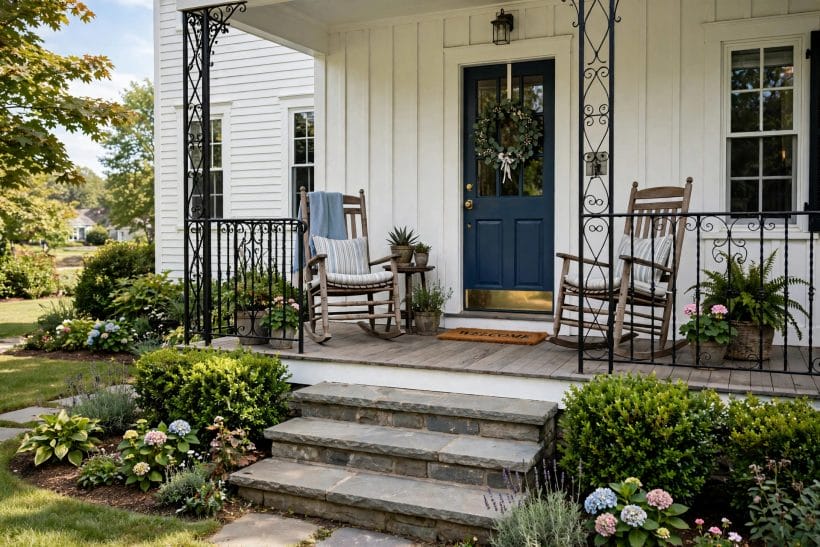
Outdoors, iron’s thin strength keeps porches open to the garden while it guards steps and edges — the exterior cousin of the front porch railing ideas in the porch post, which covers the porch railing family in every material. Here the subject is iron specifically: its finishes, its fixings, and its long negotiation with weather.
28. Plain porch bars between painted posts
The cottage classic: black iron bars in panels between timber or masonry posts, guarding the porch edge without darkening it. The posts carry the porch’s architecture; the iron simply refuses to fall off it.
29. A scrolled porch panel as the house’s handshake
One ornamental panel beside the front steps announces the house’s character before the door opens. Visitors read it unconsciously as care and craft — the cheapest curb appeal in iron, because it is only one panel.
30. Step rails that follow the garden path
Short forged handrails flanking entrance steps serve every visitor, every parcel carrier and every icy morning. Match them to the porch iron and the whole approach reads as one thought, not two purchases.
31. Terrace rails with a wide top rail
A broad, flat top rail on terrace panels holds a coffee cup, a plant pot and a leaning elbow — the social handrail. In iron it stays slim beneath its cap; in timber caps it warms to the hand in winter.
32. Iron rails on a raised deck edge
Where a deck stands above the garden, slim iron panels guard the drop while preserving the view that justified the deck. Dark finishes disappear against planting; the railing is felt as safety, not seen as fencing.
33. A gate-and-rail porch entry
A small iron gate closing the porch steps keeps toddlers and dogs in and dignity intact. Hung true and latched simply, it becomes part of the house’s daily rhythm within a week of fitting.
34. Weather-wise detailing outdoors
Outdoor iron lives or dies by details: feet raised clear of standing water, joints arranged to shed rain, and a finish system the maker stands behind. Ask about each before ordering — these questions separate fabricators from artists in the best way.
35. Winter grip: a rail you can hold
Exterior step rails earn their keep on frosty mornings. A slightly textured finish and a handrail profile the whole hand can close around are safety features no photograph shows — specify them anyway, in writing.
6. Gates and Garden Railings
The railing’s vocabulary walks out of the garden gate and along the boundary: the same bars, scrolls and finials, weather-facing and public. The gate family proper — designs, drives and grand entrances — lives in wrought iron gates; here are the railing-scale pieces: garden gates, low boundary rails and the edging that ties a plot together.
36. The scrolled garden gate
A single garden gate in the house iron’s pattern, hung between piers or posts, is the boundary’s front door. Its latch should close with a sound visitors remember fondly — a small, daily pleasure of good ironwork.
37. Low boundary railings on a dwarf wall
The traditional front-garden treatment: slim iron rails along a low wall, marking the boundary without hiding the house. Streets of it look like jewellery; one garden of it lifts the whole plot’s manners.
38. Spear and ball finials along the boundary
Finials finish the verticals: spears for the traditional boundary, balls for a friendlier face, flat caps for the modern plot. They are the railing’s punctuation — choose one and repeat it everywhere the iron appears.
39. A railing fence that follows a slope
Panels stepped or raked to follow sloping ground keep gaps even and lines calm. Raking — bars cut to the slope — is the finer work; stepping suits short, steep runs and reads more architectural.
40. Iron edging for beds and paths
Low hoops and rails edge a border with the same black line the house wears, tying planting to architecture. It keeps gravel honest, mulch in place and the garden’s geometry visible in winter when the plants rest.
41. A rose arch in railing iron
A simple forged arch over a path or gate, made by the railing’s maker in the same section and finish, extends the iron family into the garden’s third dimension. Climbers will finish what the forge began.
42. Pool and pond guards in iron
Where water needs guarding, iron panels give the barrier without the visual bulk of a fence, and local rules for such guards are strict for good reason — the maker’s knowledge of them is part of the commission, never an optional extra.
43. One iron language for the whole plot
The deepest idea in this section: stair, porch, gate and garden in one pattern family and one finish. Houses whose iron matches everywhere look commissioned and calm; the unity costs nothing but deciding it early.
7. Handrails, Posts and Finials
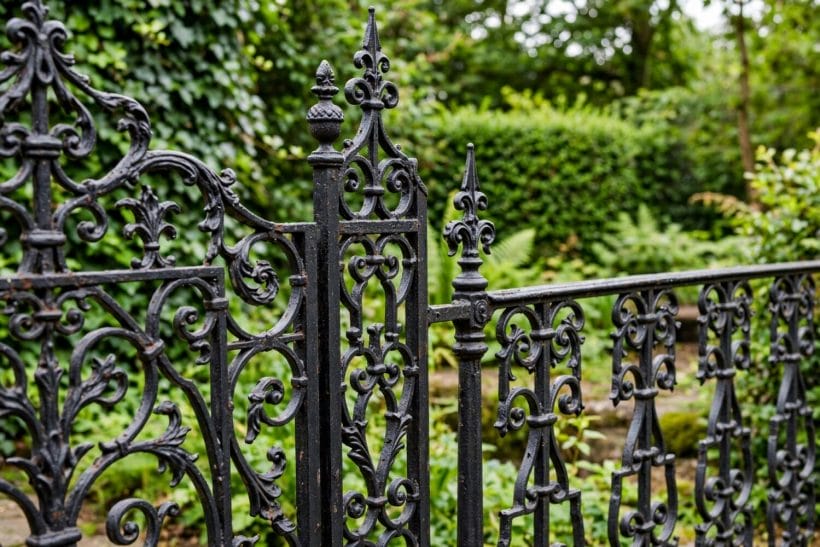
A railing is touched at the handrail and read at its posts; the panels are almost scenery between those two facts. The eight details here — rail profiles, newels, finials and junctions — are where bespoke ironwork justifies itself, because they are the parts the hand and eye meet every single day.
44. The timber handrail over iron
Already met on the stairs, the wooden rail deserves its own entry: warm, grippable, repairable, and kind in winter. Choose a profile the whole hand can close around, and let it sweep continuously — breaks at landings should be mitred, never butted.
45. The forged iron handrail
An all-iron rail, hammered to a soft profile, is the purist’s choice and the blacksmith’s signature. It runs cooler to the touch and slimmer than timber, and a well-forged one feels alive under the palm in a way extrusions never do.
46. Newel posts with presence
The posts at the flight’s foot and turns carry the composition; give them weight — a larger section, a turned or forged detail, a finial with intent. Skimped newels make grand panels look apologetic, and the eye knows it instantly.
47. Ball, urn and acorn finials
The classical finial family tops the newels: ball for simplicity, urn for formality, acorn for charm. Match them to the boundary iron’s finials and the house speaks one language from street to landing.
48. The scrolled starting volute
Where the handrail ends in a curl over the first step, the whole flight feels begun rather than cut off. The volute needs floor room and a confident smith; it is the single most requested detail in traditional iron stairs.
49. Wall-side brackets with craft
Even the unseen wall rail’s brackets can carry a small scroll or rosette — the detail regular users notice weekly. Bespoke work hides its generosity in such places, and it is why commissioned iron feels different at every touch.
50. Junctions that flow
Where rails meet posts and panels meet rails, good work flows: welds ground smooth, lines continuous, no visible fixings shouting. Run a hand along every junction before accepting the work — the hand is the strictest inspector iron has.
51. A handrail height the whole household can use
Rail height and grip follow local rules, but within them, think of the shortest and oldest hands in the house. A rail placed for the rule book alone can still fail the grandmother test — the maker should hear about both.
8. Finishes and Colours
Iron’s finish is its armour and its wardrobe in one coat. Black owns the tradition, but the palette is wider than the forge’s reputation suggests — and indoors, where rust cannot follow, colour becomes pure choice. The eight finishes below run from the canonical matte black to the painted colour that turns a railing into the room’s accent.
52. Matte black, the canonical finish
The default for excellent reasons: it recedes, it flatters every material beside it, it hides the hand’s daily evidence, and it reads traditional and modern at once. Most railings in this post, pictured or not, are wearing it.
53. Satin and gloss black
Sheen changes black’s character entirely — satin is tailored, gloss is formal and shows every scroll’s highlight. In bright halls gloss can glare; in dim ones it gives the ironwork a lacquered, jewelled depth worth the fingerprints.
54. Waxed and oiled forged finishes
Indoors, traditional iron was finished with wax or oil over the forge scale, giving a soft, breathing surface that maintenance renews rather than replaces. It is the connoisseur’s finish, honest about the metal and kind to old work.
55. Powder coating for outdoor life
The modern armour: a baked coating, tough and even, in any colour the chart holds. For exterior iron it is the practical default — ask the maker about the preparation beneath it, because coatings fail at the prep, not the paint.
56. Painted colour: green, red, cream
Garden iron wore colour long before it wore black — deep greens in planting, heritage reds at boundaries, cream in conservatories. A coloured railing outdoors disappears into or celebrates the garden in a way black politely refuses to.
57. Bronze and metallic finishes
Bronze-toned finishes warm iron toward the classical and flatter timber, brass and marble. They suit interiors where black would harden the room, and they age toward richness instead of tiredness when the coating is sound.
58. Galvanised groundwork by the sea
Coastal air eats unfinished iron hungrily; a protective metallic base under the colour coat is the standard defence the maker should propose unprompted.
59. Two-tone: black panels, bright rail
A polished or contrasting handrail over black panels — steel bright, timber warm, brass glowing — separates the touched layer from the seen layer.
9. Pairing Iron with Wood, Stone and Glass
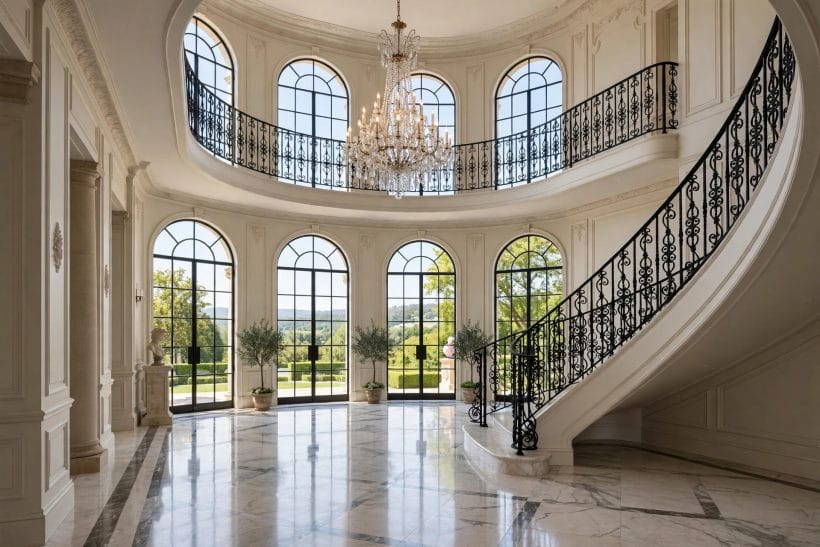
Iron is a team material: thin, dark and strong, it sets off everything it touches. The modern staircase family it belongs to is surveyed in modern staircase ideas, and the small-space stair craft in tiny house staircase interior design; the pairings below are the iron-specific ones, material by material.
60. Iron and oak, the eternal pair
Black bars, oak rail and treads: warmth above, craft below, nothing to date. This pairing carries farmhouse, traditional and modern rooms with equal ease, which is why it outnumbers every other combination in real houses.
61. Iron on marble and stone treads
The feature photograph’s grandeur: pale stone steps give black scrollwork its gallery. Fixing into stone is a specialist’s care — the drilling and anchoring must respect the tread, because a cracked tread is a tragedy in four figures of trouble.
62. Iron with glass panels
Alternating forged panels with clear glass sections mixes craft with transparency — ornament where the eye lands, openness where the room needs light.
63. Iron against limewashed walls
Soft, chalky walls are iron’s kindest backdrop: the black line draws itself against the pale wash with calligraphic clarity. Mediterranean and cottage rooms have used the pairing for centuries, and it still feels like a discovery.
64. Iron in the industrial room
With brick, concrete and steel windows, plain iron bars complete the industrial vocabulary without costume. Keep the iron plainest here — in a room of honest materials, ornament would be the only dishonest note.
65. Iron and white-painted timber
White posts and rails with black balusters is the tailored, coastal-classic mixture: the timber carries the architecture’s colour, the iron carries the line.
66. Iron in the garden room
Among plants and cane and terracotta, iron’s garden ancestry shows — the same scrolls that guard the stair trellis the conservatory.
67. Iron with brass accents
Brass finials, collars or a brass handrail over black iron is the jeweller’s mixture, warm against cool, bright against matte.
10. Safety, Care, Costs and Choosing
The last eight ideas are the ledger. Iron railing is bought once and judged daily, so the choosing questions matter more than the pattern book: safety rules honoured in the design, fixings that will hold for decades, a finish whose care the household will actually perform, and costs understood as drivers — bespoke labour, complexity and finish — rather than as any figure printed here.
68. Heights and gaps, ruled and respected
Guarding heights, baluster spacing and handrail rules exist because falls are unforgiving, and they differ by place and by use.
69. Fixings are the railing’s real strength
A panel is only as strong as its anchors into tread, floor or wall. Ask how the work will be fixed, into what, and with what — a fabricator’s fluent answer here is worth more than a portfolio of photographs.
70. The wobble test, before and after
Grasp the finished rail and push: commissioned iron should feel like part of the building, silent and immovable. Any rattle or flex is a conversation to have at fitting, not a trait to learn to live with.
71. Rust: prevention and prompt mercy
Outdoor iron asks one discipline — keep the coating whole. Touch in chips promptly, clear leaves and standing water from feet and joints, and the railing’s life extends indefinitely; neglected, the same iron forgives slowly and expensively.
72. Cleaning that takes minutes
Indoors, a dust and an occasional wipe are the whole regime; scrollwork collects dust in its curls, which a soft brush answers.
73. Cost driver: the maker’s hand
Bespoke forging is skilled hours, and hours are the price: full panels cost more than repeated balusters, which cost more than plain bars.
74. Cost driver: complexity, curves and finish
Curved flights, site-welded junctions, galvanising and premium coatings each add their share. None is waste — each buys a specific good — but a clear quote separates them so the household can choose its luxuries deliberately.
75. The sample length test
Finally, the choosing discipline that prevents all regret: commission one sample length — a baluster, a scroll, a metre of rail — before the whole work.
Final Considerations
A wrought iron railing is structure you can read: every scroll a decision, every bar a promise the house keeps daily. Choose the family first — scrollwork for ceremony, straight bars for calm — then the handrail your palm will judge, then the finish the weather will test, and commission it from a maker whose fixings and samples you have interrogated kindly and thoroughly. The stair will repay that care at every climb, for longer than anyone in the house will remember the choosing.

0 Comments