
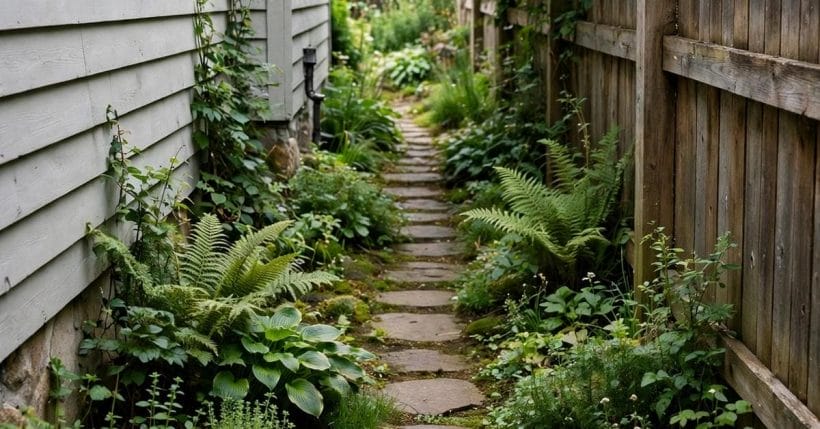
Every house has one: the narrow strip down the side, too wide to ignore and too thin to use — a corridor of fence, wall and forgotten intentions. These 75 ideas treat that strip as what it can be: a garden room one pace wide, with a proper path, planting fitted to its two different climates, a gate with dignity, storage that earns its footprint, honest drainage and light for the evening. The side yard will never be the main garden. It can absolutely stop being the wasted one.
Two facts govern everything below. The strip has two climates — one side shaded by the house, the other often a sun trap against the fence — and it has one job before all others: carrying water away from two buildings. Plant and pave with those facts in view and the ideas sort themselves.
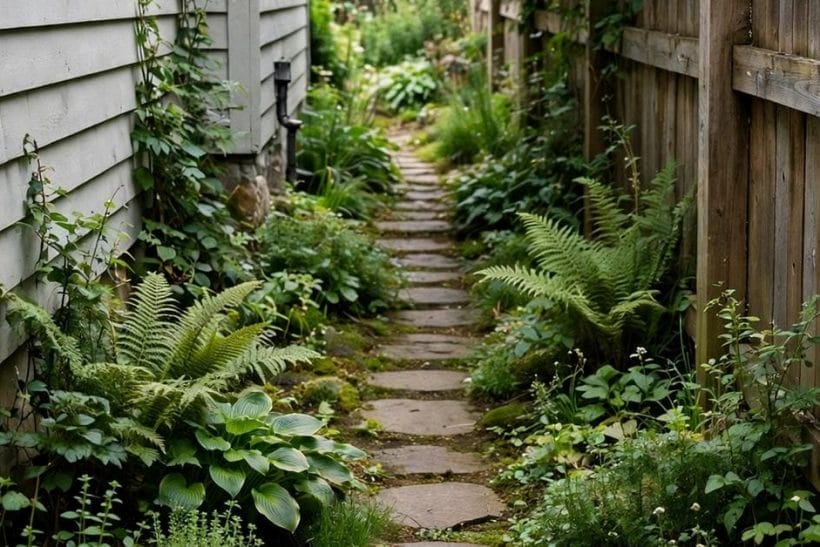
1. Side Yard Ideas at a Glance
Five elements organise the whole strip: the path that makes it a route, the planting that greens its walls, the gate that gives it a threshold, the screening that gives it privacy, and the workhorse storage that keeps it honest. The table below is the post in miniature.
| Element | What it does | In a word |
|---|---|---|
| The Path | Stepping stones or gravel | Passage |
| The Planting | Slim, shade-tolerant layers | Green walls |
| The Gate | The passage's front door | Welcome |
| The Screening | Fences, trellis and climbers | Privacy |
| The Workhorse | Bins, logs and storage | Order |
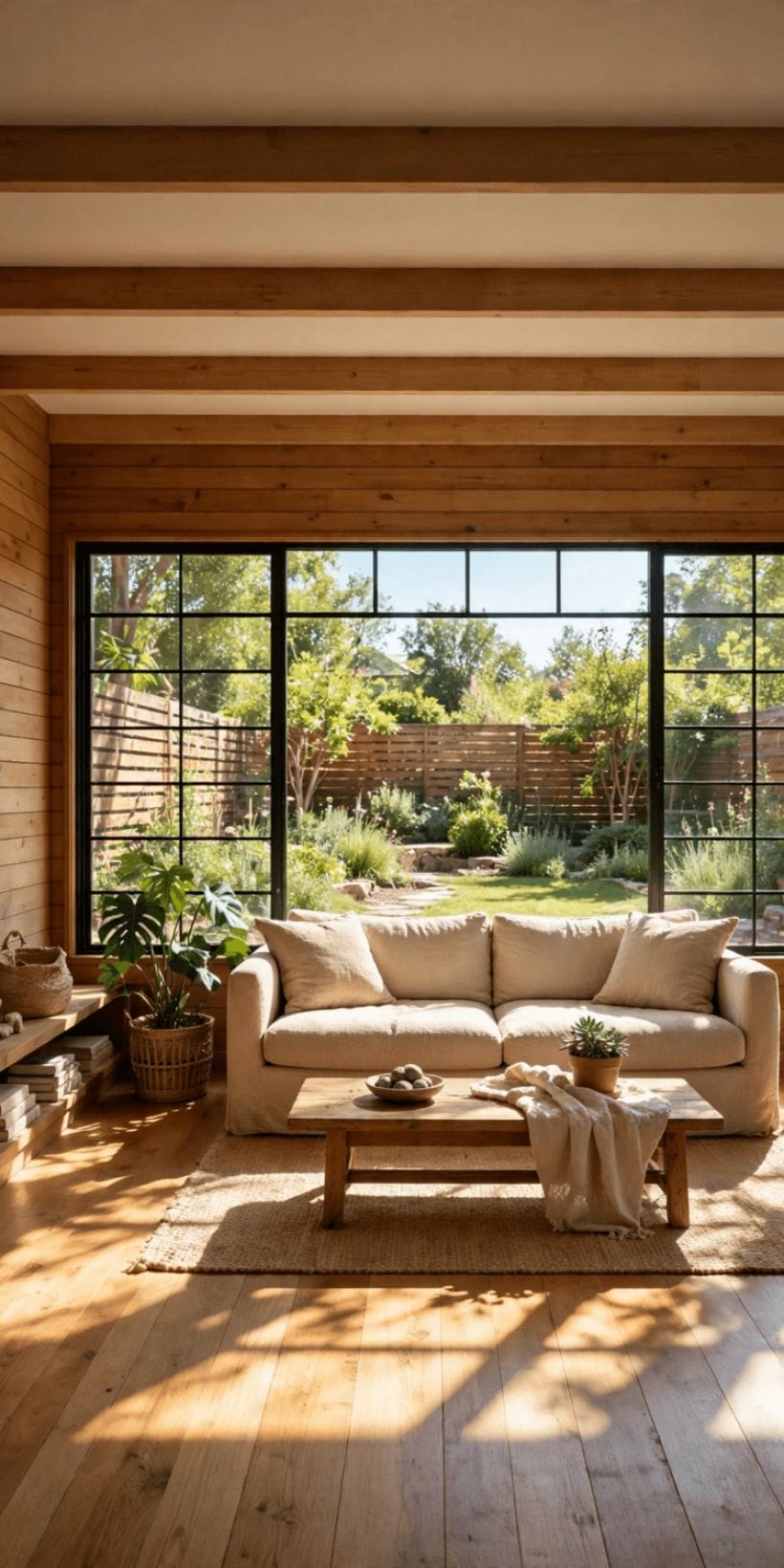
Four factors run under every idea: width, measured at the pinch points where gates, downpipes and bins narrow the run; light, because one side of the strip is usually shade and the other a reflector oven; water, with drainage falling away from both walls; and rules, since boundaries, fence heights and drainage are governed locally — check yours before building anything permanent.
Treat the side yard as a long thin room: path first, planting second, storage last — never a dumping strip. That order is the whole secret; the seventy-five ideas that follow are its working out, section by section.
2. Paths and Surfaces: The Strip Becomes a Route
A side yard is first a way through, and its surface decides whether the way is a pleasure — the hard-landscaping cousins live in stone landscaping ideas. Nine surfaces cover the ground.
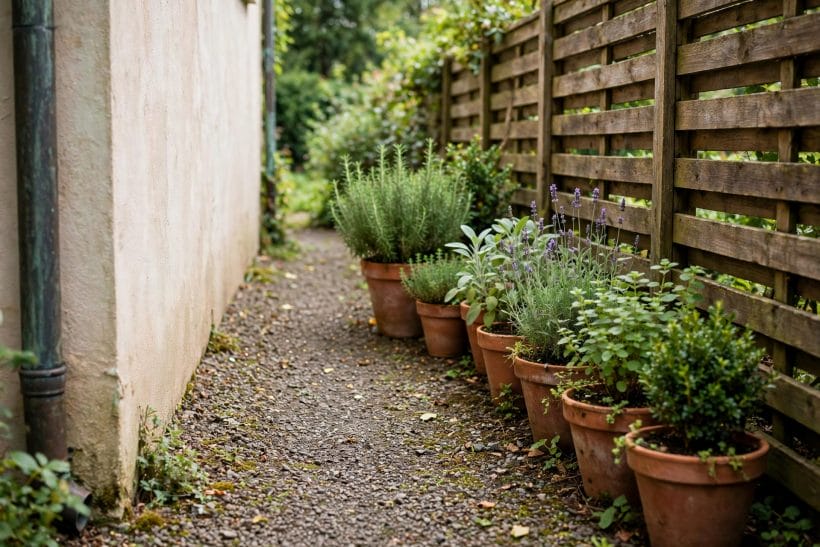
1. Stepping-Stone Spine
Generous stepping stones down the centre make the classic side-yard path: cheap, permeable and forgiving of uneven ground. Set the stones at a natural stride and let low planting creep between them.
2. Gravel Path with a Firm Edge
Gravel suits narrow passages — it drains freely, costs little and crunches reassuringly underfoot. A timber or metal edge keeps it off the beds and makes the strip read as a path, not a spill.
3. Brick Herringbone for Courtyard Dignity
Brick in herringbone gives the passage a courtyard dignity beyond its width. Laid on a free-draining base, it shrugs off shade-damp and improves as a little moss settles in the joints.
4. Large Slabs, Minimal Joints
Oversized slabs make a narrow strip feel calmer and wider: fewer joints, fewer weeds, more architecture. Leave planting pockets at the edges so the hard line softens where it meets the beds.
5. A Low Boardwalk over Wet Ground
Where the ground stays wet, a low boardwalk of timber or composite lifts the path clear of the mud and turns the problem strip into a feature. Keep the run simple and straight.
6. A Mulch Path for the Quiet Side
The least-used passage can wear the simplest path: bark or woodchip over levelled ground. It muffles footsteps, suits the utility side, and tops up each spring in minutes.
7. Checkerboard Pavers and Groundcover
Alternating slabs with low groundcover squares turns a straight run into a pattern garden. The green squares cool the stone in summer, and the grid gives the narrowest strip a designed rhythm.
8. A Gentle Curve to Borrow Mystery
Even a slight S-curve makes a short passage feel longer, because the end stays hidden. Curve gently around one planted bulge; a side yard has just room for one surprise.
9. Permeable Everything, Drainage First
Between two houses, every surface decision is a drainage decision: choose permeable materials, keep falls away from both walls, and the path serves the buildings as well as the garden.
Whichever surface you choose, walk it before you plant it: the path sets the strip’s rhythm, its width decides the beds, and its dryness decides whether the passage is used daily or avoided for half the year. A good path makes gardeners of the household; a muddy one makes the side yard invisible.
3. The Shady Side: Planting Against the House
The house wall’s bed is cool, damp and dim — and a whole flora loves exactly that; the small-garden thinking in tiny house garden ideas applies at this scale. Nine plantings green the dark side.
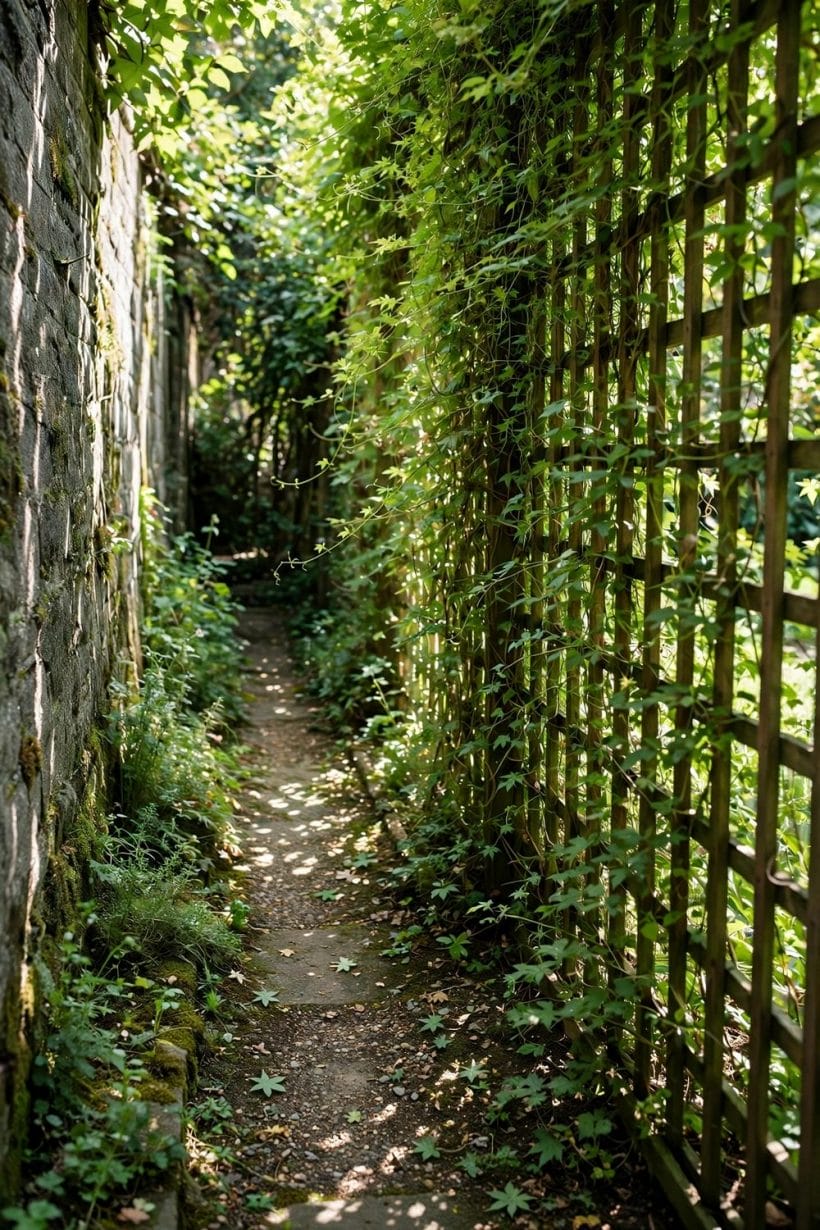
10. Hostas for the Deep-Shade Wall
Hostas are the shade strip’s anchor: bold leaves, no fuss, and a coolness that suits a wall that never sees sun. Group them generously — a drift of one variety reads calmer than a row of singles.
11. Ferns Along the Foundation
Ferns ask only for shade and moisture, both abundant against a house wall. Their fronds soften the masonry line and turn the dampest, darkest bed into the lushest planting in the passage.
12. A Green Wall of Climbers
Self-clinging climbers dress a blank side wall without eating the path’s width. Keep growth in check and clear of the gutters; the reward is a passage that feels like a green corridor.
13. Shade Groundcover Carpets
A living carpet under shrubs keeps shade beds weed-free and finished: sweet woodruff for spring scent, pachysandra for evergreen formality. Either beats bare, dark mulch through the winter.
14. Heucheras for Colour in the Dark
Coral bells bring burgundy, amber and lime foliage to beds without direct sun, colouring the shade strip without a single flower’s effort. Dot them through the ferns as punctuation.
15. Astilbe Plumes for Summer
Astilbes flower in shade where little else will, their plumes standing over ferny foliage in the passage’s midsummer weeks. They like the same damp soil the side wall provides.
16. A Slim Evergreen Backbone
One or two columnar evergreens give the shade strip winter structure when the perennials sleep. In a narrow bed, repetition beats variety: the same slim shape twice reads as design.
17. Pots for Rubble and Root Zones
Where the soil is rubble or roots, big pots of shade lovers do the work — hostas, ferns and trailers lifted to knee height. Pots also let you shuffle the display as seasons turn.
18. The Pale-Flowered Shade Scheme
Pale flowers glow in shade where colours drown: white astilbe, foamflower, pale hosta blooms. A white scheme makes the dark side feel moonlit even at noon.
The shade side has one more gift to claim: quiet. The house wall blocks street sound, the planting muffles what remains, and the green corridor becomes the most sheltered-feeling spot on the plot — plant a seat into it later, when the sections on sitting arrive.
4. The Sunny Side: Planting Against the Fence
The fence side often bakes — reflected heat, dry soil, a Mediterranean microclimate in miniature. Eight plantings exploit it.
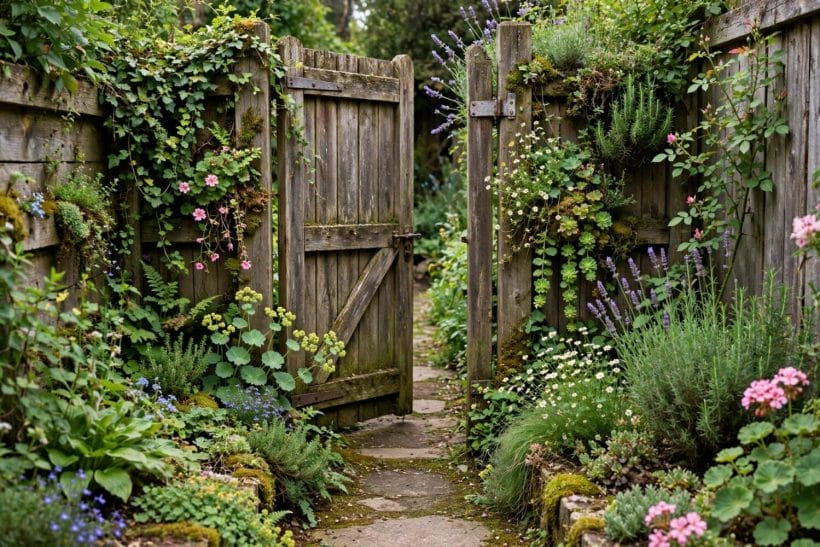
19. Lavender Along the Sunny Fence
The sunny side is a heat trap and lavender loves it: a run along the fence perfumes every passage and feeds bees all summer. Keep the soil lean and the drainage sharp.
20. A Herb Strip by the Kitchen Passage
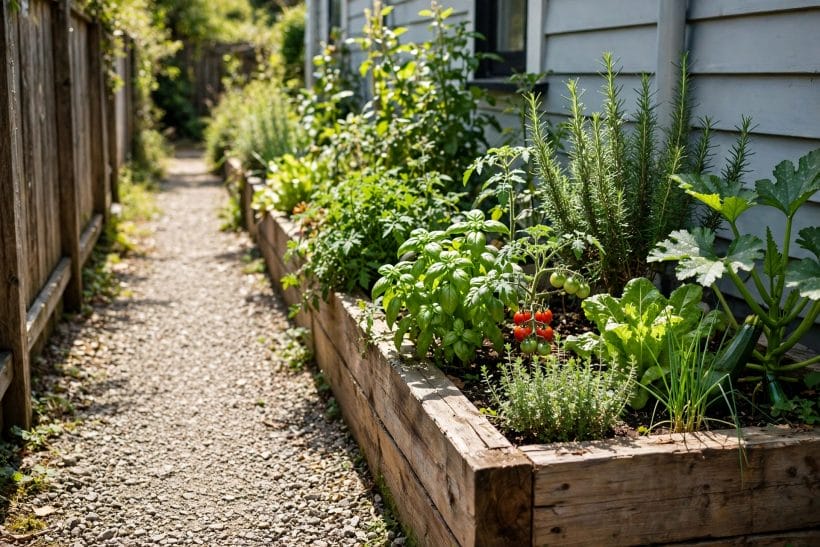
If the sunny passage passes the kitchen, plant it with herbs: rosemary, thyme and sage thrive on the reflected heat and cut the cook’s walk to a few steps.
21. Espalier Fruit on the Warm Wall
A warm wall is wasted without an espalier: apple, pear or fig trained flat gives blossom, fruit and architecture in a hand’s breadth of depth, ripened by the wall’s stored heat.
22. Gravel-Garden Planting
Sunny narrow strips suit gravel-garden plants — salvias, grasses, Mediterranean herbs — that ask little water and no staking. The gravel mulch matches the path; the whole strip reads as one design.
23. Climbing Roses on the Fence
A rose trained along the sunny fence turns the passage into a scented cut-through in early summer. Choose repeat-flowering climbers and tie them in flat, so the blooms come to nose height.
24. Tall Grasses for a Moving Screen
Slender ornamental grasses give the sunny strip privacy that moves — catching evening light, rustling pleasantly, and cut back tidily each spring. Their narrow footprint suits the passage perfectly.
25. Succulents in the Hot Gap
The driest sliver, between path and sun-baked wall, suits succulents and alpines in gravel. They ask nothing, spread slowly and make the harshest microclimate look deliberately chosen.
26. A Cutting-Flower Ribbon
A ribbon of cosmos, zinnias and dahlias along the sunny fence turns dead space into the household’s flower supply. The narrowness that limits vegetables is no limit at all for cutting blooms.
Sun and shade meet in this strip like two gardens sharing one path, and the planting plan should honour the seam: let the sunny fence run hot and Mediterranean, the house wall cool and ferny, and enjoy a contrast most gardens need two separate beds to achieve.
5. Gates and Entries: A Threshold with Dignity
The gate is the strip’s handshake, and the wider front-of-house family sits in tiny house exterior ideas. Eight treatments give the passage a front door’s manners.
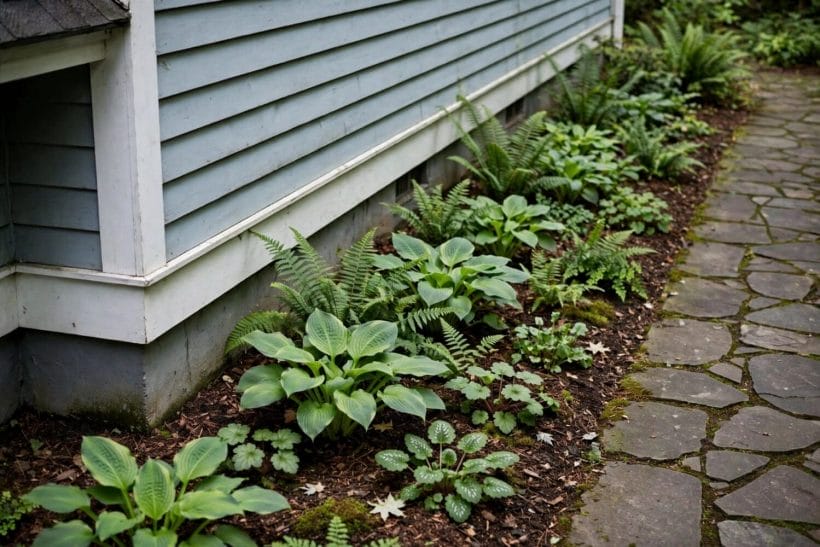
27. The Timber Gate as a Front Door
Treat the side gate as the passage’s front door: solid timber, sound hinges, a latch that closes with a satisfying clunk. It is the strip’s most-touched object and deserves the dignity.
28. An Arched Gate for a Cottage Passage
An arched top softens a tall gate and suits cottage styles. The arch also lifts the eye, making a narrow entry feel ceremonious rather than squeezed.
29. A Gate with a Grille or Glazed Panel
A small grille or glazed panel lets light and a glimpse through, so the closed gate never feels like a barricade — and the passage beyond stays a promise.
30. A Painted Gate as the Landmark
In a long green strip, a painted gate is the landmark: deep green, oxblood or slate blue against the foliage. The colour marks the threshold and photographs like a storybook.
31. A Low Picket Gate Where Openness Wins
Where the passage is shared or purely decorative, a low picket gate keeps dogs and toddlers accounted for while the view flows over it. The boundary keeps its manners; the garden keeps its openness.
32. An Arch or Pergola over the Gate
An arch over the gate frames the entry and carries a climber overhead, so passing through feels like arriving. It also gives the strip its one piece of vertical architecture.
33. Numbers, a Bell and a Lantern
Finish the entry like a front door in miniature: clear house numbers, a working bell or knocker, and a lantern that lights the latch at night. Deliveries and guests bless the clarity.
34. A Proper Step and Boot-Scraper
A broad step and a serious scraper or mat at the gate turn a muddy cut-through into a threshold. The passage beyond stays cleaner, and the garden feels entered, not trespassed.
A gate also decides the strip’s security story, told in general terms: sound hinges, a latch that truly latches, and a bolt for the far end where the passage meets the back garden. None of it needs to look defensive — good timber and honest hardware read as craft, not caution.
6. Screening and Privacy
Side strips are overlooked almost by definition; the wider boundary family lives in tiny house landscaping ideas. Nine screens give the passage its privacy — check local fence-height rules before building any of them.
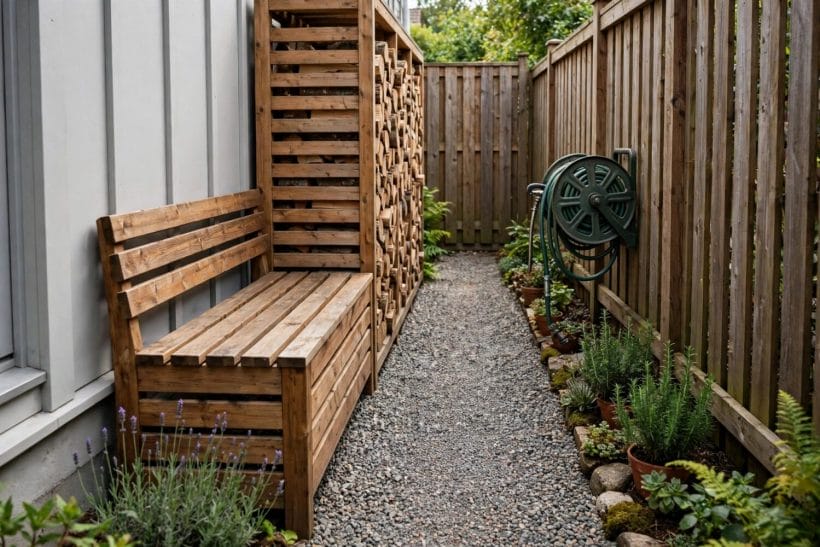
35. Trellis Panels Above the Fence
A trellis extension lifts screening height without a solid wall’s gloom, and carries climbers into the bargain. It filters views upward exactly where overlooking happens — at the angle of upstairs windows.
36. Pleached and Espaliered Green Walls
Trees trained flat on frames screen at height while their trunks leave the path its full width below. It is the narrow garden’s classic answer to being overlooked.
37. Clumping Bamboo in Root Barriers
Clumping bamboo in a root barrier gives the fastest leafy screen a side strip can grow. Keep to clumping types and sink the barrier properly; the green wall stays yours, not the neighbour’s problem.
38. Woven Willow or Hazel Hurdles
Woven hurdles screen with a texture no manufactured panel matches, suiting the strip’s semi-wild character. Expect to renew them over the years; their graceful aging is part of the charm.
39. Staggered Panels, Broken Sightlines
Solid fencing is not the only privacy: panels staggered in depth break sightlines while air and light pass between them, so the passage never feels like a corridor between walls.
40. Planting Pockets in the Fence Line
Break the fence’s monotony with planted pockets — a shrub bay, a climber tangle, a pot group every few paces. The screen becomes a garden that happens to be vertical.
41. Boundary Beauty Is Shared Property
Screening lasts longest when the neighbour likes it too: a tidy fence face, climbers that flower for both sides, a gate that suits the street. Plant diplomacy early and boundaries stay pleasures.
42. Slatted Screens near Windows
Where the passage passes windows — yours or theirs — slatted screens filter views without stealing light, keeping indoor rooms bright while the strip gains its privacy.
43. The Screen That’s a Storage Wall
A screen built as shelving — log store, pot shelves, tool racks behind slatted doors — screens and stores at once: the hardest-working answer for the narrowest strips.
Privacy in the strip is a layered thing rather than a single fence: height where the overlooking happens, texture where the eye lands, gaps where light must pass. Build the layers in that order and the passage keeps its sky while losing its audience.
7. Storage and the Workhorse Strip
The strip must work for its living — the household’s bulky, muddy, necessary things live here; their farm-scale cousins appear in farmhouse landscaping ideas. Eight systems keep the workhorse tidy.
44. The Storage Bench: Seating that Swallows
A lidded bench along the wall stores cushions, tools and toys while giving the passage a seat. In a strip too narrow for single-purpose furniture, dual purpose is the only purpose that fits.
45. A Log Store as Architecture
A stacked log store is storage that looks like design: regular, warm-toned and honest. Keep it under a small lean-to roof against the wall and the firewood seasons in view.
46. The Bin Screen: Hiding the Necessary
Wheelie bins are the side strip’s fate; a simple slatted screen hides them while the gate stays passable. Train a climber over the screen and the utility corner turns green.
47. Bikes Under a Lean-To
A narrow lean-to against the house wall shelters bikes, the mower and the barbecue in the passage’s widest bay. Site it mid-strip so both the entry and the far gate stay clear.
48. A Potting Bench in the Sun Pocket
Where the sunny wall widens, a potting bench turns the strip into a workroom: compost below, tools on hooks, seedlings on the shelf catching the wall’s warmth.
49. Tool Rails and Hooks on the Fence
Long-handled tools belong on rails and hooks along the fence, lifted off damp ground and visible at a glance. A strip that shows its tools stays tidy; one that hides them breeds cluttered corners.
50. A Hose Reel and Tap Point
A reel and an outdoor tap halfway down the strip end the era of dragging hoses around corners. Water reaches both garden ends, and the passage earns its workhorse name.
51. A Slim Shed at the Far End
If the strip widens at its far end, a slim shed anchors the whole run, and the path becomes a journey to somewhere. Check boundaries and local rules first, as with any garden structure.
The workhorse strip has one rule above tidiness: everything stored must leave a body-width of clear path, at every point, in every season. The moment bins or bikes colonise the pinch points, the passage stops being a route and becomes an obstacle course — and the garden beyond it quietly stops being visited.
8. Water and Drainage
The strip sits between two buildings, so water is its first design problem; the receiving end of the garden continues in patio ideas. Eight answers keep it dry-footed and honest — all general principles, applied under your local rules.
52. Falls Away from Both Walls
The side strip’s first law is fall: surfaces should shed water away from both walls toward a drain or soakaway. Everything else in this section is decoration on that rule.
53. A Gravel Drain Beneath the Path
Where the passage puddles, a gravel-filled drain beneath the path carries water away invisibly — the classic cure for the boggy side strip, best installed when the path is next rebuilt.
54. The River-Stone Drainage Channel
An open channel of river stones along the path’s edge turns drainage into decoration: after rain, water threads visibly through the stones, and the garden’s weather becomes something to watch.
55. Downpipes into Planters
A downpipe can water a shade planter through a diverter and rain chain rather than flooding the path. The plants drink the roof’s rain; the passage stays passable in a storm.
56. Rain Chains at the Corners
Where a downpipe meets the strip, a rain chain slows and displays the fall, guiding water into a stone-filled sump or a butt instead of splashing the path to mud.
57. A Water Butt in the Wide Bay
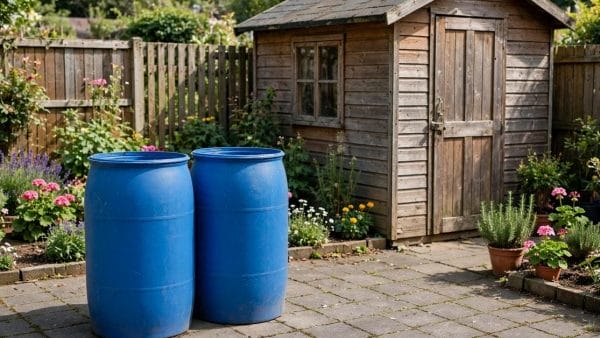
One wide bay earns a water butt — slim models exist for narrow gaps — and the stored rain serves the strip’s pots all summer. Fit an overflow that returns water to the drain, not the wall.
58. Bog Planting Where Water Gathers
If one corner insists on staying wet, plant it wet: iris, marsh marigold and moisture-loving ferns turn the sump into the strip’s lushest moment, and the drainage becomes a named feature.
59. Stepping Stones over the Wet Line
Where shallow flow crosses the path after storms, set stepping stones to bridge it. The wettest line becomes the route’s small adventure, crossed dry-footed at every season.
Drainage rewards the same patience as planting: watch the strip through one heavy rain before building anything permanent. Water announces exactly where it wants to go; the designs above work when they agree with that announcement rather than argue with it.
9. Light and the Evening Passage
A passage used after dark — bins, sheds, the shortcut home — deserves light designed, not spilt. Eight ways to make the strip glow.

60. String Lights Overhead
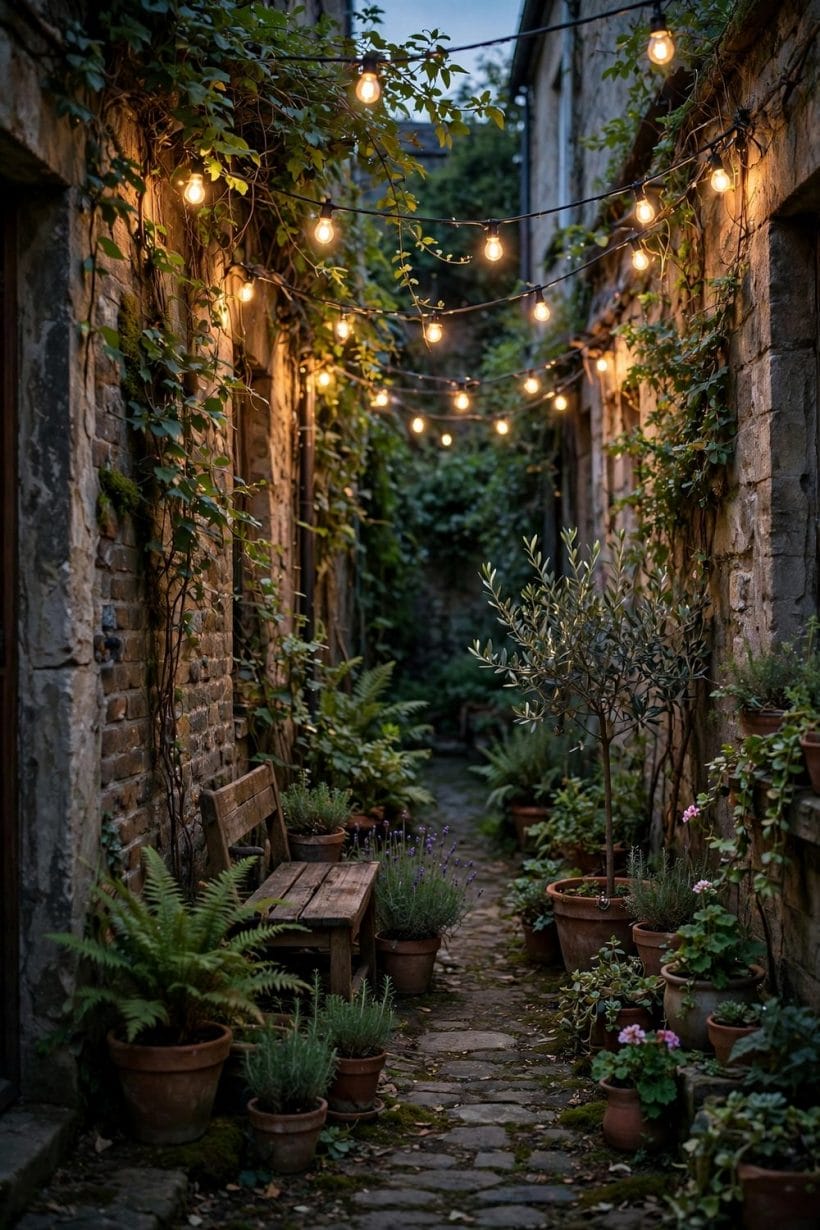
A line of warm string lights turns the passage into an evening room: the strip is narrow, so one catenary covers it completely. Evening is when a side yard can out-charm the main garden.
61. Solar Stakes Along the Path
Solar stakes mark the path’s edges for night trips — no wiring, modest cost, and the strip stays navigable after dark without flooding it with light.
62. A Wall Lantern at the Gate
One proper lantern at the gate does more than any stake: it lights the latch, welcomes arrivals and throws the planting into shadow-play. On a sensor, the passage greets you home.
63. Uplighting the Green Wall
A low uplight at the foot of the trellis doubles the green wall’s presence at night, turning screening into scenery. Keep the angle tight to the planting so the neighbours keep their darkness.
64. Candles and Lanterns at the Nook
Where the strip widens into a nook, candlelight suits its scale: lanterns on the bench, a hurricane lamp on the step. Smallness flatters flame like nowhere else in the garden.
65. Pale Surfaces that Borrow Light
Paint the fence or wall pale on the strip’s darkest stretch and the whole passage lifts. Borrowed light is still light, and the planting greens deepen against the pale.
66. A Mirror on the Fence
A garden mirror doubles the green and borrows a view the strip does not own. Angle it into planting, never into a neighbour’s window, and clean it when you clean the gate.
67. Moonlight Planting: White and Silver
White flowers and silver foliage along the path catch moonlight and lamplight alike, guiding evening feet and giving the night passage a pale, deliberate beauty.
Evening light also settles the strip’s last design question — which stretch matters most. The lit gate, the glowing green wall and the pale path stones draw the eye in sequence, and a passage that composes itself after dark has usually been designed well by day as well.
10. Small Touches and Places to Sit
The finishing layer turns a route into a place; the front-of-house details continue in exterior home ideas. Eight touches close the seventy-five.
68. The One Bench in the Green
Every side strip deserves one seat: a bench where the planting is lushest turns a cut-through into a destination. Morning coffee in a green corridor is the side yard’s secret luxury.
69. A Bistro Set in the Wide Bay
Where the strip bulges, a folding bistro set claims it for breakfast — two chairs, a small table, coffee in the sun pocket while the main garden still sits in shade.
70. Bird Feeders on the Fence
Feeders hung on the fence bring the strip alive at eye level: the passage’s narrowness puts birds at portrait distance. A small water dish below doubles the visitors.
71. Scent Pockets at Hand Height
Plant scent where hands brush it: jasmine at the gate, lavender at the sunny turn, herbs along the kitchen stretch. A passage is experienced at close range, and scent is its richest close-range gift.
72. Pots of Colour at Both Thresholds
A pair of bright pots at each end of the strip bookends the journey, letting the display change with the seasons while the structure planting stays constant.
73. A Hammock in the Shaded Stretch
Two strong fixing points turn the shady stretch into a hammock berth on hot afternoons — the coolest seat on the plot. Unhooked, the hooks vanish and the path runs clear.
74. The Reading Nook
A chair, a cushion box and a small shelf for the book and the tea: the shady side’s nook is a one-person library with green walls and no interruptions.
75. Finish It Like a Place
Give the strip a threshold, a swept path and a kept gate, and it stops being the space between houses. The last idea is the first one restated: this is a room — furnish it like one.
Notice how little of the seventy-five asks for width. The strip’s constraints — two climates, one path width, neighbours close on both sides — are exactly what give its best versions their character: everything chosen, nothing spare, a garden reduced to its essentials and better for it.
Final Considerations
A side yard is the garden’s narrowest room and its most honest test: everything in it either earns its width or gets in the way. Give it a path that drains, planting fitted to its two climates, a gate with manners, storage that hides the necessary and one seat in the green — and the strip between two houses becomes the passage everyone chooses, not the one they apologise for.



0 Comments