

A compost pile that smells like a swamp is not a lazy pile; it is an unbalanced one — starved of air or drowned in nitrogen, a chemistry experiment gone wrong. Run the same pile like the bioreactor it is, with its carbon, nitrogen, oxygen and water in proportion, and the microbes do the rest: waste in, black gold out.
1. Composting 101 at a Glance
Composting 101 begins with a single reframe: a compost pile is managed decomposition, billions of microbes turning organic waste into humus, and the chemistry underneath it is simple — carbon plus nitrogen plus oxygen plus water. What decides whether the pile cooks or stinks is not effort but proportion: the ratio between the browns and the greens, the moisture held in the material, and the air worked through it. The table below gathers the whole system; the sections after it take each part in turn.
| Attribute | Detail |
|---|---|
| The Core Chemistry | Carbon + nitrogen + oxygen + water — managed decomposition, billions of microbes turning waste into humus |
| The Golden Ratio | 25–30:1 carbon to nitrogen — the microbes’ diet, the balance the whole pile runs on |
| The Greens | The nitrogen side at 15:1 — food scraps, grass and manure; the fuel |
| The Browns | The carbon side at 60:1 — leaves, straw and cardboard; the structure |
| The Working Mix | 2 parts browns to 1 part greens by volume — the rule of thumb that approximates the golden ratio |
| The Critical Mass | 3×3×3 ft minimum — the size that retains the heat the microbes generate |
| The Working Temperature | 130–150°F in the thermophilic phase — the heat that kills pathogens |
| The Moisture | The wrung-sponge feel, about 50% — checked by the squeeze test |
| The Turning | Weekly — outer material folded to the centre for oxygen, and the pile reheats |
| The Methods | Hot in 4–8 weeks, cold in 6–12 months, plus the tumbler, vermicompost and bokashi |
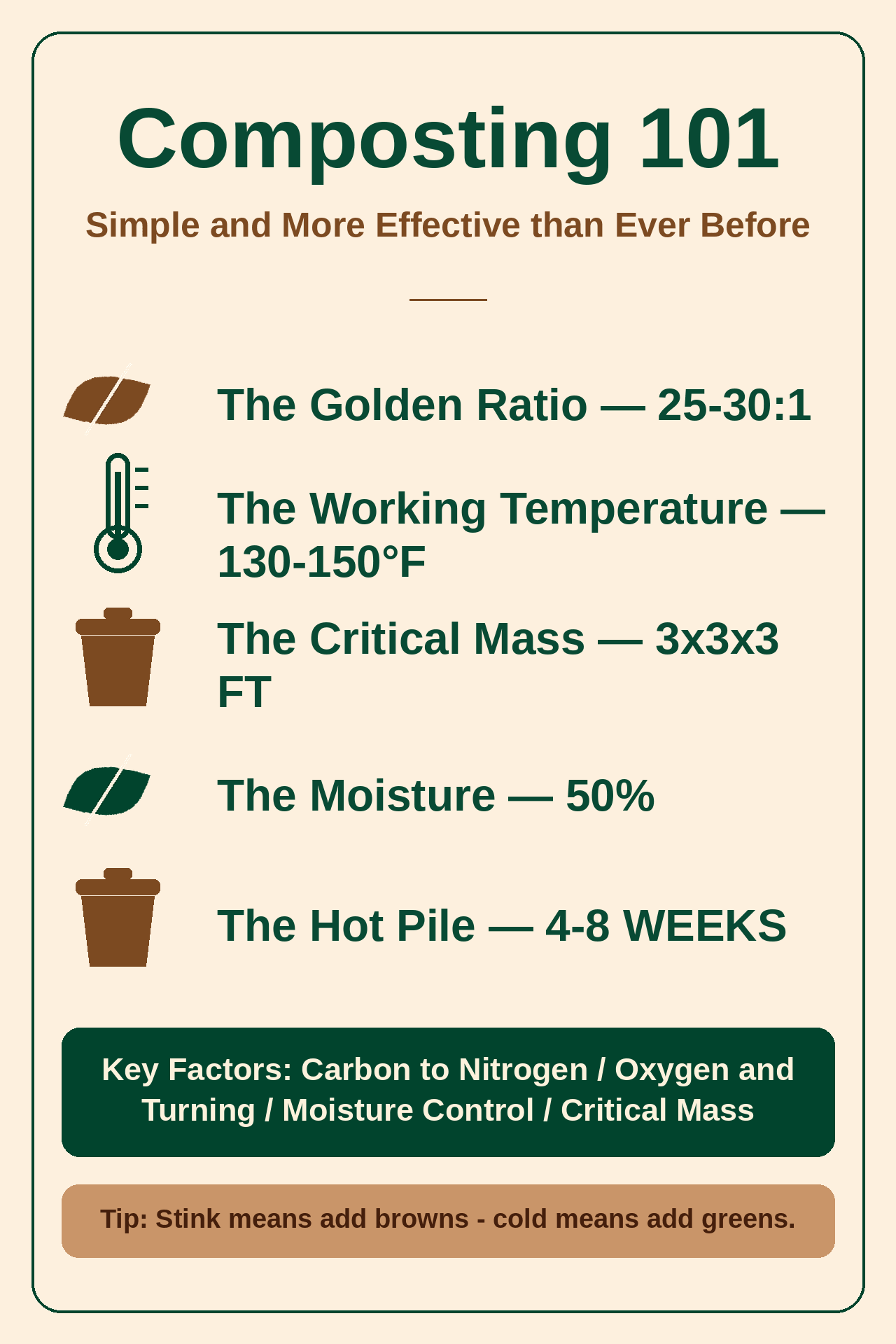
A 25–30:1 ratio, 130–150°F of microbe-made heat and a wrung sponge of moisture — the whole bioreactor on one card.
Read the table as a chain of dependencies, because that is how a pile actually behaves. The ratio feeds the microbes; the microbes make the heat; the mass holds the heat; the moisture and the turning keep the crew alive and breathing; and the method you choose sets how attentively you manage those same variables. When a pile fails, it fails at one of these links — and every link has a known fix, set out in the troubleshooting section below.
2. The Pile Is a Bioreactor
Stand in front of a working pile and nothing appears to happen. Inside, it is an industrial process running at full capacity: billions of microbes eating, multiplying and respiring, converting yesterday’s waste into humus — the dark, stable end-product called black gold. Composting is not rotting left to chance; it is decomposition under management, and the manager’s job is to keep the workforce fed, watered and breathing. A pile is not a heap to be abandoned but a bioreactor to be run.
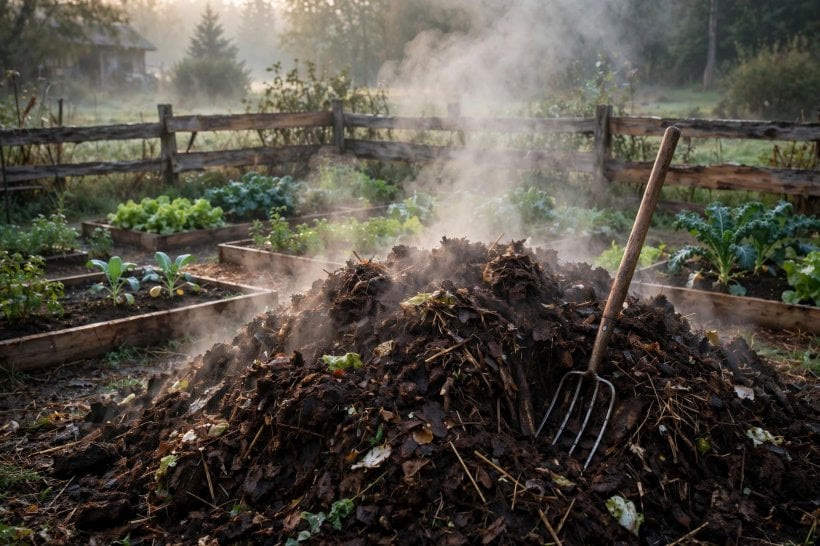
The reactor framing also explains the failures, because each classic failure is a workforce problem in disguise. A pile starved of air goes anaerobic and stinks — the crew suffocated. A pile drowned in nitrogen smells of ammonia and swamp — the crew overfed on one nutrient and starved of the other. A dry pile simply stops, dormant for want of water. None of these requires starting over; each is a dial that has drifted, and the sections below take the dials one at a time. Readers who have worked through the sustainable living quiz that scores your ecological footprint will recognise the pile’s place in that picture: the household system that turns a waste stream into a resource stream, on site, for free.
3. The Chemistry: The Carbon-to-Nitrogen Ratio
Every compost decision is downstream of one number: the ratio of carbon to nitrogen in the mix. The microbes eat both — carbon for energy, nitrogen for protein and reproduction — in proportion. The golden ratio the system runs on is 25–30:1, carbon to nitrogen: the microbes’ diet. Drift far above it and the pile crawls, starved of nitrogen. Drift far below it and the excess nitrogen escapes as smell — the swamp reek of the introduction is a ratio failure before it is anything else.
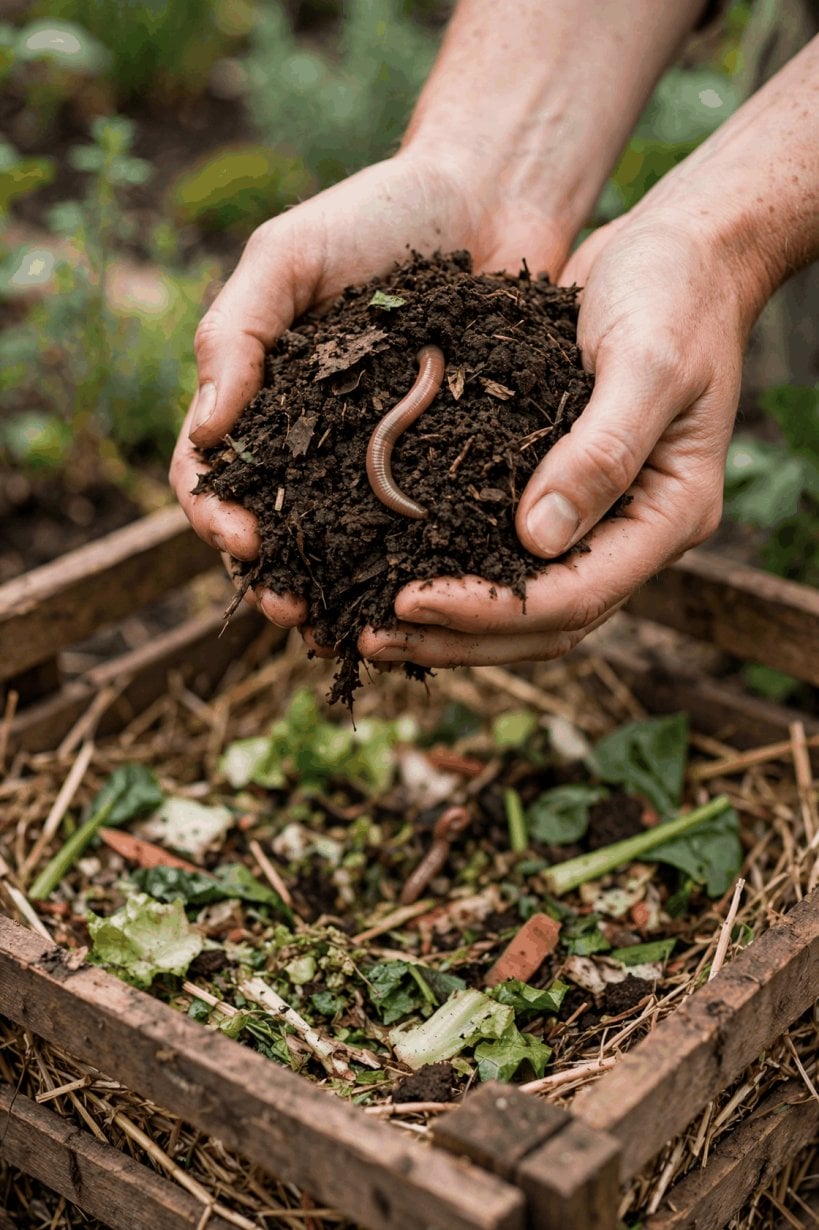
The two feedstocks sit far apart on the scale, which is what makes mixing an act of arithmetic. The greens — food scraps, grass and manure — are the nitrogen side, running at about 15:1: the fuel, rich and quick to heat a pile and just as quick to swamp it. The browns — leaves, straw and cardboard — are the carbon side, at about 60:1: the structure, slower, drier, the material that keeps a pile open and breathing. Neither composts well alone: greens collapse into a dense, airless, smelling mass; browns sit nearly unchanged, waiting for nitrogen that never arrives. Composting happens in the blend.
The working shortcut that lands near the golden ratio without a laboratory is the mix the original gives by volume: 2 parts browns to 1 part greens. It is a rule of thumb — an approximation, openly — because real materials vary: autumn leaves are not straw, and grass clippings are not manure. Build every addition roughly two-to-one, and read the pile’s temperature and smell as the instruments that report the true ratio.
4. Who’s Working: Bacteria, Fungi, Actinomycetes and the Macro Crew
The workforce arrives in succession, each crew suited to a phase of the breakdown. First and primary are the bacteria, which colonise fresh material immediately and multiply at extraordinary speed. As their feeding generates heat, the population shifts from the mesophilic bacteria that start the pile to the thermophilic kinds that thrive in it: the heat’s makers, driving the core to the 130–150°F working range. Bacteria do the bulk of the pile’s chemistry, fast — which is why a well-built pile heats within days.
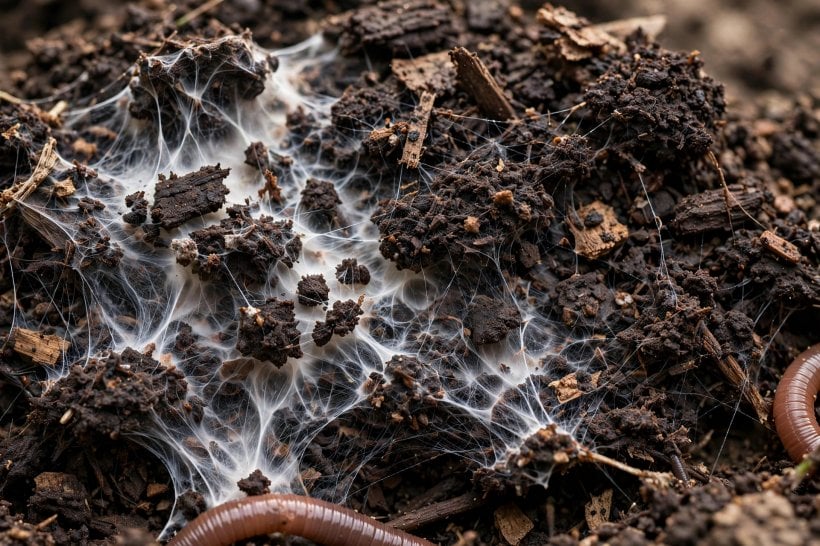
The fungi work the material bacteria cannot. Their specialty is the woody fraction — the lignin in sticks and stems, the slow carbon that would otherwise outlast the pile — worked patiently as the pile cools and matures. Behind them come the actinomycetes, the finishers: visible as white threads webbing through finished compost, and responsible for the earthy smell of soil itself.
Above the microscopic crews works the macro crew: the worms and the beetles, the shredders and aerators of the original’s description. They chew coarse material into fragments the microbes can attack, and their burrowing opens channels that let air move between turnings. Their arrival is also a signal — macro life colonises a pile as it cools and stabilises, so a pile full of worms and beetles is a pile in its finishing phase. The succession is the pile’s biography: bacteria heat it, fungi unlock its wood, actinomycetes finish it, and the visible creatures certify it ready.
5. The Build: Layering the Pile
A pile is built once and managed for months, and the build determines how easy the management will be. Size comes first: 3×3×3 ft is the minimum — the critical mass, the volume at which the pile generates heat faster than its surface loses it, so the core can reach and hold the thermophilic range. Smaller piles compost, but slowly and coolly; the cube is the smallest reactor that truly cooks. Site it where the other dials are easy to work — water within reach, and ground that drains rather than puddles; the same permeable-surface thinking that shapes an eco-friendly driveway built from alternatives to asphalt and concrete applies under a pile: the base must shed water, never seal it in.
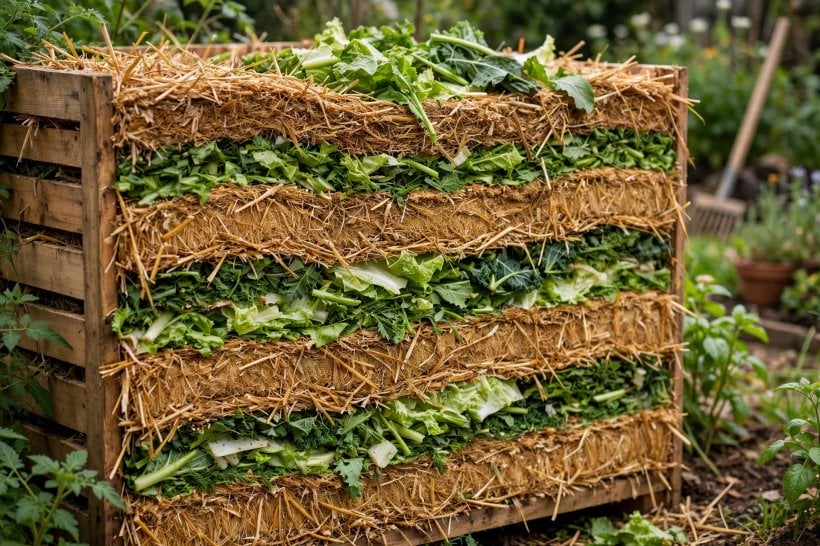
The construction is a lasagna. It starts on a base of coarse material — sticks laid first, because the base layer is the pile’s airflow and drainage, the plenum that lets air enter from below and liquid escape. Above it, alternate greens and browns in layers of about 4 inches, holding the two-to-one proportion as the stack rises, and water as you build, so the pile starts at working moisture. The layering is not ritual; it is distribution — every green against the browns that absorb its nitrogen, every brown against the greens that activate it, so the chemistry starts everywhere at once.
Finish with a cover — a cap of finished compost or browns, or a tarp, in the original’s options. The cover holds moisture in against sun and wind, sheds the rain that would waterlog the pile, and denies pests the open buffet an uncovered pile advertises.
6. Heat, Air and Water: The Management Triangle
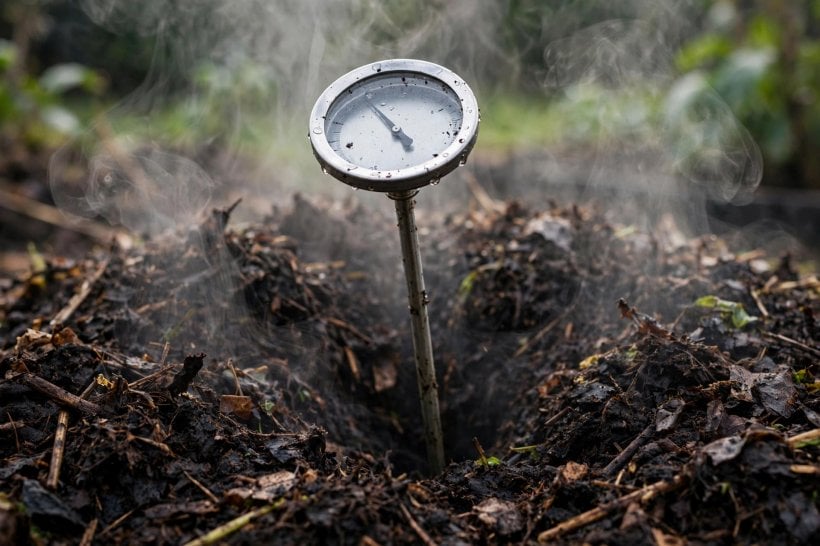
Once built, the pile is run on three dials, and the first is temperature. The target is the thermophilic range of 130–150°F — hot enough to kill pathogens and weed seeds, and the range in which the thermophilic bacteria do their fastest work. The instrument is unglamorous and essential: a compost thermometer, about $15 in the original’s costing, pushed into the core. Temperature is the pile’s dashboard: rising says the ratio and moisture are right; falling says a phase is ending or a dial has drifted.
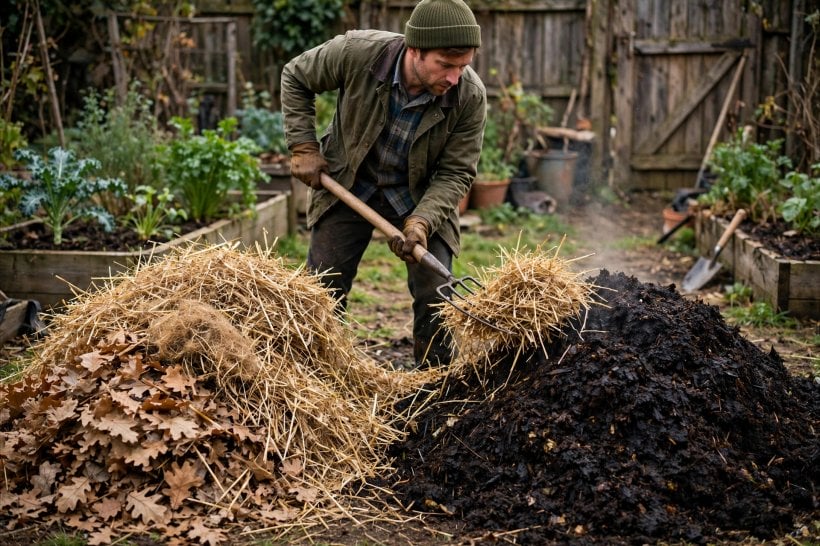
The second dial is air, worked by turning. The schedule is weekly: fork the pile over, moving the outer material to the centre and the centre outward, so every fraction takes its turn in the hot core and fresh oxygen is folded through the mass. Turning is the oxygen, in the original’s blunt equation, and its effect is immediate: a turned pile reheats as the bacteria respond to the air. Skip the turning and the core consumes its oxygen, the anaerobes take over, and the swamp smell returns.
The third dial is water. The target texture is the wrung sponge — about 50% moisture, in the original’s figure — and the test needs no instrument: squeeze a handful hard and it should feel like a sponge you have just wrung out, damp throughout, yielding at most a drop or two. A harvested supply suits the pile well in dry weather; the sizing method in the guide to rainwater harvesting systems and tank sizing will keep a garden’s piles and beds supplied from the roof — and before plumbing any collection in, the legal picture matters too, set out state by state in the legality of collecting rainwater. Heat, air, water: read weekly, correct gently, and the triangle holds.
7. Troubleshooting: Cold, Stinking and Dry Piles
Every pile problem the original lists is one of the three dials drifted out of range, and every fix is the corresponding correction. The cold pile — built days ago and stubbornly at ambient temperature — is the stalled pile, and its cause is almost always nitrogen: not enough fuel for the bacteria to multiply on. The fix is the original’s two moves together: add greens and turn — the greens feed the crew, the turning distributes them and adds the oxygen the restart needs. A pile that still refuses to heat is usually too small or too dry.
The stinking pile is the anaerobic pile: too wet, too green, too compacted, its oxygen exhausted and its chemistry switched to the swamp gases of the introduction. The fix inverts the cold pile’s: add browns and turn. The browns absorb the excess moisture and free nitrogen and reopen the pile’s structure, and the turning drives the anaerobic pockets out into the oxygenated mass. The smell fades within days when the diagnosis is right — and in a pile, smell is information: ammonia says too much nitrogen, rot says too little air, and both say add browns and turn.
The dry pile is the desert: material that crunches, dust instead of damp, a thermometer that never moved because the microbes never woke. Water is the whole fix — applied in stages while turning, so it reaches the centre rather than sheeting off dry surfaces — and the cover then holds the moisture. The pattern across all three rescues is the system’s real lesson: there is almost no such thing as a ruined pile — every failure is a ratio, a moisture level or an airflow problem in disguise.
8. Pick Your System: Hot, Cold, Tumbler, Worms and Bokashi
The chemistry is one system, but it can be run at five tempos, and the right choice is the one that fits the life around it. The hot pile is the fast method: the full discipline of ratio, mass, turning and temperature, rewarded with finished compost in 4–8 weeks — the managed method, the thermometer method, for the gardener with volume to process and a season to feed. Everything in the sections above is, in effect, the hot pile’s manual.
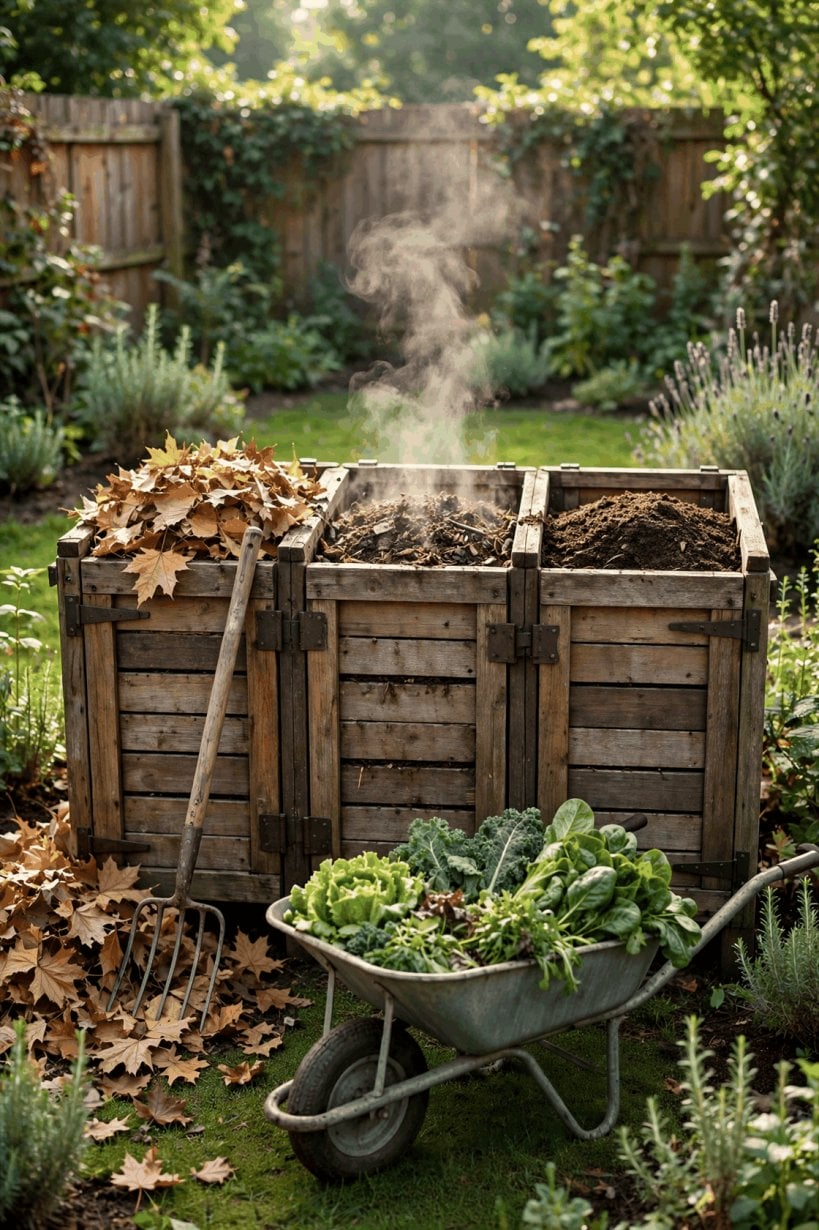
The cold pile is the same chemistry with the management removed: add material as it comes, ignore the pile, and take finished compost in 6–12 months — the patient’s method: time does the work the manager declined to do. Between the two sits the tumbler: the contained method, a sealed drum of about $100–200 in the original’s costing, whose turning is a crank rather than a fork, sized small and tidy for a modest waste stream.
The last two methods leave the pile behind entirely. Vermicompost gives the work to worms: red wigglers in a bin, the indoor method, the apartment method — quiet, nearly odourless, producing castings of the highest quality from kitchen scraps alone. Bokashi runs the opposite chemistry on purpose: an anaerobic fermentation, a pre-treatment in which the waste is pickled rather than decomposed, then buried in soil to finish. Each method honours the same accounting in different currency — heat, time, money, space or worms — and the real choice is which currency you hold most cheaply.
9. What Goes In: The Yes List and the No List
Feeding the reactor is a sorting decision made at the kitchen door, and the original’s lists are short enough to memorise. The yes list: vegetable scraps, coffee, eggshells, leaves, straw and cardboard — the browns and greens of the earlier sections in their kitchen-and-garden forms. In practice the sorting habit is the whole discipline: a scraps bucket that never receives the no list, and a browns store beside the pile so every green addition can be matched two-to-one on the spot.
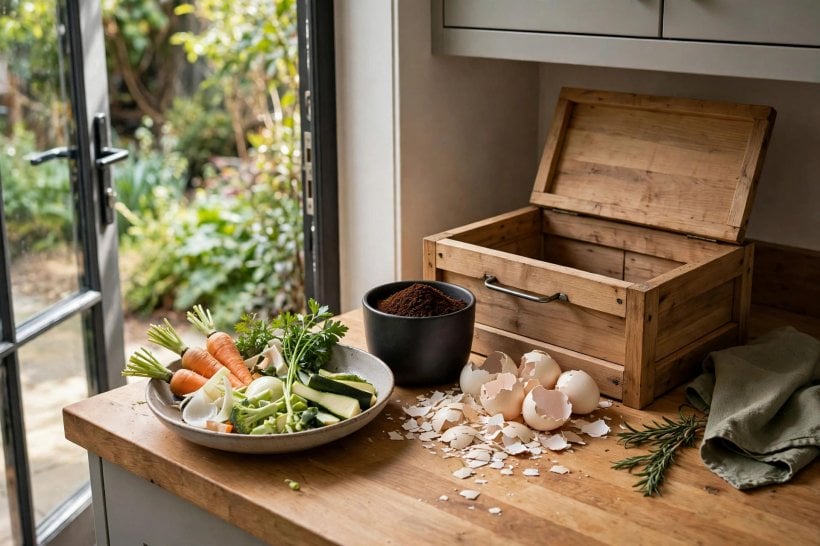
The no list is equally specific, and each entry carries its reason. Meat, dairy and oils are excluded for the pests they draw — with the original’s own exception: a genuinely hot pile, held in the thermophilic range, can take them. Diseased plants are excluded for their pathogens and routed to the burn pile instead. Black walnut is excluded for its chemistry: juglone, the allelopathic compound that suppresses other plants. Glossy paper is excluded for the chemicals in its coatings, where plain cardboard is a first-class brown.
One feedstock sits beyond the lists, flagged advanced: humanure. The original places it in its own category — thermophilic treatment required, a separate system, for experienced hands — within the wider sanitation picture of an off-grid property, where power, water and waste are planned together, as in the guide to tiny house utilities for power, water and off-grid sewage. For the household pile, the rule is simpler: greens and browns from kitchen and garden, the four exclusions respected, and the advanced stream left to its own system.
10. Using It: The Black Gold and the Closed Loop
Finished compost announces itself without instruments: crumbly, dark, earthy-smelling — the original’s three tests — with none of the feedstock recognisable in it. The timeline depends on the method: the hot pile’s weeks, the cold pile’s seasons, with the original’s six-month mark between them as the common expectation. Its first job is the simplest: the top-dress. Spread about 2 inches over the garden beds — the mulch application, the no-till application — and let the soil life pull it downward; the worms do the mixing, and the bed is fed from the top the way a forest floor is fed by its leaves.
The second use concentrates the biology rather than the bulk: compost tea, the brewed extract of the finished material, sprayed as a foliar feed — the biology delivered directly to the leaves, in the original’s framing. And around both uses sits the larger pattern: the closed cycle, waste to soil to food to waste, the loop that turns a property’s outputs into its inputs. It is the same self-provisioning arithmetic that the homesteading economics of financial independence off-grid keeps arriving at from the money side: every loop closed is a bill that stops arriving. The feedstock is free, daily and already on site — worth weighing for anyone scoring ground of their own with the system in where to buy land for eco-living, since soil you can build is worth more than soil you must import; city gardeners will find the permission side in which US cities have the best urban agriculture and sustainable living codes.
Final Considerations
Balance the chemistry first — 25:1 carbon to nitrogen, approximated two-to-one by volume at every addition. Build to the critical mass — 3×3×3 ft minimum — so the pile can hold its own heat. Then run the management triangle: hot, moist and turned, read weekly off a thermometer and a squeezed handful. Pick the method that fits your life, feed the pile from the yes list, and close the loop.




2 Comments