

People fall for tiny living on a monthly promise: a smaller home should mean smaller bills, and in many ways it does. But the honest question is not what one quiet month costs. It is what a full twelve months cost, once the land, the utilities, the insurance renewal, the servicing, the move you did not plan and the winter you did plan for badly have all taken their turn. That is the real annual cost tiny house living asks you to budget for, and it looks nothing like the single flattering figure in a sales post.
This breakdown works through a whole year line by line, in the order the bills actually arrive. It deliberately avoids invented figures, because what you pay is set by where you park, how you heat, whether you are hooked up or off grid, and how honestly you maintain the place. What transfers to every owner is the structure: which costs are monthly, which are annual, which are seasonal, and which only look occasional until the year they all arrive together. Budget the structure first, and your own numbers have somewhere true to land.
Annual Cost Tiny House Living at a Glance
The table below answers the questions owners ask when the first full year closes. Each short answer points to the section that unpacks what drives that cost up or down.
| Question | Short Answer |
|---|---|
| What is usually the largest yearly line? | Land. Rent or a pitch fee runs every month, and even owned land carries preparation, access and upkeep costs across the year. |
| Are utilities dramatically cheaper in a tiny house? | Usage is smaller, but standing charges, bottled fuel, tank emptying and hookup fees do not shrink with floor area, so savings are real but partial. |
| How often does insurance bite? | Once a year, as a specialist renewal. It is predictable, and it rewards a documented build, a legal pitch and an honest description of how the home is used. |
| How much should go to maintenance? | A steady monthly reserve beats a hopeful zero. Small homes wear their single bathroom, heater and seals hard, and call-out charges do not scale down. |
| Why does the total swing by season? | Heating, cooling, water use and storm repairs all cluster. Winter and summer write different bills, which is why a single average month misleads. |
| What does one move do to the year? | It can rewrite it. Towing, preparation, permits and re-siting turn a settled budget into a project budget for that month. |
| How do you find your true yearly total? | Track one full year, category by category, including renewals and reserves. The method in section 10 is the whole point of this guide. |
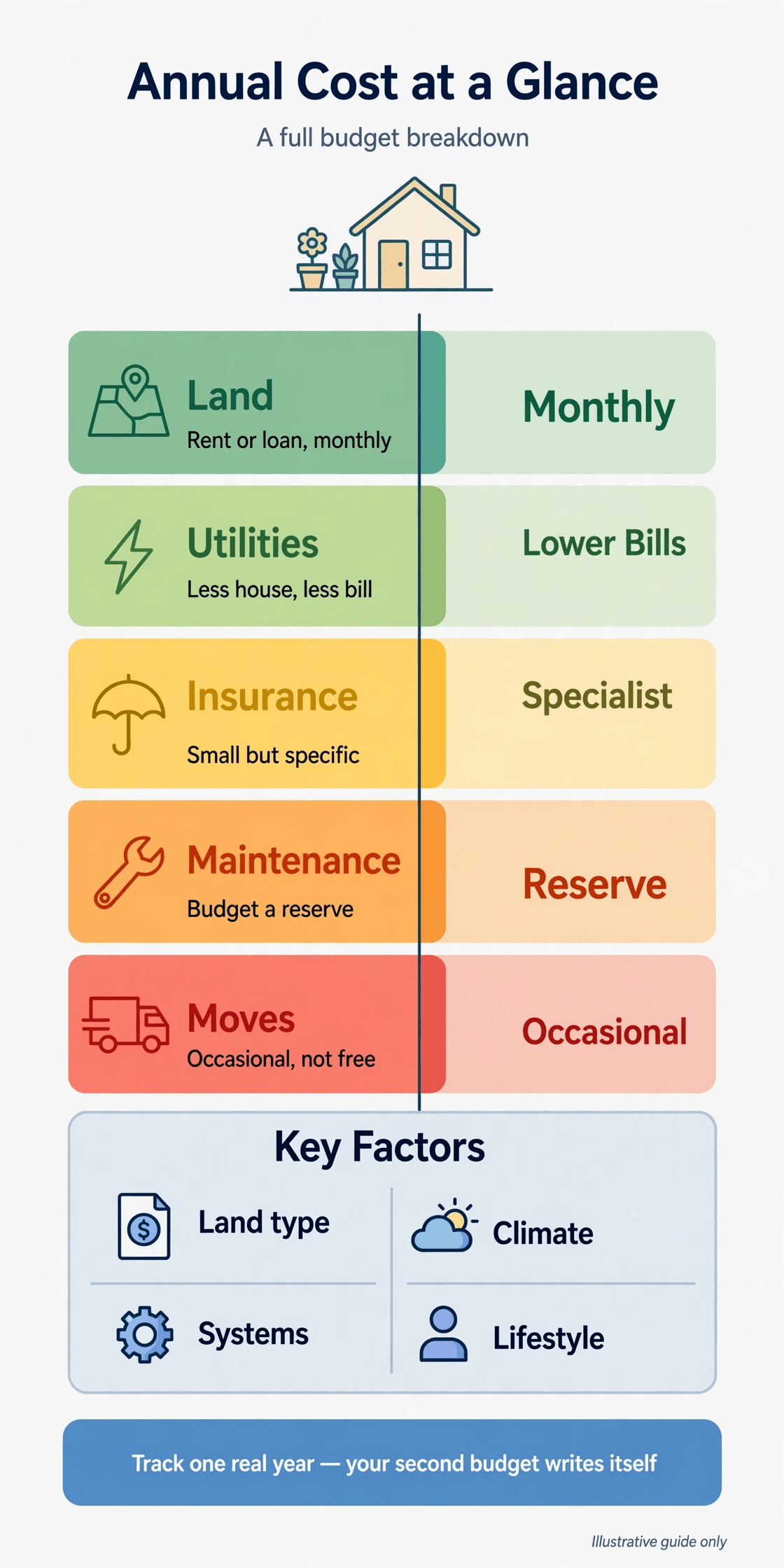
1. Land: Rent, Pitch Fees and Owning Your Ground
Every yearly budget starts with the ground, because the ground never stops charging. If you rent a pitch, that fee is the spine of the year: it arrives in good months and bad, it can be reviewed upwards, and it buys very different things in different places, from a bare legal space to a serviced pitch with hookups, parking and amenities. If you own the land, the monthly line disappears but the yearly one does not. Rates or taxes, access upkeep, drainage, fencing and the slow maintenance of the plot itself still belong in the budget.
What drives this line is location and security above everything. Ground near work, towns and services costs more than remote ground, and a pitch with a proper agreement costs more than an informal arrangement that can end with a phone call. Price that security honestly. The cheapest land year is often the one that ends early, with a move you then have to fund. Owners comparing tiny living with conventional renting should compare this line first, because it is the one most often left out of the comparison entirely.
2. Utilities Through the Year: Power, Water, Waste and Fuel
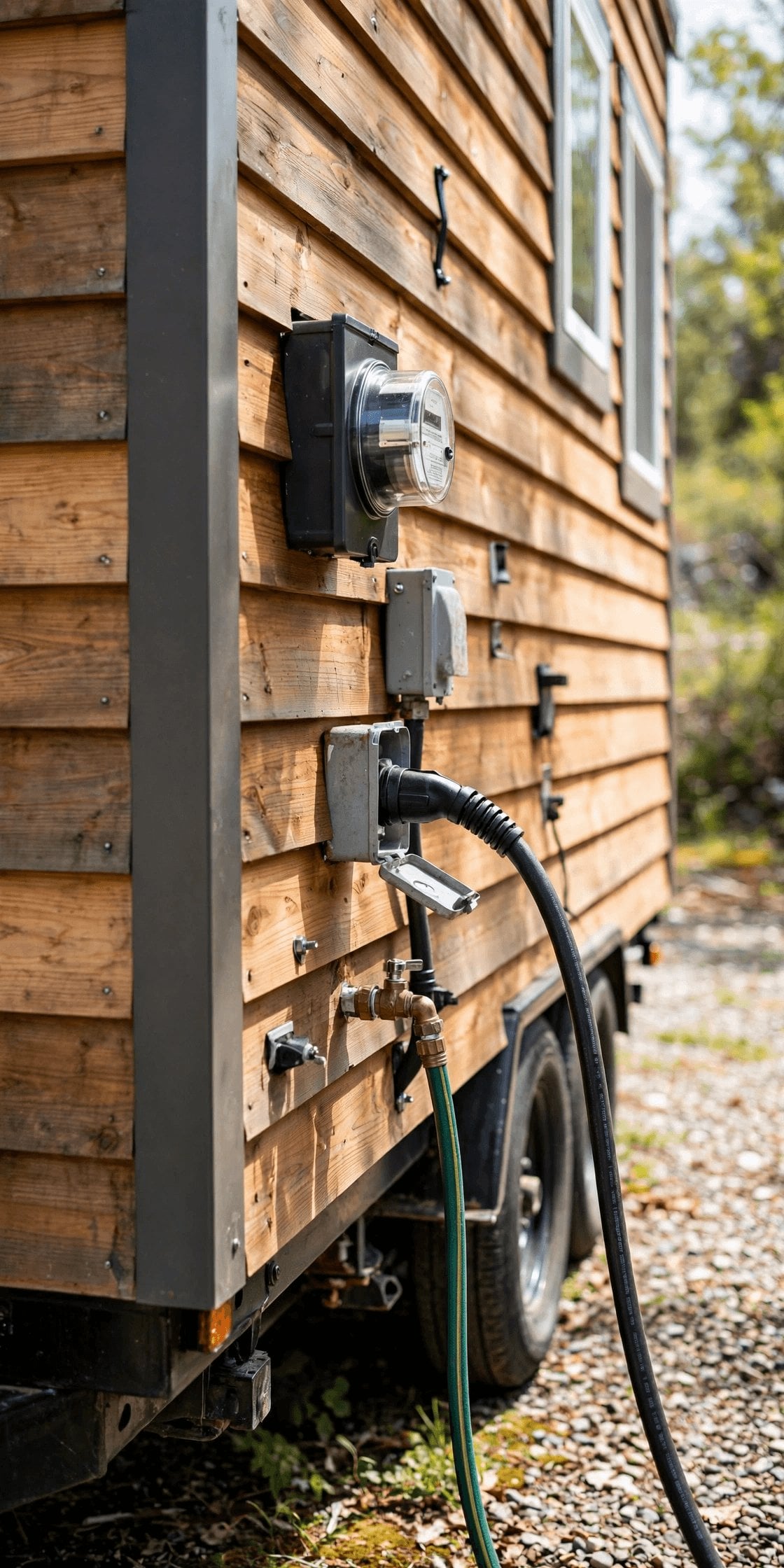
Utilities in a small home are a study in two halves. The usage half genuinely shrinks: fewer lights, less water heated, a small volume of air to warm. The fixed half does not shrink at all. Standing charges, meter arrangements, minimum delivery terms for bottled fuel, water filters, and waste tank emptying all charge for the service existing, not for how much of it a tiny household uses. This is why utility bills fall in a tiny house, but never by as much as the floor area falls.
How you are supplied decides the shape of the cost. A hooked-up pitch folds utilities into site arrangements and meter readings. An off-grid home swaps bills for consumables and servicing: fuel for a generator, replacement filters, and the upkeep of the systems themselves. Either way, the plumbing choices underneath matter for decades, and the thinking in tiny house plumbing layout and DWV design shows why access, falls and venting are budget decisions as much as building ones: systems that can be maintained cheaply will be, and systems that cannot will eventually be repaired expensively.
3. Insurance and Paperwork: The Annual Renewals
Once a year, the paperwork bill arrives as a cluster. Insurance on a tiny house is specialist cover for an unusual risk, part building and part vehicle, and the premium reflects how clearly you can answer questions about construction, certification, siting and movement. Around it gather the smaller renewals: registrations, inspections, site licences and any local charges that apply to how and where the home is kept. Individually each looks minor. Together they form a predictable annual lump that should never surprise anyone who has lived through one full cycle.
The cheapest way to hold this line down is evidence. Keep the build record, the certificates, the pitch agreement and photographs of the installation in one folder, and renew from documents rather than memory. Insurers price uncertainty, and a well-documented home removes uncertainty. The expensive version of this section is always retrospective: regularising paperwork that should have been done in sequence, or discovering at renewal that an undeclared change, a move, a tenant, a change of pitch, has quietly undermined the cover you were counting on.
4. Maintenance and a Reserve That Actually Works
A tiny house concentrates wear. One bathroom handles every shower, one small heater cycles constantly, and every seal, hinge and latch works as often as it would in a house three times the size. Materials for repairs are smaller, certainly, but tradespeople charge for attendance and time, and compact or specialist parts often cost more than standard ones and take longer to arrive. A yearly budget with no maintenance line is not optimistic. It is simply unfinished, and the year will finish it for you, usually in bad weather.
The working solution is a reserve: a modest amount moved aside every month, whether or not anything broke that month, so that servicing, resealing, tyre care and the inevitable appliance failure are paid from a fund rather than from panic. Finishes matter here too. Surfaces chosen with repair in mind, of the kind covered in lightweight interior wall finishes for tiny houses, can be patched, replaced in sections and kept light, while precious one-off finishes turn a small knock into a small project. Small, regular attention is the cheapest maintenance contract a tiny home will ever have.
5. Food, Laundry and Everyday Living in a Small Space
The everyday lines change shape in a tiny house rather than disappearing. Food is the clearest example. A small kitchen rewards planning and punishes bulk buying: storage is limited, the refrigerator is compact, and shopping more often in smaller quantities can cost more per meal than the big weekly shop a large kitchen absorbs. The trade-off cuts both ways, because a small larder also wastes less. Food bought is food eaten, and the spoilage that quietly inflates a big household budget has nowhere to hide.
Equipment choices decide much of this section. The selection logic in the best compact kitchen appliances for tiny houses is really about running costs in disguise: right-sized appliances use less power and water, standard sizes are cheaper to replace, and dual-use machines earn their counter space twice. Laundry tells the same story. A compact washer costs bench space and plumbing; laundromat life costs money, time and travel every single week. Neither answer is wrong. Both belong in the yearly total, written down, rather than absorbed invisibly into general spending where nobody can learn from them.
6. Heating, Cooling and Seasonal Swings
No honest yearly budget can be built from an average month, because tiny houses do not have average months. Winter concentrates heating fuel, condensation management, freeze protection and storm wear. Summer answers with cooling, shading and higher water use. Spring and autumn are the cheap shoulders in between, and they are exactly the months people use when they estimate, which is why first-year estimates so often fail in January rather than in June.
Fuel choice is the lever you set once and pay for monthly. The comparison in propane vs electric for tiny houses, with tank sizing shows installation cost and running cost pulling in opposite directions, and neither wins everywhere: delivered fuel suits some pitches and punishes others, while electric heating is simple where supply is strong and painful where it is metered dearly. Protect the building while you pay to warm it, too. The guidance on tiny house skirting options for pipes and insulation is a winter budget line in physical form, cutting the frozen-pipe repairs and heat loss that turn a cold snap into an invoice.
7. Moves, Travel and Changing Where You Park
A tiny house on wheels carries a cost no fixed house has: the option, and sometimes the necessity, of moving. A move is a transport project, not a drive. There is preparation inside and out, tyres, brakes and lights to return to road condition after months standing still, a suitably rated tow vehicle or a professional to supply one, and possibly route planning or permits depending on size and local rules. At the far end, siting and hookup costs happen again in miniature. One move can cost more than several months of the running budget it interrupts.
Even standing still, the running gear belongs in the yearly account, because tyres age, bearings sit and brakes corrode whether the wheels turn or not. The reasoning in how to choose trailer axles rated at 14,000 lbs for a tiny house is a budgeting document as much as a technical one: correctly rated, maintained running gear is what makes a move a planned expense instead of a roadside emergency. Budget a small annual line for the trailer’s health, and a separate, honest figure for a move in any year you think one is even possible.
8. Off-Grid Costs: Solar, Batteries, Water and Waste
Off-grid living swaps monthly bills for ownership of the whole system, and ownership has its own yearly rhythm. Panels need cleaning and occasional inspection. Batteries are consumables on a long fuse, ageing with cycles and temperature whether you watch them or not. Charge controllers, inverters and pumps are reliable until the day they are not, and water carried, filtered or collected, plus waste managed on site, all convert utility bills into time, consumables and a replacements calendar that the household itself must run.
None of this makes off-grid living expensive by default. It makes it capital-and-care based rather than bill based, and the yearly comparison has to be drawn that way: a quiet year with no replacements looks wonderfully cheap, while the year a battery bank retires looks terrible, and the truth is the average of the two. Portable and modular power, reviewed in the best off-grid power stations from Jackery, Bluetti and EcoFlow, can smooth that pattern for smaller loads, letting owners replace one unit at a time. Whichever system you run, list its components with rough ages in the budget, and let the reserve in section 4 carry their future honestly.
9. The Costs That Shrink: What Tiny Living Genuinely Saves
After eight sections of charges, the savings deserve their own honest section, because they are real. A small home uses less energy to heat and light. It holds less stuff, which quietly suppresses the spending that storage invites: fewer impulse purchases, fewer duplicates, less furniture, less of everything that needs insuring, maintaining and eventually replacing. Cleaning takes less time and fewer products. Even decorating and flooring a small space costs a fraction of the same job in a large house, and is finished before it becomes a saga.
The trade-off is that these savings are behavioural as much as architectural. A tiny house makes low spending easy; it does not make it compulsory. Owners who fill the savings gap with storage units, constant upgrades or eating out because the kitchen feels small can spend a big-house amount of money in a small-house life, and some do. The yearly budget tells you which owner you are. If the shrunken lines are genuinely shrinking, the model is working. If they are quietly reappearing under other names, the house is not the problem, and no floor plan will fix it.
10. The Track-One-Year Method: Finding Your Real Number
Here is the method this whole guide has been building toward. For one full year, record every cost the house generates, in the categories above: land, utilities, insurance and paperwork, maintenance, everyday living, seasonal comfort, moves, and system replacements. Capture the annual renewals in the month they land, keep the reserve contributions visible as their own line, and resist averaging anything until the year closes. Twelve months is the shortest period that contains every season, every renewal and at least one surprise, which is exactly why it is the unit that tells the truth.
When the year closes, do three things with the record. First, separate the fixed spine, land and renewals, from the variable lines you can actually influence. Second, mark which costs were one-offs, a move, a major replacement, and which are the repeating rhythm of your life in this place. Third, set next year’s monthly budget from the record, not from hope: fixed lines in full, variable lines at their real average, and the reserve topped up for whatever the record showed ageing. Repeat the exercise and the second year is rarely a surprise, because you have stopped budgeting for a tiny house in general and started budgeting for yours.
Final Considerations
A tiny house can absolutely cost far less to run than a conventional home, and for many owners it does, year after year. What it never does is cost nothing, and the gap between those two truths is where first-year budgets go to die. Land charges, utilities with stubborn fixed halves, specialist insurance, concentrated maintenance, seasonal swings and the occasional move are not flaws in the model. They are the model, priced properly, and a household that has priced them can relax inside its own numbers.
So do not ask whether tiny living is cheap. Ask what your year costs, in your place, with your systems, and answer it the slow, reliable way: one tracked year, honestly categorised, with a reserve doing quiet work in the background. The number you find will be less flattering than the brochure and far more useful, because a budget built on it does not collapse in February. That, in the end, is what a full breakdown is for: not to talk anyone out of a small home, but to make sure the people in one can afford to stay.


0 Comments