
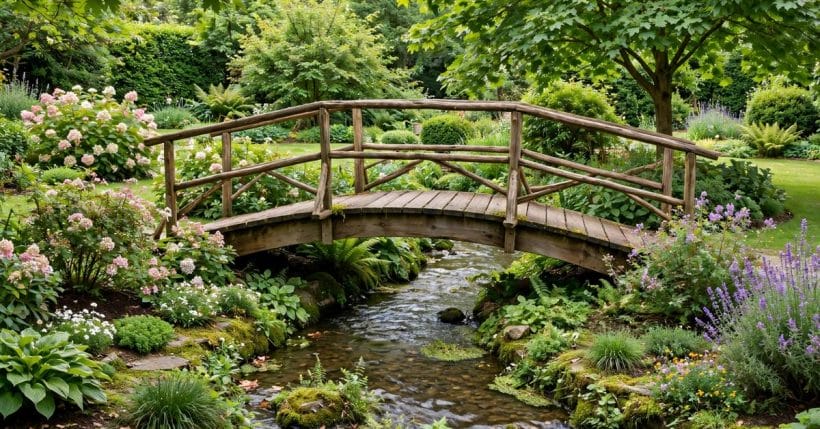
A garden bridge changes the way a backyard feels the moment you step onto it. Even a small one turns an ordinary path into a little journey, giving you a pause over a planting bed, a dry stream, or a stretch of lawn, and a reason to look at the garden from a slightly different angle. Bridges suit gardens of almost every size, from generous country plots to compact courtyards, because the bridge itself is as much a piece of garden character as it is a way across.
This collection gathers backyard bridge ideas in every mood, from gently arched timber crossings to simple flat boardwalks, painted garden bridges, and rustic crossings that look as if they have always been there. Whether your garden has a real stream, a dry bed of stones, or simply a planting scheme that deserves a feature, the ideas below cover layouts, colours, costs in general terms, and the practical details worth thinking about before you choose. If you are planning the wider garden around it, our backyard landscaping ideas are a good place to start.
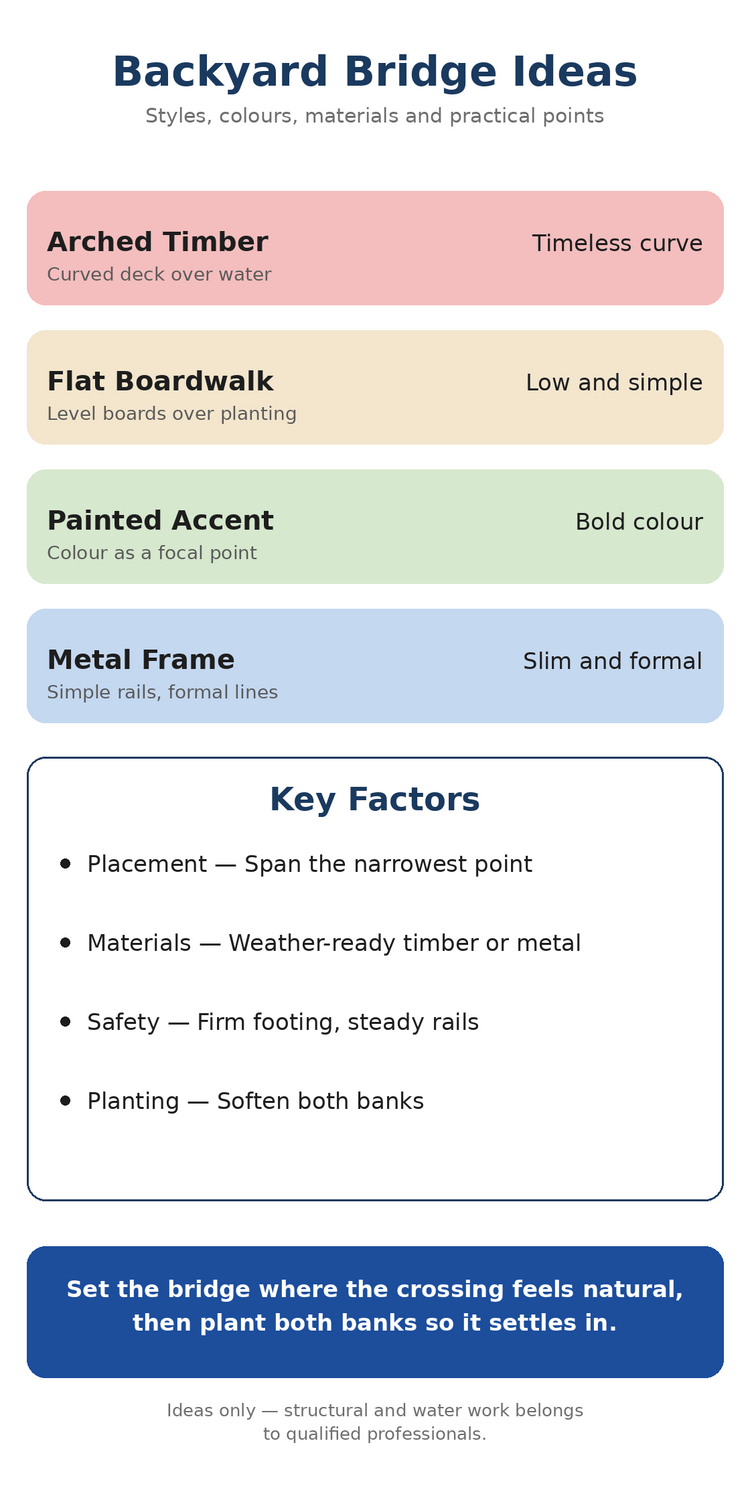
| Item | What it is |
|---|---|
| Arched Garden Bridges | The arched bridge is the classic garden bridge, and it earns that place for good reason. |
| Flat Boardwalk Bridges | Not every garden bridge needs an arch. |
| Rustic Timber Bridges | Rustic timber bridges lean into the natural character of wood, with chunky rails, bark-textured posts, and boards that show their grain. |
| Painted Bridges in Garden Colours | A painted bridge is a wonderful way to add colour to a garden without planting a single new flower. |
| Bridges Over Dry Garden Beds | You do not need a pond or a stream to justify a garden bridge. |
| Bridges as Garden Focal Points | Every good garden has a focal point, a place where the eye naturally lands, and a bridge makes an excellent one. |
| Small Bridges for Tiny Gardens | Small gardens can carry a bridge beautifully, provided the bridge is scaled to the space. |
| Bridges Beside Planting and Paths | A bridge rarely stands alone; it works best as part of a path and planting scheme that leads you to it and away from it. |
1. Arched Garden Bridges
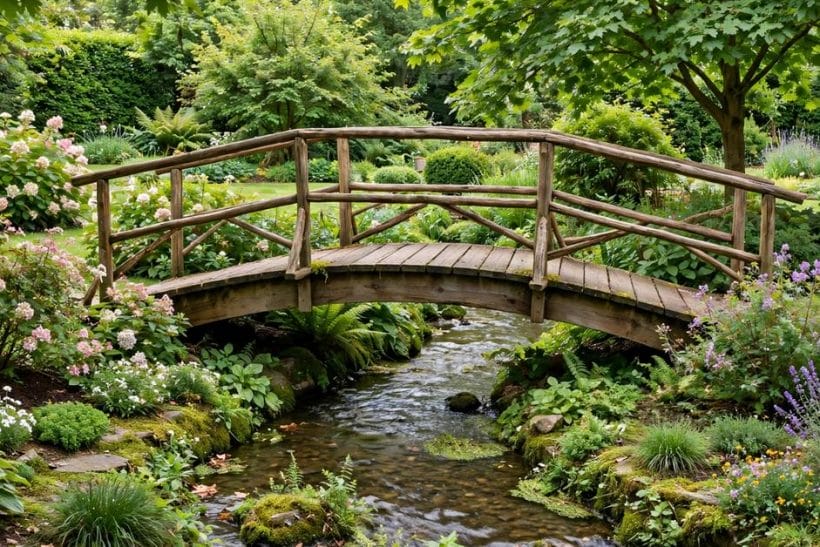
The arched bridge is the classic garden bridge, and it earns that place for good reason. The gentle rise in the middle gives the crossing a graceful silhouette that reads beautifully from across the garden, and it turns even a modest span into a feature worth photographing. Arched bridges suit traditional gardens, cottage gardens, and Japanese-inspired plantings alike, because the curve feels natural beside water, stone, and soft planting.
Look at the arch in relation to its surroundings before you settle on a style. A soft, low arch sits quietly in a flat garden and suits a calm, level planting scheme, while a more pronounced arch makes a stronger statement and pairs well with raised beds, mounded planting, or a garden with changes in level. The handrails matter just as much as the curve: simple upright rails keep the look light and open, while fuller balustrades give a more formal, finished feel.
Colour plays a quiet role here. Natural timber that is allowed to weather to a soft grey blends into a mature garden, while a stained or painted finish in a warm brown or deep green picks the bridge out as a deliberate feature. Either way, the bridge should feel connected to the planting around it, with shrubs or grasses softening the banks at each end so the crossing feels like part of the garden rather than something dropped into it.
2. Flat Boardwalk Bridges
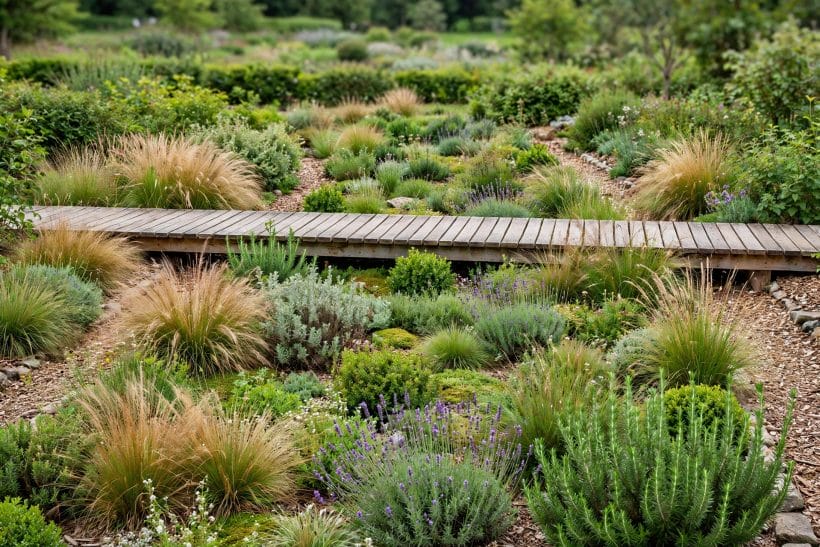
Not every garden bridge needs an arch. A flat boardwalk bridge, laid low and level across a bed, a boggy corner, or a shallow swale, has a relaxed, contemporary feel that suits modern gardens and naturalistic plantings. Because it sits close to the ground, it feels less like a structure and more like a path that happens to cross something interesting, which makes it a good choice where you want the planting to take centre stage.
Boardwalk bridges work especially well over areas that are damp underfoot or planted with moisture-loving plants, since they let you enjoy that part of the garden without disturbing the soil or the roots below. Wide boards give a generous, easy crossing, while narrower boards feel more like a woodland trail. Either way, keep the edges of the boardwalk planted or edged with stone so the structure meets the garden softly rather than ending abruptly.
For a cohesive look, match the boardwalk timber to other wooden elements nearby, such as decking, fencing, or raised beds. When the bridge, the deck, and the fence all speak the same material language, even a small garden feels considered and calm. Our tiny backyard ideas show how this kind of simple, repeatable material choice can make a compact plot feel much larger.
3. Rustic Timber Bridges
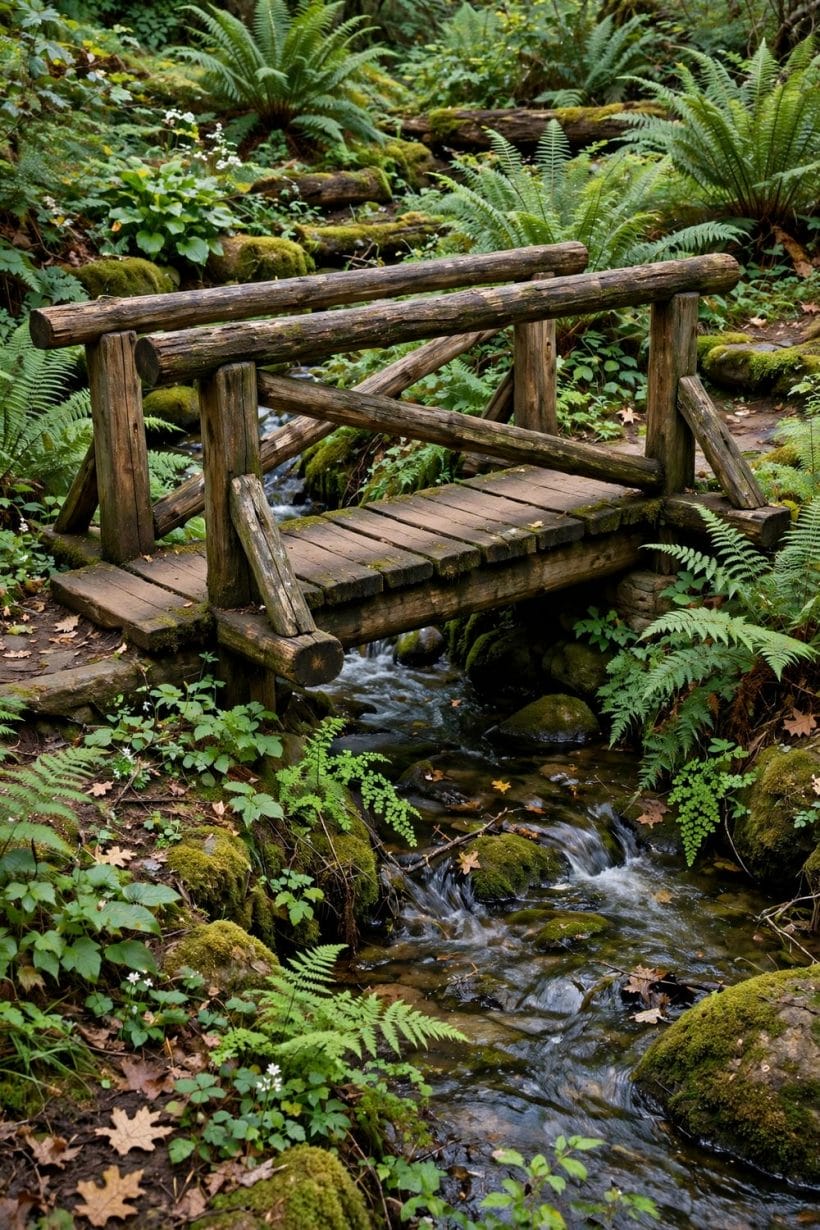
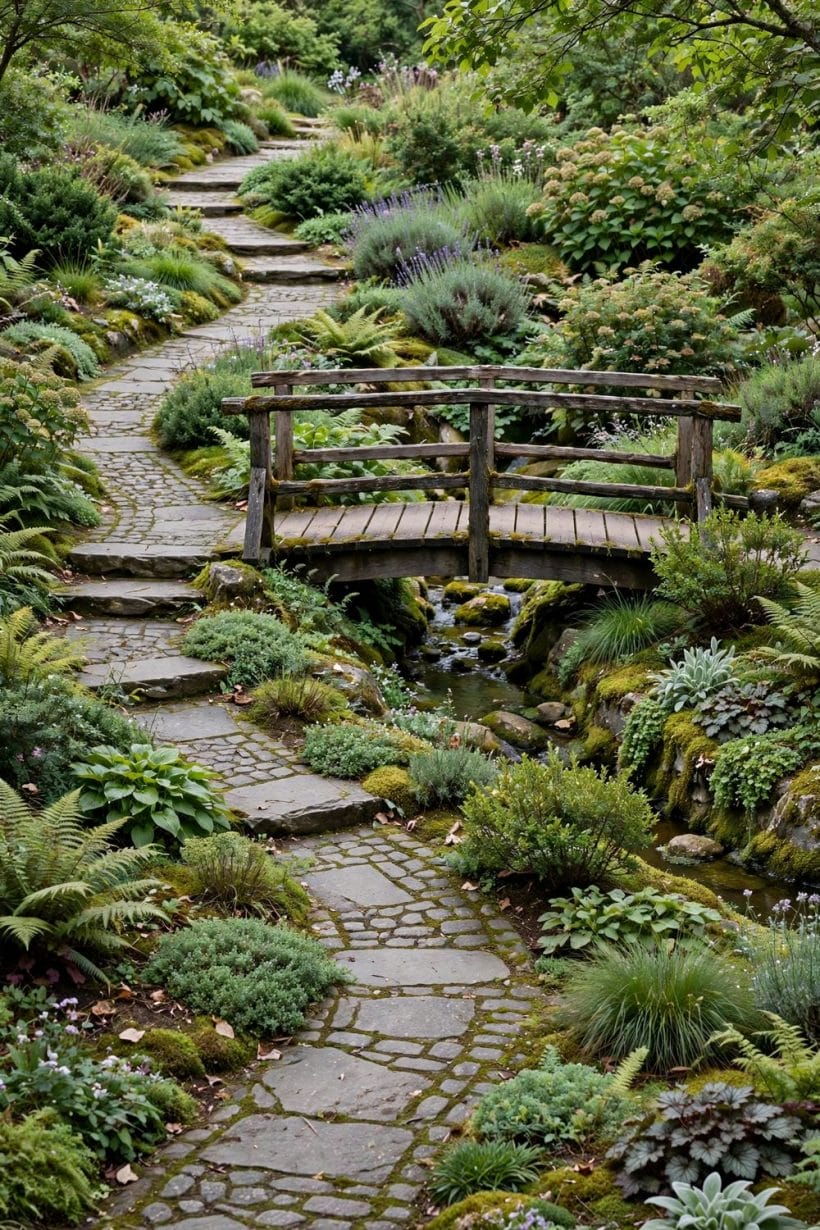
Rustic timber bridges lean into the natural character of wood, with chunky rails, bark-textured posts, and boards that show their grain. They suit woodland gardens, cottage plots, and any garden where a slightly wild, handcrafted feeling is welcome. A rustic bridge over a stream or a fern-filled hollow can become the most photographed corner of the whole garden, precisely because it looks as if it grew there.
The charm of a rustic bridge lies in its informality, but informality still benefits from a little planning. Choose a crossing point where the banks feel natural and stable, and let planting crowd in around the ends so the bridge reads as part of a woodland walk rather than a standalone ornament. Ferns, hostas, and shade-loving ground cover are natural companions, softening the timber and tying the bridge into the planting scheme.
Because rustic timber is exposed to the weather, think about how it will age. Some gardeners love the silvered, weathered look that untreated timber develops over time, while others prefer a protective finish that holds the warm brown tones for longer. Neither choice is right or wrong; it is simply a question of which version of the bridge you want to live with as the seasons pass.
4. Painted Bridges in Garden Colours
A painted bridge is a wonderful way to add colour to a garden without planting a single new flower. A classic red bridge is the most famous choice, borrowed from Japanese garden design, and it makes a joyful focal point against green foliage and grey stone. But painted bridges need not be red: deep green settles quietly into a leafy garden, soft blue-grey suits a coastal planting scheme, and crisp white gives a formal, almost romantic feel beside pale flowers and pale gravel.
When choosing a paint colour, look at the colours already present in your garden. A bridge painted to echo a front door, a garden shed, or a set of window frames ties the whole plot together, while a bridge in a contrasting colour becomes a deliberate accent that draws the eye. In a small garden, a single bold colour accent can be more effective than several competing ones, so let the bridge carry the colour and keep the rest of the scheme calm.
Painted finishes also make practical sense in gardens where the bridge gets heavy use, since a painted surface can be refreshed when it starts to look tired. A fresh coat every few seasons keeps the bridge looking cared for, and it is a small job that makes a visible difference to the whole garden. If your garden already has a painted structure to match, our garden shed ideas may help you pick a colour family that works across both.

5. Bridges Over Dry Garden Beds
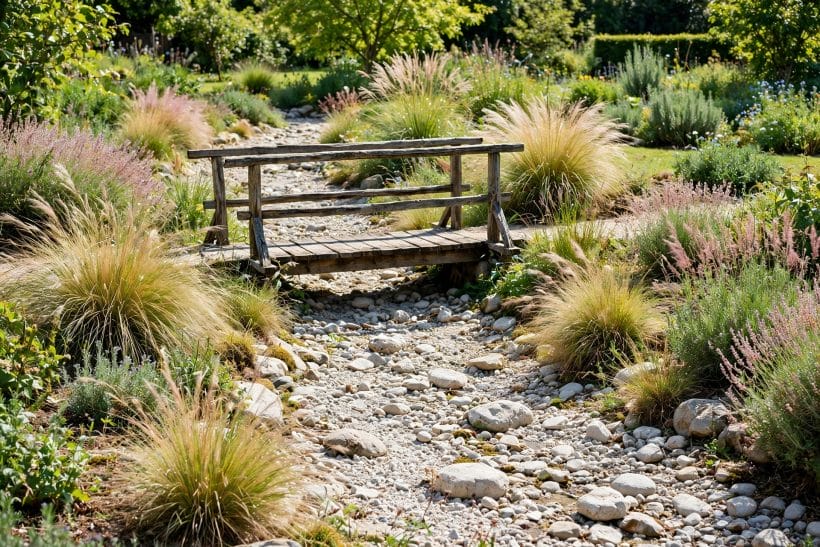
You do not need a pond or a stream to justify a garden bridge. A bridge over a dry bed of gravel, stones, or low planting can be just as charming, and it suits gardens where a real water feature would be impractical. Dry stream beds, made from river stones and pebbles laid in a winding channel, give the bridge something to cross, and they add movement and texture to a flat garden even when there is no water in sight.
Dry beds also solve a practical problem: they give a garden a sense of flow and direction. A winding gravel channel with a bridge across it leads the eye through the garden and invites visitors to follow the path and see what lies beyond. Planted with grasses, ground cover, and drought-tolerant plants along its edges, a dry bed looks intentional in every season, not just when the garden is in full bloom.
Because there is no water to maintain, a dry-bed bridge is one of the lowest-commitment bridge ideas in this collection. There are no pumps or liners to think about, and the planting around it can be as simple or as elaborate as you like. It is a good first bridge for a gardener who loves the look but wants to keep the upkeep gentle.
6. Bridges as Garden Focal Points
Every good garden has a focal point, a place where the eye naturally lands, and a bridge makes an excellent one. Placed at the end of a path, across a bend in a walk, or where two planting areas meet, a bridge gives the garden a destination and a moment of pause. It also gives the garden a sense of depth, because a feature you can walk across feels closer and more inviting than one you can only look at.
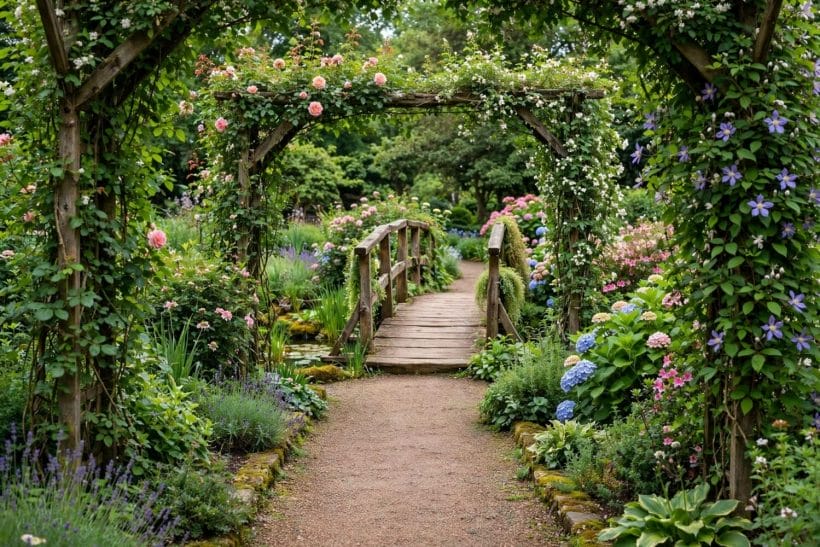
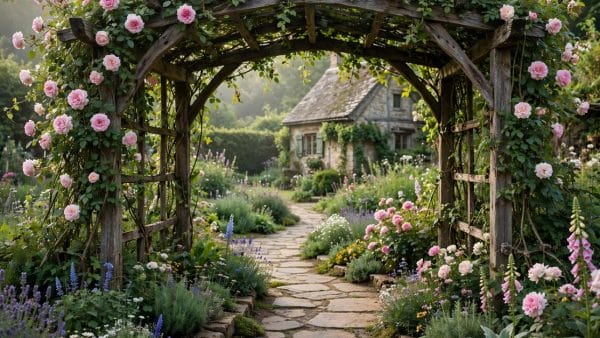
To make a bridge work as a focal point, give it a setting worthy of it. A simple arch of climbing plants at one end, a pair of planted containers flanking the approach, or a stone edging that frames the crossing all help the bridge read as a destination rather than an afterthought. Lighting, too, can play a part: a softly lit bridge in the evening turns a daytime feature into an after-dark pleasure.
Think about the view from the bridge as well as the view of it. A bridge is one of the few garden features you stand on, so what you see from the middle matters. Frame that view with planting that rewards a pause, whether it is a flowering shrub, a sculpture, or simply a well-composed stretch of lawn and trees. A bridge that offers a beautiful view from its centre will be used far more than one that simply looks good from a distance.
7. Small Bridges for Tiny Gardens
Small gardens can carry a bridge beautifully, provided the bridge is scaled to the space. A short, low bridge over a narrow bed or a tiny rill can give a compact garden a surprising sense of journey, turning a few steps of path into a small adventure. The trick is proportion: the bridge should feel like a natural part of the path, not a structure that dominates the plot.
In a tiny garden, choose simple forms and light colours. A slim flat bridge or a low arch in natural timber keeps the garden feeling open, while a heavy, ornate bridge can crowd a small space. Keep the planting around it simple as well, with a few well-chosen plants rather than a dense jungle, so the bridge and the garden breathe together.
Small bridges also pair well with other small-garden features, such as a compact patio, a raised bed, or a seating nook just beyond the crossing. The bridge becomes a threshold between one little garden room and the next, which is exactly how small gardens gain their charm: not from size, but from a sequence of small, delightful moments. Our tiny house patio ideas show how a crossing and a seating area can work together in the smallest plots.
8. Bridges Beside Planting and Paths
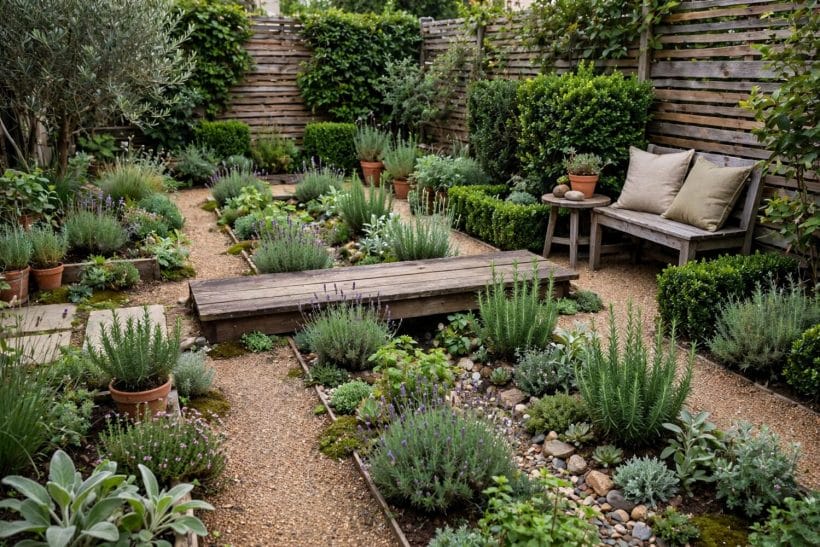
A bridge rarely stands alone; it works best as part of a path and planting scheme that leads you to it and away from it. The approach matters enormously. A path that narrows slightly as it reaches the bridge, flanked by plants that brush gently against it, builds a sense of arrival, while a wide, bare approach can leave even a beautiful bridge feeling exposed.
Planting beside a bridge should soften its edges without hiding it. Low shrubs, grasses, and ground cover at the banks work well, while taller plants set slightly back give the crossing a sense of enclosure without blocking the view. Avoid planting anything that will quickly overwhelm the bridge or make the crossing feel cramped; the bridge should remain easy and pleasant to walk across in every season.
Paths and bridges also need to agree on materials. A gravel path meeting a timber bridge feels natural, as does stone paving meeting a stone-edged crossing. When the path and the bridge share a material family, the garden reads as one continuous, considered walk rather than a collection of separate features. For the wider setting, our tiny house exterior ideas offer useful lessons in keeping outdoor materials consistent.
9. Materials and Finishes to Compare
Timber is the most popular bridge material, and it is easy to see why. It is warm, natural, and available in a wide range of finishes, from pale untreated boards to deep stained hardwood looks. Timber bridges suit almost every garden style, and they age gracefully, developing character as they weather. If you love a natural, garden-grown feel, timber is a strong starting point.
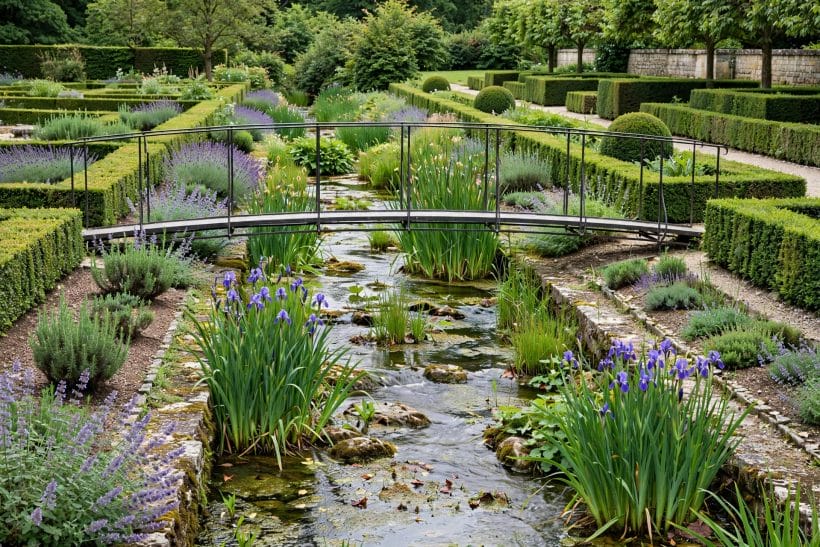
Metal bridges offer a different character. Wrought-iron-look or simple steel bridges suit formal gardens and contemporary plots, and they can be remarkably slender, which keeps the crossing feeling light. Stone and composite bridges are less common but worth considering where permanence matters: a stone bridge feels ancient and settled, while modern composite decking boards offer a low-maintenance crossing that keeps its colour without regular refinishing.
When comparing materials, think beyond the first impression. Ask how each material will look in a few years, how much care it will need, and how it will feel underfoot in wet weather. A bridge is a feature you walk on, so grip and comfort matter as much as appearance. Talking through these points with a local landscaper or builder, in general terms, can help you match the material to your garden, your climate, and the amount of upkeep you are happy to take on.
10. Costs, Care and Practical Details
Bridge costs vary widely, and that is worth understanding before you fall in love with a particular style. A simple flat timber crossing is generally among the most modest options, while an arched bridge, a painted finish, or a longer span will usually cost more, because the design is more involved and the materials more substantial. The setting matters too: a bridge over a real stream or a level change involves more groundwork than one over a flat dry bed.
It helps to think of the cost in general terms rather than as a single figure. The bridge itself is one part, and the groundwork, the path approaches, the planting at each end, and any edging or lighting are others. Getting a general sense of each part, and talking to a local supplier or landscaper about what is typical in your area, will give you a far more realistic picture than any single quoted figure could.
Care is straightforward for most garden bridges. Timber benefits from periodic cleaning and refinishing, painted bridges from an occasional fresh coat, and every bridge from a quick check of its fixings and boards as the seasons change. Keeping leaves and debris clear of the boards helps the surface last, and keeping planting trimmed back from the rails keeps the crossing comfortable to use. A little routine attention goes a long way, and it keeps the bridge looking like the feature it was meant to be.
Finally, think about who will build the bridge. Simple flat crossings are within reach of a confident gardener working with a supplier’s kit, while arched bridges, longer spans, and any crossing over real water are best discussed with a professional. Structural work over water, in particular, deserves professional advice, stated here only in general terms. The right help at the start means a bridge that is safe, stable, and beautiful for years.
Final Considerations
A backyard bridge is one of those rare garden features that is both practical and poetic: it gets you from one side to the other, and it gives the garden a story at the same time. Whether you choose a gentle arch, a flat boardwalk, a rustic timber crossing, or a brightly painted feature, the best bridge is the one that fits your garden’s scale, its planting, and the way you actually use the space.
Start with the crossing point, choose a form and a material that suit the garden you already have, and keep the colours and the planting around it calm enough for the bridge to shine. Done well, a bridge does not just cross a garden feature; it becomes the moment visitors remember. For more inspiration on shaping the planting around it, our container garden ideas show how planted containers can frame a crossing and soften the banks at each end.

0 Comments