
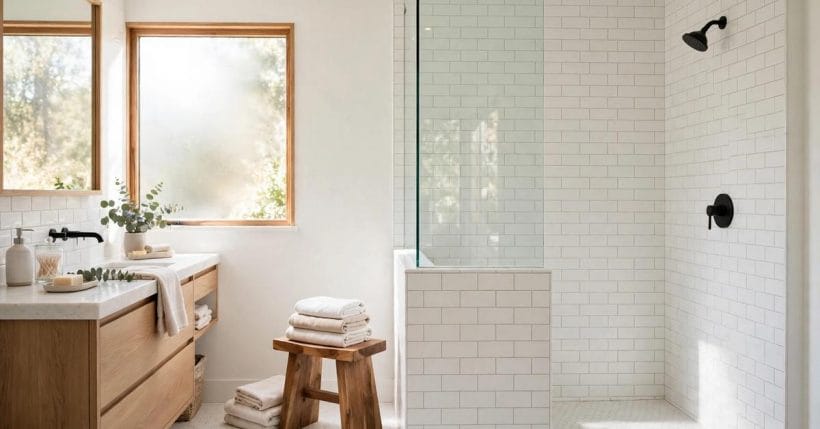
A half-wall shower enclosure keeps the shower open to the room while still giving splashes somewhere to stop. Instead of a tall screen that closes the corner off, or a curtain that moves with every draught, a short wall carries a glass panel above it, and the shower stays visible, bright and easy to step into. The effect is calmer than a fully enclosed cubicle and tidier than an open wet corner, which is why the form suits small bathrooms as well as generous ones. It is a modest idea, but the details matter: the height of the wall, the shape of the panel, the edge finish and the glass itself all change how the shower feels in daily use.
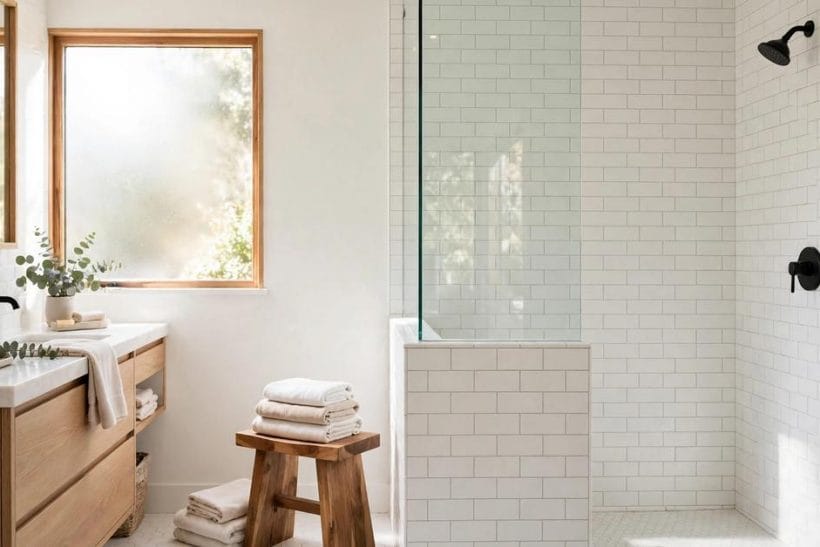
This guide stays strictly on the half wall shower glass form: what it looks like, how its parts work together, and what to notice when you are choosing between versions of it. It does not re-teach shower rooms in general. For the room around the shower, the layout owner is the shower room guide, and this post links to it rather than repeating it. Window placement, the curtain liner question, tile choices and the cost angle each belong to companion posts, and they are named only where the boundary matters so this post can stay on its own subject. Plumbing and waterproofing work around any shower is work for qualified professionals, stated here in general terms only, with no do-it-yourself instructions for either.
1. The Half-Wall Glass Form at a Glance
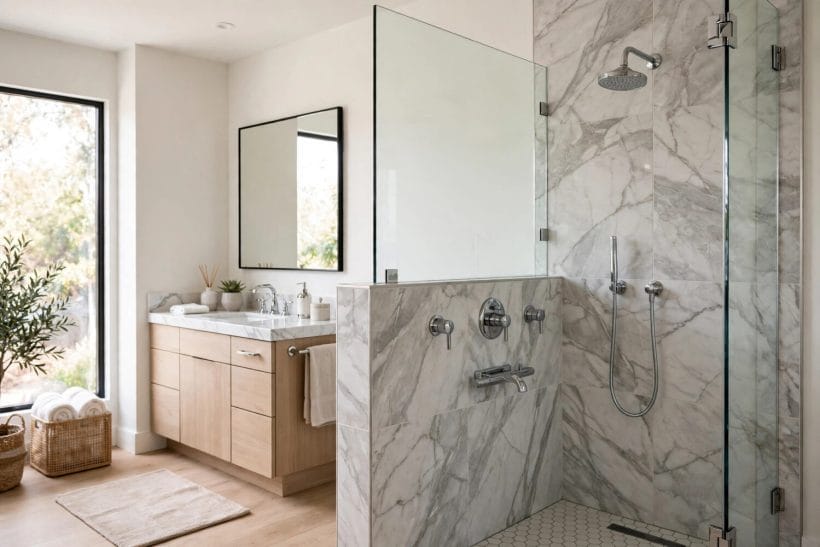
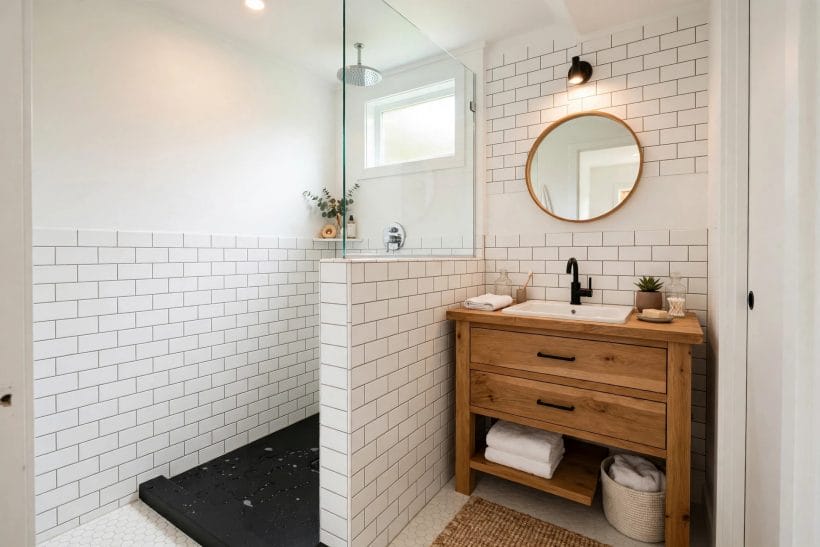
The form is simple to picture. A low wall rises from the floor beside the shower, usually to around waist height or a little above, and a glass panel continues upward from the top of that wall. The wall gives the shower a solid base that feels permanent and grounded, while the glass above keeps sightlines open and lets light travel across the room. Together they divide the wet area from the dry area without building a full-height barrier, so the bathroom reads as one room rather than two small boxes.
| Part | What it does |
|---|---|
| The half wall | Anchors the shower, holds the panel, and gives a solid surface at low level |
| The glass panel | Contains splashes at upper level while keeping the room open and bright |
| The open side | Provides the entry, kept clear so stepping in and out feels easy |
| The edge finish | Sets the tone, from a slim metal line to a softer framed outline |
| The surrounding surfaces | Carry the colour and texture that the glass itself leaves alone |
What makes the form work is the balance between those parts. If the wall is too low, the glass has to do more work than it should, and the shower can feel exposed rather than sheltered. If the wall is too high, the openness that is the whole point of the form starts to disappear, and the room can feel divided again. The pleasing versions sit in the middle, where the solid part reads as furniture-like and the glass part reads as almost nothing at all, just a clear plane that catches the light. That balance is worth judging in person whenever you can, because photographs tend to flatten it: a panel that looks invisible in a picture may still catch reflections and edges in real daylight, and a wall that looks heavy in a picture may feel perfectly grounded once you are standing beside it.
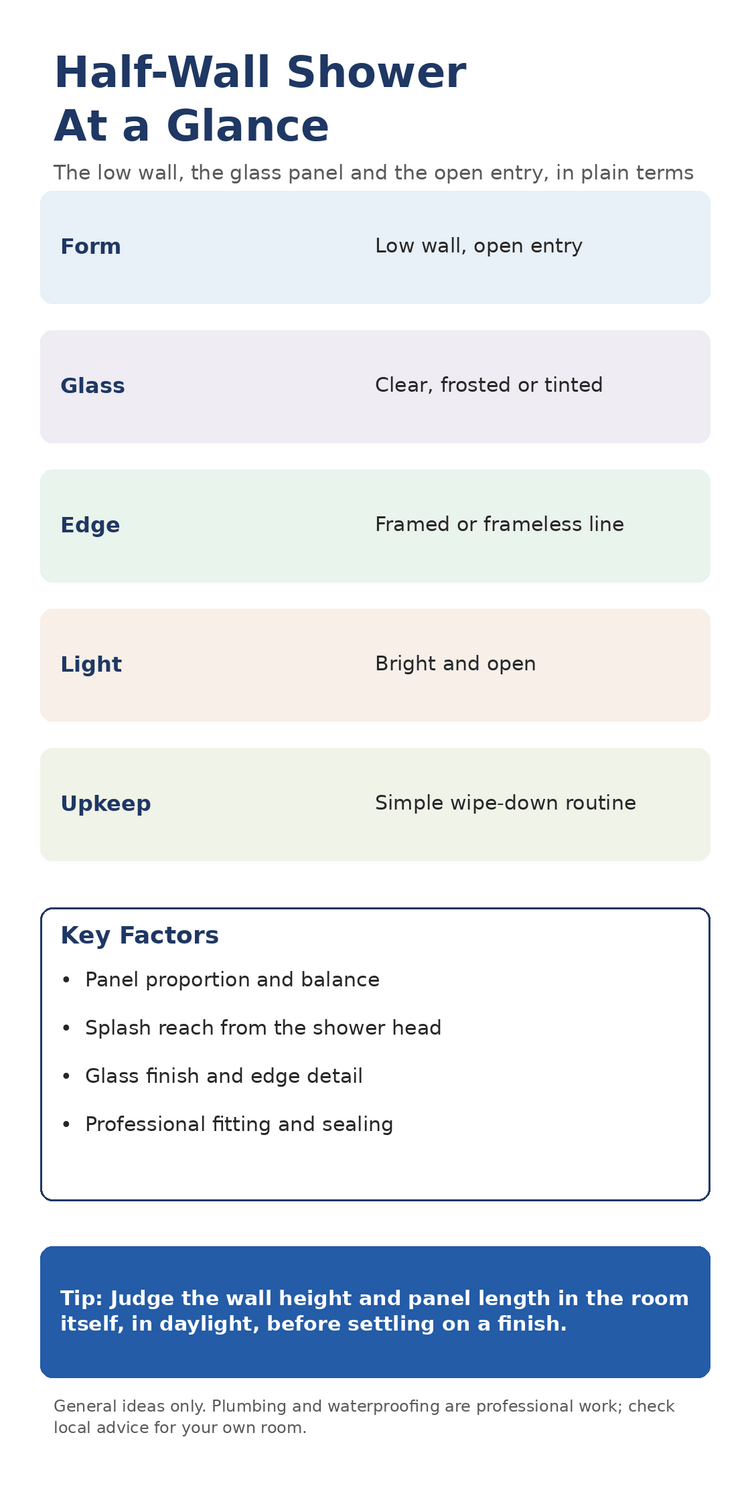
2. How the Half Wall Changes the Feel of the Room
The first thing a half wall does is change how big a bathroom feels. A full-height screen, even a clear one, creates a visible boundary that the eye stops at, and in a small room that boundary can make the whole space feel smaller. A half wall removes the upper part of that boundary, so the eye travels over the wall and across the room, and the shower borrows light and air from the rest of the bathroom. In a compact bathroom this is a genuine advantage, which is why the form appears so often in small-room planning, including the ideas gathered in the tiny bathroom ideas collection, where every division has to earn its place.
The second change is about movement. Without a door to open or a curtain to push aside, entry to the shower is a simple step around the end of the panel, and that ease matters most on mornings when the bathroom is shared and the routine is hurried. Towels, robes and dry clothes can stay within reach on the dry side, and the person showering never has to negotiate a swinging door in a tight corner. The trade-off is that the open side is also the side where splashes can escape, so the panel needs to be long enough and well placed enough to catch the main spray before it reaches the dry floor. That is a matter of judging the shower itself rather than following a fixed rule: the direction the water falls, the strength of the spray, and the shape of the floor all play a part, and a professional can advise on the arrangement for a particular room.
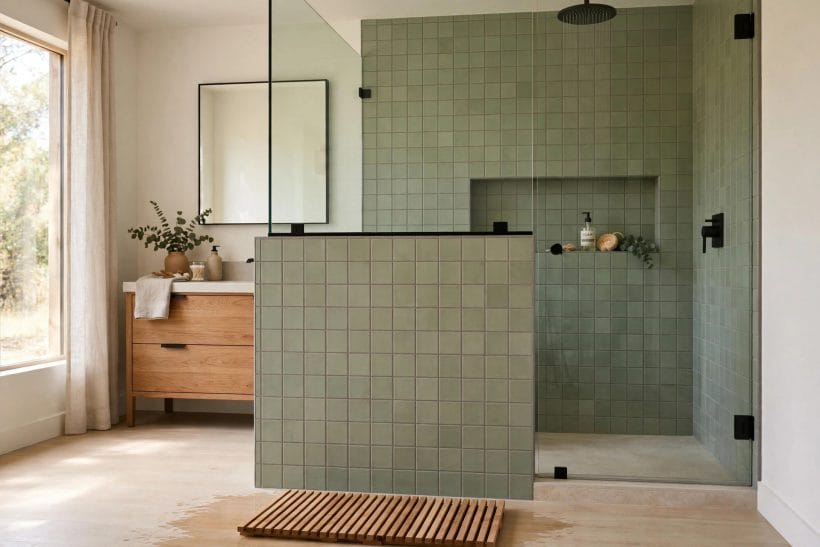
The third change is visual calm. A half wall gives the bathroom a horizontal line at a comfortable height, and that line can tie the room together, echoing the top of a vanity, the line of a mirror, or the edge of a tiled band. When the wall is finished in the same tile as the rest of the room, it can almost disappear into the surfaces around it, leaving the glass as the only visible division. When it is finished in a contrasting material, such as timber cladding or a stone-look surface, it becomes a deliberate feature, a piece of joinery in its own right. Either approach can work, and the choice depends on whether you want the shower to blend in or to stand out as a designed element in the room.
3. Fixed Panels and Return Panels: Reading the Shapes
Most half-wall enclosures use a single fixed panel that runs along the open side of the shower, parallel to the wall, and that is the shape most people picture first. It is the simplest version of the form, and its simplicity is its strength: one clear plane, one solid wall beneath it, and an open end for entry. The panel reads as a quiet screen, and because there is nothing to open or close, there is nothing to catch on a towel rail or a door frame. In a narrow bathroom, where every centimetre of movement counts, that simplicity is worth a great deal.
Some showers add a short return panel at the entry end, turning the single plane into a gentle corner. The return panel narrows the opening and catches spray that would otherwise drift out of the entry side, which can be useful where the shower head sits close to the opening or where the spray is strong. The cost of the return is a narrower entry, so the gain in splash control has to be weighed against the ease of stepping in and out, especially for anyone who moves less freely. A return also adds another edge and another line of metal or glass to keep clean, so it suits rooms where the extra containment is genuinely needed rather than rooms where it is added out of habit.
A third shape uses a panel that is angled or stepped rather than straight, following an awkward corner or a sloping ceiling. These versions are less common, and they tend to appear where the room itself is unusual, such as under a sloping roof or beside a chimney breast. They are worth noticing because they show how flexible the half-wall form can be: the wall can follow the shape of the room, and the glass can follow the wall, so the shower fits the space instead of forcing the space to fit a standard screen. Whatever the shape, the same test applies: can you step in and out comfortably, does the panel catch the main spray, and does the room still feel open once the panel is in place.
4. Clear, Frosted and Tinted Glass: Choosing the Look
Clear glass is the most popular choice for a half-wall panel, and the reason is straightforward: it preserves the openness that the form is built for. Light passes through it, the tile behind it stays visible, and the shower feels like part of the room rather than a separate compartment. Clear glass does show water marks and soap residue more readily than other finishes, so it asks for regular wiping, but many people accept that upkeep in exchange for the bright, open look. In a room with attractive tile or stone, clear glass is also the choice that lets those surfaces do the talking.
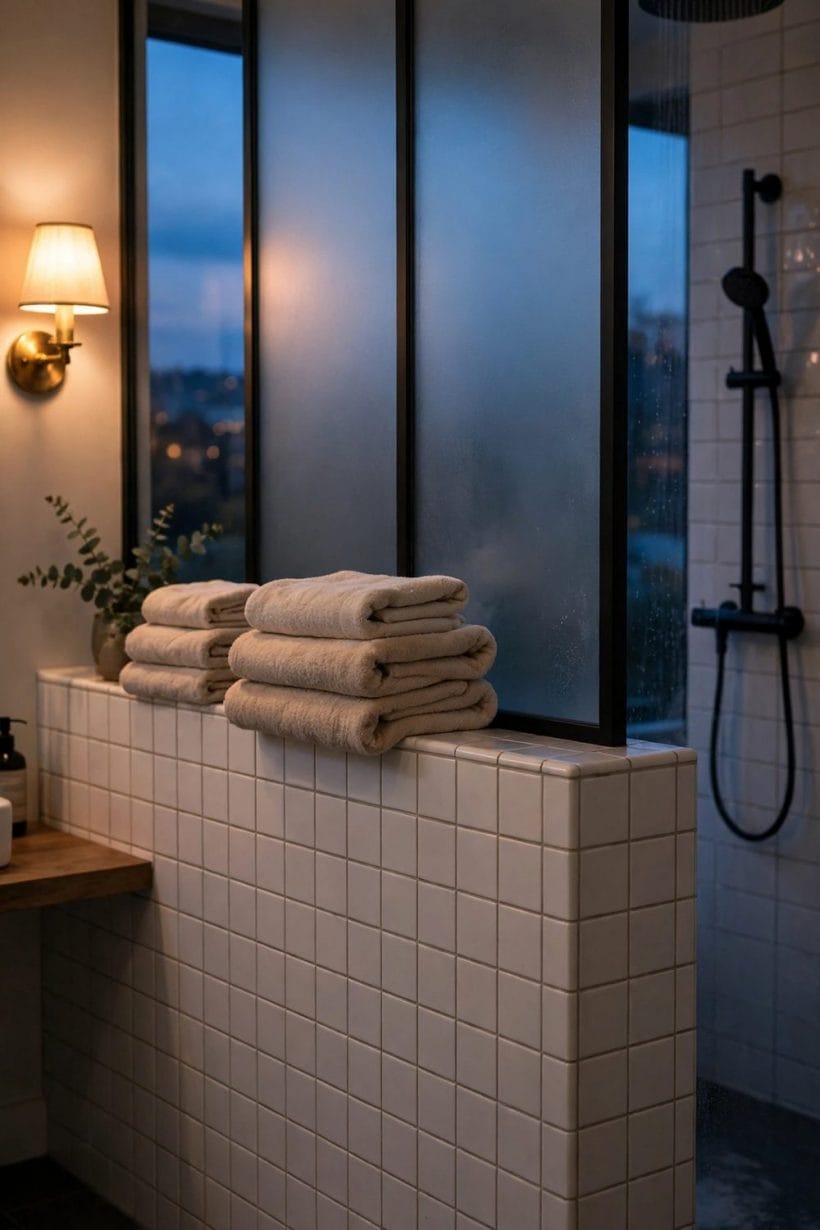
Frosted or obscured glass trades some of that openness for privacy, softening the view into the shower while still admitting light. In a shared bathroom, or in a room where the shower sits opposite the door, that softening can make the difference between a shower that feels exposed and one that feels comfortable. Frosted glass also hides water marks better than clear glass, which can make everyday upkeep feel less demanding, although the textured surface itself needs a gentle cleaning approach so the finish is not damaged over time. The effect on the room is a softer, more diffused light, and a shower that reads as a pale, glowing block rather than a transparent plane.
Tinted glass, in soft grey, bronze or green tones, is a quieter option that adds a hint of colour without closing the room down. A tint can warm or cool the light passing through it, and it can tie the shower to the metal finishes or the tile colours elsewhere in the room. The tint is usually subtle, and it should be judged in the room’s own light rather than in a showroom, because daylight, lamplight and the colour of the surrounding tile all change how a tint reads. Whatever the finish, the glass in a shower panel should be the safety type made for wet rooms, and that is a matter to confirm with the supplier and the installer rather than to assume.
5. Framed, Semi-Framed and Frameless Edges
The edge of the panel sets the character of the whole enclosure, and the three broad approaches each give a different result. A fully framed panel carries a metal outline around its edges, which gives a crisp, defined look and a reassuring sense of structure. The frame can match the taps and fittings, in chrome, brushed nickel, matt black or brass tones, and that matching can pull the whole bathroom together. Framed panels also give the eye a clear line to follow, which can be helpful in a busy room where the tile, the fittings and the accessories are all competing for attention.
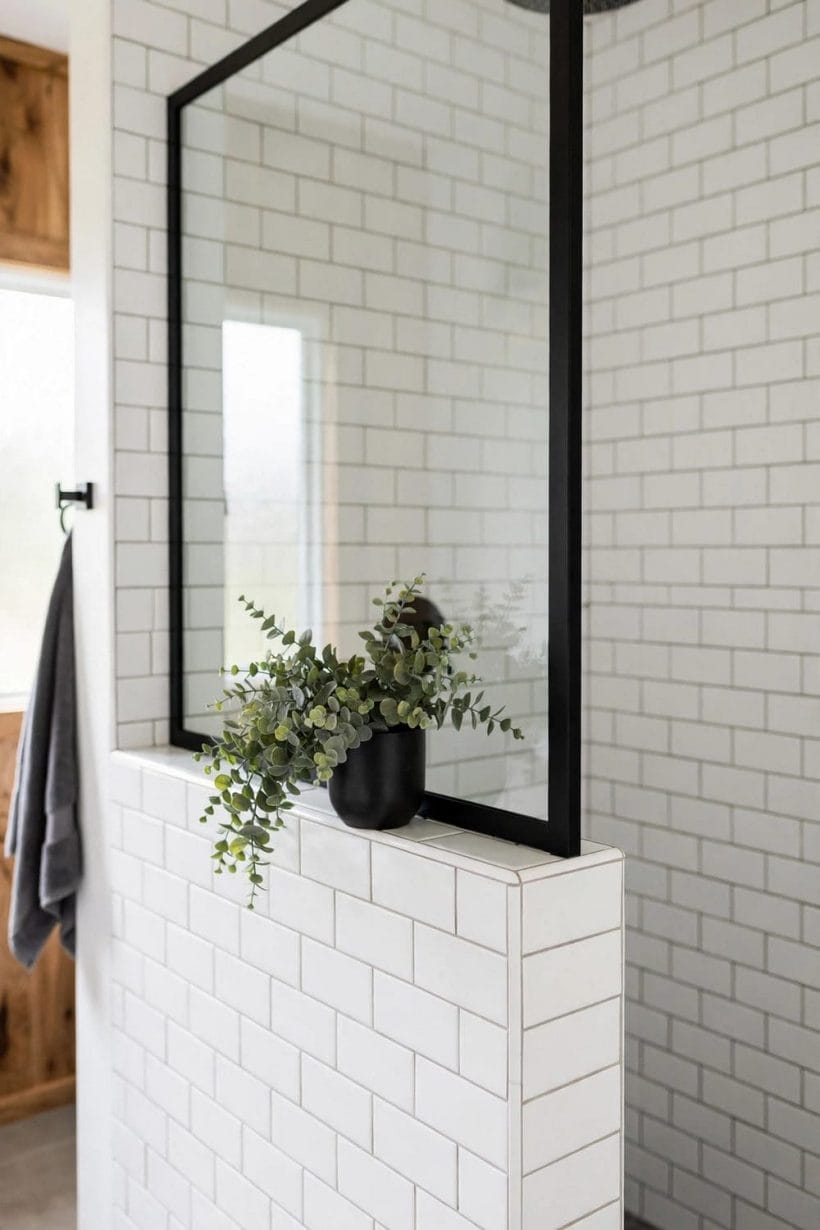
A semi-framed panel keeps a frame on some edges and leaves others bare, which softens the outline while still giving the panel visible support. This middle approach suits rooms where a full frame would feel heavy but a completely bare edge would feel unfinished, and it is a common choice in rooms that mix modern and traditional elements. The visible frame lines can also be used to echo other lines in the room, such as the edge of a mirror or the frame of a window, so the shower feels connected to the rest of the design rather than standing apart from it.
A frameless panel has minimal visible metal, often just small brackets or a slim channel where the glass meets the wall and the floor, and the result is the most open and contemporary look of the three. The glass appears to float above the half wall, and the room feels as undivided as the form allows. Frameless panels ask for careful installation, because there is less metal to hide any unevenness in the wall or the floor, and that installation is professional work, including the fixing, sealing and alignment of the panel. The payoff is a shower that barely interrupts the room at all, and in a small bathroom that near-invisibility can be the difference between a room that feels cramped and one that feels calm.
6. Height and Length: Judging the Panel by Eye
Judging a half-wall panel is less about fixed measurements and more about proportion and sightlines. Stand where you would stand to shower, and notice where the top of the wall falls relative to your own height: it should feel like a low, solid anchor, not like a barrier you have to look over. Then look at the top of the glass: it should clear the spray comfortably while leaving the open space above it that gives the form its airy quality. The panel as a whole should feel balanced, with the solid part and the glass part in a pleasing relationship to each other and to the ceiling height of the room.
Length is judged in a similar way, by following the path of the water. The panel should extend far enough along the open side to catch the spray from the shower head in its normal position, with a little room to spare for the way water bounces and drifts. A panel that stops short of the main spray will leave the dry floor damp, while a panel that runs far beyond it will narrow the entry and darken the corner for no benefit. The shape of the room matters here too: a shower set into a corner has walls on two sides to help contain the water, while a shower open on two sides leans more heavily on the panel itself. These are judgements best made with the room in front of you, ideally with a professional who can consider the drainage, the falls of the floor and the position of the shower head together.
Proportion also matters for the room as a whole, and this is where the wider plan of the home comes in. A half wall that suits a generous main bathroom may overwhelm a tiny ensuite, and a panel that feels right in a tall room may feel squat under a low ceiling. Looking at how the shower sits within the overall layout, as in the tiny house floor plans collection, helps to keep the shower in scale with the rooms around it, so the bathroom feels like part of a coherent home rather than a collection of separate fittings.
7. Colour and Finish Pairings Around the Glass
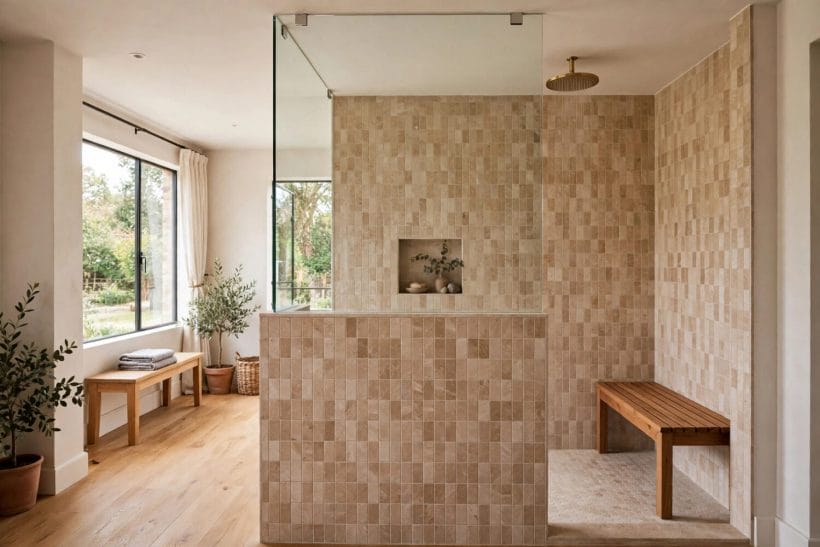
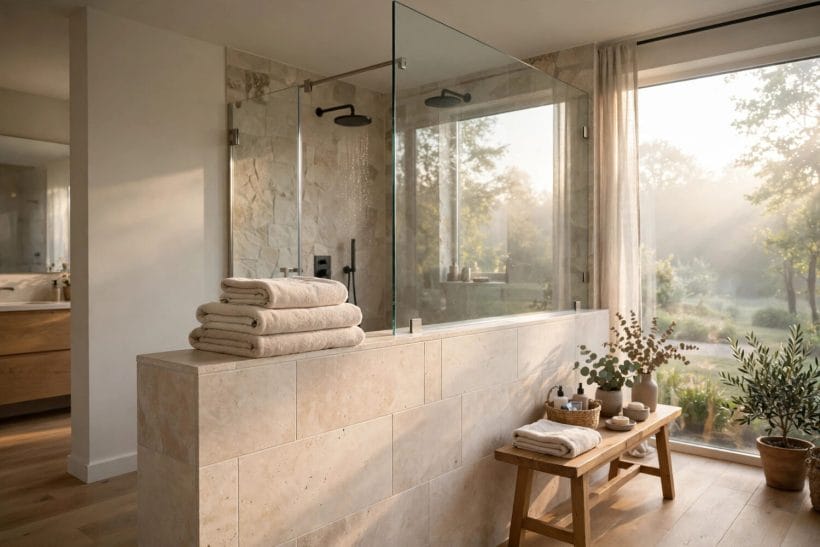
Because glass itself carries almost no colour, the surfaces around a half-wall panel do most of the decorative work, and that gives the room a great deal of freedom. White and pale grey tiles keep the shower bright and make the glass almost disappear, which suits rooms that aim for a calm, spa-like feeling. Warmer tiles, in soft beige or sandy tones, give the same form a gentler, more traditional character, and the glass warms up with them, catching golden reflections from the lamplight in the evening. Darker tiles, in charcoal or deep green, turn the shower into a dramatic corner, and the contrast between the dark tile and the clear glass can be striking, especially when the metal fittings pick up the same dark tone.
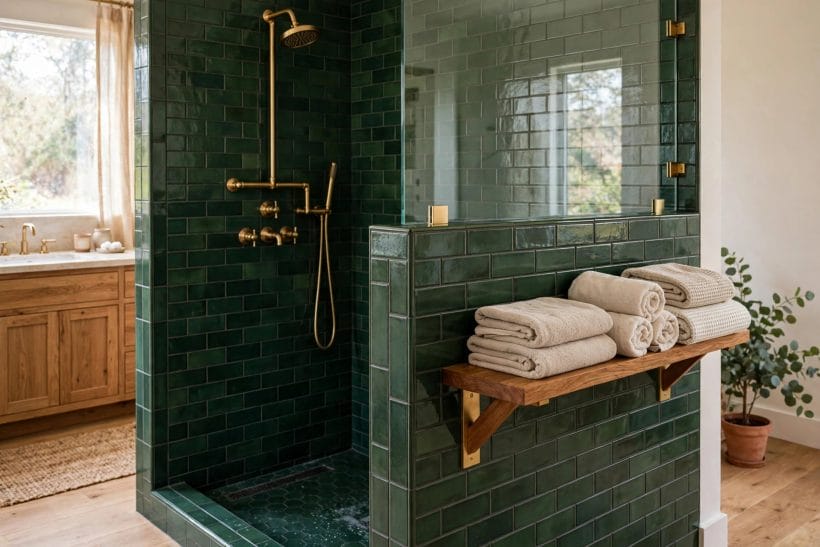
The finish of the half wall itself is part of the same decision. Tiling the wall in the same tile as the shower keeps the form quiet and continuous, and the wall reads as an extension of the shower rather than a separate piece. Cladding it in timber, or in a stone-look surface, makes the wall a feature in its own right, and that can be a good way to bring warmth into a room that is otherwise all tile and glass. Painting the outer face of the wall in the room’s wall colour, while tiling the inner face, is another approach, and it lets the wall belong to the dry side of the room while still standing up to splashes on the wet side. Each approach changes the feeling of the room, and the choice is worth making deliberately rather than by default.
Metal finishes tie the panel to the rest of the bathroom, and they deserve the same attention as the tile. Chrome is bright and reflective, and it keeps a modern room feeling crisp. Brushed nickel is softer and quieter, and it suits rooms with warm tiles and timber. Matt black is bold and graphic, and it can turn the edge of the panel into a deliberate line that echoes a black-framed mirror or black tapware. Brass and gold tones bring warmth, and they pair well with green, navy and warm white tiles. The tile angle itself has its own companion reading, and the travertine tile bathroom ideas post shows how one stone tile can set the tone for a whole bathroom, which is a useful reminder that the panel never stands alone: it always sits within a room full of other choices.
8. Light, Steam and the Open Top
The open top of a half-wall enclosure is one of its greatest strengths, and it is also the feature that most needs understanding. Because the panel does not reach the ceiling, warm air and steam can rise out of the shower and disperse into the room, rather than building up inside a closed cubicle. That makes the shower feel less steamy and less enclosed, and it means the mirror and the rest of the room clear more quickly after a shower. The open top also lets light from a window or a ceiling light fall into the shower from above, which is part of why half-wall showers photograph so brightly and feel so pleasant in person.
Light deserves its own attention, because the panel interacts with it in ways that a solid wall does not. Daylight passing through clear glass throws soft reflections onto the tile and the floor, and those reflections move through the day as the sun moves, so the shower looks slightly different in the morning and in the evening. Artificial light behaves in a similar way: a ceiling light above the shower will reflect in the glass, and a wall light beside the mirror will catch the edge of the panel. The window question is closely related, and the window in shower post treats window placement, light and privacy on their own terms, which is the right place to look if the shower sits near a window.
Steam management still matters, even with an open top. A room that cannot clear steam will stay damp, and dampness over time affects paint, grout and timber, so ventilation should be considered as part of the room rather than as an afterthought. An opening window, a well-placed fan, or simply a door left ajar after showering can all help, and the right combination depends on the room, the climate and the way the home is heated. This is general background rather than installation advice: the ventilation and waterproofing arrangements for a particular bathroom are matters for qualified professionals, who can consider the room as a whole rather than the shower in isolation.
9. Cleaning and Everyday Living With a Half Wall
Daily life with a half-wall panel is straightforward, and most of the upkeep is the kind of small routine that becomes habit quickly. A quick wipe of the glass after showering keeps water marks from building up, and a squeegee kept within reach makes that wipe a matter of moments rather than a chore. The half wall itself gives a convenient shelf at a comfortable height, and that shelf often becomes the home for a plant, a candle, or the bottle that is used most often, although anything kept there should be able to cope with occasional splashes. The open entry means there is no door track to clean and no curtain to launder, which removes two of the more tedious jobs that other shower forms bring with them.
Deeper cleaning is also simpler than with a fully enclosed screen, because every surface is reachable without climbing into a cubicle or wrestling a door off its runners. The glass can be wiped from both sides, the top of the half wall can be reached easily, and the floor around the shower can be mopped without working around a door frame. The places that need attention are the joints where the glass meets the wall and the floor, where soap and moisture can collect, and the seal along the top of the half wall, which should be checked from time to time for wear. Gentle cleaning products and soft cloths protect both the glass finish and the seal, and abrasive pads are best avoided on any coated or frosted surface.
For households with children, older family members, or anyone who moves less easily, the open entry and the absence of a step over a door track can be a real advantage, and the half wall itself can serve as a steadying handhold at a natural height, although it is not a substitute for properly fitted support rails where those are needed. The solid wall also gives a place to sit a small stool or a bathing seat nearby, and the open form means a helper can stand beside the shower without being shut out by a door. These everyday qualities are easy to overlook when choosing a shower on looks alone, but they are the qualities that decide whether the shower still feels right after months of daily use.
10. Cost Drivers in General Terms
The cost of a half-wall shower enclosure varies with a handful of drivers, and understanding those drivers is more useful than any single figure, which would depend on the room, the region and the choices made. The glass itself is one driver: thicker panels, larger panels, frosted or tinted finishes, and frameless edges each sit in a different place from a standard clear framed panel, and the difference comes from the material and the work involved in making and fitting it. The half wall is another driver, because building a tiled wall, with its waterproofing and finishing, is a different job from fitting a screen to an existing wall, and the material chosen for the wall changes the work involved.
Installation is a further driver, and it is the one most often underestimated. Fixing a glass panel level and true, sealing it properly, and tying the wall into the room’s waterproofing are skilled jobs, and the time they take depends on the condition of the existing walls and floor, the shape of the room, and whether other work is happening at the same time. Plumbing and waterproofing are professional work throughout, and any change to the shower’s position or drainage adds to the scope of the job. Fixtures and fittings are the last driver: the shower head, the controls, the tiles and the metal finishes each carry their own range of choices, and a room finished with simple, well-made fittings will sit in a different place from a room finished with elaborate ones.
The sensible way to approach cost is to gather local quotations for the actual room, with the panel shape, the glass finish, the wall material and the fittings all specified, so the quotations can be compared like with like. That approach avoids the trap of comparing a bare panel price with a fully installed price, or a tiled wall with a simple screen, as if they were the same thing. The formal cost angle for showers is treated on its own in a companion post, and this post deliberately keeps to drivers only, so readers can use it to ask better questions of their own suppliers and installers rather than to anchor on a figure that would not survive contact with a real room.
Final Considerations
A half-wall shower enclosure succeeds when it is judged as a whole: the wall, the glass, the edge, the light and the room around it, all working together rather than competing. The form is at its best in rooms where openness matters, where light is precious, and where the shower should feel like part of the bathroom rather than a box inside it. It asks for honest judgement about splash control and upkeep, and it rewards that judgement with a shower that is bright, easy to enter, and pleasant to live with day after day.
Before settling on a version of the form, it helps to look at the shower in the context of the home around it. The tiny house interiors collection shows how small rooms borrow light and sightlines from each other, which is the same principle the half wall relies on, and the simple outdoor shower ideas post offers a useful contrast, showing what happens when a shower is opened up completely rather than divided by a low wall and a panel. Seeing the half-wall form between those two poles, the fully open shower on one side and the fully enclosed cubicle on the other, makes its particular balance easier to appreciate and easier to choose well.
Talk through the arrangement with a qualified installer before committing, especially where plumbing, waterproofing or drainage is involved, and ask to see the glass finish, the edge detail and the wall material together in the room’s own light. A panel that looks right in a showroom can read differently beside your own tiles, and a wall height that looks right in a photograph can feel different when you stand beside it. The extra care is worth it, because a half-wall enclosure is a long-term part of the bathroom, and the versions that last are the ones chosen slowly, with the room itself in view.

0 Comments