
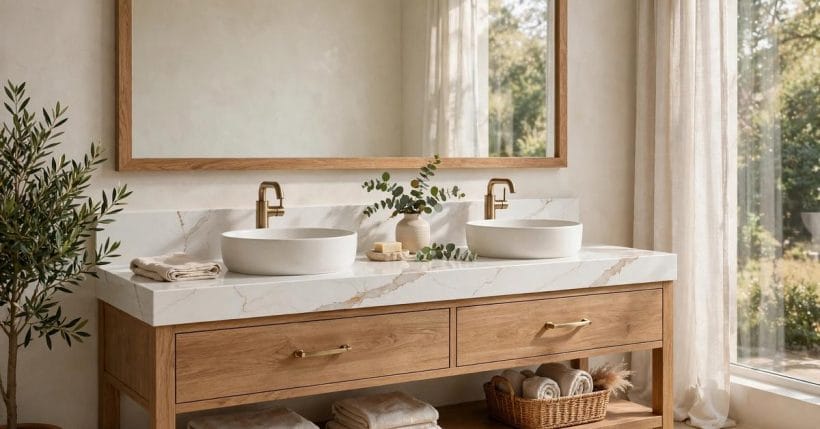
A bathroom countertop has a harder life than any kitchen worktop: standing water, hot straighteners, toothpaste, cosmetics and a daily wipe — all on a surface usually chosen in a showroom for its looks alone.
This survey walks through the top surface materials in general terms — what each one is, how it behaves around water and stains, what it asks of its owner, and which bathrooms it suits — so the showroom decision is made on behaviour, not just appearance.
1. Bathroom Countertops at a Glance
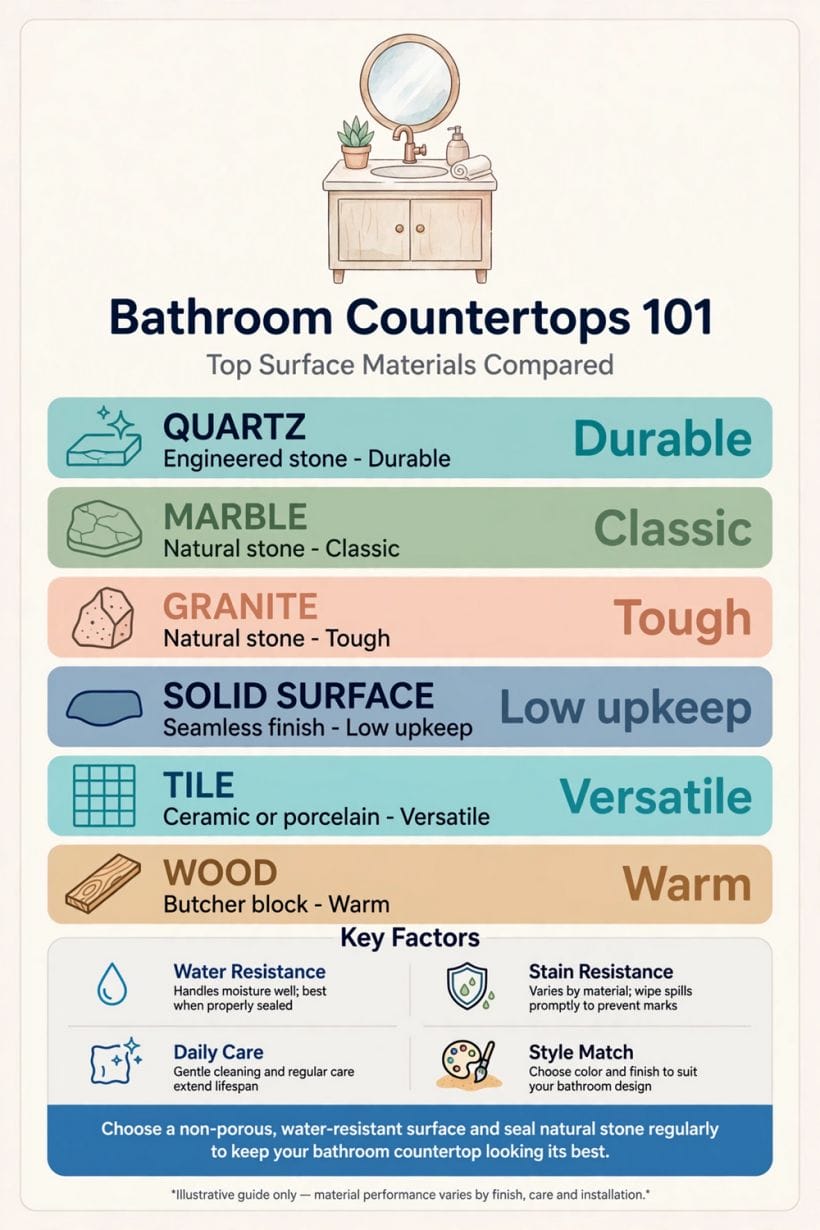
The countertop is the bathroom’s work surface and its most-touched piece of stone, composite or timber. Six material families cover almost every vanity top made: engineered quartz, natural granite and marble, solid surface, tile, and wood — plus laminate and concrete at the edges of the survey. This article is the materials overview for the whole bathroom cluster gathered under bathroom ideas: it compares the families side by side, in general terms, without prices or performance scores, because both depend on the specific product, finish and installation in ways no survey can honestly fix.
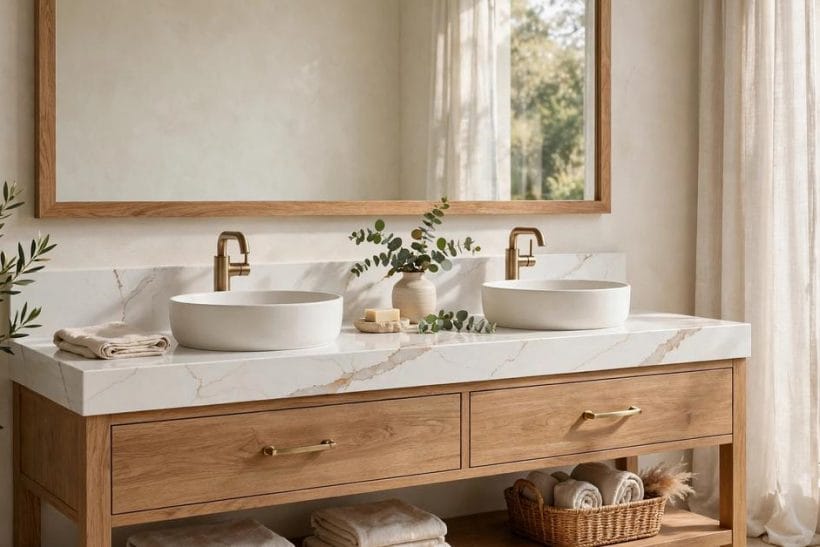
One split matters before the survey starts. Quartz appears here as one family among six; the material has its own deep-dive in the quartz countertop explainer, which takes its composition and care questions apart in full. Read this page to choose the family, then the specialist pages to choose within it. The feature bathroom shows a typical survey podium in one image — a thick stone-look top carrying twin vessel basins on an oak vanity — but every family below has bathrooms where it beats the rest.
| Material | Character in general terms |
|---|---|
| Quartz | Engineered stone; consistent colour, non-porous, no sealing routine |
| Granite | Natural stone; hard and heat-tolerant, periodic sealing |
| Marble | Natural stone; cool, veined, beautiful — and the most stain-sensitive here |
| Solid surface | Cast composite; seamless, can integrate the basin, repairable |
| Tile | Ceramic or porcelain; patterned and repairable, grout is the upkeep |
| Wood | Butcher block; warm and tactile, needs its finish maintained |
2. Quartz: The Engineered All-Rounder
1. What quartz is
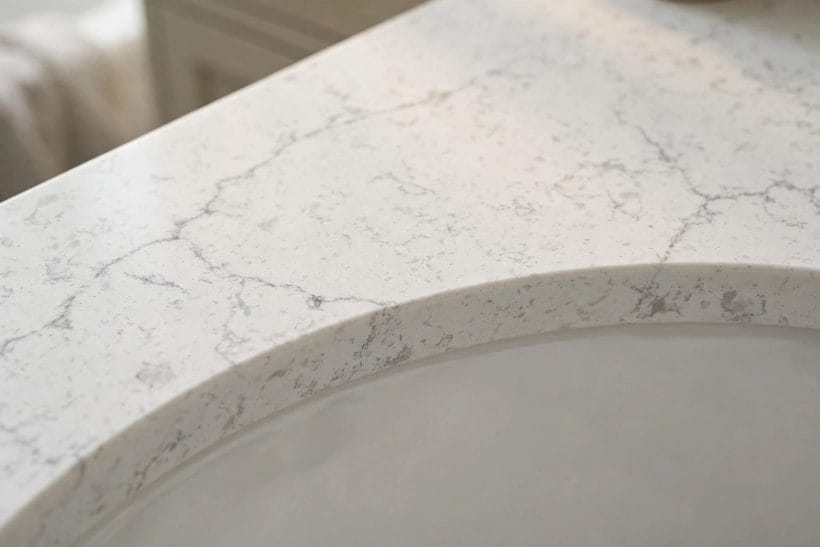
Quartz countertops are engineered: crushed quartz stone bound with resin and pigment into slabs of consistent colour and pattern. The gallery close-up shows the result — an even, fine-grained white with soft veining that repeats predictably from slab to slab, which is why quartz is the family specifiers reach for when two bathrooms must match, or when a long double vanity cannot risk a pattern surprise at its centre join.
2. How quartz behaves in a bathroom
The resin binding makes quartz non-porous, so it takes no sealing routine and shrugs off the standing water and toothpaste of daily life. Its weaknesses are heat and harsh chemicals rather than water: a hot styling tool left face-down is the classic quartz injury, so a heat mat belongs beside the basin in a quartz bathroom, and strong solvents should stay in the cupboard rather than on the top.
3. Where quartz suits best
Family bathrooms and busy ensuites, where the top is wiped by many hands and nobody will keep a sealing diary. The feature vanity’s stone-look top — thick-edged, gently veined, carrying vessel basins — is quartz’s natural habitat: calm colour, hard wear, and no maintenance conversation at all.
3. Marble: The Classic, With Caveats
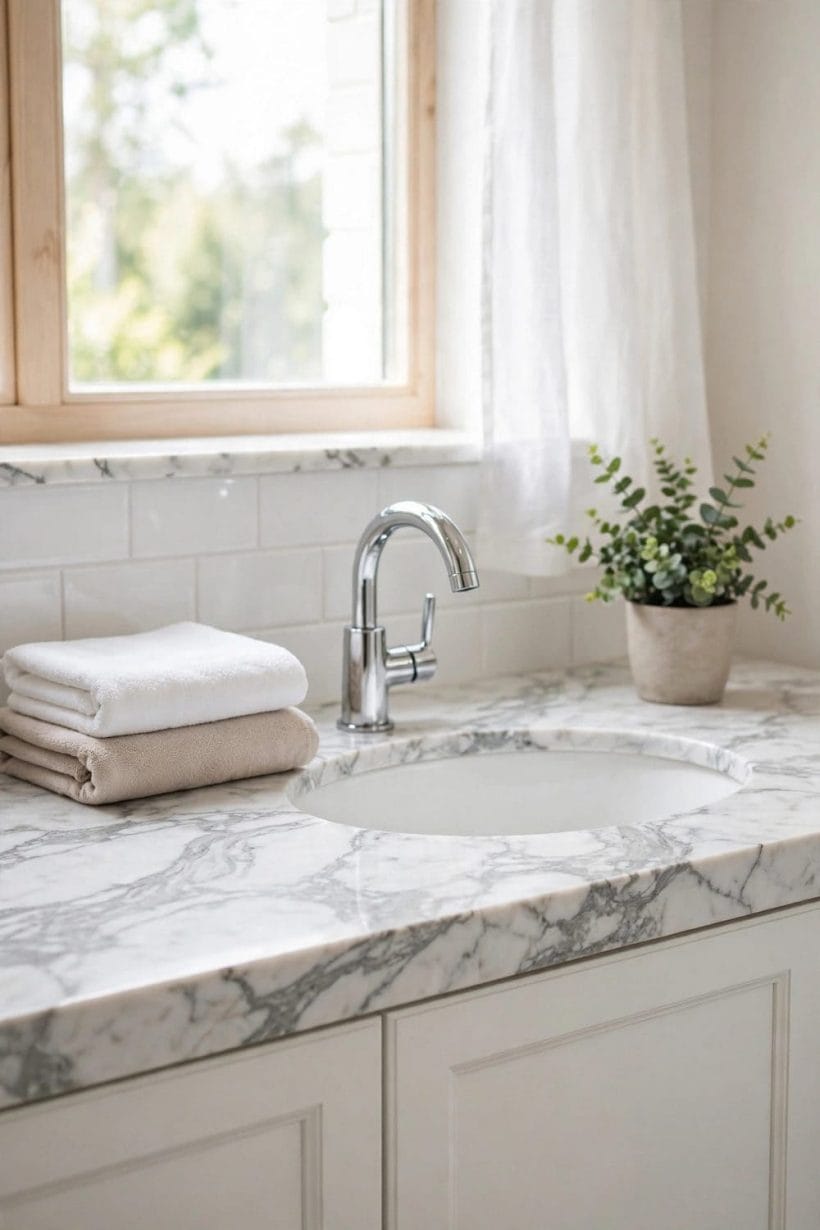
Marble is the material bathroom countertops are pictured in — cool white stone with grey veining, the spa and hotel standard for a century. Its virtues are real: it stays cool to the touch, it brightens small rooms, and no two pieces ever repeat. Its caveat is equally real: marble is softer and more porous than granite or quartz, and acidic or coloured spills — some cosmetics among them — can etch or stain it. Choosing marble is choosing both halves of that sentence.
4. Living with marble’s patina
The honest way to choose marble is to choose its ageing too. Sealed regularly and wiped promptly, it stays bright for years; used casually, it develops a soft patina of marks that some owners love as character and others read as damage. Neither reaction is wrong — but it must be had before the slab is cut, not after the first ring mark appears beside the basin.
5. Honed finishes hide the evidence
A honed — matte — finish shows etching far less than a polished one and suits marble’s bathroom use better: gentle sheen, soft reflections, and a surface that forgives the small accidents of a working bathroom. Polished marble belongs in the guest bathroom that is admired more than used; honed marble earns its place in the everyday one.
6. Where marble suits best
Ensuites and guest bathrooms used by adults with unhurried routines, and anywhere the room’s whole design leans on the stone’s veining. In a children’s bathroom with coloured toothpaste and bath paints, marble is a beautiful mistake waiting to happen — save it for the room whose users will wipe a spill when they make it.
4. Granite: Natural Stone With Grit
7. What granite is
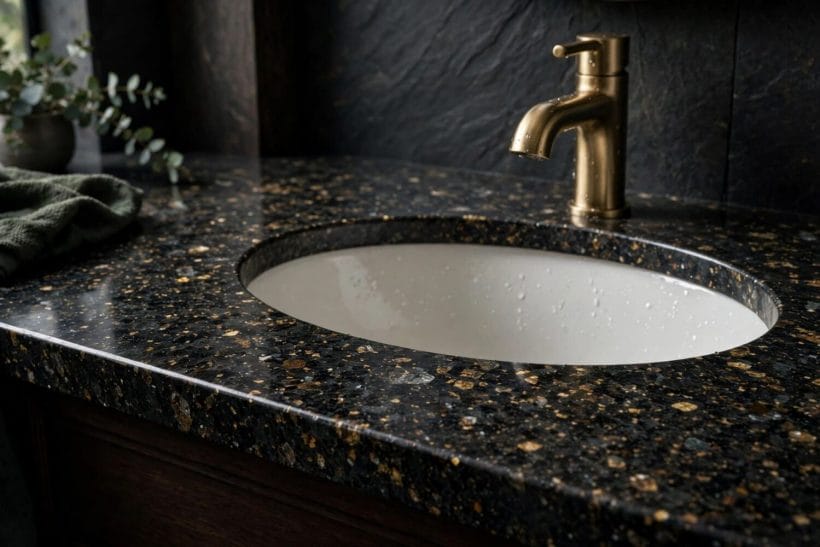
Granite is quarried stone, cut and polished, and every slab is geologically unique — the gallery’s black granite flecked with gold and bronze mineral is a pattern no factory designed. Buyers choose their actual slab, not a sample’s promise, which is part of the pleasure of the material and part of its process: the slab yard visit is not a formality.
8. How granite behaves in a bathroom
Granite is hard, heat-tolerant and unbothered by hot tools or splashes. Its one routine is sealing: the stone is microscopically porous, and a periodic seal keeps dark liquids from settling into it. In a bathroom — where spills are water and soap far more than oil or dye — granite’s upkeep is lighter than kitchen folklore suggests, and a water-drop test on the surface tells the owner when a reseal is due.
9. Where granite suits best
Bathrooms that want natural drama in a small dose: a vanity top is a modest slab, so a bold granite that would overwhelm a kitchen becomes a jewel here. Dark granites with metallic fleck, like the gallery’s, pair naturally with brass taps and moody walls, and pale granites with fine grain behave almost like neutrals.
5. Solid Surface and Integrated Basins
10. What solid surface is
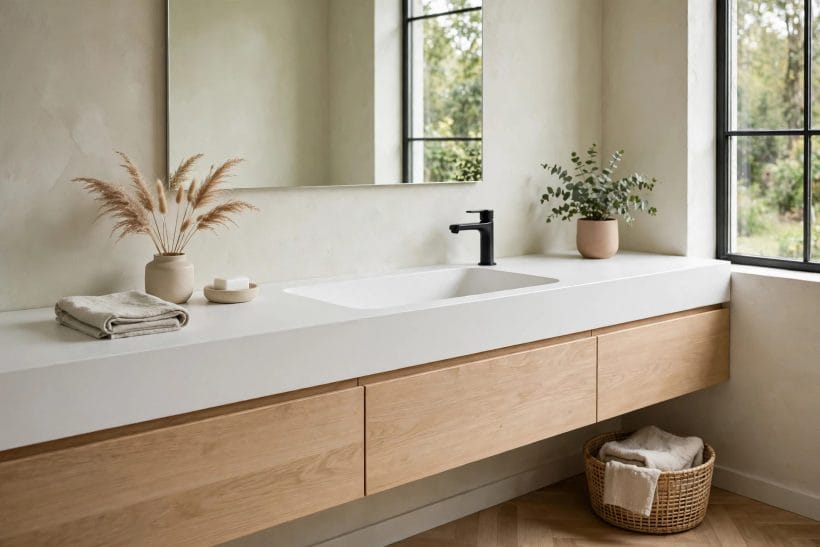
Solid surface is a cast composite — mineral filler in an acrylic or polyester resin — formed into sheets that can be joined invisibly and shaped with heat into gentle curves. The gallery bathroom shows its party trick: the countertop and the basin are one continuous piece, a shallow trough with no seam, no rim and nowhere for water and soap to hide.
11. How solid surface behaves
It is non-porous, warmer to the touch than stone, and — uniquely in this survey — repairable at home level: scratches and dull patches can be sanded and re-polished back towards the original surface. It dislikes strong heat, so styling tools need the same mat discipline as quartz, and its softer landing for a dropped bottle is a genuine comfort in a family bathroom.
12. Where solid surface suits best
Minimal and family bathrooms alike: minimalists for the seamless troughs and integrated basins, families for the repairability and the absence of grout or seals to maintain. On a wall-hung vanity like the gallery’s, a solid-surface top keeps the whole unit looking carved from a single material, which is the quiet luxury the family sells.
6. Tile Countertops
13. What a tile countertop is
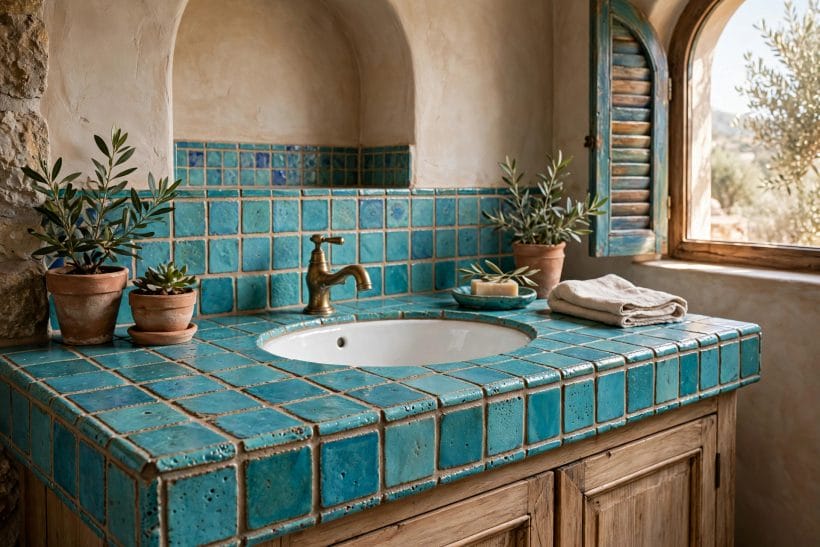
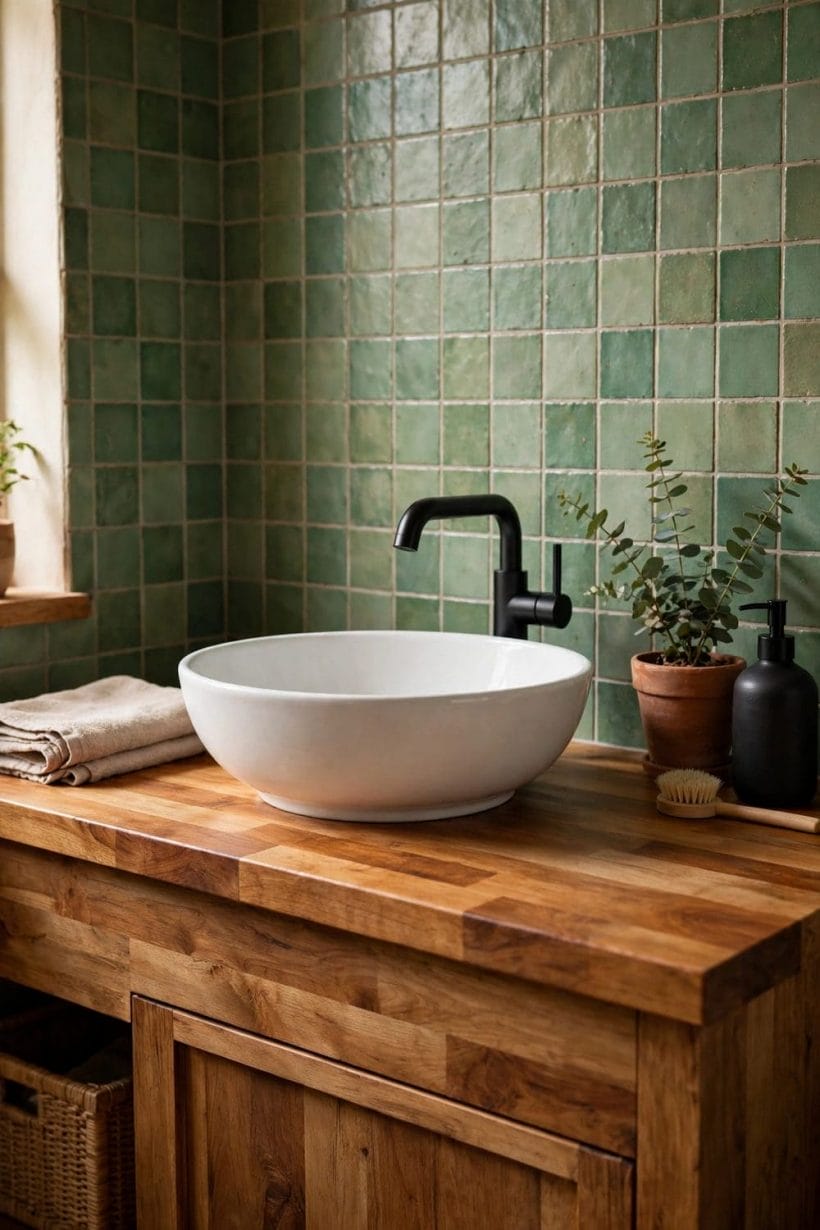
A tiled top is a waterproofed substrate — board or screed — finished in ceramic or porcelain tile: the gallery’s glossy turquoise squares, hand-glazed and slightly uneven, carrying counter and splashback in one continuous skin. Large-format porcelain shrinks the grout count to a few lines; small tiles multiply the pattern and the hand-made feel.
14. Grout is the upkeep
The tiles themselves are nearly indestructible and completely waterproof; the grout lines between them are the maintenance story — they collect soap film, need sealing in some systems, and want a brush rather than a wipe. Cement-free grouts close much of that gap, and the wider tile questions are taken apart in ceramic tile bathroom, where tile is the room’s whole surface rather than just its top.
15. Where tile suits best
Bathrooms with a point of view: Mediterranean colour, patterned porcelain, handmade gloss glazes that move in the light. Tile is also the repairable option — one cracked tile can be swapped without replacing the top — which keeps it in the survey long after slab materials took the mainstream, and makes it the renovator’s friend in older houses.
7. Edges, Splashbacks and Basin Pairings
16. Edge profiles change the material’s mood
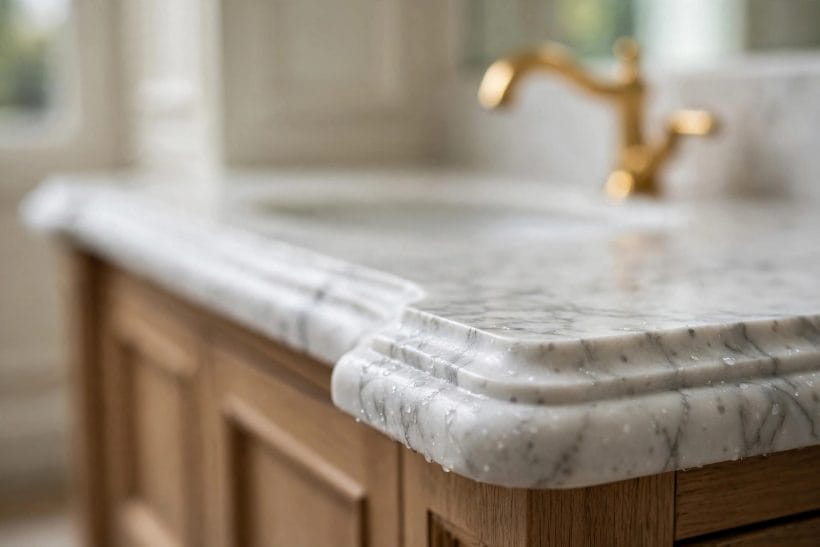
The gallery’s stepped ogee edge makes marble read traditional; the same slab with a plain square edge reads modern. Edges are chosen per material — stone takes profiles beautifully, solid surface rounds softly, tile needs a trim or a bullnose piece — and the choice changes the top’s whole period feel while adding almost nothing to the fabrication story.
17. Splashbacks and upstands
A short upstand in the countertop material, like the feature vanity’s stone backplate, protects the wall joint with the least visual fuss; a full-height splashback in the same slab turns the vanity wall into a single stone composition. Tile tops usually run the tile up the wall, as the gallery bathroom in section 6 does — the simplest full-height answer of all.
18. Basin pairings
Vessel basins sit on top and show the counter off; undermounts disappear and maximise wipeable surface; integrated basins erase the joint altogether but exist only in solid surface, cast materials and some stone fabrications. Choose basin and material together — each constrains the other — and style the pair within the wider room using modern bathroom ideas as the frame.
8. Choosing by Bathroom
19. The family bathroom
Prioritise forgiveness: quartz or solid surface, an undermount or integrated basin, no sealing diary, nothing that stains at the sight of bath paint. The top will be wiped by whoever is nearest, with whatever is nearest — choose the material that survives that management style, because the management style will not change for the material — the same forgiveness test the tub side of the room is set in alcove bathtub ideas.
20. The ensuite
Adult routines allow the beautiful-but-honest materials: marble for the ritual of it, granite for drama, wood for warmth. An ensuite is also where a thicker, more decorative edge profile earns its place, because the room is experienced slowly and closely, as part of the bedroom’s comfort — the same long view that shapes bathroom remodel cost planning, where the vanity top is one decision among many but the one touched twice a day.
21. The guest and cloakroom bathroom
Small tops, occasionally used: this is where a jewel material fits a modest slab — a striking granite offcut, a marble remnant, a handmade tile. Guest bathrooms reward the memorable over the bulletproof, and a dramatic little countertop does the remembering for the whole room.
9. Wood, Concrete and the Warm Industrials
22. Wood and butcher block
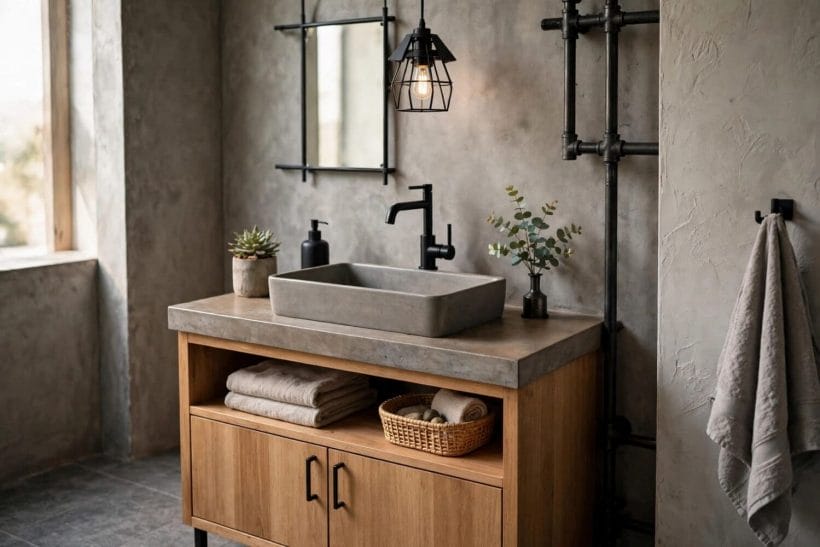
A timber top — sealed butcher block or a solid hardwood slab — brings a warmth no stone can: it is quiet under bottles, kind to dropped glass, and repairable by sanding and re-oiling. Its price is vigilance around the basin, where standing water tests the finish daily; in a splash-heavy family bathroom a wood top is a commitment, while in a calm ensuite it is the cosiest surface in this survey.
23. Concrete tops
Cast concrete, like the gallery’s grey top under a rectangular vessel basin, is the industrial entry: made to the vanity’s measure, pigmented, sealed, and ageing into its own patina of water marks. Owners who love it call that character; owners who want a surface to stay showroom-new should look at quartz instead. It is also heavy, so the vanity beneath must be built to carry it.
24. Laminate and the honest budget option
Modern laminates imitate stone convincingly, shrug off water on their face, and leave budget for the taps and tiles people actually touch — their weakness is the edge and the basin cut-out, where water can reach the core if the sealing fails. As a first-bathroom or rental answer it is entirely respectable, and pretending otherwise would make this survey a sales pitch instead of a survey.
10. Care, Sealing and Honest Upkeep
25. The sealing diary, by material
Granite and marble take periodic sealing; quartz, solid surface, glazed tile and laminate take none. That single difference is the honest core of countertop upkeep — everything else is wiping. If nobody in the house will ever seal a stone, the survey has quietly made its recommendation, whatever the showroom said.
26. Daily care that covers all six
Wipe standing water rather than leaving it to dry, clean with mild products, keep a mat under hot styling tools, and lift — don’t drag — heavy bottles across stone. Those four habits, none of them material-specific, prevent nearly every countertop injury this survey’s families ever suffer, in family bathrooms and ensuites alike.
27. Repairs: what can come back
Solid surface sands back towards new; wood re-oils; a single tile swaps out; laminate patches discreetly at its edges. Stone is the least forgiving — chips and etches are professional work — which is worth one thought at purchase time: in countertops, beauty and reparability rarely peak in the same material, and knowing which one the household values is the real conclusion of the survey.
Final Considerations
Choose the family by the bathroom’s real life first — who wipes it, how often, and whether anyone will ever seal a stone — and by the room’s design second. Quartz and solid surface forgive; granite endures with a small diary; marble rewards care with unmatched beauty; tile brings pattern and repairability; wood and concrete bring warmth and character at the price of vigilance. Get the basin pairing and the edge right alongside the material, and the countertop stops being a showroom gamble and becomes the hardest-working surface in the house, chosen on evidence.


0 Comments