

No single change lifts a house front like a black front door. It is the full stop at the end of the path — sharp against pale siding, warm against brick, calm against stone — and it makes every wreath, lantern and brass knocker hung on it look deliberate.
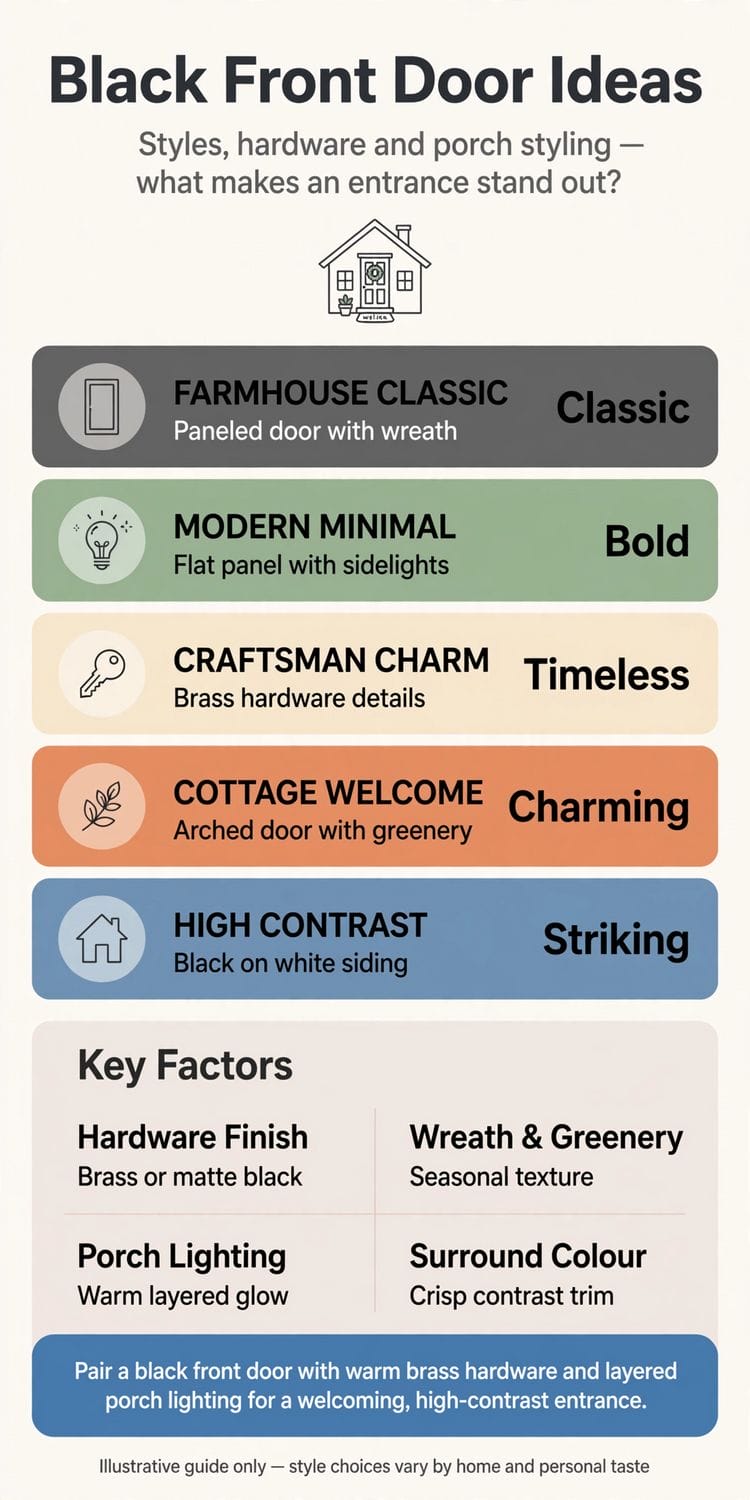
This collection works through black front doors by style, hardware and setting: classic panelled doors, flat modern slabs, arched cottage doors, the metals that suit black best, and the porch styling that finishes the entrance.
1. Black Front Doors at a Glance
Black works on a front door for three plain reasons: it hides the scuffs an entrance collects, it frames whatever hangs on it — wreath, knocker, house number — like a picture frame, and it suits almost every architecture. This post owns the colour: for the wider collection, start with front door ideas, where every colour is in play. Within the family, double front doors owns wide paired entrances and entry doors with sidelights owns glazed side panels — here, sidelights appear only as partners to black.
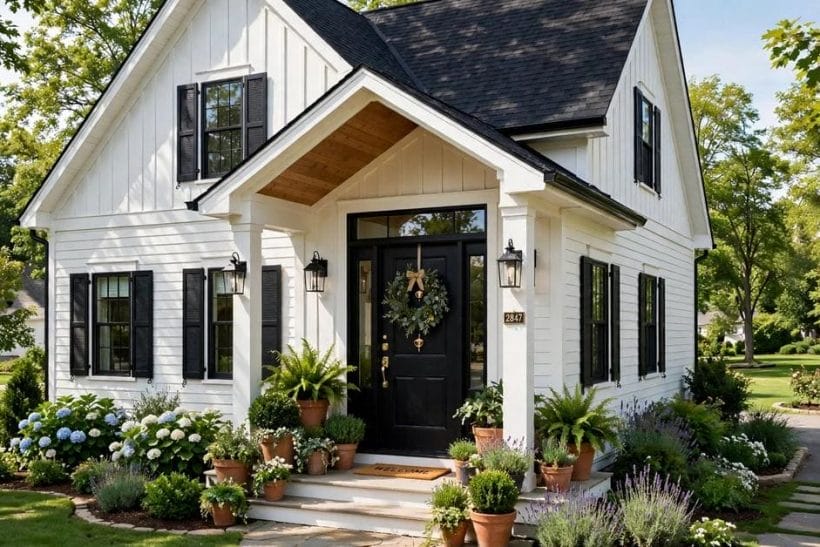
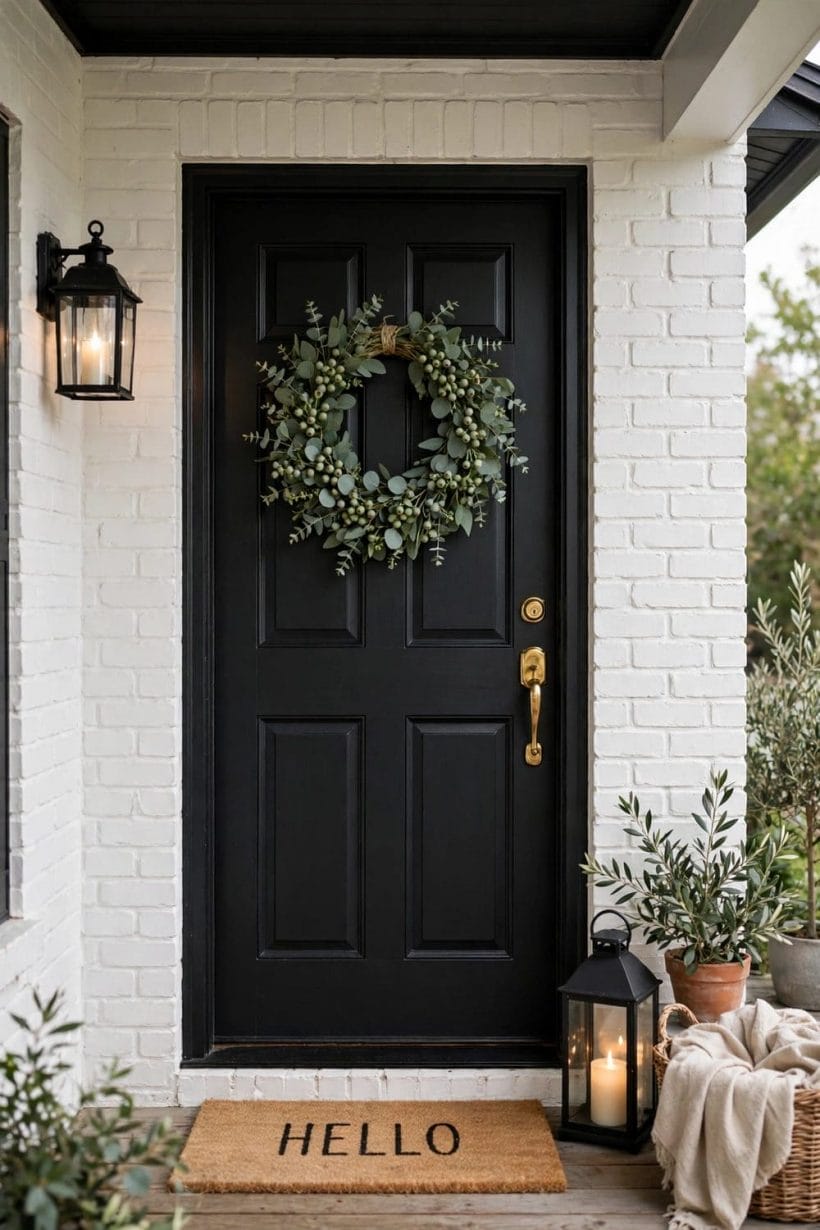
The feature house shows the classic formula: a panelled black door with a eucalyptus wreath and brass handle, sidelights and a transom above, black shutters echoing the door across white board-and-batten walls, terracotta pots of ferns softening the steps. Almost every idea below varies those moves — colour discipline, one warm metal, something green, light on both sides.
| Door family | Character |
|---|---|
| Panelled traditional | Raised or recessed panels, wreaths, brass — the timeless black door |
| Modern flat slab | Flush surface, long pull handle, minimal trim |
| Glazed and sidelight | Black frame holding glass — light in, privacy tuned by the glazing |
| Arched and cottage | Curved heads, ledged planks, garden-first charm |
| Double doors | Paired black leaves for wide openings and grand arrivals |
2. Classic Panelled Black Doors
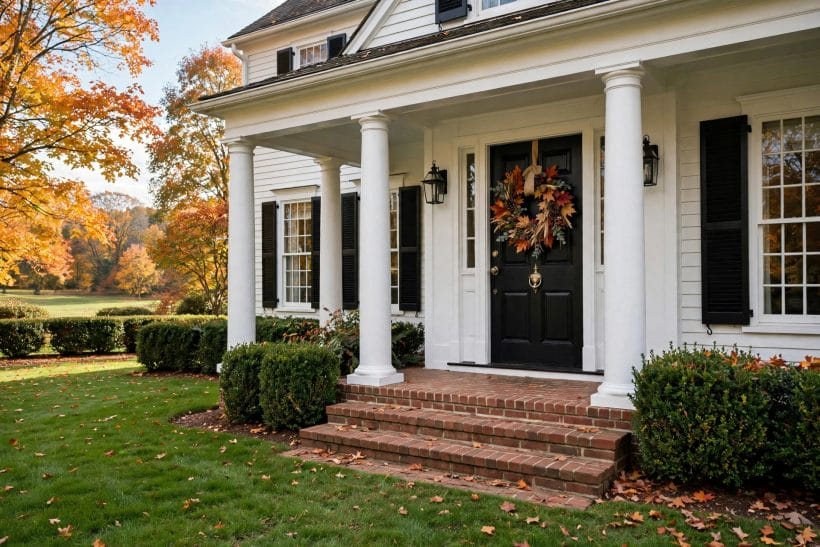
The panelled door is where black began, and still the safest choice: mouldings catch shadow, the colour reads formal without stiffness, and the style suits any house built before flat slabs existed. The gallery house pairs its door with an autumn wreath, white columns and brick steps — the full traditional welcome.
1. Six-panel colonial in gloss black
The six-panel layout under high gloss is the definitive traditional black door. Gloss throws back the porch light and shows every moulding edge — and every fingerprint, so this finish suits households happy to wipe the door down as part of the welcome.
2. Four-panel with a raised centre
Four broad panels with raised centres give a heavier, more architectural read than six small ones. The bigger fields of black suit taller doors and wider porches, bridging colonial and craftsman houses.
3. Recessed panels in satin black
Recessed panels under a satin finish are the quieter classic: less shine, softer shadow lines, a door that reads tailored rather than polished. Satin is also the most forgiving sheen on older doors whose surfaces are not perfectly flat.
4. Panelled door with a fanlight
A semicircular fanlight above a black panelled door is Georgian formality at its best: the black frame makes its radiating bars read like ironwork, and the arrangement pours light into a hall panelled doors otherwise keep dim.
5. Wreath-ready black: plain and uncluttered
Some panelled doors are best left a plain black backdrop: no kick plate, no extra mouldings, one wreath changed with the seasons. The gallery door works this way — the wreath is the decoration, and black makes it glow.
6. Panelled door, black shutters to match
Matching the shutters to the door doubles the effect: the eye reads a coordinated black scheme across the whole front rather than one dark door. The feature house runs this formula on every window — the most copied look in this collection.
7. White surround, black door
A crisp white architrave around a black door is contrast doing quiet work — the pale frame outlines the door like a mount around a print. It suits rendered and weatherboard houses, and it is the easiest surround to keep: repainted with the trim.
8. Brick steps up to black
Warm brick steps under a black door ground the whole entrance: red-brown treads, white risers if the house is pale, and the black door waiting at the top. Brick also hides the mud a pale step shows within a week of wet weather.
3. Modern and Minimal Black Doors
Modern black doors swap mouldings for proportion: wide slabs, flush surfaces, hardware reduced to a single long pull. Black turns the door into a graphic rectangle on the facade and lets the architecture do the talking.
9. Oversized flat slab, no trim
A single wide slab with no architrave at all — frame hidden, wall running straight to the door edge. The look depends on perfect flatness, so this is a new-build or full-replacement choice rather than a repaint.
10. Long vertical pull handle
The long bar pull is the modern door’s signature: one vertical line of steel or black metal running a third of the door’s height. On black it reads as a shadow line, exactly where a hand carrying shopping wants it.
11. Pivot door in matte black
Pivot-hung doors swing on offset pins, so they can be far wider than hinged doors allow. In matte black a pivot door is a pure monolith — a slab of darkness that rotates. Best under a porch or canopy, where the wide leaf stays weather-protected.
12. Flush door, concealed hinges
Concealed hinges and a flush frame remove the last visual interruptions, leaving black surface and one handle. The style suits flat-roof porches and needs precise fitting — a door this plain shows every uneven gap.
13. Black door, black frame, pale wall
Painting the frame the same black as the door enlarges the dark rectangle and sharpens the modern read. Against render or pale brick the doorway becomes a single bold graphic — the simplest strong entrance a plain facade can have.
14. Horizontal groove detailing
Two or three shallow horizontal grooves routed across a flat slab add shadow lines without mouldings. They catch raking light morning and evening, so the door’s face changes through the day while staying, strictly, a flat black rectangle.
15. Matte black on concrete and render
Matte black against grey concrete or render is the industrial branch of the family: two mineral surfaces, no shine anywhere. A single steel planter or a run of grasses at the base keeps the severity welcoming rather than forbidding.
16. Number as the only decoration
Oversized house numbers can be a modern black door’s whole decoration. Brushed steel or brass numerals on black are legible from the street and quietly luxurious up close.
4. Hardware That Makes Black Sing
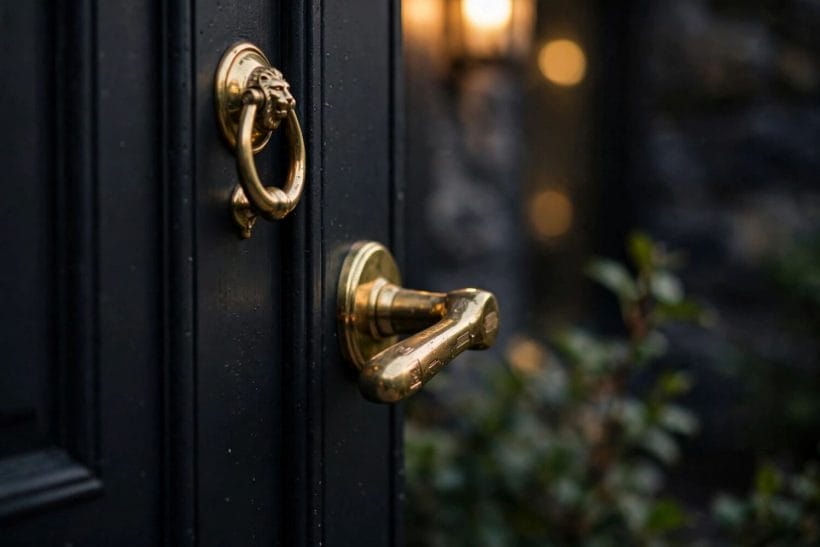
Black is the best backdrop hardware ever gets: every metal reads brighter against it, and small pieces — knocker, letter slot, kick plate — become jewellery. The gallery close-up shows the classic pairing: a brass lion knocker and lever handle glowing against black panels at dusk.
17. Brass knocker, brass handle
Unlacquered brass on black is the heritage pairing: warm gold against near-black, ageing gracefully together. A lion or ring knocker at eye height, a lever or knob below — the gallery door’s arrangement has welcomed visitors for centuries.
18. Centre knob with ring knocker
The centred knob — placed mid-door rather than at the edge — is a traditional British arrangement that suits panelled black doors perfectly. It turns the door’s face into a composed picture, hardware balanced like furniture on a cabinet front.
19. Matte black on black
Black hardware on a black door disappears by day and reappears as silhouette under porch light. The tone-on-tone look is the modern choice, and it keeps a flat slab door completely uninterrupted — texture, not contrast, does the work.
20. Polished chrome for coastal houses
Chrome and polished nickel stay bright in salt air that dulls brass, and their cool shine suits black doors on white coastal houses. The pairing is crisp and nautical without a single rope or anchor in sight.
21. Kick plate in a warm metal
A brass or copper kick plate along the door’s base protects the black paint where boots land, and adds a deliberate band of metal to the composition. On black it reads as jewellery with a job — the hardest-working ornament on the door.
22. Letter slot kept low and level
A horizontal letter slot set low on the door keeps the face clean for the wreath and knocker above it. Match its metal to the handle, keep it dead level, and the door’s front stays composed even on post-heavy mornings.
23. Black hinges, hidden or butt
Visible hinges should match the door or the hardware, never sit between the two: black butt hinges on a black door, or fully concealed hinges on modern slabs. It is a small detail no visitor names and every visitor’s eye registers.
24. A spyhole and bell in the same metal
Finish the set with the small pieces in the same metal: viewer, bell push, house number. Mixed metals look accidental; one metal, repeated, looks like a decision — and black makes any single metal richer.
5. Rustic and Craftsman Black Doors
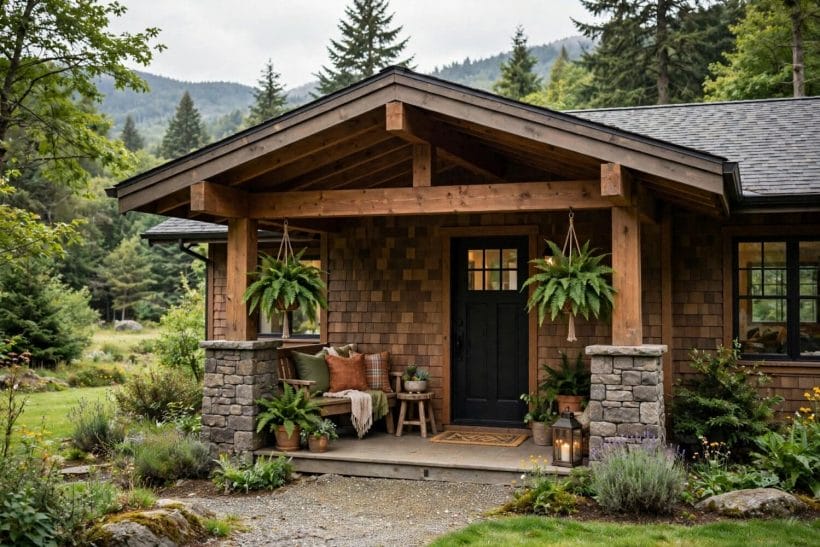
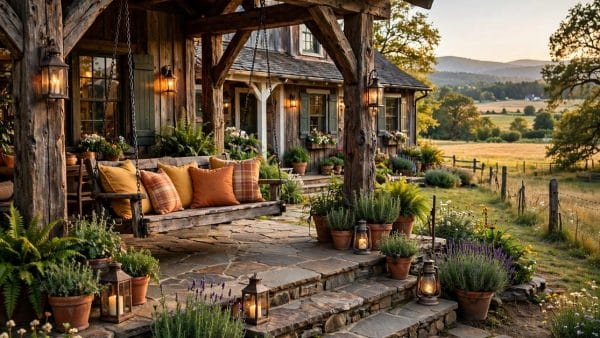
On rustic and craftsman houses, black doors sit inside timber porches and stone pillars, the colour deepening the natural palette instead of fighting it. The gallery home — shingle walls, timber beams, stone piers, hanging ferns — is the type at its best.
25. Ledged plank door in black stain
Vertical planks with horizontal ledges, finished in a black stain that lets the grain show through, is the rustic standard. Stain rather than paint keeps the timber honest, and the door ages into the house instead of peeling away from it.
26. Craftsman door with a dentil shelf
The craftsman arrangement — upper glazing over a small ledge, panels below — looks superb in black: the colour unifies the busy carpentry and sets off the glass. Pair it with chunky black lanterns on the porch posts.
27. Black door, natural timber surround
Leave the surround in oiled timber and paint only the door black: the warm frame mediates between dark door and light wall, and the porch feels built rather than decorated. The gallery porch runs exactly this mediation.
28. Stone pillars, black door
Stone piers flanking the porch give a black door a sense of arrival — the dark leaf framed by geology. Keep planting low and green around the stone so the composition stays door, stone, foliage, nothing else competing.
29. Small-paned cottage door
A grid of small panes in the door’s upper half, black-framed, suits cottages and cabins: the glazing pattern does the decorating, the black makes it graphic, and lamplight through the panes is the warmest welcome a small house can offer.
30. Black stable door
A split stable door in black — top half open to the garden, bottom half shut against dogs and draughts — is working-country charm. Black tidies the rustic form just enough to sit happily on a rendered cottage as well as a farmhouse.
31. Iron strap hinges as decoration
Long black iron strap hinges across a plank door are both structure and ornament. On a black door they read as texture — slightly different sheen, same colour — and they are the honest hardware a ledged door was designed around.
32. Bench, boots and a black door
The rustic entrance is a working place: a bench for boots, a basket for kindling, hooks for leads, arranged around the black door like furniture around a fireplace. The gallery porch shows how welcoming the working look can be.
6. Arched and Cottage Black Doors
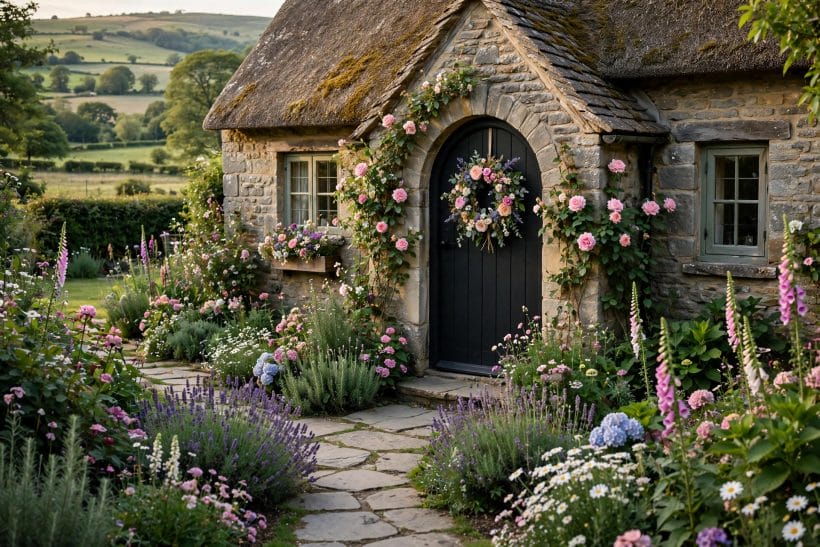
An arch softens everything black hardens: the curved head turns the dark door into a garden picture. The gallery cottage — stone walls, thatch above, an arched door wreathed in flowers and ringed with roses — is the family’s romantic end, proof the colour is not only for sharp modern houses.
33. Full arch in a stone opening
A true semicircular arch in a stone opening is architecture doing the decorating; the black door simply fills it with shadow-toned calm. Keep hardware small and dark so the curve stays the whole story.
34. Segmental arch, panelled below
A shallow segmental arch — a gentle curve rather than a half-circle — suits taller doors and brick houses. Panel the lower leaf traditionally, glaze nothing, and let the softened rectangle read as a classic door with its corners kindly rounded.
35. Arched door, climbing roses
Train a climbing rose around an arched black door and the colour earns its keep every summer: black is the one door colour that makes pink, red and white roses all look more vivid. The gallery cottage’s rose ring is the arrangement to copy.
36. Cottage door with a floral wreath
On cottage doors the wreath can be wilder than the formal eucalyptus ring — dried flowers, herbs, seasonal foliage. Against black, even a loose, garden-gathered wreath looks composed, which is the colour’s gift to informal houses.
37. Black ledged door, iron thumb latch
The thumb latch — pressed with the thumb, lifting a bar inside — is the cottage door’s original handle, and in black iron on a black ledged door it is nearly invisible until a hand finds it. Charming, mechanical, and repairable forever.
38. Low door, low lintel, black finish
Old cottages often have doors lower than modern ones. Black dignifies the small scale: a low black door under a deep lintel reads as storybook rather than undersized, especially with a lamp beside it.
39. Garden gate black to match
Echo the door’s black on the garden gate and the house and garden become one composition. The repetition is cheap — one tin of paint — and it makes a cottage front feel designed from the pavement to the porch.
40. Hollyhocks and foxgloves at the base
Tall cottage perennials planted either side of a black door frame it in summer spires. The gallery garden’s foxgloves and lavender show the scale to aim for: planting nearly door-height, colour everywhere, the black door calm at the centre of it.
7. High-Contrast Modern Entrances
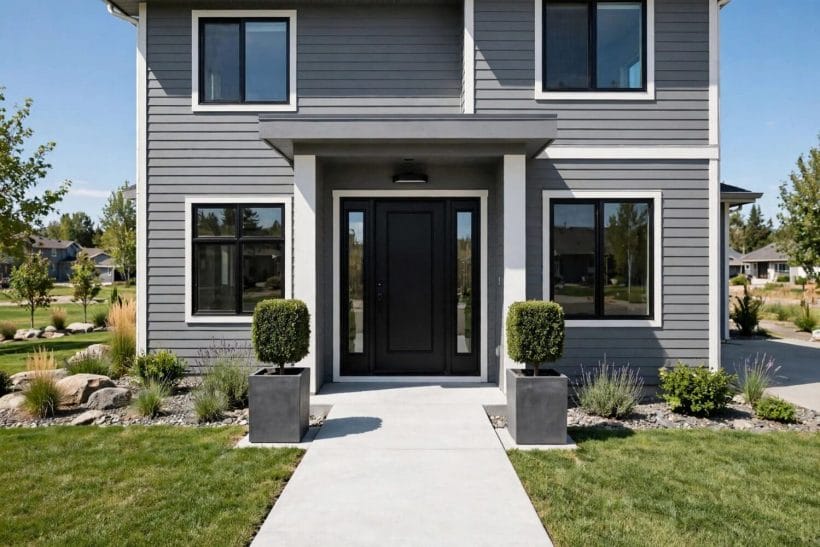
The gallery house — grey siding, white trim, a black double door with sidelights on a straight concrete path — shows black’s modern party trick: on a restrained facade it becomes the single event — everything else can stay quiet.
41. Double black doors, sidelights both sides
Paired black leaves with a sidelight each side fill a wide opening with symmetry. Doubles get their full treatment in double front doors — but as a black statement, they are unmatched.
42. Grey house, black door, white trim
The three-tone scheme — mid-grey walls, white trim, black door — is modern suburbia’s most reliable formula. The door is the darkest note, the trim the lightest, and the grey mediates; it is almost impossible to get wrong.
43. Black door on black cladding
Charred-timber and black-stained cladding houses take the door black too, and the entrance becomes a study in texture: matte door, feathered cladding grain, one steel handle. Add light — a lantern, a lit number — or the door vanishes at dusk.
44. White house, black door, black roof
Echoing a black door with a dark roof gives a pale house a top-and-bottom frame, the white walls held between two dark bands. The feature farmhouse runs roof, shutters and door in the same black family to exactly this effect.
45. Single planter pair
Two identical planters, one each side, are the modern entrance’s whole planting scheme — box balls, grasses or small conifers in plain cubes. On the gallery house they mirror the door’s symmetry and keep the path’s clean lines unbroken.
46. Straight path, centred door
A dead-straight path to a centred black door is modern formality: no curves, no planting spilling over, the door visible from the gate like a target. It suits new-builds and renovated facades where every line has been made deliberate.
47. Black door with a full-height side panel
One wide sidelight panel, floor to ceiling beside a black slab door, stretches the entrance across the facade. Glaze it frosted for privacy and the panel glows at night like a lantern built into the wall.
48. Recessed porch, black door at the back
Setting the black door at the back of a deep recessed porch doubles its drama: a pale tunnel of porch, then darkness. Paint the recess white or pale grey and the door reads from the street as a framed picture of an entrance.
8. Black Doors With Sidelights and Glass
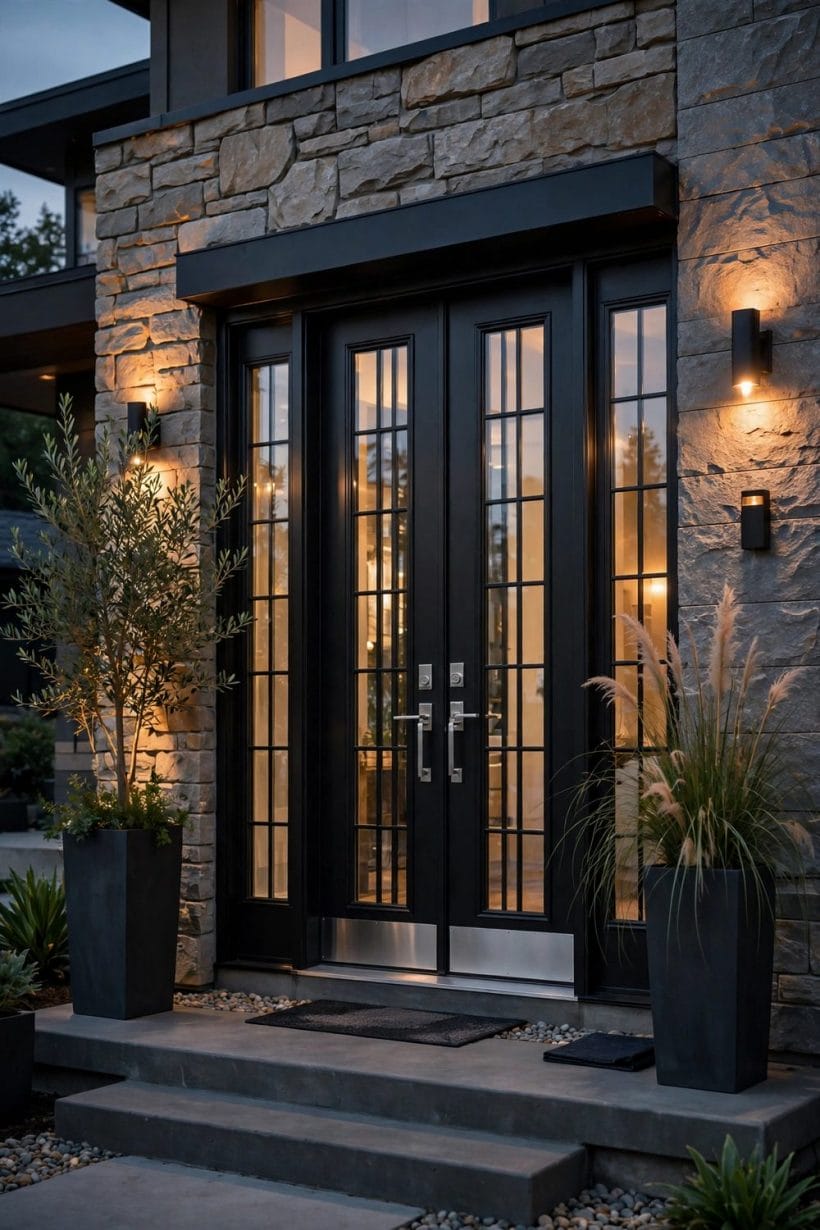
Glass is black’s best partner: the dark frame turns panes into pictures and makes a hall’s light part of the facade. Sidelights as a subject belong to entry doors with sidelights; here the glass serves the black door it flanks.
49. Twin sidelights, clear glass
Clear sidelights either side of a black door give the entrance width and the hall daylight. On houses set back from the street, clear glass costs no privacy and shows off a lit hallway like a shopfront.
50. Frosted sidelights for street-facing doors
Frosted or reeded glass keeps the light and loses the audience — the right call where the pavement is close. In a black frame the frosted panes read as pale panels by day and glow softly at night.
51. Transom window above the door
A horizontal transom over a black door, like the feature house’s, lifts the whole entrance and lights the hall’s top half. Match its frame to the door’s black and the pair read as one tall, composed unit.
52. Half-glazed panelled door
Glazing the upper half of a panelled door keeps the traditional lower panels and gains a window’s worth of light. With black framing the grid, even a simple four-pane top light looks tailored rather than plain.
53. Leaded glass in a black frame
Leaded and stained glass belong in black frames: the dark surround intensifies coloured glass and gives clear panes an almost ironwork quality. Period houses with original glass should keep it — black sets it off best.
54. Full-length glazed door, black grid
A mostly-glass door divided by a black grid — steel-look bars over one large pane — is the contemporary classic. In black it reads as architecture, not as a door at all.
55. Obscure glass, clear border
A clear border around an obscure centre gives privacy with a tailored edge — the glazing equivalent of a mount around a picture. In sidelights it keeps a bright rim of view at eye level while the centre stays private.
56. Matching black fanlight and sidelights
Combining a transom with twin sidelights wraps the black door in glass on three sides — the full Georgian-to-modern entrance suite. Keep every frame the same black, and the whole assembly reads as one piece of joinery.
9. Brick Houses and Porch Styling
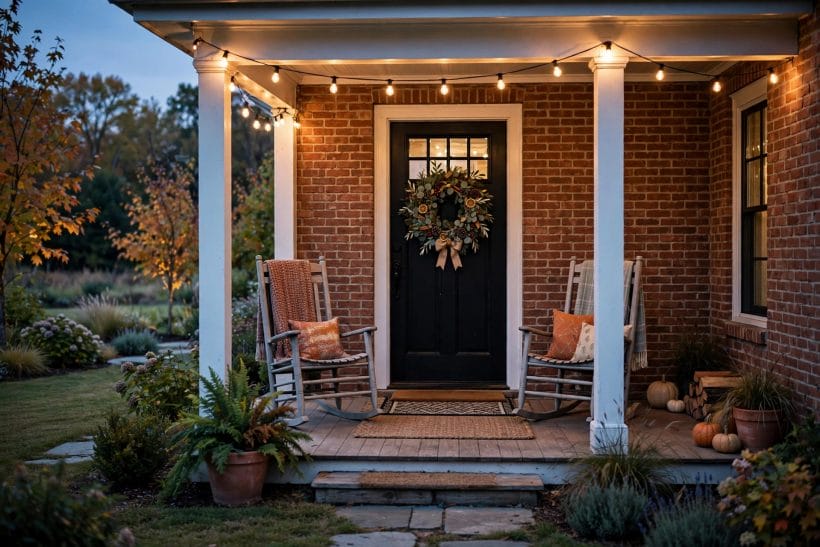
Brick and black are old friends: warm red-brown brickwork deepens against a black door, and the door sharpens brick’s softness. The gallery porch — rocking chairs either side, string lights overhead — shows the evening version, and a reminder that rustic porch ideas and front porch railing ideas both start from a door worth styling around.
57. Red brick, black door, cream trim
Cream — not brilliant white — trim softens the red-brick-and-black contrast into something mellow and period: the right surround for older brick, where stark white can look like a repair rather than a choice.
58. Dark brick, black door, brass light
On dark engineering brick a black door nearly merges with the wall, so light and metal do the marking: a brass lantern each side, a brass number, and the entrance appears from the darkness as guests approach.
59. Rocking chairs flanking the door
A pair of rocking chairs turns a porch with a black door into a room people use. Keep the chairs dark or natural — black rockers double the door’s presence; pale cushions keep the arrangement friendly, as on the gallery porch.
60. String lights over a black door
A run of warm string lights across the porch ceiling makes a black door glow by reflection at dusk — the cheapest evening upgrade an entrance can have. The gallery porch’s festoon glow is the effect to aim for.
61. Lanterns at two heights
Pair wall lanterns beside the door with a standing lantern at the step: two heights of light model the entrance in depth and light the keyhole, the step edge and the wreath in one arrangement. Black lantern bodies disappear into the scheme.
62. Seasonal door dressing
Black takes every season’s dressing without clashing: spring blossom, summer greenery, autumn leaves and pumpkins, winter evergreen and berries. No other colour lets the calendar decorate this freely.
63. A bench and boot tray for real life
Style meets mud at the front door: a bench, a tray for wet boots, a hook rail inside the porch. Kept tidy and dark-toned, the working kit reads as furniture rather than clutter.
64. Planting in odd numbers
Group pots in threes and fives — the feature porch’s terracotta crowd runs to a dozen and still reads calm, because the pots share one material and the black organises the green. One large pair plus small clusters is the reliable formula.
65. A mat that earns its place
A coir or woven mat in natural tones is the one pale note a black-door porch needs at ground level: it lightens the step, wipes the boots, and keeps the doorway from reading as a dark hole at pavement level.
66. Painted porch floor, black door above
A painted or stained porch floor in a mid tone — grey, sage, warm stone — gives the black door a stage. Keep the floor a clear step lighter than the door so the eye climbs: floor, step, door, wreath, in that order.
10. Painting and Caring for a Black Door
The practical close: black is demanding to apply and easy to live with. These painting and care ideas decide whether a black door looks sharp in year five or only in week one — the discipline behind every door above, and behind the general craft in the front door guide.
67. Choose the sheen for the house
Gloss for traditional formality, satin for most houses, matte for modern slabs. Sheen changes black more than any other colour — it decides whether the door reflects the garden or absorbs light — so test the finish on the door’s edge first.
68. Prepare like the colour is watching
Black shows every brush mark and dust nib, so preparation matters more than the paint: sand between coats, wipe down with a tack cloth, and paint in still, mild weather when dust and insects are fewest.
69. Mind the sun on south-facing doors
Dark colours absorb heat, and a black door in full afternoon sun works its paint and seals hard. On exposed doors, a porch or canopy is paint protection as much as comfort — and quality exterior paint earns its price here.
70. Paint the edges and the bottom
The door’s bottom edge is where water wins. Seal and paint every edge whenever the door is open for painting; a black door fails from its unseen edges long before its face fades.
71. Keep the weather bar and seals black
Draught seals and threshold strips in black disappear into the door; in white or aluminium they stripe it. Matching the unglamorous parts separates a finished black door from a painted one.
72. Wash, don’t repaint
Most tired-looking black doors are dirty, not faded: pollen and road film grey the surface. A wash with mild soapy water twice a year restores the depth and postpones repainting by seasons.
73. Touch up chips the week they happen
Black touch-ups blend well because the colour matches itself edge to edge. Keep a small pot of the door’s paint for knocks from bikes, keys and furniture deliveries — five minutes now prevents the rust spot and the full repaint later.
74. Repaint on the trim’s schedule
When the porch trim is repainted, do the door in the same session: the blacks — door, shutters, lanterns — then match exactly, and the whole entrance renews at once instead of drifting into several near-blacks.
75. The dusk test
Judge a black door at dusk, porch light on, garden dim: the door should hold its depth, the hardware glint, the wreath read. If the entrance composes itself at that hour, colour, sheen and styling are all working.
Final Considerations
A black front door succeeds on discipline: one colour, repeated on shutters or trim where the house invites it; one metal family across knocker, handle and lantern; something green at the base; light arranged so the door still performs at dusk. Choose the door family first, then let hardware and porch styling finish the sentence. No other can of paint buys this much entrance.

0 Comments