
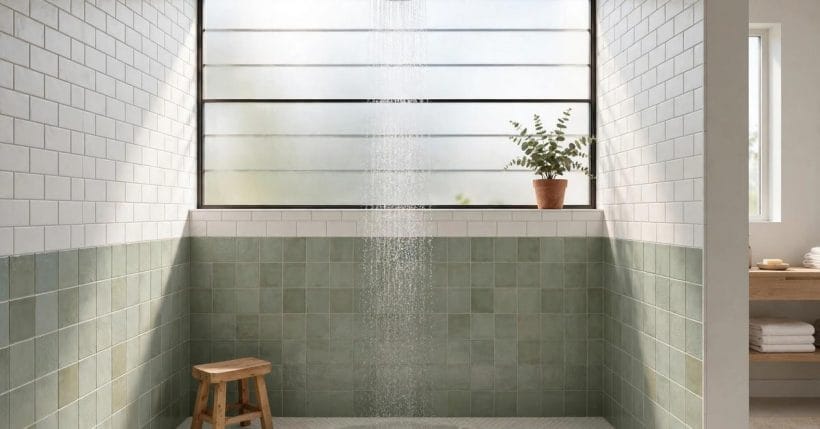
A window in the shower changes the whole feel of a bathroom. Daylight replaces a dark corner, steam has somewhere to go, and a small room can feel open without giving anything away to the street. The trick is that the window has to do three jobs at once: bring light in, keep the view out, and survive daily splashes. Get the placement right and the rest follows.
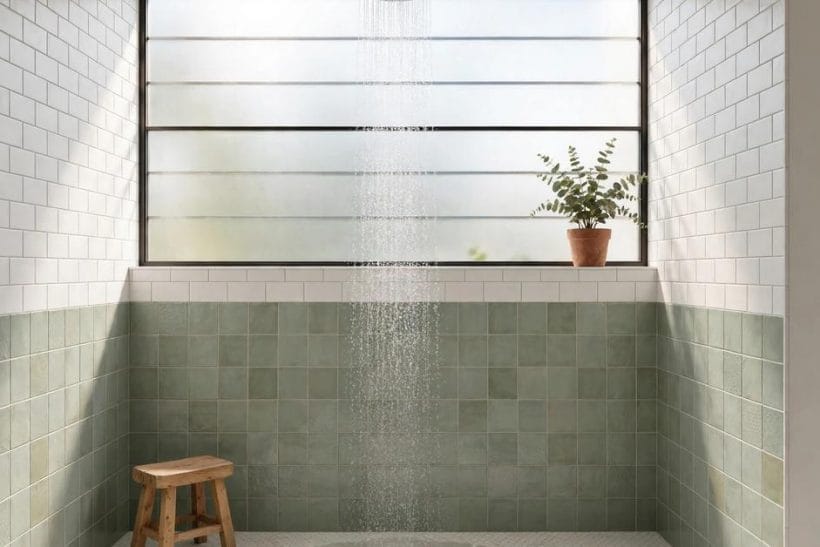
This guide stays strictly on the window itself: where to put it, what glass to choose, how it handles privacy and air, and how to keep it clean. It does not re-teach shower rooms in general. For the room around the shower, the layout owner is the shower room guide, and this post links to it rather than repeating it. Waterproofing and plumbing around any shower window are work for qualified professionals, stated here in general terms only, with no do-it-yourself instructions.
1. The Window in Shower at a Glance
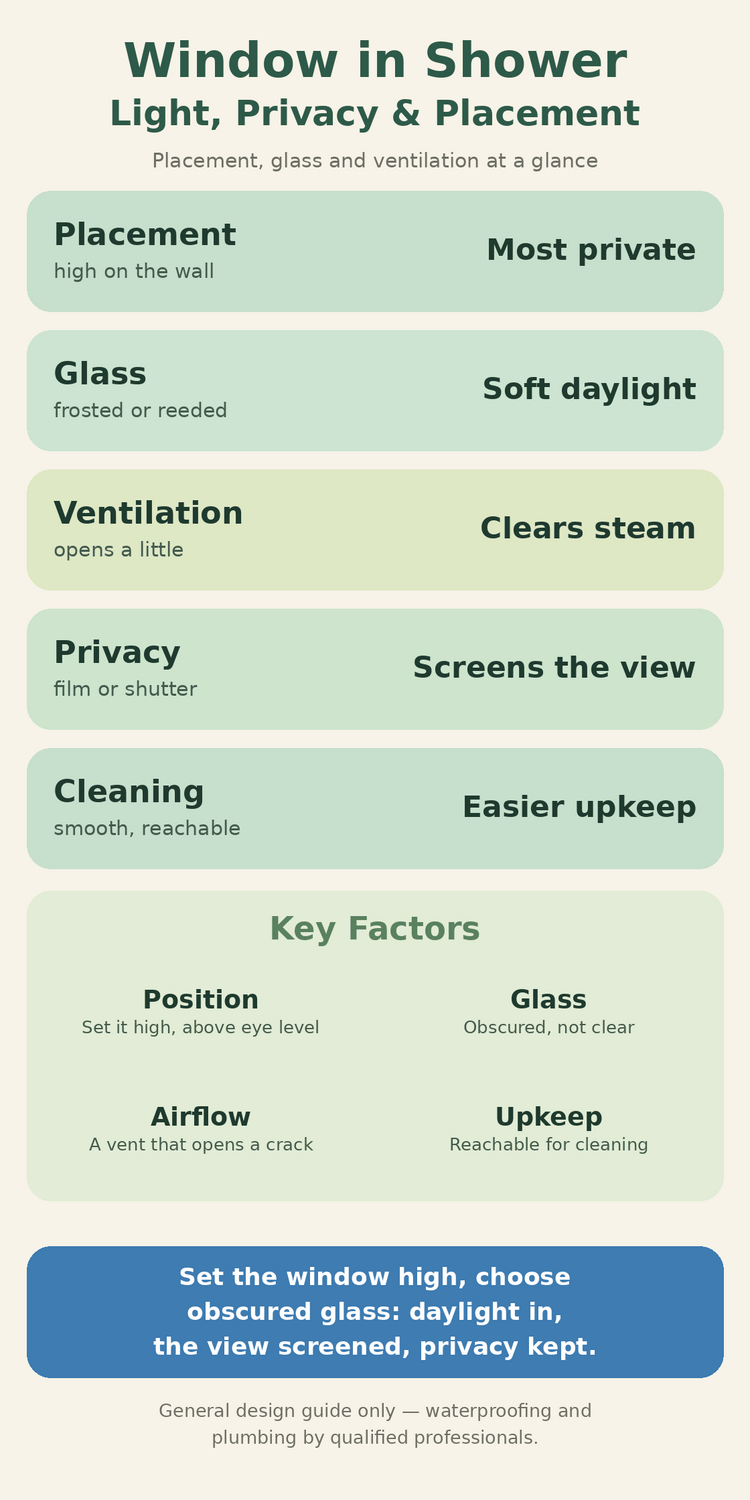
Every good shower window answers the same five questions before anyone talks about style. Where does it sit on the wall, what kind of glass does it carry, how much light does it admit, how private is it from outside, and can air move through it. A window that answers all five well feels effortless in daily use. A window that answers only one or two becomes a compromise you notice every morning.
| Question | What good looks like |
|---|---|
| Placement | High on the wall, above the normal sightline |
| Glass | Obscured glass that softens the view without darkening the room |
| Light | Bright, diffused daylight across the shower, not a harsh beam |
| Privacy | Screened by height, glass and covering together, not by one trick alone |
| Air | An opening section or vent that lets steam escape |
| Upkeep | Smooth surfaces within easy reach for wiping down |
The sections below work through those questions one at a time, so you can judge any shower window you see, whether it is in a new bathroom plan, a renovation sketch, or a home you are thinking of buying. The same logic applies in a generous walk-in and in a compact corner, which is why placement comes first and decoration comes last.
2. Height First: Why High Windows Win
Height is the single most useful privacy tool a shower window has, and it costs nothing. A window set high on the wall sits above the eye level of anyone outside, so it can admit generous daylight while revealing almost nothing of the person showering. That is why the classic shower window is a horizontal band near the ceiling rather than a full-height pane at standing height.
High placement also spreads light better. Daylight entering near the ceiling washes down the tiled wall and across the shower floor, lifting the whole corner instead of throwing a bright patch in one spot. In a walk-in shower, where there is often no door to bounce light around, that wash of light from above is what keeps the space from feeling like a tiled box. The window becomes the room’s lamp as well as its outlook.
There is a practical side too. A high window stays clear of the main splash zone, so it spends less of its life wet, and its sill is less likely to collect standing water. That matters for upkeep, because a sill that dries between showers stays cleaner than one that stays damp. If you remember one rule from this guide, make it this one: set the window high first, then choose the glass.
3. Size and Shape: Wide, Tall, Small and Square
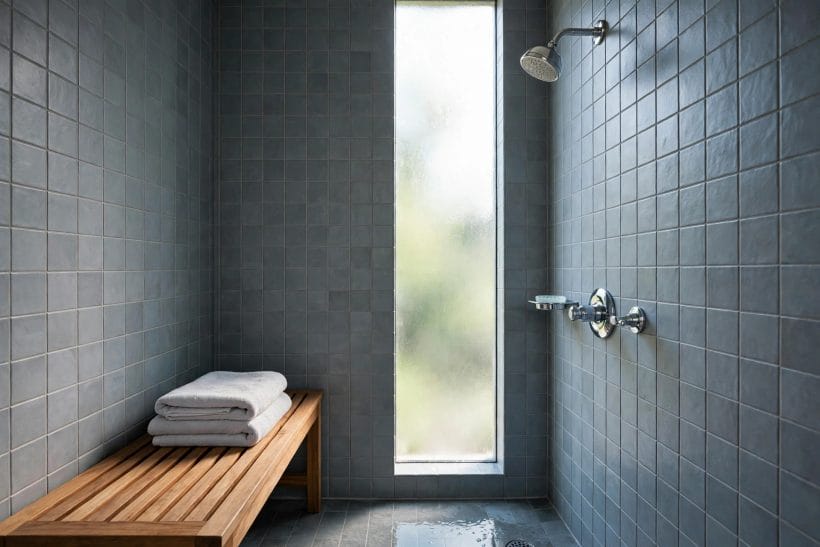
Once the height is settled, the shape of the window sets the character of the shower. A wide horizontal window suits a long shower wall, giving an even band of light and a calm, architectural look. A tall narrow window suits a tight corner, where wall space is scarce and a vertical slot of light can make the corner feel taller than it is. A small square window, set high and centred, suits a compact shower that needs light without sacrificing wall space for shelves or a niche.
Shape also changes how the light behaves. A wide window gives broad, even daylight that flatters tile and makes colours read true. A tall window gives a shaft of light that moves across the wall as the day goes on, which can be beautiful but can also throw strong contrast in a small room. A small window gives a gentler glow that suits a moody, enclosed shower, provided the rest of the bathroom has enough light of its own.
None of these shapes is right in every room. The wide band needs a long enough wall to look deliberate rather than squeezed in. The tall slot needs enough height above the shower to sit clear of fittings. The small square needs to be big enough to ventilate as well as light, or it becomes decoration rather than a working window. Judge the shape against the wall you actually have, not the photograph you liked.
4. Frosted Glass: The Everyday Default
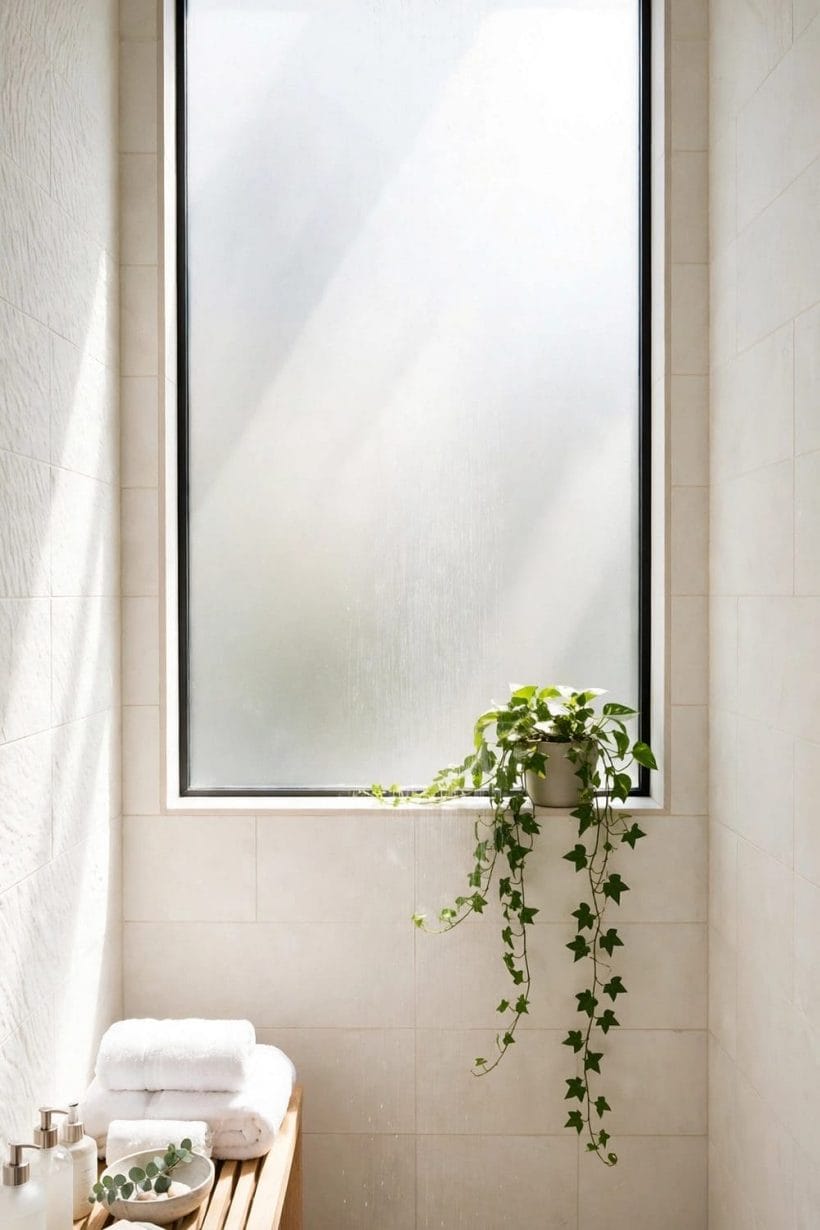
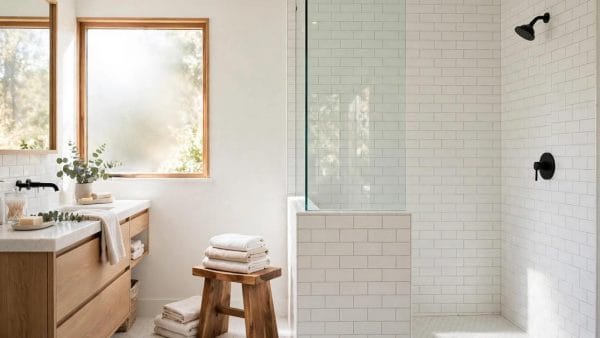
Frosted glass is the default shower-window glass for a simple reason: it does the privacy job on its own, in daylight and at night, without any covering to operate. The frosting scatters light as it passes through, so shapes on either side dissolve into soft blurs. The room stays bright, because most of the daylight still gets through, but nobody outside can make out anything distinct.
Frosted glass also forgives a less-than-perfect outlook. Where a clear window would frame a neighbour’s wall or a bin store, frosted glass turns that view into a calm glow, and the eye stops looking for a view and starts enjoying the light. That makes it a kind choice for overlooked bathrooms, where the alternative is keeping a blind permanently closed and losing the daylight altogether.
The trade-off is honest and small: you give up a clear view out. If the outlook is genuinely lovely, a garden or a stretch of sky, frosted glass everywhere can feel like a waste. That is where the next sections come in, because textured glass, glass block and clear glass with a covering each keep some of that view while still protecting privacy in different ways.
5. Reeded, Textured and Glass-Block Options
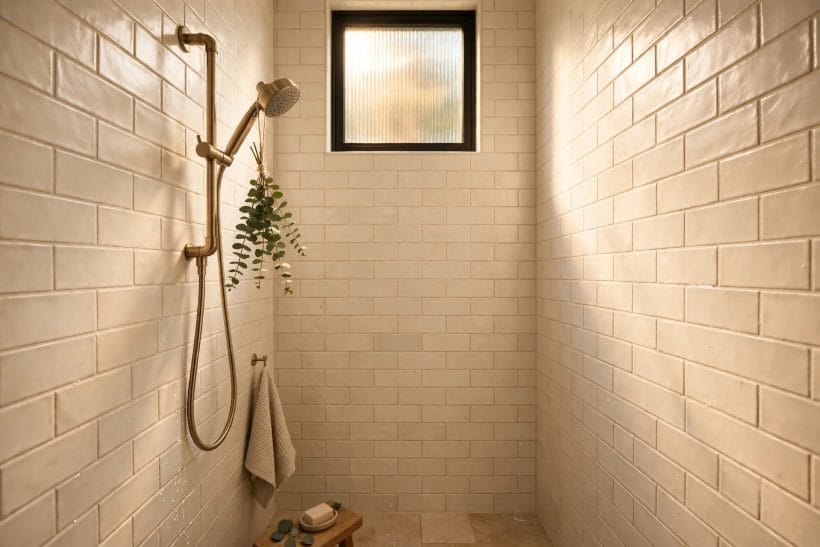
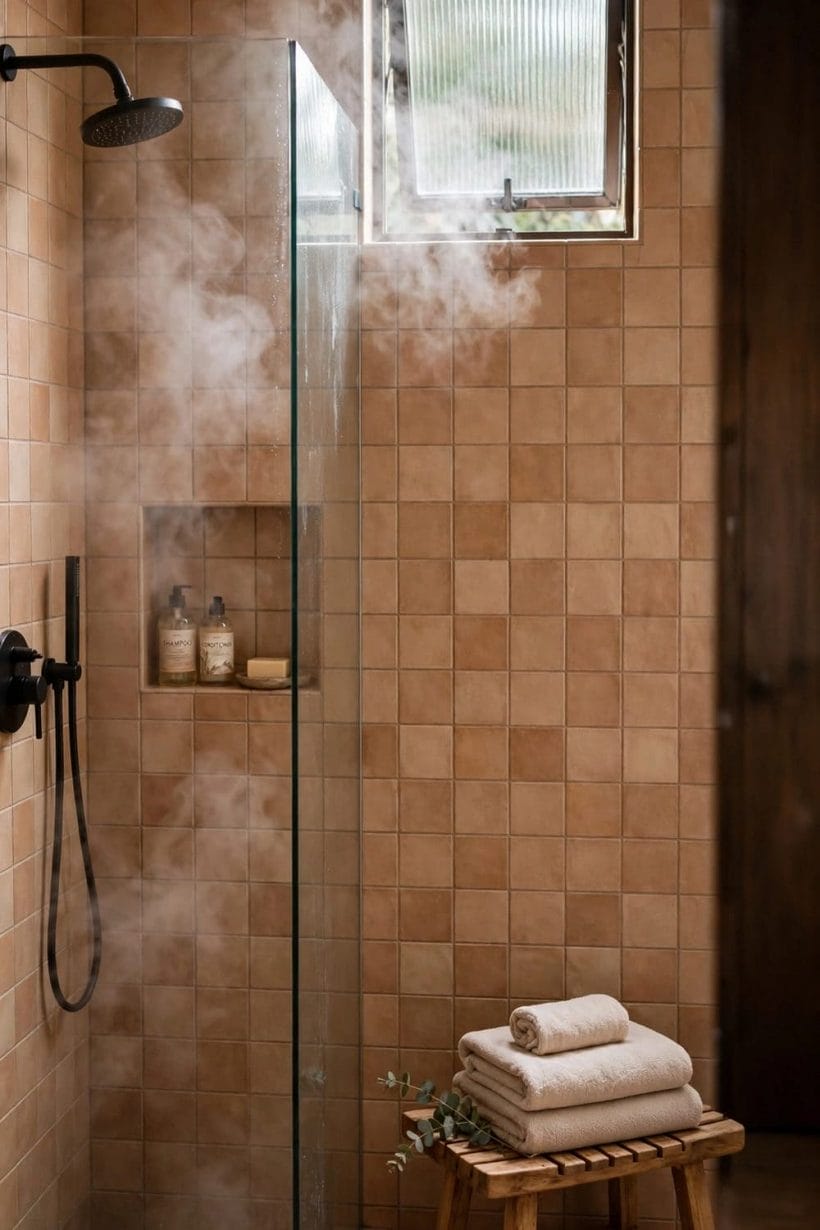
Reeded glass carries vertical ribs that blur the view while letting light through in soft stripes. It reads more decorative than plain frosted glass, and it pairs well with both traditional bathrooms and modern ones, because the ribbed texture catches light and gives the window a crafted feel. Like frosted glass, it works without a covering, which keeps the daily routine simple.
Other textured glasses work on the same principle with different patterns: hammered, seeded or rain-patterned glass each scatter the view in their own way. The differences between them are mostly visual, so choose by how the texture looks against your tile rather than by any claim about one being stronger or better. What matters is that the glass is obscured enough that a person standing outside cannot resolve detail, and that it still admits plenty of daylight.
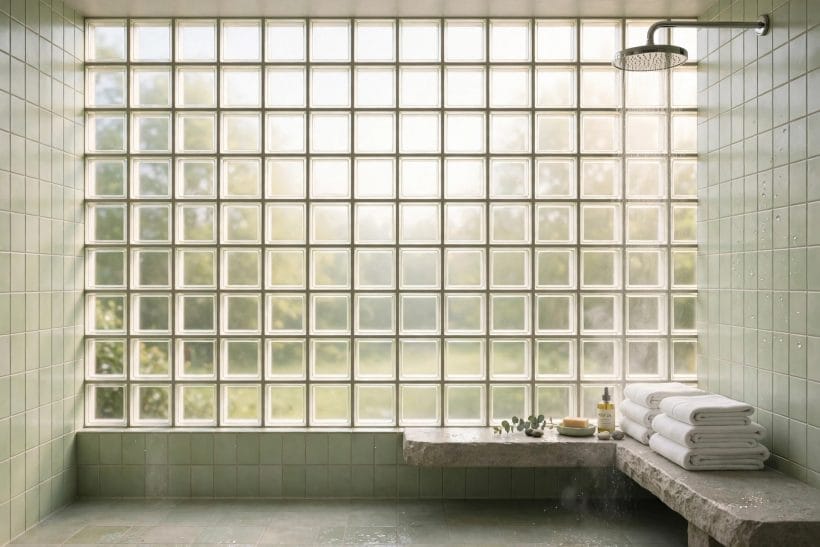
Glass block is the bolder cousin of textured glass. A wall of glass blocks glows like a lantern, gives complete privacy, and suits a shower that wants light from a whole wall rather than a single opening. It belongs with the enclosure conversation too, so if you are weighing a glass-block wall against a glazed screen, the double shower guide’s discussion of generous glazed shower spaces is a useful neighbour. Glass block does not open for air, though, so a glass-block shower still needs its ventilation from elsewhere in the room.
6. Clear Glass with a Privacy Layer
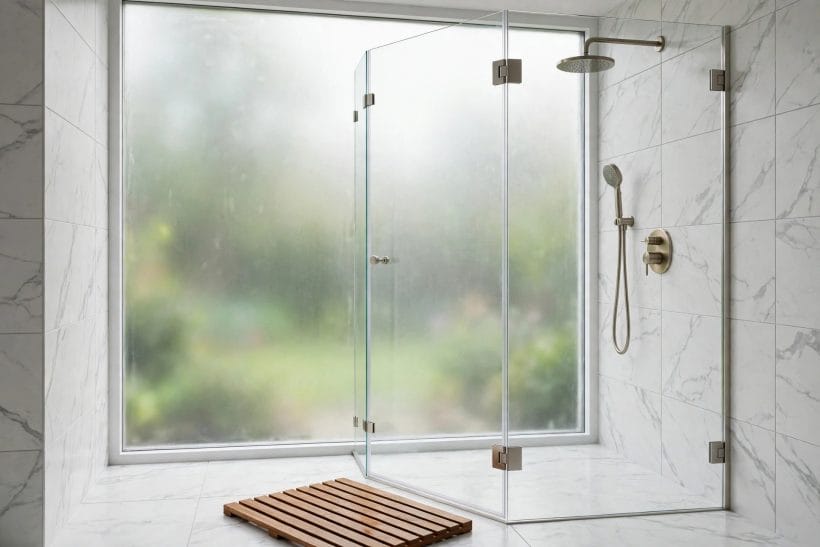
Clear glass with a privacy layer is the flexible option: a film, a shutter or a blind that you can adjust, so the window can be open to the view when privacy allows and screened when it does not. Privacy film is the simplest layer, applied to the glass to obscure the view while keeping the daylight. It suits rented homes and tight budgets, because it changes the window without changing the joinery.
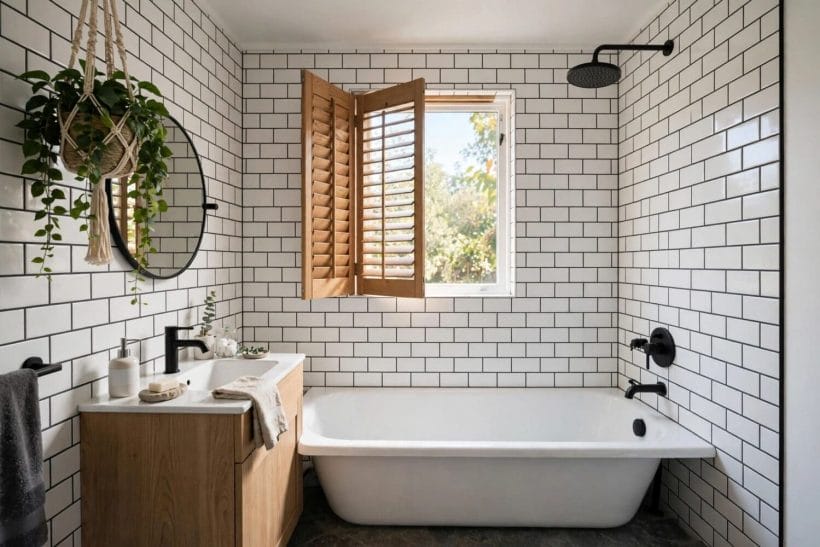
Shutters and blinds give more control, and they change the look of the room more. A shutter can be tilted to admit light while blocking the sightline, and closed fully for complete privacy. A blind can be raised out of the way when the shower is not in use. Both need to suit a wet room, because a covering that soaks up water or traps damp behind it will not stay pleasant for long. Smooth, wipeable materials and a habit of leaving the covering open to dry are what keep this option working.
The honest caution with clear glass and a layer is that privacy now depends on the layer being in place. A film that peels at the corner, a shutter left open, or a blind left raised all undo the privacy in an instant. If the household will not reliably operate the covering, obscured glass is the safer default, because it cannot be forgotten. Choose the layer for rooms where someone will actually use it, and choose obscured glass everywhere else.
7. Ventilation: A Window That Opens a Crack
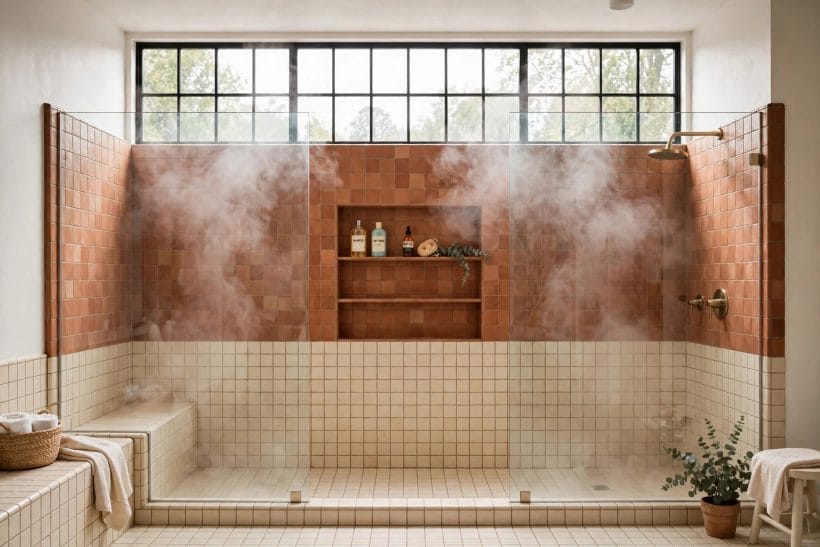
A shower makes steam, and steam needs somewhere to go. A window that opens, even a little, is the most direct way to clear it, because warm damp air rises and slips out while cooler air replaces it. That keeps mirrors clearer, grout drier and the room fresher between showers, and it does the job quietly, without a fan running.
The opening does not need to be large. A top-hung section that tilts open a crack, or a small vent within the frame, moves a surprising amount of air over the course of a shower and the minutes after it. What matters is that the opening is easy to reach and easy to operate with wet hands, so it actually gets used. A beautiful window that is too high to reach or too stiff to open will stay shut, and the room will pay for it in lingering damp.
Ventilation also protects the window itself. Glass that is ventilated dries faster, frames stay cleaner, and the seal around the window spends less time sitting in condensation. If the shower is part of a larger open plan, the open shower guide is worth reading alongside this one, because an open shower spreads its steam further and leans on its window even more. Where a window cannot open at all, the room’s other ventilation has to carry the whole load, and that should be confirmed as part of the bathroom plan rather than assumed.
8. Light Through the Day
A shower window is used at different times of day, and its light changes with each one. Morning light is cool and directional, and a window that catches it makes the first shower of the day feel awake and clean. Evening light is warmer and lower, and the same window can throw long soft shadows across the tile. Neither is better in itself; the question is which direction the window faces and when the household actually showers.
Direction matters in general terms. A window facing the morning sun will be bright early and softer later. A window facing away from direct sun will give steady, even light all day, which suits a bathroom that is used at all hours. A window that faces strong afternoon sun may need obscured glass or a covering to keep glare down, because direct sun on wet tile can be dazzling. None of this needs precise measurement to judge: stand in the room at the times you shower, and notice where the light falls.
Artificial light still matters, because a shower window gives nothing after dark. The window should be planned together with the room’s lighting, not as a replacement for it, so the shower is well lit on a winter evening as well as a summer morning. For that half of the plan, the vanity lighting and mirror guide covers how bathroom lighting is layered around mirrors and basins, and the same layering logic applies to the shower corner.
9. Keeping the Window Clean and Dry
A shower window lives in the wettest room in the house, so its cleaning routine deserves a thought before it is chosen. Smooth glass wipes down in moments, while deeply textured glass and intricate frames hold water and soap residue in their corners. If the window is within reach of the shower, a quick wipe after use keeps it clear. If it is high and out of reach, it will be cleaned rarely, so a smooth, simple design is the kinder choice.
Condensation is the other daily fact of a shower window. Warm damp air meets cool glass and mists it, and that mist then runs down in droplets. Good ventilation, covered in the section above, is the first answer, because it removes the damp air before it settles. A sill that sheds water rather than pooling it is the second answer, and it is worth checking how the sill is detailed rather than assuming it takes care of itself.
Any work that touches the waterproofing around the window, the seals, or the plumbing nearby belongs to qualified professionals. This guide deliberately gives no instructions for tanking, sealing or plumbing work, because a shower window that leaks into the wall is a slow, hidden problem that only shows itself when the damage is done. Ask a professional to confirm the waterproofing detail around the window as part of any bathroom project, and treat that confirmation as part of the job, not an optional extra.
10. Small Bathrooms and Shower-Over-Bath Windows
Small bathrooms benefit from a shower window more than large ones do, because daylight is the cheapest way to make a tight room feel bigger. A high window over a shower-over-bath keeps the wall space free for storage, admits light across the whole room, and avoids the closed-in feeling that a windowless small bathroom often has. The same height rule applies, with one extra care: the window must sit clear of the bath’s splash line in daily use, so it is not permanently wet.
In a compact plan, the window also has to share the wall with everything else the room needs: a mirror, a cabinet, a rail, a shelf. That is where the small square or narrow vertical window earns its place, because it takes the least wall and still gives light and air. Planning the window together with the storage, rather than fitting it in afterwards, is what keeps a small bathroom feeling composed instead of crowded.
For the wider small-room conversation, the tiny bathroom ideas guide collects the space-saving moves that pair with a well-placed window: wall-hung fittings, clear sightlines and storage that stays off the floor. The window is one move among many, but in a small room it is often the move that makes the others work, because light is what lets a tight plan breathe.
Final Considerations
A good shower window is decided in this order: height first, glass second, ventilation third, and decoration last. Height gives privacy for free. Obscured glass keeps that privacy without a daily routine. An opening section clears steam. Everything after that, the shape, the frame, the covering, is a matter of taste and of suiting the room you have.
Before committing, check the three things that cannot be fixed by styling: that the window sits above the normal sightline from outside, that it can be reached and opened for air and cleaning, and that a qualified professional has confirmed the waterproofing and plumbing details around it. Those three checks are the whole job in miniature, and they are worth more than any particular brand of glass or frame.
Shower windows reward restraint. One well-placed window, with the right glass and a way to let air through, will outlive any number of decorative features, because it does its quiet work every single day: light in, steam out, privacy kept.


0 Comments