

A bay window can be the best seat in the house, but only when its dressing handles light, privacy and those awkward angles well. This guide walks through layouts, colours, likely costs and the practical details that matter in small rooms and larger homes alike, so you can choose with confidence rather than guesswork.
From café curtains to tailored blinds, every option below is judged on how it looks, how it cleans and how it performs day to day.
1. Bay Window Treatments at a Glance
| Question | Short answer | Best first step |
|---|---|---|
| What gives the most flexible light control? | Layered dressing: a blind for glare plus curtains for softness | Start with the layout checks in section 2 |
| What works best for privacy on a street-facing bay? | Bottom-up blinds, café curtains or shutters on the lower half | Check sightlines from outside at night |
| What is easiest to clean? | Smooth blinds and washable, unlined curtains | Read the care notes in section 9 |
| What suits a window seat? | Short blinds or shutters that never fight with cushions | See the seat layouts in section 6 |
| Where does the money usually go? | Fabric quantity, tracks or poles for angled bays, and fitting | Compare like-for-like quotes using section 7 |
| What is the most tailored look? | Made-to-measure shutters or a neatly fitted Roman blind | Measure carefully with the guide in section 8 |
Choosing a bay window treatment starts with three honest questions. How much light do you want to keep? How overlooked is the room? And how will you actually use the space in front of the glass — as a seat, a desk spot, a plant shelf or simply as breathing room? The table above gives the quick answers, and the sections that follow unpack each one. In a compact home, the bay often does double duty, so the dressing has to earn its place without eating floor space. That is why this guide keeps coming back to layouts first and decoration second: a beautiful curtain that blocks a seat or a radiator helps nobody. Work through the glance table, note your priorities, then read the sections that match them before you spend anything.
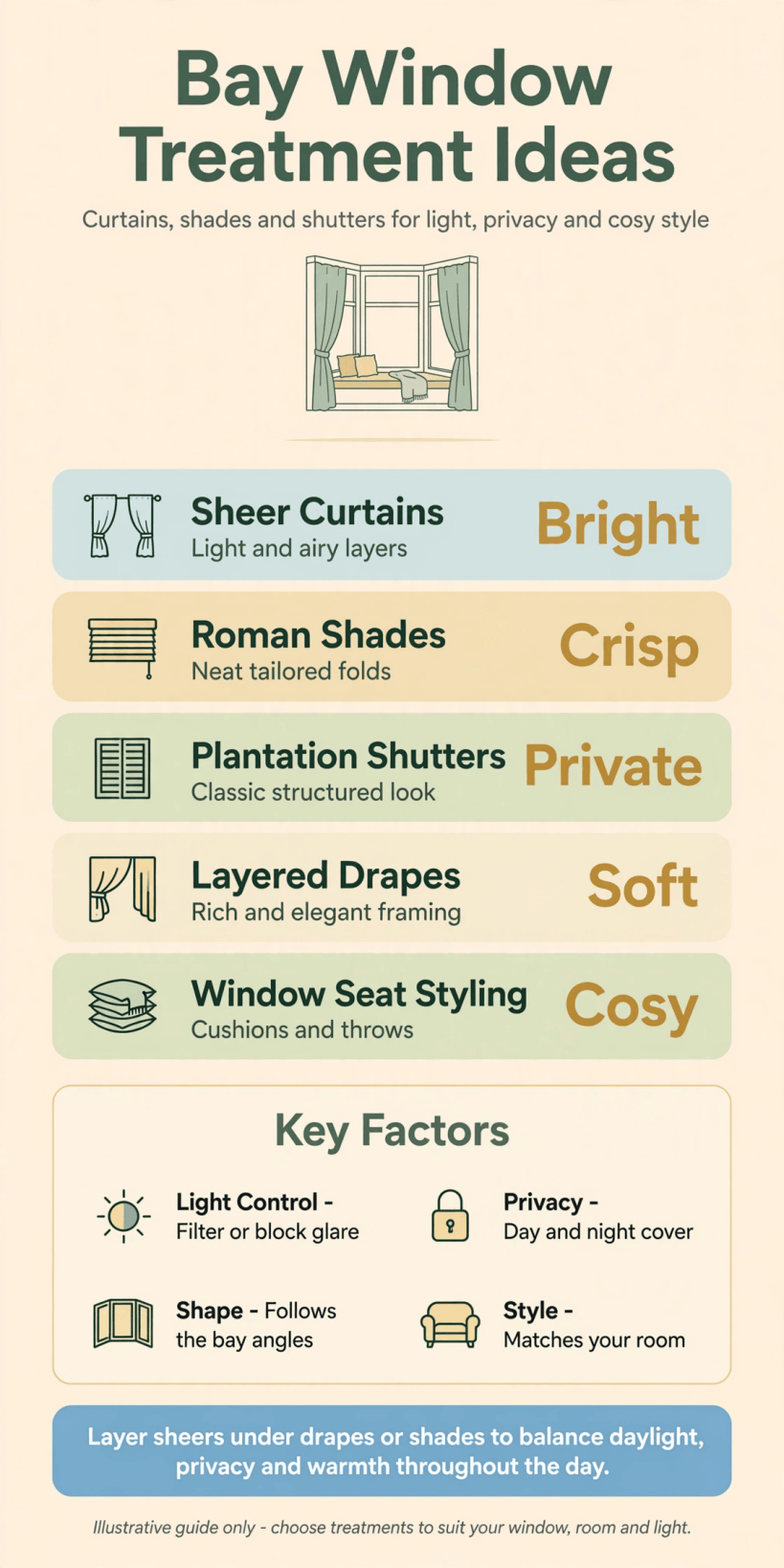
The main bay dressing options compared at a glance — layout, light control, privacy and upkeep side by side.
2. Start With the Layout: How the Bay Is Actually Used
Every successful scheme begins with the shape of the bay itself. A three-sided angled bay behaves differently from a curved bow or a square box bay, and the dressing that flatters one can fight the other. Stand in the room and note where the angles fall, where the seat or furniture sits, and which pane gets the strongest sun. Deep bays can take curtains that follow the curve and pool slightly, while shallow bays usually look cleaner with blinds fitted inside each section so the architecture stays visible.
Think about movement, too. If the bay holds your favourite reading chair, you will open and close the dressing daily, so smooth-running tracks and easy reaches matter more than drama. In open-plan spaces, ideas borrowed from tiny house living room ideas are useful: keep the window wall visually light, let one material lead, and repeat it in cushions or a rug so the bay feels planned rather than leftover. Finally, check radiators, vents and opening windows before choosing lengths. Curtains that trap warm air behind them waste heat, and blinds that clash with handles will annoy you every single day.

3. Colour Choices That Flatter a Bay
Colour can either open a bay up or close it down. Pale, warm neutrals bounce daylight deeper into the room and suit bays that face away from the sun, while deeper tones on curtains can frame a bright bay like a picture and make the view the star. If your walls are already strong, let the dressing be quieter; if the room is plain, the bay is a natural place for one confident colour or a gentle pattern that picks up tones from elsewhere in the room.
Test colours at the glass, not across the room. Fabric looks different backlit, and a sample that seems soft at noon may glow orange at sunset. Hold samples up in morning, midday and evening light before committing. For bolder inspiration, the palettes in colourful tiny house interior ideas show how one accent colour can repeat through a small space without overwhelming it. Keep ceilings and the bay soffit light if the room feels low, and remember that lining colour matters too: from the street, a consistent pale lining looks tidy across every pane, whatever the room-side fabric does.
4. Curtains for Bays: Tracks, Poles and Honest Hanging
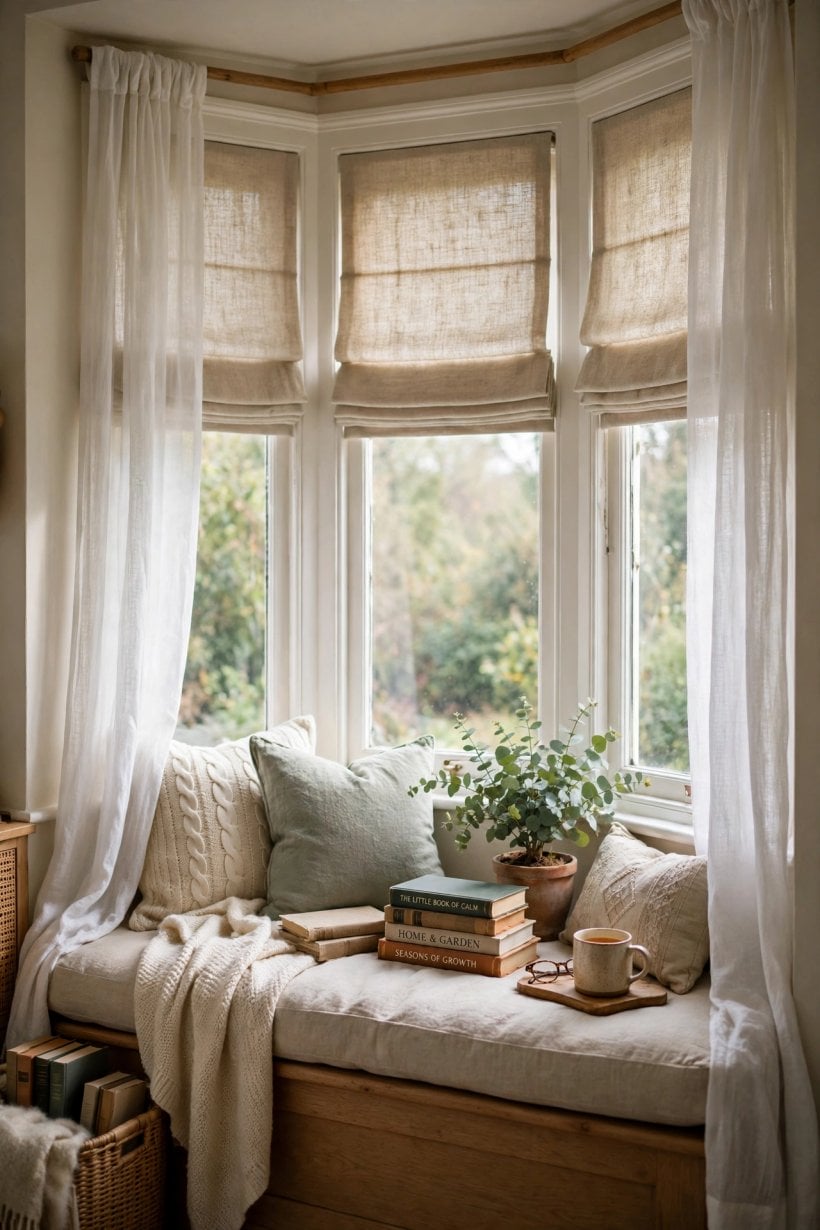
Curtains bring softness and insulation that blinds cannot match, but bays test them hard. A bending track fitted to the ceiling or wall usually gives the smoothest travel around angles, while poles need passing brackets and rings designed to glide past them. Decide early whether curtains will dress the whole bay as one sweep or hang as pairs on each straight section; the first feels grand, the second is simpler to fit and cheaper to make.
Fabric weight changes everything. Sheers and linens drift and glow but offer little privacy at night, so pair them with a blind behind if the room is overlooked. Heavier fabrics with a thermal or blackout lining suit bedrooms and street-facing rooms, echoing the layered approach used in many tiny house bedroom ideas, where every layer has to work hard. Keep the drop consistent: just clearing the sill, resting lightly on a seat, or reaching the floor in one clean line. Half-measures look accidental. And allow generous fullness — skimped curtains stretched flat across a bay lose the folds that make them worth having in the first place.
5. Blinds and Shutters: Crisp Lines and Easy Control
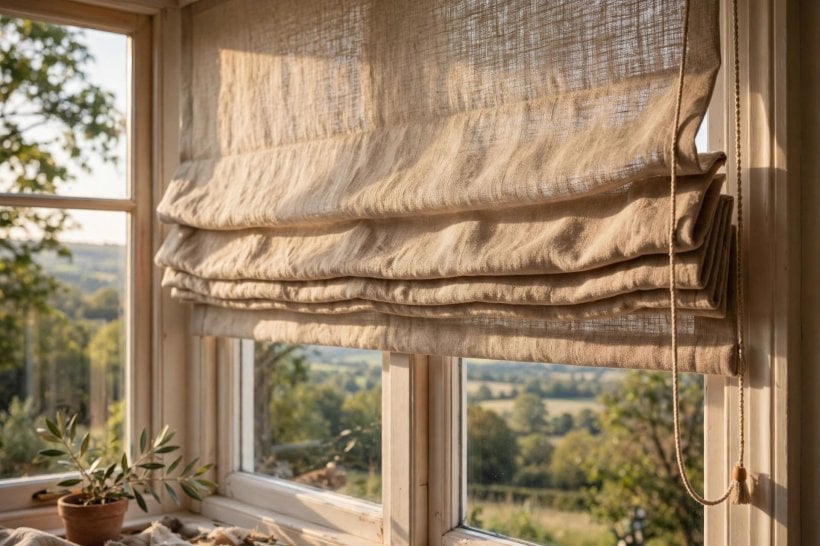
Blinds suit bays where furniture crowds the glass or where you want light control pane by pane. Roman blinds soften the lines and use fabric economically, rollers are the simplest and easiest to wipe down, and Venetians tilt to manage glare while keeping a view. Fitted inside each section of the bay, they keep the shape crisp and leave sills free for plants, books or a lamp.
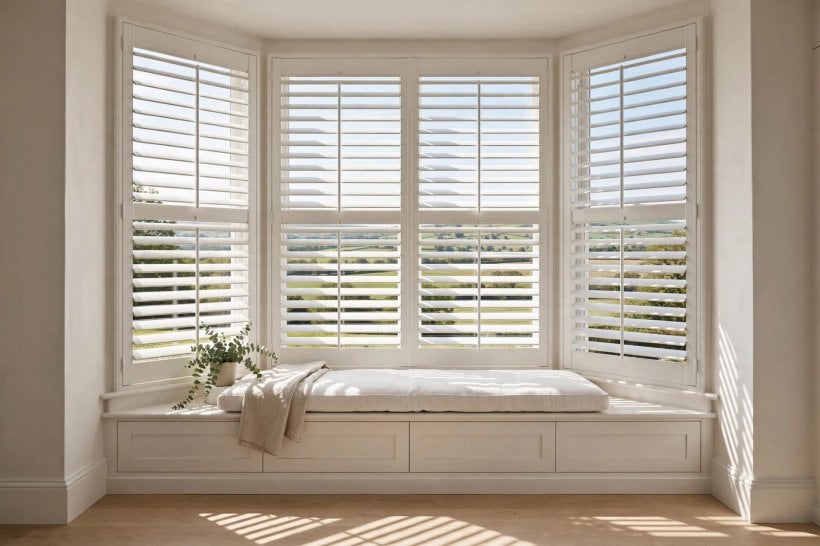
Shutters are the most tailored option and often the most practical in busy rooms: they shrug off condensation in kitchens and bathrooms, wipe clean, and let you open the top for light while closing the bottom for privacy. The trade-offs are cost and permanence, so measure with care and think about how the frames affect opening windows. In small homes, where the guides to bedroom interior design for tiny houses stress furniture that hugs the walls, the slim profile of shutters or a neat blind keeps every centimetre usable. Whatever you choose, operate each blind from the seat or sofa position before finalising cord and control sides — convenience is a design feature, not an afterthought.
6. The Window Seat: Dressing Around Your Best Perch
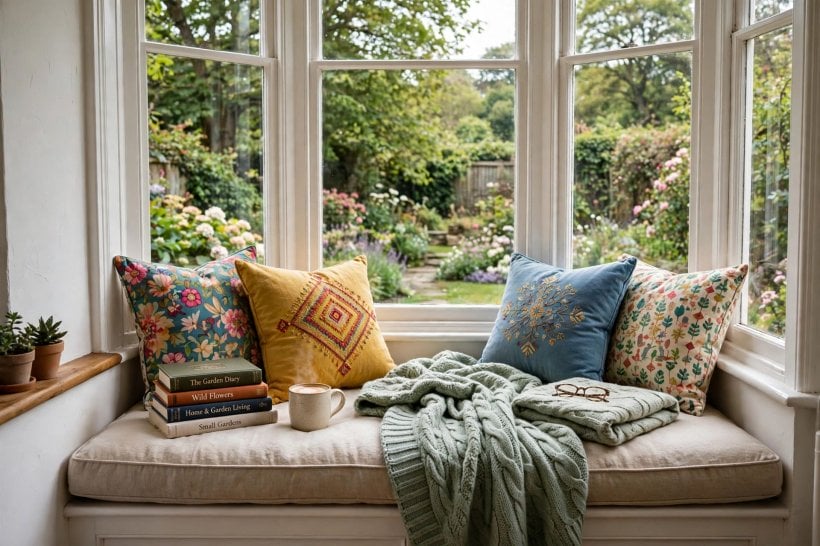
A seat transforms a bay from a window into a room within a room, and the dressing has to respect it. Short blinds, shutters or café curtains keep fabric out of the way of cushions and sleepy readers, while full curtains drawn behind the seat can feel wonderfully cocooning in the evening if there is space for them to hang without crushing the upholstery. Decide which mood you want before you build or buy anything.
Build storage into the seat if you can: a lift-up lid or drawers underneath swallow blankets, board games and the charger tangle, a trick borrowed from the best tiny barn house interior ideas, where no nook goes unused. Choose cushion fabrics that tolerate sunlight, because even northern light fades textiles over a season or two, and add a washable throw instead of worrying. Keep the seat depth honest — too shallow is perch-like, too deep strands you away from the backrest — and test it with the cushions you already own before committing to carpentry. A well-dressed seat bay quickly becomes the most contested spot in the house, which is exactly the point.
7. Costs: What Drives the Price and Where To Save
Bay dressings cost more than flat-window equivalents for simple reasons: there is more glass, more fabric, and the hardware has to turn corners. The main drivers are the type of dressing, whether it is made to measure or adapted from standard sizes, fabric and lining choices, the track or pole system, and professional measuring and fitting. Shutters and bespoke curtains sit at the top of most budgets; simple rollers and ready-made sheers at the bottom.
Get quotes on a like-for-like basis: same coverage, same lining, same hardware, fitting included or clearly excluded. Ask what is charged for the angled sections, because that is where estimates quietly grow. Sensible savings come from mixing levels — made-to-measure where the fit is visible, standard sizes where it is not — and from reusing good tracks. False economies include thin linings that perish in sunlight and bargain tracks that judder from day one. Anyone planning a whole small home, as in the step-by-step approach to how to build your own tiny house, knows the rule: spend on what moves and wears daily, save on what is purely decorative. Windows you open every morning belong firmly in the first group.
8. Measuring and Fitting Without Tears
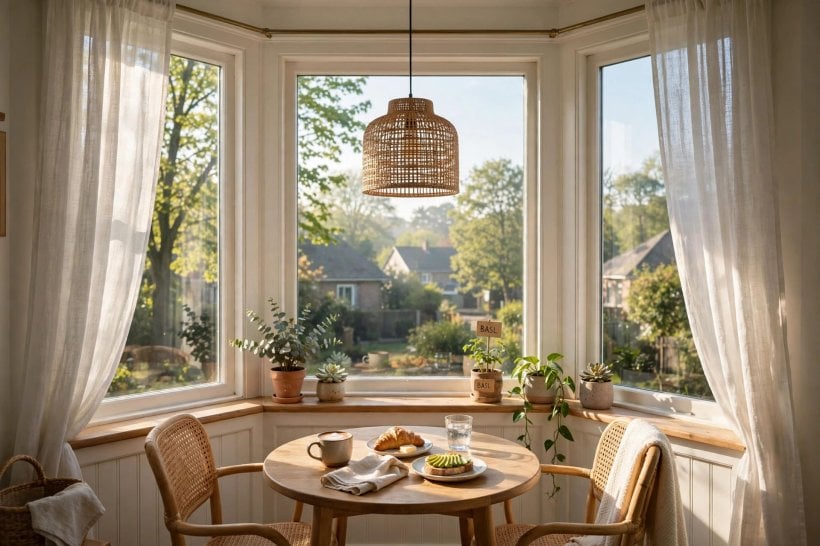
Measure a bay as several windows, not one. Record each straight section separately, note the angles where sections meet, and measure at the top, middle and bottom because older frames are rarely perfectly true. Decide whether the dressing sits inside each recess or across the face of the bay, then measure for that choice consistently. Photograph each pane with your notes beside it; when a quote or order looks wrong, the photos settle arguments quickly.
Check the practical collisions before ordering: window handles, trickle vents, alarm sensors, seat lids and radiator valves all compete for the same few centimetres. If you are fitting a track, confirm the ceiling or wall can take fixings where the brackets need to land, especially in older homes with lath, plaster or hidden services. Order one section first if a supplier allows it, and live with it for a week. This patient, test-first habit is the same one recommended throughout good small-space planning: a bay rewards precision, and small errors repeat at every angle, so the hour spent measuring is the cheapest part of the whole project.
9. Cleaning, Care and Living With Your Choice
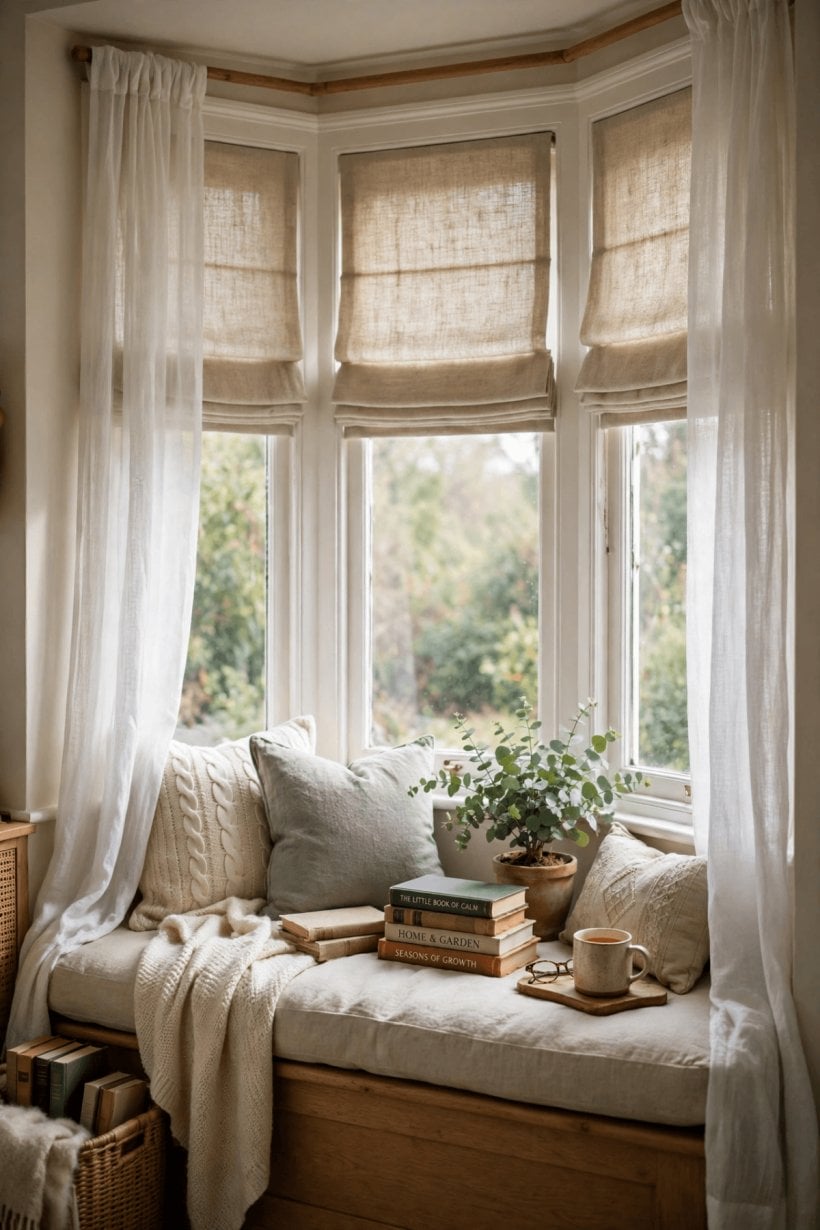
Bays gather dust on every ledge and attract condensation on cold mornings, so choose dressings you can maintain without a drama. Blinds and shutters wipe down in minutes. Curtains last longer between washes if you vacuum them gently with an upholstery tool and rotate any that sit in strong sun. Washable fabrics matter in kitchens and in homes with wood stoves, pets or small children; dry-clean-only panels in a busy family room will quietly become a source of guilt.
Condensation deserves respect. Air needs to circulate between glass and dressing, so avoid sealing curtains tight against a cold bay all winter, and wipe frames on damp mornings before mould takes an interest. The same ventilation logic appears in guides to tiny house bathroom ideas, where moisture management decides whether finishes thrive or fail. Check cords, brackets and shutter hinges once a season, tighten what has worked loose, and keep spare rings, hooks and a fabric offcut in a drawer. Small maintenance done early is what keeps a bay looking intentional five years on instead of tired.
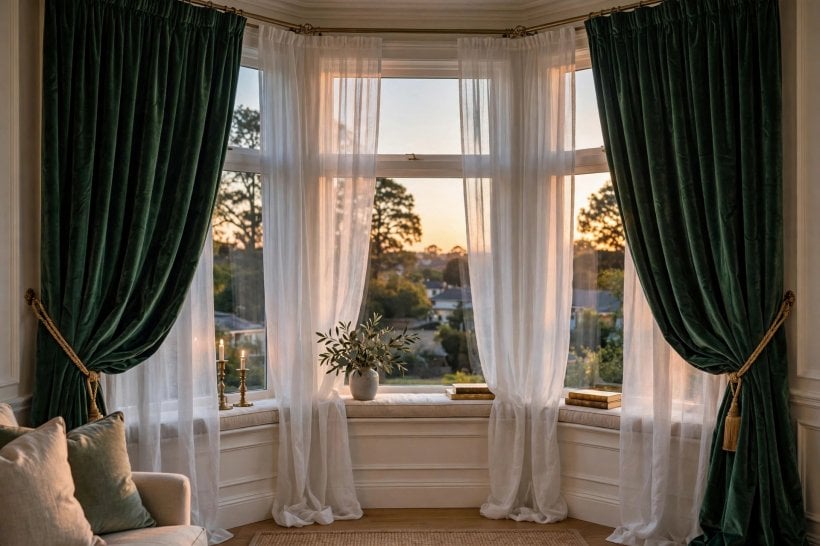
One last habit is worth adopting before you order anything: live with samples in the bay for a full day and night. Pin the fabric, prop the blind sample, or hang the shutter colour card exactly where the finished dressing will sit, then check it at breakfast, at noon, at dusk and under your evening lamps. Bays collect light from several directions at once, so they expose differences that a flat window hides — a white that turns grey, a pattern that suddenly shouts, a lining that glows warmer than expected. Note which option still pleases you at the least flattering hour, because that is the one you will be happy with in February as well as June. Take a phone photo at each stage as well; the camera is brutally honest about clashes and about whether the dressing is stealing the view. If two options survive this test, choose the one that is easier to operate and clean, since you will handle it twice a day for years. Looks win the first week, but ease wins every week after that, and a bay that stays easy stays loved.
10. Common Mistakes and Small-Room Fixes
The classic bay mistakes are easy to avoid once named. Dressing only the centre pane leaves the sides looking forgotten. Hanging curtains inside a shallow bay shrinks the room and fights the seat. Choosing fabric from a tiny swatch, without seeing it backlit at full width, leads to colours that behave nothing like the sample. And blocking the view entirely wastes the very thing a bay exists to give you — a wider, calmer outlook, ideally towards planting arranged with the layering seen in tiny house landscaping ideas.
In small rooms, slim beats grand almost every time. Fitted blinds, a single pair of curtains drawn to the sides, and a light palette keep the bay feeling like extra space rather than a stage set. Keep patterns either small and calm or large and confident; mid-sized busy prints date fastest. Repeat one colour from the bay somewhere else in the room so the window feels connected, and store the off-season extras — spare cushions, heavier throws — out of the bay itself. If you inherit a bay dressed by someone else, live with it through a full week of mornings and evenings before ripping anything out. Half of what looks wrong is often just the wrong light at the wrong hour.
Final Considerations
The right bay window treatment is the one that fits how the room is lived in: light controlled without fuss, privacy when you want it, and a seat or sill that stays useful every day. Start with the layout, let colour support the architecture, budget for the angles, and measure twice. Do that, and a bay stops being the awkward corner of the room and becomes, as it should be, the place everyone quietly hopes is free.



0 Comments