

An air jet tub promises a gentler, quieter soak than a whirlpool, using warmed air bubbles instead of pumped water. Before you buy one, though, the details that decide whether you love it — jet layout, blower care, access for repairs, cleaning habits — are exactly the details listings tend to skip.
This guide works through those checks in plain order, so you can compare any model on the facts that matter and ignore the sales noise.
1. Air Jet Tubs at a Glance: Quick Questions and Answers
| Question | Short answer | Check before you buy |
|---|---|---|
| How does an air jet tub work? | A blower pushes warmed air through many small holes in the tub floor and walls | Ask where the jets sit and whether the air is heated |
| Is it gentler than a whirlpool tub? | Generally yes — air bubbles give a lighter, champagne-like massage | Decide which sensation you actually prefer before paying for either |
| Does it need special cleaning? | It needs regular drying and periodic system flushing, but there are no water-filled pipes to scrub | Read section 8 and follow the maker’s care routine |
| Can one fit a small bathroom? | Often, if you plan access, electrics and the route through the house | Measure with the checklist in section 7 |
| What extra running parts are there? | A blower, sometimes an inline heater, controls and a check valve | Confirm spares and servicing are available locally |
| What should you never skip? | An access panel for the blower and pump-side fittings | Agree its position with your installer in writing |
Use this table as the short version of the whole air jet tubs guide: if a seller can answer these six questions clearly, you are dealing with a straightforward product; if answers stay vague, keep looking. Air systems are simpler than water-jet systems in some ways — the air channels do not hold bath water — but they add a blower, electrics and a drying routine of their own. Nothing here is difficult, yet all of it is easier to check before the tub is tiled in than after. The sections that follow take each check in turn, from how the bubbles are made to how you will clean them in year three, when the novelty has worn off and only good design still feels effortless.
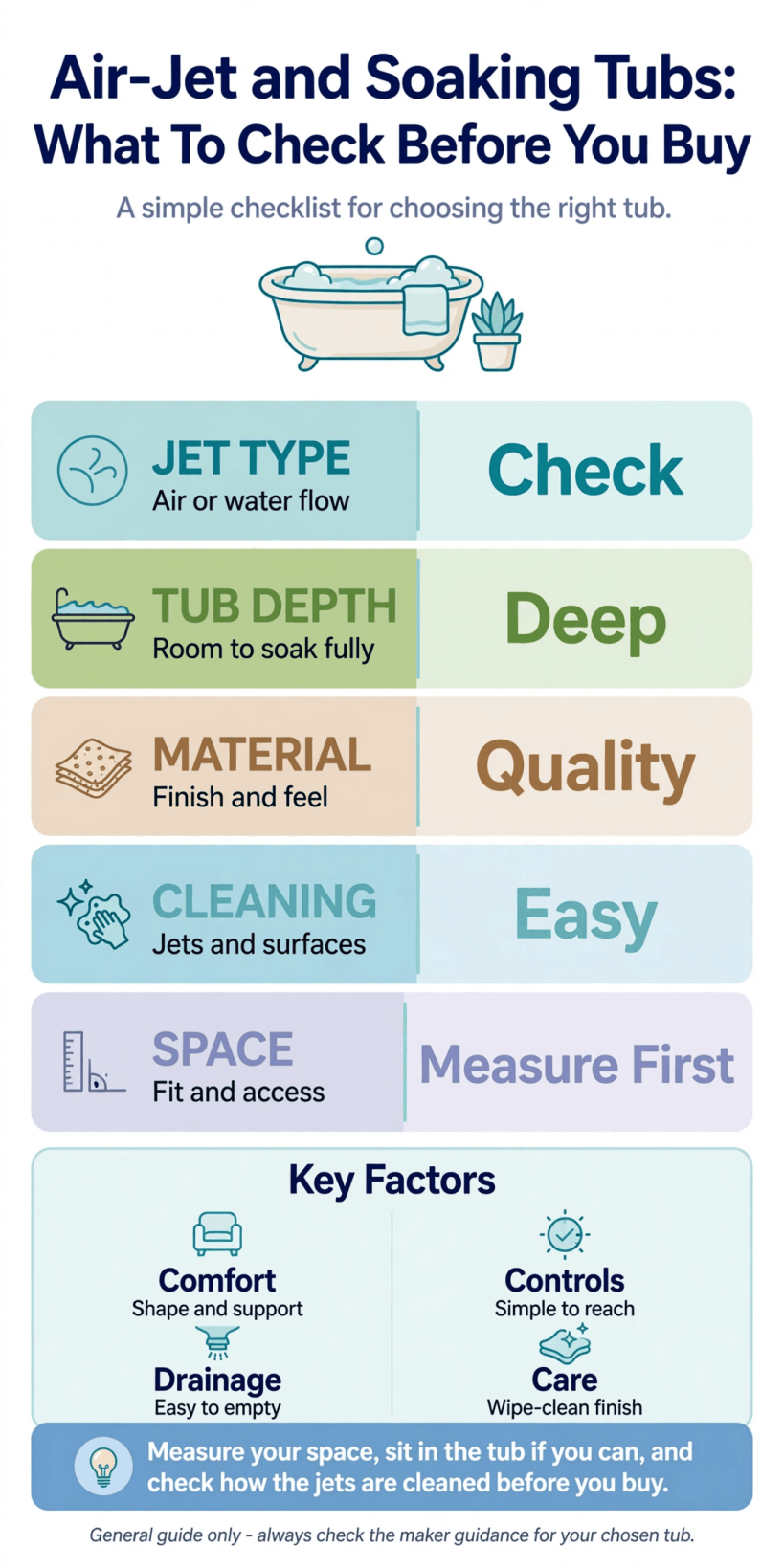
The key checks at a glance — jets, blower, access, electrics, cleaning and costs, summarised before you buy.
2. How Air Jets Work, and What To Check About Them
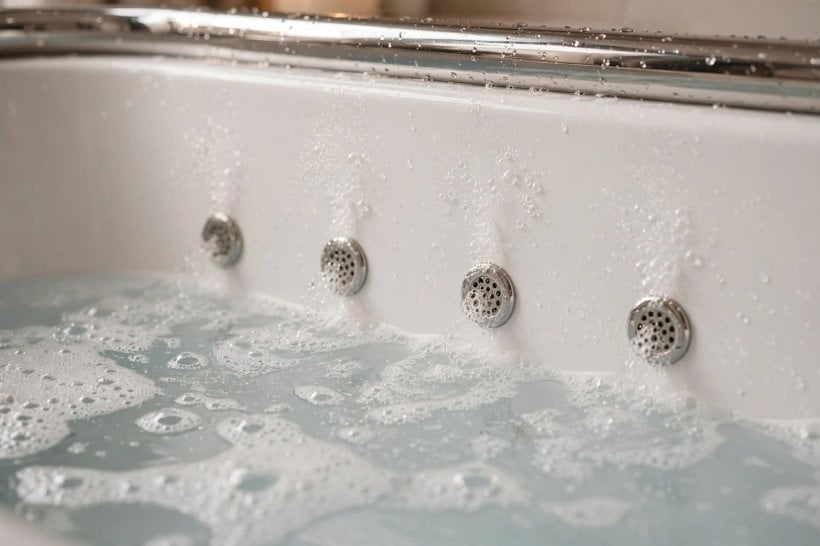
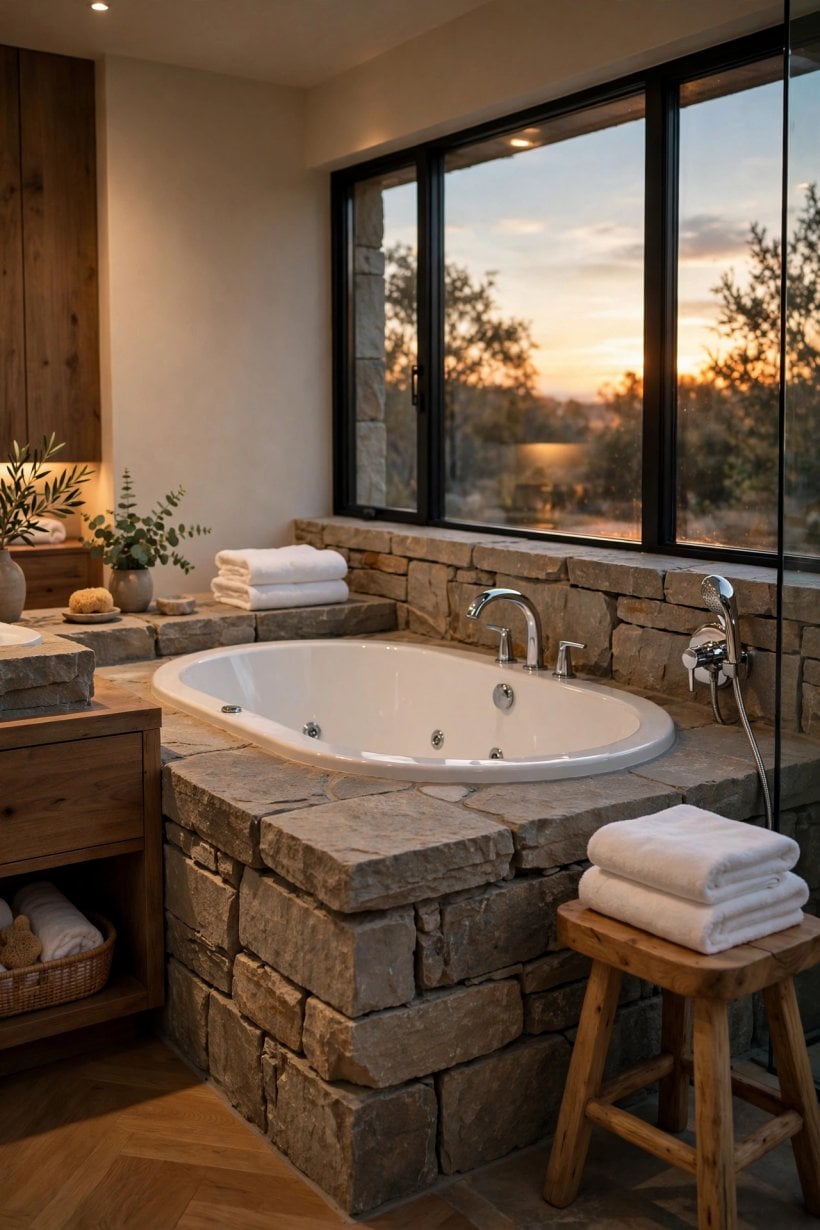
An air jet tub has dozens of small openings, usually across the floor and lower walls of the bath. A blower draws in room air, warms it, and pushes it through those openings so fine bubbles rise through the water. Because the system moves air rather than recirculated bath water, the feel is light and even, and the intensity comes from the blower speed rather than from a pump. Check how many jets a tub has, but pay more attention to where they are placed: jets under your back, calves and feet matter more than a headline number.
Ask whether the blower has variable speeds, because a single fixed blast suits nobody for a whole soak. Check whether the air is heated — unheated air can cool the bath surprisingly fast in a cold room — and whether a delay or purge cycle blows the channels dry after use. That purge cycle is a genuine hygiene feature, not a gimmick. Finally, listen if you can: blowers vary in noise, and a short demonstration, or at least an honest conversation about where the blower will sit, tells you more than any brochure. In the space-planning spirit of good tiny house bathroom ideas, treat sound, heat and access as part of the design from the start, not as surprises to manage later.
3. Size, Shape and Who the Tub Has To Fit
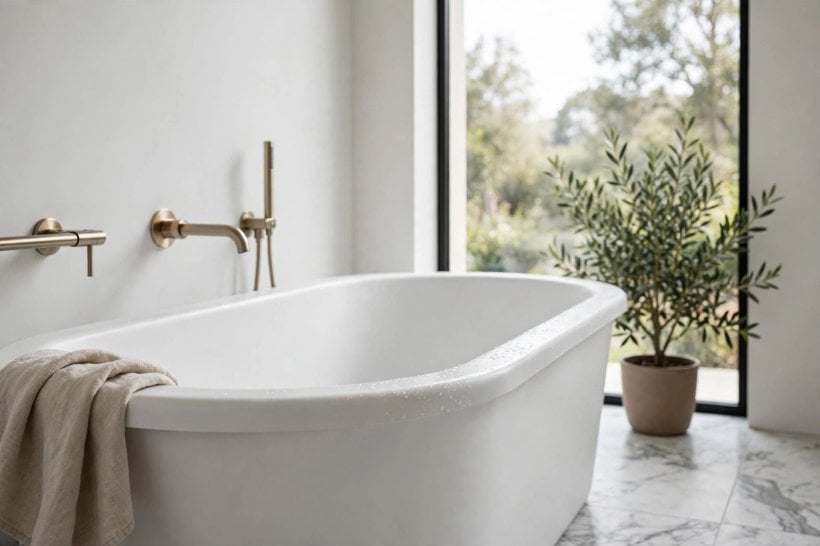
Start with the bathers, not the bathroom. Note the height and build of the tallest regular user, then look at internal length and width rather than the external footprint — two tubs with identical outer sizes can feel completely different inside because of wall slope, seat shaping and jet placement. A deep, narrower tub suits a single soaker who likes to be enveloped; a wider, shallower one is kinder for bathing children or sharing. If anyone using it has limited mobility, check the rim height, the step-over, and whether a grab rail can be fitted where hands naturally land.
Then check the room around it. The tub must travel through doors, halls and stairs, sit level on a floor that can carry the combined weight of tub, water and bather, and leave honest space to get in, out and cleaned around. Sketch the layout the way planners of bedroom interior design for tiny houses sketch a sleeping space: every centimetre assigned, nothing assumed. Freestanding models look simple but need plumbing reached from below or neatly from the wall; inset models hide pipework but demand access planning. Neither is better in the abstract — the right answer is the one your room, your floor and your household can support comfortably for years.
4. Materials, Construction and Finish
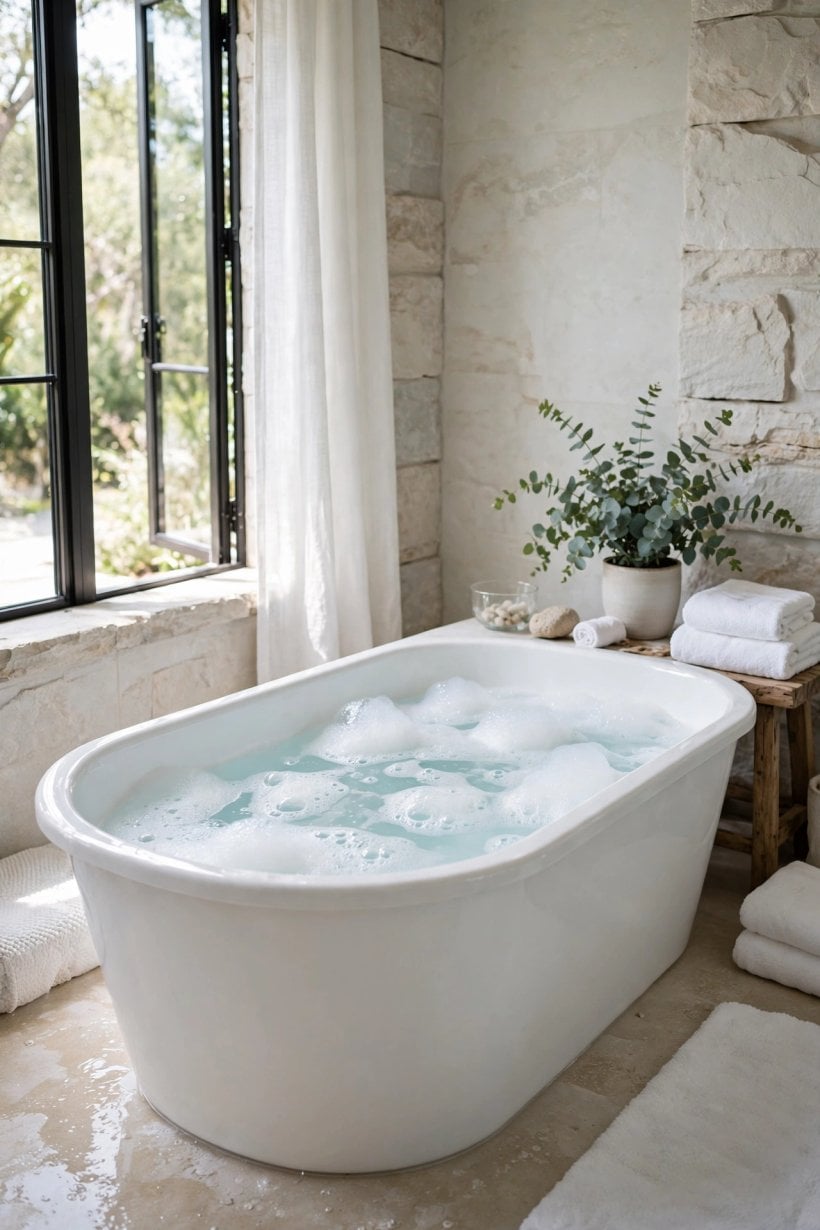
Most air jet tubs are formed from acrylic or similar sheet materials, sometimes reinforced, and the construction quality shows in small places: a rim that does not flex when you press it, a base that feels fully supported rather than drum-like, and jet fittings that sit flush so they do not catch skin or trap grime. Check how the tub is supported — a proper frame or full baseboard spreads weight and keeps the shell quiet — and ask what happens under warranty if a jet fitting fails.
Finish matters for cleaning as much as looks. Smooth, non-porous surfaces shrug off bath oils and coloured products better than textured ones, and lighter interiors make it easier to see when the tub needs a proper clean rather than a rinse. Think about the rest of the room while you choose: in calm, colour-led schemes like those in colourful tiny house interior ideas, the tub is usually the quiet background and the walls or textiles carry the personality. That is a sensible order of priorities, because finishes on walls are cheap to change and a plumbed tub is not. Whatever material you choose, confirm which cleaning products the maker allows, since some common sprays can dull or damage specialist surfaces over time, quietly voiding the guarantee you thought you had.
5. Plumbing, Electrics and the All-Important Access Panel
An air jet tub needs the usual water supply and waste, plus a dedicated electrical supply for the blower and any heater, installed to your local rules by a qualified electrician. Ask early where the blower will live: under the tub, in an adjacent cupboard, or further away with longer air lines. Each position changes noise, warmth and serviceability. Confirm the circuit protection required, the position of isolation switches, and that no electrical fitting ends up somewhere a future plumber or homeowner cannot reach safely.
The access panel is the least glamorous and most important decision in the whole purchase. Blowers, valves and connections eventually need inspection, and a tub that has been sealed in with tile and hope turns a small job into demolition. Agree the panel’s size and position with your installer before fitting, photograph everything before it is closed up, and keep those photographs with the house paperwork. This is the same forward-thinking habit that runs through any good self-managed project, from a bathroom refit to the whole-house planning in how to build your own tiny house: the work you hide is the work you must document. Five minutes of foresight here can save a wall later.
6. Controls, Heaters and Everyday Usability
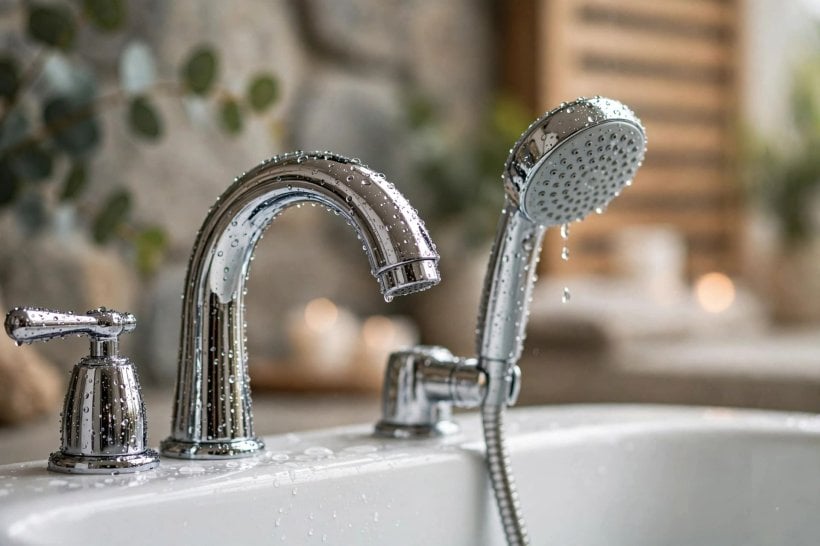
You will operate this tub with wet hands, in low light, while relaxing — so controls deserve more scrutiny than they usually get. Are they electronic pads, pneumatic buttons or a remote? Can you reach them from a seated position without stretching? Do they respond with gloves of bath foam on your fingers, and can a guest work them out without a manual? Variable blower speeds, a timer and a simple on-off you can find by feel cover most real needs; endless programmes mostly cover brochures.
An inline air heater is worth understanding clearly. It warms the air before it enters the water, slowing how quickly a long soak cools; it does not heat the bath like a kettle, and it will not rescue water that started lukewarm. Check its power draw alongside the blower’s, because both may share the new circuit you are paying to install. Also ask about automatic purge or drying cycles, child locks if small children will use the tub, and what the controls do after a power cut — a tub that restarts its blower unexpectedly at midnight is a story nobody wants. Judge features by the Tuesday-evening test: useful when you are tired, not just impressive in a showroom.

7. Fitting One Into a Small Bathroom
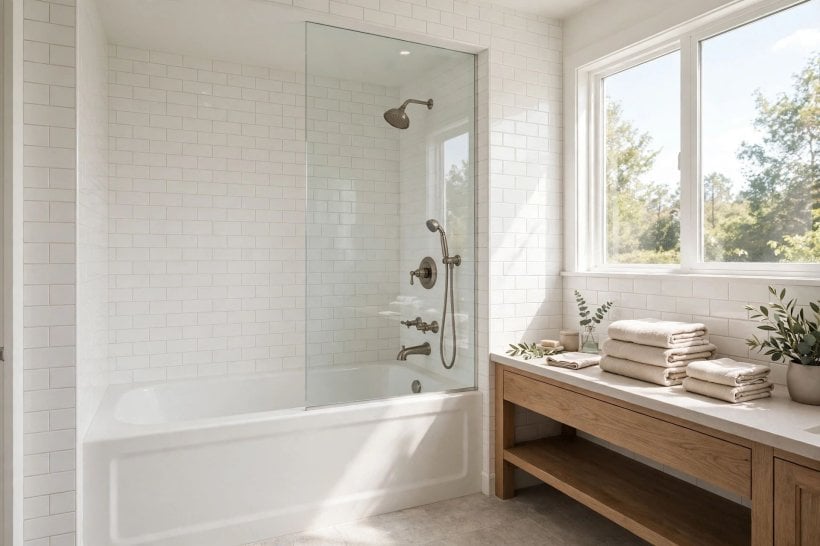
Compact bathrooms reward honesty. Measure the room, the door openings and the turning space on stairs or landings, then measure again with skirting and radiators included. Alcove and back-to-wall shapes often suit small rooms best because they waste no perimeter, and a shower over the tub can replace a separate enclosure if the screen and wall finishes are planned for spray. Keep the blower’s air path as short and straight as the layout allows, and position the access panel where a person can actually kneel and work, not behind a permanently fixed vanity.
Small rooms also amplify noise and steam, so plan extraction and think about where the blower’s hum will travel at night. Borrow the layered thinking from tiny house living room ideas: in a tight footprint, every element does two jobs, so let the tub’s surround include a shelf for candles and bottles, let the bath panel carry the access hatch invisibly, and let lighting be warm and dimmable rather than a single bright downlight. Choose the largest tub that fits those rules — not the largest that can be forced through the door — and the room will feel generous instead of squeezed, which is the whole point of bathing rather than merely washing.
8. Cleaning and Hygiene: The Routine You Are Signing Up For
Air systems have a real hygiene advantage: the channels carry air, not yesterday’s bath water, so there is no loop of pipework quietly holding stale water. That advantage only counts if you keep the routine. Let the tub dry between uses, run the purge or dry cycle if your model has one, and wipe jet openings when you clean the bath so oils and soap residue do not build up around the rims. Follow the maker’s schedule for any deeper system clean, and use only products they approve for the surface and fittings.
Be honest about your household’s habits before you buy. If baths are daily and the tub rarely dries fully, ask harder questions about drying cycles and ventilation in the room; if it is a weekend luxury, a simpler model with a good purge cycle will stay fresh with very little effort. The same realism shapes the best tiny barn house interior ideas, where finishes are chosen for the life actually lived in them. Also check how replacement seals, jet caps and control parts are supplied in five years’ time — a maker who still lists spares for older models is telling you something reassuring about how long they expect their tubs, and their customers, to stay together.
9. Costs: What You Actually Pay For
Quotes for air jet tubs stretch widely because you are buying several things at once: the tub itself, the blower and jet system, any heater, controls, delivery of a large rigid object, plumbing and electrical work, and the finishing — panels, tiling, screens and making good. When comparing prices, separate the product price from the installed price, and make sure each quote covers the same scope. The cheapest tub can become the dearest project if it needs structural floor work, a new circuit and complex access carpentry that a slightly dearer, better-planned model avoids.
Running costs are usually modest but worth a thought: a blower and heater draw power during a soak, and longer, hotter baths use more water and heating energy, whatever stirs the bubbles. Spend your money in the order the tub will reward you: sound construction and jet placement first, a reliable blower with sensible speeds second, access and installation quality third, and decorative extras last. Keep a contingency for the unknowns older houses specialise in — floors that are not level, walls that are not square, pipework that is not where anyone expected. A calm budget with a reserve beats a stretched budget with crossed fingers, every single time.

10. Questions To Ask Before You Order
Before paying a deposit, work through a final list out loud with the seller or installer. Where exactly will the blower sit, and how will it be reached? What electrical work is included, and who certifies it? What is the internal soaking length, not just the external size? Is the air heated, how many blower speeds are there, and is there an automatic drying cycle? Which cleaning products are approved, what does the warranty cover — shell, blower, controls, fittings — and for how long? How are spare parts ordered, and what is the realistic delivery route into your bathroom, measured, not assumed?
Write the answers down, because verbal promises evaporate. Check the returns position if the tub arrives damaged, agree who inspects it on delivery day, and never let a tub be tiled in before it has been filled, run through a full cycle and checked for leaks and blower noise with everyone present. That single test — water in, jets on, ears open, torch under every fitting — catches most problems while they are still easy to fix. A careful seller will welcome the checklist; it protects them as much as you. If anyone resists basic questions, that resistance is itself the most useful answer you will get, and it costs you nothing to walk away with it.
Final Considerations
An air jet tub is a simple pleasure built from unglamorous details: jets where your body actually is, a blower you can reach, controls you can work half asleep, and a cleaning routine you will genuinely keep. Use this air jet tubs guide to test every model against those details, in that order, and the choice largely makes itself. Buy the tub that fits your room, your floor, your electrics and your habits — not the one with the longest feature list — and it will still feel like a small daily luxury long after the showroom shine is forgotten.




0 Comments