
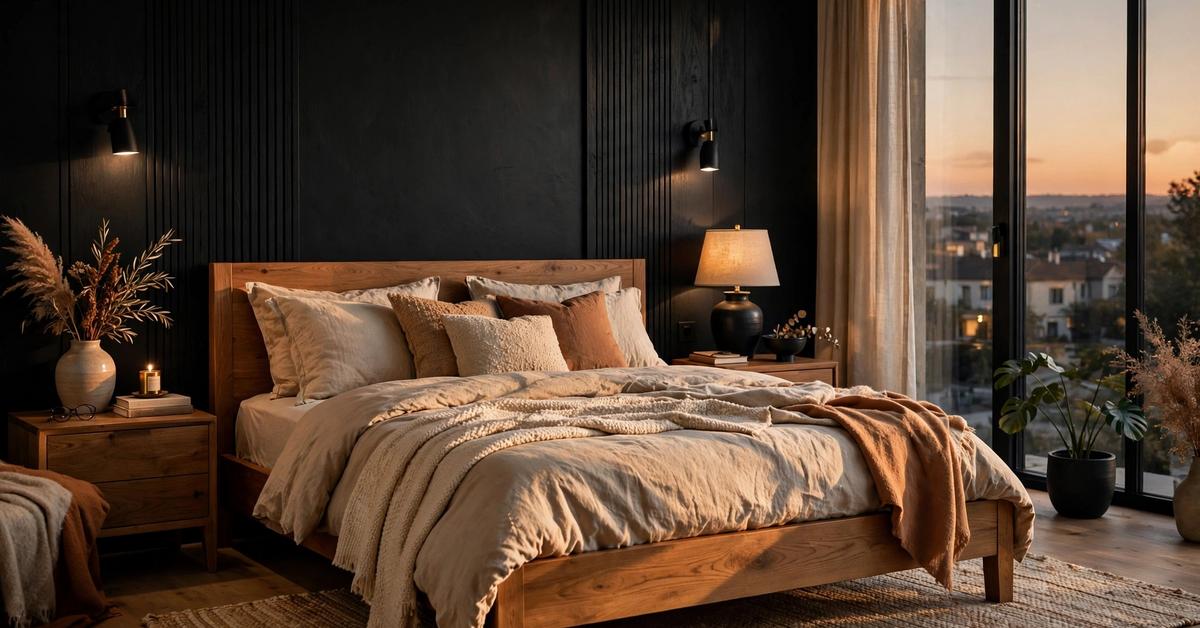
Black walls in a bedroom sound like a dare, until you see one done well: the bed glows against the dark, the light pools warm, and the room feels less like a box and more like a held breath.
These seventy-five ideas keep one angle — the walls themselves. Colour, coverage, bedding, wood, light, storage and paint craft all serve the dark backdrop; the furniture-led black bedroom lives in its own post, linked below.
1. Bedroom with Black Walls at a Glance
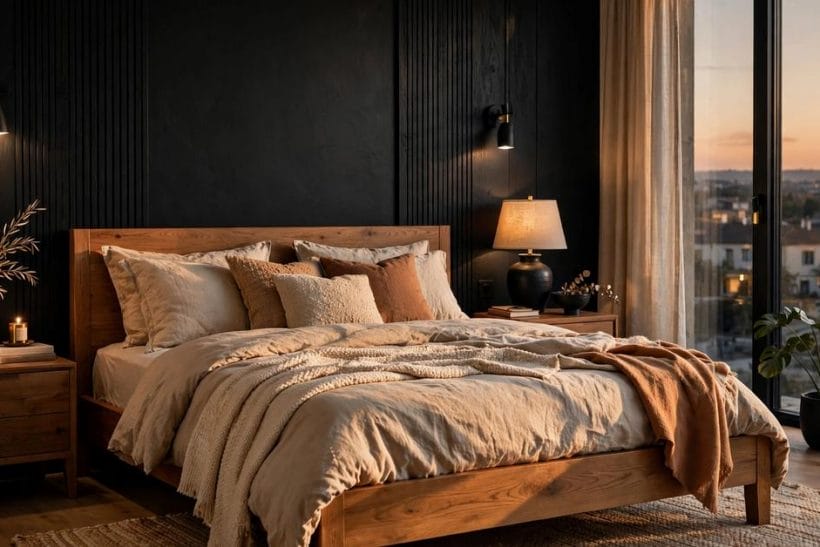
The central entity is the black-walled bedroom: a sleeping room whose walls — one, some or all — are finished in black or near-black, with every other decision made in answer to that darkness. The room-wide survey belongs to the bedroom ideas pillar; the sibling post black bedroom is furniture-led — black beds and dark pieces on ordinary walls — while this post is walls-led: start here if the wall colour is the decision, there if the furniture is.
| Question | Short answer |
|---|---|
| One black wall or all four? | One wall behind the bed is the classic commitment; all four is the cocoon — the sections below weigh light, room size and nerve for each |
| Will black walls make the room feel smaller? | They blur the corners, which can read as smaller or as endless — pale bedding, a light ceiling and layered light decide which |
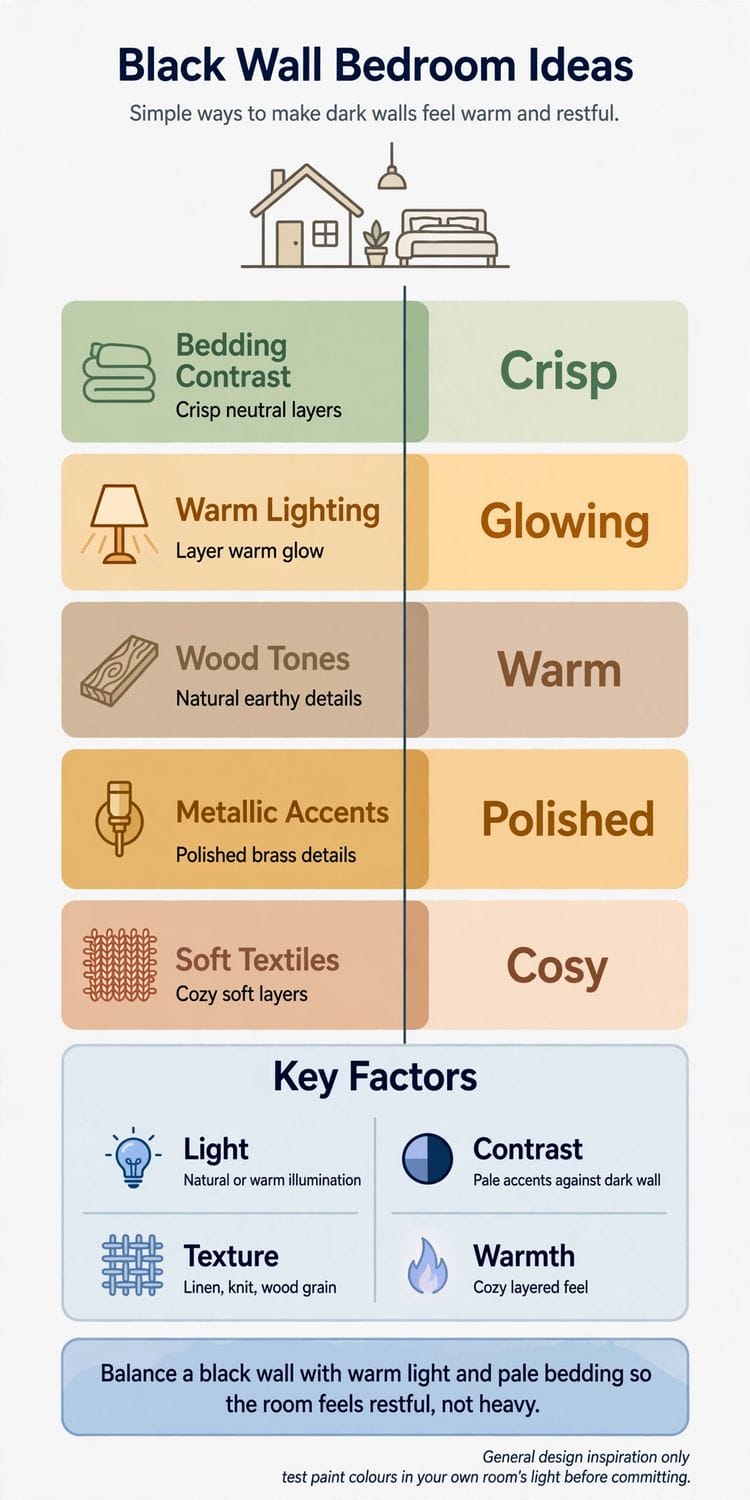
| What bedding suits black walls? | Whites, creams and warm neutrals give the contrast; rust, ochre and olive give the glow — both families are worked through below |
| Is black paint hard to live with? | It shows dust and scuffs sooner than mid-tones and rewards good prep — finish and paint craft are covered in the last section |
2. One Wall or Every Wall: Choosing Your Coverage
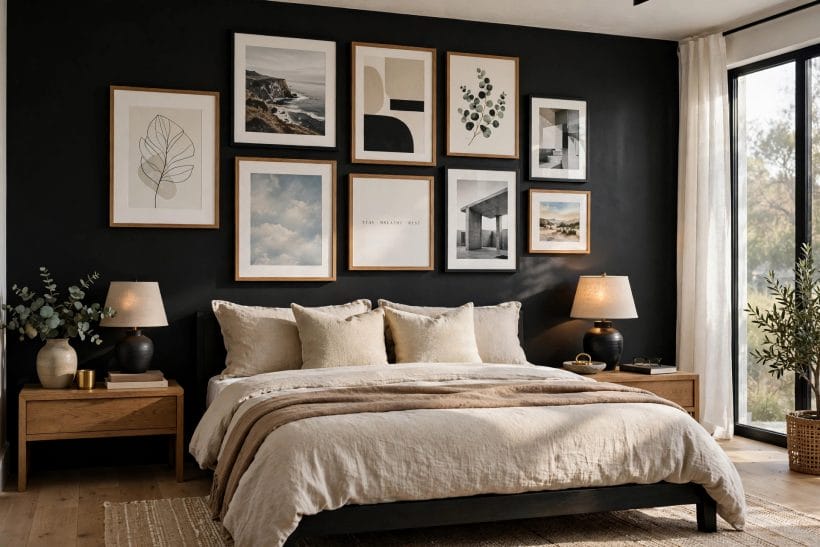
Coverage is the first and largest decision. A single wall is a backdrop; four walls are an atmosphere. Neither is braver — they are different rooms, and the nine starting points below frame the choice before colour and bedding refine it.
1. The headboard wall only
Black behind the bed is the classic first move: the wall you see least while in bed, and the one that frames pillows best. Other walls stay light, the room keeps its daylight, and the bed becomes the portrait.
2. All four walls, the full cocoon
Every wall black dissolves the box entirely — corners vanish, the ceiling floats, the room turns inward. It suits bedrooms used mainly at night, and asks for confident lighting and bedding contrast to stay restful rather than heavy.
3. Two walls: the corner wrap
Painting the headboard wall and one side wall wraps the bed in an L of darkness. It reads intentional from the door, keeps two light walls for dressing, and gives artwork dark and pale grounds to play against.
4. Black above the picture rail
In rooms with a picture rail, black above and a warm neutral below flips the usual order — the dark hovers like a canopy. A gentle route into black where full walls feel like too much.
5. Black below: the wainscot line
Black to chair-rail or panelling height, with a soft colour above, grounds the room the way dark trousers ground an outfit. The line gives beds and furniture a horizon, and the upper wall keeps the room’s light bounce alive.
6. The black ceiling question
A black ceiling over pale walls lowers the sky and makes tall rooms intimate; over black walls it completes the cave. Test it where ceilings are high and lighting warm — low ceilings under black feel like a lid.
7. Black inside the alcove
Alcoves, chimney breasts and the recess beside a wardrobe take black beautifully — the architecture already frames them. A dark alcove behind a reading chair or dressing table gives the room depth without asking the main walls to commit.
8. The renter’s black: fabric and panels
Where paint is not allowed, black comes in cloth: a stretched fabric panel, black curtains behind the bed, or freestanding black screens. Surprisingly close to paint — and it all leaves with you.
9. Black that stops at the door
Paint the room’s black up to — but not including — the door and trim, keeping those crisp white or warm wood. The pale frame tells the eye the darkness is a choice with edges, not a spill.
3. The Blacks Themselves: True Black, Off-Black and Blue-Black
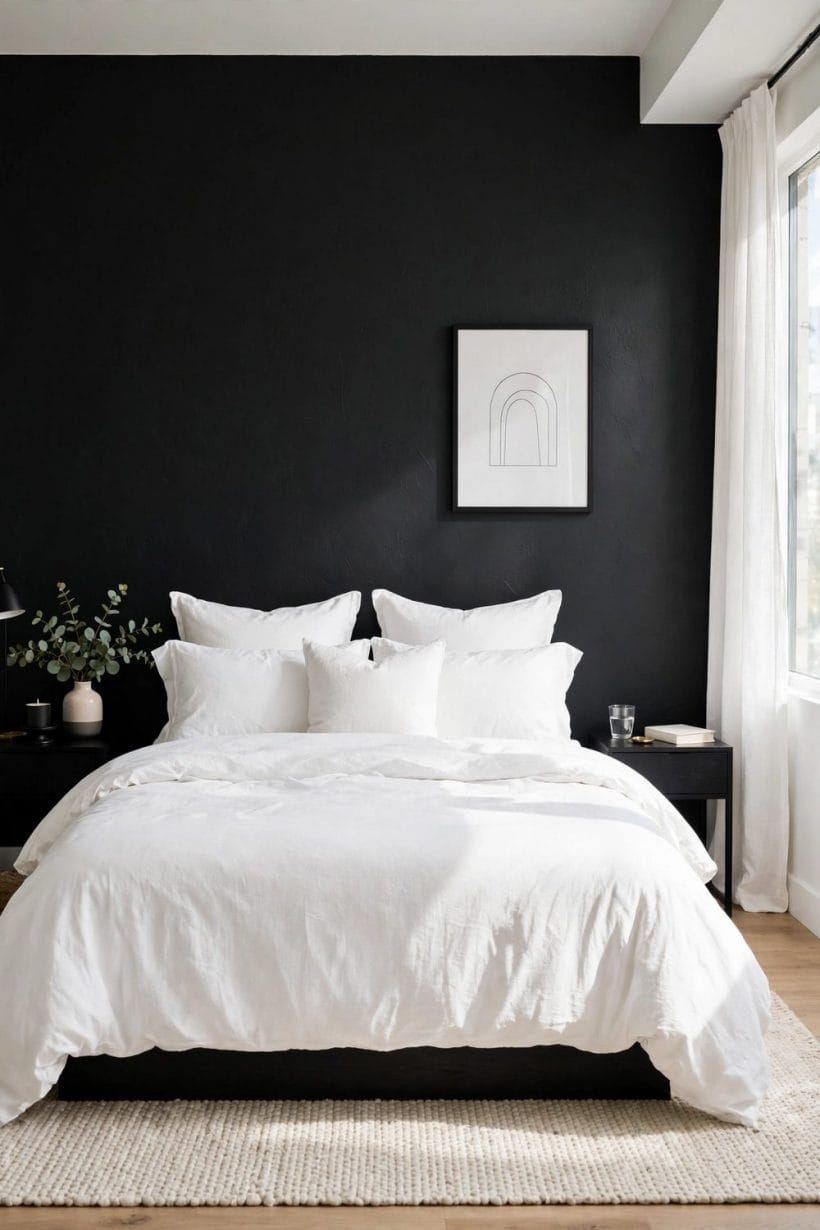
Black is a family, not a colour. Undertones decide whether the room feels like velvet, slate, ink or smoke, and they argue with your light and your wood. These nine ideas sort the family before a single tester pot is opened.
10. True neutral black
The straight black — no leaning — is the boldest and least forgiving: colours beside it look pure, and every roller mark shows. It suits confident, simple rooms where the bedding does the soft talking.
11. Blue-black: the ink wall
A breath of blue turns black into ink — cooler, deeper, and kind to white bedding and chrome. Blue-black is the evening colour par excellence, and it flatters north-facing rooms less than warm ones, so test it where it will live.
12. Green-black: the forest depth
Green-leaning blacks read like deep forest shade — softer than they sound, and beautiful with oak, brass and cream. In morning light the green shows; by lamplight it settles back to black. A favourite for rooms that want mystery without cold.
13. Brown-black: the warm coal
Brown-black is black with the fire still in it — the warmest of the family and the easiest to live with. It loves linen, leather, rust and terracotta, and never gives the blue-ish flash that makes some blacks feel like screens.
14. Charcoal: black’s gentler cousin
Charcoal is where the nervous start: dark grey with real presence but a softer edge, more forgiving of light and dust. Many “black wall” rooms that feel calm are actually charcoal — the depth is there, the absolutism is not.
15. Matte black: the velvet finish
Matt black drinks light and reads as depth itself — walls like velvet in photographs. It marks more easily than eggshell, so save it for adult bedrooms and walls hands rarely touch.
16. Eggshell black: the practical sheen
A soft eggshell sheen is the working finish for black bedrooms: wipeable, tougher, and it catches just enough light to show the wall’s planes. Most lived-in black rooms land here, trading a little drama for a lot of forgiveness.
17. Limewash and textured black
Limewash, clay paint and other mineral finishes give black a cloudy, moving surface — the wall becomes weather rather than paint. Texture hides imperfections, softens the dark, and suits old houses whose walls were never flat to begin with.
18. Black panelling and slats
Black-painted panelling, board-and-batten or timber slats build the darkness into the architecture: shadow lines do half the work, and the wall gains a rhythm flat paint cannot. It is the strongest version — and the one guests photograph.
Deep colours are a family across the bedroom colour set: the moodiest alternative to black is the jewel-depth of purple bedroom ideas, which warms where black cools.
4. Bedding Against Black: Whites, Creams and Warm Neutrals
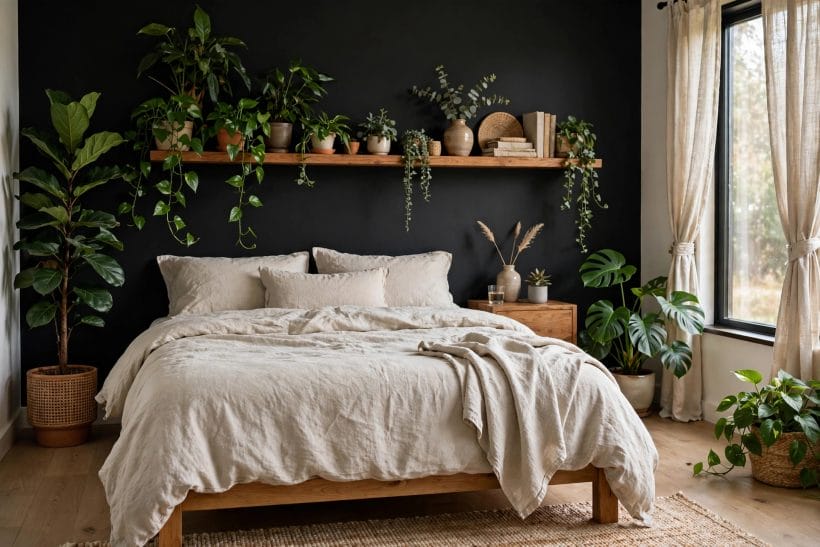
Bedding is the contrast engine of the black-walled bedroom — the largest pale surface in the room, deciding whether the dark feels crisp or cosy. These nine ideas build the bed as the wall’s partner.
19. Crisp white bedding, the classic contrast
White sheets and a white duvet against black is the photograph everyone knows, and it earns the fame: maximum contrast, hotel-clean, endlessly fresh. Keep the white warm-leaning rather than blue-white so the pairing glows instead of glaring.
20. Cream and ecru: the softer contrast
Cream bedding gives nine-tenths of the contrast with half the starkness. Against black it reads candlelit and calm, and it forgives the slight colour drift between separately bought pieces that pure white matching never does.
21. Linen’s rumple against black’s polish
Washed linen in stone, flax or soft white is black’s best texture friend — the rumple stops the room feeling like a showroom. Linen also photographs honestly: what you see in the picture is what the morning looks like.
22. The warm-neutral stack
Layer oatmeal, camel, taupe and mushroom across duvet, throw and cushions and the bed becomes a gradient rising off the dark wall. It is the most forgiving scheme to build slowly, piece by piece, from what you already own.
23. Black bedding on black walls
Full monochrome — black or charcoal bedding against black walls — works when texture does the separating: matte linen, a knitted throw, gloss beside chalk. Without texture layers it flattens; with them, it is the deepest calm on this page.
24. A single coloured throw
One throw in rust, ochre, olive or deep teal across the foot of a neutral bed gives the black room its jewel. One is the discipline — two competing throws turn the jewel into a jumble, and the wall stops being the star.
25. Pattern kept small and quiet
Fine stripes, small checks and subtle woven patterns survive black walls; big florals and loud geometrics fight them. If pattern is your joy, let it live in one cushion or a folded quilt, scaled small against the room’s large darkness.
26. The bed skirt and valance question
Dark walls draw the eye to the bed’s silhouette, and a valance in the bedding’s pale tone finishes the outline cleanly. Where the frame is beautiful timber, skip it — the legs against black are a picture already.
27. Seasonal bedding swaps
Black walls are the constant; bedding is the season. White linen for summer’s brightness, cream wool layers for winter’s depth — the wall makes each swap look deliberate, and two bedding sets refresh the room more cheaply than any repaint.
5. Wood, Metal and Warm Materials
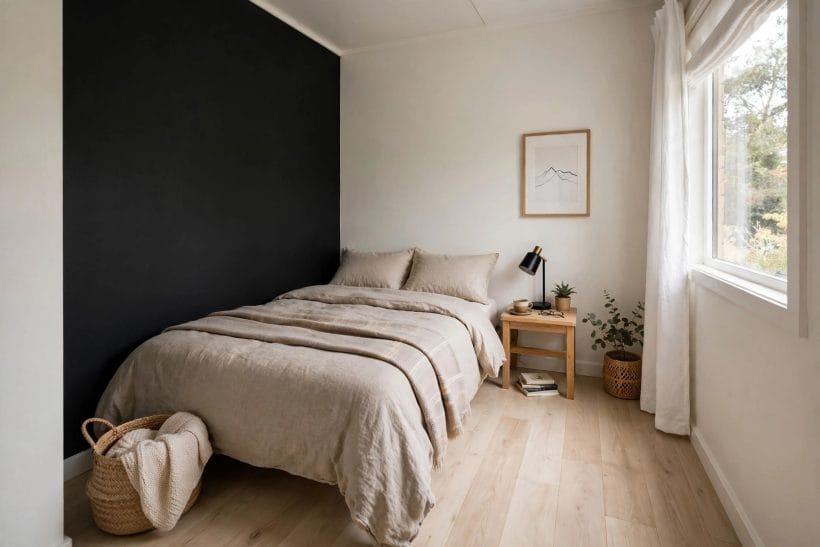
Black is a cool customer; warmth is carried in by materials — timber, brass, leather, rattan — dosed here so the room feels ember-warm rather than showroom-cold.
28. The warm wood bed frame
Oak, walnut or any honey-toned timber bed against black is the pairing the style is built on: the wood glows like firelight against the dark. Pale pine can look raw beside black; mid and warm tones are the reliable company.
29. Brass and gold-toned metals
Brass is black’s oldest friend — lamps, handles, mirror frames and bedside trays in brushed or aged brass catch small lights all over the room. Keep the metal family to one or two finishes so the glints rhyme rather than argue.
30. Black metal, used carefully
Black metal bed frames and lamps disappear into black walls — sometimes the point (calm, minimal), sometimes a loss (the furniture turns to silhouette). If you choose it, let bedding and wood carry the middle tones the metal no longer provides.
31. Leather’s warm wear
A tan or cognac leather headboard, bench or even a single chair warms black walls the way a saddle warms a horse — the colour deepens beside the dark, and leather’s sheen gives the wall’s mattness something to answer.
32. Rattan, cane and woven texture
Woven bedside pendants, a cane-fronted wardrobe or a rattan laundry basket bring the handmade, sunlit note that stops black reading corporate. Their honey colour sits in the same family as warm timber, so they layer without effort.
33. The wooden floor decision
Mid-tone timber floors are the black-walled bedroom’s best friend; very pale floors can look stark, very dark floors merge into the walls’ shadow. A rug between the two tones usually settles whatever argument remains.
34. Stone and marble accents
A marble-topped nightstand or a stone tray gives black walls one cool, polished note — the contrast of cave and quarry. A little goes far; stone everywhere turns the bedroom into a bathroom’s mood, however beautiful the veining.
35. Mirrors that double the light
A mirror on or opposite a black wall doubles whatever light the room has and gives the darkness a window. Aged or smoked glass suits black best — the reflection stays moody, not shopfront.
36. Artwork: pale mounts, quiet subjects
Art on black walls wants pale mounts and breathing room — the wall is already a gallery’s most dramatic hang. Line drawings, pale abstracts and photographs with deep shadows all sit well; busy, dark art disappears into its ground.
6. Lighting a Dark Room Well
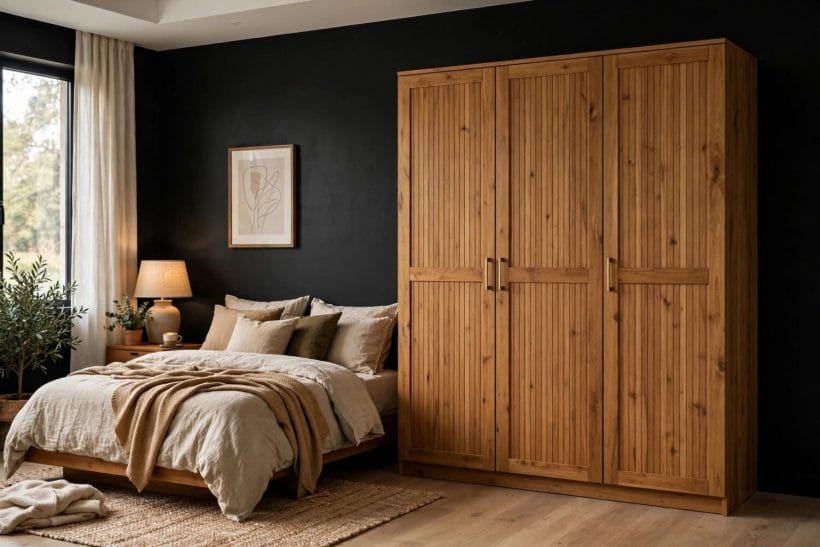
Black walls do not need more light — they need better-placed light. With no pale-wall bounce, lamps work in layers: pools at the bed, a glow at the mirror, something gentle overhead.
37. Layered light, never one ceiling bulb
A single central light in a black room makes a cave with an interrogation lamp. Build three layers instead: bedside pools for reading, low ambient light for dressing, one soft overhead glow — each on its own switch.
38. Bedside lamps as the main event
In a black-walled bedroom the bedside lamps are effectively the room’s windows after dark. Choose shades that throw light down and out — pale linings bounce a warm halo onto the wall, and the black behind turns to velvet.
39. Wall sconces on the black wall
Sconces mounted on black read as floating flames — the fitting nearly vanishes, the glow remains. Brass and black fittings both work; position is by the bed and the mirror, where faces and pages need the kindness.
40. Warm bulbs only
Daylight-blue bulbs against black walls produce the morgue effect everyone fears. Warm-toned bulbs — the ones sold as warm white — are non-negotiable here; they are what turns the same paint from cold to ember between morning and night.
41. Dimmers everywhere they fit
Black bedrooms live at half-light: bright enough to dress by at seven, low enough to unwind by at ten. Dimmers on the main circuits let one room be both, and dimmed warm light is where black paint looks its most expensive.
42. Daylight: the north-facing test
Before committing, watch your room’s daylight honestly. North-facing rooms give black walls a blue-grey cast all day; south-facing rooms feed them sun. The colour sections above help — warm-undertone blacks rescue cool light, and vice versa.
43. Sheers and layered curtains
Black walls with heavy blackout curtains can feel sealed; a sheer layer keeps daytime privacy while letting the wall meet softened light. Pale sheers against the dark also give the window a picture-frame contrast the room will thank you for.
44. Candlelight and the evening ritual
It is not a cliché if it works: black walls are candlelight’s best room. Candles or low lanterns on the dresser turn the whole wall into firelight’s backdrop — a ritual no pale room can copy.
45. Lighting the dressing corner
The practical corner — wardrobe, mirror, the choosing of clothes — needs its own honest light, or black walls will have you dressing by guesswork. A lamp or sconce at the mirror keeps colours honest.
7. Colour Accents That Survive Black

Black is the most hospitable backdrop a colour can have — almost every hue deepens against it. The art is in the dose: accents here work like seasoning.
46. Rust and terracotta: the ember accents
Rust cushions, a terracotta pot, a clay-coloured throw — the ember family is black’s most natural colour company, warming without brightening, and the easiest to live with.
47. Ochre and mustard: contained sunshine
Yellow’s deep end — ochre, mustard, old gold — glows against black like lamplight. Use it in cushions, a single chair or a lampshade, and compare its cheer with the full-commitment version in yellow bedroom ideas, where the colour takes the walls instead.
48. Olive and sage: the quiet greens
Muted greens sit calm against black, bringing the garden in without a single bright note. Olive bedding on a black-walled room is a deeply restful combination — the colours are close in depth, so nothing shouts.
49. Deep teal and petrol blue
Blue-greens nearly as dark as the wall create the tone-on-tone room: black behind, teal cushions and curtains in front, depth everywhere. It is the scheme for people who found black by loving dark colours, not by wanting contrast.
50. Blush and dusty pink
Soft pink against black is unexpectedly grown-up — the dark takes the sweetness out and leaves the warmth. Blush linen, a dusty rose cushion or pale pink art mounts soften the wall without lightening the room’s mood.
51. Cream as an accent, not just bedding
Beyond the bed, cream in curtains, a rug and lampshades repeats the bedding’s contrast around the room so the contrast feels designed rather than accidental. Three pale notes — bed, window, floor — is the reliable triangle.
52. Plants: green that is alive
A living green is the one accent that never clashes with black: leaves against the dark look lit from within. Choose plants that forgive lower light, and let one tall plant own a corner.
53. Books, art and the coloured shelf
A low bookcase or picture ledge against a black wall turns spines and covers into a colour strip — free accents you already own. Arrange loosely; the wall’s drama means the shelf does not need to perform tidiness.
54. The one bright thing
Every black room can carry exactly one bright, saturated object — a scarlet chair, a cobalt vase, a sunflower-yellow cushion — and it will be what guests remember. More than one and they compete; the wall’s calm is the price.
Black is the far end of the wall-colour journey that runs through bedroom with gray walls ideas and the bedroom with blue walls ideas — each takes one colour and asks what it does to sleep.
8. Storage That Disappears into the Dark
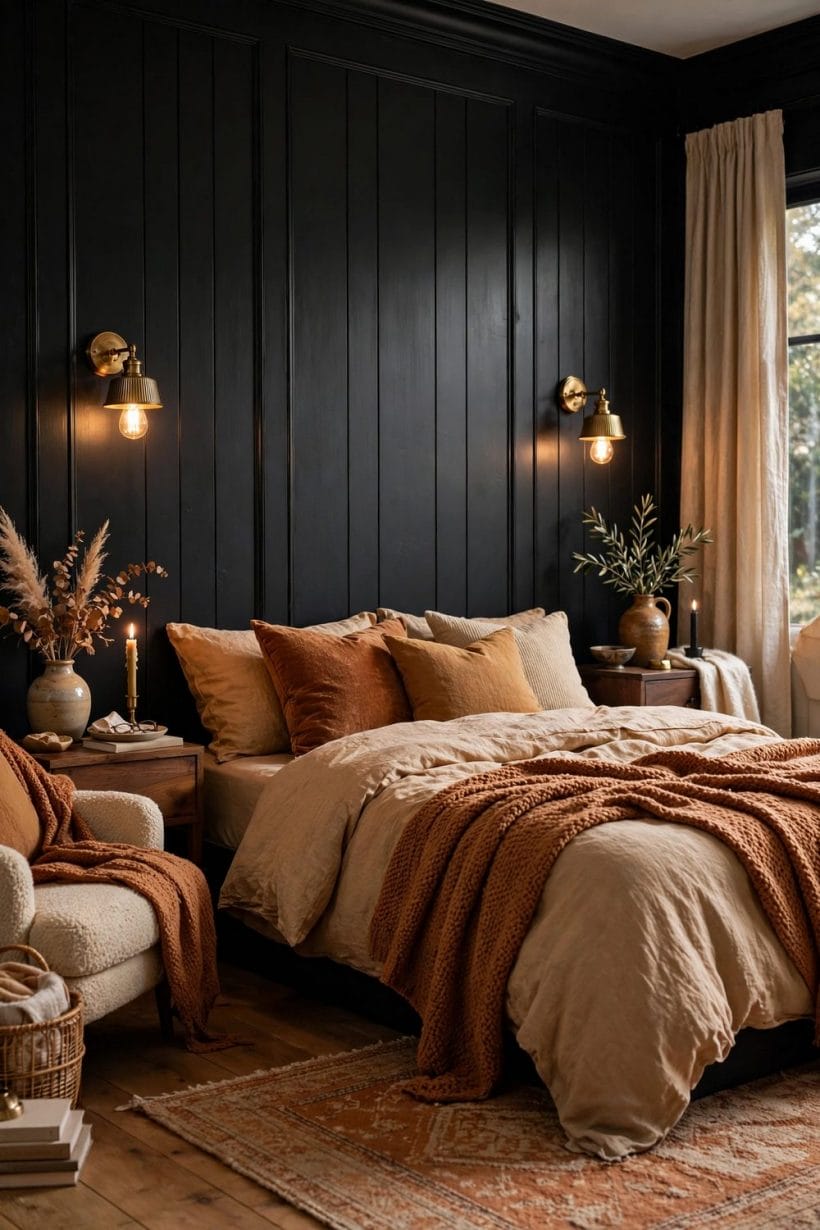
Black walls offer storage a gift no pale room can: furniture the colour of the wall nearly vanishes. These nine ideas use that camouflage to keep the calm unbroken by clutter.
55. Wardrobes painted the wall’s black
Built-in wardrobes painted the same black as the wall are the style’s masterstroke: a whole wall of storage reads as a flat, calm surface. Handles in brass or timber give the hand its landmarks without breaking the spell.
56. The black dresser against the black wall
A freestanding dresser painted to match gives most of the built-in effect for a fraction of the commitment. Against the wall it becomes a silhouette — a stage for the lamp, the plant and the pale objects.
57. Open storage: keep it pale or keep it shut
Open shelves and rails show everything, and against black every coloured jumper becomes an accent whether you meant it or not. If your clothes are a rainbow, choose doors; if neutrals, open storage becomes display.
58. Under-bed storage stays invisible
Drawers and boxes under the bed disappear entirely in a black-walled room, especially with a valance or a low frame. It is the cheapest storage win here: the darkness does the hiding that baskets do in pale rooms.
59. A dark bookcase for the bedtime shelf
Books beside the bed are a pleasure; the visual noise of their spines is not. A black bookcase against the black wall holds the library in shadow; one pale bookend keeps it findable at midnight.
60. The dressing corner, screened in black
A black folding screen or curtain can hide the chair of clothes, the laundry basket and the ironing pile behind one dark plane. Screens suit black rooms especially — they read as wall, furniture and shadow at once.
61. Nightstands that float or match
Nightstands either vanish (black, wall-matched) or glow (warm timber, pale stone) — there is no useful middle. Decide per side if the room is asymmetric by nature; matched pairs suit the formal, panelled versions of the style.
62. Hidden storage in the headboard wall
Where the black wall is a built-out panel or slatted section, shallow cupboards and niches can hide inside it — bedside clutter behind flush doors, revealed by a press. The wall stays serene; the room stays honest.
63. Baskets and boxes in dark fibres
For storage that stays visible — throws, chargers, the book pile — dark woven baskets and black boxes keep the texture and lose the noise. Pale baskets work too, but they join the accent count.
9. Small Bedrooms and Low-Light Rooms
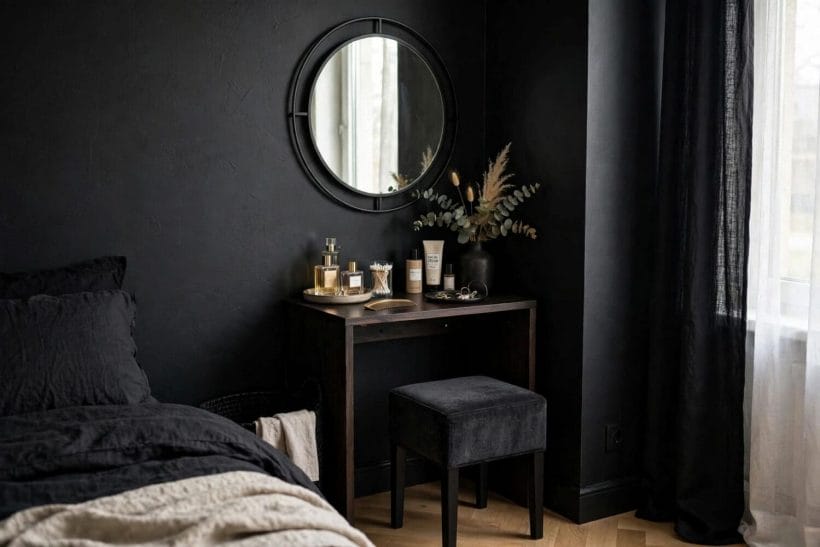
The received wisdom says small, dark rooms must be painted white. It is half wrong: black cannot make a room bigger, but it can make a small room feel intentional instead of apologised for.
64. Blur the corners, lose the box
In a small room, black walls hide the corners that announce its size — the eye cannot find the edges, so the room reads as depth rather than measurement. The oldest theatre trick, and bedrooms are its natural stage.
65. All-in dark beats one dark wall in tiny rooms
Counter-intuitively, one black wall in a very small room can chop it shorter, while all-over dark unifies it into one cocoon. Commit fully or stay pale — the halfway version has the costs of both.
66. Keep the ceiling and floor light
The small black room’s safety rails: a white or pale ceiling and a light floor or rug keep a horizon of brightness in the room. The walls hold the mood; the top and bottom hold the air.
67. Mirrors and glass earn their place
In low-light rooms, a mirror opposite the window is not decoration, it is infrastructure — it returns the daylight the black walls absorb. Glass-fronted or open furniture likewise keeps sightlines long in rooms that have few to spare.
68. Scale down the furniture, not the bed
Keep the bed generous — it is the room’s purpose — and slim everything else: narrow nightstands, a wall-mounted lamp, storage that hangs or hides. Black walls forgive a full bed; they do not forgive clutter.
69. The single-window room
One small window is enough if the wall colour around it goes dark and the window treatment stays pale and sheer — the contrast makes the window look larger and its light more deliberate. Heavy dark curtains would seal the effect shut.
70. Box rooms and the sleep-only brief
The tiniest bedrooms often hold only sleep: a bed, a lamp, a body. Those are the rooms black was invented for — no desk, no dressing table, just the cocoon and the morning alarm glowing in the kind dark.
10. Paint, Prep and Choosing Well
Black is the least forgiving colour a wall can wear: every roller line, filled crack and dusty corner announces itself. The last five ideas are the craft that separates the velvet wall from the streaky one.
71. Test big, and live with the tester
Paint the largest swatch you can bear — a full square of wall, not a stripe — and live with it through a day and a lamplit evening. Blacks change more between light conditions than any other colour; the tester is where that is learned cheaply.
72. Prep like the wall will be inspected
Fill, sand and wash the wall properly, because dark paint spotlights every flaw the light rakes across. Sugar-soap the grease, sand the filler flush, dust like you mean it — with black, preparation is most of the job.
73. Prime with a grey or tinted base
Black over white primer takes coat after coat to reach depth; a mid-grey or tinted primer gets the wall most of the way there in one. Ask at the paint desk — the trade’s standard trick for dark colours.
74. Expect the extra coat, and the edge discipline
Budget for three coats where pale colours need two, and cut edges in with care: a wobbly line against a white ceiling is visible from the bed, which is where you will stare at it.
75. Keep the touch-up pot, forever
Black walls scuff, and scuffs on black show pale. Keep the leftover paint, labelled with room and date, and touch up the week marks happen — two minutes that keep the wall looking newly done.
Costs here are mostly the costs of any good paint job — preparation, paint quality, the extra coat dark colours drink — plus the lighting the room now deserves. Spend first on prep and bulbs.
Final Considerations
Lie in the bed at dusk before you judge a black wall — that is the hour and angle it was chosen for. If the bedding glows, the lamps pool warm and the corners have politely disappeared, the room is doing its job.
A black-walled bedroom earns its keep by being one decision taken seriously: the right black for your light, coverage chosen for your nerve, contrast carried by bedding and timber, storage that uses the camouflage, and honest prep. Choose the black, commit to the wall, and sleep in the calm on the other side of it.


0 Comments