
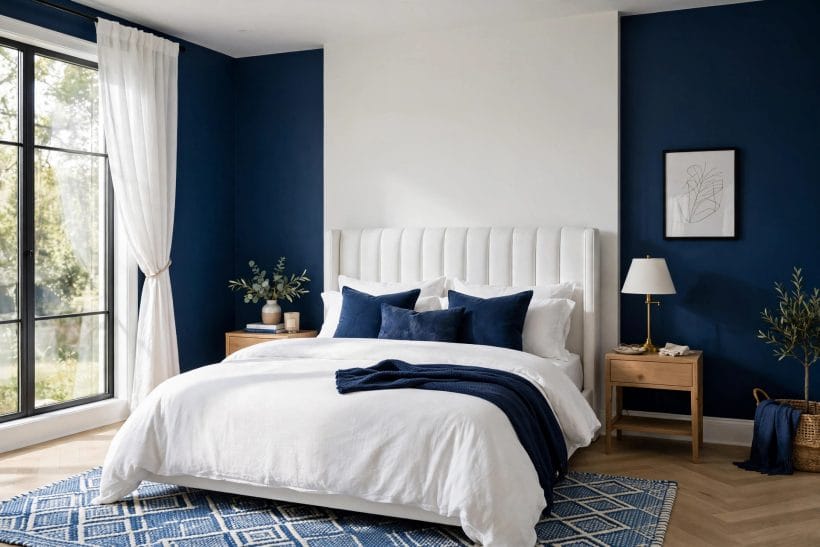
Most blue bedrooms are painted the obvious way round: blue on the wall behind the bed, white everywhere else. This post asks the impolite version of the question — what happens when you reverse it, and give the accent wall to the white instead?
The room at the top of this page is the reversal done confidently: the bed wall kept white, the blue carried around it. Everything below stays strictly on that pairing — which wall should be the white one, how much blue is enough to still call it a blue room, and what the light does to both. It deliberately does not re-open the general blue-bedroom question.
1. The Pairing at a Glance
First, an honest signpost: the broad subject of blue bedroom walls — shades, schemes and whole-room tours — belongs to the bedroom with blue walls ideas collection, which owns that ground. This page keeps only the narrow decision it cannot make for you: in a room already committed to blue, does the single contrasting wall earn its keep better in white? The table is the decision in miniature.
| Option | What it does | Character |
|---|---|---|
| Blue Accent Wall | Bold focal point | Striking |
| White in Blue Room | Lightens deep colour | Bright |
| Natural Light | Best with blue walls | Plenty |
| Ease to Change | Repainting one wall | Easy |
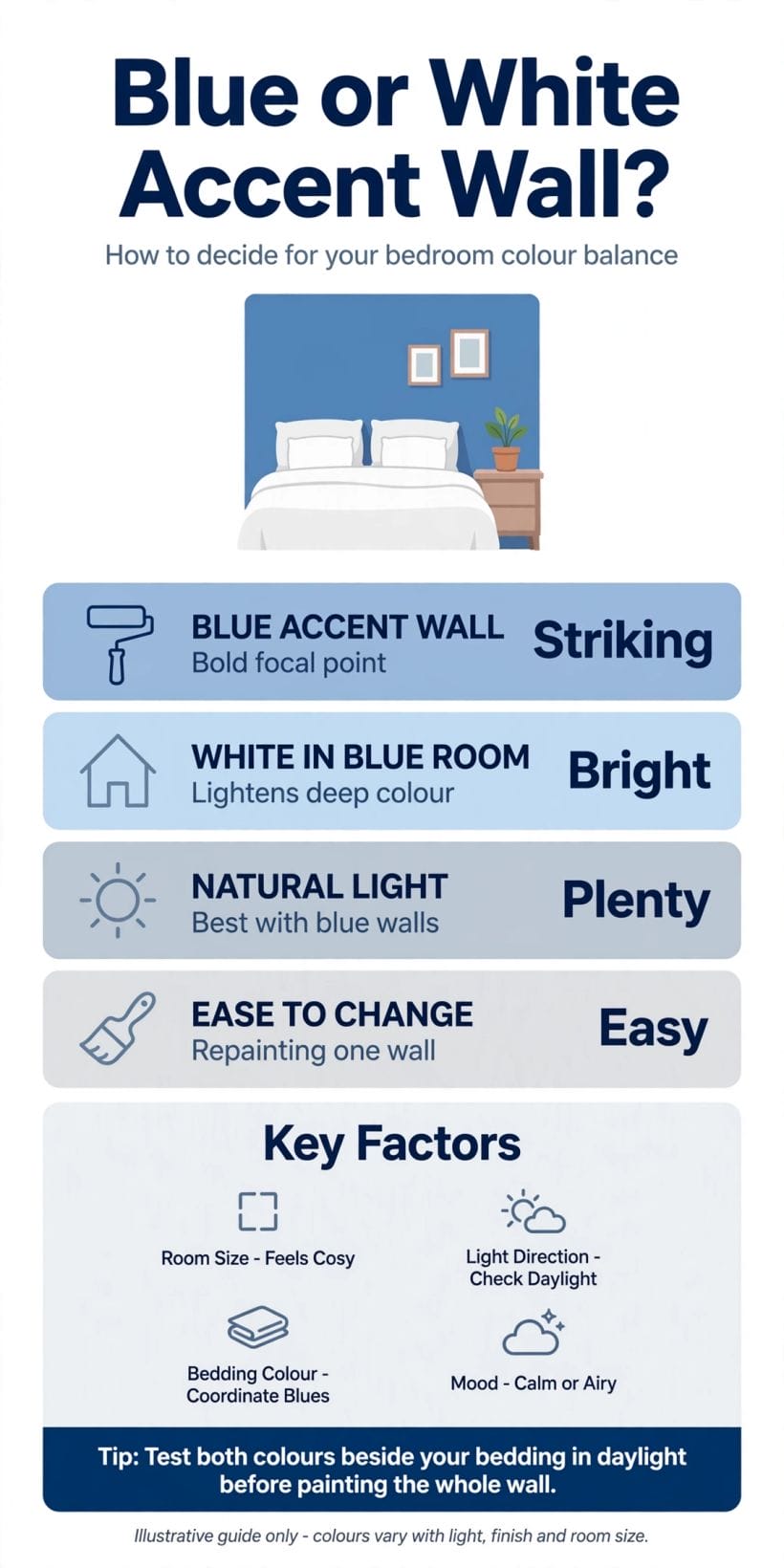
Four factors steer the choice. Room size — a deep colour makes a room feel cosy, and the white wall hands some of that snugness back. Light direction — check the daylight before committing either way. Bedding colour — the blues have to be coordinated across paint and cloth, or the pairing frays. And mood — calm or airy is the real question underneath the colour one, and this post returns to it in every section.
2. Which Wall Earns the White
The white accent earns its place where the eye lands first and rests longest — which in most bedrooms is the wall the bed stands against, because it is the wall the room is arranged to face. Giving that wall to white, as the feature photograph does, frames the bed in the room’s lightest surface and lets the surrounding blue close in like a border. Giving it instead to the window wall spends the effect on the wall nobody looks at — the view out-competes any paint.
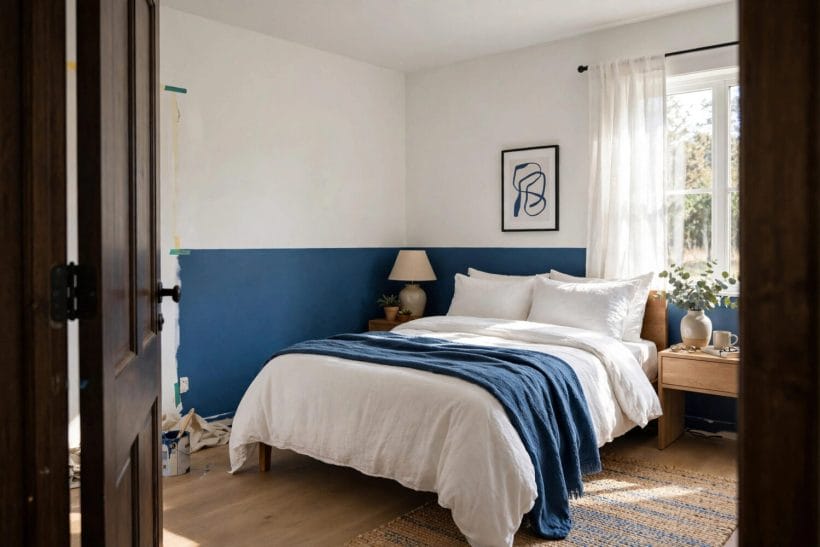
The doorway view above shows the compromise candidate: the bed wall split, blue below and white above. It proves the rule by halves — whichever colour holds the zone behind the pillows does the accent’s work, and here the white upper half still lightens the room even with blue at the bed’s back. In small bedrooms the choice narrows further, because there are fewer walls to spare; the layouts in the tiny house bedroom ideas collection show how little wall a small room actually has, which is why each one there has to be assigned deliberately.
3. The Other Answer, Honestly Stated
The conventional arrangement deserves its due before this post argues past it. A blue bed wall with white elsewhere — the portrait below — concentrates the colour where the bed’s white linen can strike against it, deepens the room’s focal point, and asks nothing of the other walls. In a bright room with a plain bed, it is often the right answer, and the owner collection linked in section 1 is full of it done well.
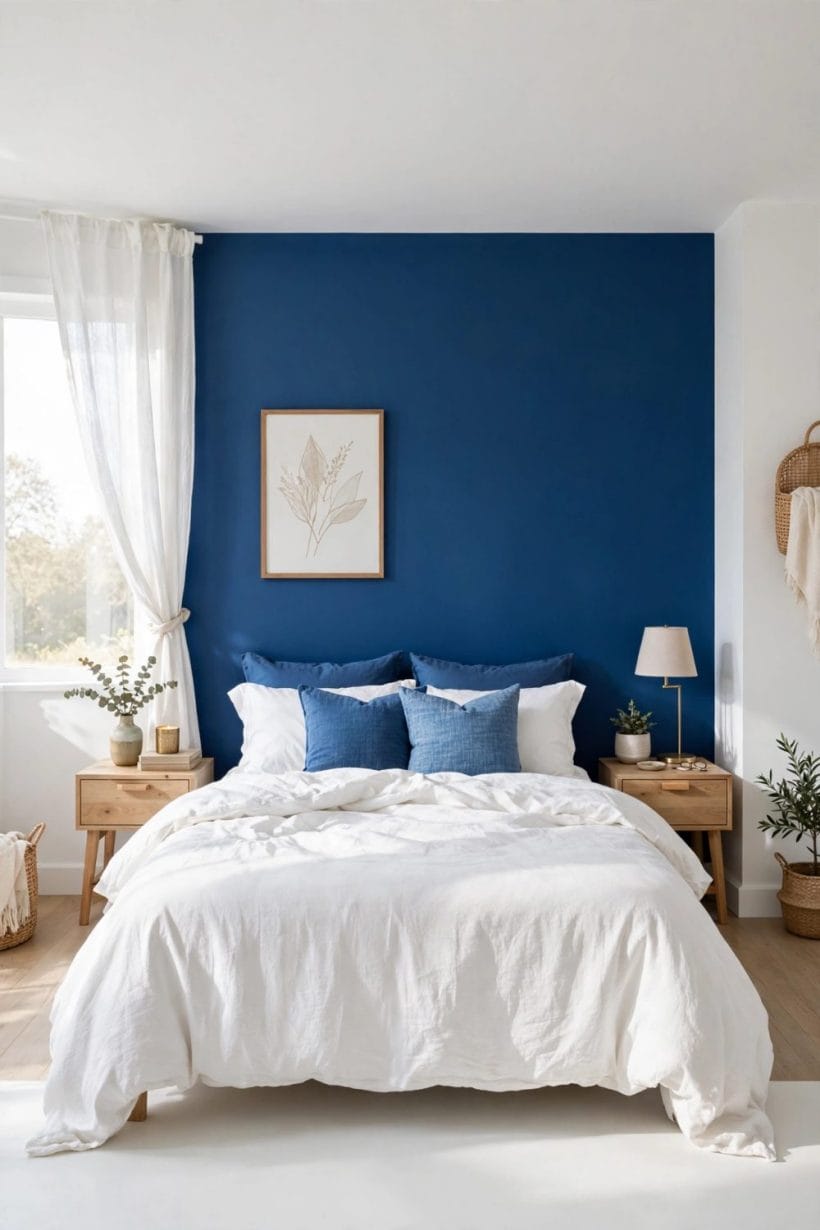
Choose the reversal instead when one of three things is true. The room is small or north-lit and a deep bed wall would swallow it. The bed itself is dark or heavily patterned and needs a pale ground to read against. Or the household simply tires of focal points and wants the calm distributed — the blue everywhere at low intensity, the white wall as the resting place. The pairing is a dial, not a doctrine.
4. The Headboard Question
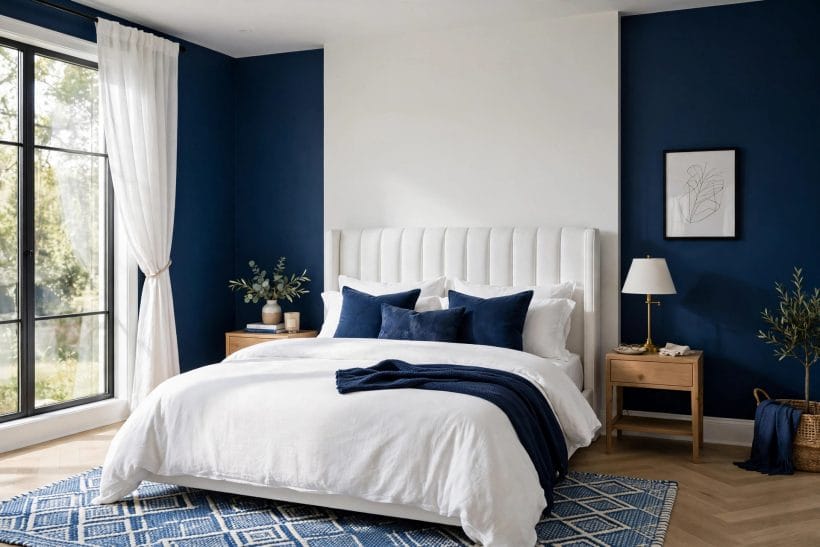
Reverse the walls and the headboard’s job reverses with them. Against blue, a white headboard is the brightest object in the room and carries the bed wall almost alone — the close-up below is exactly that arrangement, panelled navy behind a tall white upholstered headboard, brass lamp for warmth. Against a white accent wall, the same white headboard disappears, and the bed’s presence has to come from elsewhere: a timber or upholstered-deep headboard, a canopy line, or bedding with enough pattern to hold the wall.
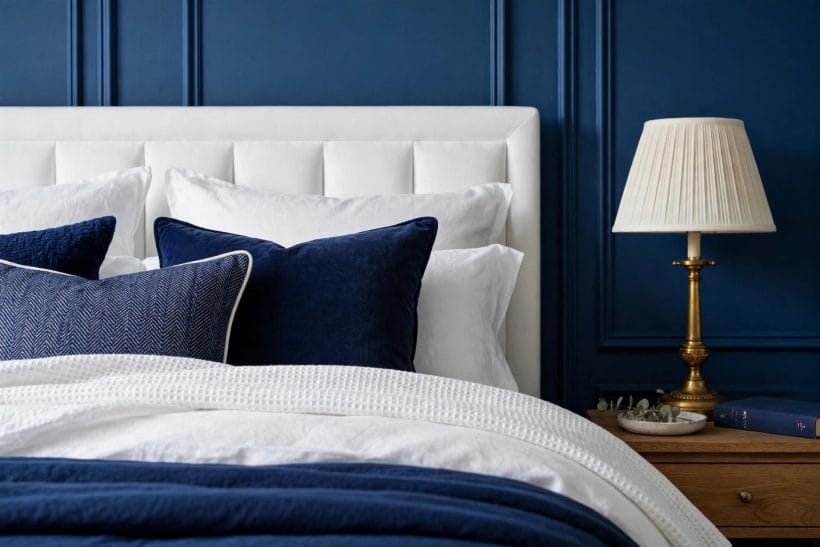
So the pairing question is never only about paint. Price the headboard you actually own into the decision: a household with a beloved white headboard and white bedding is, whether it knows it or not, already dressed for a blue bed wall — and the white accent will serve it better on the wall opposite, where the bed is viewed from, than behind the bed itself.
Bedside dressing follows the same logic. On a blue bed wall, pale art and light-toned lamps layer brightness exactly where the sleeper looks last at night; on a white bed wall, the dressing darkens instead — navy cushions, a deep throw, timber frames — or the room’s focal wall becomes its palest, emptiest surface and the blue around it starts to feel like a frame around nothing. The pairing is only finished when the bed wall, whichever colour it took, has been given objects in the opposite register to stand on it.
5. Proportions: How Much Blue Is a Blue Room?
The pairing is really a ratio wearing a colour’s name. Three blue walls and one white reads as a blue room with a light accent. One blue wall and three white reads as a white room with a blue accent — a different room with a different mood, and the photograph below lives there: mostly white, one strong blue wall, and the blue carried onward by the bedding so the single wall does not feel like an apology.
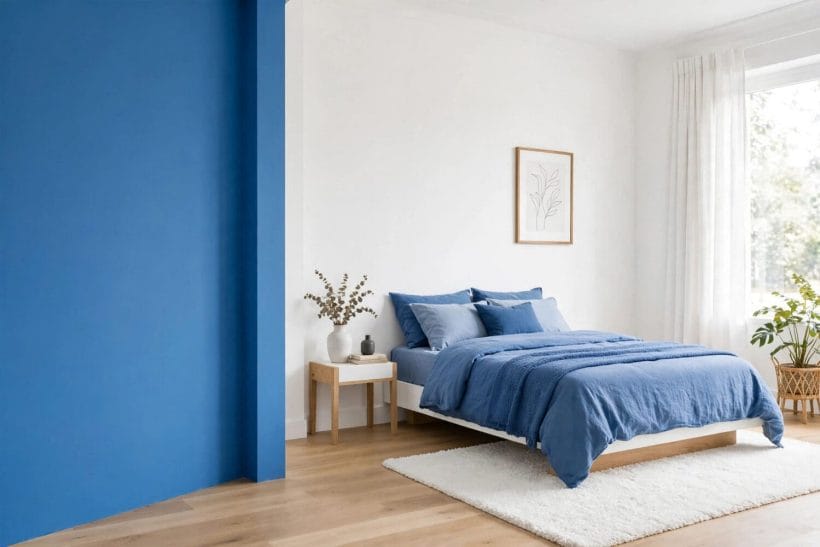
Between those poles sit the splits: the half wall of section 2, the blue ceiling some households add as a fifth surface, the blue confined to a chimney breast or an alcove. The ratio thinking is the transferable part — the tiny house colour palette guide builds whole small-home schemes on one dominant, one support and one accent in disciplined proportions, and a blue bedroom is simply that arithmetic with two colours and a bed. Decide the ratio first; the walls then assign themselves.
6. Blue Without Paint: The Window Wall
One wall in most bedrooms is mostly glass, and it offers the pairing a cheat: the blue can arrive as cloth rather than paint. The room below keeps every wall white and lets deep blue curtains frame the window wall floor to ceiling — from the bed, the view is a blue-bordered landscape, and the room reads unmistakably as a blue-and-white bedroom with not one wall painted.
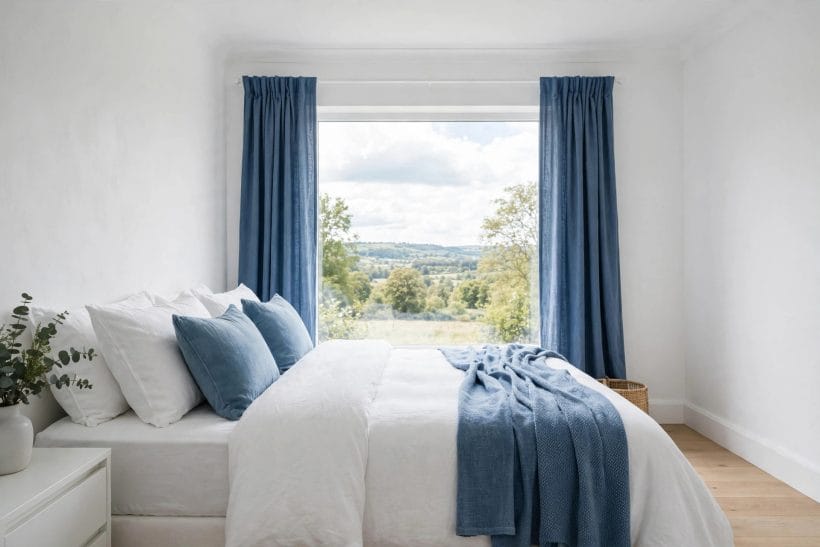
The cheat has honest advantages for the undecided: curtains can be swapped in an afternoon, they soften a room’s sound as paint never does, and they let a rented or borrowed bedroom join the pairing without a landlord’s permission slip. Their cost is discipline — once the curtains carry the blue, the bedding and cushions must stay mostly white and pale, or the room’s ratio tips from accent to clutter.
One more wall deserves a ruling before the paint opens: the door wall — the one behind the camera in every photograph of the room, and the one the sleeper actually faces on waking. Households split on which audience matters, and the split is worth a household conversation: a white door wall greets the waking eye with light, while a blue one lets the sleeper wake inside the colour, facing the calm white across the room. Neither is wrong; they are different mornings.
7. The Pairing After Dark
Judge the pairing twice: once in the morning and once by lamplight, because the two rooms are not the same. Lamplight warms everything it touches; deep blue walls deepen toward ink, and the white wall — reflecting every lamp in the room — glows gently and becomes, after dark, even more of an accent than it was at noon. The dusk photograph below, pale bedding against blue walls under a warm lamp, is the pairing in its evening register.
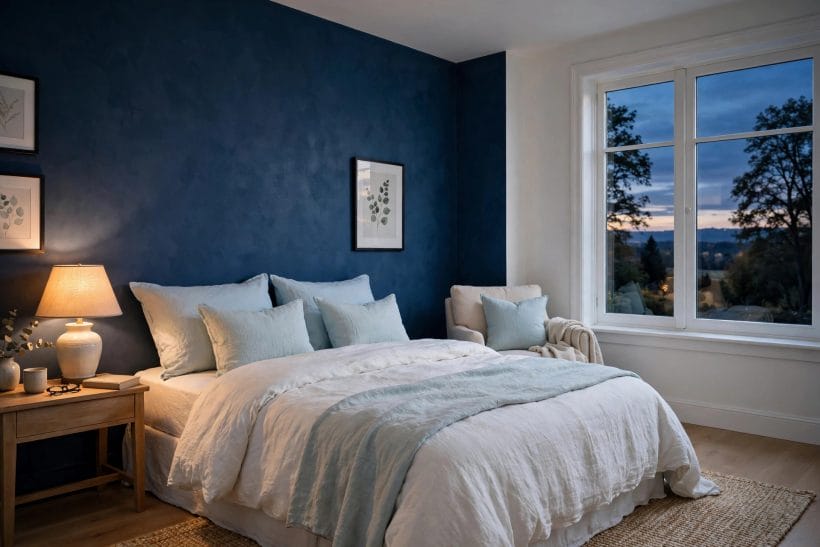
Finish and sheen mediate all of this: a matte blue drinks light and stays velvety, while a satin finish throws lamplight back and can make a deep wall feel restless at night. Paint behaviour under different light is a subject of its own — the tiny house interior paint colours guide tests how finishes shift small-room colours across the day — and its first lesson applies here whole: never sign off on a blue from a daylight viewing alone.
8. Textiles: The Bridge Between the Two
Walls set the pairing; textiles referee it. The portrait below keeps its walls white and hands the entire blue brief to the bed — curtains and bedding in matched deep blues — proving from the other side what section 6 argued: in this pairing, cloth and paint are interchangeable currencies, and most real rooms spend some of each.
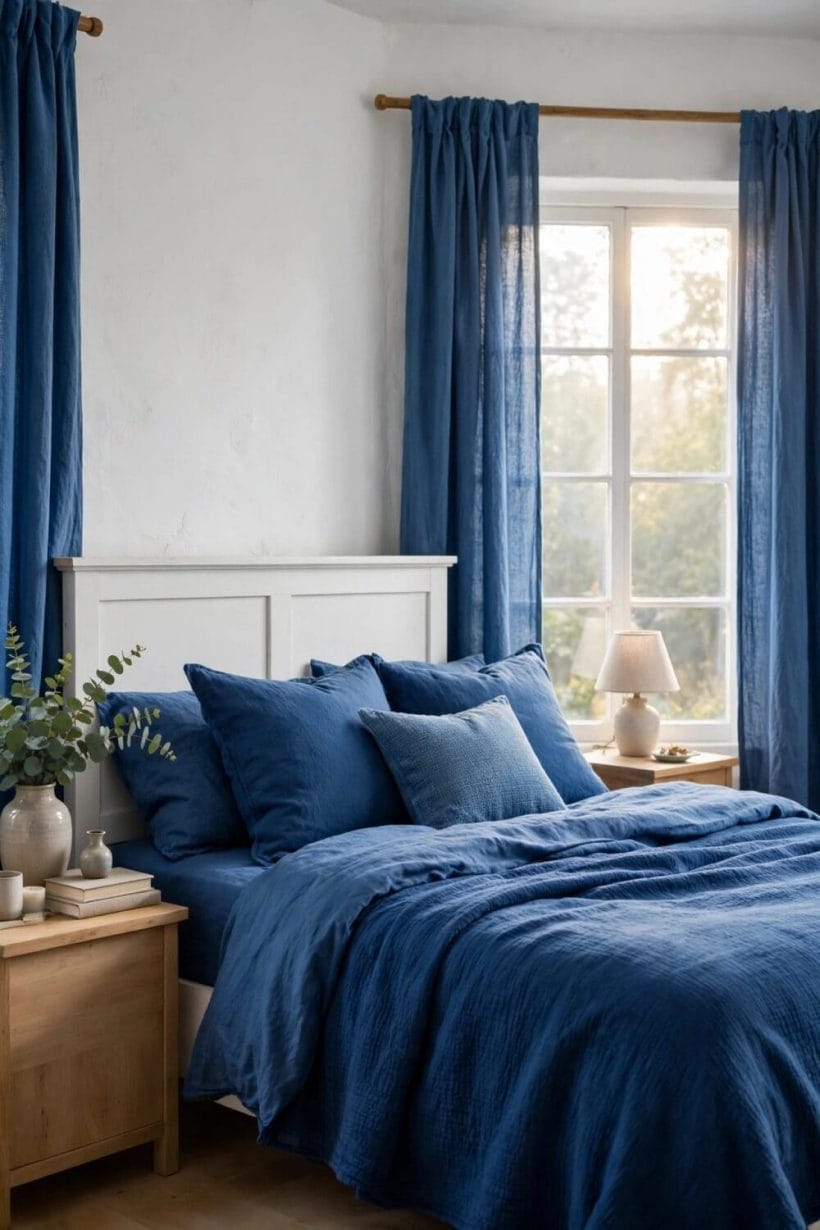
The coordination rule is the infographic’s quietest factor and the one most often broken: coordinate the blues. A navy wall, a royal cushion and a powder throw are three arguments, not a scheme. Pick the wall’s blue and let every textile either match it, deepen it by one step, or leave blue alone entirely in whites and naturals. Whole interiors built on exactly this discipline — the blue and white tiny house interior tour is the worked example — show how calm the two-colour household feels when nothing in it is nearly blue.
9. Partial Accents: The Arch and the Half Wall
Between all-blue and all-white walls sit the partial accents, and they answer the pairing question with a shrug that often suits real households. A painted arch behind the bed — the soft example below, in the palest blue against white — zones the sleeping area, uses a fraction of the paint, and can be extended, deepened or painted out in a single afternoon as confidence grows.
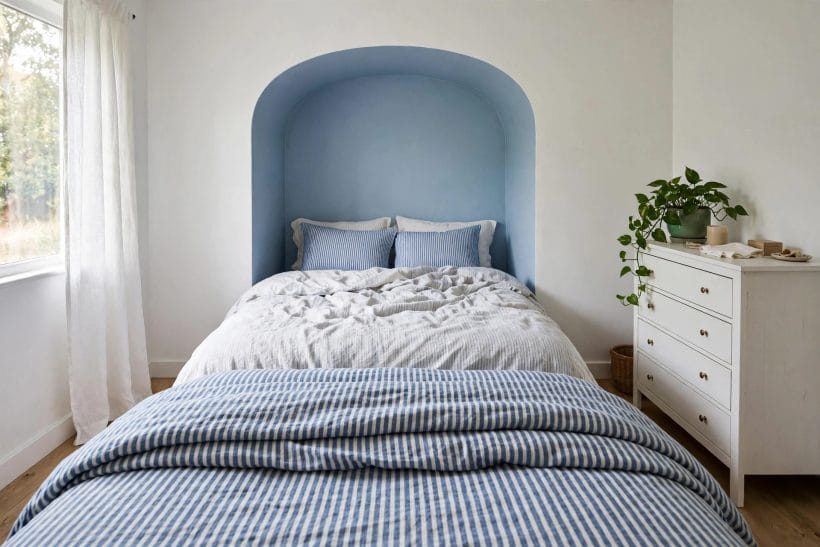
Treat partial accents as the pairing’s apprenticeship rather than its compromise. Live with an arch or a half wall for a season and the household learns its own answer — whether it keeps wanting more blue or more light — at the cost of one tester pot. What it should not do is multiply: an arch, a half wall and a blue ceiling in one small room is not a ratio, it is an argument.
10. Test First: Samples and a Week of Looking
The infographic’s tip is the whole method: test both colours beside your bedding in daylight before painting anything whole. Paint generous sample boards — bigger than feels sensible — and move them around the room: behind the bed, beside the window, opposite the door. Live with them through a full week of weather if the room allows it, because a blue that sings on a bright Tuesday can brood through a grey weekend.
Small rooms compress the experiment usefully: their walls are few, their light changes fast, and a sample board covers a meaningful fraction of the wall it is testing — one more reason the small-bedroom thinking in the tiny bedroom ideas collection pairs well with this decision. When the week is done, decide by the evening viewing, not the morning one: bedrooms are slept in at night and merely dressed in by day, and the pairing that wins at lamplight is the one the room will actually live with.
Final Considerations
A white accent wall in a blue room is not the safe option or the daring one — it is simply the pairing with its emphasis moved, from the wall behind the bed to the walls around the sleeper. Choose the wall by where the eye rests, set the ratio before the colour, coordinate every blue in the room, and let a week of samples overrule an afternoon of enthusiasm. The room will tell you which way round it wants to be — the whole craft is in listening before the paint dries.




0 Comments