
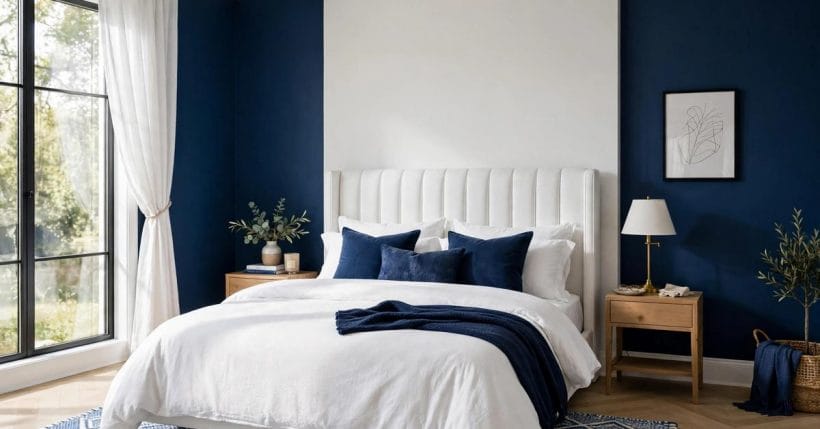
One wall of blue, three of white, and a bed dressed like a sail — the blue accent bedroom is the most reliable drama in decorating, because its recipe is a contrast rather than a colour. The blue gives the room its depth; the white gives it back its light.
These seventy-five ideas work the pairing properly: the wall, the blue itself, the whites around it, the bedding’s echo, the furniture, the light, and the question of how far the colour should travel. It is the accent-wall discipline throughout — quite different from a room papered in pattern, as the wallpaper bedroom shows, and from a whole room committed to one colour.
1. Bedroom with Blue Walls Ideas at a Glance
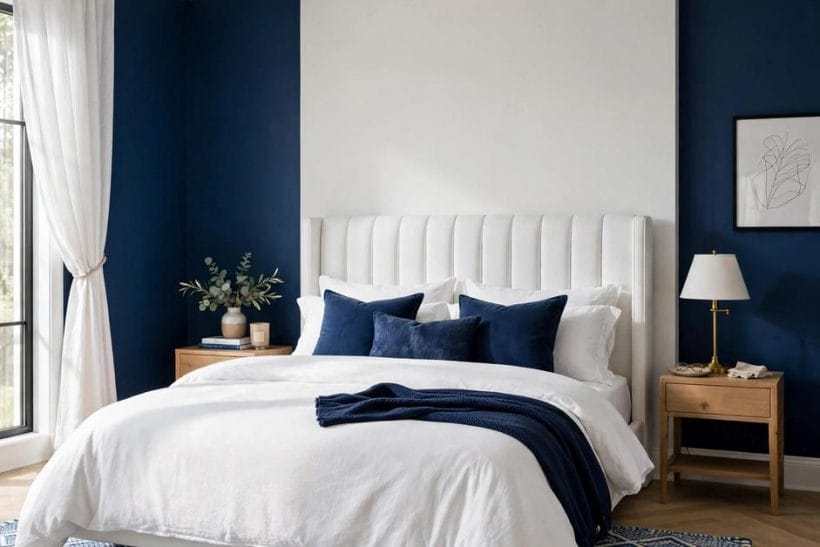
A bedroom with blue walls, in this post’s discipline, means one saturated blue accent wall — almost always the bed’s — inside an otherwise white room: the keyword’s scenario of a bedroom with blue accent on white walls. It is a specialist slice of the colour-led bedroom family whose general home is the bedroom ideas pillar, and a brighter cousin of the single-hue disciplines like the purple bedroom. What follows covers the accent scheme only: wall choice, blue choice, whites, textiles, furniture, light and the colour’s travels.
| Question | Short answer |
|---|---|
| Which wall takes the blue? | The wall behind the bed — the bed dresses it, and the sleeper faces the calm white instead |
| Which blue is most reliable? | Deep navy for the classic portrait; the right blue is finally the one that stays true under the room’s evening lamps |
| How is the white handled? | As a second colour with its own job — true white walls, layered white bedding, pale timber as the warm mediator |
| Where does the colour echo? | At pillow scale — cushions, a throw, a patterned piece — never a blue duvet, which halves the contrast |
| What is the classic failure? | The blue travelling until the accent is lost, or bedding that doubles the statement instead of answering it |
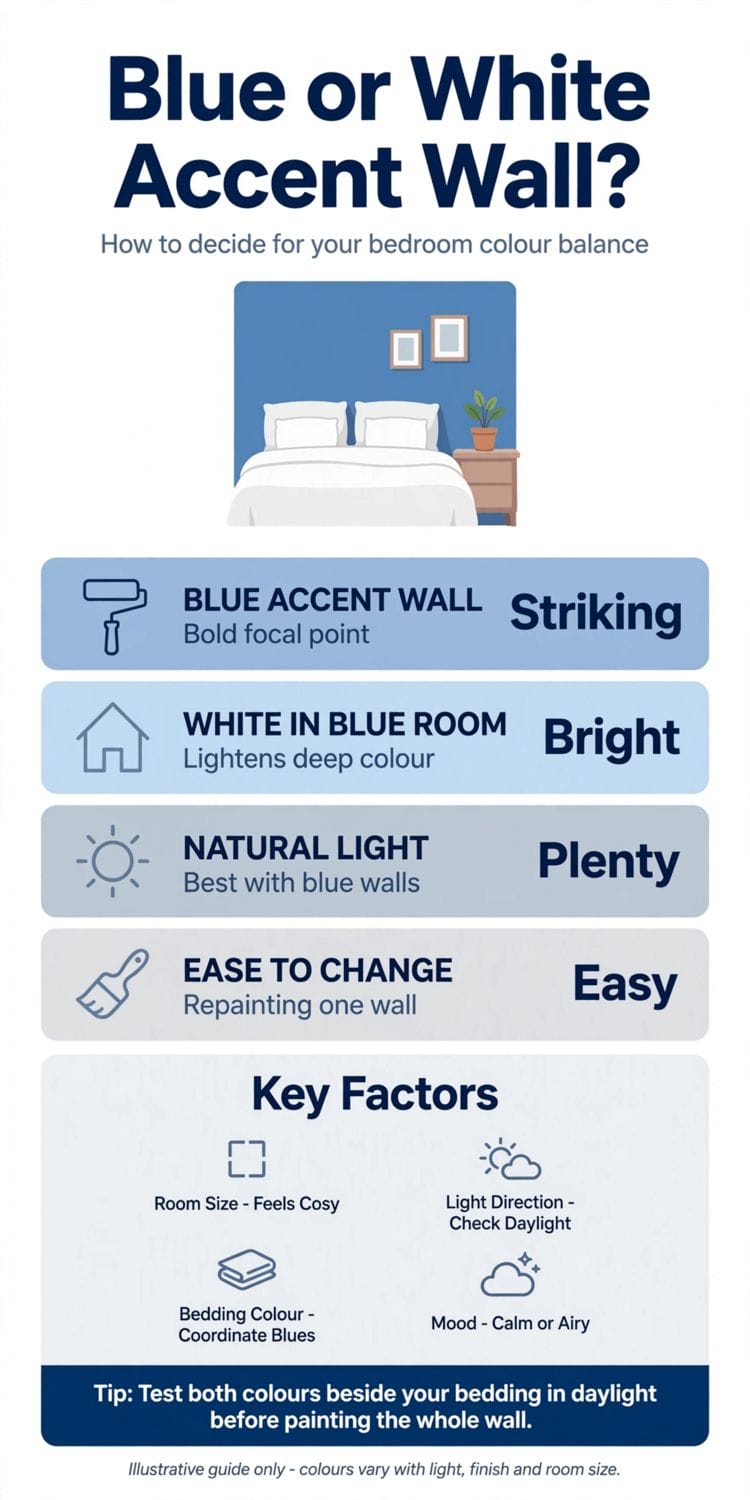
2. The Accent Wall: Which Wall, and Why It Is the Bed’s
In the blue-and-white bedroom the accent wall does the room’s one dramatic job, and it almost always belongs behind the bed. The headboard wall is seen framed by the bed itself, finished by pillows, and viewed from the door as the room’s portrait — no other wall works as hard for its paint.
1. Give the blue to the wall behind the bed
The headboard wall is the accent wall by nature: the bed dresses it, the pillows caption it, and the sleeper never has to stare at the strongest colour in the room while falling asleep.
2. Stop the blue at the wall’s own edges
A clean stop at the corners is what makes the scheme read as architecture rather than accident. Crisp edges, no wrapping — the white walls frame the blue like a mount frames a print.
3. Let the headboard stand pale against it
A white, pale timber or natural rattan headboard silhouettes beautifully on blue, the way a sail reads against the sea. Dark headboards on dark blue can work, but pale is the reliable drama.
4. Centre the composition on the bed
Pictures, sconces and the bed itself should compose as one picture on the blue wall. A centred arrangement on a single strong wall is the room’s whole geometry, so hang it with care.
5. Keep the other three walls honestly white
The accent only accents against quiet company. White walls — not cream, not pale grey pretending — keep the contrast the scheme is named for, and bounce the daylight the blue absorbs.
6. Carry the blue onto nothing else structural
Blue skirting, blue ceiling, blue door: each addition dilutes the one-wall idea. The scheme’s discipline is a single saturated surface in a white room, defended firmly.
7. Size the drama with the wall, not the tin
A whole wall of deep blue is a bigger statement than any colour chart admits. In a small room it still works — the wall recedes visually — but test it at full width before believing the swatch.
8. Use the wall the door reveals first
Where the bed cannot take the blue wall — a window behind it, a door in the wrong place — give the blue to the wall facing the entrance. The room should announce its idea on entry.
9. Let wardrobes stay white and disappear
Fitted storage painted with the white walls vanishes politely and leaves the blue wall unchallenged. A wardrobe competing in timber or colour turns the portrait into an argument.
10. Break the blue with one large pale picture
A single oversized pale artwork or a pair of white-framed prints gives the eye a rest inside the blue field and proves the wall was a backdrop, not a flood.
11. Decide the wall before any furniture is bought
The accent wall organises the bed, the art and the light. Chosen first, everything else has a brief; chosen last, the room has blue in it rather than being built on it.
3. Choosing the Blue: Navy, Cobalt, Powder and Everything Between
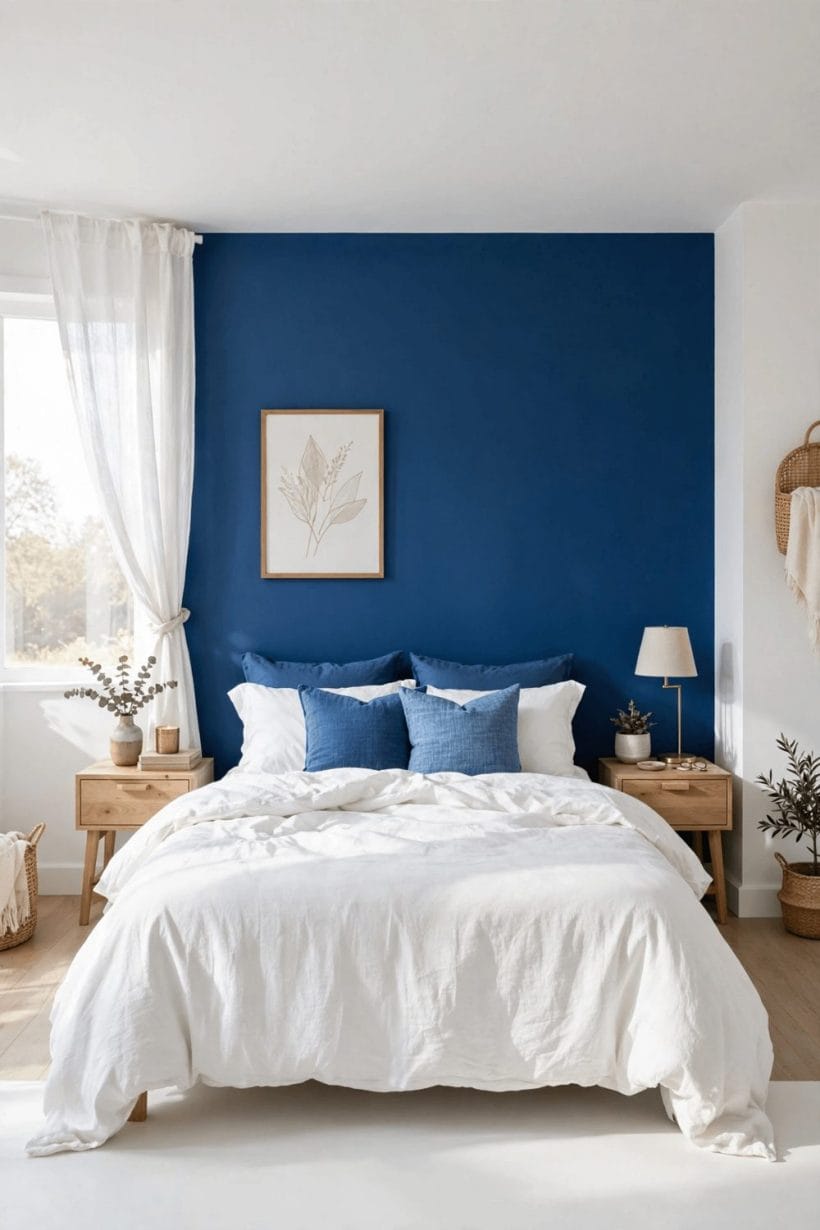
Blue is not one colour but a climate range, from powder to near-black, and the accent wall’s depth decides whether the bedroom feels crisp, calm or cocooned. Choose by the room’s light first and by taste second — the light will be voting every day.
12. Choose navy for the classic portrait
Deep navy behind a white bed is the scheme’s signature — formal, calm and flattering to every timber and metal. It is the blue least likely to be regretted at year three.
13. Use cobalt or royal blue for a brighter nerve
A cleaner, louder blue suits white’s crispness and a room with strong daylight. It makes the scheme feel coastal and awake rather than hushed.
14. Let powder blue soften the whole idea
At the pale end, the accent wall whispers instead of declaring. Powder against white is gentle, nursery-adjacent and lovely in small rooms that fear the dark wall’s weight.
15. Try teal-blue where the light is warm
A blue leaning green answers warm afternoon sun and pairs naturally with plants and brass. In north light it can turn cold, so the sample earns its keep here.
16. Test grey-blue for the restful middle
Blues cut with grey — the dusty, weathered family — give the accent without the saturation. They flatter bedrooms that want calm more than theatre.
17. Sample the colour at wall scale, not card scale
Paint a board big enough to lean behind the bed and live with it through a full day. Blue deepens as it spreads; the wall will be bluer than the card promised.
18. Watch the blue at night under the lamps
Bedrooms are evening rooms. A blue that sings at noon may turn black at nine or purple under warm bulbs — judge it in the light it will mostly be seen in.
19. Keep one blue in the room
Accent wall, bedding echo, cushion echo — the echoes should be the same blue or its honest tints. Two near-miss blues side by side read as a mistake, not a palette.
20. Match the undertone to the white
A blue-white wall paint beside a green-leaning blue can quarrel quietly. Choose the white for the blue — crisp whites with clean blues, warmer whites with greyed ones.
21. Let the floor vote too
Pale timber cools a scheme down; dark floors warm it. The blue sits between floor and ceiling, and both neighbours shift how deep it reads — sample against the actual floor.
22. Buy the best paint the wall can have
A single saturated wall shows every flaw in coverage. Rich, well-pigmented paint in a flat or low-sheen finish is the difference between velvet and patchwork.
4. The White Around It: Walls, Bedding and the Crisp Contract
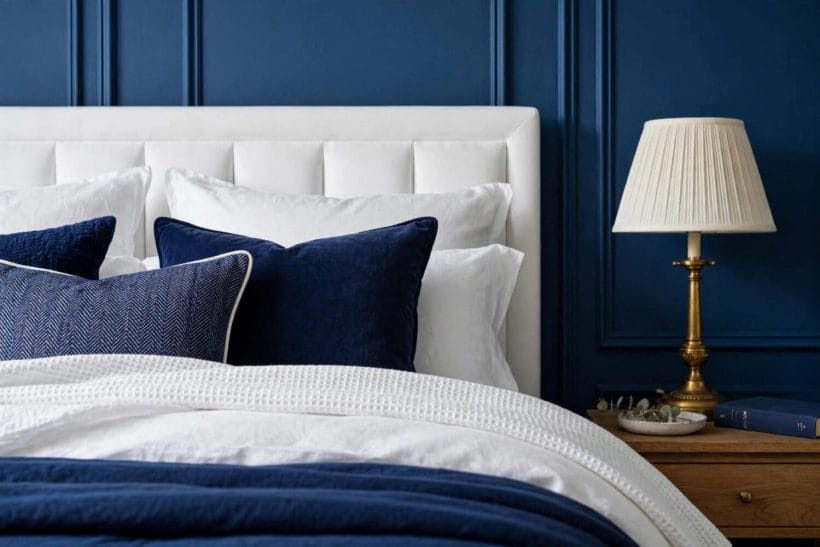
White is not the scheme’s absence of colour — it is the second colour, with its own work to do. The white walls return the light, the white bedding brightens the blue by contrast, and the whole arrangement stands or falls on keeping the whites clean, layered and deliberate.
23. Dress the bed in white first, always
White bedding against the blue wall is the scheme’s postcard. Layered — sheet, duvet, a folded throw line — it gives the room its freshness and its hotel calm.
24. Layer the whites so they are not flat
White on white works through texture: linen’s slub, cotton’s smoothness, a waffle throw, a quilted coverlet. One flat white reads as a showroom; three textures read as a bed.
25. Keep the walls a true, calm white
The wall white should neither yellow nor blue too far. Its job is neutrality with good manners — the mount, never the picture.
26. Echo the blue in the bedding’s smallest dose
A cushion pair, a throw’s stripe, the lumbar pillow in the wall’s own blue ties the bed to its backdrop. The echo should be unmistakable and small.
27. Use white curtains to keep the windows light
At windows on the white walls, sheer or pale curtains preserve the scheme’s airiness and soften the daylight the blue wall drinks. Heavy dark curtains would start a second scheme.
28. Let pale timber be white’s warm partner
Oak, ash and painted white furniture sit between the white and the blue, warming the junction. A room of only blue and white can chill; pale wood is the thermostat.
29. Keep the ceiling white and the light honest
A white ceiling returns the room’s height and keeps the blue wall’s top edge crisp. Coloured ceilings belong to other schemes; this one’s contract is one blue wall in a white room.
30. Choose white furniture where pieces must recede
The chest of drawers, the desk, the chair at the window — painted white, they serve without competing, and the blue wall keeps its solo.
31. Protect the whites from the blue’s reflection
Strong blue can cast a cool note onto nearby white in bright sun. It is usually flattering; where it greys the bedding, a warmer white in the textiles corrects it.
32. Wash the scheme weekly, in effect
White bedding and pale walls show the room’s life honestly. The scheme looks its best kept fresh — it is a crisp contract, and crispness is maintenance.
33. Add one warm metal to mediate
Brass or warm bronze in the lamp, the frame, the handle — a single warm metal keeps blue-and-white from feeling nautical-clinical and gives it a grown-up finish.
5. Bedding, Cushions and Textiles: The Blue Echo
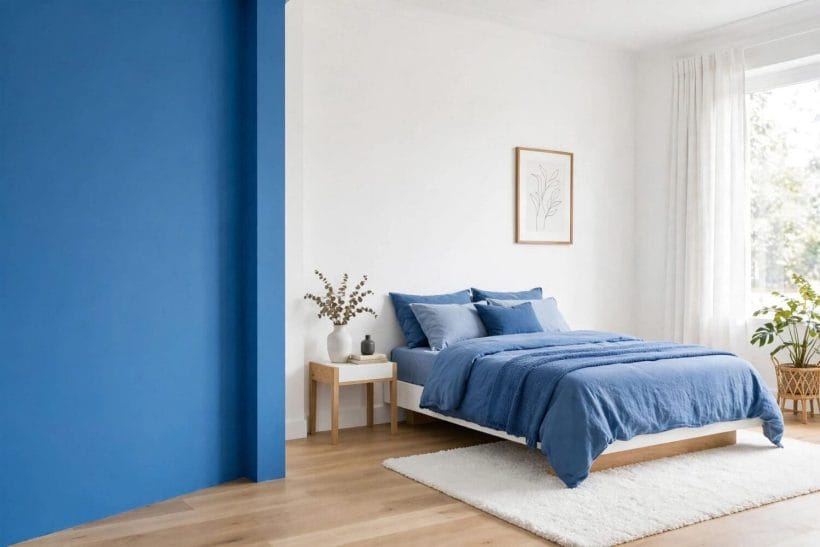
The bed is where the accent wall’s colour gets answered in cloth. Textiles are the scheme’s adjustable part — the doses of blue, pattern and warmth that can change with the season while the wall stays put.
34. Answer the wall with cushions, not the duvet
A blue duvet doubles the statement and halves the contrast. Keep the bed’s big surfaces white and let cushions and a throw carry the echo at pillow scale.
35. Build the cushion stack in threes
White sleepers at the back, the blue pair in the middle, one patterned or textured cushion in front: the stack reads designed from the door, which is where bedrooms are judged.
36. Use pattern to marry the two colours
A blue-and-white pattern — a stripe, a block print, a small check — is the scheme’s peace treaty, containing both colours in one cloth. One patterned piece is enough.
37. Fold a throw across the bed’s foot
The folded throw is the bed’s underline. In the wall’s blue it completes the portrait; in a warm neutral it softens it. Either way, it should look placed, not dropped.
38. Choose natural fibres for the calm layers
Linen and cotton breathe, soften with washing and hold the scheme’s easy register. Shiny synthetics fight the matte wall and cheapen the whites.
39. Swap the echo with the seasons
Deeper blue and a wool throw for winter; paler blue, even a faded indigo, with cotton for summer. The wall is permanent — the textiles are the room’s wardrobe.
40. Keep the rug pale and let it ground the bed
A light rug under and around the bed extends the white field across the floor, so the blue wall stands at the end of a pale room rather than a dark one.
41. Add one black or charcoal note for definition
A single dark accent — a cushion, a frame, the lamp’s stem — sharpens the blue-and-white softness the way a frame sharpens a print. Small, singular, deliberate.
42. Let children’s and guests’ versions simplify
In a child’s room or a guest room the same contract works with fewer layers: white bedding, one blue cushion set, the wall doing the rest. The scheme scales down gracefully.
43. Iron nothing, but shake everything
The blue-and-white bed looks best relaxed-crisp: linen unpressed but plumped, cushions karate-chopped, the throw folded once. Perfection reads as a hotel; care reads as a home.
44. Retire faded blues before they grey the scheme
Sun and washing fade the echoes first. When the cushions no longer match the wall’s family, replace the small cloth, not the big paint.
6. Furniture Against the Blue: Timber, White and Metal
Furniture in the blue-and-white bedroom is cast against two backgrounds at once: pieces on the blue wall are silhouettes, pieces on the white walls are servants. Choosing which pieces get the drama is the room’s quiet art — the family thinking that also orders the black bedroom, where every piece plays against darkness.
45. Stand pale timber against the blue
Light oak and ash bedside tables read warm and clear against deep blue. Their grain becomes the wall’s texture, and their drawers stay findable in the evening gloom.
46. Keep the bed frame quiet
The bed is the blue wall’s foreground, not its rival. A simple upholstered, timber or white frame supports the portrait; an ornate one stages a coup in front of it.
47. Give the room one dark piece for weight
A single dark timber or black piece — a chair, a chest — anchors the pale scheme and stops it floating away. One is ballast; three are a different room.
48. Use mirrors to give the blue a second appearance
A mirror on a white wall reflecting the blue wall doubles the scheme’s pleasure and its light at once. It is the cheapest way to own the colour twice.
49. Choose the wardrobe’s finish by its wall
Against white, wardrobes can carry the pale timber; against the blue — where fitted storage sometimes must sit — white keeps them subordinate to the wall’s colour field.
50. Let bedside lamps be the room’s jewellery
Small, warm-metal or ceramic lamps at the bed’s shoulders are the furniture layer’s sparkle, and the only shine the matte blue needs beside it.
51. Keep the desk or dressing table on a white wall
Work and grooming want the bright walls’ light. The blue wall is for sleeping against; the white walls are for living against — assign the furniture accordingly.
52. Use a bench or ottoman at the bed’s foot
A pale bench closes the bed’s composition and catches the throw, the book, the morning’s clothes. Against blue, an upholstered bench in a warm neutral is the room’s handshake.
53. Hang the television nowhere near the blue wall
A black screen hung on the accent wall murders the portrait. If a screen must live here, it belongs on a white wall, small and unapologetic.
54. Prefer legs to plinths in a small room
Furniture on legs shows the floor and lightens the room’s lower half, which matters when one wall is drinking light. The blue wall is heavy enough; the furniture should float.
55. Repeat the headboard’s material once
The headboard’s timber in a stool, its fabric in a cushion — one repetition stitches the bed’s foreground to the room. Twice is a theme; once is a rhyme.
7. Light for a Blue Room: Keeping the Colour True
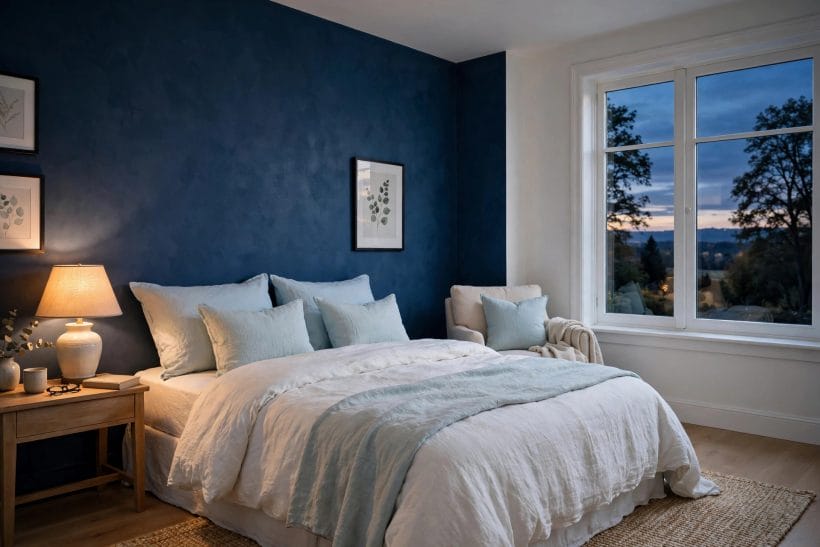
Blue is the colour most at the mercy of light: daylight can bleach it, warm bulbs can enrich it, cold ones can turn it to slate. Lighting a blue accent bedroom means choosing, deliberately, which blue the room will be after six in the evening.
56. Put warm light at the bed’s shoulders
Bedside lamps with warm bulbs enrich navy and cobalt alike, giving the wall its evening velvet. The reading light and the colour’s best friend are the same fitting.
57. Keep the ceiling light soft and secondary
A diffused ceiling light for dressing and cleaning, dimmable if possible, and off by preference. Blue walls under a hard white downlight look like an office that lost its way.
58. Use daylight as the scheme’s morning gift
Morning sun on a blue wall with white bedding is the scheme at its freshest. Keep the window’s dressing sheer enough to let that hour happen.
59. Add a picture light or sconces to model the wall
Light washing down the blue wall from above models its flatness into depth and keeps the colour from going dead at night. Flat colour plus flat light equals a corridor.
60. Choose bulbs consistently warm
Mixed temperatures make the blue patchy — warm here, cold there. One warm temperature throughout keeps the wall one colour from door to pillow.
61. Dim the room down in layers for sleep
Lamp, then lamp off, then darkness — a blue bedroom should be able to descend gradually. Dimmers and switched lamps make the colour deepen as the evening does.
62. Light the white walls to lift the room
On the darkest winter afternoons, a wash of light on the white walls returns the room’s brightness without touching the blue’s mood. Balance is aimed, not averaged.
63. Keep a candle or its flameless twin for the last hour
At candlelight, deep blues go almost black and whites go amber — the scheme’s most romantic register. A bedroom should own that hour deliberately.
64. Test the paint under the actual evening light
The final say on any blue belongs to the room’s own lamps at night. If the wall turns purple or grey under them, the blue is wrong for this room, however famous its name.
65. Clean the windows like it matters
In a scheme built on contrast, daylight is a material. Clean glass sharpens the blue’s edge against the white more surely than any repaint.
8. Beyond One Wall: When the Blue Travels
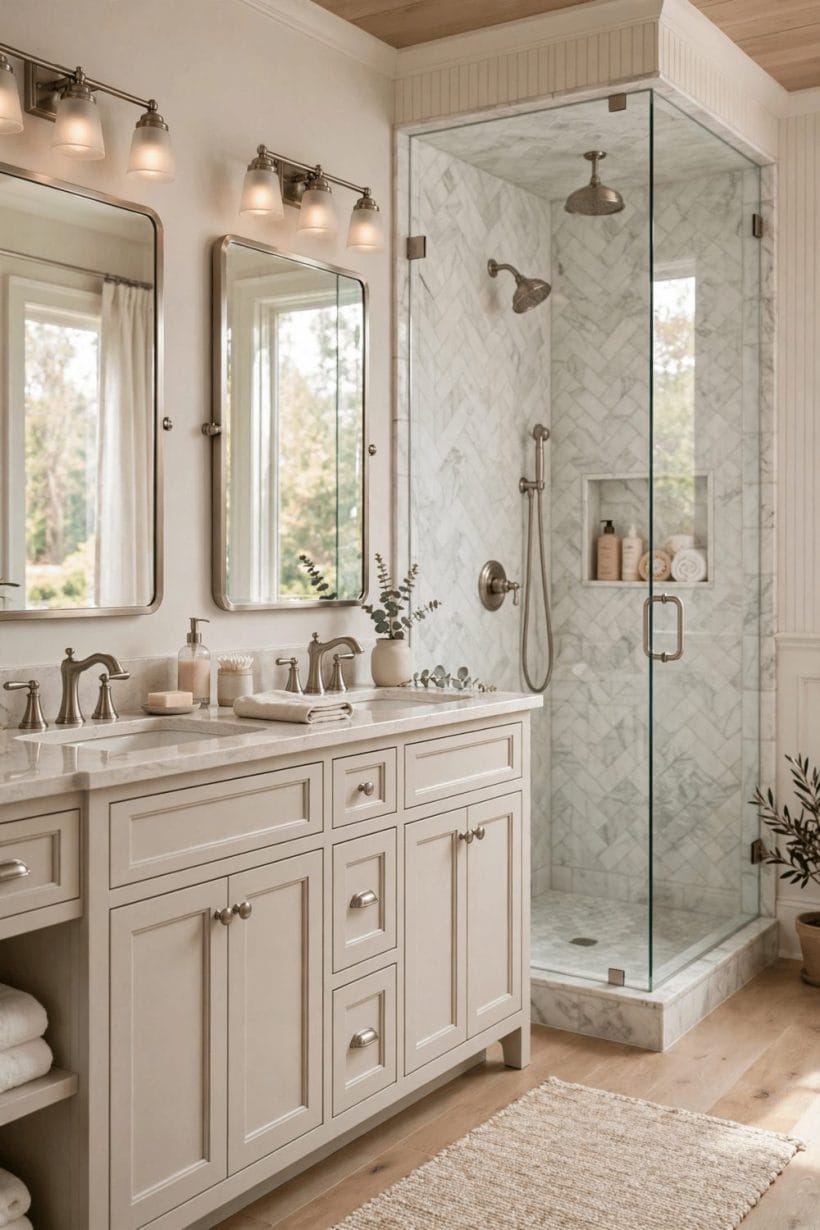
The one-wall discipline is the scheme’s classic form, but blue can travel — to a second wall, a ceiling, a door, the inside of a wardrobe — each journey changing the room’s character. Travel deliberately, knowing what each extension costs the original idea; the contrasts with the whole-wall approach are mapped in the bedroom with gray walls post, where grey takes every wall at once.
66. Wrap the blue around one corner
Carrying the accent onto the return wall by a short distance deepens the bed’s alcove feeling. It is the gentlest travel — the portrait gains a frame’s thickness.
67. Paint the ceiling blue only in a tall room
A blue ceiling lowers the sky and can be magical in a high room with white walls everywhere else. In an ordinary height it is a lid; respect the difference.
68. Give the door the blue for a contained surprise
The bedroom door painted the wall’s blue, closed inside a white hall, promises the room before it opens. A small, reversible travel with outsized charm.
69. Extend the blue into the ensuite’s accent
A towel set, a tiled splashback or one painted wall in the ensuite in the same blue carries the bedroom’s idea through the door. Continuity at small dose.
70. Try two blue walls in the largest rooms
Opposite or adjacent blue walls halve the white’s role and double the cocoon. It suits big, bright rooms — and is no longer, strictly, the accent scheme but its confident cousin.
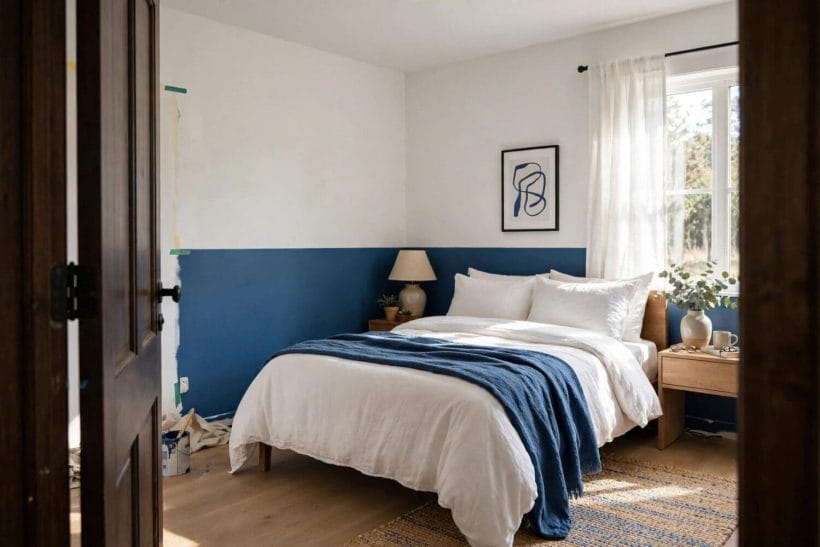
71. Use blue wainscot-height on the white walls
A painted lower wall in the accent blue, capped with a rail, gives period rooms a tailored version of the idea — colour at furniture height, white above.
72. Take the blue to the window wall for the view’s sake
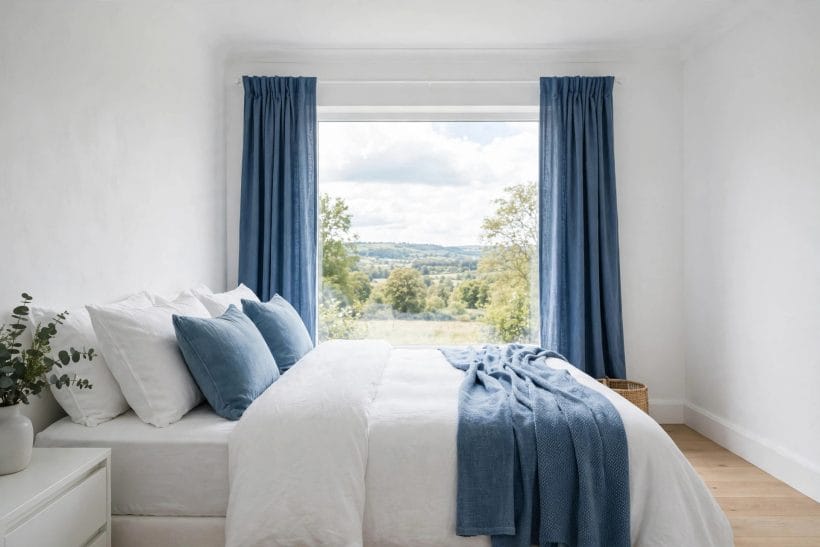
Framing a beautiful view with blue makes the window the room’s picture and the view its changing art. The bed then takes white’s brightness as its backdrop instead — a legitimate swap.
73. Colour-drench a small dressing area instead
Where a dressing nook opens off the bedroom, drenching the nook — walls and ceiling — in the blue makes a jewel of the small space while the bedroom keeps its one-wall calm.
74. Let a rental stop at the one wall
For rooms that must be handed back, one wall is the reversible commitment: a weekend to paint, a weekend to restore. The scheme’s classic form is also its most portable.
75. Know when to leave it at one
The accent wall endures because it is enough. Most rooms, most blues, most light — one wall, perfectly chosen, beats a travelling colour that never settles.
9. Checks and Mistakes: Reading the Room from the Door
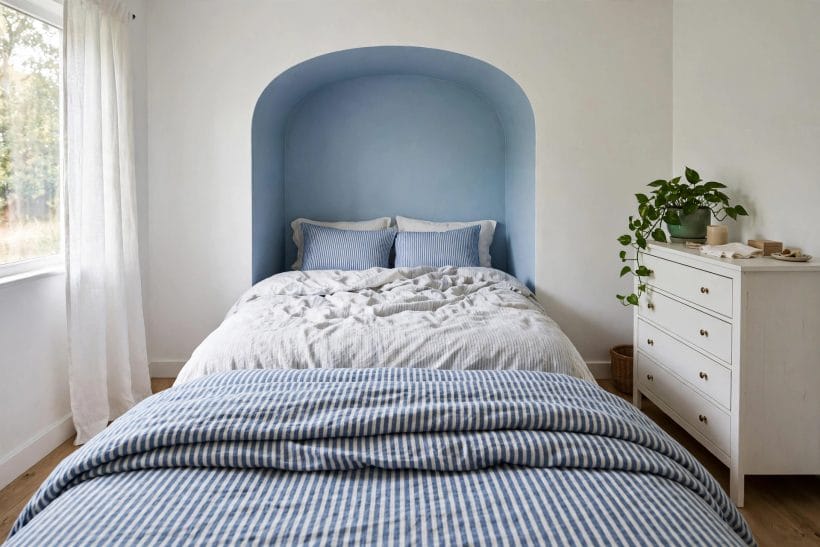
Judge the finished room from the doorway, where every visitor judges it. The composition should resolve at a glance: blue field, pale bed, one echo of colour in the cloth, quiet white around. Squint, and the room should become three tones — if it becomes five, something has been allowed to compete. Then lie on the bed at night under the room’s own lamps and read the wall’s colour honestly; if it has turned to slate or violet, no daylight beauty will save the choice.
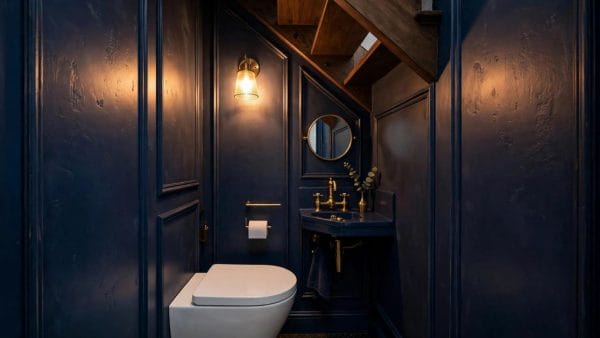
The mistakes form a pattern of excess. The blue creeps — a second wall, the ceiling, the door — until the accent has no white left to accent against. The bedding doubles the statement instead of answering it. The white yellows beside a clean blue, or the blue greys beside a warm one, because undertones were never introduced to each other. And small rooms are denied the scheme altogether by household myth, when a deep blue accent wall in a small white room is one of decorating’s most reliable enlargements — the wall recedes, the whites advance, and the room reads bigger for its contrast. A sleeping alcove under the roof makes the same point in the attic bedroom, where one strong wall organises a difficult shape.
10. Costs and Pulling It Together
Few schemes are kinder to a budget. The modest end is one tin of good paint and white bedding — the entire transformation for the price of a dinner out. The middle adds the pale headboard, the lamps and the cushion set that complete the portrait. The top is finish: beautiful paint in depth, made joinery in white, art at scale on the blue field. Across every rung, the money goes where the eye goes — the wall’s finish, the bed’s cloth, the light at its shoulders — and nowhere else needs much at all.
Pull it together by choosing the wall first, the blue second — in the room’s own evening light — and everything else in answer. One blue wall, honestly white surroundings, and the confidence to stop there: that is the whole design, and it is enough.
Final Considerations
The blue accent bedroom has outlived every fashion cycle thrown at it because it is built on contrast, and contrast does not date. Navy or powder, grand room or small, the recipe holds.
Paint the one wall well, keep the whites true, and let the bed sail. The simplest schemes are the ones a household can love longest.

0 Comments