

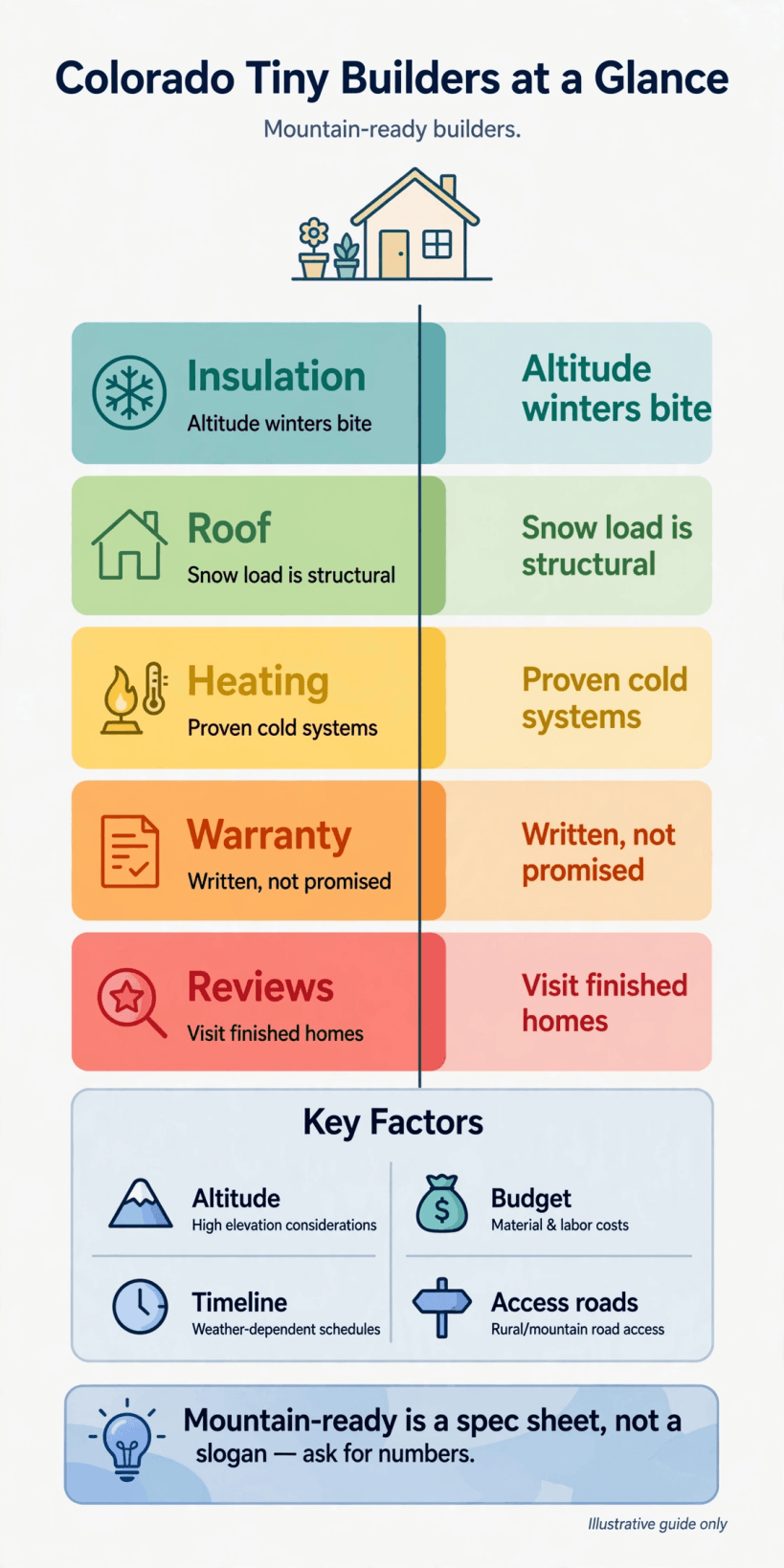
A tiny house in Colorado is not tested by its first photograph but by its first January. Altitude thins the air and the patience of heating systems, snow loads sit on the roof for weeks, pipes freeze in a single clear night, and the last mile to many sites is a steep dirt road that resents trailers. This guide compares the best tiny house builders in Colorado by the method that actually protects a buyer — not by inventing company names, prices or star ratings, but by comparing the builder types you will really meet against the mountain criteria that separate a four-season home from a three-season mistake.
The comparison is deliberately framed around types and tests rather than names. The types are the ones you will encounter everywhere in the state: certified factory builders, local custom shops, kit, plan and shell sellers, and foundation or ADU specialists. The tests are Colorado’s own: insulation that performs at altitude, structure that carries snow, heating with a proven record in real cold, delivery that survives mountain access roads, and a written warranty that means something when the nearest help is an hour away. Score every real company on your shortlist against the same tests, and the mountain-ready builders identify themselves quickly.
| Builder type | What they suit | What to verify |
|---|---|---|
| Certified factory builder | Buyers who want inspected, repeatable builds with four-season specifications in writing | Snow-load and insulation figures for your elevation, written warranty terms |
| Local custom shop | Mountain lots, one-off designs and buyers who want a builder who lives with the same winters | Finished homes at similar altitude you can visit, heating track record |
| Kit, plan and shell seller | Confident DIY buyers with time, tools and a weather window to build in | What is included, snow-load design responsibility, what finishing in winter really involves |
| Foundation and ADU specialist | Permanent homes on owned land where frost depth and permits decide the design | Foundation below frost line, local permitting experience, utility protection |
| Shell builder | Buyers who want a weather-tight, insulated shell and will finish the interior themselves | A written definition of shell, insulation included or not, sealed openings |
1. Certified Factory Builders and Mountain Specification
A certified factory builder works to a documented standard, with third-party inspection at framing, electrical and plumbing stages before the walls close. For Colorado, the certificate is the beginning of the conversation, not the end: ask what snow load the roof is specified for, what insulation values the floor, walls and roof achieve, and whether those figures suit your elevation — a specification written for the Front Range foothills is not automatically a specification for a high valley where winter is longer, colder and heavier with snow.
Before comparing quotes, read what RVIA certification means for a tiny house so certification language holds no mysteries. Then ask whether the builder will state the cold-climate figures for your exact model in the contract documents, and whether certification covers the options you are adding — extra windows, a different roof, a heavier finish package can all change the weight and the thermal story. The trade-off with factory builds is limited structural flexibility, but for many mountain buyers a documented, repeatable four-season build, inspected the same way every time, is worth more than bespoke promises.
2. Local Custom Shops in Colorado’s Mountain Towns
A local custom shop’s real product is local winter. Builders who live at altitude know which heating systems their neighbours actually rely on, how deep frost reaches into local soil, which roads become impassable and when, and how a roof behaves under the snow their town — not a town three hours and four thousand feet lower — actually receives. Ask which elevations the shop has delivered to recently, and ask to visit a finished home at a similar altitude that has survived at least one full winter. Its owner is the most honest brochure in Colorado.
The trade-offs are capacity and price. Mountain shops are small, their seasons are short, and a build that slips can meet winter half-finished — so ask who physically does the work, what is subcontracted, and how the schedule handles weather. When the quote looks high beside factory or kit prices, weigh it against the true cost of tiny houses, prefab vs DIY. A custom price that includes altitude-appropriate insulation, snow engineering, difficult delivery and warranty support is not honestly comparable to a fair-weather shell price, and Colorado punishes the difference.
3. Kit, Plan and Shell Builders at Altitude
Kit sellers, plan sellers and shell builders hand much of the work — and at altitude, much of the weather risk — to you. A plan is drawings and responsibility, including, crucially, the snow-load and insulation decisions the drawings embody. A kit adds bundled materials but rarely includes the trailer, heating system, interior finishing or delivery up your road. A shell gives you a framed, weather-tight structure, though at altitude the honest question is whether weather-tight also means insulated, sealed and ready for a heating system, or merely rain-proof in July.
Price this route with winter in the spreadsheet: covered storage so materials stay dry, a build window that respects the season, heating and freeze protection for plumbing you install yourself, and the labour reality of finishing work in cold, thin air. Buyers who cost it honestly often still choose it — building your own mountain home is a legitimate ambition — but they choose it for the doing, not for a saving that assumed a Denver spring lasts all year at nine thousand feet.
4. Altitude Insulation and Airtightness That Actually Performs
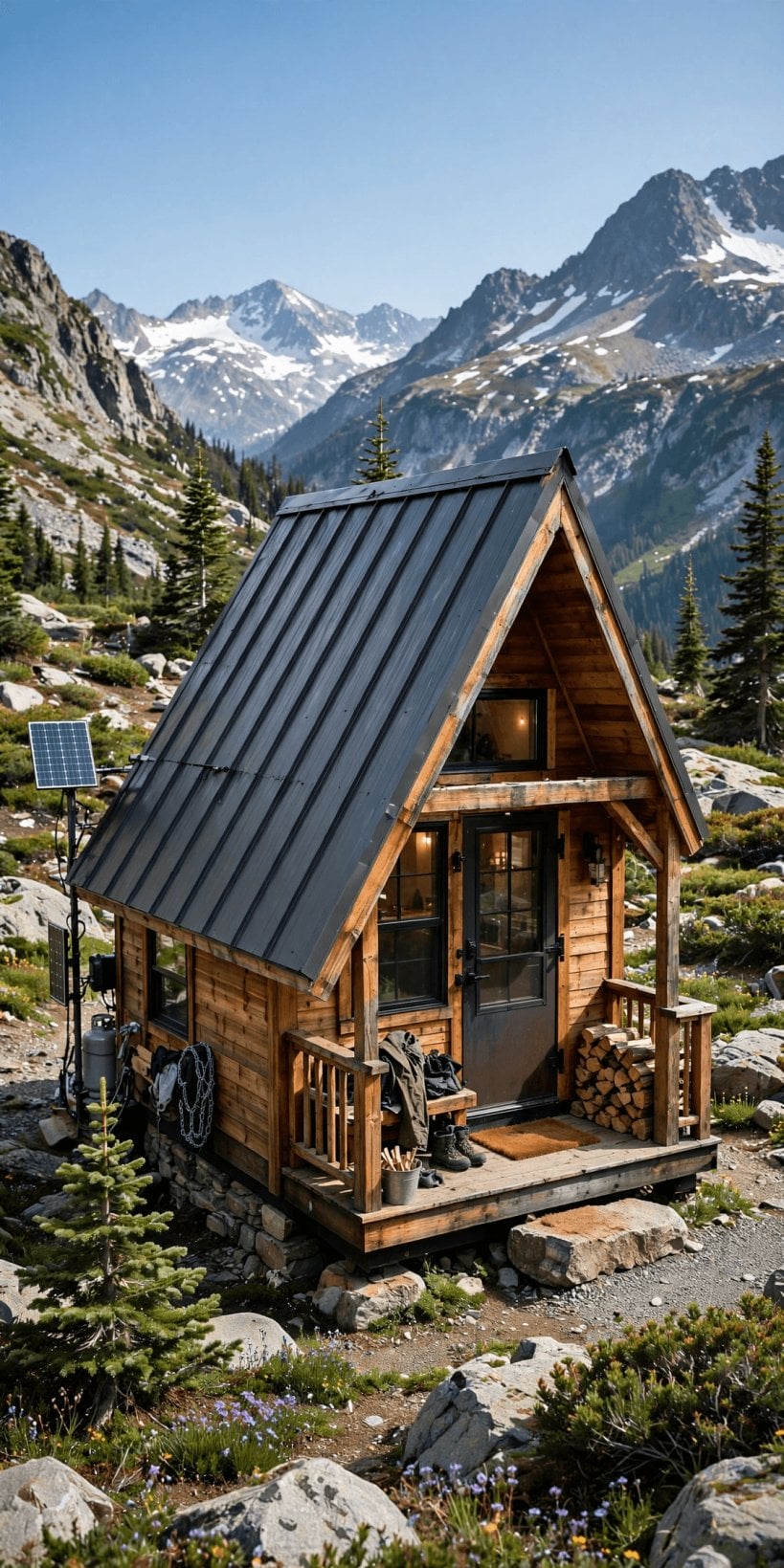
At altitude, insulation is not a comfort upgrade; it is the difference between a heating system that copes and one that runs all night and loses. Ask every builder for the actual insulation values in floor, walls and roof, and how the envelope is sealed — because airtightness matters as much as thickness in a small, wind-exposed box. The floor deserves special suspicion: a tiny house floor sits over cold air, and a thin floor build is felt in every room. Wheel wells, trailer steel and plumbing runs are the cold bridges where cheap envelopes confess.
Compare the approaches using our guide to how to insulate a tiny house: spray foam, rockwool and sheep’s wool, then ask how the chosen system behaves with moisture in a home that breathes out cooking and shower steam into cold walls all winter. Ask, too, what the builder’s own test is: a blower-door figure, a winter reference at your altitude, anything more measurable than the word cosy. Insulation is invisible in a showroom and unforgettable in February, and it is the specification mountain buyers most regret believing on faith.
5. Snow-Load Structure, Roof Pitch and Ice Dams
Snow in Colorado is not a decoration; it is a structural load that arrives wet, stays for weeks, drifts unevenly and slides when it chooses. Ask each builder what roof load the design carries, how that figure was arrived at for your county and elevation, and how the load path runs from roof to walls to floor to trailer or foundation. Ask about roof pitch and covering with the same seriousness: a pitch that sheds snow in one valley may hold a sliding, damaging slab in another, and metal roofing, snow guards and protected entries are design decisions, not accessories.
Ice dams are the quiet sequel — heat escaping through a thin roof melts snow that refreezes at the cold edge, prising water under coverings. The defence is the insulation and airtightness of section four, plus ventilation detailing a cold-climate builder can explain without notes. Designs that take this seriously appear again in our guide to tiny house plans for cold climates. A builder who asks about your elevation before quoting a roof understands Colorado; one who specifies the same roof for every altitude is selling a photograph, not a structure.
6. Heating Systems Proven in Colorado Cold
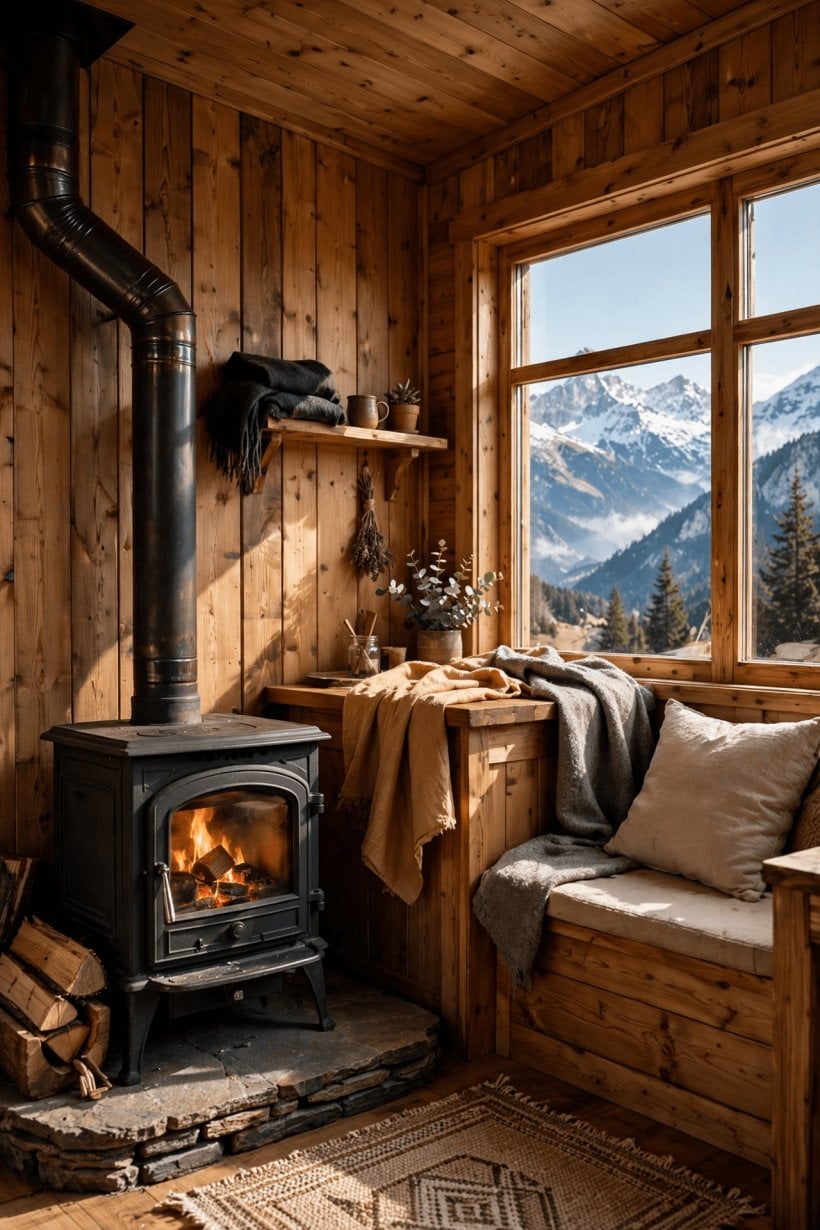
Proven is the operative word. Ask each builder what heating system their delivered mountain homes actually use through a full winter, and what the backup is when the first system falters at twenty below. The serious answers name a primary heat source sized for the home and the altitude, a plan for pipes when the home is empty, and honest talk about fuel storage and electricity supply in places where both can be interrupted by weather. Mini-splits lose capacity as temperatures fall; stoves demand clearances and daily attention; propane systems need venting done properly. There is no magic option — only understood ones.
The full landscape is set out in our guide to how to heat a tiny house, and it will help you hear the difference between experience and optimism. Ask for a winter reference at altitude and put the question plainly: what did January cost, and did the pipes survive the coldest week? A builder whose homes have genuinely wintered in the high country answers with specifics and sympathy. A builder who promises that a small heater will be plenty has simply not yet been responsible for a frozen, split pipe in somebody else’s February.
7. Delivery on Mountain Roads: Access, Escorts and Timing
In Colorado the delivery is an expedition, and it should be planned like one. Ask every builder who surveys the route, what vehicle and trailer combination will be used, and what the plan is for the grades, switchbacks, low branches, soft shoulders and seasonal restrictions between the highway and your site. Escort vehicles, permits for oversize loads and a weather window all belong in the written quote, with a named answer to who pays if the attempt has to be abandoned and retried. Photograph and measure your access in every season you can, and share it in writing before you sign.
The costs and risks of moving small homes are mapped in our tiny house moving guide and transport cost breakdown. Timing matters as much as route: a delivery scheduled against the first serious snow is a gamble billed to you. Ask when the builder stops delivering to your altitude for the year, and treat the answer as a quality signal. The builders who respect mountain roads — who would rather deliver in September than gamble in November — are the same builders whose homes tend to arrive level, undamaged and ready for winter.
8. Written Warranties and Cold-Climate Aftercare in Colorado
Ask for a sample warranty before you pay a deposit and read it with a cold night in mind. Structure, roof, weatherproofing, plumbing and electrical systems should each have a stated period and a claim process, and the appliances will usually carry their own manufacturers’ terms passed through the builder. Then ask the mountain question: who performs warranty work, and how long does it take them to reach your altitude in winter? A warranty serviced from the flatlands by appointment in six weeks is a different promise from a local arrangement — and a frozen pipe does not keep office hours.
Aftercare is where cold-climate builders quietly distinguish themselves: manuals for every system, labelled valves and panel, a winterising and de-winterising routine in writing, guidance on skirting and pipe protection, and a named contact for the first winter. Ask what the warranty excludes — transport damage, site movement, owner modifications and neglected winter maintenance are common and fair, provided they are written down before anyone is cold and cross. The builders worth choosing explain the exclusions early, stock the small parts their homes need, and treat your first January as part of the product they sold you.
9. Contracts and Payment Stages With Colorado Builders
The contract should name the exact specification — snow load, insulation values, heating system, delivery route and date window — the total price, the exclusions, and payments tied to visible milestones rather than dates alone: deposit, frame complete, weather-tight, fit-out, delivery. You should never be far ahead of value you could point to, and every change order should be priced and signed before the work happens. In a short mountain building season, also ask what the contract says about weather delay: who decides, who pays, and where a finished home waits if your site — or the road to it — is not ready.
If you are borrowing, align the builder’s payment stages with your lender’s draw schedule early, using how to finance a tiny house as background, and confirm in whose name title paperwork will be issued. Ask who owns materials paid for in advance and what the cancellation clause really costs at each stage. None of these questions signals distrust. Builders who finish homes in Colorado winters expect them, answer in writing, and are visibly calmer than sellers who prefer the agreement friendly, verbal and thin — because they know which kind of contract survives first contact with January.
10. Red Flags When Comparing Colorado Tiny House Builders
The universal warnings apply: large cash deposits with no contract, contracts in a different name from the business you visited, refusal to show a finished home or share the warranty text before payment. Colorado adds altitude-specific tells. A builder who never asks your elevation is the first. One who specifies the same insulation and roof for a valley floor and a high pass is the second. Promises that a single small heater laughs at twenty below, or that delivery is possible any month of the year on any road, are optimism wearing a sales jacket.
Watch the paperwork temperature as well. Quotes with no snow-load figure, no heating specification, no delivery survey and no weather clause are not simpler quotes — they are unpriced risks transferred to you. Distance makes every one of them harder to fix: the builder is far, the weather is close, and help moves slowly on winter roads. None of these flags needs expertise to spot, only the willingness to ask what this home does in January, in writing, and to believe thin answers mean a thin build. Colorado will ask the same questions later, less politely and at your expense.
Final Considerations
Mountain-ready is not a trim level; it is a chain of decisions — insulation and airtightness, snow-carrying structure, proven heating, honest delivery planning and a warranty that survives geography — that either holds at altitude or does not. Certified factory builds suit buyers who value inspected consistency with four-season figures in writing. Local custom shops suit buyers whose land and winters demand local knowledge. Kits, plans and shells suit hands-on builders who price the season honestly. Score every builder against the same Colorado tests, insist on the figures in the contract, and plan delivery like the expedition it is. Do that, and the home you buy in a mild month has already been chosen for the month that matters.


0 Comments