

A farmhouse sink changes the rules for the tap above it. The basin sits further forward, runs deeper than a standard sink, and asks far more of spout height, reach and spray coverage — so a faucet that works beautifully elsewhere can splash, strain and look lost here.
This guide matches faucet to apron-front sink properly: the measurements, mounts, styles, sprayers and finishes that make the pairing work every day.
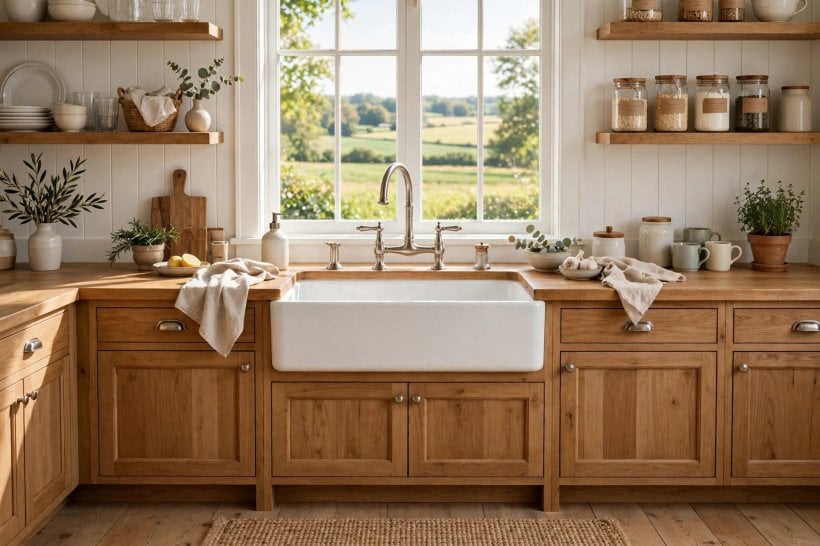
1. Farmhouse Sink Faucets at a Glance
A farmhouse faucet is not a separate product category so much as a set of relationships: the faucet is the fixture, and its defining attributes are spout height above the basin, horizontal reach into the basin, mounting position relative to the apron front, handle type and swing, spray function, and finish against the sink material. Get those attributes in proportion to a deep, wide, forward-set apron-front basin and almost any style works; get one wrong — usually reach or clearance — and the most beautiful faucet in the shop becomes a daily irritation. Choosing the best faucet for farmhouse sink use is therefore a measuring exercise first and a style exercise second.
| Why is a farmhouse sink different? | It is deeper and wider than a standard sink, and its apron front pushes the basin forward — so the faucet needs more height and more reach to land water in the middle of the bowl. |
| What matters most? | Spout height and spout reach measured against your actual basin depth and width, plus handle clearance behind the sink. |
| Where can it mount? | On the deck behind the sink, on the wall above it, or as a bridge faucet spanning two holes — each needs a different space check first. |
| Which finishes suit apron sinks? | Polished nickel, chrome, matte black, unlacquered brass and oil-rubbed bronze — chosen to sit calmly against fireclay, cast iron, stainless steel or copper. |
| Biggest mistake? | A spout that is too short or too low: water lands near the front edge, splashes out of the deep basin, and big pots will not fit underneath. |
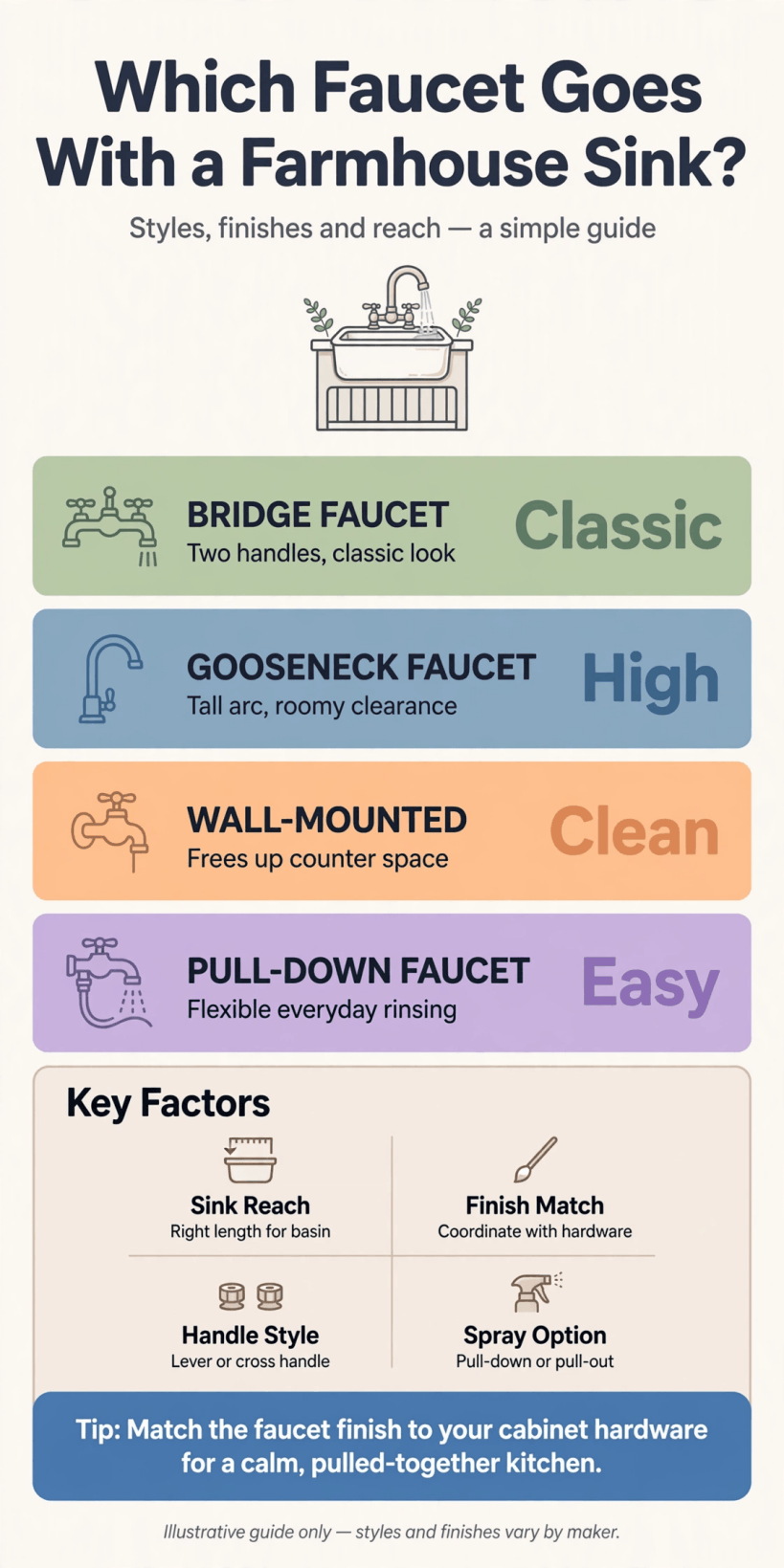
At a glance: measure height, reach and clearance against the real basin first — then choose style, sprayer and finish to match the sink and the room.
2. Why Farmhouse Sinks Are Different
An apron-front sink — the farmhouse sink — replaces the front of the cabinet with its own exposed face, so the basin begins closer to you and the back edge sits further from the faucet than in a conventional drop-in or undermount layout. That forward position is the whole point ergonomically: you stand closer to the work, lean less, and wash large items without reaching across a strip of counter. But it quietly moves the target. Water from a standard faucet is aimed at a basin centre that is no longer where it used to be.
Depth compounds the problem. Farmhouse basins are typically deep — made for stockpots, roasting trays, baking sheets and, in working farmhouses historically, everything from produce to bathing babies. A deep basin needs clearance underneath the spout for tall vessels to pass, and it punishes a short stream: water falling a long way into a deep, hard bowl gains speed and splashes, while water landing too close to the front wall of the basin climbs it. Width matters too, because many farmhouse sinks are broad single bowls with no divider. A fixed stream only ever serves one spot, so coverage — by reach, by swing or by sprayer — becomes part of the design, not an extra. The compact-bowl thinking in compact kitchen appliance and sink sizing guides makes the same point from the opposite direction: the faucet and the basin are one system, and they should be chosen together, never in isolation.
3. Measuring First: Spout Height and Reach Against the Basin
Two measurements decide whether a faucet suits your sink, and both are taken from the sink you actually own — or the exact model you are ordering — not from a showroom impression.
Spout height: clearance under the arc
Spout height is the vertical distance from the mounting surface to the outlet where water leaves. Picture your tallest regular jobs: filling a stockpot, rinsing a large roasting pan on its side, standing a tall vase or a watering can under the stream. The pot must pass under the outlet with room for your hands, and it must do so over the rim of a deep basin, which already sits high. High-arc, gooseneck profiles exist largely for this job: the arc buys working clearance without raising the whole fixture. If you regularly fill very tall vessels, also think about whether they can simply stand in the deep basin itself while filling — depth that works against a low faucet works for a tall one.
Spout reach: where the water lands
Reach is the horizontal distance from the centre of the faucet body to the centre of the stream. On an apron-front sink the stream should land near the middle of the basin, or at least comfortably past its back wall, so washing water falls into the bowl rather than onto its rear edge or the strip behind it. Measure from your mounting holes to the basin centre and compare that figure with the reach in the manufacturer’s dimensions before you fall for a finish. A handsome faucet that lands its stream a few inches short will splash the back of the basin and leave the front half of a wide bowl unserved. Finally, check swing: most single-post faucets rotate, and the arc of that swing should stay inside the basin at both extremes, especially in a corner or against a side wall.
4. Mounting Types: Deck, Wall and Bridge
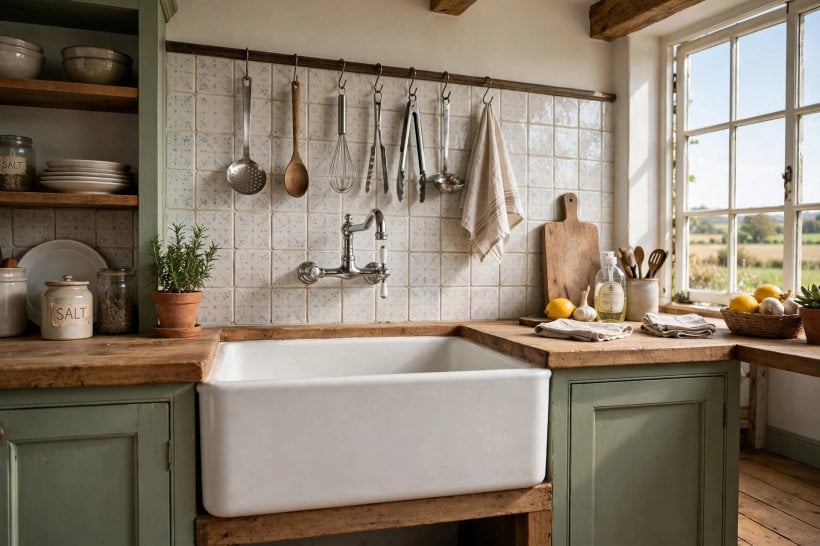
Deck-mount behind the sink is the commonest arrangement: the faucet sits on the countertop, the sink’s own ledge, or a mounting plate in the narrow strip between the back of the sink and the backsplash. That strip is the critical dimension. Measure its depth honestly — apron sinks pushed forward can leave only a slim ledge, and a chunky faucet base, separate handles and a soap dispenser may simply not fit in a row. Check, too, what is underneath: the ledge must have solid material to drill and enough clearance below for supply connections and tightening. Where the ledge is too narrow, a single-post faucet with controls integrated into the body takes far less room than a widespread set.
Wall-mount frees the ledge entirely and suits the farmhouse look beautifully — the faucet emerges from the backsplash or wall above the sink, often with a long, sometimes jointed spout. It demands planning: supply lines run inside the wall, the outlet must be high enough to clear tall pots yet close enough to the wall that its reach still lands mid-basin, and any future change of mind involves opening the wall, not just swapping a fixture. In cold climates, supplies in an exterior wall need a freezing-risk thought as well.
Bridge faucets mount through two holes with the valve bodies exposed and joined by a horizontal bridge carrying the spout — the period-correct partner for an apron sink, covered as a style in the next section. As a mounting proposition, a bridge needs its two holes at the correct spacing, either in the sink ledge or the counter behind it, and enough ledge depth for the bodies to sit without crowding the backsplash. Whichever mount you choose, settle it before cabinets and counters are finalised: the layout decisions in tiny house kitchen floor plans show how early the sink wall’s geometry locks everything — faucet included — into place.
5. Faucet Styles: Bridge, Single-Handle, Commercial-Style and the Pot-Filler Look
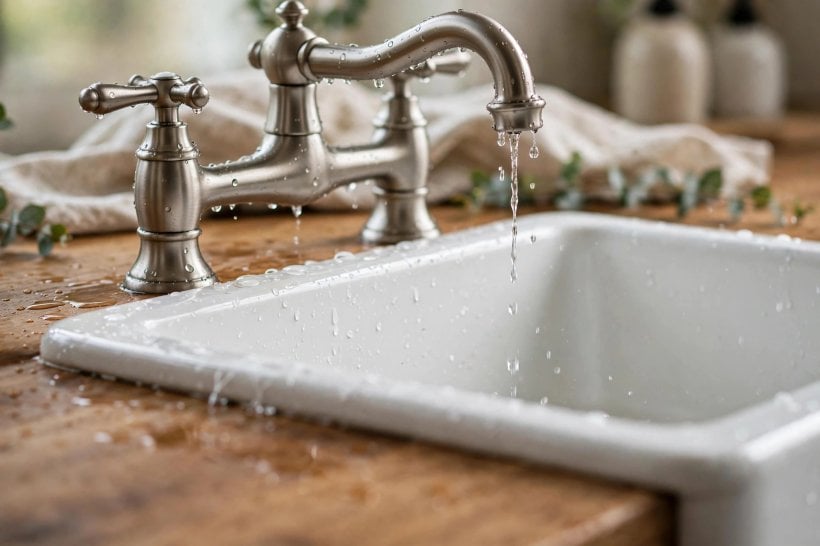
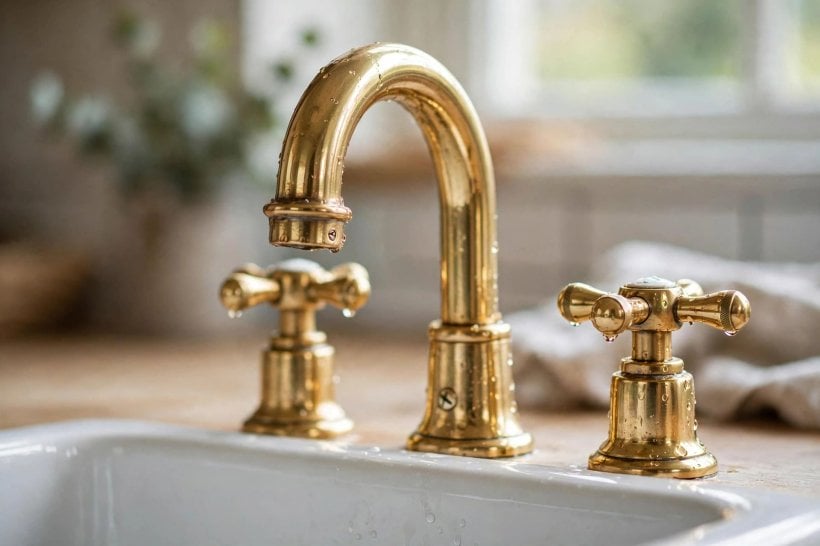
Bridge faucets are the heritage choice. Two separate hot and cold valves, an exposed bridge, a central spout — often high-arc — and handles in cross or lever form. They read as plumbing, honestly made, which is exactly why they flatter a fireclay or cast-iron apron sink: both objects come from the same working-kitchen tradition. The trade-offs are practical: two hands or two movements to balance temperature, more ledge width consumed, and more joints and surfaces to wipe down.
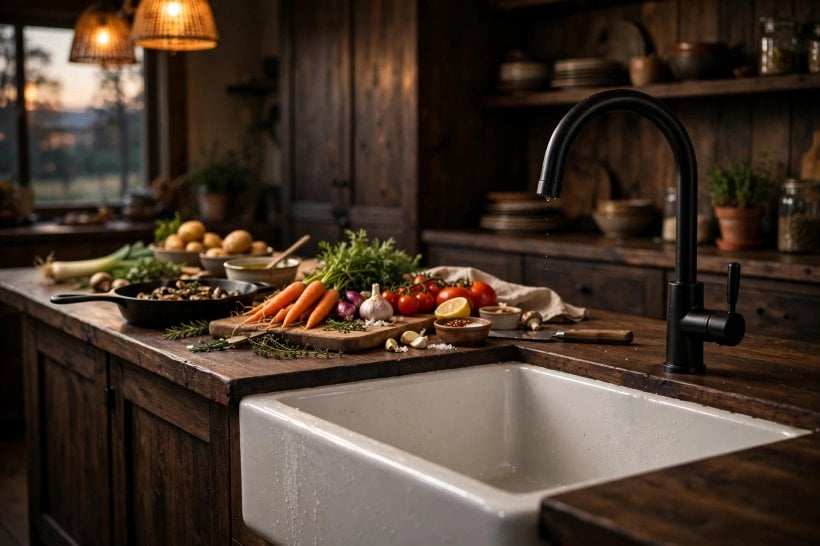
Single-handle faucets put flow and temperature under one lever, usually on a tall gooseneck body. They are the easiest to use with full or messy hands — a nudge of the wrist does it — and the most forgiving where ledge space is tight, since one post does everything. In traditional detailing they can look entirely at home over an apron sink; in cleaner lines they carry the same sink into modern farmhouse territory without changing anything else.
Commercial-style faucets borrow from professional kitchens: a tall spring-wrapped spout, an exposed coil, and a spray head that undocks for serious rinsing. Over a big farmhouse basin they are genuinely capable — the spring spout reaches everywhere and shrugs off stockpots — but they are visually loud and tall, so check overall height against wall cabinets, shelves and window trim above the sink, and be sure the room wants that industrial energy.
The pot-filler look — a jointed, swing-out arm — occasionally appears at the sink itself, but pot fillers belong over the hob, filling pans where they will cook. At the sink, the same visual language is better served by a wall-mounted faucet with an articulated spout, which fills tall vessels without pretending to be a second fixture. Style, in every case, should follow the checks in the previous sections: the prettiest profile fails if its reach is short. The broader style-matching approach in tiny house kitchen design ideas applies directly — pick the kitchen’s period first, then let the faucet speak that language.
6. Sprayer Options for a Big Basin
A wide, deep, single-bowl basin is precisely where a sprayer stops being a gadget. A fixed stream serves one circle of the bowl; everything else — the corners where tray edges rest, the far side of a roasting pan, the basin walls themselves after a messy job — needs water brought to it.
Pull-down sprayers are the natural fit for high-arc farmhouse faucets: the head draws down from the spout on a hose, keeping the working end over the basin where it belongs. Pull-out sprayers sit in lower, straighter spouts and pull toward you — useful, though the lower spout gives up the pot clearance that made the high arc attractive. Separate side sprayers keep the faucet itself simple and period-clean — a bridge faucet with a side spray is a classic combination — at the cost of one more hole in the ledge and a hose that lives under the sink.
Whichever type you choose, check three practicalities. The hose should be long enough to reach every corner of your basin and retract smoothly without snagging on under-sink clutter. The spray head should switch between a steady stream and a wider spray without fiddly controls, since you will operate it one-handed with the other hand holding the pan. And the head should seat back into the spout positively — a sprayer that droops or dangles after a year of use announces itself every time you enter the kitchen. For households that batch-cook, preserve, or wash serious cookware daily, treat the sprayer as the main event and the spout as its dock. The water-supply side of that workload — pressure, pipe runs and connections — is covered in how tiny houses get water and plumbing, and a quick read there will tell you what your system can comfortably feed.
7. Finishes and Pairing With Sink Materials
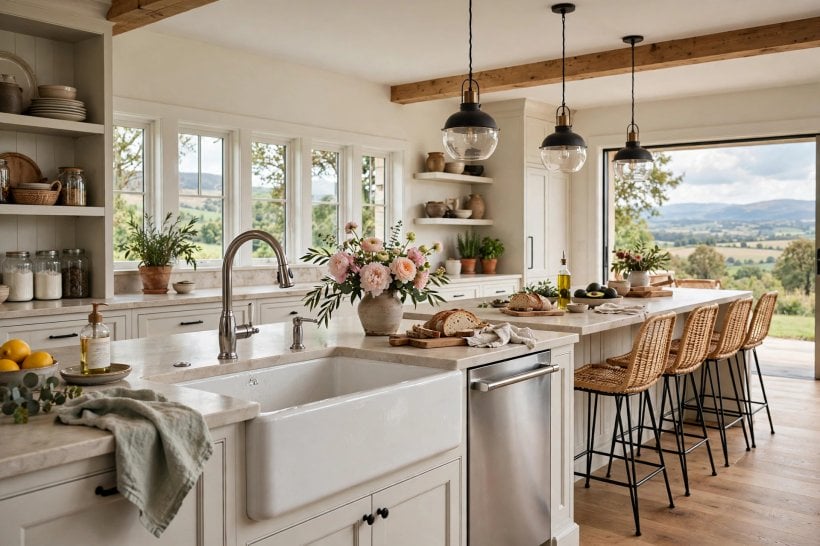
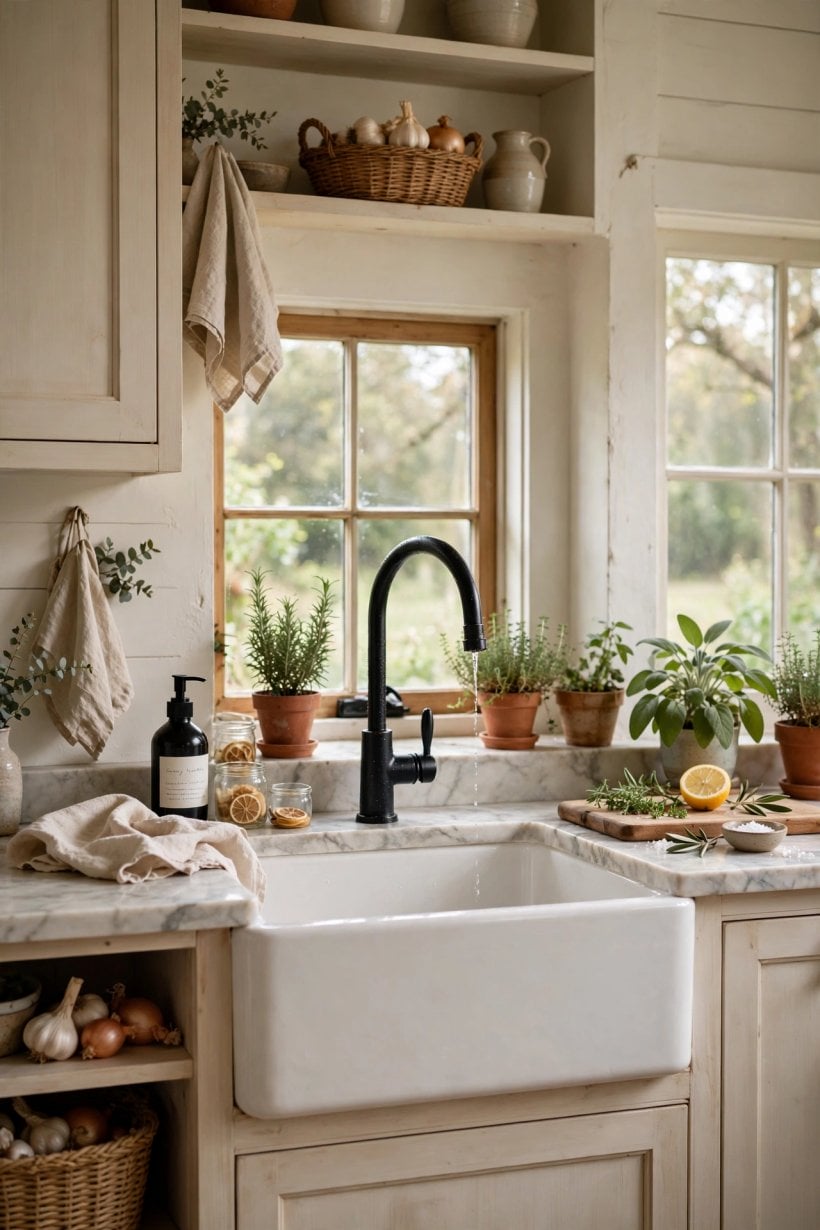
Finish is where the faucet either joins the sink as one composition or argues with it daily. Five finishes carry the farmhouse palette. Polished nickel is warm-toned and softly reflective — the period-authentic partner for fireclay and enamelled cast iron, and forgiving of water spots. Chrome is cooler, brighter and the easiest to match with appliances and hardware elsewhere in the kitchen. Matte black gives a modern graphic edge, silhouettes beautifully against a white apron front, and shows pale water marks more readily, so it suits households that wipe down as they go. Unlacquered brass is a living finish: it starts bright and deepens into a patina with touch and time, which devotees love and minimalists should avoid. Oil-rubbed bronze brings near-black brown depth that sits naturally with copper, dark wood and traditional schemes.
Pair by sink material. Fireclay and enamelled cast iron — glossy, warm white, traditional — take nickel, brass and bronze most naturally, though chrome is the crisp classic. Stainless steel apron sinks lean contemporary: match with chrome or a brushed steel-toned finish so the metals read as relatives, and let matte black be the deliberate contrast if you want one. Copper sinks are the statement already; a faucet in a bronze or aged-copper direction supports them, while a bright competing metal splits the room’s attention — and remember a copper basin’s patina will evolve, so choose a finish that still flatters it in five years, not just on delivery day.
Two disciplines hold any pairing together. First, repeat the faucet finish at least once nearby — cabinet handles, a light fitting, the rail the towels hang from — so it reads as a scheme rather than an accident; the styling examples in tiny house kitchen ideas show how much calmer a kitchen looks when its metals agree. Second, judge finishes in your kitchen’s own light, on samples if you can: nickel and brass warm up under evening light, chrome and black stay cooler, and showroom daylight flatters them all equally and misleadingly.
8. Handle and Control Clearance: The Check Everyone Forgets
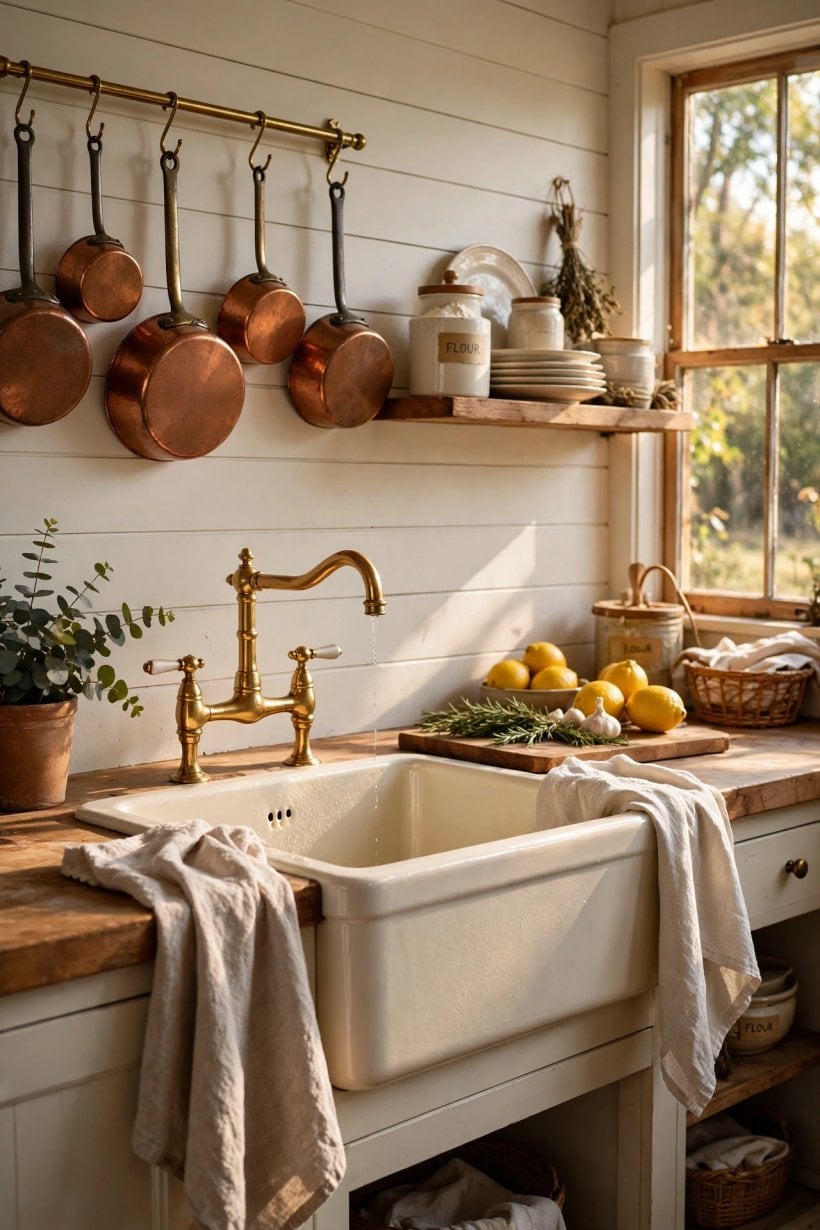
More farmhouse faucet returns are caused by handles than by spouts. The space behind an apron sink is shallow by design, and three collisions wait there. A lever handle on a single-post faucet typically swings backward as it turns on or adjusts — if the backsplash is close, the lever strikes it before reaching full flow or full hot. Two-handle and bridge sets need finger room around each handle: you should be able to grip and turn a cross or lever handle fully without rapping knuckles on the wall or the window sill. And on a window-sill sink run — the classic farmhouse arrangement — a tall faucet or a rear-swinging lever can foul the sill, the window itself, or the plants and bottles that inevitably colonise the sill.
The checks take five minutes with a tape and the manufacturer’s dimension sheet. Measure from the mounting-hole centre line to the backsplash; compare it with the handle’s rearward travel at its widest point, not just the body’s depth. Confirm side clearance for separate handles, including the space your hand needs, not only the handle itself. If space is genuinely tight, the solutions are built into the types already covered: a faucet with its lever on the front or side of the body, a wall-mounted set that moves controls up and out of the strip, or a bridge whose handles turn in a compact arc. Ergonomics matter beyond collision, too: cross handles suit traditional looks and grip well with wet hands, levers suit anyone with limited grip strength and anyone cooking with messy fingers, and a single lever suits speed. Choose for the hands that will actually use it, every day, with the same honesty you would apply to the layouts in kitchen small-space design ideas.
9. Pairing by Kitchen Style: Traditional, Modern Farmhouse and Industrial
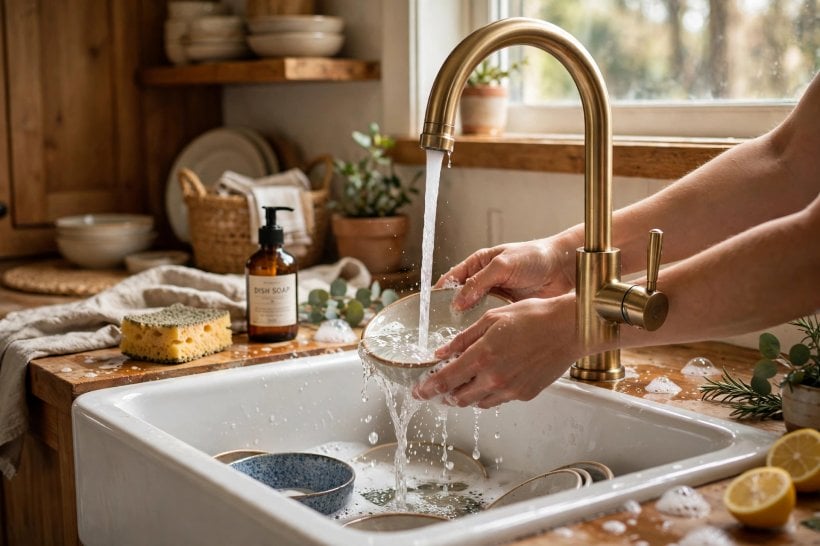
Traditional and period kitchens
Let the bridge faucet lead: cross handles, polished nickel or unlacquered brass, a fireclay or cast-iron apron front, and a side spray if you want one. Every element comes from the same era of working kitchens, so nothing has to try — the pairing reads as inheritance rather than decoration. Keep the arc graceful rather than towering, and let aged, living finishes do the storytelling.
Modern farmhouse
This is the apron sink’s most popular current setting: white or stainless sink, clean cabinetry, warm wood, and a faucet that bridges old and new. A single-handle gooseneck in matte black, chrome or brushed nickel is the standard answer — farmhouse in its proportions, modern in its operation. Pull-down spray included, handles un-fussy, finish repeated in the cabinet hardware. The room stays calm because the sink supplies the nostalgia and the faucet supplies the ease.
Industrial and commercial-leaning kitchens
Pair a stainless apron sink with a commercial-style spring faucet, or a wall-mounted articulated spout in chrome or matte black. Open shelving, hard surfaces and visible function complete the language. The caution is scale: industrial fixtures are tall and assertive, so in a small kitchen choose the slimmest version that still clears your pots, and let it be the room’s one loud object. Whichever of the three directions you take, the farmhouse thread — honest materials, visible function, nothing pretending — should survive; it is the same thread that runs through farmhouse living room ideas, translated into the room where water does the work.
10. Buying Checks and Mistakes to Avoid
Run the buying checks in order, on paper, before ordering anything. One: basin dimensions — depth, width, and the distance from mounting holes to basin centre. Two: ledge depth between sink and backsplash, and what can actually be drilled and connected beneath it. Three: the faucet’s spout height and reach against check one, including swing. Four: handle travel and grip clearance against check two, plus any window-sill conflict. Five: hole count and spacing — the sink, ledge and faucet must agree, and any spare hole needs a planned occupant such as a soap dispenser or a cover. Six: sprayer type, hose length and retraction, tested in the showroom if possible. Seven: finish judged in your light and paired deliberately with the sink material. Eight: water efficiency in general terms — modern kitchen faucets are flow-rated, a lower-flow model with a good sprayer usually cleans as well as an older thirsty one, and an aerated stream feels fuller than its rating suggests; if your supply is a pump or off-grid system, confirm the faucet’s needs suit it. Nine: overall height against anything above the sink — cabinets, shelves, pendants, window trim.
Then the mistakes, each one a check skipped. A spout too short or too low, landing water at the basin’s back edge so it splashes out of a deep bowl and tall pots never fit beneath it. A lever that meets the backsplash halfway through its travel, so full hot stays theoretical. A finish chosen from a screen that clashes with the sink in real light — bright chrome against warm copper, cold black against creamy fireclay without a single supporting note nearby. A bridge faucet ordered for a ledge with the wrong hole spacing. A commercial-style giant installed under a low cabinet it now touches. And the quietest mistake of all: a wide single bowl with no sprayer, condemned to have its corners rinsed with a jug forever. Every one is avoidable with the tape measure and the dimension sheet — unglamorous tools that decide whether a beautiful faucet is also a good one. A final browse of kitchen ideas to elevate your home’s style is a useful sanity check at this point: note how the finished kitchens you admire keep faucet, sink and hardware in one consistent language.
Final Considerations
The best faucet for farmhouse sink pairings is never a single winning model — it is the faucet whose height clears your tallest pot, whose reach lands mid-basin, whose handles turn freely in the space behind your sink, and whose finish treats the apron front as a partner. Meet those four tests and the style choice is free: heritage, modern or industrial can all be the right answer in the right kitchen.
So pick by household. Keen traditionalists and owners of fireclay or cast-iron sinks should start with a bridge faucet in nickel or brass. Busy family cooks who value one-handed speed should take a high-arc single-handle with a pull-down sprayer in chrome or matte black. Serious batch-cookers with a stainless apron sink can justify the commercial-style spring spout — once its height is checked. Measure first, choose second, and the tap above your farmhouse sink will feel less like a purchase and more like part of the sink itself.



0 Comments