

Read enough Lane recliner reviews and you will find one owner calling a chair the best seat in the house while another calls the same style disappointing. Both can be honest — they sat in different chairs, at different stores, with different expectations.
This guide shows you how to read those reviews for patterns, and the frame, mechanism, cushion, upholstery and warranty checks to make on the actual chair in front of you before you pay for it.

1. Lane Recliners at a Glance
Lane is a long-established American recliner name, sold through furniture stores and larger retailers at accessible-to-mid price points rather than at the premium end of the market. That position shapes what a fair review should judge: not whether a Lane chair matches a luxury recliner costing far more, but whether its frame, mechanism, cushions and stitching are honestly made for the money — something you can verify yourself, chair by chair, with the checks in this guide.
| What type of recliners? | Upholstered reclining chairs and reclining sofas in manual and power versions, including rocker, glider and wall-hugger styles at some retailers. |
| How are they sold? | Mainly through furniture stores and retailers, so stock, delivery terms and after-sales service vary by the shop you buy from. |
| Why do reviews conflict? | Different models, fabrics, sitters and retailers sit behind the same brand name; one review rarely describes the exact chair you are considering. |
| What should you check? | Frame material, mechanism smoothness, cushion cores, seams and upholstery, fit for your body, and the written warranty terms. |
| Biggest mistake? | Judging the whole brand by a star average instead of sitting in, inspecting and pricing the specific chair you would take home. |

At a glance: judge a Lane recliner the way you would judge any recliner — by construction you can touch and test, not by the badge or the average star rating.
2. How to Read Lane Recliners Reviews Without Being Misled

Star averages are the least useful part of any review page. When you work through lane recliners reviews, read for patterns instead: if owner after owner mentions the same detail — a stiff handle, a seat that stays supportive, a frame that creaks, fabric that marks easily — that repeated detail is real information about a particular model. One furious review tells you about one delivery; twenty reviews circling the same point tell you about the chair.
Sort what you read into three buckets. Chair complaints — mechanism noise, cushions flattening early, seams pulling — belong to the model and its construction. Retailer complaints — late delivery, slow swaps, unhelpful returns — belong to the store, and a different store may sell the same chair with none of those problems. Fit complaints — a seat too deep, a back too short — belong to the match between chair and sitter, and are the easiest to avoid by testing the chair yourself.
Weight detailed, dated reviews over short ones, and reviews of the exact model and fabric over reviews of the brand in general. Note how long the owner had lived with the chair: comfort in week one is mostly cushion softness, while reviews written after a year or more are the ones that speak to mechanism wear, cushion resilience and upholstery behaviour. The same discipline helps with any seating decision for a compact home, which is why the layout thinking in tiny living room ideas starts from how a piece is actually used, not from a catalogue photograph.
3. Frame Construction: The Checks That Decide How Long It Lasts

A recliner frame works harder than almost any other frame in the house, because it carries a moving mechanism as well as a sitting person. Ask what the specific chair’s frame is made from, and look for the answer in writing on the specification sheet rather than accepting a general assurance.
What to look for underneath
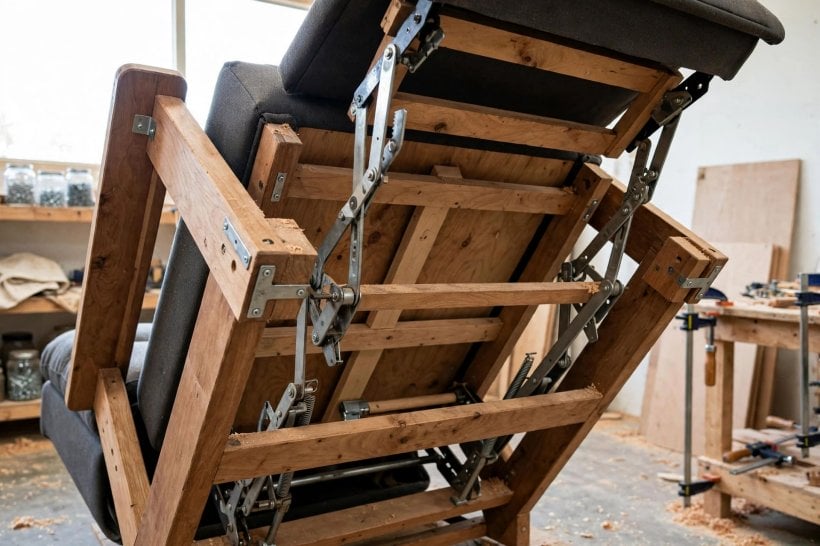
Kiln-dried hardwood or quality plywood in the main rails is the traditional sign of a frame built to resist warping and loosening; extensive particleboard in load-bearing parts is the tell of a chair built down to a price. You cannot always see the frame on an upholstered recliner, so use the indirect tests: lift one front corner — a well-made frame resists twisting rather than flexing noticeably — and shift your weight side to side in the seat, feeling for movement that should not be there.
Corner joints matter as much as material. Blocks, dowels, screws and glue used together hold far better than staples alone; ask how the corners are joined, and treat a vague answer as information in itself. Rock the chair gently from the arm: the arms should feel part of the frame, not attached to it. In a small home a recliner is often the biggest piece in the room, so its build quality carries the whole seating plan — the same reason the pieces chosen in how to decorate a tiny living room have to earn their footprint every day.
4. Mechanism Checks: Handle, Motion and Recline Positions

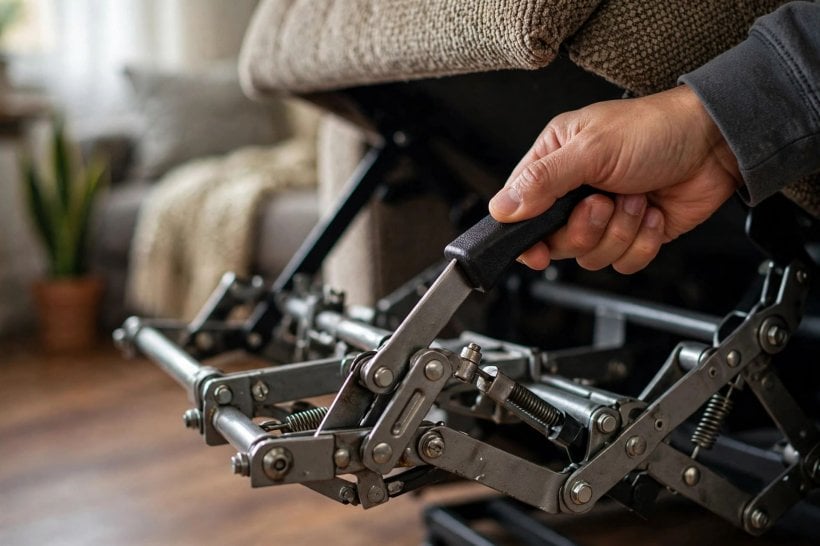
The mechanism is the moving heart of the chair, and the showroom is your one chance to test it properly. Operate the exact chair you are considering — not a different model nearby — through its full range several times.
What your hands and ears should find
Smoothness: the motion should start without a jerk, travel without grinding, and settle without a clunk. Noise: squeaks and rattles on a new chair rarely improve with use. Handle feel: on a manual chair, the handle or side release should work without excessive force, and the footrest should rise evenly rather than twisting. Positions: check how many recline positions the chair genuinely holds — some hold any angle, others click into set stops — and whether back and footrest move together or independently, since that changes how you read, watch television or nap.
Ask about wall clearance while you are there. A standard recliner needs substantial space behind it to open fully; a wall-hugger design rides forward on its base and needs only a few inches. Measure your room before you shop, and test the chair at the distance from the wall you actually have — a point that matters doubly in the compact layouts covered by small living room ideas, where a recliner that cannot fully open is a recliner wasted. Sit fully reclined for a full minute: mechanisms that feel fine for five seconds can reveal flex or sway over a longer test.
5. Cushions and Comfort: Reading Foam Without a Label
More long-term disappointment comes from cushions than from any other part of a recliner. A seat that feels luxuriously soft on a two-minute sit can feel hollow after a year, because initial softness and lasting support are different qualities.
The sit tests that reveal the core
Press test: push your knuckles firmly into the seat cushion. High-resiliency foam pushes back with spring and recovers promptly; low-density foam compresses easily, bottoms out against the base and is slow to recover. Edge test: sit on the front edge, where support breaks down first — a good core holds you, a weak one lets you slide forward. Settle test: sit for several minutes, then stand: deep, slow-fading impressions in a new chair are a warning. Ask what the core actually is — solid foam, foam wrapped in fibre, or pocket springs inside foam all age differently — and whether the cushion is removable, which makes cleaning and eventual replacement far easier.
Back cushions deserve the same attention: lumbar support should meet the curve of your back upright and reclined, and the headrest should support your head without pushing it forward. Comfort here is personal in a way frame quality is not — two sitters can honestly disagree about the same cushion — which is why fit complaints in reviews say little about a chair you have not sat in. For homes where one seat must serve as reading chair, television seat and nap spot, the multi-use thinking in convertible furniture for tiny houses is a useful reminder to test every position you will actually live in.
6. Upholstery and Stitching: Where Wear Shows First
Upholstery is the part of the chair you see and touch daily, and where its price point is easiest to read. Judge the options and the workmanship separately.
Choosing the covering
Leather — where offered — should feel supple rather than plasticky; ask whether it is leather on the seating surfaces only or throughout, since matched vinyl on the sides and back is common at accessible prices and is honest value as long as it is disclosed. Performance fabrics are woven for stain resistance and abrasion and suit households with children or pets. Standard fabrics and faux leathers vary widely: rub the sample firmly, check how the surface responds, and ask about the abrasion rating if the retailer can provide it. Look at the chair in daylight-toned light if you can — showroom lighting flatters colours and hides thin coverings.
Checking the workmanship
Seams tell the truth cheaply. Look for even, straight stitching with no skipped stitches or puckering, panels that line up from cushion to cushion, and taut upholstery without loose wrinkles. Tug very gently at a seat seam — it should feel firmly closed, not gaping. Check the areas that flex every time the chair reclines: the seat sides, footrest edges and top of the back, where covering and stitching work hardest.
7. Sizing and Fit: The Chair Has to Fit the Sitter

A well-built recliner in the wrong size is still the wrong recliner, and fit is the one quality no review can judge for you. Bring your measurements — and the sitter — to the store.
Work through the fit points in the chair itself. Seat depth: sitting fully back, fit two or three fingers between the seat’s front edge and the back of your knees; a deeper seat leaves shorter sitters perched or slouched. Seat height: your feet should rest flat on the floor upright, so standing up is easy. Back height: the top of the back should support your head reclined without pushing your chin down. Width and arms: sit as you actually sit, book or phone in hand, and check the arms support your elbows without crowding. If two people of different builds will share the chair, the larger sitter’s test matters most — a too-small chair fails completely, while a slightly generous one can be adjusted with a cushion.
Then fit the chair to the room. Measure its width, its depth fully reclined, and the doorway it must travel through on delivery — recliner backs often remove, so ask. Leave walking room around it open; the planning approach in tiny house living room ideas treats circulation space as part of the furniture decision, and a recliner deserves exactly that treatment.
8. Power vs Manual: Choosing the Mechanism Type

The choice between manual and power is a choice about daily use, budget and what can go wrong, and reviews of either type make more sense once the trade-offs are clear.
Manual recliners work by handle, lever or body weight. They cost less, have fewer parts to fail, need no power point and can go anywhere in the room. Their limits are fixed recline stops on some designs and the effort of the handle, which matters for sitters with limited hand strength. Power recliners move at a button’s touch, stop at any angle, and often add powered headrests or lumbar adjustment. Their costs are a higher price, a motor that can eventually need service, a cord tying the chair to a socket or a battery to manage, and a heavier chair to move.
Test whichever type you choose as you will use it. On a power model, run the full cycle twice, listen to the motor under your weight, locate the buttons by feel — you will use them in the dark — and ask what happens in a power cut. On a manual model, work the handle from your natural sitting position, not leaning forward to help it. Neither type is better in the abstract; the right answer suits the sitter’s hands, habits and room, and that distinction explains much of the disagreement in reviews of the same chair.
9. Warranty Fine Print: Three Different Promises in One Document
“Warranty” on a recliner is rarely one promise; it is usually several, running for different lengths on different parts, and the headline number in an advertisement is normally the longest of them. Ask for the actual document for the specific chair and read it before you pay, not when something squeaks.
Check the structure part by part. Frame terms are typically the longest, since a sound frame should outlast everything else. Mechanism terms cover the moving metalwork and are the clause most likely to matter, so note their length and whether labour is included or only parts. Cushion terms are usually the shortest and often cover defects rather than the gradual softening every foam undergoes — a distinction worth understanding before you mistake normal settling for a fault, or a fault for settling. Upholstery terms may be separate again.
Then read the conditions. Who do you claim through — manufacturer or retailer — and who pays transport if the chair is collected? What is excluded: commercial use, misuse, normal wear? Keep the document and receipt with the chair’s model details. A store that hands over the warranty cheerfully before purchase is telling you something good about how it handles claims; a store that waves the question away is telling you something too. The principles match any careful furniture purchase from the retailers covered in this guide to finding furniture stores near you — paper first, payment second.
10. Comparing Retailers and Deciding Who a Lane Recliner Suits
Because Lane chairs reach you through retailers, the same chair can be a different purchase at a different shop. Compare the whole offer, not the ticket price alone: delivery cost and timing, whether the chair is placed in the room and packaging removed, the returns window if it feels wrong at home, and how each store handles warranty claims in practice — ask directly, and check the store’s own reviews for the pattern of answers. A slightly higher price at a store that swaps a faulty chair without argument is usually cheaper over the chair’s life.
The alternatives, in general terms
Budget no-name recliners undercut everything on price and can serve light, occasional use, but the checks in this guide — frame material, cushion recovery, seam quality, written warranty — are exactly where their savings are usually taken, so apply the tests strictly. Premium recliner brands charge considerably more for denser cushioning, finer coverings, smoother mechanisms and longer warranties; heavy daily users may genuinely feel that difference over years. Lane sits between those poles: a long-established name at accessible-to-mid prices, where value depends on the individual chair passing the construction checks rather than on the badge alone.
So, who should pick one?
A Lane recliner suits a buyer who wants a recognised name and a comfortable, conventional chair without paying premium-brand money, and who will spend twenty minutes in the showroom running the frame, mechanism, cushion and seam checks before choosing the specific chair. Look elsewhere if you need the very longest warranty terms, the finest leather, a specialist compact size, or the absolute lowest price regardless of construction. That is the balanced verdict the one-line question — good quality or low end — actually deserves, and the same middle ground most lounge planning, including tiny house lounge design ideas, ends up recommending: buy the best construction your budget reaches, verified in person.
Final Considerations
Read lane recliners reviews the way this guide has read them throughout: patterns over averages, causes over stars, and the specific chair over the brand. Lane’s long presence in American furniture stores at accessible-to-mid prices means a great many owners and opinions — and almost none of them were written about the exact chair, fabric and retailer combination you are about to buy.
So do the unglamorous things: sit in the chair for real minutes, work its mechanism repeatedly, press its cushions, inspect its seams, measure it against sitter and room, read its actual warranty, and compare the retailer’s whole offer in writing. A Lane recliner that passes those checks is a sound purchase at its price; one that fails them is not rescued by a famous name.




0 Comments