

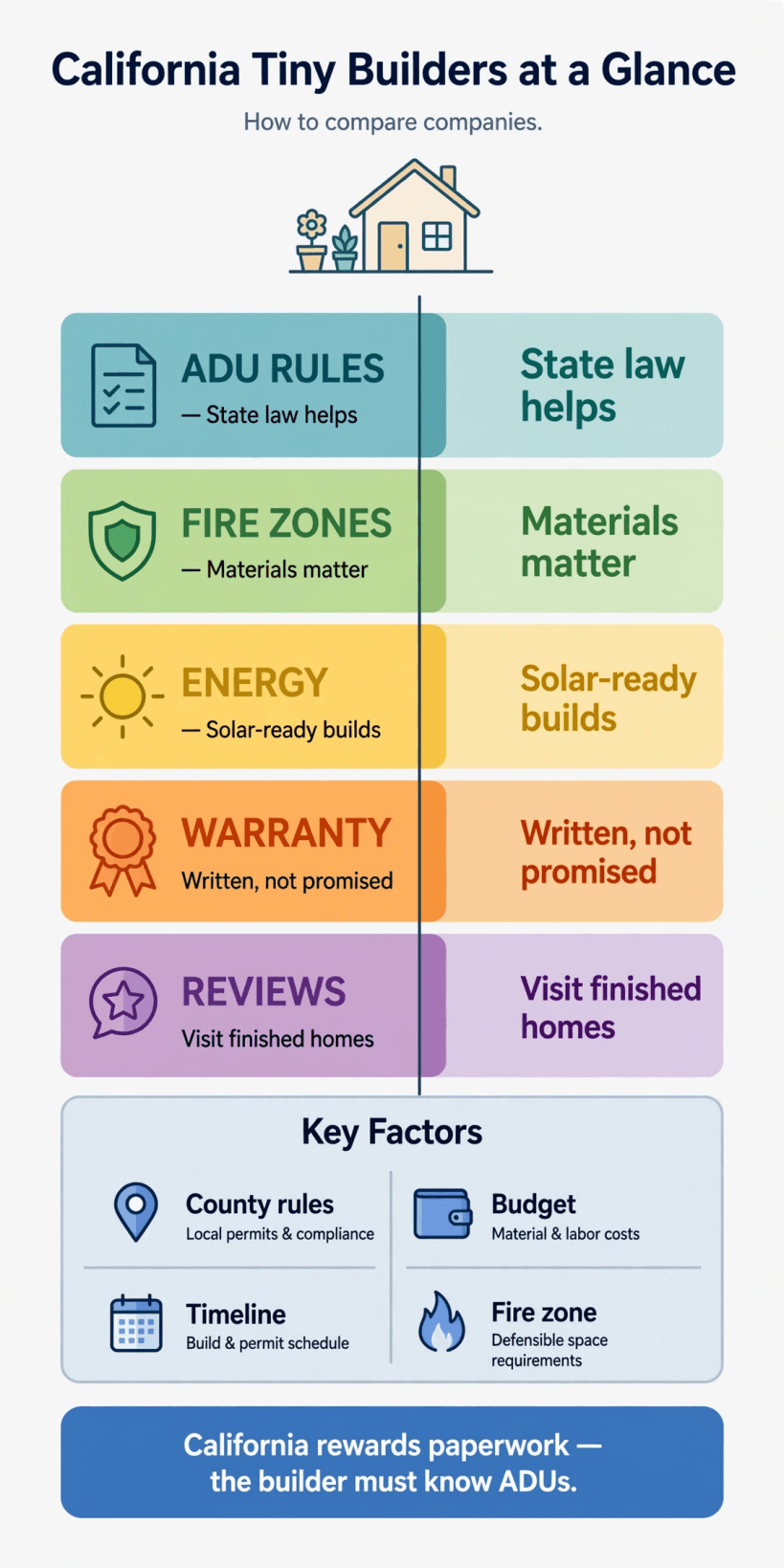
California asks more questions of a tiny house than any other state — and asks them county by county, form by form. The same home can be a welcome backyard dwelling in one place, a permitted headache in the next, and a non-starter in a third. This guide compares the best tiny house builders in California by the method that actually protects a buyer — not by inventing company names, prices or star ratings, but by comparing the builder types you will really meet, the California criteria that separate a careful build from a risky one, and the questions that reveal the difference before any deposit changes hands.
The framing is honest: the twelve names in the title are handled as twelve comparison slots — four builder-type groups, each checked against three California tests of paperwork, fire safety and energy readiness. The groups are ADU specialists, certified factory builders, local custom shops, and kit, plan and shell sellers. Score every real company on your shortlist against the same twelve slots and weak answers stand out quickly. In California, the builder who understands your county’s paperwork is worth more than the builder with the prettiest portfolio, and this comparison is built to show you which one you are talking to.
| Builder type | What they suit | What to verify |
|---|---|---|
| ADU specialist | Backyard homes on owned land, where permits and utility ties decide the project | Completed permitted projects in your county, who handles the paperwork, foundation specification |
| Certified factory builder | Buyers who want inspected, repeatable builds with documents officials recognise | Certification documents, state and local paperwork support, written warranty terms |
| Local custom shop | One-off designs, difficult lots and buyers who want to visit during the build | Finished homes you can inspect, fire-zone experience, who does the work |
| Kit, plan and shell seller | Confident DIY buyers with time, tools and a place to build | What is included, what is not, and who carries design and permit responsibility |
1. ADU Specialists and Backyard Homes in California
Accessory dwelling units are where California tiny living most often becomes legal, permanent and financeable, and ADU specialists are the builders who live in that world daily. Their value is rarely the structure itself — it is knowing setbacks, utility connections, foundation expectations and the local forms in the right order. Ask how many permitted ADUs the builder has completed in your county, not just in California generally, because experience two counties away may transfer poorly. Ask who prepares and submits the paperwork, who attends inspections, and what happens to the price if the county asks for changes.
The trade-off is scope. An ADU specialist thinks in foundations and permanence, so if you want wheels and mobility, you are in the wrong conversation — clarify at the first meeting whether the home will be a dwelling unit, a movable tiny home, or something your county treats as an RV, because those categories open different doors. The background in our guide to zoning laws for tiny houses will help you hear whether a builder’s answers match how officials actually decide. A genuine specialist welcomes the paperwork conversation; it is, after all, most of what you are paying for.
2. Certified Factory Builders and California Paperwork
A certified factory builder works to a documented standard, with third-party inspection at framing, electrical and plumbing stages before the walls close. For California buyers the paperwork has a second audience: county officials, lenders and insurers who all read documents more willingly than promises. Ask which standard the builder works to, who inspects, and what document pack arrives with the home — certificates, specifications, manuals and warranty terms in one organised file. That pack is unglamorous and enormously useful, sometimes years later when an official, buyer or insurer asks questions you cannot answer from memory.
Before comparing quotes, read what RVIA certification means for a tiny house so you can separate certification from certification-style language. Then ask the California follow-ups: does the builder deliver into your county regularly, do they support the local paperwork or merely hand it over, and does certification cover the exact model and options you are ordering? The trade-off with factory builds is flexibility — structural changes may be limited to protect the certification — but in a state where documentation decides what is allowed, a well-documented standard build is often the fastest route from deposit to a home you may legally occupy.
3. Local Custom Shops and County-by-County Rules
A local custom shop builds one home at a time, and its advantage is attention: unusual lots, specific views, a home office that must fit exactly, a client who wants to choose everything. In California that attention must extend to rules that change at the county line. Ask the shop which counties it has delivered into recently and what it learned there — septic or sewer, foundation or wheels, fire district overlays, energy requirements. A shop that works locally will answer with stories and specifics; a shop guessing from a distance will answer with confidence and no detail.
Ask also to walk through a finished home at least a year old, and to speak with its owner about how the builder behaved when the county, the weather or the budget pushed back. Small shops carry waiting lists and their quality depends on who is on the tools, so ask who physically builds and what is subcontracted. When the custom quote looks high, weigh it against the true cost of tiny houses, prefab vs DIY: a price including engineering, paperwork support, delivery and warranty is not comparable to a bare shell price, and in California the paperwork line items are real money.
4. Fire-Zone Materials, Ember Detailing and Defensible Space
For much of California, fire is the design condition everything else hangs from. Ask every builder what the exterior of the home is made of and how the details behave around embers: roof covering and edge detailing, vent screens, eaves, decking junctions and the gap where walls meet the ground are where ember attack actually happens. Non-combustible or ignition-resistant choices in those places matter more than any single headline material, and a builder with fire-zone experience will walk you through the detail list unprompted.
Materials carry weight, cost and maintenance consequences, which is why comparing them honestly matters; our overview of tiny house siding options: cedar, metal and composite sets out the trade-offs plainly. Then ask about the site side of fire safety: how the home’s siting supports defensible space, where propane and batteries live, and what the local fire district expects. A builder who says fire is the homeowner’s problem after delivery is technically describing the contract and morally failing the conversation. In fire country, the right builder treats materials, detailing and siting as one subject — because the fire will.
5. Energy, Solar Readiness and Off-Grid Options in California
California sunshine makes energy a genuine design choice rather than a hobby. Ask each builder what solar-ready actually means in their specification: roof structure and orientation options, conduit runs, panel and battery space, an electrical design that accepts solar without surgery, and efficient base loads — insulation, shading, appliances and a right-sized mini-split — that decide how small the system can be. A home that wastes energy needs a bigger, dearer system to feel off-grid, so efficiency questions come before panel questions, always.
If you plan to generate seriously, our guide to solar panel kits for tiny homes and battery bank sizing shows how the numbers connect. Ask whether the builder offers energy documentation your county or utility may want, and how the design behaves in the smoky, shaded weeks when solar income falls — Californians plan for those honestly. Beware the word package without a specification behind it. Solar readiness, written properly, is a list of physical provisions in the build; anything vaguer is a promise to improvise later, priced at tomorrow’s rates, on a roof somebody else designed.
6. Seismic, Wind and Site Engineering Checks
California builds are checked by the ground as well as the sky. Ask how the home is anchored — to its foundation, or to its trailer and tie-downs if it stays on wheels — and what engineering sits behind the answer. In seismic country the question is not whether a small structure is strong but whether it stays connected: roof to walls, walls to floor, floor to whatever holds it down. Builders with California delivery experience will discuss anchoring, bracing and site slope without prompting, and will tell you plainly when a site needs an engineer’s eye rather than a salesman’s assurance.
Site conditions decide more than brochures admit. Slope, soil, drainage, access width and overhead clearance all belong in the conversation before the contract, supported by photographs and measurements shared in writing. Ask who visits the site, who signs off on deliverability, and who pays if a crane, an escort or a second attempt becomes necessary. A builder who insists on site information early is not being difficult; they are pricing reality instead of optimism. In a state of hills, narrow coastal roads and mountain lanes, the delivery plan is an engineering document, and it deserves to be written like one.
7. Contracts, Payment Stages and Permit Responsibilities in California
The California contract question that matters most is who owns the paperwork. Your agreement should say, in writing, who prepares permit submissions, who pays the fees, who attends inspections, and what happens to the schedule and the price if officials require changes. Beyond that, the healthy structure is familiar: exact specification, total price, stated exclusions, and payments tied to visible milestones — deposit, frame complete, weather-tight, fit-out, delivery — so you are never far ahead of value you can point to. Every change order priced and signed before the work happens, without exception.
Money timing deserves one more check. If you are borrowing, align the builder’s stages with your lender’s draw schedule early, using how to finance a tiny house as background, and confirm in whose name title or registration paperwork will be issued. Read the cancellation and delay clauses while everyone is still friendly. California projects can pause for paperwork reasons nobody caused; a contract that anticipates pauses fairly is a sign of a builder who has actually finished homes in the state, as opposed to one who has merely started them.
8. Written Warranties and Aftercare From California Builders
Ask for a sample warranty before you pay a deposit and read it like an insurer would. What is covered — structure, roof and weatherproofing, plumbing and electrical systems — for how long, through what claim process, and performed by whom? Appliances usually carry their own manufacturers’ terms passed through the builder, and site work such as foundations and utility connections may sit with different parties entirely; in an ADU project, knowing exactly where the builder’s responsibility ends and the site contractor’s begins prevents the circular conversations that follow a leak.
Aftercare is the everyday form of the same promise: manuals for every system, labelled panels and valves, paint and material codes, and a named contact for the first year. Ask also how warranty service works at California distances — a builder in the south serving a home in the far north needs a service arrangement, not a shrug. Honest builders explain their exclusions calmly: transport damage, owner modifications, neglected maintenance and site movement are common, and knowing them in advance is fair to both sides. What you are really buying in this section is a paper trail that survives the sales conversation.
9. Questions to Ask Any California Builder Before a Deposit
Start with the county, because everything else hangs from it. Which counties have you delivered into in the last two years? Who handles my paperwork, and what will you need from me and my land? What fire-zone or energy requirements apply to my site, and how does this design meet them? Then the standard questions, asked everywhere but answered best in writing: how many builds are ahead of mine, when does construction realistically start, who inspects the home and at what stages, and may I visit during the build and receive photographs of hidden work before the walls close?
Close with the handover questions. What does delivery day include — set, levelling, anchoring, systems demonstration — and what does the snagging process look like, with what dates? The inspection discipline in how to inspect a tiny home before buying applies just as well to a new home at handover, and a good builder will welcome the checklist. Ask for two owner references from homes at least a year old, in your part of the state if possible. The pattern of the answers — specific, written, unhurried — is the most reliable review a California builder can earn.
10. Red Flags When Comparing Tiny House Builders in California
Some warnings are the same everywhere: large cash deposits with no contract, contracts in a different name from the business you visited, refusal to share the warranty or let you visit a finished home. California adds its own dialect of warning. A builder who guarantees permit approval is guaranteeing something no builder controls. One who has never heard of your county’s requirements, or who dismisses fire-zone questions in a fire district, is telling you the paperwork and the risk will be yours alone.
Watch the paperwork habits. Quotes with no line for permits, engineering or delivery; solar-ready and fire-safe used as adjectives with no specification behind them; timelines that assume officials will behave unusually quickly. Every one of these predicts the same project: surprises billed to you, discovered late. Distance and California’s regulatory variety magnify weak paperwork more than in any other state in this series, because the fix for a paperwork problem is measured in months, not weekends. Slow down, ask the county questions first, and let the quality of the written answers do the ranking that star ratings cannot.
Final Considerations
California does not have one tiny house market; it has dozens of county markets sharing a flag. The right builder is the one whose type matches your route — an ADU specialist for a permitted backyard home, a certified factory builder for documented consistency, a local custom shop for a difficult lot and a particular design, a kit or shell route for hands-on buyers who cost their own labour honestly. Score the twelve comparison slots, put permits, fire detailing and warranty terms in writing, and verify the county story before the deposit. Do that, and the builder you choose has passed the test California itself will set: not whether the home photographs well, but whether it may legally, safely and insurably exist where you intend to live in it.


0 Comments