

Boho style and tiny houses look like a dangerous combination. Boho loves more – more texture, more pattern, more plants, more finds from more markets – and a tiny house has nowhere to put any of it. Yet the pairing works beautifully when you keep the boho spirit and drop the boho volume. Warm earthy colour, natural woven texture, soft layered textiles and a few treasures with stories: that is boho tiny house interior design at its best, and none of it requires a single extra square foot. It requires editing, which is a different and cheaper skill.
The secret is layering in depth rather than in quantity. One rug with a woven throw and two cushions in different weaves gives you the whole boho feeling in a corner that still has room to walk through. Closed storage does the invisible work, swallowing the everyday clutter so the texture on show can be the chosen kind. The summary table compares the main ingredients, and the ten sections that follow show how to dose each one – texture, colour, plants, textiles and baskets – so a small home feels rich and relaxed instead of like a storage unit with cushions.
Boho Tiny House Interior Design: Texture, Colour and Storage at a Glance
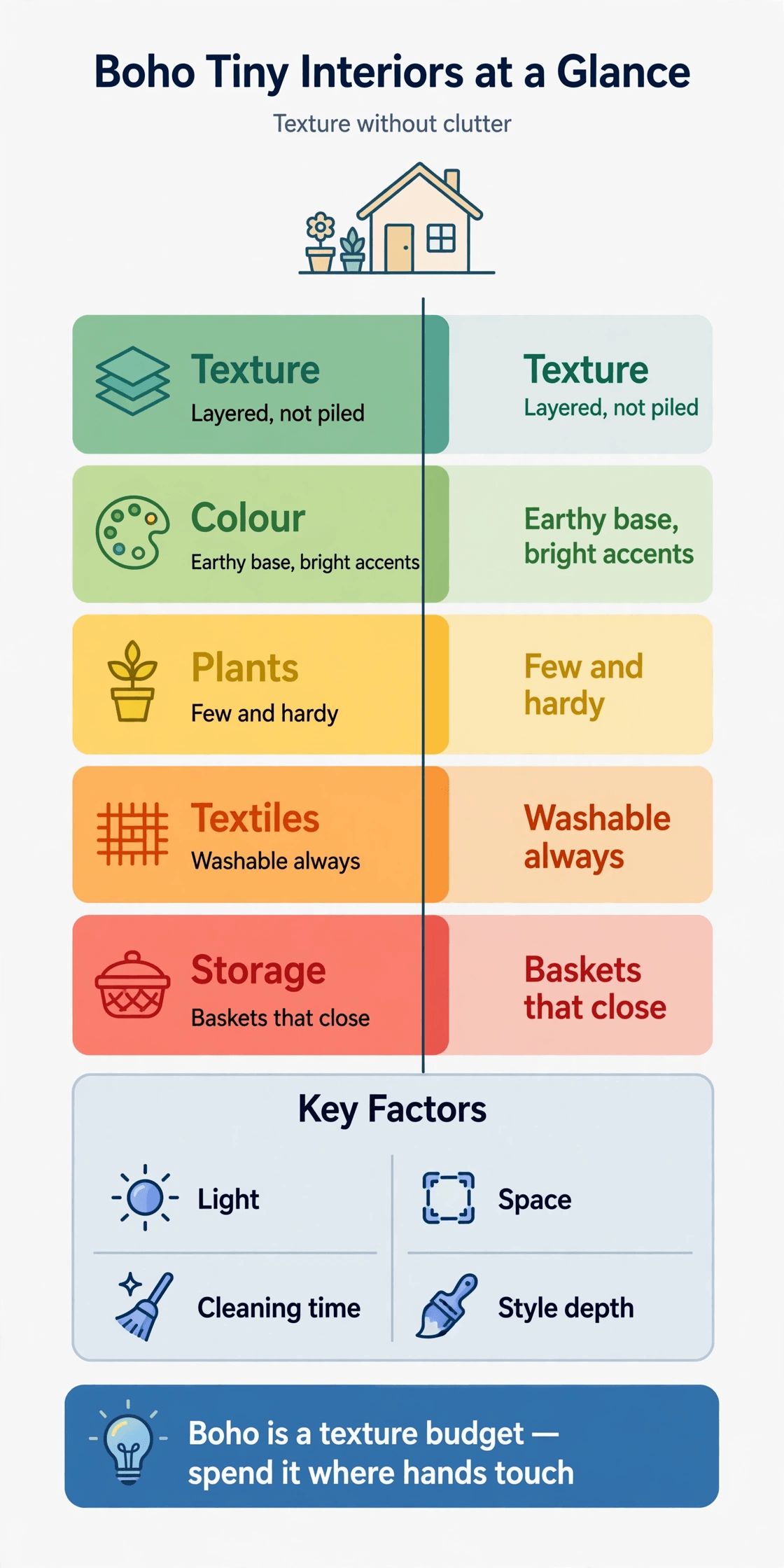
Five ingredients create almost all of the boho effect in a tiny home. Used together with restraint they feel generous; used without it they become the clutter this style is famous for, so each comes with its limit as well as its charm.
| Ingredient | Best For | Watch Out For |
|---|---|---|
| Layered texture | Warmth and richness without adding furniture | Too many competing weaves in one small view |
| Earthy palette with bright accents | A grounded base that tolerates colourful finds | Accents multiply fast; ration them per room |
| A few hardy plants | Life, softness and cleaner-feeling air in corners | Plants need light and water, not just a pretty pot |
| Washable textiles | Boho softness that survives real tiny living | Dry-clean-only fabrics will quietly be ruined or avoided |
| Closed basket storage | Hiding daily clutter inside the style itself | Baskets without lids or labels become clutter with a lid |
1. Layer Texture in Three Depths, Not Thirty Objects
Texture is the boho engine, and it works in layers. Think of three depths: the big soft layer of rugs, curtains and upholstery; the middle layer of throws, cushions and woven seat covers; and the small layer of baskets, tassels, fringe and a single wall hanging. A tiny room layered at all three depths feels complete with surprisingly few objects, because the eye reads variety of surface as richness. Skip a depth and the room feels thin; double every depth and it feels like a textile shop after an earthquake.
Choose natural fibres for the layers you touch – wool, cotton, linen, jute, rattan and cane all sit comfortably together in earthy tones, which is why boho layers harmonise so easily in the timber settings shown in compact cabin floor plans in timber frame. Keep the biggest layer the plainest: a simple rug and curtains in a warm neutral will carry patterned cushions that would fight a patterned rug. When in doubt, remove one layer, live a day, and notice how rarely you miss it.
2. Build an Earthy Base, Then Add Bright Accents Sparingly
Boho colour starts from the ground up: terracotta, clay, sand, warm brown, olive and cream form a base that feels sun-baked and calm. That earthy foundation is what allows the famous boho accents – a jewel-bright cushion, a painted pot, a vivid woven stripe – to sing instead of shout. In a tiny house you see the whole palette at once, so the ratio matters even more than usual: let the earthy tones own the walls, floor and big textiles, and keep brights to a small, deliberate share of what the eye takes in.
Ration accents by area rather than by enthusiasm. One bright moment per view is enough – the cushion cluster on the sofa, the painted stool by the door, the colourful throw at the foot of the bed. If everything is an accent, nothing is. Test new finds against the base before they move in: hold the object against your wall and rug, and if it argues with both, it belongs to a different house. The discipline sounds strict, but it is what keeps a collected, travelled feel from sliding into a jumble sale.
3. Hang It Up: Woven Wall Pieces Instead of More Furniture
Walls are the tiny boho home’s free gallery. A woven wall hanging, a flat basket cluster or a length of textured fabric brings the style’s signature softness and pattern without using a centimetre of floor or a single surface. Hang one generous piece where the light rakes across it and its texture casts tiny shadows, rather than scattering five small ones. Macrame, woven panels and flat-weave textiles all weigh very little, which matters in a small structure, and they soften the echo that hard little rooms often have.

Fix wall pieces properly for the wall you actually have. Lightweight hangings suit most tiny house walls, but check what sits behind the finish before driving anything into it; our guide to lightweight interior wall finishes for tiny houses explains how finishes and structure differ, and why a finish alone should not be trusted with weight. In a home that travels, add a way to take hangings down or secure them flat before moving day, because a swinging woven panel will sand its own wall on a long road.
4. Choose a Few Hardy Plants and Give Them the Light
Plants are boho’s living texture, but a tiny house is a strict landlord: it offers a windowsill, a shelf corner and perhaps a hook by the light, and it expects rent in the form of not dying. Choose a few hardy, forgiving plants that tolerate an occasional missed watering and the light you genuinely have, rather than a collection of delicate specimens auditioning for a greenhouse. One trailing plant softening a high shelf and one upright plant in the best-lit corner will do more for the room than eight struggling pots in the gloom.
Place plants where their needs and your sightlines overlap. A plant where you sit each morning gets noticed, watered and enjoyed; a plant behind the sofa gets forgotten and then replaced, which is clutter economics at its worst. Keep pots in the same earthy family as the room – terracotta, woven sleeves, plain clay – so the greenery reads as part of the palette. And cap the collection honestly: when a new plant arrives, an old one should be rehomed, because windowsills, like wardrobes, do not grow.
5. Pick Washable Textiles You Can Actually Live With
Boho textiles work hard in a tiny home. The throw is a blanket, a picnic rug, a sofa protector and a guest wrap; the cushions are backrests, floor seats and bed props. Anything that cannot go through a normal wash will soon look tired or be quietly exiled, and either way the style loses its softness. Choose cotton, washable wool blends and sturdy weaves with removable covers, and check the label before the colour seduces you. Natural and washable is the whole specification; delicate and dry-clean-only is a hobby, not a furnishing.
Layer textiles by season as well as by looks. The layered approach praised in tiny house plans for cold climates – warmth you can add and remove – suits boho perfectly: a heavier woven throw and an extra rug layer for winter, stripped back to linen and cotton when the weather turns. Store the off-season layer in one basket, not three, and wash everything before it goes away. Textiles that rotate cleanly twice a year stay treasures; textiles that pile up in a corner become the clutter the whole style is trying to avoid.
6. Hide the Everyday Clutter in Closed Basket Storage
Here is the boho tiny house’s real secret: the baskets are not decoration, they are the storage system, and they work because they have lids. Chargers, remotes, paperwork, craft projects, dog leads, the tangle of modern life – all of it disappears into woven baskets that look like part of the style while behaving like cupboards. Open baskets show their contents and read as clutter with better PR. Closed baskets read as texture. Give each basket one job and one home: the basket by the sofa holds living-room things, the basket by the door holds leaving-the-house things.
Size baskets to their contents and their shelf, not the other way round, and label them in a way you find charming rather than administrative – a tag, a knot of coloured yarn, a position you never change. Shared homes especially need this clarity, and the household systems in tiny house layouts for couples make the same point about every kind of storage: a thing put away differently by each person is a thing that is always lost. When a basket overflows, the answer is editing its contents, not buying a bigger basket.
7. Mix Old and New Without Recreating a Junk Shop
Boho charm comes from pieces with a past: a worn rug, a carved stool, a bowl that has travelled. Tiny houses, though, punish collecting, because every found treasure displaces something else and competes for the same few views. The rule that keeps the mix magical is proportion: let most of the room be simple, plain and new-ish – the sofa, the curtains, the basic storage – and let a small number of characterful pieces provide the stories. Three genuine finds in a calm room read as soulful; thirteen read as stock.
Test every candidate find with two questions before it crosses the threshold. Does it have a job or a place, in this room, today? And is it at least as good as whatever it will push out? Sentiment is a valid job – the small rug from a grandmother’s house earns its floor – but it must still fit the palette and the space. Photograph your rooms occasionally; a picture shows crowding your eyes have learned to ignore, and a boho room that photographs calmly almost always feels calm to live in.
8. Keep Floors and Walkways Bare Enough to Breathe
For all its layers, boho depends on visible floor. A rug defines a sitting area, but the boards around it should stay empty: no procession of baskets, plant stands and pouffes migrating across the route from door to kitchen. In a tiny house the walkway is sacred, because it is used fifty times a day, and every object parked on it is tripped over, kicked or resented in rotation. Put the texture on the seats, walls and shelves, and let feet have the floor.

This is where boho meets the practical wisdom in single-story tiny house plans with no lofts: clear, level routes make a home kinder at every age and in every hurry. A pouffe is welcome if it has a home against the wall and returns there; a floor cushion is a pleasure if it stacks into one basket. Judge the room at its busiest – bags down, dog underfoot, someone carrying washing through – and move whatever fails that test up, in, or out.
9. Light It Warm, in Pools Rather Than a Glare
Boho light is low, warm and local: a shaded lamp by the reading chair, a lantern-style light over the table, a string of soft points along a shelf edge if that pleases you. Pools of light suit layered texture, because raking, gentle light shows off weave and grain, while one bright ceiling light flattens every surface and turns earthy tones grey. In a tiny house the effect is multiplied, since all your lighting lives within a few metres of your eyes; warm bulbs and real shades are not decoration here, they are comfort.
Treat flame with the respect a small timber home demands. If you love candles, use them in stable holders, in sight, and never near the curtains and throws this style layers everywhere – or choose the good modern flameless versions and keep the romance without the risk. Keep one clear, brighter light for tasks and cleaning, on its own switch, because a home lit only for mood becomes annoying by daylight chores. Evening glow is the reward; it should not be the only setting the house owns.
10. Edit Weekly: The One-In, One-Out Habit That Saves Boho
Every style drifts, but boho drifts towards more. A shell from the beach, a cushion from the market, a plant from a friend – each arrives alone and seems harmless, and together they are how a serene room becomes a storeroom in under a year. The counter-habit is simple and weekly: one in, one out. A new find earns its place by displacing something lesser, which keeps the collection improving instead of expanding. A five-minute Friday reset – baskets checked, surfaces cleared back to their chosen objects – stops the drift before it needs a purge.
Editing is kinder than it sounds, because boho objects are meant to be loved, used and eventually passed on, not warehoused. Keep a small donation bag in one basket and let it leave when it fills. Photograph each room once a season and compare; the camera will show you the cushion that multiplied and the shelf that filled. The goal is not minimalism wearing a woven hat – it is a room that still shows you its beautiful things clearly, because nothing unchosen is standing in front of them.
Final Considerations
Build the boho in the order this guide used: texture in three depths on an earthy base, bright accents rationed, walls doing decorative work, a few hardy plants, washable everything, and lidded baskets quietly storing the evidence of daily life. Larger households borrowing from 3-bedroom tiny house designs will find the same order holds – the discipline simply has to be shared by more people, with a basket and a place agreed for everyone.
Most of all, remember what the style is for. Boho in a tiny house is not about owning the most interesting objects; it is about a room that feels warm, personal and relaxed the moment you step in, and still lets you find the scissors. Keep the layers chosen, the floor clear and the baskets closed, and the texture will do the rest – richness without clutter, character without chaos, in the smallest of homes.


0 Comments