
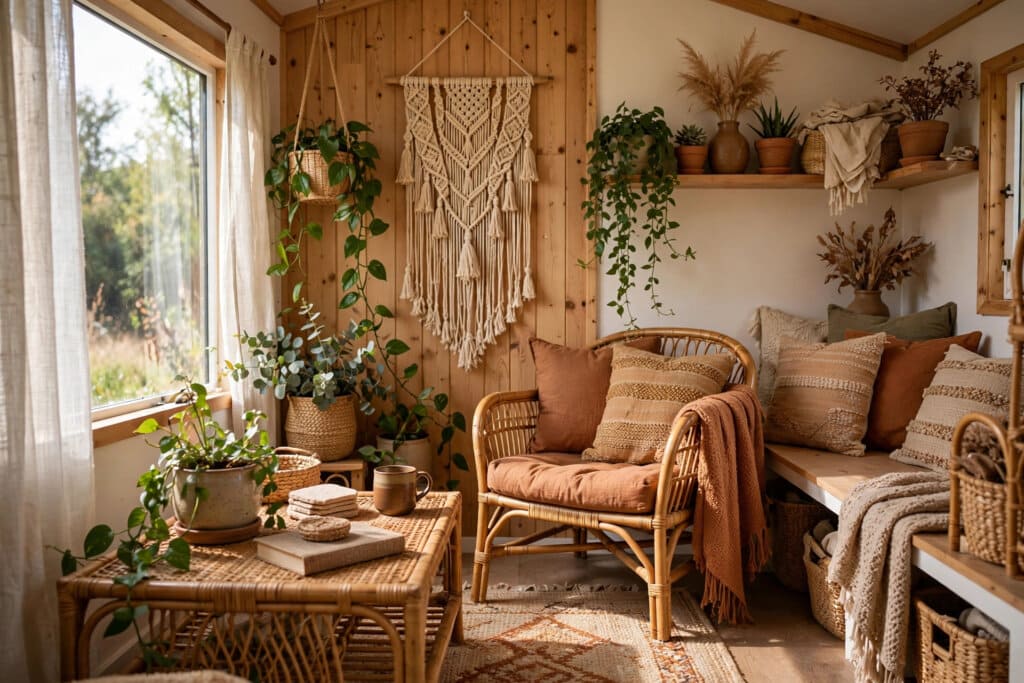
Bohemian style in a small home is a balancing act between abundance and air. The look loves layers, pattern, plants and collected things, and a tiny room loves none of those in excess. Done carelessly, the result is a hot, dusty jumble where every surface argues. Done with discipline, it becomes the warmest kind of small space: earthy, personal and calm underneath the decoration. The most successful boho tiny house interiors share one rule: the layers are limited on purpose, so each textile, plant and pattern is chosen rather than accumulated.
This roundup gathers twenty of those disciplined ideas, grouped so the style builds in a safe order: an earthy palette with jewel accents first, then limited layering, mixed patterns with a shared thread, natural textiles, low loungey furniture, trailing hardy plants, a softened kitchen, a restful sleeping corner, warm low light, and storage that hides the clutter the style tends to attract. A weekly edit closes the list, because in a small bohemian room the editing is not housekeeping. It is the design tool that keeps everything else working.
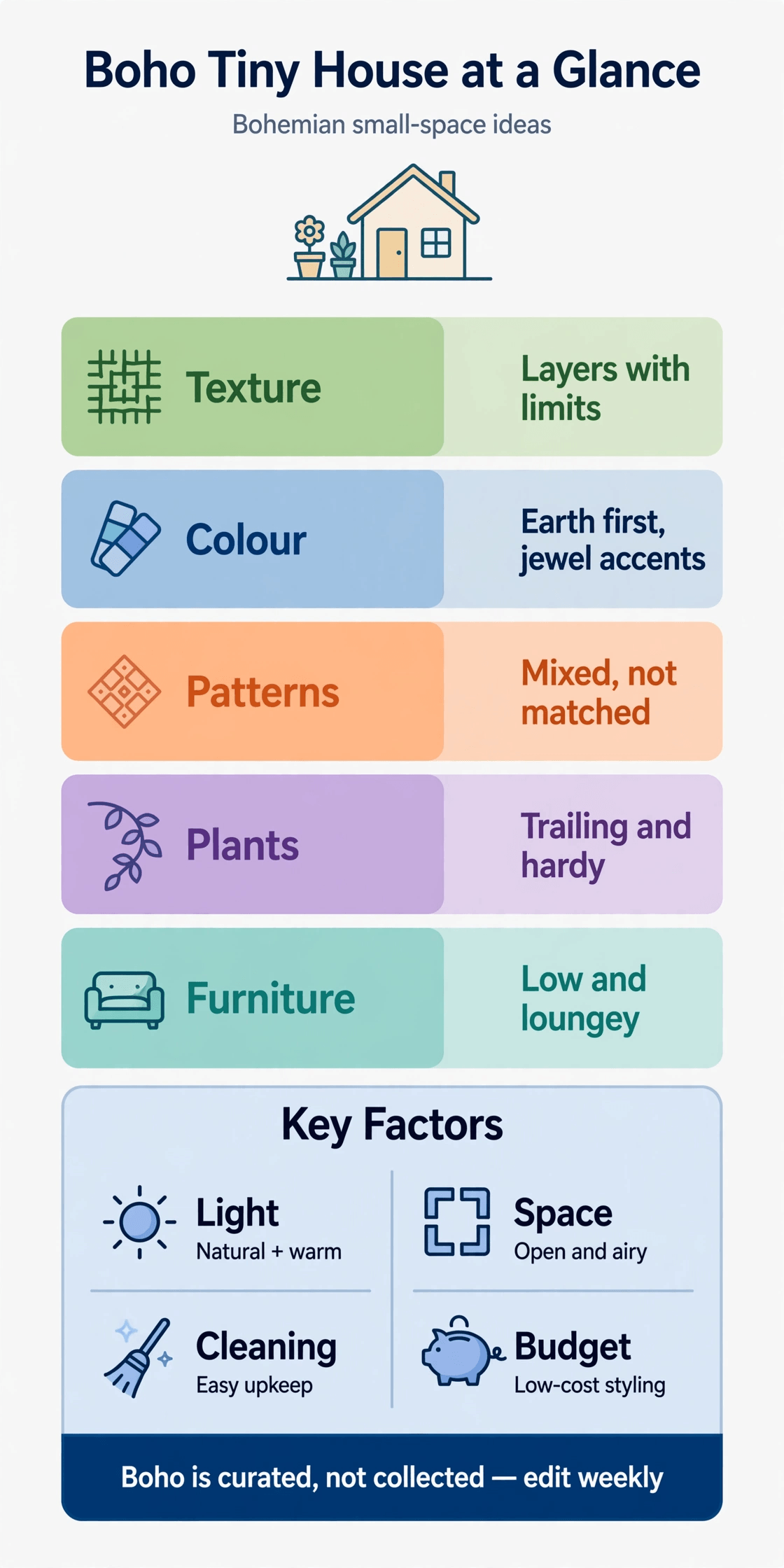
Boho Tiny House at a Glance
The summary table below maps the twenty ideas by theme, so you can start with the layer your room needs most. Every idea is then unpacked in its section, with the trade-offs stated honestly.
| Theme | Ideas | What It Solves |
|---|---|---|
| Earth palette, jewel accents | 1 to 2 | A warm, grounded base that lets a few rich colours glow without noise |
| Layering with limits | 3 to 4 | Depth from textiles in three layers, never from piles of objects |
| Mixed patterns, one thread | 5 to 6 | Pattern energy held together by scale changes and a shared colour |
| Natural textiles and texture | 7 to 8 | Warmth you can feel, added on soft surfaces instead of hard clutter |
| Low, loungey furniture | 9 to 10 | Relaxed seating that keeps sightlines open and rooms feeling taller |
| Trailing, hardy plants | 11 to 12 | Green softness overhead, from plants that forgive small-home life |
| A softened small kitchen | 13 to 14 | Open shelves and textiles that feel collected, not crowded |
| Sleep and privacy | 15 to 16 | A curtained, layered bed corner that still breathes |
| Warm, low light | 17 to 18 | Evening glow at sitting height, safely and without heat |
| Storage that hides clutter | 19 | Lidded baskets and hooks that swallow the small stuff out of sight |
| The weekly edit | 20 | A short routine that stops collected style becoming collected mess |
1. An Earth Palette With Jewel Accents
Every calm bohemian room starts with restraint in the big areas. Walls, floor and the largest furniture stay in the earth family, and the drama is rationed to pieces you can hold in two hands. Get the base right and the colourful things you already own will look curated instead of chaotic.
1. The earth base palette builds the room on warm neutrals: clay, sand, cream, terracotta, olive and natural wood tones across walls, rugs and big upholstery. These colours forgive each other, so collected pieces from different years and places settle together. Keep the base roughly consistent in warmth; a cool grey sofa will fight an earthy room no matter how beautiful the cushions on it are, and in a tiny space there is nowhere for that argument to hide.
2. Jewel accents in small doses bring in the saturated notes the style is loved for: deep teal, amber, garnet, sapphire, in cushions, a throw, glassware or one painted stool. Dose is everything. An accent repeated three times reads as a decision; spread across fifteen objects it reads as noise. When a room feels restless, remove jewel tones from the biggest items first and let them survive only where the eye lands for a moment, not where it rests.
2. Layering With Hard Limits
Layering is the soul of the style and the danger of it in a small footprint. The fix is not fewer layers but a ceiling on them, agreed before you start, so depth comes from a few deliberate strata rather than from everything you own arriving at once.
3. The three-layer rule gives every surface a maximum: a base layer (the rug, the bedcover, the sofa itself), a middle layer (one throw or runner), and a top layer (two or three cushions or one folded textile). When something new joins, something at the same layer leaves. The rule sounds strict and feels liberating, because the room keeps its depth while the washing, dusting and visual load stay at a level a small home can actually carry.
4. Layers in textiles, not objects directs the layering instinct toward soft, flat things (throws, rugs, curtains, table runners) and away from small hard objects, which multiply on shelves and are what actually make bohemian rooms feel cluttered. A flat weave adds pattern and warmth while taking almost no volume and folding away in seconds. If a surface looks busy, count its hard objects first; in most small rooms that count, not the textiles, is the problem.
3. Mixed Patterns, One Shared Thread
Pattern mixing is where bohemian rooms sing or shout. The difference is not taste but structure: patterns need different scales and one colour that appears in all of them, like a chorus returning to the same note.
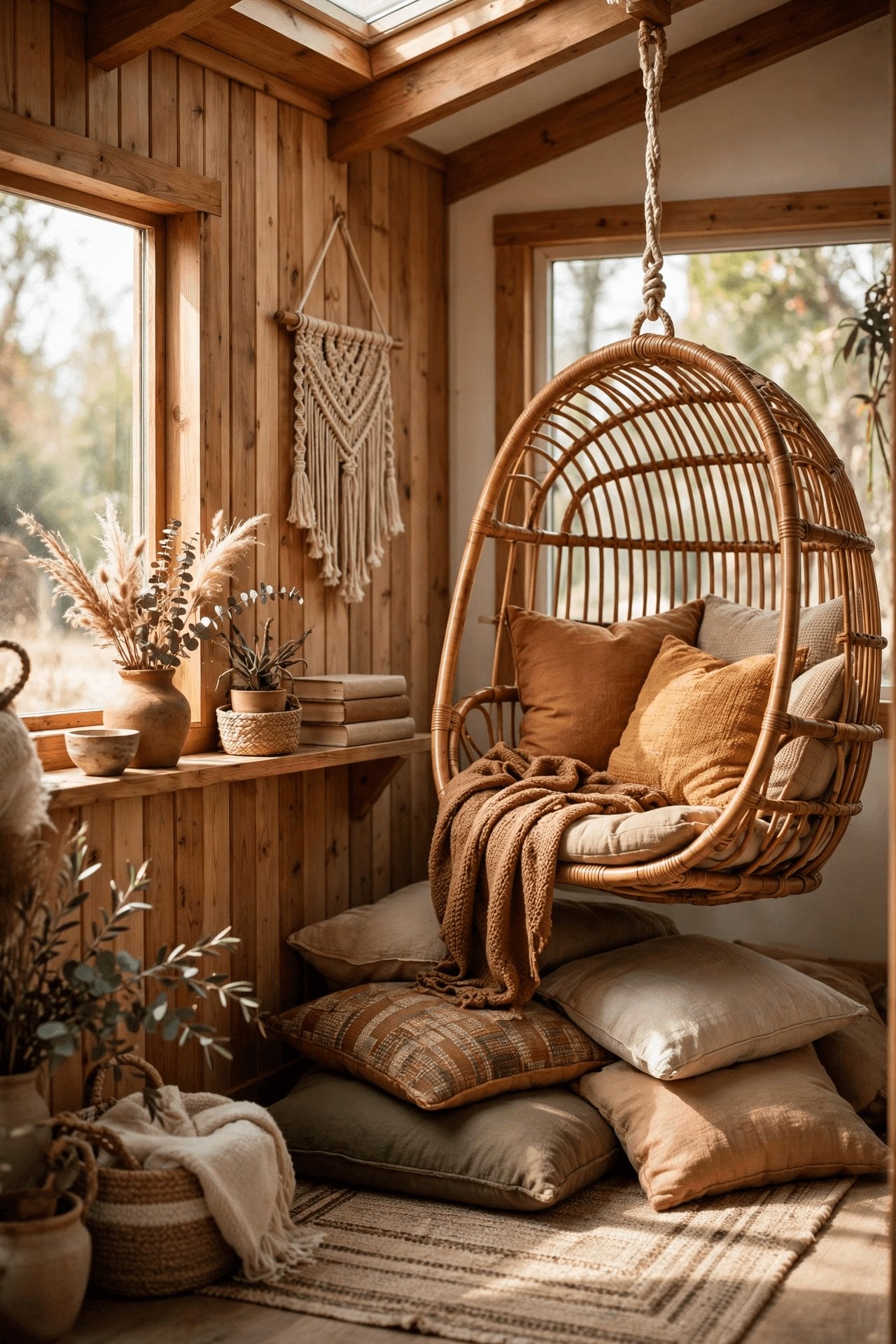
5. The pattern scale mix combines one large-scale pattern (a bold rug or bedcover), one medium pattern (cushions or curtains) and one small pattern (a napkin set, a cushion trim), never two of the same scale side by side. Same-scale neighbours compete and shimmer unpleasantly in a small room. Stand at the doorway and squint: if the patterns blur into a hierarchy, the mix works; if they vibrate against each other, swap one scale, not the whole scheme.
6. The shared colour thread picks one colour, often one of the jewel accents, and makes sure it appears in every patterned piece in the room, even as a minor stripe or motif. The thread is what lets a kilim-style rug, a floral cushion and a striped throw belong together. It also disciplines buying: a patterned thing without the thread colour in it is a lovely object for someone else’s home, and saying so at the shop saves the weekly edit later.
4. Natural Textiles and Honest Texture
Where pattern is rationed, texture can be generous, because texture warms a room without raising its visual volume. Favour fibres that age softly and can be washed, shaken or aired, since small homes cycle their textiles hard. Walls can join in too, and the ideas in lightweight interior wall finishes for tiny houses pair well with woven hangings kept light and few.
7. The natural fibre mix combines cotton, linen, wool and jute across the room’s soft surfaces, each doing what it does best: linen for curtains that move, wool for the throw that actually warms, cotton for washable covers, jute underfoot where shoes land. Synthetic shine is the enemy of the look; even one glossy throw can make its neighbours look cheap. Buy fewer, better textiles and let them be the room’s luxury, because in this style they genuinely are the furniture’s finish.
8. One woven wall moment allows a single textile hanging, woven piece or basket wall, properly fixed and no larger than a modest picture, to carry the room’s texture story at eye level. One moment, not a gallery: in a small room, wall texture multiplies fast and collects dust faster. Choose the wall you face from the main seat, keep the piece washable or shakeable outdoors, and let every other wall stay plain earth so the woven piece reads as art rather than insulation.
5. Low, Loungey Furniture
Bohemian seating sits low, and in a small home that is a structural gift: low furniture lengthens sightlines, leaves windows unblocked and makes ceilings feel higher. It also suits the under-loft and sloped-ceiling corners of tiny houses, where standard chair backs simply collide.
9. Low-profile main seating chooses a sofa, daybed or lounge chairs with low backs and exposed legs, so air and light pass over and under them. Test before you buy by sitting on the floor where it will stand and checking what it blocks: a window, a heat source, a walkway. The trade-off is accessibility. Very low seats are unkind to stiff knees, so keep one honest, higher chair in the room and let it be the beautiful exception rather than secretly resenting the whole scheme.
10. Floor cushions and a low table add the flexible layer: two or three firm floor cushions and a low central table that together host guests, games and tea, then stack or slide away so the floor returns. Keep cushions in the earth palette with the jewel thread appearing once, store them in one lidded basket or on the sofa itself, and accept their limit: they are overflow seating for people who enjoy them, not a stealth replacement for chairs at every meal.
6. Trailing, Hardy Plants
Plants are the style’s living layer, and the small-space rule is altitude: greenery should trail from high places, softening the room’s top edge while taking no floor and no surface. Choose hardiness over drama every time, because a dying plant is the saddest object in any home.
11. Trailing plants overhead sit on high shelves, cabinet tops and hanging planters, trailing down walls where nothing else needs to be. Keep trailers out of walkway headroom and away from the stove and heater, and group them where you already go with water. The same greenery suits the threshold too: the thinking behind tiny house plans with screened porches treats plants as the soft wall between indoors and out, which a good trailing shelf imitates inside.
12. Hardy species and a watering rhythm means choosing plants known for forgiving irregular light and occasional missed waterings, in pots with drainage you can manage without flooding the shelf. Small sealed homes swing in humidity, so the guidance in tiny house ventilation, HRV and mould prevention matters here: air the room, avoid soggy soil standing for weeks, and tie watering to one weekly moment, ideally the same visit as the closing edit in idea twenty, so care becomes rhythm rather than rescue.
7. A Softened Small Kitchen
The kitchen is where bohemian style usually dies of practicality, killed by jars and utensils colonising two metres of counter. The answer is to let textiles and a few displayed ceramics carry the style, while the working kit stays ruthlessly compact and mostly hidden.
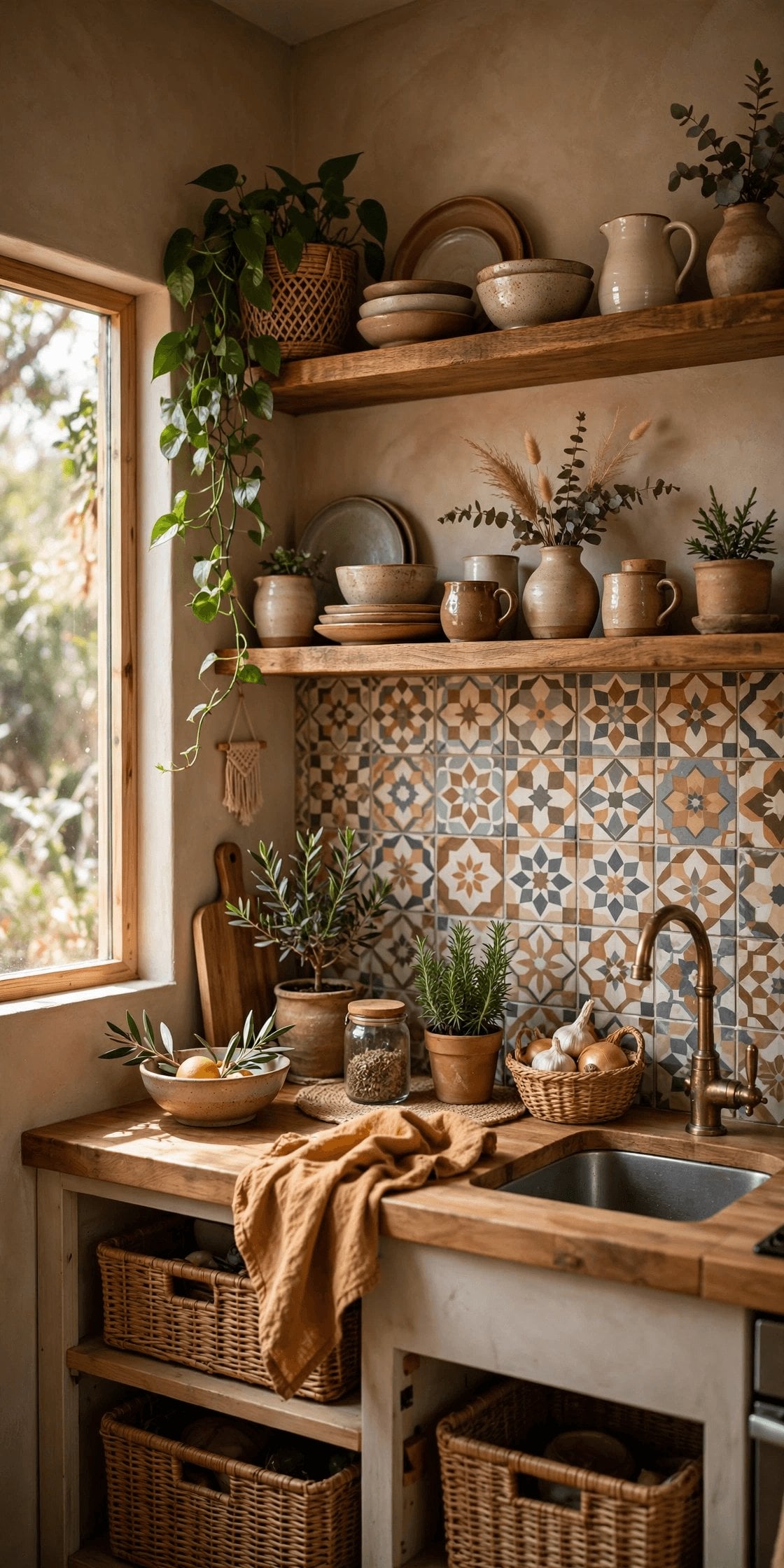
13. Open shelves, styled sparse display one family of ceramics or glasses on open shelving, in the earth palette with one jewel note, with real gaps between groups. Sparse is the operative word: a shelf at half capacity looks collected, a shelf at full capacity looks like storage that lost its door. Put daily pieces low, occasional pieces high, and let the shelf hold nothing that does not earn its display by being used weekly or loved honestly.
14. Textiles doing the decorating brings the style in through tea towels, a small runner and one curtain in the shared patterns, all washable and all replaceable in minutes. It also keeps appliances honest: choose them the way the best compact kitchen appliances for tiny houses suggests, sized for the household and the counter, then let a folded textile, not a row of gadgets, be what the eye meets. When the kitchen feels flat, change a textile before you buy an object.
8. Sleep, Privacy and the Bed Corner
In a one-room layout the bed is always on stage, and bohemian layering can either make it a beautiful alcove or a rumpled mountain range visible from the front door. Aim for alcove: a soft boundary, restrained layers, and colours that quiet down at the sleeping end of the home.
15. The curtain instead of a canopy hangs one washable curtain or textile panel to screen the bed, borrowing the romance of a canopy without its dust load or its closed-in heat. Hang it from the ceiling or a high rail so it draws fully clear by day. In lofts the same panel softens the opening; if you are shaping that space, how to frame a tiny house loft explains the structure your rail and fixings will meet.
16. Bed layers, restrained applies the three-layer rule at its strictest: a base cover in the earth palette, one throw with the jewel thread, and sleeping pillows only, with decorative cushions limited to two that store on the bed by day or not at all. Warmth should come from the right weight of bedding for the home’s insulation, a point how to insulate a tiny house makes well, rather than from piling on decorative layers you strip off every night into a corner heap.
9. Warm, Low Evening Light
Bohemian rooms are evening rooms, and their light should pool at the height where people sit, not glare from the ceiling. Low, warm, shaded light flatters textiles, hides a multitude of small-space sins and tells the body the day is ending.
17. Lamps at sitting height places two or three small lamps or shaded pendants low around the seating and bed, all with warm, consistent bulbs, instead of one bright overhead. Consistent warmth matters more than the fixtures themselves: mixed bulb colours shred the earthy palette at night, turning clay tones grey and jewel tones muddy. Put switches where a seated hand reaches, or the loveliest lamp plan will be defeated nightly by the ceiling light’s convenience.
18. Safe glow without flame recreates candlelight with warm LED candles or a small shaded lantern in the homes where real flame is a poor guest, which is most homes on wheels and many with trailing plants, curtains and low ceilings. Group the glow in one or two places rather than scattering it. The honest trade-off: LED glow lacks scent and flicker of the real thing, and gains the ability to be left on while you fall asleep, which in a fabric-rich small room is the right bargain.
10. Storage That Hides the Clutter
Collected style generates small things: beads, bottles, books, stones, postcards, the finds of every trip. The room stays serene only if those things have a closed, beautiful place to be collected into, within reach of where they land.
19. Lidded baskets and honest hooks station a few lidded baskets in the earth palette at the room’s natural landing points (by the door, beside the sofa, under the low table) and a short row of hooks for bags, hats and the day’s outer layer. Lids are non-negotiable: an open basket of clutter is a display of clutter. Size the baskets to the categories that truly arrive, review them at the weekly edit, and when a basket stays full for a month, its contents are not storage; they are a decision you have been postponing, and the kind move is to make it.
Final Considerations
A bohemian small space is a garden, not a photograph: it grows by nature, and it stays beautiful only with regular, gentle pruning. The last idea is therefore the one the whole style depends on in a tiny footprint, and skipping it is how lovely rooms slowly become storage units with cushions.
20. The weekly edit spends ten minutes once a week walking the room with fresh eyes and one bag: something returns to its home, something leaves the house, and one surface is restored to its three-layer limit. Work the same route as tiny house living and decluttering for a move to 200 square feet in miniature, small and often rather than rare and heroic. Photograph the room monthly if it helps you see drift. The edit is not a failure of the style; it is the style, practised by people whose rooms stay calm.
Build the look in the order given, palette before patterns and storage before shopping, and judge every addition by whether the room still breathes at the end of the day. A small bohemian home will never be minimal, and it should not try to be. It can be layered, storied and serene at once, provided the layers are limited, the thread holds, and the weekly edit keeps its quiet appointment.


0 Comments