

Cottage style in a small home is a promise of softness: cream light, faded florals, furniture with rounded edges and a kitchen that smells of herbs. In a tiny footprint that promise needs protecting, because the same pieces that make a cottage cosy, the baskets, jars, quilts and collected china, can crowd a small room into a bric-a-brac shop within a single season. A successful cottagecore tiny house keeps the softness and disciplines the collecting, so every rustic touch is either useful, washable or honestly loved.
This roundup gathers eighteen of those disciplined ideas, grouped in a gentle order: a cream, sage and rose palette first, then florals and gingham under control, an open-shelf enamel kitchen, vintage soft-edged furniture, washable textiles, baskets and jars doing real storage work, herbs and flowers at small scale, a reading corner, a cosy bed and warm light. It closes with the dusting rule, the small habit that decides whether a rustic tiny interior stays charming or becomes a chore you resent.
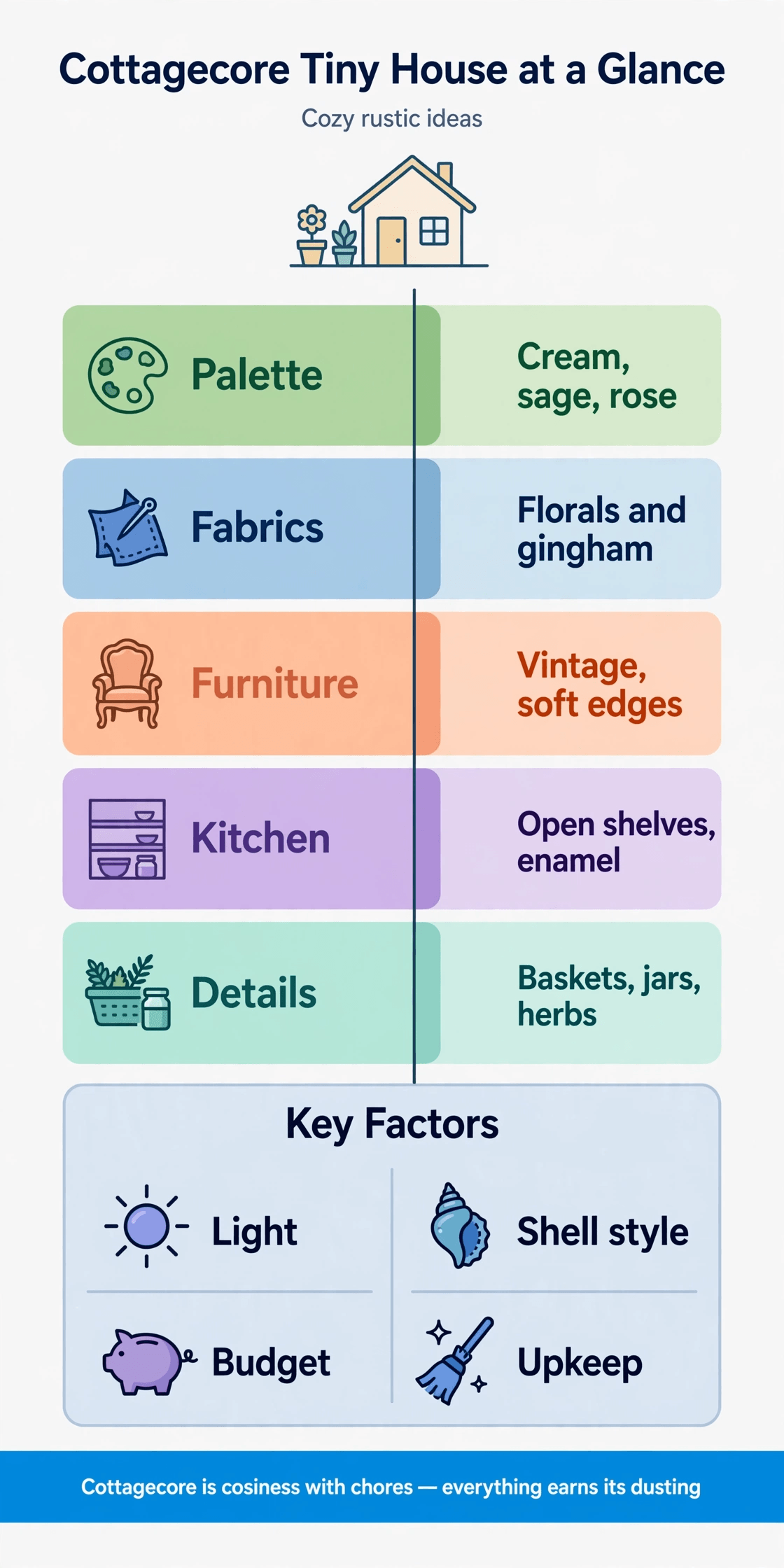
Cottagecore Tiny House at a Glance
The summary table below maps the eighteen ideas by theme, so you can start with the layer your room needs most. Every idea is then unpacked in its section, with the trade-offs stated honestly.
| Theme | Ideas | What It Solves |
|---|---|---|
| Cream, sage and rose palette | 1 to 2 | A soft, light base that makes small rooms feel calm and larger |
| Florals and gingham, rationed | 3 to 4 | Pattern romance with one hero print and a hardworking check |
| Open-shelf enamel kitchen | 5 to 6 | A pretty, practical kitchen where display and storage are the same thing |
| Vintage, soft-edged furniture | 7 to 8 | Rounded, storied pieces sized and placed for small rooms |
| Washable textiles and curtains | 9 to 10 | Quilts and soft layers that survive real life and the laundry |
| Baskets and jars at work | 11 to 12 | Beautiful containers that store by category, not by hiding mess |
| Herbs and flowers, small scale | 13 to 14 | Living green and blooms in doses a tiny room can support |
| The reading corner | 15 | One soft-edged chair, real light and a basket, arranged for daily use |
| A cosy bed | 16 | Warmth from the right layers in the coldest, smallest corner |
| Warm light | 17 | Gentle lamps and daylight habits that flatter the palette |
| The dusting rule | 18 | A display limit that keeps rustic charm cleanable |
1. A Cream, Sage and Rose Palette
Colour does the heavy lifting in this style, and the tiny-home version is lighter than the farmhouse photographs suggest. Cream carries the big areas, sage cools it, and dusty rose appears the way jam appears at breakfast: in small, delicious amounts. The guidance in lightweight interior wall finishes for tiny houses helps keep those pale walls practical as well as pretty.
1. Cream as the working base covers walls, ceiling and the largest furniture in warm cream and soft white, reflecting the limited daylight a small home gets and giving every vintage piece a quiet backdrop. Keep creams warm rather than blue-grey, and test them at dusk: a cream that turns dingy in evening light will make the whole room feel tired. One finish for walls and woodwork keeps the small space unified, and touch-ups stay invisible, which matters in a home where furniture touches walls daily.
2. Sage and rose as the accents divide the supporting roles: sage for the calm pieces (a painted cabinet, curtains, the kitchen’s lower fronts) and dusty rose for the soft ones (cushions, a quilt’s reverse, a teapot’s cosy). Neither accent should exceed roughly a third of what the eye sees, and they should meet often, because sage and rose together are the palette’s signature. When in doubt, remove rose first; it is the sweeter colour and the one that tips a room from cosy to sugary.
2. Florals and Gingham, Rationed
Pattern is the style’s joy and its most common failure in small rooms, where three competing florals at close range become visual noise. The cottagecore answer is rationing with affection: one floral gets to be the hero, and the hardest-working check in decorating history does the supporting work.
3. One floral hero chooses a single floral (curtains, the main quilt or one chair) at a scale the room can hold, with the palette colours already in it, and lets every other pattern in the room defer to it. Choose the hero in the fabric you can wash, because florals show the dust of small-home life honestly. If you fall for a second floral, it may enter only as a small, removable piece, a cushion cover or a tablecloth, and only if it shares the hero’s colours and a smaller scale.
4. Gingham as the neutral check works everywhere the hero cannot: napkins, shelf edging, a cushion, the curtain in the kitchen window. Treat gingham the way other styles treat a plain linen, as a background pattern that calms florals and stripes alike. Keep to one gingham colour, sage or rose, in one scale, repeated. Its charm is its humility; the moment gingham starts competing, in three colours at two scales, the room stops looking gathered over time and starts looking themed.
3. The Open-Shelf Enamel Kitchen
The cottage kitchen earns its beauty by working in the open. Open shelves, enamelware and jars are not decoration added to a kitchen; they are the kitchen, visible and within reach. This only stays charming if the working kit is compact and edited, sized the way the best compact kitchen appliances for tiny houses recommends, and if everything displayed is used weekly.
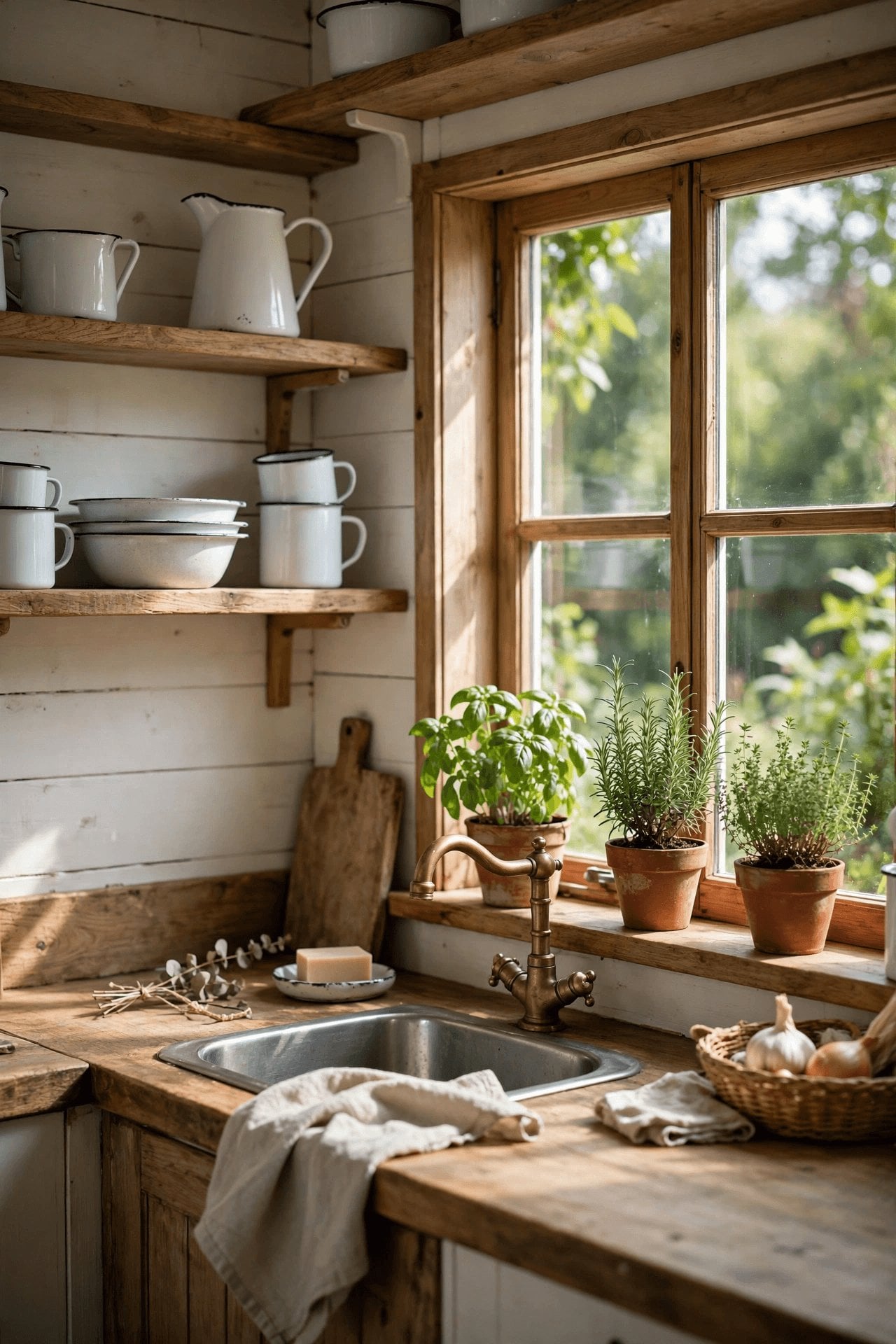
5. Open shelves with enamelware replace upper cupboards with one or two wooden shelves holding enamel and stoneware in cream and sage: light to the eye, honest to use, and quick to wipe. Fix shelves into sound structure and keep the heaviest pieces low and central. The trade-off is dust and grease, which is why this idea pairs with the dusting rule at the end: a shelf you can clear, wash and reload in minutes is a pleasure; a shelf of forty precious pieces is a weekly punishment.
6. A working counter, not a display keeps the small counter for the day’s real tools, a bread board, a utensil crock, a bowl for fruit, with herbs and jars standing behind them in one tidy row. Everything else lives on the shelves or in the baskets from section six. If the counter fills, the rule is subtraction, not rearrangement: one thing returns to storage for each thing that arrives. A clear stretch of counter, even a short one, is what makes a tiny kitchen feel generous while you cook.
4. Vintage Furniture With Soft Edges
Vintage pieces bring the patina this style runs on, and small rooms reward the older virtues: narrower proportions, rounded corners, legs that let the floor show. Shop with a tape measure and a stricter eye than the antiques deserve, because sentiment is not a storage strategy.
7. Soft-edged seating first chooses the main chair or small sofa with rounded arms, a skirted or slipcovered base and a washable cover in cream or a faded floral that is not the hero print. Slipcovers are the vintage lover’s honesty mechanism: they admit that small homes eat, spill and host muddy dogs, and that the furniture must survive it gracefully. Keep one spare cover if you can; a chair that can be re-dressed in ten minutes never becomes the room’s problem.
8. Rounded wood, honest patina favours small tables, cabinets and stools with softened edges and worn finishes, placed where their silhouettes calm the room’s hard lines. Limit dark wood: one or two mid-tone pieces warm a cream room, while a full suite swallows the light. Pass on pieces that need restoration you will not do, and on anything whose drawers stick or doors sag, because in a tiny home every piece is handled daily and small annoyances become the house’s personality.
5. Washable Textiles and Layered Curtains
Textiles carry the cosiness, so they must carry the washing too. Every soft thing in this style should be machine-washable, shakeable or cheap enough to replace without grief, and curtains should work in two layers the way cottage windows always have.
9. Quilts and throws that work layer the bed and the main chair with one quilt and one throw each, in the palette, chosen for warmth and washability rather than fragility. Rotate a second set seasonally if storage allows one lidded box, no more. The test is Friday night: if a spill would ruin your weekend because a textile cannot be washed, that textile belongs in a house with a spare room. Cosiness that cannot be laundered is just anxiety with fringe.
10. Two-layer window dressings pair a sheer or half-curtain for daytime privacy and softened light with a heavier lined curtain for evening warmth and darkness. In a small home the heavier layer genuinely insulates, and the sheer keeps the room from feeling watched without losing the garden. Keep hems clear of heaters and hob, wash the sheers often since they are the home’s air filter in effect, and let both layers share the palette so the window reads as one calm idea at every hour.
6. Baskets and Jars Doing Real Work
Storage in this style is visible and beautiful, which makes it either charming or a lie. Baskets and jars stay honest when each one owns a category, has a limit, and is light enough to move for cleaning, a respect for load that tiny house weight limits, GVWR and axle ratings teaches for the whole home and that shelving deserves in particular.
11. Baskets by category assigns each basket one job, blankets, craft, kindling, the dog’s things, and stations it where that job happens. Matching or near-matching baskets calm the eye; a dozen unrelated containers read as clutter wearing costumes. Choose lids for anything dusty or pet-adjacent, line baskets that hold textiles, and when a basket overflows weekly, the category gets edited, not a bigger basket bought. The basket is the boundary, and the boundary is the point.
12. Jars and labels in the pantry decants dry goods into clear or enamel-lidded jars so stock is visible at a glance, labelled simply with what and when. In a tiny kitchen this prevents the true cottagecore disaster: three open bags of the same flour breeding in a dark cupboard. Keep the jar family small enough to wash in one sink-load, store spices away from steam, and let one shelf, not every surface, be the jar shelf. Visibility is for use, not for staging a shop window you must dust.
7. Herbs and Flowers at Small Scale
Green life is essential to the look and easy to overdo where every surface already works for a living. Keep plants useful, few and at the edges: herbs you eat, one vase at a time, and nothing trailing across a workspace or a hob.
13. A sill of working herbs grows three or four pots of the herbs you actually cook with on the brightest sill, in matching simple pots with drainage you can manage. Rotate them to the step or a porch in fine weather; the fresh-air logic behind tiny house plans with screened porches applies in miniature, since herbs and people both thrive with a threshold to the outdoors. Water little and often, keep soil off the enamel, and replace a failed herb without ceremony.
14. The one-vase rule allows a single small vase of fresh or dried flowers in the room, changed with the seasons and the garden’s mood, instead of arrangements in every corner competing with the floral fabrics. Fresh stems want clean water and the room wants moving air, and the guidance in tiny house ventilation, HRV and mould prevention is a fair reminder that damp, still corners are where small homes and cut flowers both go wrong. When the vase empties, the room rests bare for a while; the pause is part of the charm.
8. The Reading Corner
Every cottage interior deserves one corner devoted to doing nothing useful beautifully. In a tiny home that corner must be small, real and used daily, or it becomes a stage set stealing the room’s best light.
15. One chair, real light, a basket builds the corner from the soft-edged vintage chair of idea seven, or its sibling, turned toward the best natural light, with a small side surface for a cup, a lamp for the evening and one basket for the current book and knitting or letters. Keep the corner’s textiles in the quieter end of the palette so it rests the eye, and defend its emptiness: it is not overflow seating, not a clothes chair, and not where parcels wait. A corner kept clear is used; a corner used as storage is a corner lost, and with it goes the room’s one promise of leisure.
9. A Cosy Bed in a Small Corner
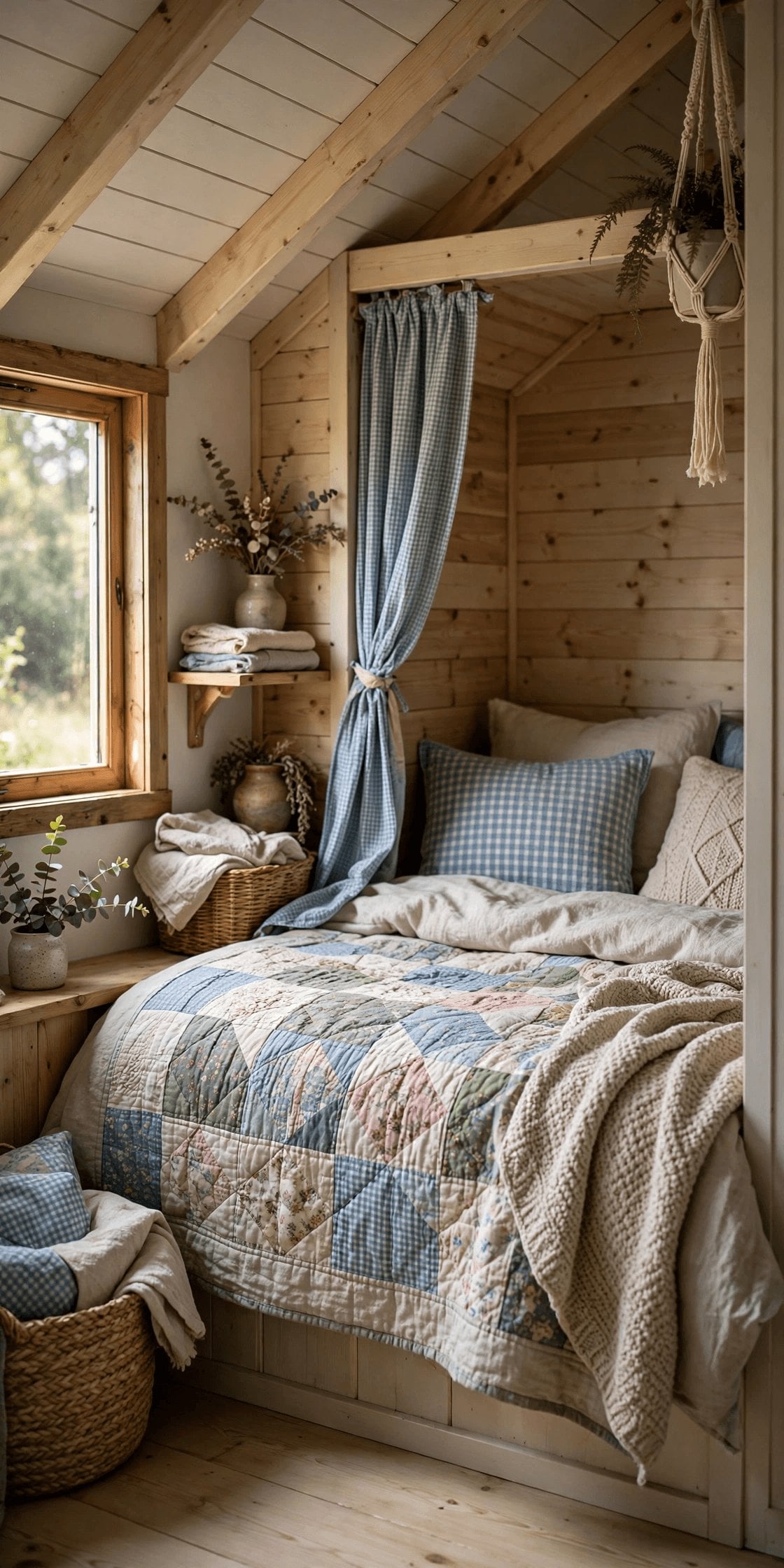
The bed in a cottage-style tiny home usually lives in the coldest, darkest geometry the house has, under eaves or in a loft, and cosiness there is a technical achievement before it is a decorative one.
16. Warmth from the right layers beds the sleeping corner with a washable quilt in the hero’s quieter colours, a wool layer for the cold months and cotton against the skin, sized to the bed so nothing trails to the floor gathering dust. If the bed sits in a loft, how to frame a tiny house loft covers the structure under you, while how to insulate a tiny house explains why the roof slope above you matters as much as the blankets. Add a small rug where feet land and one cushion, no more; the bed should invite sleep, not require an archaeological dig to enter.
10. Warm Light for Pale Rooms
Pale palettes live or die by light: right, they glow like morning; wrong, they look like a clinic. Cottage light is warm, low and a little bit golden, and it is planned rather than inherited from whatever fitting the house came with.
17. Lamps where the life is places small shaded lamps at the reading corner, the bed and the kitchen shelf, all with warm consistent bulbs, so the cream walls take on their evening honey tone and the sage stays green instead of grey. Keep one lamp on a timer if the home stands empty at dusk in winter; a lit window is both welcome and security. Daylight gets the same care: keep sills clear, glass clean, and the sheer curtains of idea ten washed, because in a small pale room, clean glass is a decorating decision all by itself.
Final Considerations
Rustic charm has one honest enemy, and it is not minimalists. It is dust, which settles on open shelves, basket rims, jar lids and dried flowers with complete impartiality. The whole style in a small space stands or falls on whether its display load was chosen with cleaning in mind, which is why the last idea governs all the others.
18. The dusting rule sets the limit before you buy or display anything: if you cannot lift it, wash it or wipe it in the time a kettle boils, it does not go on open display in this house. Shelves hold what passes the test, precious fragile things live behind glass or with family who have the room for them, and a ten-minute weekly dust, worked into the same rhythm as tiny house living and decluttering for a move to 200 square feet, keeps the promise. The rule sounds severe and feels like freedom, because a cottage room you can clean in minutes is a room you can actually relax in.
Build the look gently, palette before patterns and storage before shopping, and let every piece pass two questions: can it be washed, and will it be loved weekly? A cottage-style small home will never be grand, and it should never try. It can be soft, useful and serene at once, provided the florals are rationed, the baskets have jobs, and the dusting rule keeps its quiet veto over them all.


0 Comments