

The boxes are not the hard part — anyone can rent a dumpster. The hard part is your grandmother’s dish set, the bookshelf that says who you are, the quiet grief of admitting the life those objects represented is over. Moving to 200 square feet is a psychological project with a physical component, and this guide works both halves.
Tiny House Living: At a Glance
Moving from 1,500 square feet to 200 is not an organizing challenge; it is an identity challenge. Every object you own carries a story, an aspiration or a guilt, and 200 square feet forces you to decide which stories come with you. That is the honest shape of tiny house living: a deep reduction done slowly and deliberately, category by category, ending in a home where everything left genuinely earns its place. The ten stages below follow the order that works — the math first, then the four-box method, the category sequence, the wardrobe and kitchen edits, the paper and sentimental gauntlets, the selling that funds the move, and finally the first thirty days and the identity shift waiting on the other side. If you are still choosing the house itself, browsing tiny house floor plans with these storage numbers in mind will tell you quickly which layouts can actually hold the life this process leaves you with.
| Stage | What It Decides | Key Number |
|---|---|---|
| 1. The Math of 200 Square Feet | The true size of the cut | 800–1,200 cu ft of storage; you keep 2–5% |
| 2. The Four-Box Method | Keep, rehome, sell or release — everything | Sell only what is worth $50+ |
| 3. Categories, Not Rooms | The sequence that builds decision muscle | 2–4 months for a full household |
| 4. The Wardrobe | A capsule that always works | 30 pieces, one color palette |
| 5. The Kitchen | 40 tools, not 140 | 2 place settings per person, plus 2 guest |
| 6. Papers and Books | The digital transition | One fireproof box; keep 10–20 books |
| 7. The Sentimental Gauntlet | The final boss | One tote for all memorabilia |
| 8. Selling | Funding the transition | $2,000–8,000 realistic total |
| 9. The First 30 Days | Surviving the adjustment | 10-minute daily reset; judge at day 90 |
| 10. The Identity Shift | Life over stuff | The 5% was always the point |
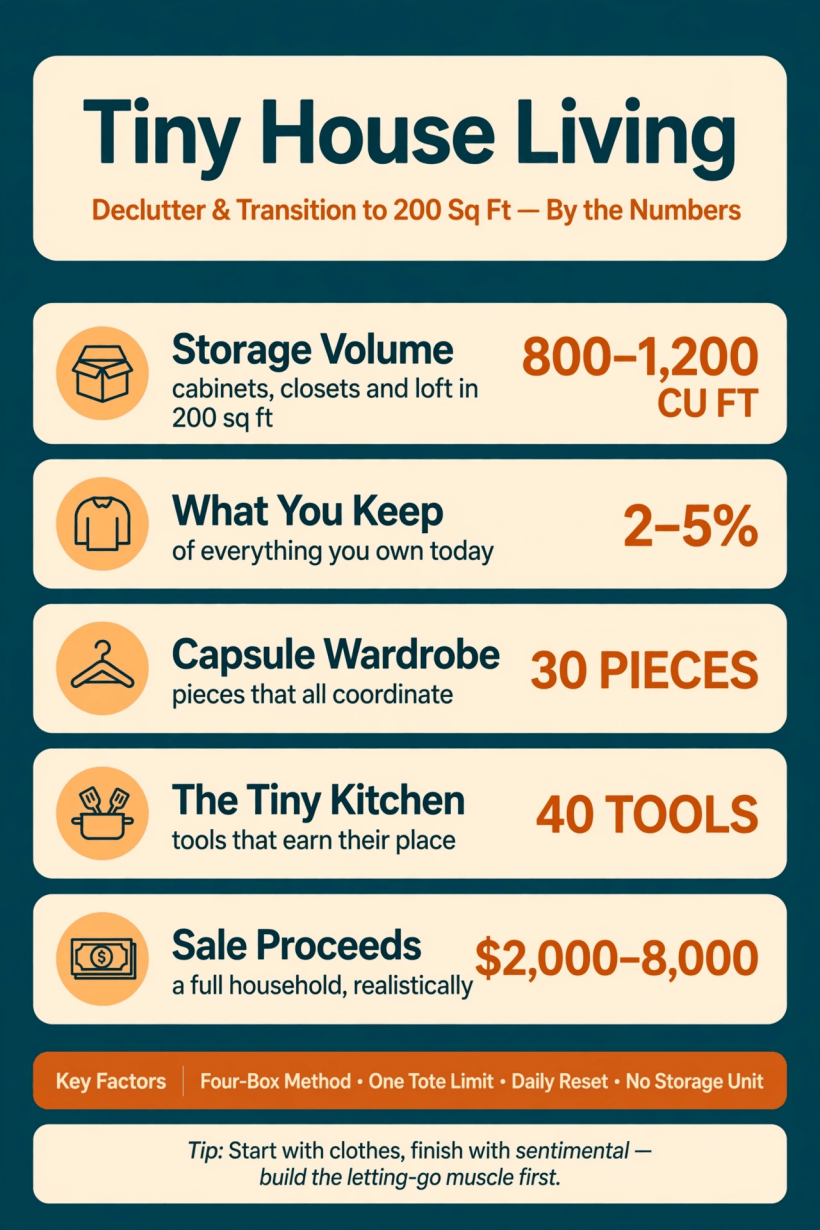
The transition in five numbers: the storage a 200 sq ft house actually holds, the share of your possessions that survives the cut, the capsule wardrobe and the 40-tool kitchen, and what selling the rest can put back in your pocket.
1. The Math of 200 Square Feet
Start with the numbers, because the numbers end the argument. A 200-square-foot tiny house holds roughly 800–1,200 cubic feet of storage once you count the cabinets, closets, under-bed space and loft. The average American home, by contrast, holds 300,000+ items. Set those two figures side by side and the conclusion is unavoidable: you are keeping roughly 2–5% of your possessions. Internalize that early, because everything else in this guide is downstream of it. The transition is not “organizing better,” and it is not a storage puzzle waiting for a cleverer solution. It is a 95%+ reduction, and the sooner that stops sounding like a loss and starts sounding like a specification, the easier every later decision becomes. The math is clarifying precisely because it is unforgiving: it ends the fantasy that clever storage will save everything, and replaces that fantasy with a real question — which 5% of your things actually constitutes your life? Answer that question honestly and the decluttering is already half done, because you are no longer defending objects one at a time. You are curating, against a fixed and known capacity, and curation is a far calmer activity than triage.
2. The Four-Box Method (Scaled for Tiny)
The classic four-box method still works — it just needs tiny-house thresholds. The boxes are Keep, Rehome, Sell and Release. Keep is for what you use weekly or what is truly irreplaceable, and its target is brutal: the whole box has to fit inside the new house’s storage. Rehome is the guilt-free exit — things given to specific people who actually want them, not dumped on relatives as a burden with a bow on it. Sell is for what is worth the listing effort, and the rule of thumb keeps it disciplined: only items worth $50 or more. Release — donate, recycle, trash — will be the fastest-growing box, and it should be; most of a household belongs there. Work room by room, and finish each room completely before starting the next, because partial decluttering spread across six rooms is procrastination with boxes. Above all, apply the tiny-house test to every single “keep”: ask, out loud, “Where does this live in 200 square feet?” If you cannot name the specific cabinet, drawer or hook, it is not a keep — it is a hope, and hopes do not fit in 800 cubic feet. It helps to know what real storage a small house offers; the layouts in our guide to tiny house plans with hidden storage show the cabinets, stair drawers and under-bed voids your Keep box genuinely has to fit into.

3. Categories, Not Rooms: The KonMari Sequence
The four-box pass clears space; the category pass tells the truth. Declutter by category across the whole house — clothes, then books, then papers, then kitchen, then sentimental — rather than room by room, because the category view reveals the true volume of what you own. The rooms hid it from you: gathered in one place, you discover you own 14 spatulas. The order matters as much as the method. Start with the easy categories, clothes and kitchen gadgets, to build decision muscle while the stakes are low, and end with sentimental items — photos, heirlooms — when your letting-go capacity is at its strongest. Expect the full sequence to take most people 2–4 months for a complete household, and treat that timeline as a feature rather than a delay. Rushing produces regret, and regret produces rebuying, which is how a declutter quietly reverses itself in the first year of small-space life. Done at the right pace, each category is a training set for the next: the hand that learns to release a duplicate spatula without flinching is the same hand that will eventually hold a box of letters and make a clear-eyed decision about it.

4. The Wardrobe: 30 Pieces That Work
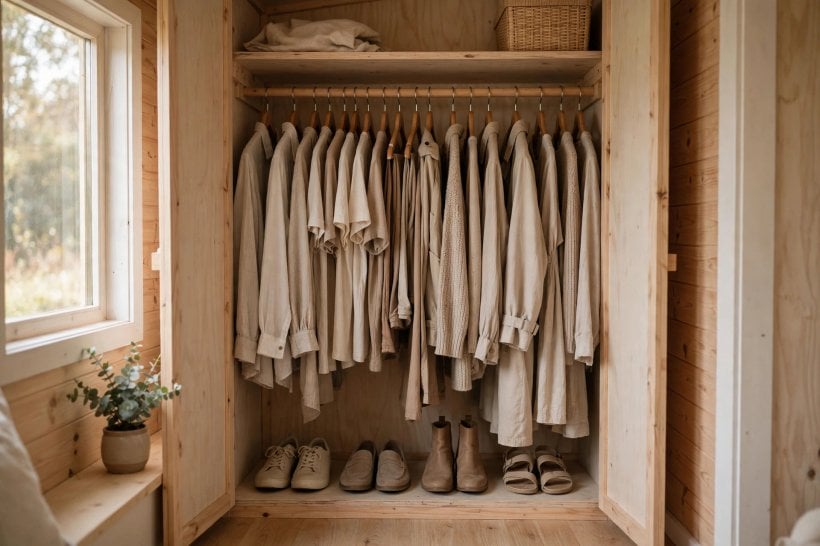
The tiny closet holds 20–40 garments, and the capsule wardrobe is how those garments stop feeling like a ration. Build it deliberately: 7 tops, 4 bottoms, 2 dresses or jumpsuits (or suits), 3 layers in the form of jackets and sweaters, 7 undergarments, and 4 pairs of shoes — daily, outdoor, dress and sport — with seasonal rotation stored elsewhere. The rule that makes the whole capsule function is coordination: every piece must work with every other piece, which means committing to one color palette and letting it make your decisions for you. A garment that only pairs with one other garment is a specialist you cannot afford at this scale. Judged that way, the capsule is not deprivation; it is the end of “nothing to wear.” Every combination works, getting dressed takes a minute, and the rail holds nothing that makes you feel vaguely guilty for never choosing it. The closet itself deserves the same discipline as its contents — the storage layouts in our roundup of tiny house closet design ideas show how a small rail, a few drawers and honest vertical space can hold a 30-piece capsule without a daily fight.
5. The Kitchen: 40 Tools, Not 140
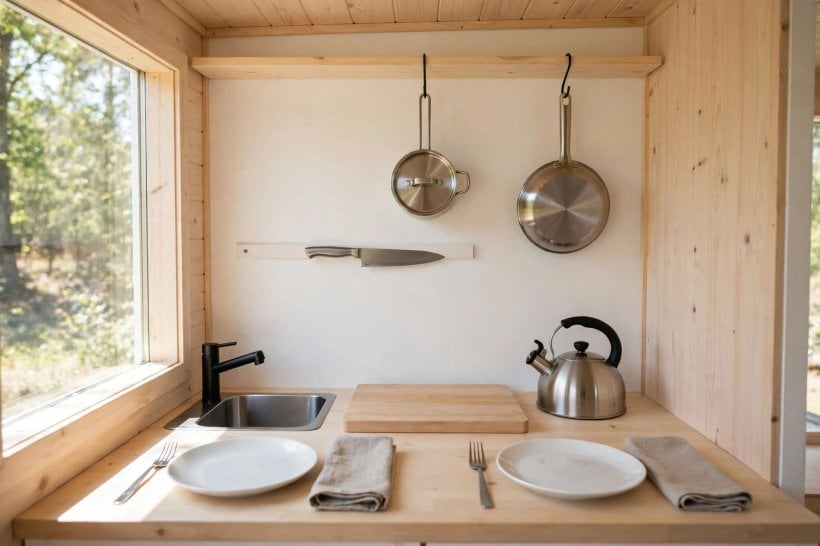
A tiny kitchen fits roughly 40 tools, and the winnowing is easier than it sounds once you accept what the 40 are. Set the tableware first: 2 place settings per person, plus 2 guest settings — enough for real hospitality, not enough to let dishes pile up into a second sink’s worth of procrastination. The keepers among the tools are the ones your actual cooking uses: one good knife and a cutting board, one pot, one pan and one sheet tray, the basic utensils — spatula, tongs, ladle, whisk — measuring basics, and your genuine daily appliances, which for most households means just one: the coffee maker or the kettle. Everything else is auditioning, and most of it fails the audition. The bread maker, the juicer and the fondue set are the appliances of aspirational cooking — equipment bought for a cook you intended to become — and they are the first to go. The kitchen’s honest test is the same one the whole house uses: if you have not used it in a year, the tiny house will not change that. Cooking in a small kitchen with 40 sharp, familiar tools is faster and calmer than cooking in a big one with 140 strangers, because every reach lands on the thing you meant to grab.
6. Papers and Books: The Digital Transition
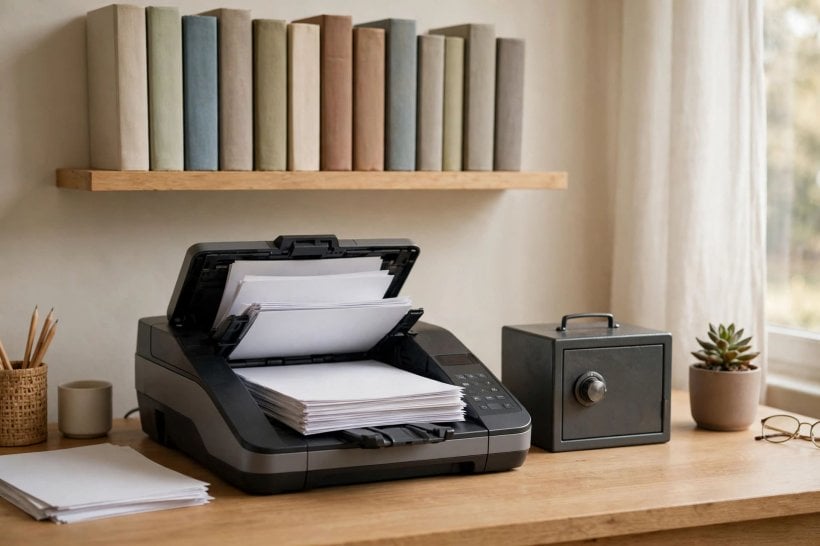
Papers shrink by scanning, not by sorting. Scan the essentials — tax records, titles, medical files — and let a $300 document scanner chew through a filing cabinet in a weekend. Be realistic about the work involved: a filing cabinet is roughly 4 hours of scanning, so schedule it like the project it is rather than a rainy-day task that somehow never happens. What must stay physical goes into one small fireproof box: birth certificates, property deeds, the originals whose paper is the point. Books get a sterner edit. Keep the 10–20 you genuinely reread or reference, and let the rest go to the library — which is, when you think about it, free storage with better lighting, holding your books safely until the day you actually want one again. Sentimental papers need a middle path, because a child’s artwork and a parent’s letters are not “papers” in the filing sense. Photograph everything, keep a curated physical selection — one box — and release the rest with gratitude. The photograph preserves the memory; the box preserves the texture of the few pieces that matter most; and the rest leaves without taking your history with it, because your history was never really stored in a filing cabinet to begin with.
7. The Sentimental Gauntlet
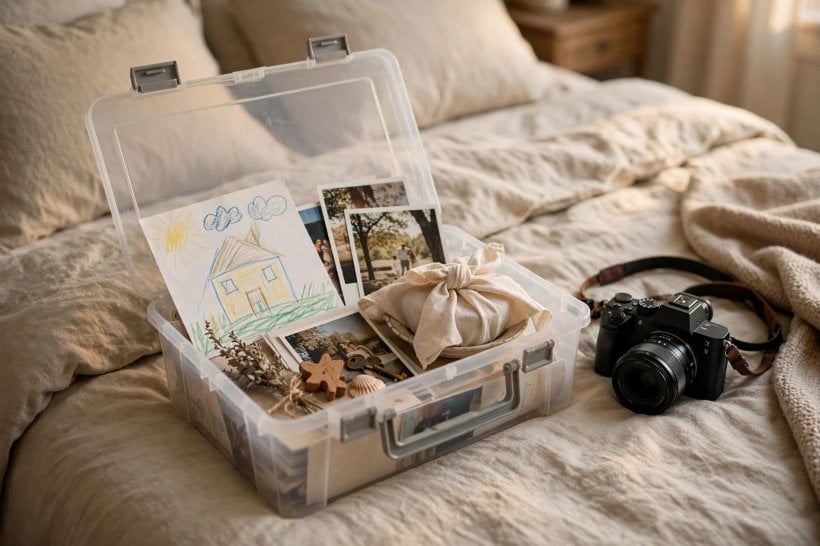
Sentimental items are the final boss, which is why the sequence saves them for last, when your decision muscle is strongest. The framework has three rules. First, keep the best representative, not the collection: one photograph of your grandmother’s kitchen holds the memory; the 40-piece dish set mostly holds cupboard space. Second, keep the story and release the object — photograph the thing, write the memory down, and let the object itself go to someone or somewhere else. The story is the heirloom; the object was only ever its container. Third, set a hard container limit: one tote for all memorabilia. The limit is not cruelty — it is delegation. The tote makes the decisions for you, because once it is full, every new candidate has to be worth displacing something already inside, and very few are. Expect the emotional weather here to be real. Heirlooms with no taker in the family are not heirlooms; they are storage obligations wearing a nicer name. And grief for the life the objects represented is normal — but it is grief to process, not inventory to store. Process it, and the tote that remains will be dense with meaning instead of merely full.
8. Selling: Funding the Transition
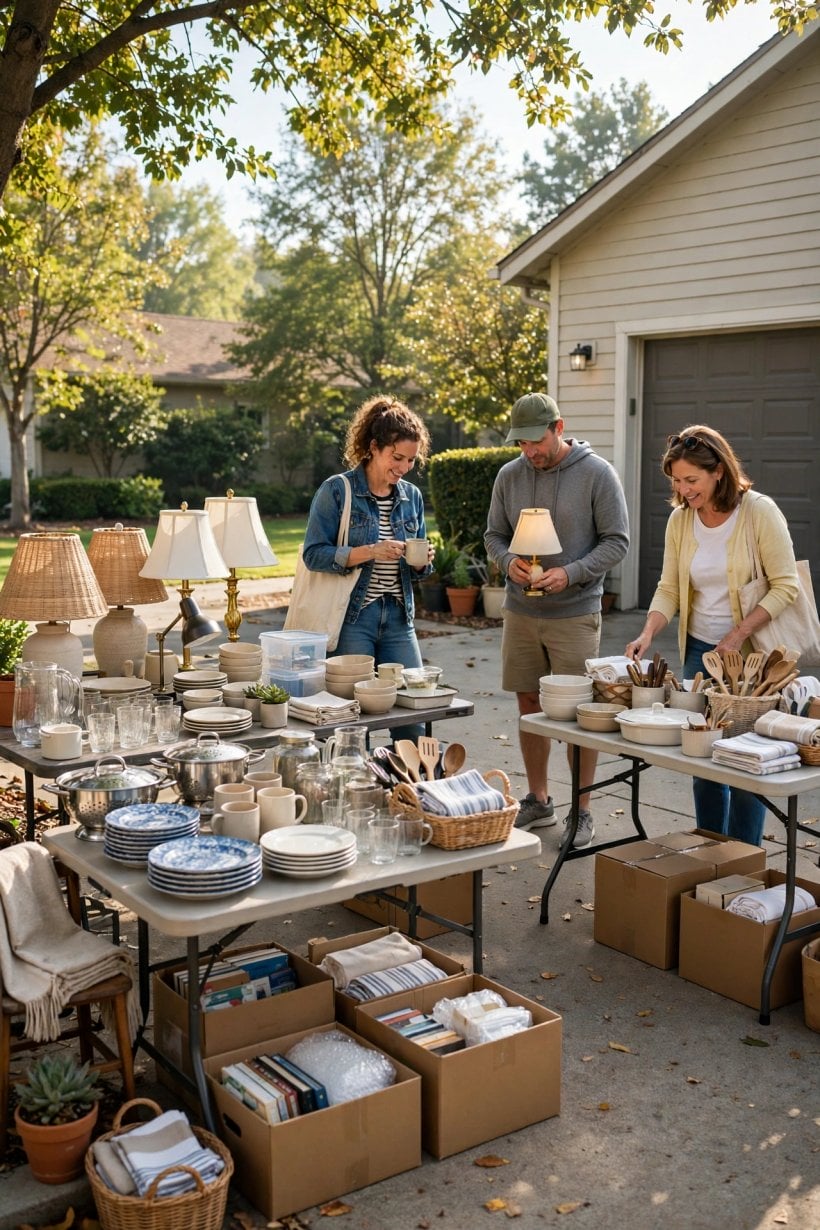
Done well, the declutter pays for the move. Furniture and large items sell best on local marketplaces, so price them at 30–50% of retail for a quick sale and let velocity do the work. Specialty items — instruments, tools, collectibles — reward patience instead, and belong on the niche platforms where the buyers who value them actually gather. The “everything must go” weekend sale then clears the long tail: the hundred small things that were never worth listing individually. Set expectations honestly. A realistic total for a full household is $2,000–8,000 — meaningful money toward the transition, not a windfall, and planning around the realistic figure keeps the budget honest. In the final month, price for velocity above all: every unsold item becomes either a donation or a storage unit, and storage units are where transitions go to die. So the rule is absolute — never rent one “temporarily.” A storage unit converts a decision you were about to finish into a monthly bill for not finishing it, and the temporary ones have a way of outliving the resolve that rented them.
9. The First 30 Days in 200 Square Feet
The transition shock is real, and it runs on a schedule you can set your watch by. Week one feels like camping — novelty carries it. Week two feels like a mistake: where is everything, and why did you do this? Week three is when the systems emerge, because in 200 square feet everything has a place precisely because it must. By week four, it feels like home. You can accelerate the adjustment with three disciplines. Unpack completely on day one, because boxes are psychological anchors to the old life and a half-unpacked house keeps one foot in it. Establish the daily reset — 10 minutes every evening returning everything to its place — and treat it as non-negotiable, because at this scale a day’s drift is visible and a week’s drift is a landslide. And give it 90 days before judging any of it. The furniture you kept has to work as hard as the systems do, which is why so many small-space dwellers lean on the pieces in our collection of convertible furniture tiny house plans — beds that become desks and tables that fold away are systems in furniture form. The same first-month rhythm applies in any small footprint; our notes on how to live in a tiny apartment describe the identical adjustment curve at apartment scale. Almost everyone who lasts the 90 days never looks back.

10. The Identity Shift
The deepest transition is the last one, and it is not about objects at all. You stop being someone with stuff and become someone with a life. The objects were always proxies — for security, for status, for memory, for aspiration — and the tiny house forces direct engagement with the underlying needs instead. You cannot outsource your sense of security to a garage full of spares, or your identity to a bookshelf, when neither exists. Most long-term tiny dwellers report the same surprise on the far side of the process: they do not miss the things. They miss nothing. The 95% reduction reveals that the 5% was always the point — the people, the work, the place, the mornings. What remains deserves to be arranged with care rather than merely stored, and the ideas in our guide to tiny house decorating ideas are aimed at exactly that kept fraction: rooms built around a few loved things instead of many tolerated ones. The decluttering was never really about the objects. It was about making room for the life — and discovering, once the room exists, how much of that life was waiting for space rather than for more things to fill it.
Final Considerations
Decluttering for tiny house living is the most honest inventory you will ever take — of your possessions and of yourself — and it has a natural calendar. Work it backwards from the move: four to six months out, take the easy categories — clothes, kitchen, garage — and build the decision muscle. Two to four months out, take the hard categories — books, papers, hobby gear — and sell the valuable pieces while there is still time for patience to pay. At the two-month mark, face the sentimental items and fill the curated tote. In the final month, run the velocity sale, donate the remainder, and rent no storage under any circumstances. Move week is for one thing only: unpack completely on day one and establish the daily reset. Then, at day 90, evaluate honestly and release the 10% you kept but never touch — everyone keeps a little too much, and the day-90 release is part of the process, not an admission of failure. If you want the broader method in one place before you begin, how to tiny house walks the whole lifestyle from first principles. Do the inventory slowly, do it completely, and trust the process: the life on the other side of the 95% reduction is not smaller. It is concentrated, intentional and — by every account of those who have done it — larger than the one you left.



2 Comments