
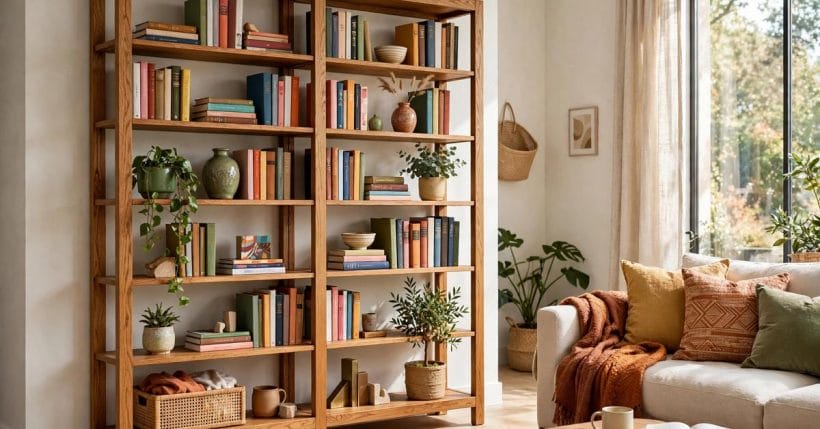
A bookcase is never just a place for books. It is a room’s memory, its display, and often its largest piece of furniture. The best bookcases do three jobs at once: they hold a collection safely, they show the objects that matter to the household, and they shape the wall they stand against. This survey walks through the forms that do those jobs well, from tall freestanding shelves to low profiles and corner solutions, with the practical notes that separate a good bookcase from a beautiful problem.
No maker is named and no price or performance claim is made here, because bookcases vary enormously by construction and material. What follows is a tour of forms and ideas, with attention to light, weight, proportion, and the small decisions — shelf spacing, depth, backing, and anchoring — that decide whether a bookcase serves a household for decades or sags within a year.
1. Tall Freestanding Bookcases
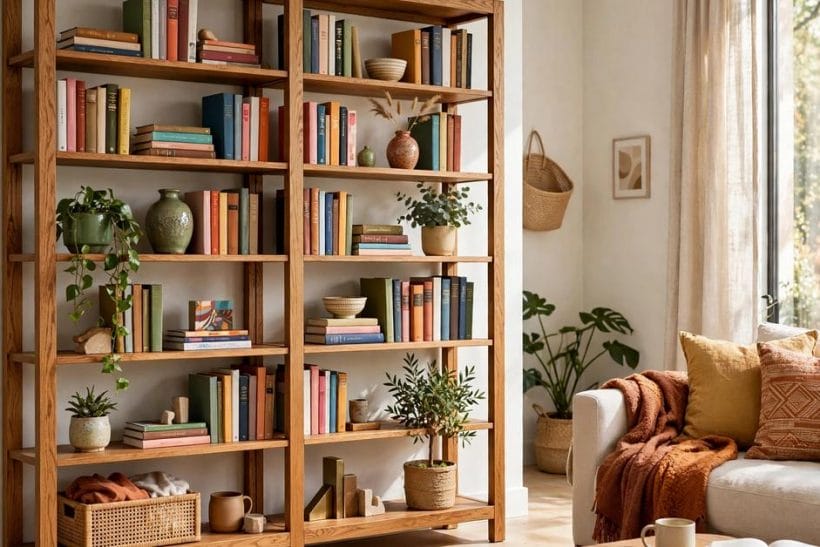
The tall freestanding bookcase is the classic form: a full-height case that stands against a wall and holds a serious collection. Its strength is capacity. A tall case uses vertical space that would otherwise go empty, and it gives a room a sense of height and order. Its weakness is weight and presence: a fully loaded tall case is heavy, and it dominates the wall it stands against.
Two details matter most. First, anchoring: any tall bookcase in a home with children, pets, or earthquakes must be fixed to the wall, because a loaded case can tip. Second, shelf span: shelves that run too far without support sag under books, so look for cases with centre supports or shorter spans on the longest shelves. A beautiful case with sagging shelves is a failed case.
Interior design ideas show tall bookcases used as room anchors, where their height balances low furniture and gives a wall a clear purpose.
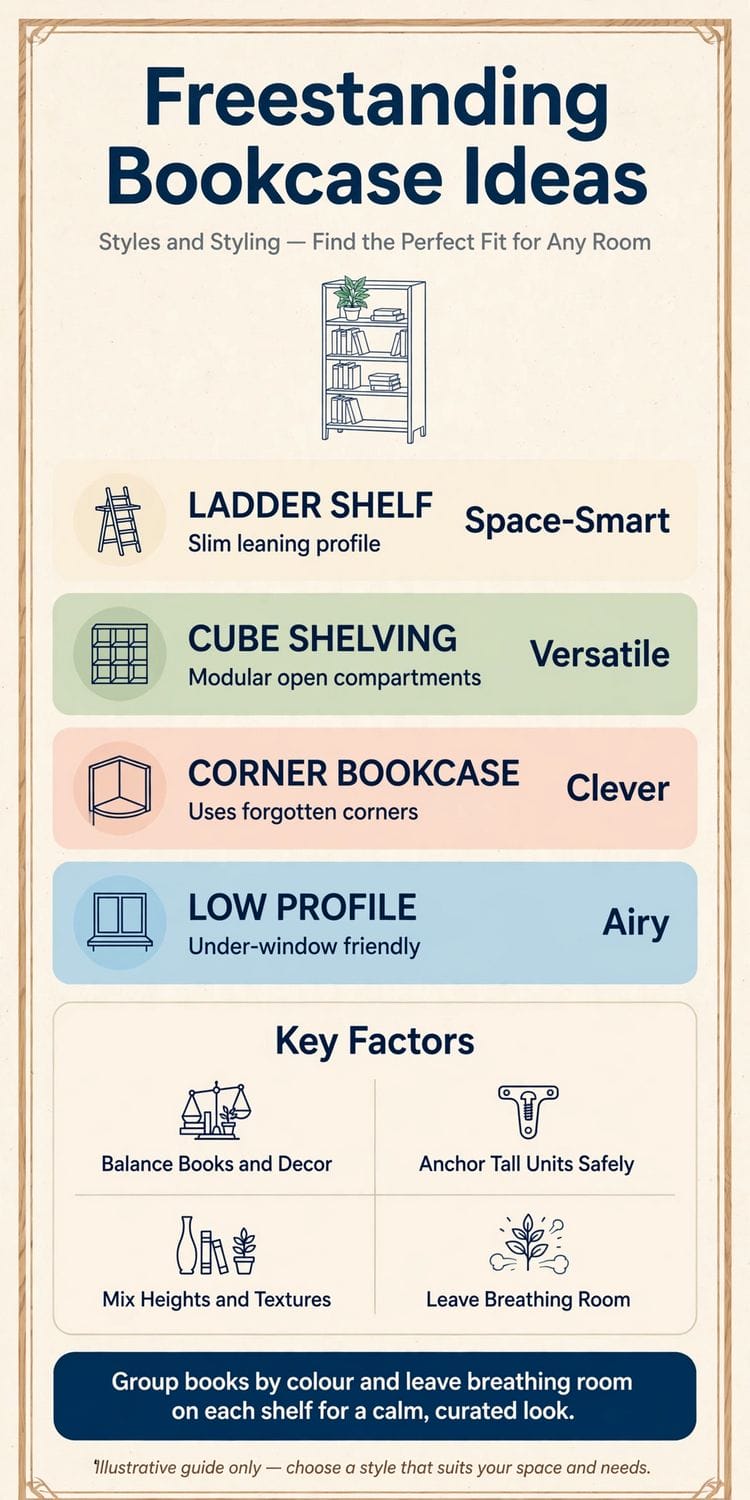
The infographic above summarises the freestanding forms at a glance: ladder shelves for light rooms, cube shelving for flexible display, corner cases for awkward walls, and low profiles for rooms that need to stay open.
2. Low Profile Bookcases
Low bookcases — cases that sit at or below waist height — suit rooms where the wall above needs to stay open for art, windows, or light. They hold a respectable collection without closing a room in, and they double as display surfaces: a lamp, a plant, or a framed photograph on top turns storage into a sideboard. In living rooms, a low case under a window is often more useful than a tall case beside it.
Low cases also work as room dividers in open-plan spaces, where a back-to-back pair creates a boundary without blocking light or conversation. The trade-off is capacity: a low case holds fewer books, so it suits households that curate rather than accumulate. Choose low when the room needs air more than it needs shelves.
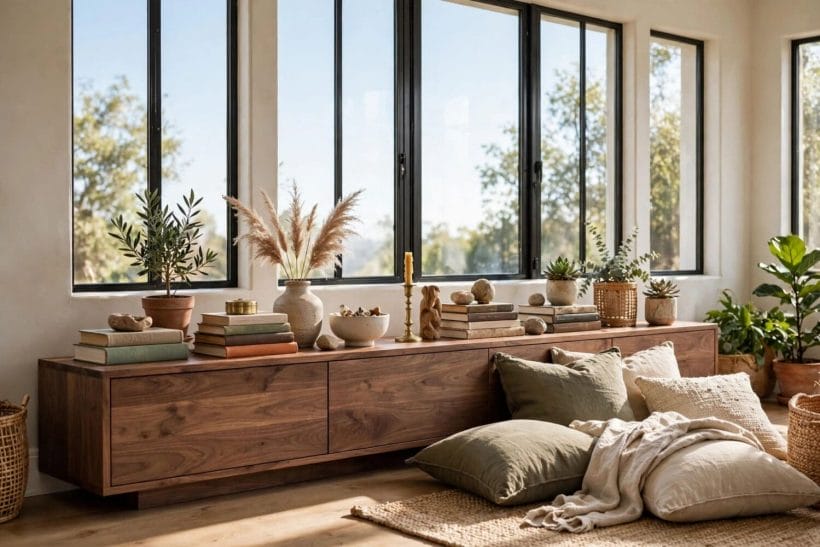
The low case under tall windows above shows the form’s best quality: the room keeps its light and its view, while the books stay close at hand.
3. Ladder Shelves and Open Frames
Ladder shelves lean against a wall with shelves that deepen toward the bottom, giving a light, open look that suits small rooms and rented homes. Their strength is visual lightness: because they have no solid sides or back, they barely interrupt a wall. Their weakness is capacity and dust: open shelves hold less weight, and everything on them is exposed.
Ladder shelves suit display collections — a few favourite books, plants, and objects — better than a working library. Books on a ladder shelf need bookends, because there is no side panel to hold the last book upright. And the lean itself needs a secure wall behind it, since a ladder shelf that slips forward is a hazard.
Tiny house designs use ladder shelves and open frames where every inch counts, because their lightness keeps a small room feeling open while still holding what matters.
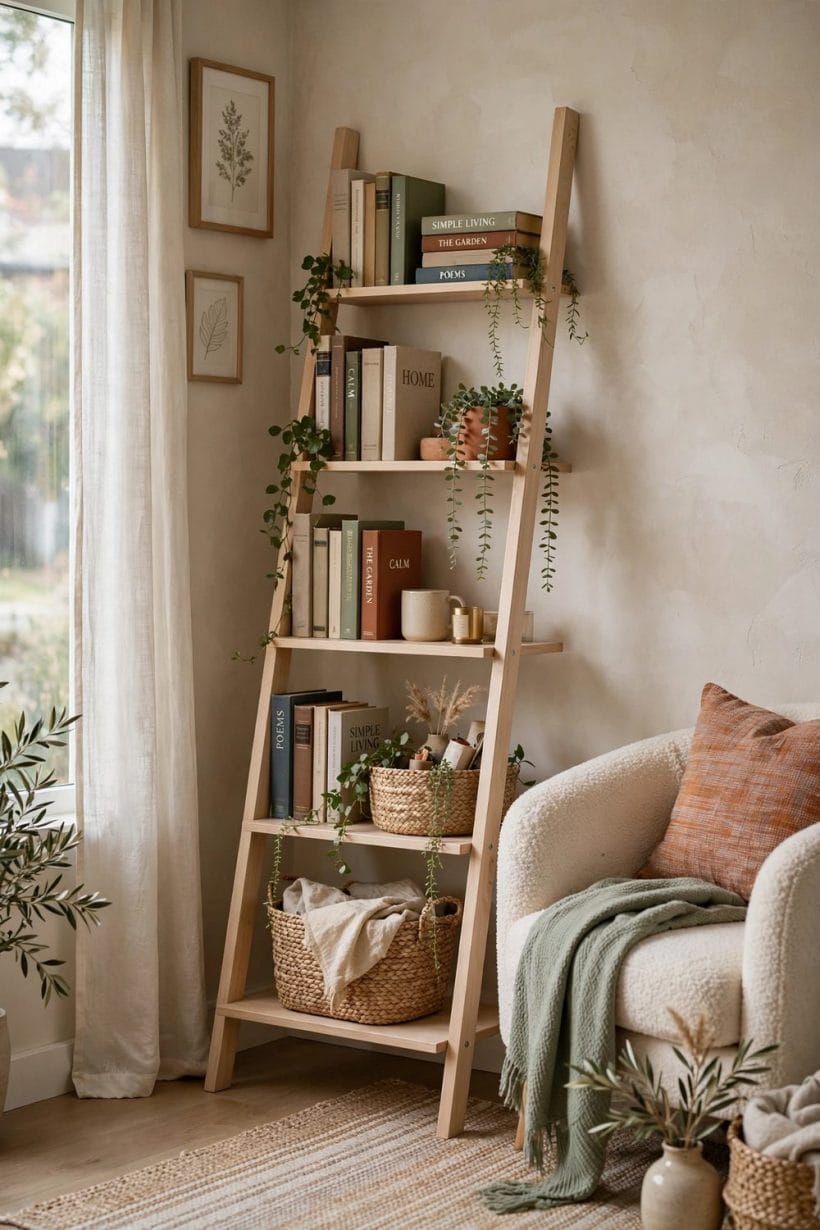
The ladder shelf beside an armchair above is the form used well: a reading corner where the shelf holds what the chair needs, and nothing more.
4. Cube Shelving and Modular Cases
Cube shelving divides a case into square compartments, each holding a small group of books or a single display object. Its strength is flexibility: cubes can be rearranged, stacked, or expanded, and they suit collections that mix books with objects. Its weakness is that standard cubes fit standard books awkwardly — tall art books and oversized volumes may not fit, and small paperbacks can look lost in a large cube.
Modular cases extend the same idea to whole walls, where units combine into a composition tailored to the room. The key to a good modular wall is planning the composition before buying: measure the wall, plan where tall books go, and leave some cubes deliberately empty. A modular wall that is packed solid looks like storage. One with breathing room looks like design.
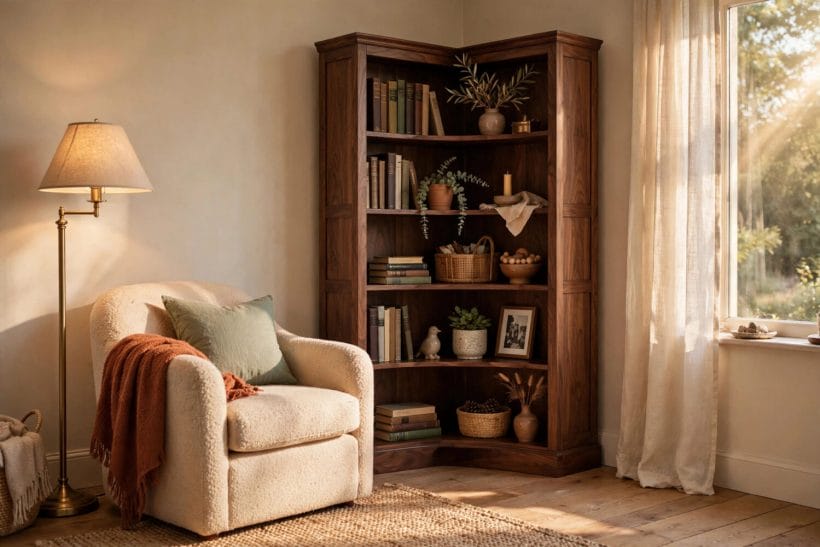
Corner bookcases, like the one above, rescue walls that would otherwise hold nothing. The corner is often the most wasted space in a room, and a case built for it turns waste into a reading nook.
One more idea worth considering is the bookcase as a room’s second function. A tall case beside a desk becomes a reference wall. A low case behind a sofa becomes a ledge for lamps and cups. A case flanking a doorway frames the passage and makes a plain opening feel intentional. When a bookcase serves two purposes, it earns its floor space twice, and small rooms in particular benefit from furniture that refuses to do only one job.
5. Corner Bookcases
Corner cases solve a specific problem: the awkward corner where two walls meet and no ordinary furniture fits well. A corner bookcase wraps the angle, using depth that would otherwise sit empty, and it creates a natural reading nook when paired with a chair. The form works best when it is built or chosen for the corner, because a standard rectangular case pushed into a corner wastes its own depth.
Watch the geometry: corner cases with deep shelves can swallow books at the back, so shallower shelves or angled fronts keep everything reachable. And mind the light: corners are often the darkest part of a room, so a corner bookcase benefits from a nearby lamp or a light-coloured finish that reflects what light there is.
Craftsman living room ideas show built-in and corner woodwork used to make rooms feel crafted rather than furnished, and a corner bookcase carries the same spirit.
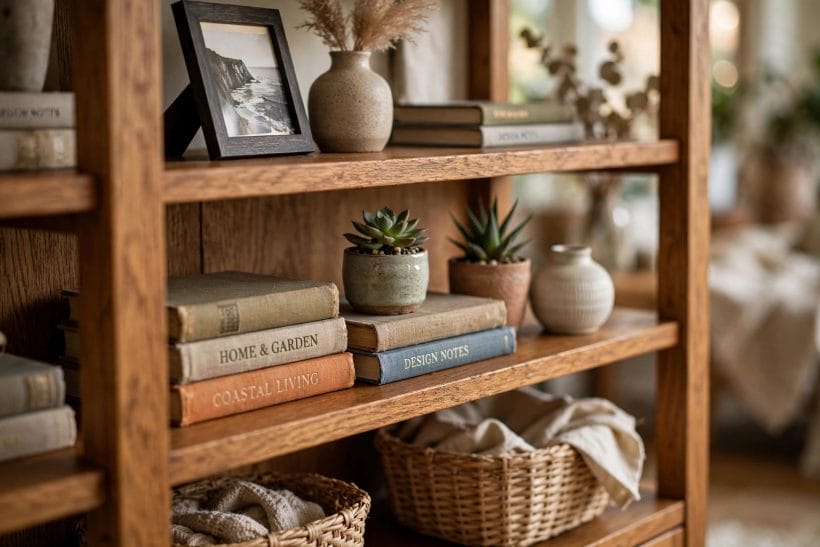
Close-up, as above, the details that matter become visible: shelf depth, basket storage for small items, and plants that soften the wood without hiding the books.
6. Built-In Bookcases
Built-in bookcases are fitted to a wall, often flanking a fireplace or filling an alcove, and they read as architecture rather than furniture. Their strength is integration: a built-in looks like it belongs to the house, uses every inch of its wall, and adds perceived value to a room. Their weakness is permanence: a built-in cannot move with you, and a poorly planned one locks a room into a layout that may not suit the next household.
Built-ins reward careful planning of shelf heights. Mix fixed shelves for standard books with a few adjustable shelves for oversized volumes, and plan lighting from the start — a built-in without light becomes a dark wall of spines. If the built-in flanks a fireplace, keep heat and clearance in mind, and choose materials that suit the room’s humidity and temperature.
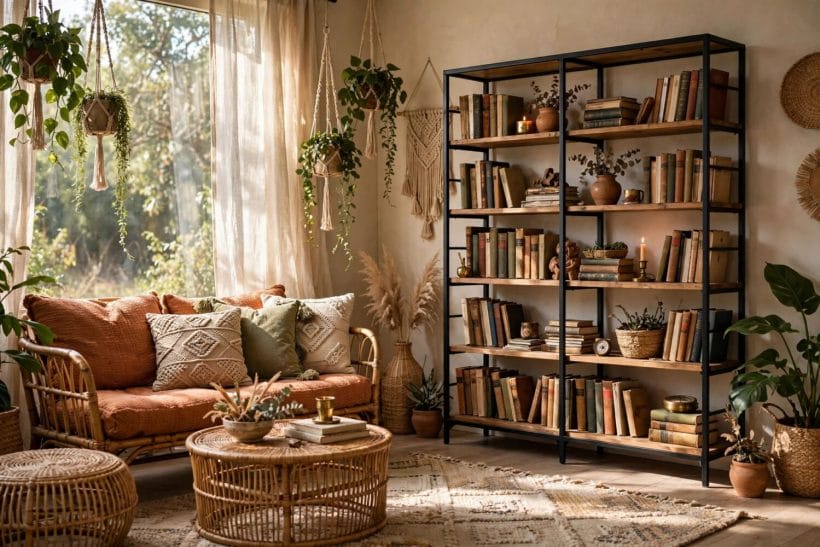
The black metal case above shows how material changes a bookcase’s character: the same books read as contemporary against dark metal, where they would read as traditional against warm wood.
7. Materials: Wood, Metal and Mixed
Wood is the traditional bookcase material, and its warmth suits most rooms. Solid wood is beautiful and durable but heavy and costly. Veneered cases offer wood’s look at lower weight and cost, though edges and corners reveal the difference over time. Metal cases — black steel frames with wood shelves — suit contemporary rooms and carry heavy loads well, but they can feel cold in a soft room.
Mixed materials often give the best of both: a metal frame for strength and lightness, with wood shelves for warmth. Whatever the material, check the same three things: shelf thickness and support, back panel strength, and finish quality at edges and joints. A bookcase fails at its weakest shelf, not its strongest.
Kitchen ideas show the same material discipline in another room: the materials that last are the ones chosen for the load they will actually carry.
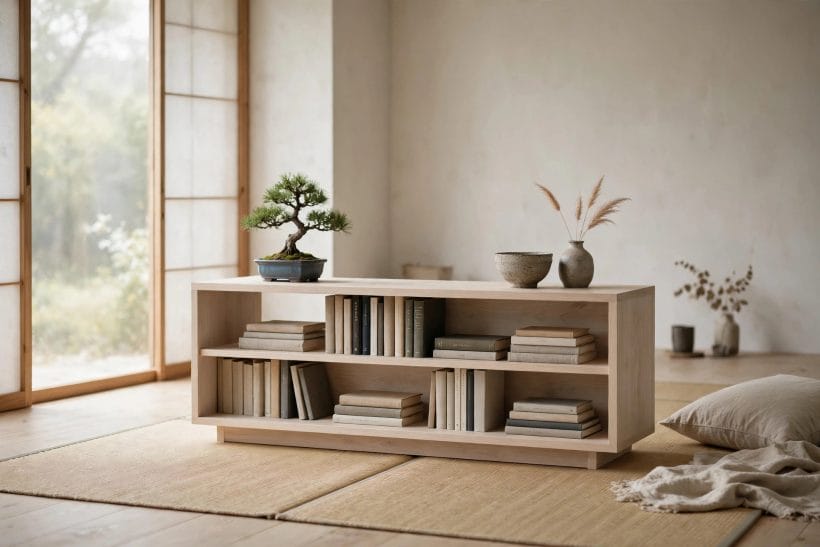
A low white case in a calm room, as above, shows how a pale finish keeps a bookcase from dominating a quiet space. The books provide the colour; the case stays neutral.
8. Styling: Books, Objects and Breathing Room
Styling a bookcase is an art of restraint. Books should dominate, but not exclusively: a few objects — a plant, a framed photograph, a collected stone — give the eye places to rest. Group books in a mix of vertical rows and horizontal stacks, because horizontal stacks break the monotony of spines and create platforms for small objects. Leave some shelves partly empty, because a packed case looks like storage and a case with air looks like a collection.
Colour can organise a case, whether by grouping similar spines or by arranging a gradient, but colour organisation should serve the reader, not just the photograph. A case arranged purely for colour can make finding a book harder, and a bookcase that frustrates its reader has failed its first job. Style for the household first, and let the photograph follow.
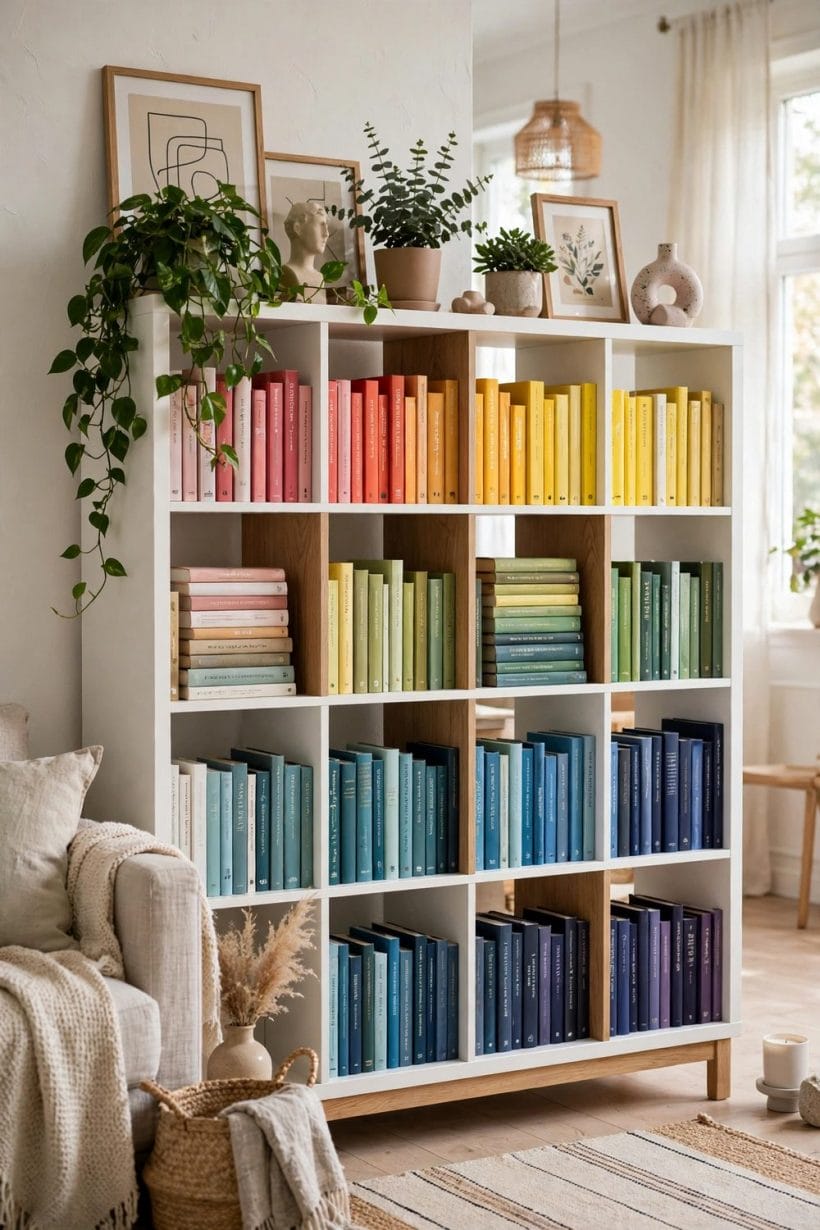
Colour-arranged cubes, as above, show the approach at its most photogenic. It works beautifully when the household knows its books well enough to find them by colour and position.
9. Small Spaces and Children’s Bookcases
Small rooms need bookcases that work harder: narrow cases for hallways, cases that fit under stairs, and cases that double as bedside tables or window seats. In a small room, a bookcase should earn its footprint by serving two purposes, and it should stay shallow enough not to crowd the walkway. Measure the room’s circulation before choosing a case, because a bookcase that blocks movement is worse than no bookcase at all.
Children’s bookcases have their own rules: low shelves children can reach, forward-facing bins for picture books, and rock-solid anchoring, because children climb. A children’s case should invite browsing, with covers visible rather than spines hidden, and it should grow with the child by accepting larger books as reading advances.
Scandinavian bedroom shows the pale, calm rooms where low, light bookcases feel most at home, and coffee table pictures show how a living room’s surfaces work together with its shelves.
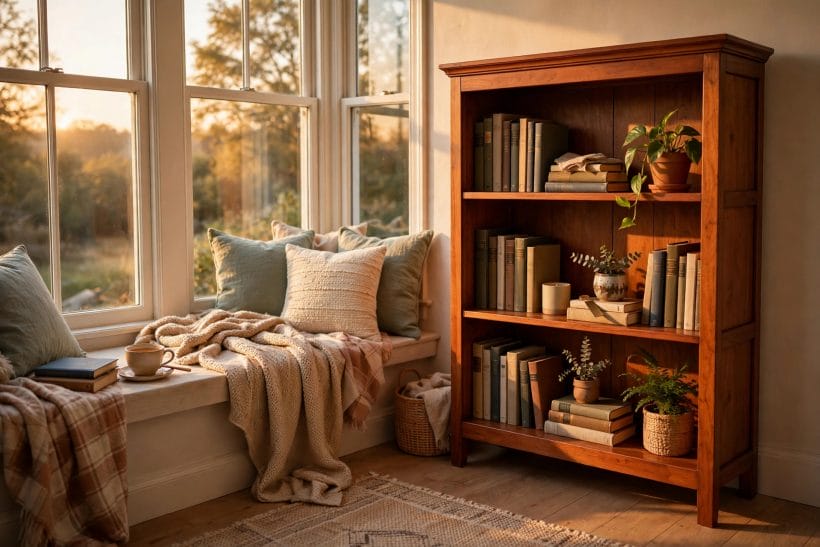
A bookcase beside a window seat, as above, is the small-space ideal: storage, seating, and light in one corner, with the books exactly where the reader sits.
Finally, consider the bookcase’s future. Collections change, rooms change, and households move. A freestanding case moves with you and adapts to new rooms. A built-in stays and serves the next household. Neither is better in the abstract. The right choice is the one that fits how long you expect to live with the case, how often your collection changes, and whether the wall it stands against is likely to be rearranged.
10. Choosing, Placing and Living With a Bookcase
Choosing a bookcase starts with measuring: the wall, the books, and the room’s circulation. Count the books, note the tallest ones, and measure the wall’s width and height. A case that fits the wall but not the books, or the books but not the room, is a mistake that measurements prevent. Then consider weight: a loaded bookcase is among the heaviest furniture in a house, so floor strength and anchoring deserve thought, especially upstairs.
Placement follows light and use. Books fade in direct sun, so a case facing a south window needs its spines protected or its books rotated. A case near the reading chair gets used more than one in a distant corner, and a case in a hallway gets browsed in passing. Put the bookcase where the reading happens, not where the empty wall happens to be.
Living with a bookcase means editing it. Collections grow, tastes change, and shelves fill. A yearly pass — removing books that no longer earn their place, dusting, and re-spacing — keeps a case from becoming a warehouse. The best bookcases are not the fullest ones. They are the ones whose shelves reflect the household living with them right now.
Final Considerations
Bookcases reward the same care as any major furniture choice: measure first, choose for the load, anchor tall cases, and leave room for the collection to breathe. Freestanding cases anchor rooms, low profiles preserve light, ladder shelves lighten small spaces, cubes flex with changing collections, and corners rescue wasted walls. Built-ins belong to the house; the rest belong to the household and should move with it.
Tiny house porch ideas carry the same lesson outdoors: the best structures are the ones shaped by the life lived around them, not by the space they happen to fill.

0 Comments