

It is the most tempting number in tiny living, so let us treat it honestly from the first line. Can you build tiny house for 10000 dollars and end up with somewhere real to live? Yes, sometimes, in a specific shape: a small, simple house, built slowly by its owner, on a sound used trailer, with salvaged materials doing heavy work and every finish decision made by the budget rather than by taste. What that money will not buy, anywhere, is a miniature version of a conventional new house with new everything, professional labour and money left over. The distance between those two houses is the whole subject of this guide.
So this is a budget guide in the literal sense: where a sum like this has to go, what drives each part up or down, and where the hard borders of the possible actually lie. The allocations below are clearly labelled illustrations, not quotes and not predictions, because materials prices vary by place, by season and above all by what you can find second-hand near you. One builder’s bargain trailer is another’s money pit, and one town’s salvage yard is another’s empty shed. Read the structure, not the exact split: a sound foundation, a small square shell, salvage before retail, safe minimal systems, and your own time poured in where money used to go.
Building a Tiny House for $10,000: Quick Answers
| Question | Answer |
|---|---|
| Is it possible at all? | Yes, for a small, simple, mostly self-built house using a sound used trailer and substantial salvaged material. No, for a new-materials, professionally built equivalent. |
| What is the biggest single cost? | Usually the trailer and the shell materials between them. Together they typically claim the largest share of the whole budget before a single fitting is bought. |
| Where does salvage matter most? | Windows and doors, which are expensive new and plentiful used, followed by interior fittings, appliances and timber with a past life. |
| What must never be cut? | Trailer soundness, structural fixings, safe electrical and heating work, and weather-tightness. Cheap there becomes expensive, or dangerous, later. |
| What substitutes for money? | Time and patience: your own labour, waiting for the right used items, building in phases, and accepting simple finishes. |
| What does the figure exclude? | Land, hookups, permits and fees, transport, tools you do not own, and your labour, all of which exist whether or not they appear in the build budget. |
1. What the Money Has to Cover: Every System in One Small House
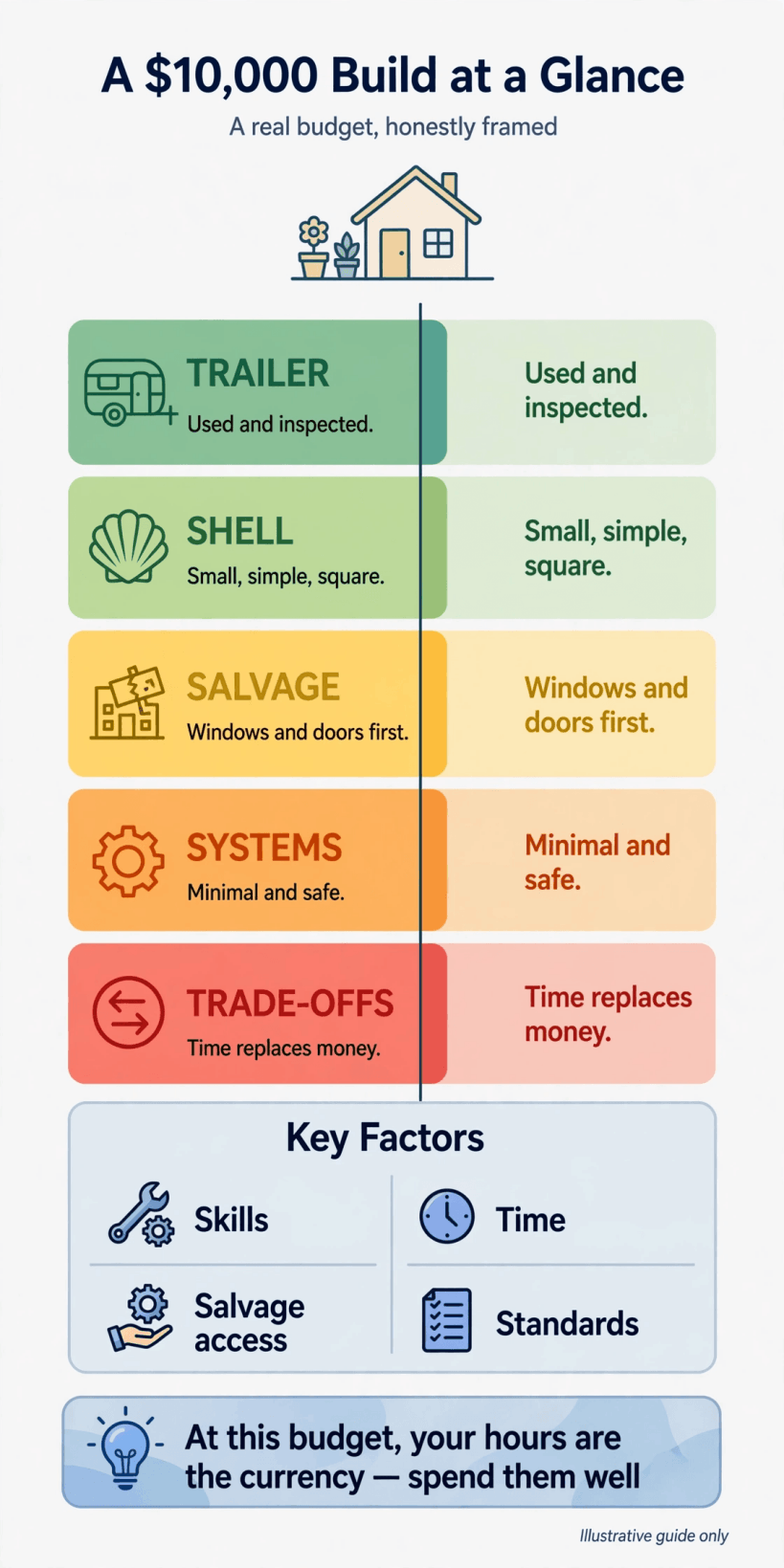
Begin by respecting the list, because a tiny house is not a shed with a bed in it. The budget has to produce a foundation that moves safely, a structure that holds together at road speed and in storms, a weatherproof envelope, insulation, windows and a door, and then the systems of an actual dwelling: somewhere to sleep, cook, wash and use the toilet, plus power, water and heat at a safe basic standard. Every one of those lines is compulsory. The art of the low-budget build is not deleting lines. It is delivering each line at its simplest honest quality, and letting size, salvage and labour do the saving.
As an illustrative shape only, picture the money in rough shares: the trailer and the shell materials as the two heavy blocks, together claiming much of the total; windows, doors and the roof covering as the next tier, wildly variable depending on salvage; systems and interior fittings as a protected but modest slice; and a contingency held back for the discoveries every build makes. The drivers matter more than any split: distance you haul materials, what your local second-hand market actually holds, how much of the work your own hands can do, and how small you are willing to build. That last driver is the master one, which is why the wider picture in the true cost of tiny houses: prefab vs DIY is worth reading before your own spreadsheet hardens into a promise.
2. Think Small and Square: The Shape That Makes the Number Possible
Every low-budget tiny house that succeeds starts as a drawing with very little in it: a compact footprint, straight walls, a simple roof shape, and a layout arranged around standard material sizes so that sheets and lengths arrive whole and leave as walls, not as offcuts. Small is not a compromise at this budget, it is the entire strategy, because every additional stretch of length multiplies across trailer cost, framing, cladding, roofing, insulation and floor finishes at once. A house a little shorter and simpler is cheaper in six budgets simultaneously.
Square thinking continues inside. One wet wall with the simple plumbing grouped together, sleeping in a loft or a convertible space rather than a separate bedroom, storage built as the furniture instead of bought as furniture, and openings placed where standard used windows exist rather than where a rendering would put them. None of this prevents the house being handsome. Simple proportions, honest materials and good light have carried far more expensive architecture than this. What it prevents is the budget bleeding out through a hundred small custom decisions, each innocent, together fatal.
3. The Used Trailer: Inspected First, Trusted Later
The trailer is where this budget is won or quietly lost, because it is both the foundation and the largest single purchase, and a bad one cannot be renovated away. The low purchase price of a rough trailer is an illusion if the frame needs extensive steel work, the running gear is worn, or its rated capacity was never meant for a house. Inspect like a sceptic or bring someone who is one: frame straightness and rust, especially where water sits; welds; axles, brakes, tyres and lights; the deck and outriggers; and honest paperwork. The full method is in the tiny house trailer buying guide, and at this budget it may be the most valuable reading you do.
Expect the right trailer to claim a serious share of the whole sum, and let it. A sound used trailer at a fair price, cleaned, treated against rust and fitted with a proper subfloor, is the one place where spending more of the budget early saves money everywhere after. The false economy is the trailer that is cheap because it is tired: every later stage inherits its problems, from a floor that is hard to level to a house that should not really travel. Buy the best foundation the budget can reach, then design the house the remaining money can honestly finish.
4. The Shell: Framing, Sheathing, Roof and Weather Tightness
With the trailer settled, the shell is the second heavy block, and its economics are dominated by two choices: how you frame, and how ruthlessly the design uses standard sizes. A simple framed shell, sheathed and wrapped properly, roofed with a straightforward, durable covering in a simple shape, is achievable work for a careful self-builder and uses materials the second-hand and surplus world can genuinely supply in part: timber, sheet goods and fixings appear used and discounted often enough to reward the patient. Complex roof shapes, dormers and feature cladding are where shell costs go to party, so at this budget they mostly stay in other people’s houses.
Weather tightness is the non-negotiable quality inside this stage, more than any finish. A shell that keeps water out completely, flashed and sealed at every penetration and junction, protects everything the later budget buys, while a leaky shell quietly destroys insulation, interiors and morale in the first wet season. The discipline is the same as sealing and weatherproofing tiny house sill plates at the details: corners, sills, window openings and the roof edges, done carefully once, with the right tapes, flashings and sealants, none of which are glamorous and all of which are cheaper than rot.
5. Salvage First: Windows, Doors and Fittings With a Past Life
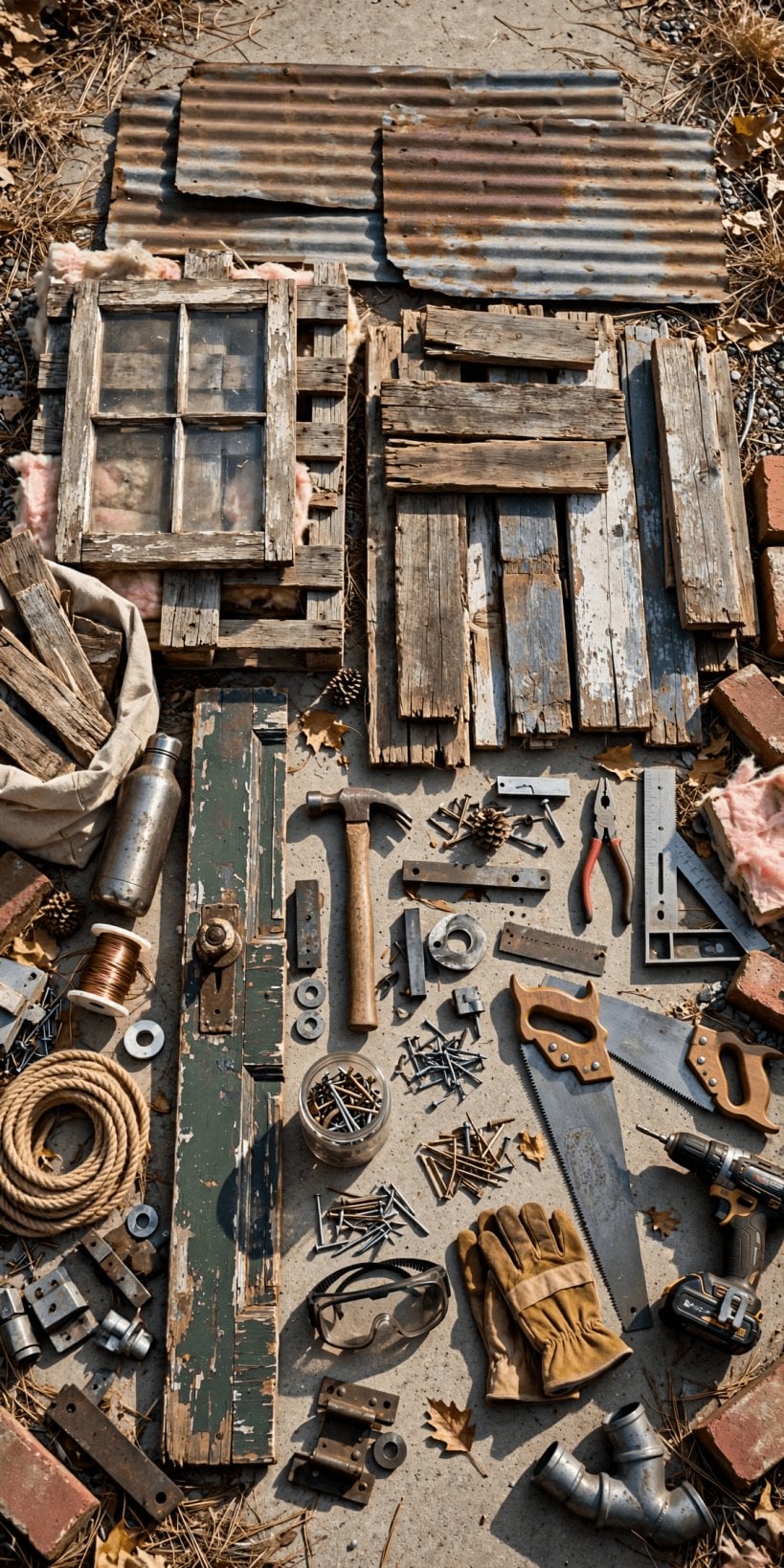
Here is where the budget becomes possible, and the order of operations flips: at this level you do not design openings and then shop for them. You find the windows and doors first, sound used units from demolitions, renovations and surplus yards, and design the walls around what you found. Windows are among the most expensive new items in any small build and among the cheapest used, because renovating households discard perfectly serviceable ones for fashion, so a flexible framer with a van and patience holds one of the strongest cards in budget building. The same logic stocks the interior: a used door, reclaimed timber for shelves and counters, second-hand sinks, cabinets and fittings.
Salvage has rules that keep it a saving rather than a hobby that eats the build. Buy condition, not stories: glass intact, seals and frames sound, sizes measured twice and recorded on the plan. Standardise around your finds rather than collecting charming one-offs the structure then has to be customised to fit. Store finds safely and build in the order the materials allow, which means the schedule bends around opportunity, a real cost counted in months rather than money. And know what not to salvage: anything whose failure would be dangerous or hidden, from suspect electrical gear to a tired water heater, belongs in the new-and-safe column regardless of price.
6. Insulation and Interior Finish on a Budget
Insulation punches far above its cost in a tiny house, because the volumes are small, the comfort difference is enormous, and skimping here taxes every winter and summer that follows. The good news for this budget is that a small house needs little material in absolute terms, so even doing this layer properly, floor, walls and roof, with gaps filled and continuity kept, is one of the more affordable stages. The comparison of what each material gives and asks is in how to insulate a tiny house; at this price the winner is usually whichever sound option your budget and building style can install completely, because a complete modest insulation beats a patchy premium one every time.
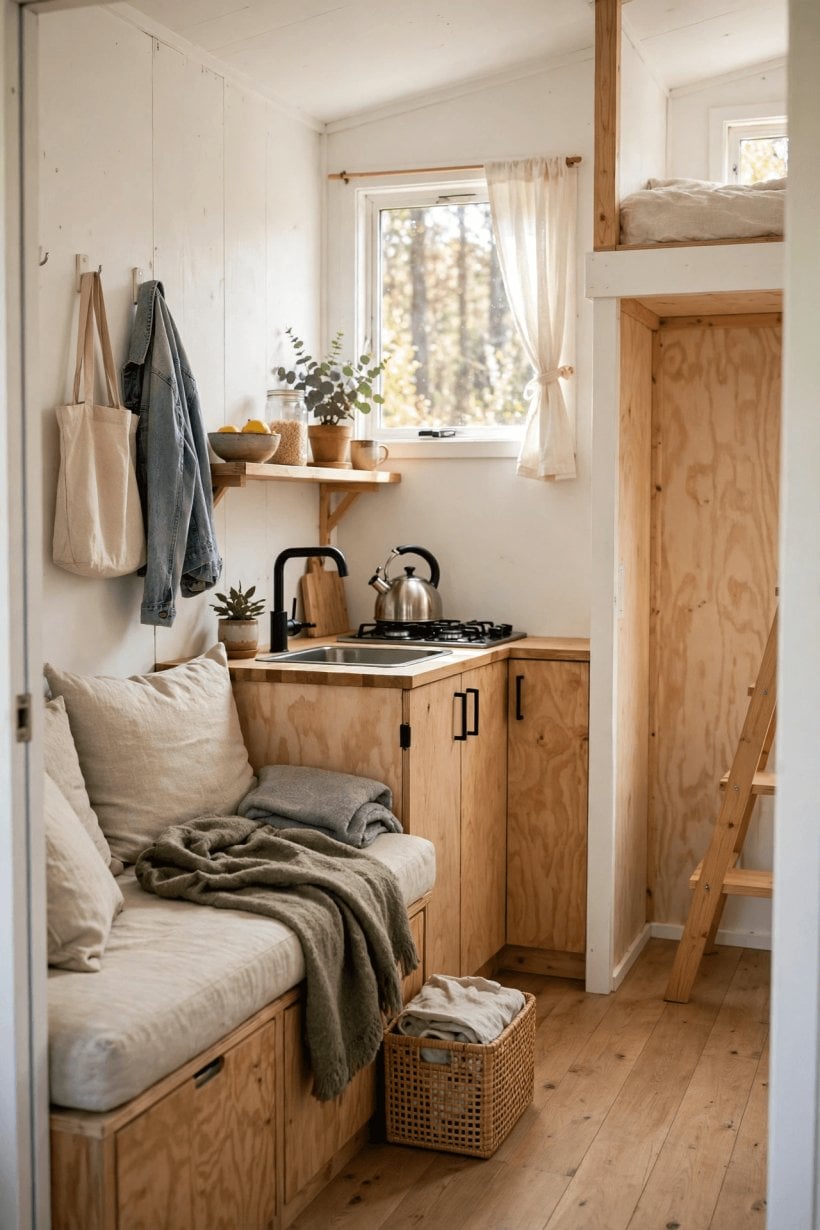
Interior finish is where restraint becomes a style. Simple sheet or board linings, painted; a floor in a hard-wearing, inexpensive finish; open shelving instead of cabinetry runs; a compact galley kitchen built from basic units and reclaimed worktop rather than a fitted showpiece. Borrow the thinking in compact kitchen appliances for tiny houses: few, simple, right-sized things, bought used where condition allows. The houses that look best at this budget lean into the honesty of it, clean lines, visible timber, everything earning its place, rather than imitating expensive finishes thinly, which fools nobody at arm’s length.
7. Minimal Safe Systems: Power, Water and Heat Done Properly
Systems are where ‘minimal’ must never become ‘makeshift’. The low-budget pattern is simple versions of safe things: a small, correctly installed electrical system sized to a modest life and checked by a qualified electrician where the rules require it; simple plumbing with few fixtures, grouped together, using the logic in tiny house utilities: power, water and off-grid sewage; a basic toilet solution chosen for the site, from a hookup to a well-managed composting arrangement; and one modest heat source suited to a small, well-insulated volume, an area where how to heat a tiny house lays out the honest contenders.
What gets phased is not safety but sophistication. Hot water can start simple. Off-grid power can start as a hookup and grow later, or begin as a genuinely small system matched to small loads. Water storage and waste arrangements can be the basic versions that meet the rules of wherever the house will sit. Design the routes and spaces for the grown-up versions now, while the walls are open, and the upgrades become weekend projects instead of surgery. The one unforgivable budget move is hiding cheap work inside finished walls: every system in this house should be safe, inspectable and boring, because excitement in wiring and plumbing is measured in callouts and damage.
8. Time Replaces Money: The Labour Equation
Strip the romance away and this budget is an exchange: money you do not spend becomes hours you do. Professional labour is the largest single thing the $10,000 house does without, and the builder’s own evenings, weekends and holidays are the invisible second budget that makes the visible one balance. That exchange can be joyful, educational and deeply satisfying, and it can also be the reason a build takes a year of spare time, strains a relationship, or stalls at the weather-tight stage while life happens. Price your time honestly, not at a wage, but at its real cost in seasons and energy, before assuming the exchange is free.
Patience is the second currency. Salvage appears on its own schedule, skills are learned on offcuts before they are spent on the house, and some stages simply wait for the right used window, the right help, the right weather window. Building in phases helps the cash flow and the morale both: trailer, then weather-tight shell, then a camp-able interior with systems roughed in, then the slow finishing as funds recover. A house that becomes usable in stages gets used, and a used house justifies its own completion in a way a perpetual project never quite does.
9. What This Budget Cannot Do
Honesty is the feature of this section, because knowing the borders keeps the whole project out of trouble. This budget cannot buy land, and it does not cover what the land demands: access, levelling, hookups and their connection work, the groundwork in how to prepare land for a tiny house, nor permits, inspections and fees where they apply. It cannot hire the build out, buy a new trailer and new materials throughout, or deliver a large house: size is the first casualty of the arithmetic, and pretending otherwise ends in an unfinished shell.
It also cannot safely absorb surprises without its contingency, cannot include the tools a builder does not already own or cannot borrow, and cannot keep a schedule that ignores salvage, weather and learning curves. Perhaps most importantly, it cannot finish every room to magazine standard on day one, and households who need that standard should hear this guide clearly: the gap is not closed by optimism, cheaper versions of structural things, or debt quietly renamed. It is closed by a bigger budget, a smaller house, or a longer timeline. Those are the only three levers there have ever been.
10. A Realistic Path: Sequence, Patience and the Contingency Habit
Put the build in the order the money survives. First, the site question answered well enough to know the house can legally and practically sit where you intend, because a finished house with nowhere to be is the most expensive outcome of all. Second, the trailer, inspected hard and bought well. Third, the shell to weather-tight, designed small and square around salvaged openings already in your possession. Fourth, insulation and the safe minimal systems, installed simply and inspectably. Fifth, the interior in phases, camp-able before it is beautiful, with finishes improving as the budget recovers between stages.
Hold a contingency from the start and defend it like a structural member, because every build finds something: steel that needs more work than the inspection promised, a salvaged unit that fails at fitting, a price that moved since the plan was drawn. Track spending against the rough shares as you go, in a notebook or a spreadsheet, and let the tracking steer the later choices while steering is still possible. That, in the end, is the realistic secret of the $10,000 house: not a trick, not a hack, but a small design, a sound foundation, salvage before retail, safe simple systems, and an owner willing to be the labour, the patience and the contingency plan, all three.
Final Considerations
Can you build a tiny house for $10,000? Yes, if the sentence is allowed to finish itself: a small one, a simple one, a salvaged one, built by you, slowly, on a trailer you inspected like a sceptic, with safe systems kept simple rather than corners cut, and land, fees and labour honestly counted as the separate things they are. No, if the sentence secretly means a new, large, professionally finished house at a fifth of the going way. Both answers are useful. The first has genuinely housed people who planned in the order this guide sets out. The second, believed, has filled a lot of yards with unfinished shells. Choose the first sentence, build in sequence, and the number stops being a fantasy and becomes what it should be: a discipline that a determined builder can actually meet.


0 Comments