

Choosing who builds your tiny house shapes everything that follows: how the home handles a long Texas summer, how safely it tows, how easily it insures, and how it holds up two years after delivery day. This guide compares the best tiny house builders in Texas by the method that actually protects a buyer — not by inventing company names, prices or star ratings, but by comparing the builder types you will really meet, the criteria that separate a careful build from a risky one, and the questions that reveal the difference before any deposit changes hands.
The number in the title is handled honestly here as fifteen comparison slots: five common builder types, each checked against three Texas-specific tests — certification, climate fit and contract clarity. A slot might be a certified factory builder, a local custom shop, a kit and plan seller, a foundation or ADU specialist, or a shell builder who hands over the finishing work to you. Score every real company on your shortlist against the same fifteen slots and weak answers stand out quickly. That process is worth far more than a glossy ranking nobody verified.
| Builder type | What they suit | What to verify |
|---|---|---|
| Certified factory builder | Buyers who want inspected, repeatable builds that finance and insure more easily | Current certification documents, inspection stages, written warranty terms |
| Local custom shop | One-off layouts, unusual lots and buyers who want to visit during the build | Finished homes you can walk through, who actually does the work, build schedule |
| Kit and plan seller | Confident DIY buyers with time, tools and a place to build | Exactly what is included, what is not, and who carries design responsibility |
| Foundation and ADU specialist | Permanent backyard homes on owned land | Local permitting experience, foundation specification, utility connections |
| Shell builder | Buyers who want a weather-tight shell and will finish the interior themselves | A written definition of shell, sealed openings, and what finishing will really cost |
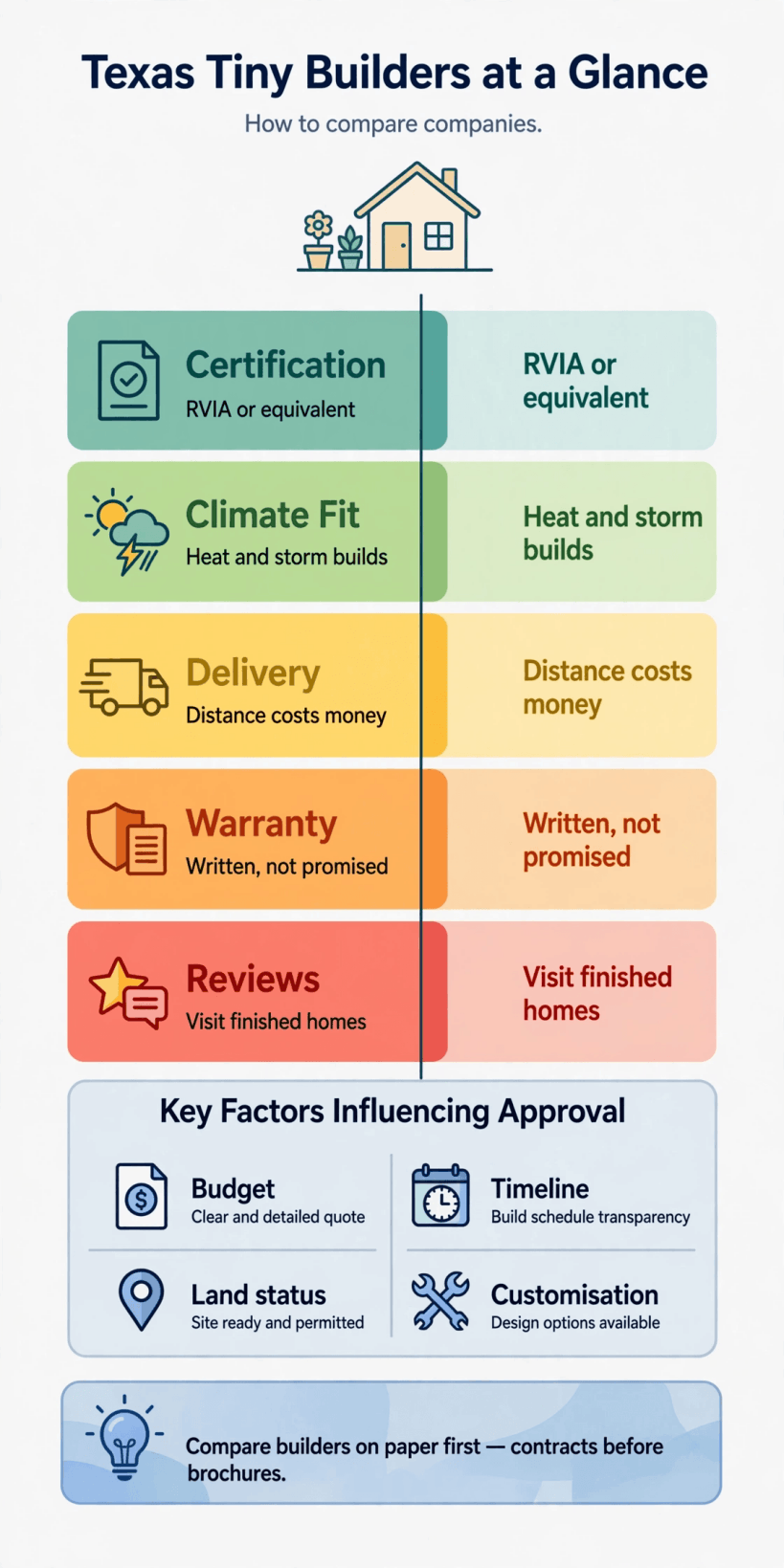
1. Certified Factory Builders and RVIA-Style Certification in Texas
A certified factory builder works to a documented standard, with third-party inspection at stages of the build rather than a single glance at the finished home. Ask which standard the company builds to, who inspects, and at what points — framing, electrical and plumbing are the stages that matter, because they are hidden once the walls close. Genuine certification paperwork names the inspecting body and the standard; vague claims of being certified-style or built to code are not the same thing, and a careful builder will show you the documents without being asked twice.
The practical payoff is wider acceptance. Certified builds are usually easier to finance, insure and place in parks that ask questions about construction quality, and the resale conversation is simpler too. The trade-off is flexibility: factory builders protect their certification by limiting structural changes, so deep customisation may be refused or priced firmly. Before you compare quotes, read what RVIA certification means for a tiny house so you can tell a certified build from a marketing phrase, and ask whether certification covers the exact model and options you are ordering — not just another home in the range.
2. Local Custom Shops and Visiting Finished Texas Homes
A local custom shop builds one home at a time, usually within driving distance of its customers, and that closeness is its real advantage. You can visit the workshop, watch your own build progress, and — most valuable of all — walk through finished homes and speak with the people living in them. Ask to see a home that is at least a year old, not just the showroom example. A year of Texas seasons reveals how seals, siding and shading actually perform, and owners will tell you honestly how the builder handled the small problems every build produces.
The trade-offs are capacity and consistency. A small shop may have a long waiting list, and quality depends heavily on who is on the tools that month. Ask who physically builds the home, what is subcontracted, and how hidden work is photographed before it is covered up. Good shops document everything as a matter of pride. When you compare a custom quote against factory and DIY routes, weigh it against the true cost of tiny houses, prefab vs DIY, because a custom price that includes delivery, set-up and warranty support is not directly comparable to a bare shell price.
3. Kit, Plan and Shell Builders: What Is Actually Included
Kit sellers, plan sellers and shell builders sit at the affordable end of the market because they hand much of the work — and the risk — to you. A plan is drawings and responsibility: you source every material and carry every mistake. A kit adds pre-cut or bundled materials, but rarely includes the trailer, appliances, interior finishing or delivery. A shell build gives you a framed, weather-tight structure whose definition varies wildly between sellers, from bare framing to insulated, wired and lined.
None of these routes is wrong, but all of them are mis-sold when the headline price is compared with a turnkey home. Before you commit, demand an inclusions list in writing and price the missing items yourself: trailer, windows, roofing, insulation, electrics, plumbing, interior lining, appliances, transport and your own weeks of labour. Ask who is responsible if a plan detail fails inspection, and whether the drawings are licensed for your state and use. Buyers who cost this route honestly often find the gap to a finished build is smaller than the adverts suggest — and they choose it for the satisfaction of building, not for a saving that was never real.
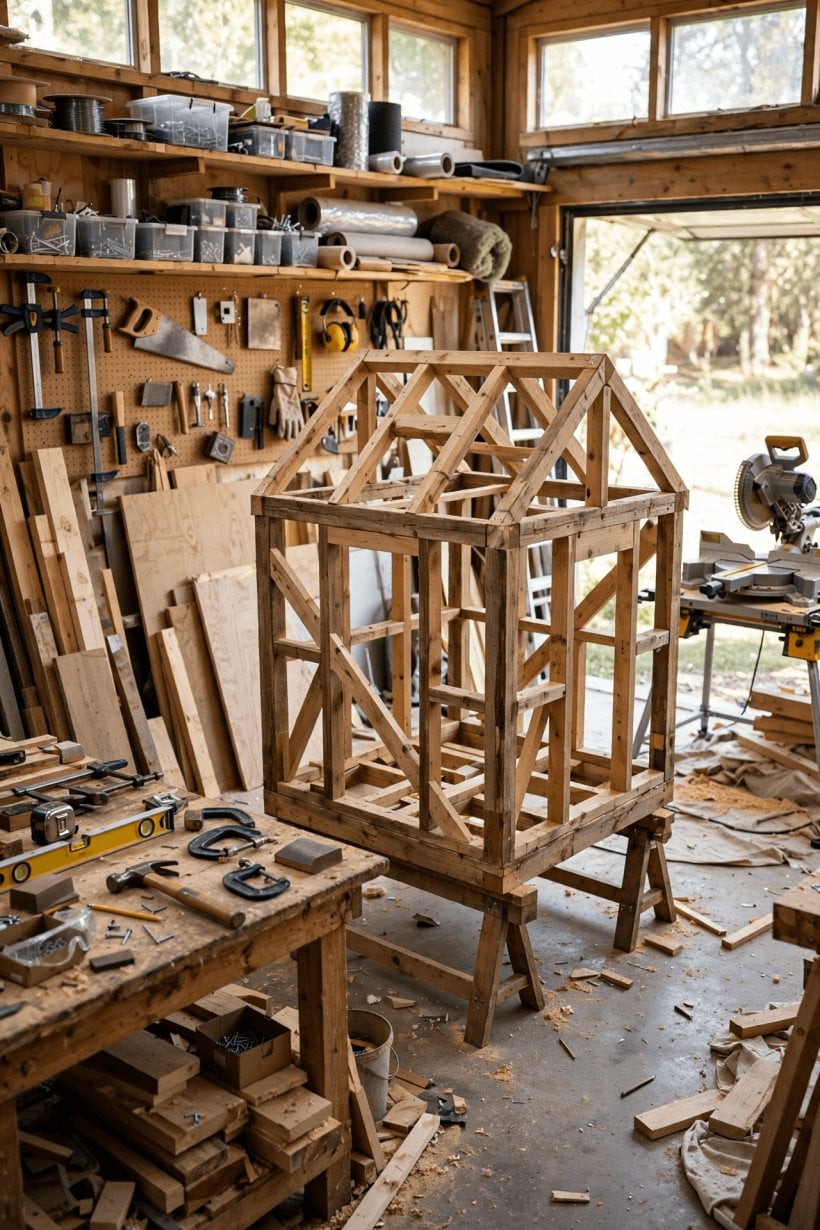
4. Texas Heat: Cooling, Insulation and Shade in a Builder’s Specification
Texas heat is the climate test that exposes optimistic specifications. A tiny house has little thermal mass, large window areas relative to its volume, and a metal roof baking above a shallow ceiling cavity. Ask every builder how the home is cooled, what insulation values the walls, floor and roof actually achieve, and how west-facing glass is shaded. A mini-split is the common answer, but sizing matters: an oversized unit short-cycles and leaves humidity behind, while an undersized one runs all afternoon and still loses. Our guide to how to install a mini split in a tiny house shows what correct sizing and placement look like.
Then ask about the unglamorous details: sealed ductless drainage, exterior shading options, roof colour and reflectivity, and whether the builder has delivered homes to your part of the state — Gulf humidity, Hill Country sun and Panhandle wind are different problems. A builder who answers with specifics, and offers summer references from owners in a similar climate zone, is telling you the truth about experience. A builder who promises it will be fine everywhere is selling, not building. Heat performance is decided on paper long before the first hot day tests it.
5. Storm, Wind and Roof Detailing for Texas Tiny Houses
Texas weather arrives from every direction: Gulf storms, line squalls, hail and straight-line winds that test a small, light structure harder than a conventional house. Ask how the roof is tied down, how walls are anchored to the trailer or foundation, and what wind exposure the design assumes. Hurricane ties, continuous load paths and properly fastened roofing are not upgrades in storm country; they are the structure. Get the answers in the specification, not in a conversation, and ask what documentation comes with the home for insurers who will ask the same questions.
Towing adds a second wind problem. A tall tiny house meets highway air at speed, and detailing that shrugs off a storm on site may still suffer on the road if panels, trim and roofing edges are not secured for travel. The physics are covered in our guide to tiny house wind resistance and aerodynamic towing. Ask the builder how the home is prepared for transport, who secures it, and what is checked on arrival. In Texas, storm readiness is not a regional extra — it is a core buying criterion, and builders who build for it say so in writing.
6. Delivery Distance, Access and Set-Up Costs Across Texas
Texas distances punish vague delivery promises. A builder three hundred miles away may still be the right choice, but the delivered price must include transport, escort vehicles if the load needs them, insurance during transit, and the set-up work at your site — levelling, blocking, anchoring and utility connection are rarely part of a factory-gate quote. Ask for delivery as a written line item with a stated distance, and ask who carries the risk if the home is damaged on the road or cannot be placed because access was misjudged.
Access deserves its own conversation before you sign. Photograph and measure your gate, turns, overhead lines and ground conditions, and share them with the builder in writing. A site a delivery driver refuses is an expensive problem discovered too late. The trailer underneath matters just as much: axle ratings, brakes and tyre condition decide whether the trip is routine. Our tiny house trailer buying guide covers what to check. A builder who asks detailed questions about your land before quoting delivery is showing professional habits; one who waves the question away is leaving the risk with you.
7. Contracts, Payment Stages and Change Orders With Texas Builders
The contract is where a good builder becomes easy to identify. It should name the exact specification, the total price, what is excluded, the build start and completion windows, and a payment schedule tied to visible milestones — deposit, frame complete, weather-tight, fit-out, delivery — rather than to dates alone. You should never be far ahead of the value of work you could point to. Change orders deserve special attention: every change, however small, should be priced and signed before the work happens, because verbal changes are where budgets quietly double.
Ask what happens if the build runs late, who owns materials paid for in advance, and in whose name the title or manufacturer’s paperwork will be issued. If you are borrowing, align the builder’s payment stages with your lender’s draw schedule early, using how to finance a tiny house as background — a mismatch discovered mid-build helps nobody. Read the cancellation clause before you need it. None of this signals distrust; professional builders expect these questions, document their answers, and are visibly more comfortable than sellers who prefer everything to stay friendly and unwritten.
8. Written Warranties and Aftercare From Texas Tiny House Builders
A warranty is only as good as its written text. Ask for a sample warranty before you pay a deposit and read what it actually covers: structure, roof and weatherproofing, plumbing and electrical systems, and the appliances, which usually carry their own manufacturers’ terms passed through the builder. Note the period for each part, the claim process, and — crucial in a state this size — who does the work. A warranty serviced from four hundred miles away means either a long wait, a local contractor the builder nominates, or a home that travels back at somebody’s cost. Find out whose.
Ask also what the warranty excludes. Towing damage, site movement, owner modifications and neglected maintenance are common exclusions, and knowing them in advance is fair to both sides. A builder who explains exclusions calmly and puts reasonable ones in writing is behaving more honestly than one who promises to cover everything forever. Aftercare is the daily version of the same promise: manuals for every appliance, a labelled panel, paint and material codes, and a named contact for the first year. These small documents are the difference between a home that is easy to live in and one that puzzles every tradesperson who visits.
9. Questions to Ask Any Texas Builder Before You Pay a Deposit
Deposits buy a place in a queue, so the questions come first. Ask how many builds are ahead of yours, when construction realistically starts, and what the deposit secures in writing. Ask who inspects the home and at what stages, whether you may visit during the build, and whether photographs of hidden work — wiring, plumbing, insulation — are taken before the walls close. Ask for two owner references from homes at least a year old and a finished weight certificate or weighbridge ticket for a comparable model, because towing plans built on guessed weights fail early.
Then apply the same discipline you would use on any major purchase and read how to inspect a tiny home before buying — most of its checks apply to a new home at handover, and a good builder will welcome a structured inspection rather than a hurried wave-through. Ask what the handover includes: levelling, systems demonstration, manuals, warranty documents and a snagging process with dates. Write down the answers. The builder who answers patiently, specifically and in writing has just shown you how they will behave when something goes wrong — which is the moment the comparison actually matters.
10. Red Flags When Comparing Tiny House Builders in Texas
Some warnings are consistent across every builder type. Large cash deposits with no contract, or contracts in a different name from the business you visited, should end the conversation. So should a refusal to let you see a finished home, speak to a past customer, or read the warranty before paying. Vague certification claims that dissolve when you ask for documents are another classic: genuine credentials survive questions, and invented ones rely on you not asking. Pressure is its own flag — a builder with a healthy order book does not need your signature today.
Watch the paperwork habits, too. Quotes that fit on a text message, specifications described as standard without saying what standard includes, delivery promised without a site conversation, and prices that rise through a chain of small verbal extras all predict the same build experience. Distance magnifies every one of these risks in Texas, because fixing a problem across five hundred miles tests goodwill that a contract should have made unnecessary. None of these flags requires expertise to spot — only the willingness to slow down. The buyers who get good homes are rarely the ones who found a secret builder; they are the ones who asked ordinary questions and believed the answers they were given.
Final Considerations
There is no single right builder type for Texas — there is a right match between a builder, a piece of land, a climate zone and the way you intend to live. Certified factory builds suit buyers who value inspected consistency and easier paperwork. Local custom shops suit buyers who will visit, decide and adapt as the build unfolds. Kits, plans and shells suit hands-on buyers who cost their own labour honestly. Score all fifteen comparison slots, insist on the written warranty, the written contract and the written delivery terms, and visit a finished home before money moves. Do those unglamorous things and the builder you choose has already been tested the way that counts: by evidence, not by promises.


0 Comments