

A room with a wall of books built into it does not feel decorated. It feels decided — as if the house has announced, in joinery, what it is for.
Seventy-five built-in bookcases follow: the joinery itself, library walls, cases around windows and into corners, the styling of shelves, small-space double duties, and colour and light — closing the built-ins family, and this runsheet, with the bookcase’s own post.
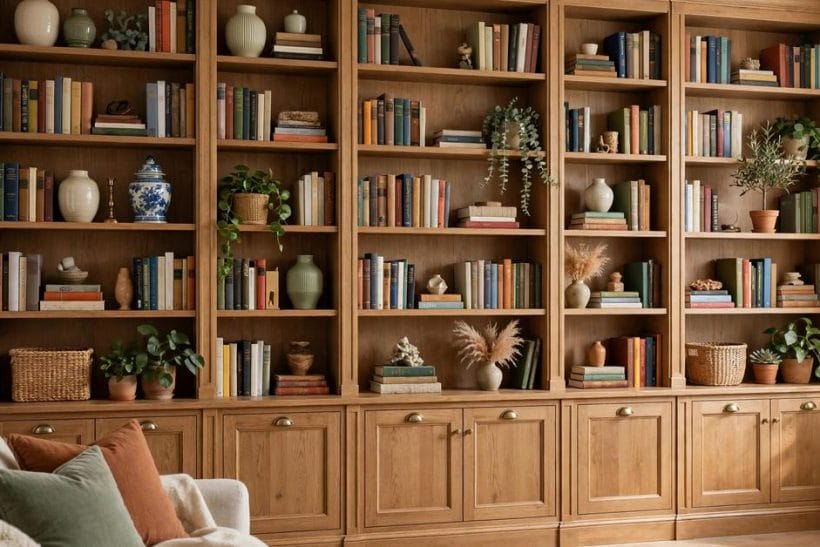
1. Built In Bookshelves at a Glance
The central entity is the built-in bookcase: shelving constructed as fitted joinery — a carcass measured and scribed to the room, with shelves fixed or adjustable, a finished back, and face details such as cornice and skirting that continue the room’s own architecture — together with its contents, the household’s real library. Its attributes are capacity without footprint, composition at the scale of a whole wall, storage divided between display above and cupboards below, and a permanence that reads as part of the house rather than furniture in it. This post owns the bookcase lane of the built-ins family: the fireplace built-ins survey owns bookcases composed around a fire, the built-in closets survey owns the same fitting craft applied to clothes, and both are linked here as siblings, not retold. All fixing, heat-adjacent and electrical points are stated generally, as professional work under local rules.
| Question | Short answer |
|---|---|
| What defines a built-in bookcase? | Shelving built as fitted joinery — scribed to the wall, finished with the room’s own cornice and skirting lines. |
| How is it sized correctly? | From the real collection: the tallest and deepest books set the shelf heights and the carcass depth. |
| What is the classic layout? | Cupboards below for the untidy volumes, open shelves above for the library, lighting built into the carcass. |
| How does it differ from its siblings? | The fireplace post owns cases around a fire; the closet post owns fitted storage for clothes. This post is bookcases, on their own walls. |
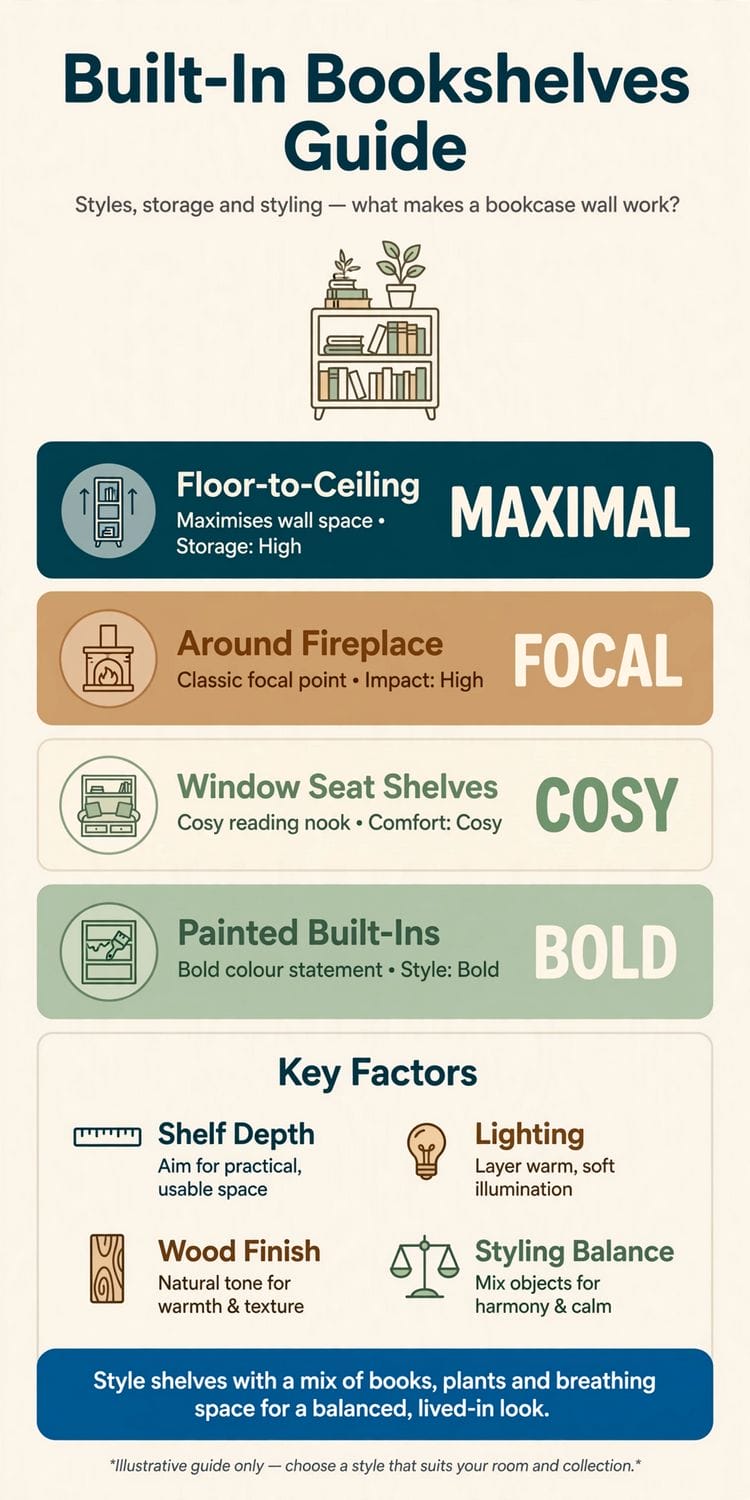
2. The Joinery Itself: Carcass, Shelves, Backing and Trim
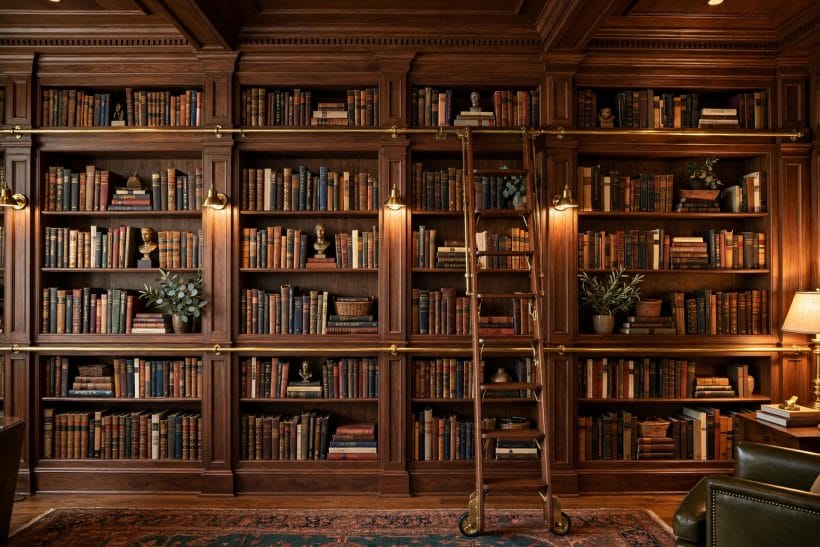
A built-in bookcase is architecture pretending to be furniture, and this survey stays on bookcases throughout. Its closest siblings are linked as their own lanes where they belong; here the subject is the bookcase itself — how it is built, and why construction choices decide whether it reads as a library or as a compromise. All fixing, structural and electrical points are stated generally, as work for joiners and the trades they call in.
1. The carcass: boxes built to the wall
A built-in starts as a carcass measured to the room’s real dimensions — its smallest true points, not its nominal ones — and scribed to walls that are never quite straight.
2. Fixed shelves for the library look
Shelves fixed at spacings set by the books they will hold give the classic, composed library wall.
3. Adjustable shelves for the living collection
Shelves on pins or tracks forgive collections that grow, shrink and change format. The joinery trick is to make adjustability invisible — recessed tracks, matched shelf edges — so flexibility never reads as office furniture in the sitting room.
4. Depth decided by real books
Shelves should be sized from the household’s actual shelves-worth: paperbacks, art folios and children’s picture books ask very different depths, and a case built for one wearing the other looks wrong in both directions.
5. Backing that makes it architecture
A panelled, painted or timber backing turns a bookcase into a wall, while an open back turns it into a rack.
6. Face frames and cornice: the furniture face
A face frame, a cornice continuing the room’s own moulding, and skirting run across the bookcase’s base make the joinery disappear into the house. The bookcase stops looking installed and starts looking original — the highest compliment built-ins can earn.
7. Timber, or painted joinery timber
Fine timber bookcases star in libraries and studies; painted softwood and board serve everywhere else at gentler cost and take the room’s colour exactly.
8. The plinth and the level floor
Old floors slope, and a built-in must start level or every shelf broadcasts the tilt. A scribed plinth, levelled by the joiner before the carcass lands, is the unglamorous foundation of every serene library wall in this survey.
9. Doors below, shelves above
The classic division — cupboards in the bottom section, open shelves above — hides the household’s untidy volumes, games, cables and archives where they belong, and displays the books where they glow.
10. Lighting built into the case
Shelf lighting wired in at build time, with cables hidden in the joinery, turns evening bookshelves into the room’s warmest wall.
11. Ladders and steps for tall cases
Floor-to-ceiling cases need their reach solved handsomely: a library ladder on a rail, or a solid step stool that lives in the design.
3. Library Walls: The Full-Room Bookcase
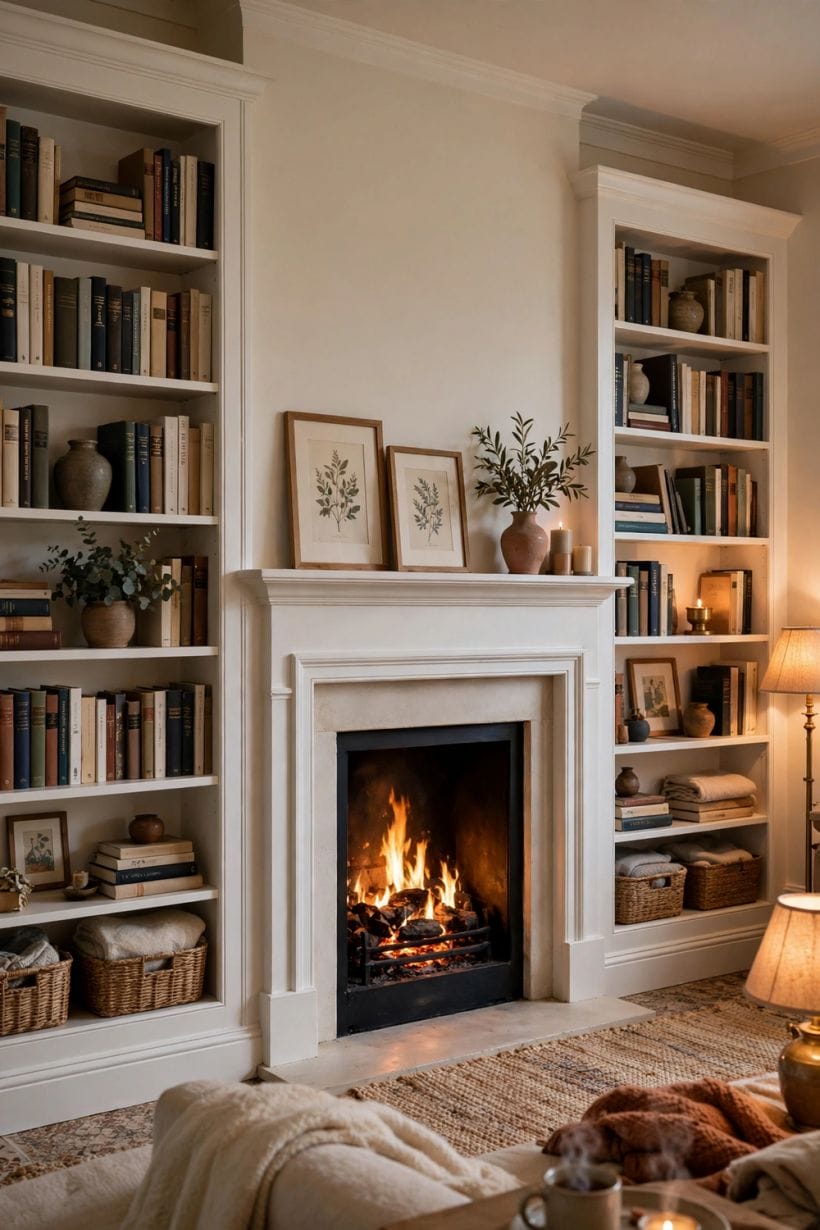
The library wall is the built-in’s grand register — a whole elevation of books, composed like architecture. The living spaces that host these walls have their own surveys, including the living room ideas pillar; this section stays on the wall of books itself and the composition decisions that make it cohere.
12. Wall to wall, floor to ceiling
The complete treatment: cases filling one elevation entirely, cornice at the top, skirting at the bottom, no gaps apologising at the edges.
13. Symmetry around a central opening
Cases balanced either side of a window, door or fireplace give the formal, Georgian calm. Symmetry forgives mixed contents — the architecture holds the composition while the shelves hold everything from atlases to board games.
14. The asymmetric modern library wall
Contemporary cases break the grid deliberately: varied bay widths, a reading niche left open, one tall section for folios. The asymmetry works only when it is clearly designed — measured from the room’s geometry, not from leftover space.
15. A doorway through the books
Cases wrapping a doorway, with a shelf bridge above it, make the entrance to a room a threshold through literature.
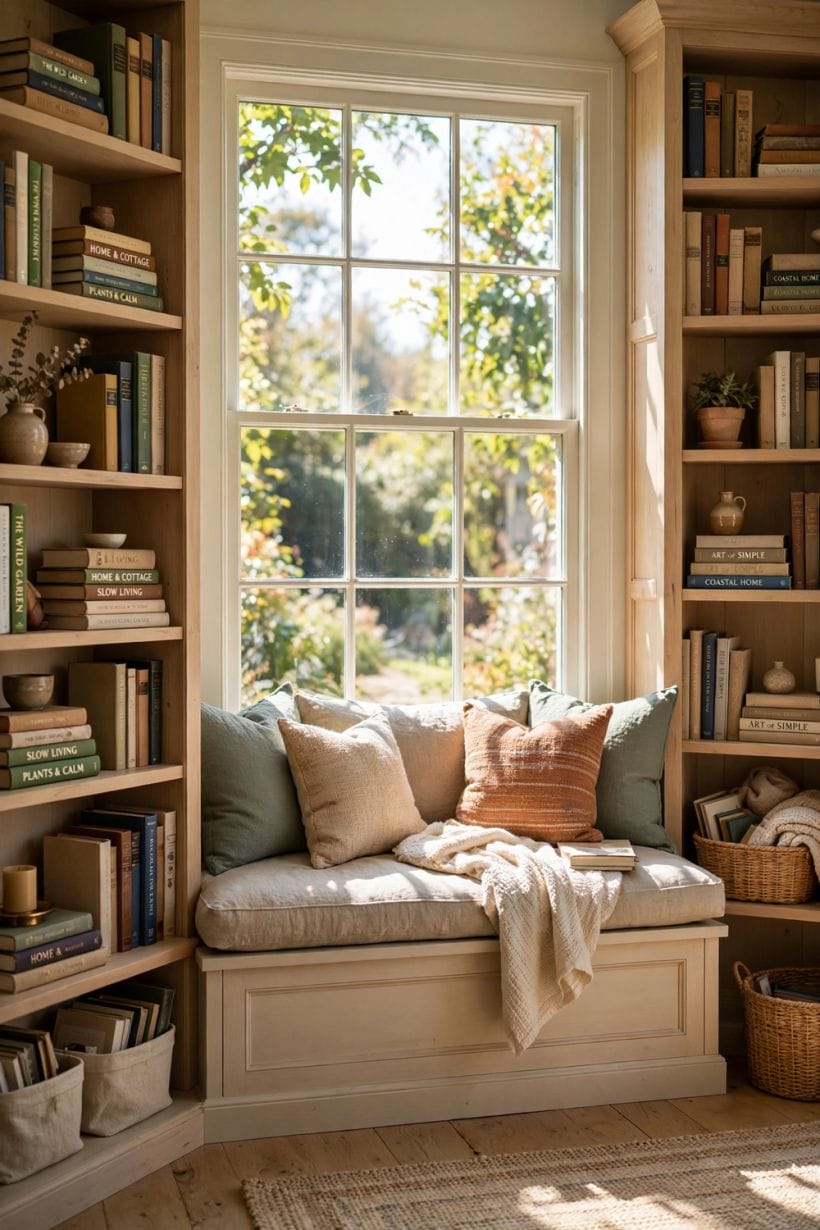
16. The window seat inside the library
A deep window opening flanked and bridged by cases, with a seat in the window itself, is the reader’s altar in its complete form. It is also a composition the study room ideas lane admires from its own side; here it is built as a bookcase, seat and all.
17. Two walls meeting at a corner
Turning the library around a corner — with the corner bay mitred, curved or left as a square pier of books — doubles the wall’s hold on the room.
18. The fireplace wall of books — a sibling’s lane
Bookcases flanking a fireplace are this family’s most famous composition, and its fireplace-flanked specialist survey is the fireplace built-ins post, which owns the fire’s clearances and the white-joinery register. Here it is simply saluted as the classic the library wall grew from.
19. Books as the room’s colour
A full library wall needs no other decoration: bindings supply the palette.
20. The media wall absorbed into books
Television, sound and screens housed in one bay of a bookcase wall, behind doors or in the open, let a sitting room be a library first.
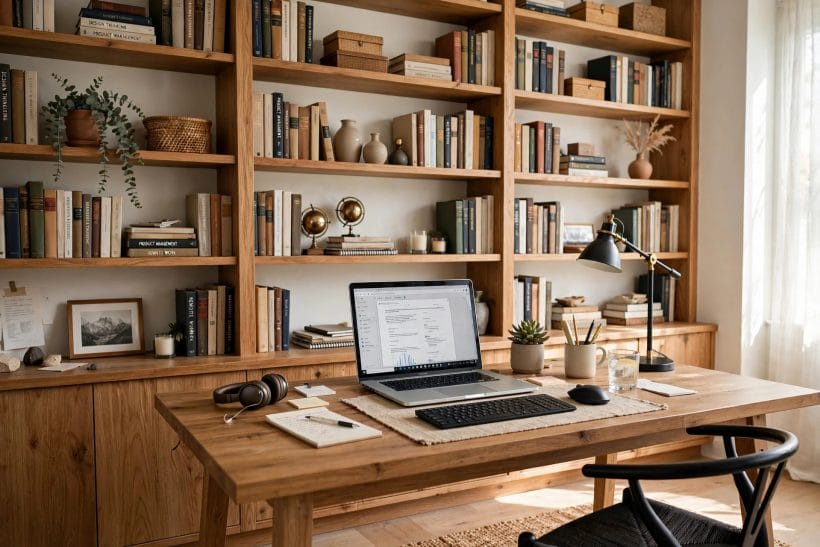
21. A desk bay within the wall
One bay left as a desk — shelf above, light above that, the chair drawn up — makes the library wall work as a study without a study’s room.
22. Ceiling height borrowed back
Taking cases to the ceiling adds a shelf or two and, more importantly, ends the dusty no-man’s-land where shorter cases hoard ornaments.
4. Bookcases Around the Room: Windows, Doors, Chimneys and Corners
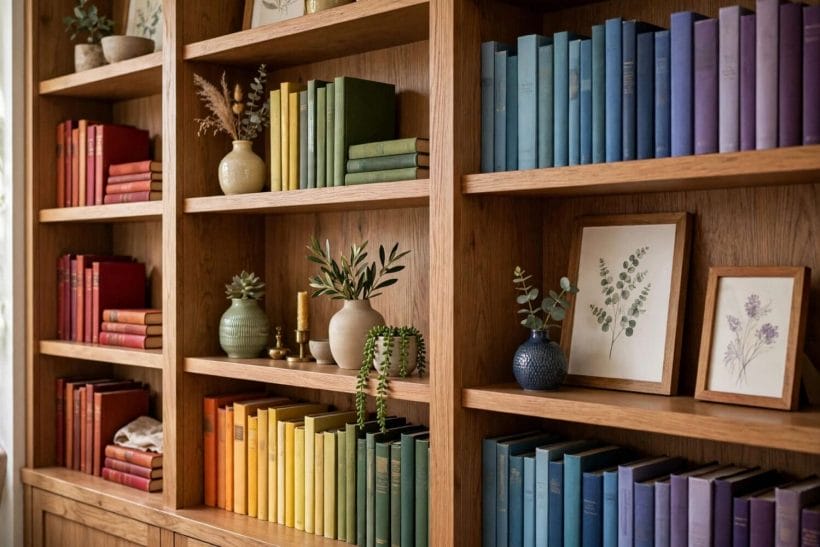
Not every bookcase is a wall. This section composes cases into the room’s awkward gifts — around openings, into alcoves, across chimney breasts — where fitted joinery turns architectural leftovers into the house’s most characterful storage. Its closet sibling, which solved the same fitting problem for clothes, is the built in closets survey; here the fittings hold books.
23. Alcove cases, the classic pair
The alcoves beside a chimney breast are where built-ins were born: two fitted cases turning dead recesses into libraries.
24. Cases around a window
Bookcases framing a window, with a low case beneath it as a seat or shelf, make the light work for the reader: books to the hand, daylight over the shoulder.
25. The chimney breast in books
Wrapping shallow cases across a chimney breast itself — where depth allows and heat is honestly assessed by professionals — turns a blank projection into a media or display wall.
26. Corner cases that turn gracefully
A corner handled with a diagonal or curved bay keeps the library flowing; a corner handled with two cases butted leaves a dead wedge and a visible compromise.
27. Low cases as room dividers
A waist-high bookcase dividing sitting from dining, back panelled and top finished as a shelf for lamps and plants, stores books on both faces in double-sided versions. Low cases divide without darkening, which is why open-plan houses keep rediscovering them.
28. The hallway library
A hall wide enough for one shallow case gains a library corridor: books at paperback depth, a runner underfoot, pictures opposite.
29. Staircase walls of books
The wall following a stair’s rake takes shelves stepped with the flight — the house’s most theatrical bookcase and a joinery showpiece.
30. Bay window cases
Inside a bay, low cases following the facets, with a cushioned top, make the window seat library that estate agents photograph first.
31. Cases in the eaves and attics
Sloped ceilings defeat freestanding furniture and surrender to fitted joinery: cases stepped down the slope, drawers in the lowest triangle, the tall centre bay for folios. Attic libraries in the eaves are among the most loved rooms in this survey.
32. The bed wall of books
A headboard wall of cases — shallow shelves above, deeper bays to the sides, reading lights in the joinery — makes the bedroom its own library.
33. Bookcases in children’s rooms
Low, deep, reachable cases sized to picture books, with face-out display shelves a small reader can browse by cover.
5. Styling the Shelves: Books, Objects and Breathing Room
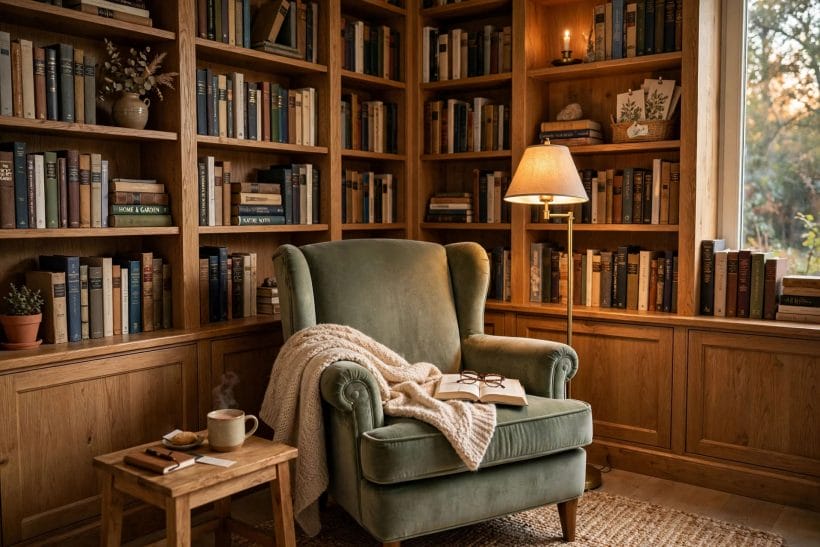
A bookcase is built once and styled forever. This section arranges the contents — the balance of books and objects, order and air — that separates the libraries everyone photographs from the storage everyone else sees. The reading-corner end of this art is the reading nook ideas lane’s home ground; here the styling stays on the shelves themselves.
34. Books first, objects second
The honest hierarchy: a bookcase is for books, and objects earn their places among them rather than evicting them. Rooms styled with books as props age into embarrassment; rooms where real libraries carry a few chosen objects age into character.
35. Breathing room at the ends of runs
Leaving the last hand’s breadth of some shelves empty — or lying a small stack flat there — lets the eye rest and the collection look chosen.
36. Horizontal stacks as punctuation
A low pile of books laid flat breaks the vertical rhythm, carries an object on top, and gives the shelves their composed, magazine calm.
37. Art and objects with real jobs
A picture leaned in a bay, a bowl that actually holds the reading glasses, the clock, the plant that trails — objects with jobs belong on shelves. Pure ornaments, however pretty, are the first thing a growing library rightly evicts.
38. Order systems that survive real life
By subject, by author, by household member, by the order they will be re-sought — any order maintained beats any order admired. Colour-ordering suits small, stable collections and photographs; it quietly fails every reader who actually retrieves books nightly.
39. Face-out favourites
One or two beloved covers displayed face-out, like a bookshop’s choice shelf, give the wall its changing exhibition. Rotate them with seasons and obsessions; the face-out bay is the library’s conversation with the room.
40. The deep-shelf strategy
On deep shelves, books sit at the front edge in one proud row — never double-ranked into invisible exile, unless the back row is raised on a hidden step.
41. Lighting the styled shelf
Warm, low light from above each bay flatters bindings and faces alike; a single picture light over the face-out shelf makes the evening wall. Styled shelves under cold ceiling light lose half their effect — lighting is styling’s silent half.
42. Plants on shelves, placed kindly
Trailing plants soften case geometry beautifully and water damage ruins shelves completely; the reconciliation is cachepots, saucers and plants placed where a drip lands on a sill, not a folio.
43. Editing as a household ritual
A library that never sheds becomes storage that happens to hold books.
44. The chair completes the styling
Every styled library wall needs its reader’s chair drawn near, with a side table and a lamp — the reading nook the shelves imply, completed in furniture. The reading nook ideas survey composes such corners in full; on a library wall, the chair is styling’s full stop.
6. For Readers: The Chair, the Light and the Room Around the Books
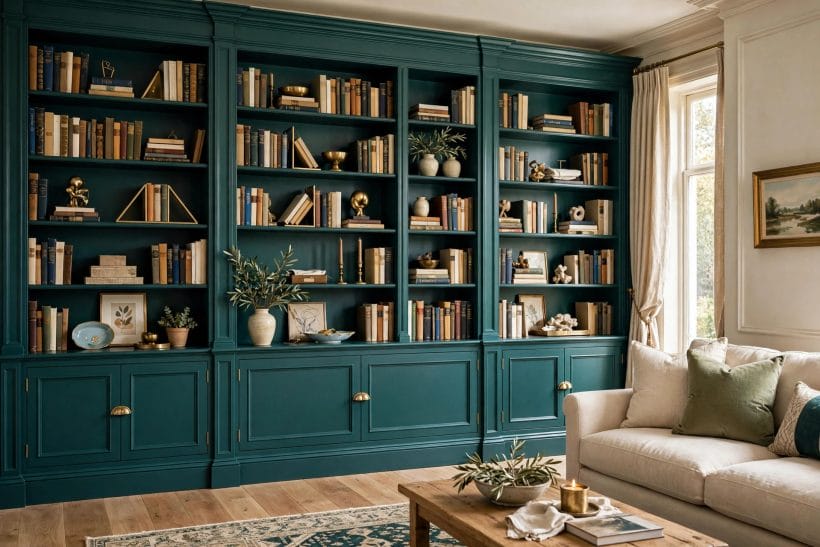
A bookcase succeeds only when somebody reads beside it. This section composes the reader’s side of the wall — the seat, the lamp, the table and the room’s traffic — because the finest joinery in the survey still fails a household that can admire its books only standing up.
45. The armchair drawn close
One deep chair, angled to the shelves and the window at once, with the current book’s stack on its side table — this is the library wall’s reason for existing.
46. A window seat among the cases
Where a window interrupts the shelving, its seat is the most contested reading place in any house: daylight, a view to rest the eyes, books at both elbows.
47. The lamp at reading height
Reading light belongs at the seated reader’s shoulder, warm and shaded, whether it comes from a floor lamp, a wall light in the joinery, or a picture light’s borrowed glow.
48. A table for the stack and the cup
Every reading chair needs its small table — for the current pile, the spectacles, the drink.
49. The children’s reading corner
A low bay, a cushion on the floor, face-out picture books and a lamp a small reader may switch alone: the corner where readers are made.
50. Evening light for the whole wall
At night the library becomes the room’s fire by other means — if its lighting was layered: shelf lights low and warm, the chair’s lamp brighter, the rest of the room dimmer.
51. Quiet: the library’s acoustics
Books are superb sound softeners, and a cased wall measurably calms a hard room’s echo.
52. Traffic kept off the reader’s back
Compose the chair where the room’s through-routes pass in front, not behind: readers sit deeper when nobody walks at their back.
53. The shared reading room
Two chairs, one table, lamps at both shoulders — the library for households that read together in companionable silence.
54. A desk among the books
The reader who writes needs the desk bay: reference shelves within swivel reach, light from the left or right as handedness dictates, and the chair that serves both desk and armchair duties being a hopeful fiction — give the desk its own, on castors, and park it in a bay.
55. The morning library
East light, the newspaper chair, coffee on the low case: many houses use their library hardest before breakfast.
7. Small Spaces and Double Duties: Bookcases That Earn Their Footprint
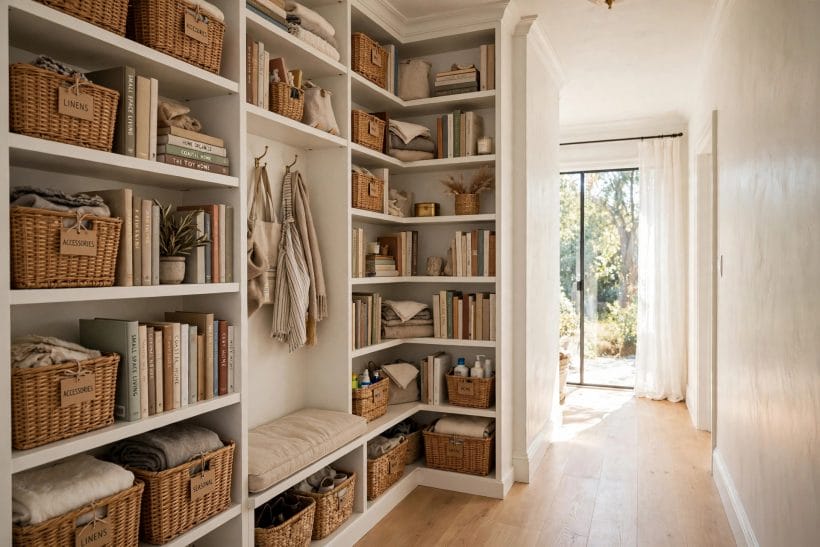
In small homes a bookcase must work double shifts — storage, divider, desk, even bed-head — and fitted joinery is how it does so without wasting an inch. The tiny-house readership of this site asks the most of every wall; this section answers at every scale down to the one-bay flat.
56. One bay, perfectly fitted
A single floor-to-ceiling bay in an alcove or beside a door can hold a household’s whole cherished library if its shelves are spaced from the real collection.
57. The over-door shelf run
The wall above doorways is storage’s most wasted acreage: a fitted shelf run there, reached by the household stool, takes the reference books, the archives, the once-a-year volumes.
58. Bookcase doors and secret shelves
A case built as a door — to a study, a cupboard, a loo — is joinery’s party trick with a serious core: a wall of storage that is also the entrance.
59. The landing library
Landings are pure passage in most houses and pure opportunity in fitted ones: a shallow case wall, a window seat where light allows, the household’s lending library at the top of the stairs.
60. Under-stair bookcases
The triangle under a flight takes stepped cases beautifully — tall bays at the high end, drawers at the low.
61. Bookcases as headboard and room divider in studios
In a studio flat, a double-sided case divides bed from sofa while storing both rooms’ books — the single hardest-working object the flat owns.
62. Kitchen and dining bookcases
Cookbooks deserve joinery too: a case bay in the kitchen or dining room, shelves deep enough for folios of recipes, a section for the serving pieces.
63. The work-from-home case wall
One wall of cases with a desk bay, lockable cupboards for work’s clutter, and shelves that face a camera kindly has become the modern household’s most commissioned joinery.
64. Children growing through the joinery
A nursery case at picture-book depth, re-shelved for chapter books, then study texts, then the teenager’s own library — adjustable shelving and one desk bay make a single commission serve fifteen years.
65. Renters’ honourable approximations
Where walls cannot be built into, tall cases fixed safely back to the wall with furniture straps, cornice added, gaps scribed with trim — the near-built-in — captures most of the effect and leaves with the household.
8. Colour, Light and the Finished Wall
The last design decisions are the visible ones: what colour the joinery wears, how light reaches the books, and how the finished wall sits with the room’s architecture. This section finishes the bookcase as the room will actually see it, morning and evening.
66. Painted the room’s colour: the disappearing library
Cases painted exactly as the walls let the books supply all the colour and the joinery vanish into architecture. It is the calmest, most modern-classic treatment, and the kindest to mixed collections and real life.
67. The dark library: ink, forest and oxblood
Deep colours on cases make bindings glow and rooms feel evening-ready at noon. Dark joinery demands good lighting planned in the carcass; without it, libraries turn to caves — with it, they are the most flattering rooms in the house.
68. Timber tones and the honest grain
Stained or oiled timber cases suit studies, snugs and houses whose architecture is already warm. One timber, used consistently and matched at repairs, is the discipline — a library wall is too big to forgive a near-match.
69. White and pale joinery for small rooms
Pale cases lift small and north-facing rooms, show the books crisply, and forgive the dust less visibly than folklore admits.
70. Back panels in a second colour
Painting the case’s back a tone deeper or warmer than its frame gives shelves a shadow-box depth that flatters everything on them. It is the painter’s cheapest luxury in joinery — one pot, one afternoon, a wall transformed.
71. Picture lights and shelf lights
Brass picture lights over bays, discreet strips under shelves, a lamp’s pool on the reading chair: layered light is what evening does for libraries.
72. Cornice, skirting and the room’s own lines
Continuing the room’s cornice across the cases and its skirting along their base is the finishing discipline that makes built-ins read as the house’s own idea. Every photograph in this survey that looks inevitable has those two lines unbroken.
73. Handles and the closed sections
Cupboard doors in the case want handles that suit the joinery’s register — turned timber, brass, leather — and that hands enjoy daily.
74. The styled top shelf and the ladder’s rest
What stands on the topmost shelf and where the ladder rests are the wall’s final composition.
75. Books, dust and the honest shine
Libraries gather dust where hands do not reach, and the kept library answers with the feather brush and the annual edit rather than with glass everywhere.
9. Checks and Mistakes: Before the First Purchase or the First Stone
Measure the collection before the carcass. Count and measure the books as they will actually live — tallest, deepest, the awkward folios, the growth the household honestly expects — and set depths, shelf heights and bay counts from the collection, not from a catalogue’s standard case. Built-ins fail on paper, in the measuring, long before they fail in the workshop.
Settle the fitting questions professionally. Fixing into walls, cases near heat sources, anything involving wiring for shelf lighting, and tall cases in any house with children are matters for joiners and electricians working to local rules. This survey’s rule is that those conversations happen at design stage, when they are cheap, not at installation, when they are not.
Choose fixed or adjustable shelving by the household’s truth. Libraries that have settled can glory in fixed, composed shelving; growing, shifting, multi-generation collections need adjustability hidden gracefully in the joinery. Either is right; the wrong one, chosen for looks, is resented at every re-shelving for decades.
Avoid the standing mistakes: shelves too shallow for the biggest books, a cornice stopped dead at the case instead of continued across it, skirting omitted at the base, lighting added as visible cable after the fact, and the top gap left as a dusty shelf for ornaments nobody chose. Every one is visible daily, and every one is avoidable on the drawing.
Check the wall and floor before the design hardens. Out-of-square walls, sloping floors and hidden services decide how a case can be scribed, levelled and fixed; the joiner’s site survey, made before final drawings, is what separates the seamless installations in this survey from the shimmed and filled apologies.
Keep the joinery’s records: paint and finish codes, timber and supplier, the maker’s name, one spare shelf and its pins. Built-in bookcases are repaired, extended and re-shelved by future hands — often future owners — and the small file you keep is how the wall stays itself for the next fifty years.
10. Costs and Pulling It Together
Costs for built-in bookcases follow the joinery’s honest logic, stated without figures: a single alcove pair in painted joinery sits at the gentle end, full library walls in fine timber at the deep end, and across the range the maker’s measuring, scribing and finishing hours are the real substance of any quote — compare quotes on construction and materials declared plainly, not on totals alone.
Spend first on the carcass and the fitting: level, scribed, honestly backed and properly fixed. Cornices can continue existing moulding cheaply, lighting can be roughed-in and fitted later if the budget insists, and doors can join open shelves in a second phase — but a case built cheaply at its bones resents every later kindness.
Pulling it together: size the case from the real books, fit it to the real wall, divide it into display above and storage below, light it from inside its own joinery, and finish its lines as the room’s own. Do that, and the bookcase disappears into the house while the library takes over the room — which is the whole art this survey, inside the wider world of the site’s home design ideas collection, exists to teach.
Final Considerations
A built-in bookcase is the rare commission that improves a house twice: once as architecture, immediately, and once as a library, compounding daily. The five posts of joinery in this family each own their fitting — closets, fireplace walls and now the bookcase itself — and the bookcase’s claim is the oldest: it turns a room into the place the household’s mind lives.
Commission it from the real collection, fit it to the real wall, and style it by editing rather than filling. Then draw the chair close. The wall will do the rest, the way it has in every loved library in this survey — quietly, warmly, and shelf by ordered shelf.

0 Comments