

One number answers this question exactly — not roughly, not by trade habit, but by arithmetic anyone can check in twenty seconds: 27.
This explainer derives that number from the units themselves, converts both ways, and works it through mulch, soil and concrete examples with every step shown — no other figures, no prices, nothing to take on trust.
1. How Many Cubic Feet in a Cubic Yard at a Glance
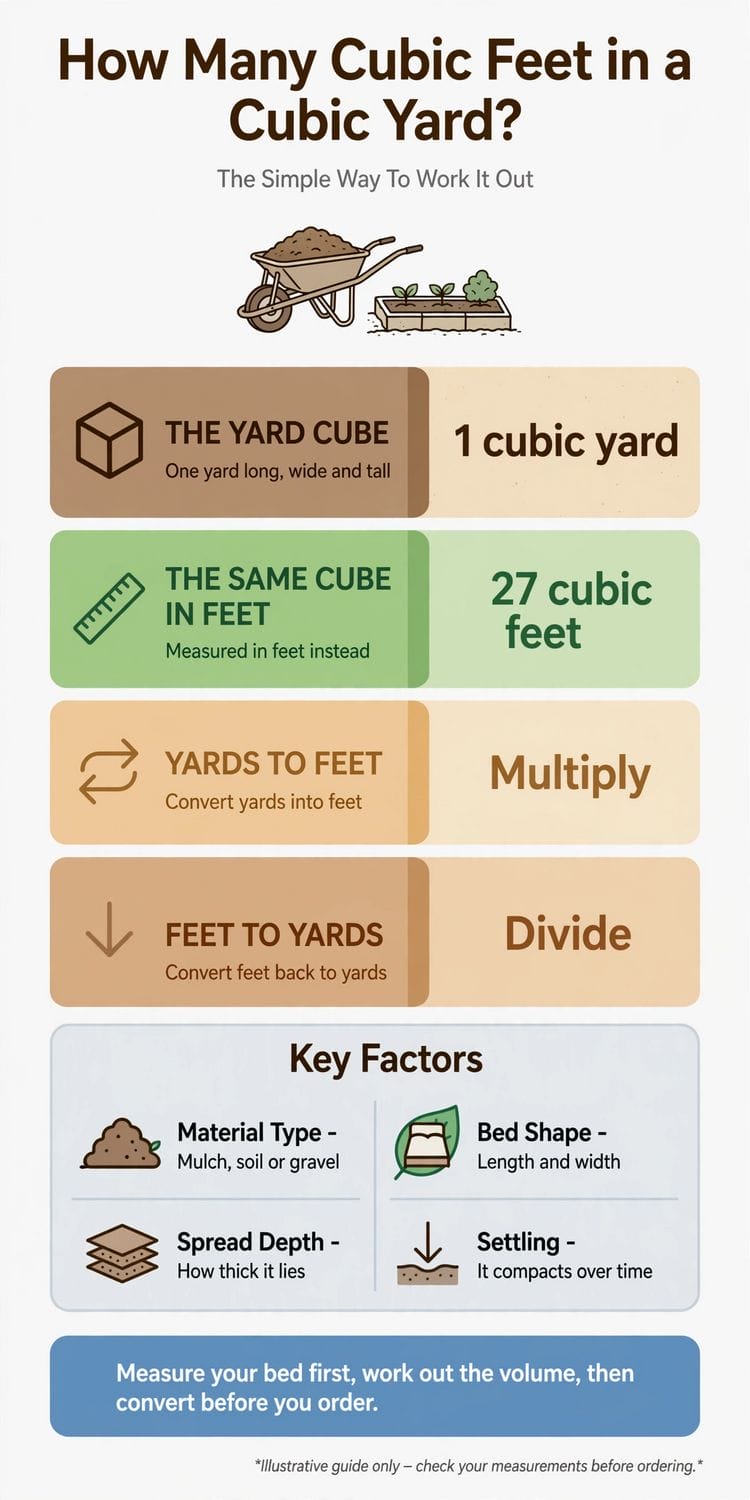
The central entity is the cubic yard as a unit of volume, defined against the cubic foot. A cubic foot is a one-foot cube; a cubic yard is a cube one yard — three feet — on every edge, and filling it with one-foot cubes takes 3 × 3 × 3 = 27 of them, so one cubic yard equals exactly 27 cubic feet. This is a verifiable mathematical fact, not an estimate or a statistic, and it is the one precise figure this guide is built on: all other numbers in the post are either round example inputs chosen for clarity or results derived from the constant by shown working — area times depth for volume, division by 27 for yards, multiplication by 27 for feet. No prices, product specifications or statistics appear anywhere in the post.
| Question | Short answer |
|---|---|
| How many cubic feet in a cubic yard? | Exactly 27 — because a yard is 3 feet, and 3 × 3 × 3 = 27. |
| How do I turn cubic feet into cubic yards? | Divide by 27. For example, 54 cubic feet ÷ 27 = 2 cubic yards. |
| How do I turn cubic yards into cubic feet? | Multiply by 27. For example, 3 cubic yards × 27 = 81 cubic feet. |
| How do I find a project’s volume? | Length × width (in feet) × depth (in feet, so inches ÷ 12 first) gives cubic feet; then divide by 27 for cubic yards. |
2. The Two Units: What a Cubic Foot and a Cubic Yard Actually Are
Both units measure volume — how much space something fills — and both are built from the humble cube. A cubic foot is the volume of a box whose edges are each one foot long: one foot wide, one foot deep and one foot high. A cubic yard is the same idea at yard scale: a box whose edges are each one yard — that is, three feet — long. Nothing else hides inside either unit; there is no density, weight or material involved, only space.
Volume is not area, and not weight
The confusion this guide exists to clear up usually starts here. Square feet and square yards measure flat area, like a floor; cubic feet and cubic yards measure filled space, like a skip, a soil heap or a concrete slab. And volume is not weight either: a cubic yard of light, dry mulch and a cubic yard of wet soil fill exactly the same space, while weighing very different amounts, because weight depends on the material and volume does not.
Why the yard is the bulk unit
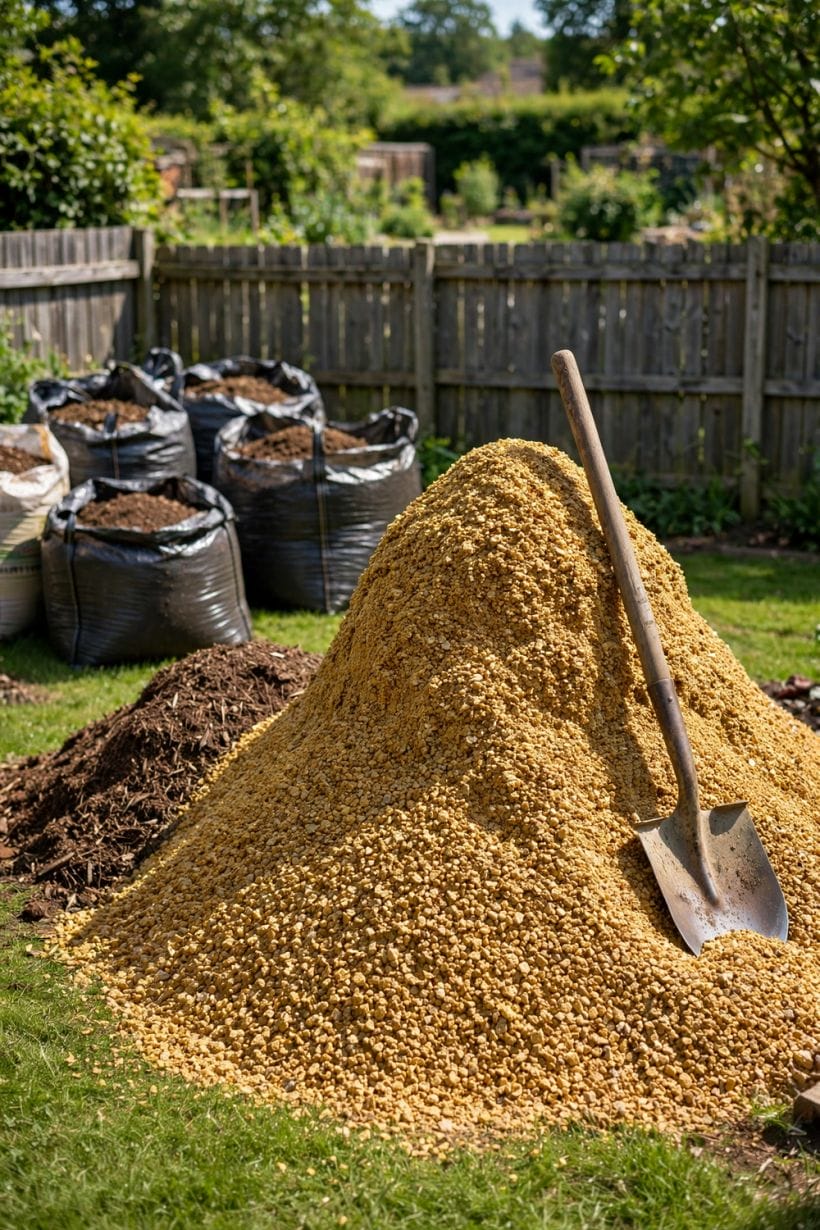
Garden and building materials are sold in bulk by the cubic yard because the cubic foot is inconveniently small at that scale — soil, mulch, gravel and ready-mixed concrete are ordered in whole or part yards, delivered loose or in bulk bags described by volume. Bags on a shelf, by contrast, are usually labelled in cubic feet. Home projects live in both worlds at once, which is why the conversion between them is the one piece of arithmetic this whole topic turns on.
Keep one picture in mind for everything that follows: the one-yard cube, three feet on every edge, filled completely by stacking one-foot cubes inside it. The next section simply counts those cubes — and the count is the answer to the question in this post’s title.
3. The Conversion Itself: Multiply, Divide and the Number 27
Here is the whole conversion, derived in one line of counting. The yard cube is 3 feet wide, 3 feet deep and 3 feet high. Filling it with one-foot cubes takes 3 along the width, 3 along the depth and 3 in height: 3 × 3 × 3 = 27. So one cubic yard contains exactly 27 cubic feet. That is not an approximation, a trade convention or a rounded rule of thumb — it is exact, and every calculation in this guide is built from it and can be checked against it.
Cubic yards to cubic feet: multiply by 27
To turn cubic yards into cubic feet, multiply by 27. One cubic yard is 1 × 27 = 27 cubic feet. Two cubic yards are 2 × 27 = 54 cubic feet. Three cubic yards are 3 × 27 = 81 cubic feet. Half a cubic yard is 0.5 × 27 = 13.5 cubic feet. The rule never changes with the material, because the units measure space only.
Cubic feet to cubic yards: divide by 27
To turn cubic feet into cubic yards, divide by 27. A volume of 54 cubic feet is 54 ÷ 27 = 2 cubic yards. A volume of 135 cubic feet is 135 ÷ 27 = 5 cubic yards. Most real projects land between whole numbers — 40 cubic feet is 40 ÷ 27, which is about 1.48 cubic yards — and a decimal answer like that is normal, correct and exactly what you round up from when ordering, as the worked examples show.
The sanity check that catches every error
Whichever direction you convert, check the size of the answer against the units: a cubic yard is the bigger box, so the number of cubic feet must always be larger than the number of cubic yards for the same volume. If your arithmetic produces fewer cubic feet than cubic yards, the operation went the wrong way — divide instead of multiply, or the reverse. This single check catches the most common conversion error before it reaches an order form.
4. Worked Example: Mulch for a Garden Bed
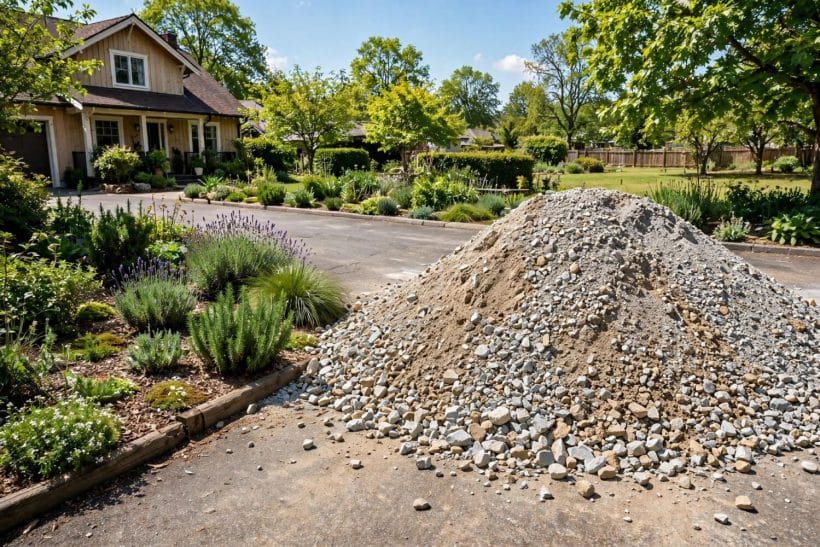
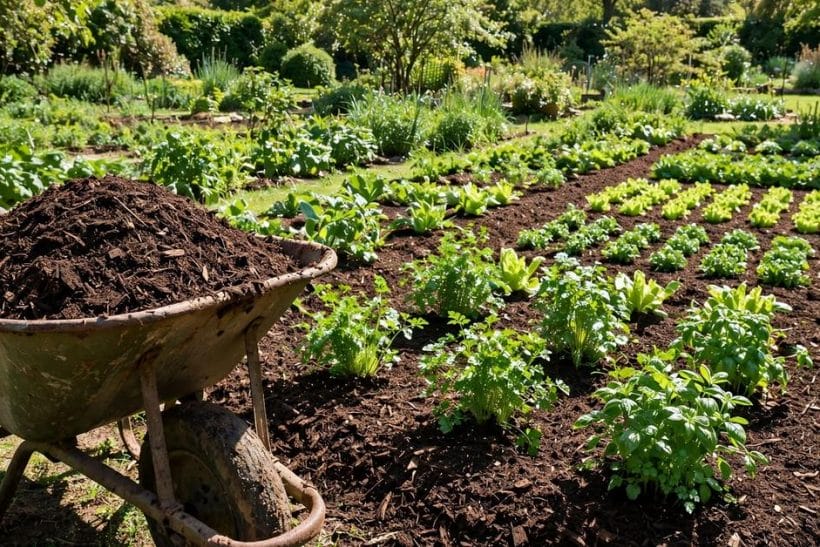
Take a simple rectangular bed, 10 feet long and 5 feet wide, to be mulched 3 inches deep. Every input is a round number, and each step is shown, so the working can be followed and re-checked. The soil and planting side of beds like this belongs to the what is loam explainer; this section is purely the measurement.
Step one: turn the depth into feet
Depths for mulch and soil are usually given in inches, and the formula needs feet, so convert first by dividing by 12, because there are 12 inches in a foot. Here, 3 inches ÷ 12 = 0.25 feet. The other conversions worth knowing by sight are 6 inches = 0.5 feet and 12 inches = 1 foot exactly; 2 inches is one sixth of a foot, about 0.167 feet, if a thinner layer is planned.
Step two: work out the volume in cubic feet
Multiply length by width by depth, all in feet: 10 × 5 × 0.25 = 12.5. The bed needs 12.5 cubic feet of mulch. That figure is complete and correct in cubic feet — it is the number to use if the mulch is bought in bags labelled by the cubic foot.
Step three: convert to cubic yards
Divide by 27: 12.5 ÷ 27 = about 0.46 cubic yards — just under half a cubic yard. So the same bed can be ordered either way: 12.5 cubic feet from the bag shelf, or roughly half a cubic yard in bulk. When the two routes are priced, compare them on this same volume, never bag count against yard count, which is how mulch budgets quietly go wrong.
5. Worked Example: Soil for Raised Beds and a Topsoil Layer
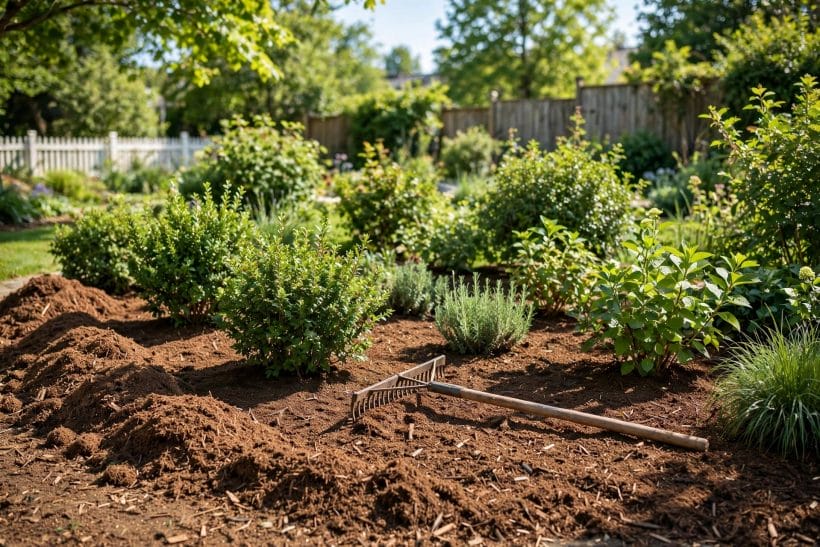
Soil is where the conversion earns its keep most often, because beds are measured in feet, depths in inches, and bulk soil is sold by the yard. Two examples follow, both with round inputs and every step shown.
Filling a raised bed
A raised bed 8 feet long and 4 feet wide, filled 1 foot deep with soil: the volume is 8 × 4 × 1 = 32 cubic feet. Convert to yards by dividing by 27: 32 ÷ 27 = about 1.19 cubic yards. Two identical beds need exactly double: 64 cubic feet, which is 64 ÷ 27 = about 2.37 cubic yards. In practice the order is rounded up from the calculated figure, because a bed filled nearly full settles and because running short mid-fill is worse than a modest surplus that the garden will always find a use for.
A topsoil layer over a rectangle
Topsoil spread 6 inches deep over a rectangle 20 feet by 10 feet: first the depth, 6 inches ÷ 12 = 0.5 feet. Then the volume: 20 × 10 × 0.5 = 100 cubic feet. Then the conversion: 100 ÷ 27 = about 3.7 cubic yards. Notice how a modest-looking layer over a fair area becomes several yards — depth multiplied over area grows volumes faster than intuition expects, which is precisely why the arithmetic, and not a guess at the supplier’s yard, should make the order.
One caution belongs with every soil example: these calculations give the volume to order, not the weight to move. A cubic yard of soil is a heavy thing by any measure, and how it arrives — loose-tipped, in bulk bags, or in small bags carried through the house — is a logistics decision to make with the supplier, on the volume figures this guide produces.
6. Worked Example: Concrete for a Slab and a Path
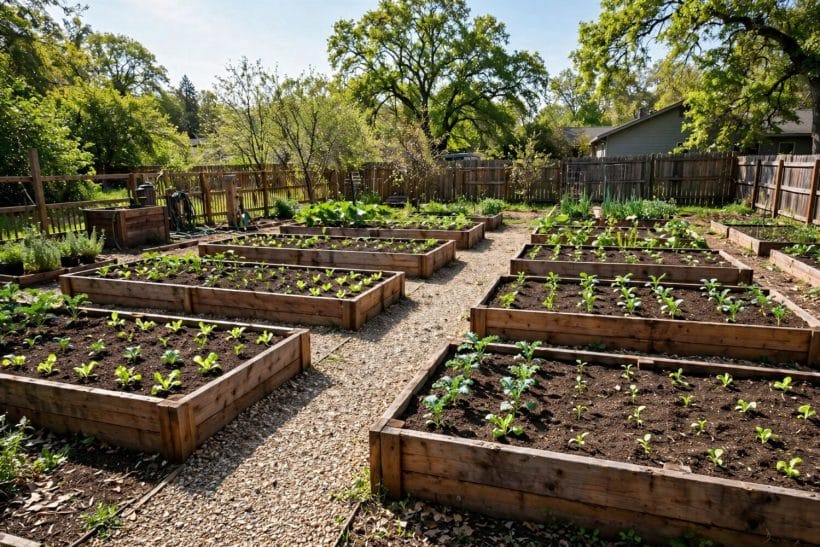
Concrete is ordered by volume and wasted by miscalculation, so it is the conversion’s most serious use. The slabs here are small garden structures; anything structural is designed and specified by professionals, and this section covers only the volume arithmetic. Finished concrete surfaces as a patio material are surveyed in the concrete patio ideas lane — here the same material is simply being measured.
A small square slab
A slab 10 feet by 10 feet, poured 4 inches thick. Convert the thickness first: 4 inches is one third of a foot, about 0.333 feet. Volume in cubic feet: 10 × 10 × 0.333 = about 33.3 cubic feet. Convert to yards: 33.3 ÷ 27 = about 1.23 cubic yards. So a modest garden slab is already well past one cubic yard — the single most useful calibration this example offers.
A garden path
A path 12 feet long and 3 feet wide, also 4 inches thick: 12 × 3 × 0.333 = about 12 cubic feet. In yards: 12 ÷ 27 = about 0.44 cubic yards — just under half a yard, the same territory as the mulch bed in the earlier example, reached by a completely different shape. Different materials, different projects, one method: that is the point of learning the method rather than memorising any single answer.
Estimators and suppliers often add a small allowance for uneven ground, spillage and the slab being a fraction deeper in places than drawn. That allowance is a practical judgement to agree with the supplier; the calculated volume itself should stay exact, so the allowance is visible as an allowance and not smuggled into the arithmetic.
7. The General Method: From Any Area and Depth to Cubic Yards
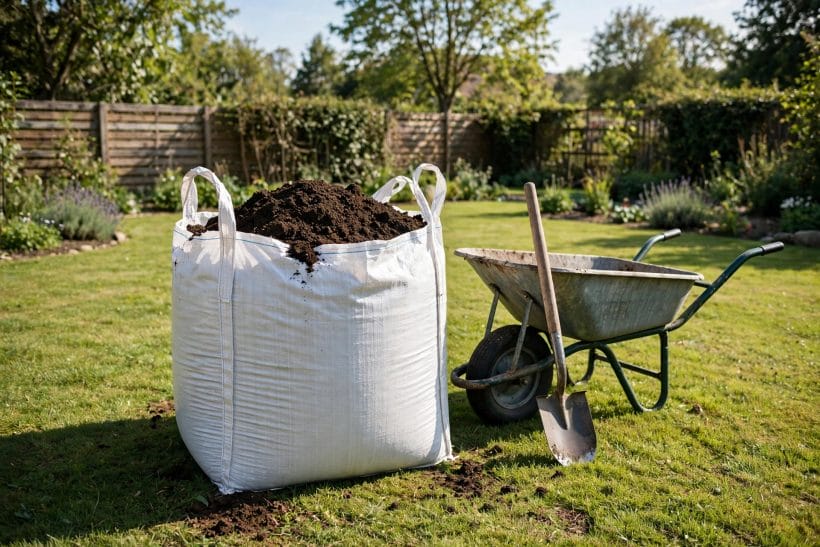
Every worked example above is the same three moves, and this section states them as the reusable method. It is the method the flooring and surfacing trades use daily — floor areas in the flooring installation cost guide, for instance, are measured flat, in square units, and only become volumes when a depth, like a screed or a bed of mortar, is added. Keep area and volume separate in your notebook and the method stays foolproof.
Move one: area in square feet
Multiply the length by the width, both in feet, to get the area in square feet. A rectangle 10 feet by 5 feet has an area of 50 square feet. For awkward shapes, break the plan into rectangles, calculate each, and add them — gardens and rooms are almost always rectangles in disguise.
Move two: depth in feet, then volume in cubic feet
Convert the depth from inches to feet by dividing by 12, then multiply the area by the depth: 50 square feet × 0.25 feet = 12.5 cubic feet. Area times depth is volume — this multiplication is the step most often skipped by estimators who jump straight from the size of a bed to the size of an order.
Move three: divide by 27
Divide the cubic feet by 27 to get cubic yards: 12.5 ÷ 27 = about 0.46 cubic yards. Write the full chain on the order itself — dimensions, depth, cubic feet, cubic yards — so the supplier can check it in seconds and so a mistake, if there is one, is found on paper rather than in a delivered heap. The flat-measurement cousin of this method, for materials sold by area, is walked through in the laminate flooring cost guide.
8. Bags and Bulk: Converting Between the Shelf and the Yard
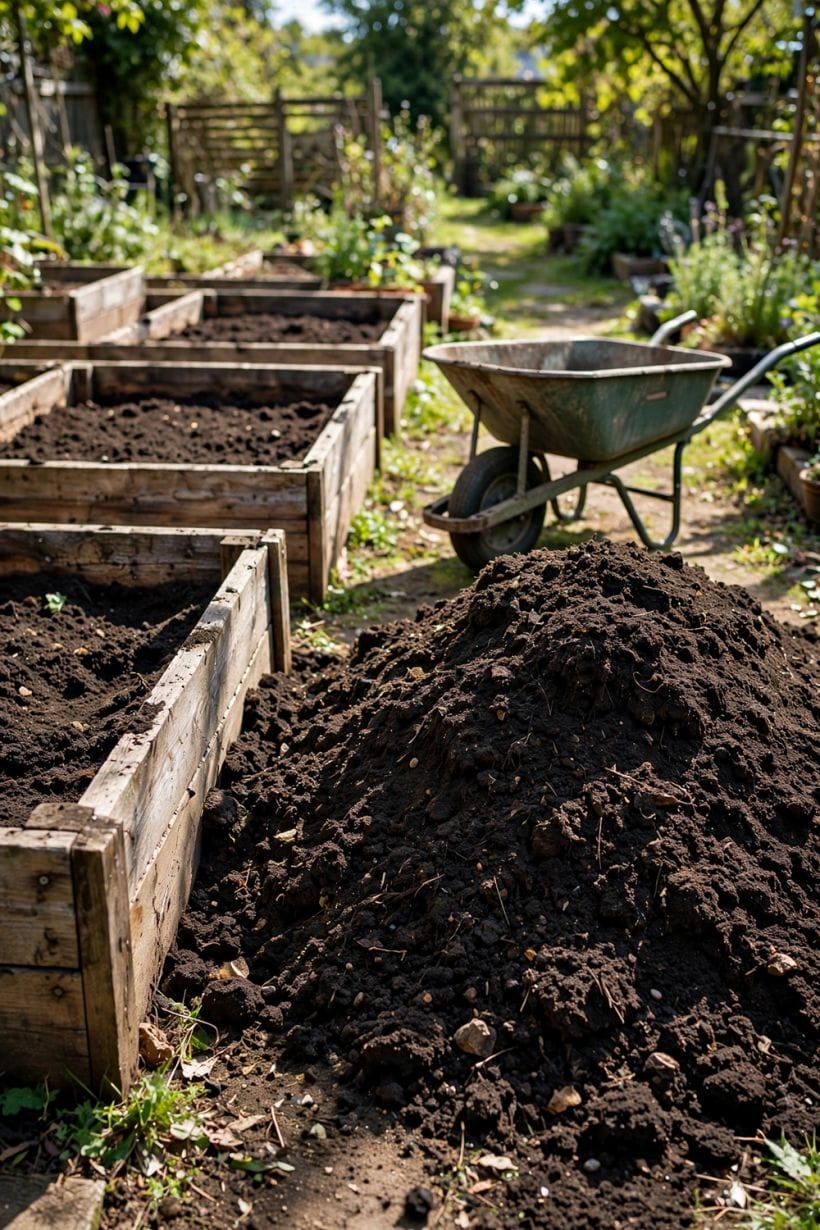
The last everyday conversion is between bagged material, labelled in cubic feet, and bulk material, sold in cubic yards. Bag sizes vary by product and maker, so the examples use one clearly stated, round label size — read your own bag’s label and use its figure in exactly the same arithmetic.
How many bags in a cubic yard?
Suppose a bag is labelled 2 cubic feet. Bags per cubic yard: 27 ÷ 2 = 13.5 bags. Since bags are sold whole, a full cubic yard from that shelf takes 14 bags. The same method serves any label: bags per yard is always 27 divided by the bag’s cubic feet, and the answer is always rounded up to whole bags.
How many bags for part of a yard?
Half a cubic yard is 0.5 × 27 = 13.5 cubic feet. In 2-cubic-foot bags: 13.5 ÷ 2 = 6.75, so 7 bags. The mulch bed from the earlier example needed 12.5 cubic feet: 12.5 ÷ 2 = 6.25, so 7 of those bags cover it, with a little left for topping up thin spots. Working from the calculated volume, rather than from a guess per bed, is what makes bag arithmetic reliable.
Which route suits the project?
As a matter of handling rather than price — prices are your suppliers’ to quote, not this guide’s to invent — small volumes favour bags for cleanliness and storage, and large volumes favour bulk for the labour saved. The crossover is yours to find by pricing the same calculated volume both ways; the conversion in this section is what makes that a fair comparison instead of two unrelated numbers.
9. Common Mistakes: Where Conversions Go Wrong
Using 3 or 9 instead of 27
The classic error. Because a yard is 3 feet, it is tempting to divide cubic feet by 3 — but 3 converts lengths only. Because a square yard is 9 square feet (3 × 3), 9 is tempting too — but 9 converts flat areas only. Volume adds the third dimension: 3 × 3 × 3 = 27. Any conversion of cubic units that does not involve 27 is wrong, however confident it feels.
Forgetting the depth entirely
Measuring the bed, quoting its area, and ordering that number in yards treats a surface as a volume. A 50-square-foot bed at 3 inches deep needs about 0.46 cubic yards, not anything resembling 50 of anything. Depth is not a detail in volume maths; it is a third of the calculation, and leaving it out produces the most expensive mistake in this whole guide.
Mixing inches and feet in one multiplication
Multiplying length in feet by width in feet by depth still in inches gives a number 12 times too large, which then gets divided by 27 into an order several times too big. Convert every measurement to feet before any multiplication begins — the method section’s order of moves exists precisely to prevent this.
Rounding down to the neat number
Calculations end in decimals; deliveries cannot be topped up by the wheelbarrow from the supplier’s yard once the truck has left. Round orders up to the next orderable amount — the surplus of mulch, soil or aggregate always finds work in a garden, while a shortage stops the job. Rounding the calculation itself is fine; rounding it down is the error.
And the meta-mistake, worth stating once: trusting a single unverified number from memory, a forum or a rushed phone call for a fact that takes twenty seconds to derive from 3 × 3 × 3. The constant is checkable, the method is three moves, and every figure in this guide can be re-derived on the back of the delivery note — which is exactly what the readers of the wider patio ideas projects, and every measuring job on this site, deserve.
10. Costs and Pulling It Together
Pulling the whole guide together: the answer to the title question is exactly 27 cubic feet in one cubic yard — 3 feet, cubed. Converting yards to feet-of-volume means multiplying by 27; converting back means dividing by 27; and measuring a real project means area in square feet, times depth in feet, divided by 27. Three facts, each derivable from the others, are the complete toolkit.
Use them in the order that prevents waste: calculate the true volume first, write the working down, price that same volume in bags and in bulk where both exist, and round the final order up — never the calculation down. No prices appear in this guide, deliberately: suppliers and seasons set those, while the volumes you ask them to price are yours to get exactly right.
And keep the check in your pocket for every future quote, delivery and neighbour’s confident shortcut: for the same pile of material, the cubic-feet number is always the bigger one, 27 times bigger than the cubic-yard number. If a figure in front of you breaks that rule, it is wrong — however official the form it arrived on.
Final Considerations
How many cubic feet in a cubic yard? Twenty-seven — exactly, provably, from the three feet in a yard, multiplied by itself three times. It is a small fact, but it is the hinge between the way gardens are measured and the way materials are sold, and getting it right is the difference between a project that flows and a driveway blocked by three times too much soil.
Work the method once on your own next bed, slab or path — area, depth, divide by 27 — and it becomes permanent knowledge, the kind this site’s whole home design ideas collection exists to hand over: not a number to look up again, but a piece of arithmetic you own.




0 Comments