
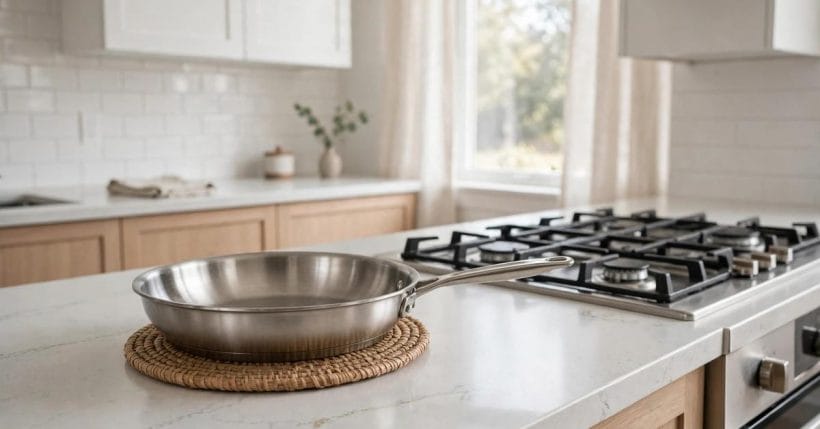
A pan comes off the stove, steam rising, and the nearest flat surface is the countertop. In that moment the question asks itself: can you put a hot pan on quartz? It is a practical question, asked in the middle of cooking, and it deserves a careful answer rather than a hurried one. This post stays with the habits that careful cooks use around quartz tops, the layers that sit between pan and surface, and the places where the maker’s own instructions matter more than any general guide.
Nothing here is a promise about any particular top. Quartz tops differ from one maker to another, and the guidance that came with a given top is the guidance that fits that top. What follows is general care, written for everyday kitchens: how to move hot pans, where to rest them, what to keep within reach of the stove, and how small routines keep a countertop looking its best over time.
1. The Question, Stated Carefully
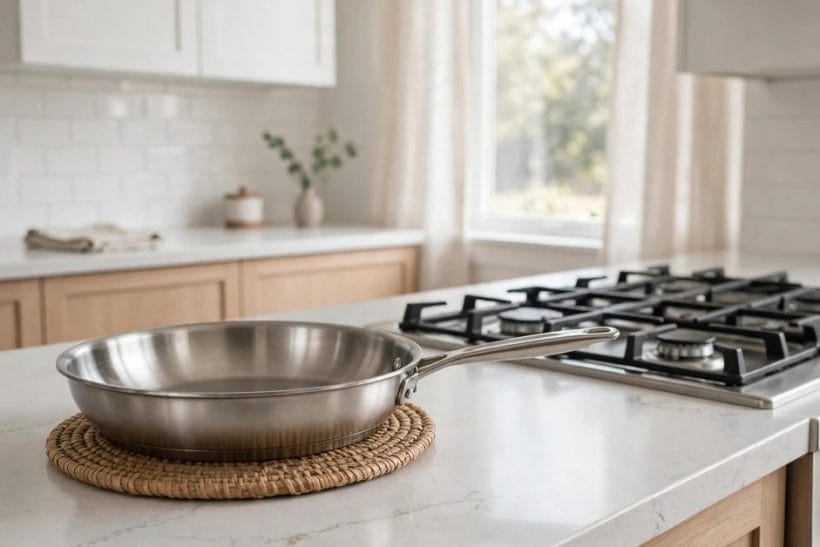
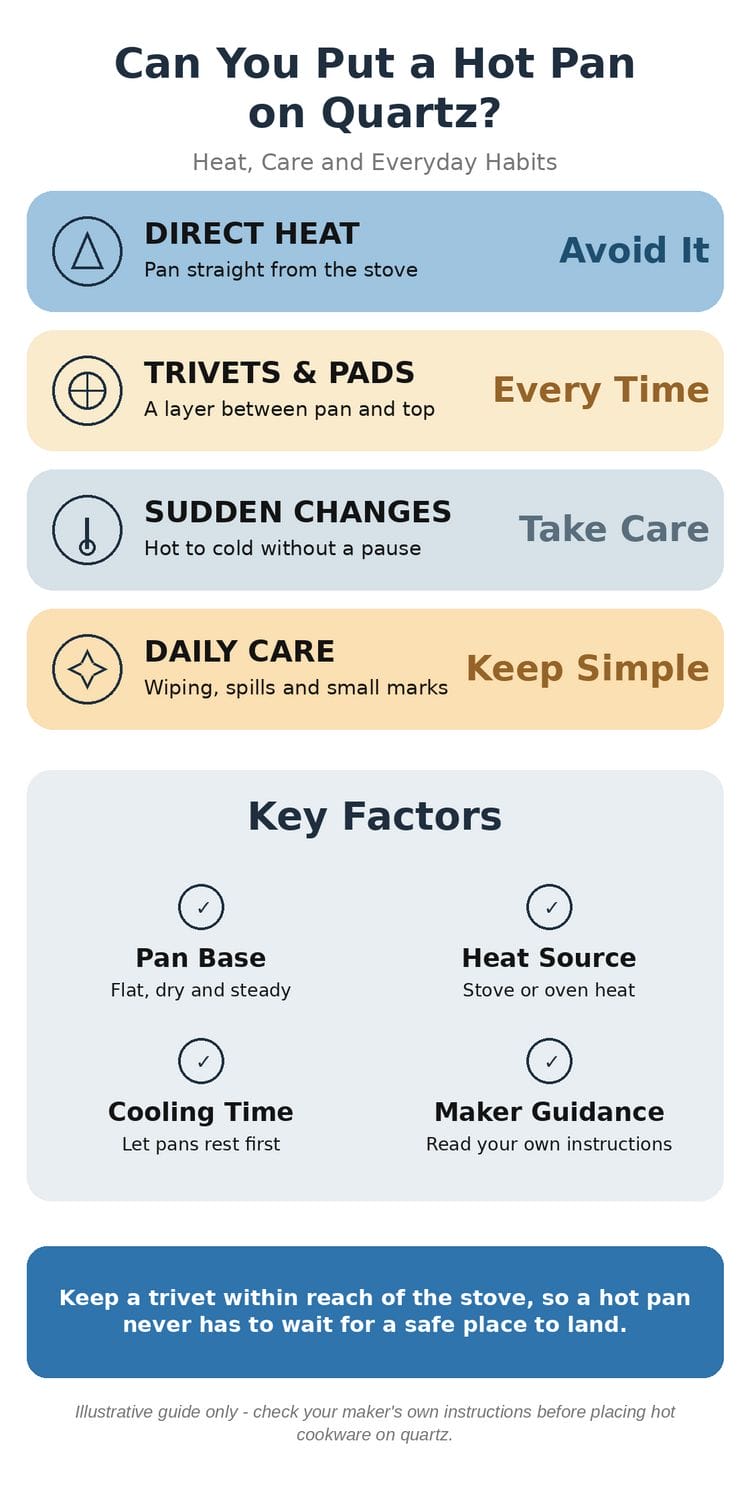
The honest version of the question is not really about a single pan. It is about a habit: what happens, day after day, when hot cookware meets a quartz surface. A single careful moment is easy. The harder part is the busy evening, the pot that is heavier than expected, the tray that has to land somewhere right now. Habits are what carry those moments, and the habit that serves quartz best is a simple one: keep a layer between hot cookware and the top, every time, without stopping to judge how hot the pan feels.
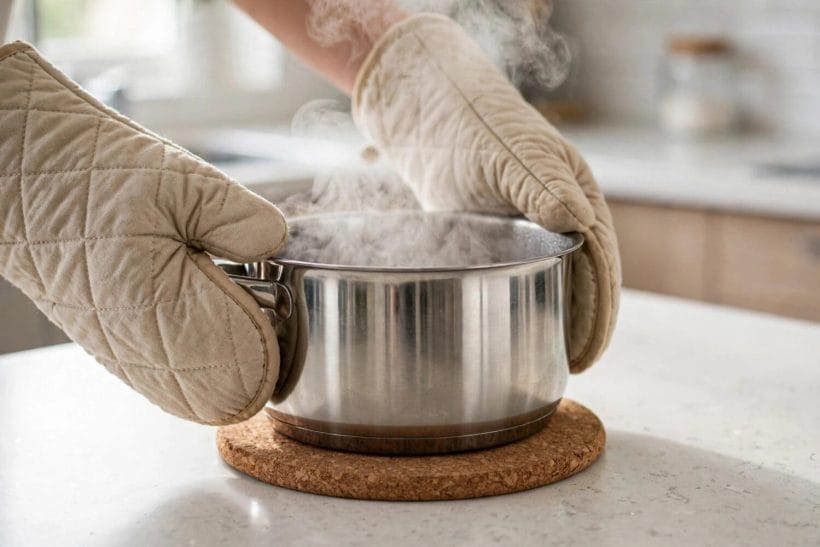
Judging by feel is unreliable. A handle can feel manageable while the base is still carrying far more heat than the surface beneath it should meet directly. Oven mitts protect hands, not countertops, and a pan that is comfortable to carry can still be unwelcome directly on a finished top. The cautious cook therefore does not grade pans by touch. The rule stays the same whether the pan held a gentle simmer or a long roast: it lands on a trivet, a pad or a mat, never straight on the quartz.
That sameness is the point. When the rule has no exceptions, there is nothing to decide in the rush of serving dinner. The trivet lives in one place, the pan goes there, and the countertop stays out of the transaction entirely. Readers who want the wider picture on quartz troubles, from heat marks to stains and chips, will find it in the quartz countertop problems guide, which sets out what to check before buying as well as how to live with a top day to day.
2. What Quartz Is, in Everyday Terms
A quartz countertop is an engineered surface: crushed quartz stone held together with resins and shaped into slabs, then cut and finished for a kitchen. That construction is why quartz tops look so even, why their patterns repeat so calmly across a long run, and why they feel so smooth under the hand. It is also why care guidance for quartz reads differently from guidance for a solid stone slab cut straight from a quarry. The two are not the same material, and habits that suit one do not automatically suit the other.
The resin content is the part that matters for heat habits. Stone itself takes heat in its stride, but the binding that holds an engineered top together is a different substance with different tolerances, and makers describe those tolerances in their own care sheets. That is why general advice can only go so far. A guide can explain the cautious habit; only the maker of a given top can say what that top is made to meet. For the fuller explanation of how quartz differs from granite and quartzite, see the quartz countertop explainer.
In the kitchen, the practical meaning is plain. Treat a quartz top as a beautiful working surface that rewards a little ceremony around hot pans, rather than as a resting place for them. The ceremony is small: a trivet by the stove, a pad by the oven, a mat where trays land. Once those pieces are in place, the habit costs nothing and the top is never asked to do work it was not described as doing.
3. Why a Barrier Between Pan and Top Helps
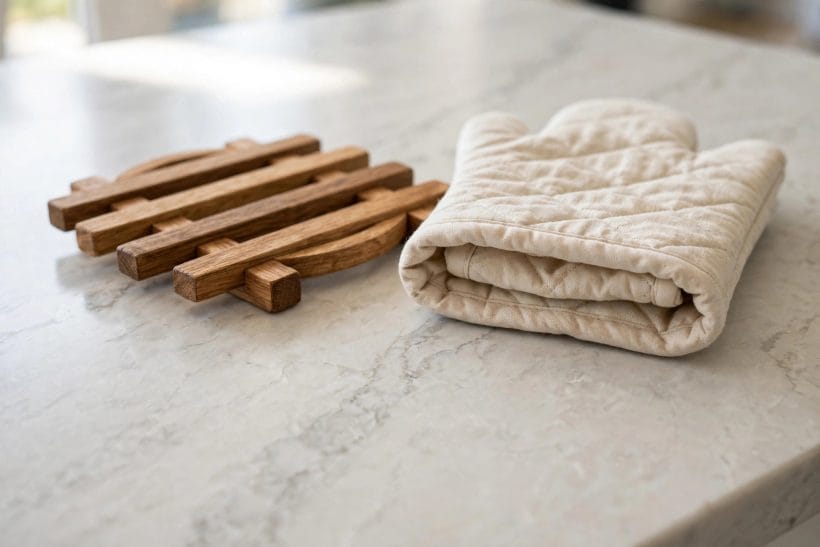
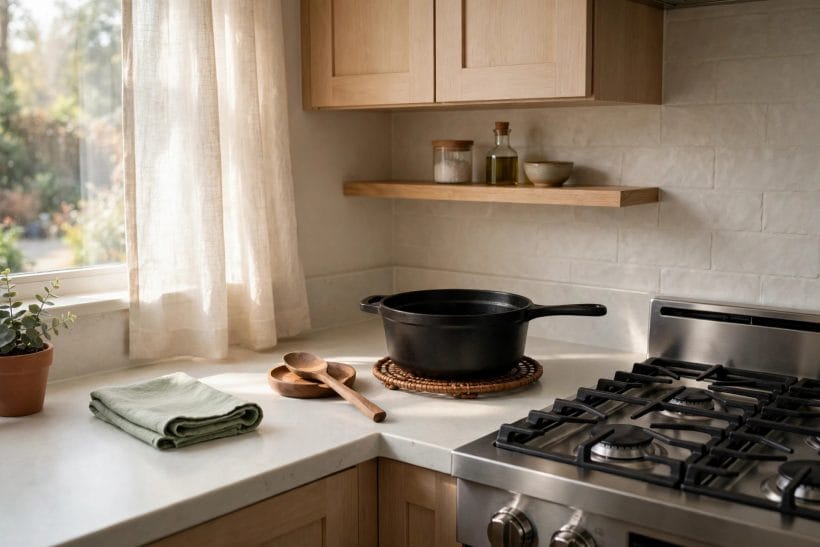
A barrier does a modest job, and it does it well. It holds the pan a little proud of the surface, lets air move beneath the base, and spreads the meeting point so the top never takes the full heat of the pan in one small patch. A woven trivet, a cork pad, a silicone mat and a wooden board all serve this purpose in their own way, and the differences between them matter less than the fact of using one at all.
The barrier also buys time. A pan set on a trivet cools in the open air while dinner is served, and by the time it is carried to the sink it is a different object from the one that left the stove. A pan set straight on a top, by contrast, hands its heat to the surface at once, with nowhere for that heat to go. The trivet habit is therefore not only about the top. It is about giving heat a gentler path out of the pan, which suits the cook, the pan and the kitchen alike.
Barriers have one more virtue: they are visible. A trivet sitting empty beside the stove is a reminder in itself, and guests who cook in an unfamiliar kitchen read it at once. Nobody has to be told the house rule when the trivet is already there, waiting in its place. Keep one where pans are lifted, one where the oven door opens, and one near the serving spot, and the habit largely keeps itself.
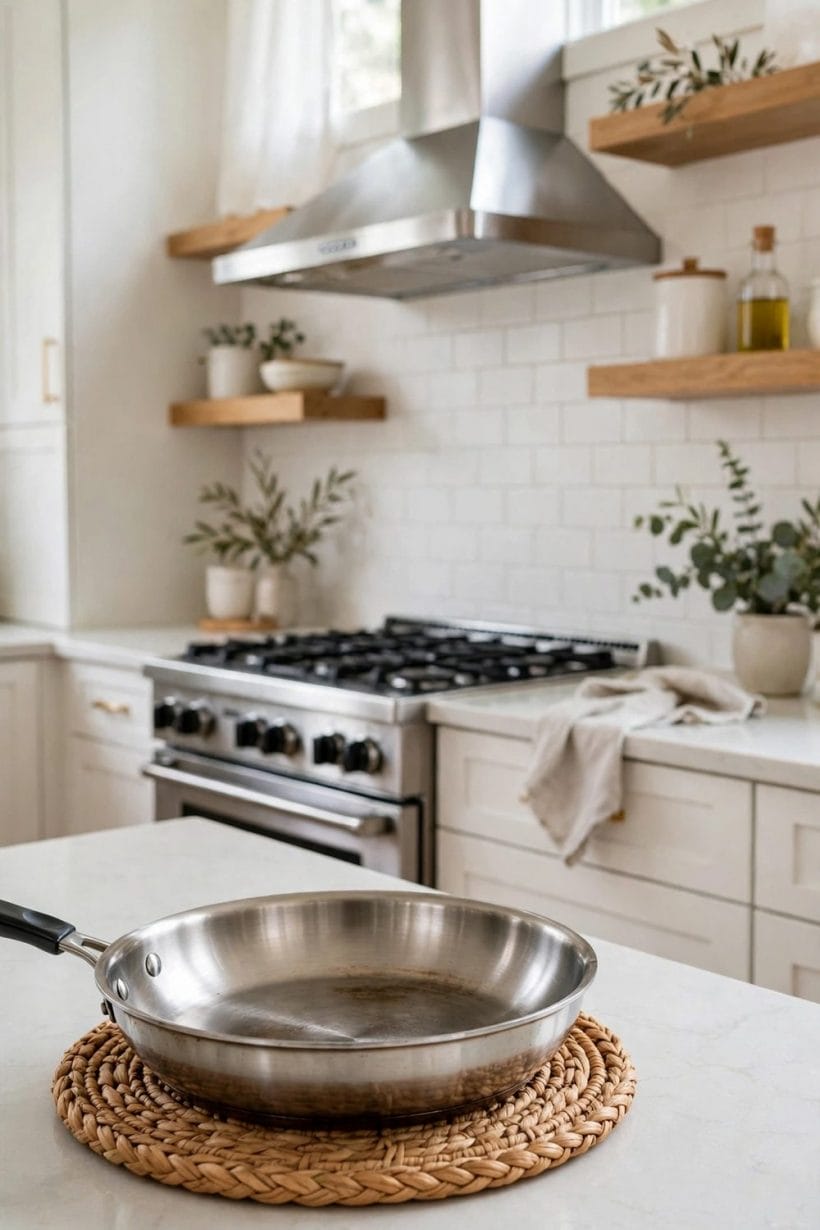
4. Trivets, Pads and Mats: Choosing a Layer
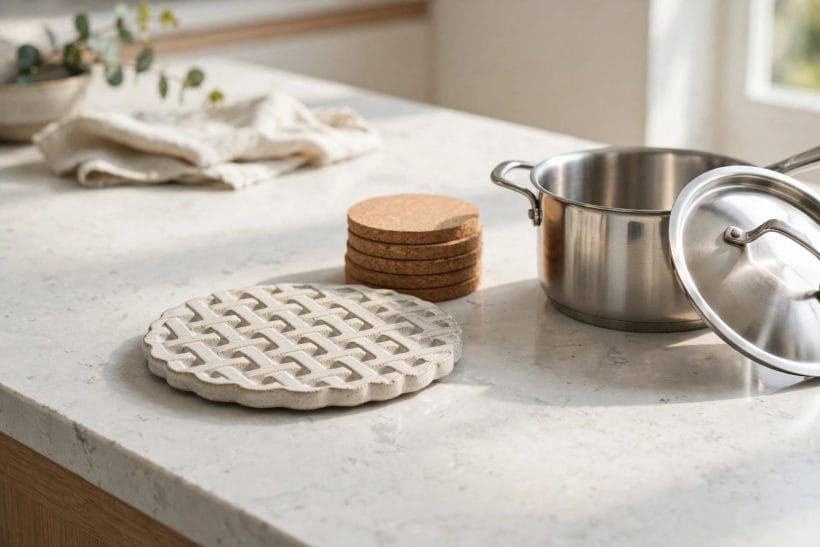
Trivets come in several familiar forms, and each has its own character. Woven trivets in straw or cotton are light, washable and kind to surfaces, and they suit everyday pans well. Cork pads are slim, stack neatly in a drawer and give a firm seat under a heavy pot. Wooden trivets look handsome left out on the counter and take heat calmly, though they ask for an occasional wipe and a dry store. Silicone mats lie flat, grip well and slide under trays as easily as under pans, and they roll away when the meal is done.
Size matters more than style. A trivet should be wide enough for the base of the pan it will hold, so the whole base sits supported and nothing overhangs the edge. A small pad under a wide skillet is a wobble waiting for a moment of inattention, and a wobbling pan is a spill risk before it is anything else. When in doubt, choose the larger layer, and keep a couple of sizes on hand: a generous one for stockpots and roasting pans, and a smaller one for saucepans and skillets.
Thickness plays a part too. A slim pad is fine for a pan that has rested a little, while a thicker trivet gives more breathing room under a pan straight from high heat. The point is not to collect every kind. Two or three well-chosen layers, kept where they are used, will cover nearly every evening. What matters is that the layer is there, that it fits the pan, and that reaching for it is easier than setting the pan down bare.
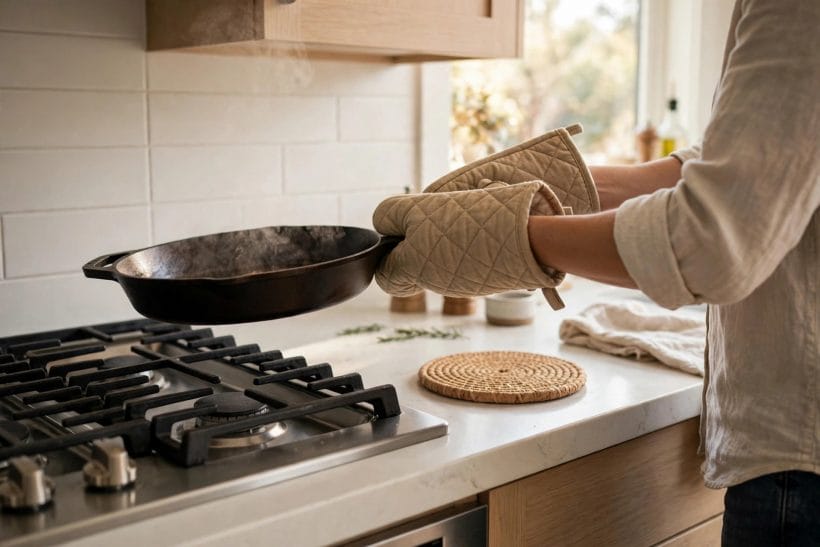
5. Moving a Hot Pan: Mitts, Handles and Clear Space
Before a pan moves, the landing spot should already be ready. Clear the trivet, check that it sits flat, and make sure nothing small is waiting to be knocked: a spoon rest, a phone, a glass left near the edge. The move itself should be short and level, with both hands where the pan asks for them, and the path from stove to trivet kept free of clutter. Most kitchen mishaps with hot pans are not about the pan at all. They are about the journey, and a clear journey is a calm one.
Mitts deserve a word of their own. A good pair fits the hand, covers the wrist, and stays dry, since a damp mitt carries heat far faster than a dry one. Keep mitts where the stove is, not in a distant drawer, and replace them when the padding thins or the fabric wears. A mitt that has served well for years may look fine while insulating far less than it once did, so a quick check now and then is worth the moment it takes.
Handles ask for attention as well. A handle left jutting over the edge of the stove invites a passing sleeve, and a handle turned inward, over the stove rather than out into the room, keeps the pan where it belongs. When a pan is lifted, the handle should be gripped firmly and the base kept level, so nothing sloshes toward the rim. These are small disciplines, but they are the ones that keep a hot pan an ordinary object rather than an event. Compact kitchens ask for the same disciplines in less room, and the tiny house kitchens collection shows how cooks arrange trivets, mitts and landing spots when counter space is genuinely tight.
6. Cooling Down: Resting Pans Before They Land
A pan does not have to go straight from flame to counter. A short rest on the stove, with the heat off, lets the fiercest heat ease before the pan is moved at all. For dishes that need to settle, that rest improves the food as well as the habit, and for everything else it simply makes the carry easier. The trivet is still used when the pan does land, but the pan that lands after a rest is a cooler, calmer object than the one lifted at full heat.
Sudden changes deserve the same gentle approach. A pan that has been very hot, then meets something cold and wet, is going through a sharper change than a pan that cools in the air. Careful cooks avoid plunging hot pans into cold water as a matter of routine, and they wipe a top with a cloth that is damp rather than soaking when a spill needs attention. None of this is dramatic. It is the ordinary patience of letting hot things cool and cold things warm, applied to the busiest room in the house.
Time is the quiet ingredient here. Dinner rarely needs the pan moved the instant the heat goes off, and the few moments of rest are usually invisible to everyone at the table. Build the pause into the routine: heat off, pan rests, table is set, pan moves to its trivet. The countertop never enters the story, and the meal is none the worse for the wait.
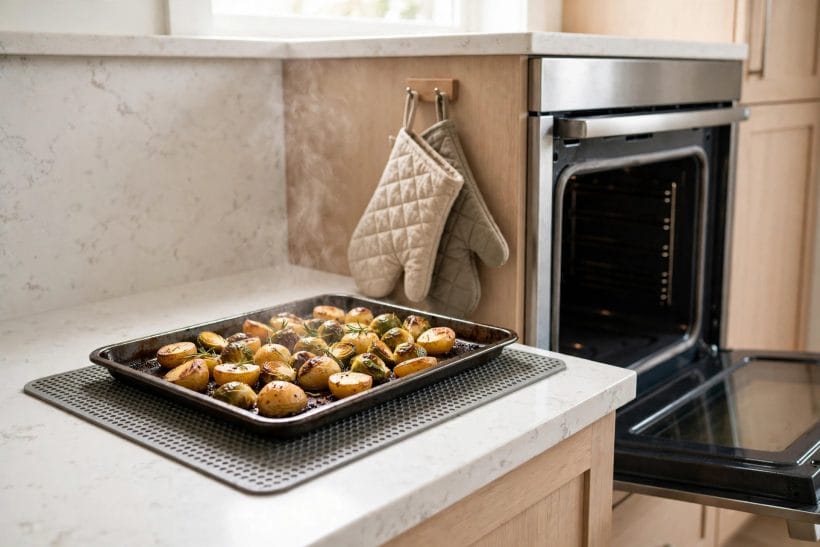
7. Oven Dishes, Trays and Baking Sheets
Oven cookware brings its own version of the question. A roasting pan, a baking sheet or a casserole dish comes out of the oven carrying heat across a wide base, and it needs a landing spot at least as wide as itself. A single small trivet under a long tray leaves the ends unsupported and the tray liable to tip, so oven landing spots should be generous: a long mat, a pair of trivets set side by side, or a wooden board broad enough for the whole dish.
The oven door itself is part of the routine. Open it fully, stand to one side of the heat that rolls out, and lift with mitts that cover the wrists, since a tray pulled toward the body can brush a forearm on the rack. Set the tray down level on its mat, and leave it there while the oven is closed and the mitts come off. The habit mirrors the stovetop one exactly: the dish never rests on the bare top, not even for a moment while something else is fetched.
Baking days test the habit most, because trays come out in sequence and counter space fills fast. Plan the landing spots before the first tray comes out, and keep a spare mat folded nearby for the tray nobody expected. When the kitchen is small, that planning matters even more, and the tiny kitchen ideas collection offers layouts where landing spots, storage and serving space are worked out in advance rather than improvised mid-bake.
8. Spills, Marks and Everyday Cleaning
Quartz tops are forgiving of everyday mess, and their care is mostly a matter of promptness. A spill wiped while it is fresh rarely leaves a trace, while the same spill left to dry invites a longer conversation with a cloth. Warm water, a soft cloth and a mild soap cover most days, and a gentle wipe in the direction of the pattern keeps the surface looking even. Abrasive pads and harsh scouring have no place here: they do not clean better, they only wear the finish that makes the top easy to clean in the first place.
Colour deserves a little extra care. Strongly coloured foods and drinks, left sitting on a pale top, can leave a faint shadow that asks for more work than a prompt wipe would have. The remedy is not worry but timing: wipe as you go, keep a cloth in hand while cooking, and treat the countertop as a surface that is cleaned during cooking, not only after it. Cooks who keep that rhythm rarely meet a mark that surprises them.
Seams and edges ask for the same gentle treatment. A seam is a join, and joins prefer soft cloths and mild cleaners to anything that might work its way in. The same goes for the edge profile, where a knock from a heavy pan can leave a reminder that outlasts the meal. Setting pans down on trivets, away from the edge, protects the edge as surely as it protects the field of the top. For the way quartz carries into the rest of the room, including the wall behind the stove, the quartz backsplash pictures collection shows the material used vertically, where heat habits and cleaning habits meet.

9. Small Kitchens and Tight Counters
A small kitchen sharpens every part of this habit. When counter space is scarce, the trivet competes with the chopping board, the serving dishes and the ingredients still waiting their turn, and the temptation is to set the pan wherever a gap appears. The remedy is to give the trivet a permanent home rather than a borrowed corner: a hook by the stove, a slim slot beside the oven, a drawer divider that keeps pads flat and findable. A trivet with a home is a trivet that gets used.
Vertical storage helps too. Trivets hung on the wall or on the inside of a cabinet door take no counter at all, and a mat rolled in a tall container stands ready without sprawling. In a compact kitchen, the landing spot itself can be planned as part of the layout: a heat-friendly zone beside the stove that is kept clear by agreement, not by luck. The household rule can be as simple as a sentence: nothing hot lands outside the trivet zone.
Choosing surfaces is part of the same planning. A kitchen with several surfaces asks which one meets hot pans, which one takes chopping, and which one stays clear for serving, and the answers shape where trivets live. The trending kitchen countertops guide compares the surfaces cooks are choosing now and what to check before settling on one, which is a useful companion when a small kitchen is being planned or refreshed.
10. When to Check the Maker’s Guidance
Every general guide, including this one, ends at the same place: the instructions that came with the top. Makers write care sheets for their own material, and those sheets carry the details no general post can: what the maker describes as suitable, what cleaning agents the maker names, and where the maker draws its own lines. When a top is new, the care sheet is worth reading before the first pan is lifted. When a top is older and the sheet is lost, the maker’s website usually carries the same guidance under the product name.
There are moments when checking is not optional but wise. A top that has been repaired, a kitchen that has changed hands, a new household member cooking on an unfamiliar surface: each of these is a good reason to look the guidance up again rather than trusting memory. The same applies when cookware changes. A new roasting pan, a heavier casserole, a different stove: any of these can change the heat a top meets, and the maker’s guidance is the reference that keeps pace with those changes.
Cookware guidance matters alongside countertop guidance. Pans carry their own care sheets, and the two documents together describe the whole transaction: what the pan is made to do, and what the top is made to meet. The induction cookware checks guide shows how cooks weigh materials, bases and care before buying, and the same habit of checking before buying serves countertops just as well. Read both sheets, keep the trivet habit, and the question largely answers itself in daily practice.
Final Considerations
Can you put a hot pan on quartz? The careful household answers with a habit rather than a verdict: pans land on trivets, pads or mats, every time, without exception and without debate. The habit is cheap, it is easy to teach, and it leaves the countertop out of the heat entirely. A trivet by the stove, a mat by the oven, mitts that fit and stay dry, and a short rest before the pan moves: these small pieces add up to a kitchen where hot pans are ordinary and countertops stay calm.
Keep the maker’s guidance close, wipe spills as they happen, and give the trivet a permanent home so the habit survives busy evenings. Quartz rewards that kind of steady, undramatic care, and the reward is a top that looks as good in years to come as it did when it was first fitted. The pan will always need somewhere to land. Make sure that somewhere is ready before the stove is lit.




0 Comments