

Hang a rod too high and every morning starts on tiptoes. Hang it too low and dresses pool on the floor. This guide explains the common closet rod heights, what 84 inches really means in daily use, and the simple reach checks that settle the question for your household.
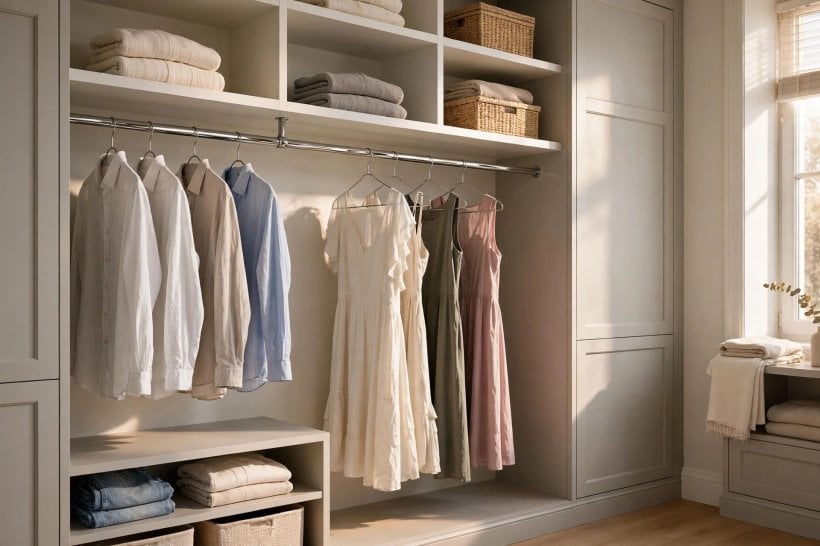
1. At a Glance: Rod Height Key Points
There is no single closet rod height that suits every person, every garment and every ceiling. What installers call standard heights are really common conventions: numbers that have evolved because they work for many adults of average height with typical clothing. Your job is to test those conventions against the people and the garments in your own home before anything is fixed to a wall.
| Question | Key point |
|---|---|
| Is 84 inches a code requirement? | No. Treat published rod heights as common conventions and manufacturer suggestions, not as rules you must follow. Comfort and garment length decide. |
| Where does 84 inches usually appear? | Most often as the upper rod in a double-hang layout, where a second rod below uses the wall efficiently. |
| What matters more than the number? | Whether the shortest regular user can lift a hanger on and off the rod comfortably, every day, without stretching or a stool. |
| How much space do clothes need below a rod? | Enough that the longest garments clear the floor, a shelf or the rod below them. Measure your own longest pieces on their hangers. |
| Can I change a rod height later? | Usually yes. Most rods sit in sockets or on brackets that can be moved, though patched holes and repainting are part of the job. |
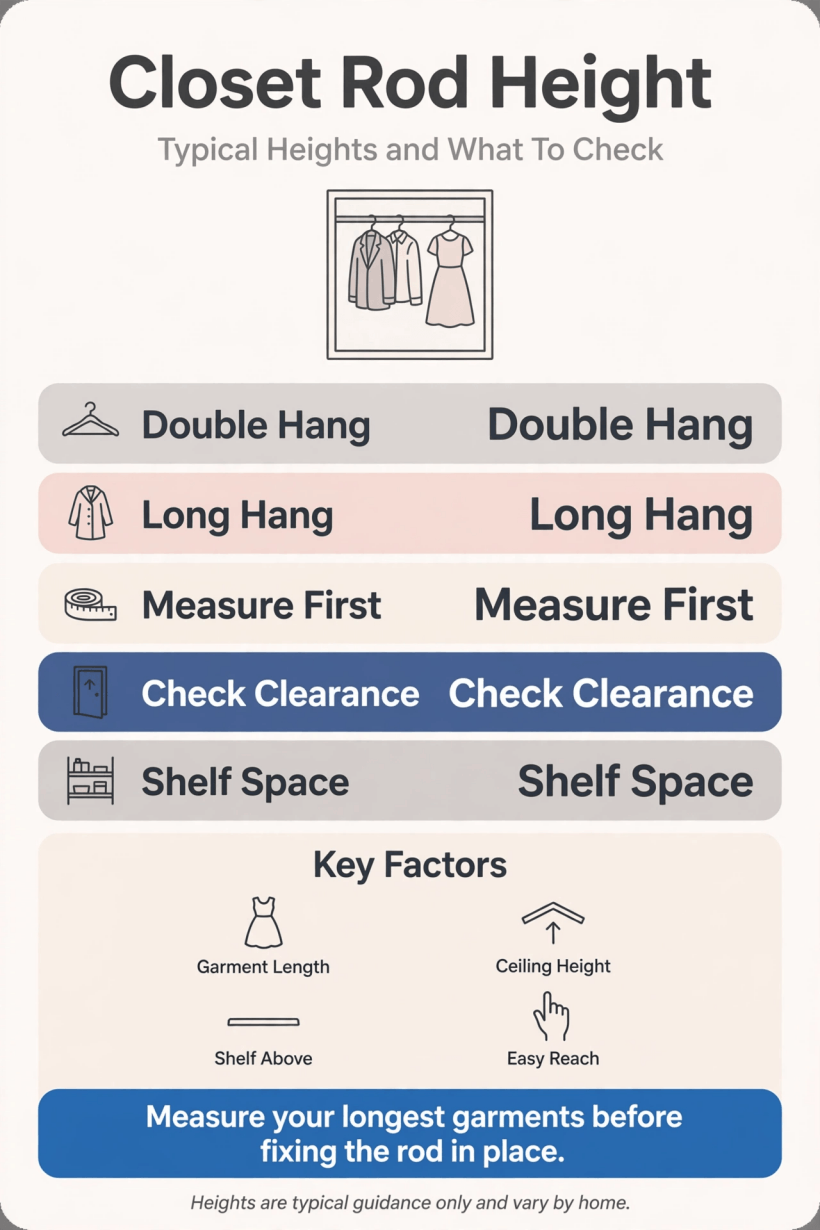
Common rod layouts and the reach checks to run before you drill.
The sections that follow unpack each row: how the conventions arose, how double-hang and long-hang layouts differ, how to run a two-minute reach test with a tape and a hanger, and how garment lengths, shelves and doors change the answer. If you are planning a whole small bedroom rather than one closet, the space planning in our small home interior design ideas guide is a useful companion.
2. Where the Common Numbers Come From
Open any closet organiser catalogue and the same heights appear again and again. A single rod for a mixed wardrobe is often drawn somewhere around the high sixties to low seventies in inches from the floor. Double-hang layouts, with one rod above the other, commonly place the upper rod in the low eighties and the lower rod around forty inches. A shelf frequently sits a little above the top rod. None of these figures fell from the sky; they are compromises between garment lengths, the reach of an average adult, and the ceiling heights of typical homes.
Understanding that these are conventions, not commandments, changes how you use them. When a homeowner asks what the height of closet rod should be in their new wardrobe, the honest answer is that the catalogue number is a starting hypothesis. A tall household with long coats will bend it one way; a household where a shorter adult does most of the laundry will bend it the other. Both are right, because the convention was only ever a summary of other people’s closets.
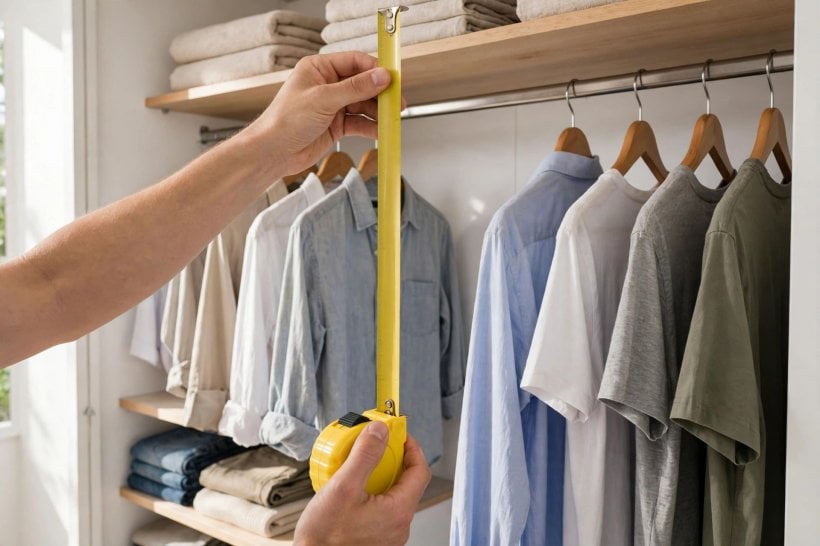
Ceiling height explains much of the variation between homes. In a room with a low ceiling, an upper rod in the low eighties leaves little room for the shelf and storage boxes above it, so the whole layout compresses downward. In a tall room, the same rod can feel modest, with generous storage above. Measure your closet’s full interior height first, then sketch the layout from the ceiling down as well as from the floor up, so the shelf, the rods and the floor space are planned as one system.
3. So, Is 84 Inches Too High?
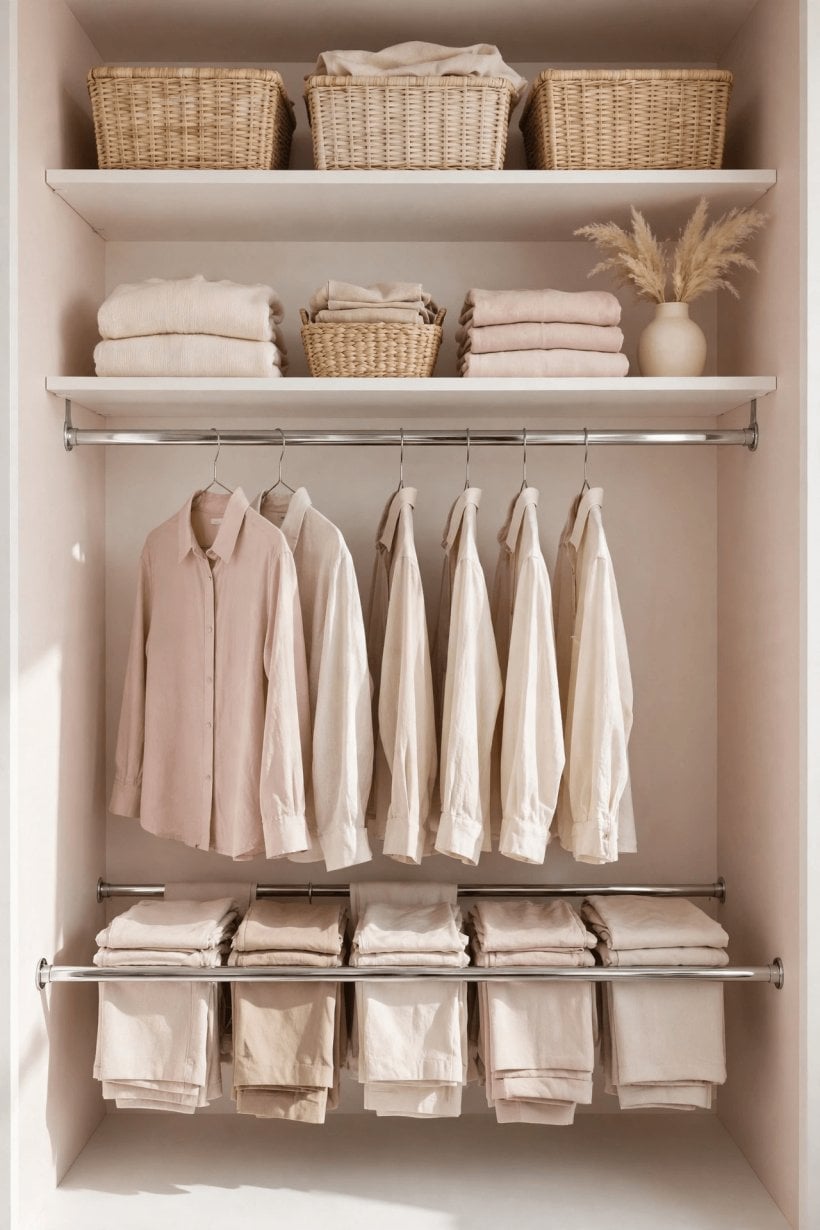
For an upper rod in a double-hang setup, 84 inches is a widely used convention and it works well for many adults. It lifts shirts and trousers high enough that a second rod below can hold another full row, which is the entire point of double hanging: two wardrobes’ worth of short garments in the wall space of one. In that role, the height is not extreme at all; it is the geometry that makes the lower rod possible.
As a single rod, the same height tells a different story. A lone rod at 84 inches leaves a tall void beneath shirts that only reach halfway down it, void that usually becomes a tangle of shoes and boxes, while every hanger still has to travel up to the full height. For long dresses and coats a high single rod can be justified, because the garments use the drop. For a general wardrobe it usually signals a layout that was copied from a double-hang plan without the second rod ever being fitted.
The deciding factor is never the number on its own; it is the reach of the person using it at 7 in the morning, half awake, holding a hanger in one hand. If that person has to stretch, rise on tiptoes or lift hangers at an awkward angle, the rod is too high for them whatever the catalogue says. Lowering an upper rod by even a couple of inches, and giving the difference to the shelf zone, often transforms daily use while costing almost nothing in storage, a trade our dining room interior design ideas readers will recognise from shelving choices in small rooms.
4. The Reach Check: A Two-Minute Test
You do not need to install anything to test a height. You need a tape measure, a hanger holding a typical garment, and the shortest adult who will use the closet regularly. Mark the candidate rod height on the wall with painter’s tape. Have the tester lift the hanger to the mark and hook it over an imaginary rod, then take it down again, several times, at natural speed, in the shoes or bare feet they would normally have at the closet.
Watch for the quiet warning signs: shoulders rising toward ears, the hanger needing a flick to clear the mark, the garment swinging into the tester’s face, or an instinctive step closer that would not exist once doors, drawers or a laundry basket are in the way. A height that passes ten relaxed repetitions passes. A height that only works with effort fails, even if it matches a published standard exactly, because the test that matters happens daily and in a hurry.
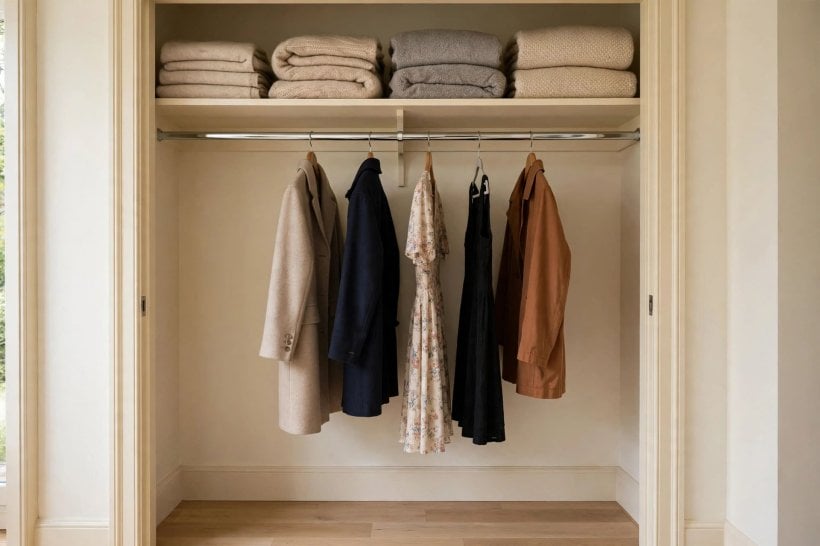
Repeat the test for children and for anyone with limited shoulder movement, on the sections they will actually use. Households often settle on a mixed answer: the main upper rod at a height the taller partner manages easily, a lower rod or a pull-down section for the shorter partner and children, and the highest shelf reserved for things fetched rarely. That kind of honest zoning, rather than a single heroic number, is what makes a closet feel designed. The same household-first thinking shapes the storage in our tiny houses for sale in Charlotte buyer’s guide, where every inch has to work for real routines.
5. Garment Lengths: The Other Half of the Equation
A rod height is only half a measurement; the other half hangs from it. Before fixing anything, measure your own longest garments on their hangers, from the top of the hook to the hem, because sizes vary more than people expect. A long dress, a winter coat, a jumpsuit and a pair of trousers folded over a hanger all claim very different amounts of vertical space, and the longest regular item in each section sets the minimum drop that section needs.
Long-hang sections are the hungriest. If the longest coat measures more than the space beneath a proposed rod allows, hems will drag on the floor, a shelf or an obstructions below, picking up dust and creasing. Short-hang sections are more forgiving, which is why double hanging works: shirts, blouses, jackets and folded trousers cluster in a fairly predictable band of lengths, so two stacked rows fit a known wall height with a little air to spare.
Do not forget the hanger itself. The hook and neck of a hanger add several inches between the rod and the shoulder of the garment, and chunky wooden hangers, slimline flocked hangers and dress hangers all differ. Measure with the hangers you actually own, and if you plan to standardise hangers later, measure with those. Owners of compact wardrobes in our tiny houses for sale in Nashville guide learn this quickly: in a small closet, the hanger allowance is the difference between a layout that works on paper and one that works on Monday.
6. Double Hang, Single Hang and Long Hang Layouts
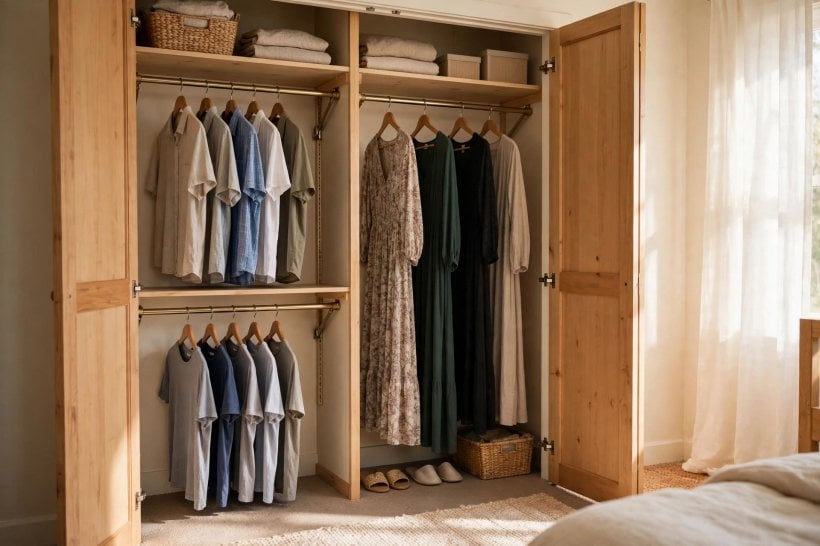
Double hanging is the space multiplier: two rods, one above the other, for shirts, blouses, jackets and folded trousers. Its convention puts the upper rod high because the lower rod and its garments must fit beneath, and its shelf usually sits just above the upper rod. It suits households whose wardrobes are mostly separates and who prize capacity over ceremony. Its weakness is reach at the top rod, which is why the reach check in section four matters most exactly here.
Single hanging trades capacity for calm. One rod, everything visible at a glance, nothing hidden behind a second row. It suits mixed wardrobes with a share of longer pieces, guest rooms, and anyone who finds double rows visually noisy. Long hanging is really a dedicated zone rather than a whole layout: a section where dresses and coats get the full drop they need, often beside a double-hang section, so each garment type gets the geometry it wants instead of a compromise that serves neither.
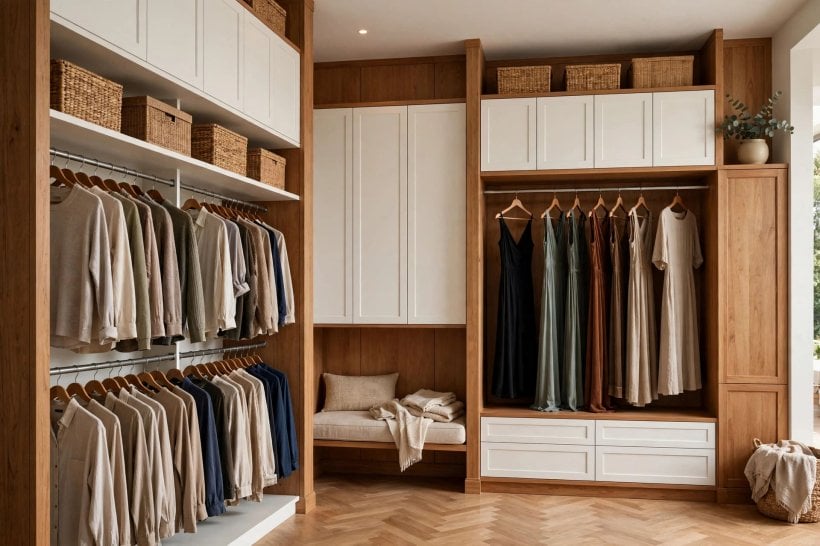
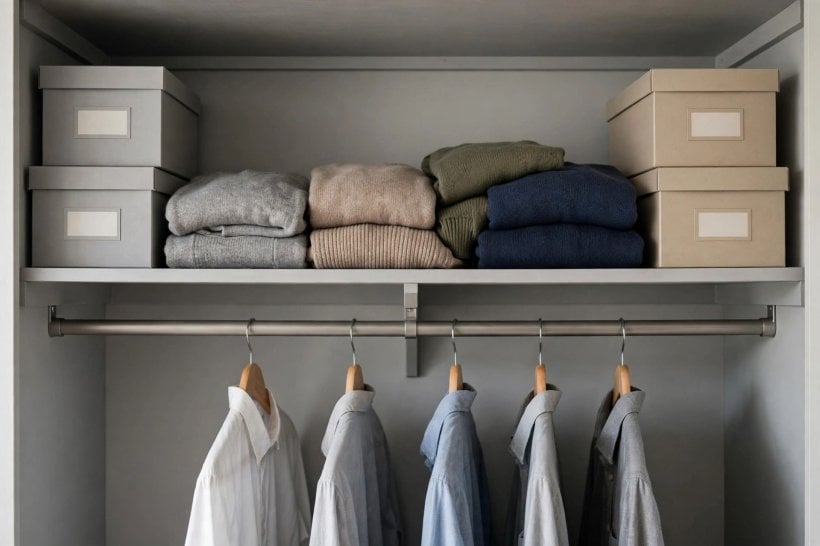
Shelves and drawers complete the system. The shelf above the top rod commonly carries the least-used storage, and its height is whatever the ceiling leaves after the rod takes its share; if reaching that shelf needs a stool, store accordingly, with light, stable, rarely needed boxes rather than heavy daily items. Below the rods, keep the floor zone honest: a low shelf or shoe rack under a long-hang section steals drop from dresses, so measure the section with its floor furniture in place, not in theory.
7. Shelves Above, Doors in Front: Clearances People Forget
The gap between rod and shelf is a small measurement with outsized effects. Too little space and hangers scrape the shelf underside every time they are lifted off the rod, which people feel dozens of times a week. As a working approach, lift a hanger off your marked line in the reach test and see how much vertical travel it needs to clear; the shelf should sit comfortably above that travel, not at its limit.
Doors are the other forgotten clearance. Hinged doors swing through the space hands want to occupy, bifolds project into the closet when open, and sliding doors always hide half the wardrobe. A rod height that tests fine with the doors removed can frustrate once the doors return, because the tester unconsciously stood inside the closet during the test and will actually stand outside it, reaching in, every day after. Run the final reach check from the position the doors impose.
Lighting plays a part too. A high rod pushes garments up toward the ceiling, where a single ceiling light may leave the row in shadow, and dark clothes become hard to tell apart. A shelf-mounted strip light or a fitting placed to wash the hanging rows makes a high layout feel far more usable. These small environmental checks, reach, doors, light, are the same practical trio we suggest for display storage in our gift shop interior design ideas guide.
8. Children’s Closets and Shared Closets
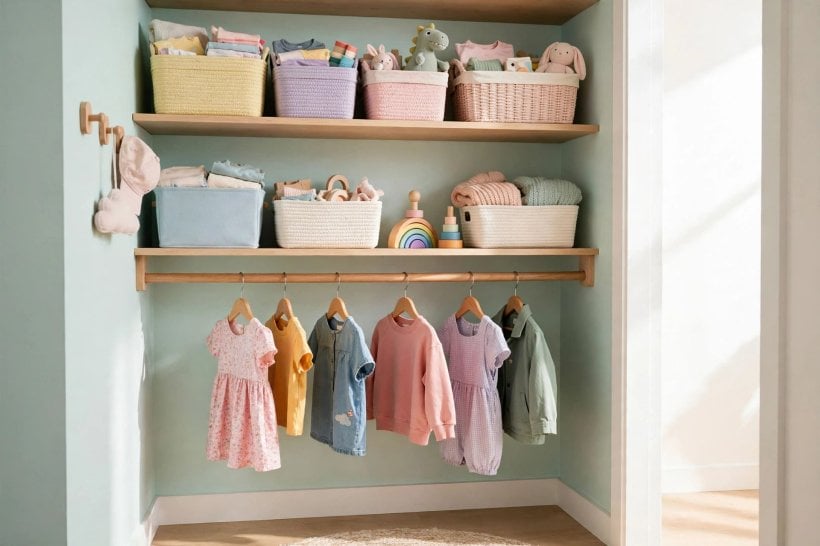
Children outgrow closet layouts faster than any other storage in the house. A rod a five-year-old can use independently sits far below adult conventions, which tempts parents to install everything low and then reinstall it all a few years later. Adjustable systems earn their keep here: rods that re-seat into a new row of holes, or a second low rod that can move up as its owner grows, turn a rebuild into a ten-minute job.
Independence is the real goal. A child who can hang up their own clothes and choose tomorrow’s outfit without fetching an adult uses the closet more and tidies it more, so pitch the everyday rod at their comfortable reach and keep the high zone for out-of-season storage and the clothes they are growing into. In shared adult closets, the same principle applies between partners of different heights: give each person a section tuned to them rather than averaging both into mild inconvenience. Households planning a child’s room in a compact home will find kindred planning in our tiny house for sale in Dallas guide, where adjustable storage appears again and again.
9. Rod Strength, Supports and Sagging
Height is the famous variable, but support is the one that fails loudly. A long rod full of winter coats carries serious weight, and an unsupported span will bow over time, sliding hangers toward the middle and stressing the end sockets. As a general approach, longer spans need a centre support bracket, and the bracket needs a shelf or a fixing point above it to hang from, which is one more reason the rod-to-shelf relationship matters.
Check what the rod fixes into. Sockets screwed into solid side panels or into studs behave very differently from sockets in thin board or plasterboard alone. If your closet walls are the hollow kind, plan fixings that spread the load, and be honest about the heaviest load the section will carry: a rail of suits and coats is a different proposition from a rail of summer shirts. Many people deciding the height of closet rod for a heavy long-hang section also shorten the span or add the centre support at the same time, while the tools are out.
Material choice plays a quiet role. Metal rods in oval profiles resist bending well and let hangers slide smoothly; round wooden rods look warm in an open wardrobe but can flex more over a long span. Whichever you choose, test the finished installation progressively: hang a few garments, then a full row, and watch the rod over the first week. A tiny early bow is information; caught early, it is a bracket added in minutes rather than a collapse in a year. Bigger home projects have the same rhythm of staged checking, as readers of our guide to solar panels for a tiny house will recognise.
10. Adjustable and Pull-Down Options
If no fixed height passes the reach test for everyone, adjustability is the grown-up answer. Slotted upright systems let rods move in small increments as wardrobes and households change, and they forgive the most common planning error, which is discovering after installation that the convention you copied fits nobody in the house. The small premium for a track-based system is usually recovered the first time a layout change takes minutes instead of a weekend.
Pull-down wardrobe lifts serve the opposite problem: plenty of height, not enough reach. A hinged mechanism brings a high rod down to a comfortable level and returns it smoothly, turning the upper wall into genuine everyday storage for a shorter user or a wheelchair user, rather than a museum of rarely worn clothes. They cost more than a fixed rod and need their mechanism respected, loads kept within the maker’s guidance and the swing path kept clear, but in a tall closet they can be the difference between using the full height and abandoning the top third of the wall.
Whichever route you take, leave yourself a record. Note the final heights on a label inside the closet or in your home file, with the date and the reason. Future you, a future partner, or a future owner adjusting the layout will be grateful for the thinking, not just the number.
Final Considerations
So, is 84 inches too high? As the upper rod of a double-hang layout, for an adult who passes the reach test, it is a sensible and widely used convention. As a single rod for a shorter household, or as a number copied without checking garments, doors and reach, it can be a daily irritation. The height itself is neither right nor wrong; the fit is what matters.
Measure your longest garments on their hangers, mark candidate heights in tape, and let the shortest regular user vote with a hanger in their hand. Support long spans properly, respect the shelf and door clearances, and choose adjustable fittings when the household is still changing. Do that, and the rod disappears into the background of your mornings, which is exactly where good storage belongs.



0 Comments