

A window dressed with both curtains and blinds has a particular charm. The blind does the quiet work of softening daylight and guarding privacy, while the curtain adds softness, colour and a finished edge to the room. Seen together, the two layers make a window feel considered rather than merely covered, and they give a room a focal point that changes gently through the day as the light shifts. These blinds and curtains together ideas gather pairings that work in real rooms, from airy sheers over a simple blind to full drapes framing a tailored blind in a formal living room.
The appeal of the pairing is its flexibility. One layer can stay in place while the other moves, so a room can feel open in the morning, shaded at midday and private in the evening without any single treatment having to do everything. Colour and texture do much of the work: a linen curtain softens the straight lines of a blind, a patterned curtain warms a plain blind, and a calm neutral pairing lets furniture and artwork take the lead. The ideas below look at each pairing on its own terms — what it looks like, how it handles light and privacy, and which rooms it suits best — so you can find the combination that fits your window and your way of living.
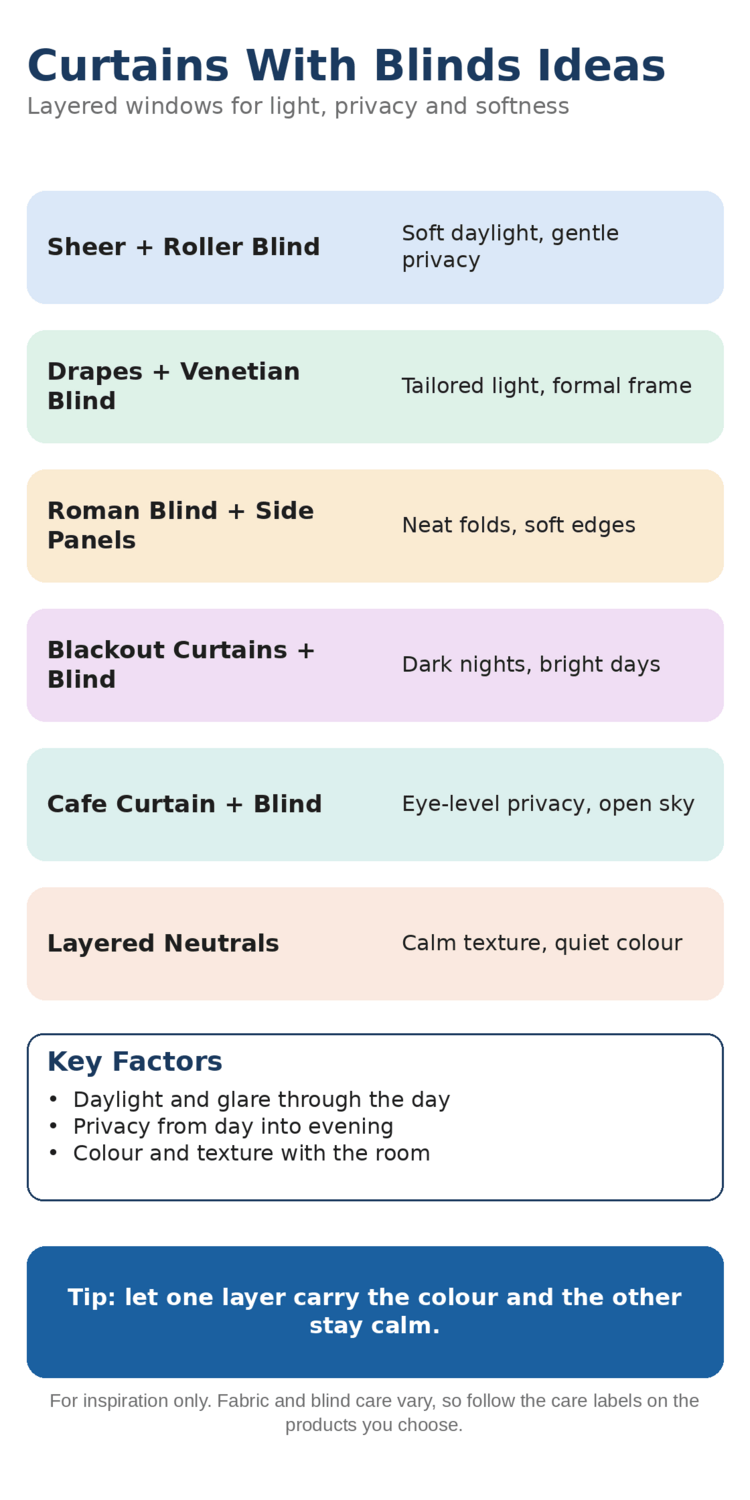
| Item | What it is |
|---|---|
| Sheer Curtains Over Roller Blinds for Soft Daylight | Sheer curtains over a roller blind are one of the most forgiving pairings in home design, and they suit rooms where daylight matters as much as privacy. |
| Full-Length Drapes Framing Venetian Blinds | When a window deserves a sense of occasion, full-length drapes framing venetian blinds give it exactly that. |
| Roman Blinds Paired With Side Curtain Panels | Roman blinds have a soft, tailored fold that sits somewhere between a curtain and a blind, and pairing them with side curtain panels brings out the best of both. |
| Blackout Curtains Over Light-Filtering Blinds for Bedrooms | Bedrooms ask more of a window treatment than any other room: soft light in the morning, privacy at night, and darkness for sleep. |
| Café Curtains With Blinds on the Lower Window | Café curtains with blinds on the lower part of a window bring a relaxed, cottage-like charm to kitchens and breakfast rooms. |
| Layered Neutrals in One Palette and Two Textures | Not every pairing needs contrast of colour. |
| Bold Colour Pairings That Still Read Calm | Bold colour has a place in a layered window, provided one layer stays calm enough to let the other sing. |
| Combined Treatments for Wide and Tall Windows | Wide and tall windows are a gift, but they ask for a pairing that can handle their scale. |
| Small Rooms Where the Pairing Keeps the Window Open | Small rooms sometimes shy away from layered treatments, for fear that two layers will crowd the window. |
| Everyday Living With Curtains and Blinds Together | The best test of any pairing is everyday life. |
1. Sheer Curtains Over Roller Blinds for Soft Daylight
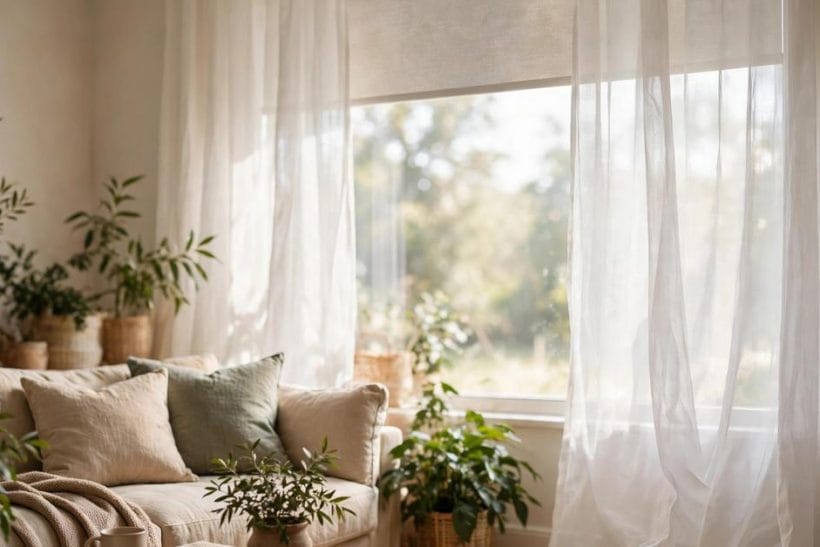
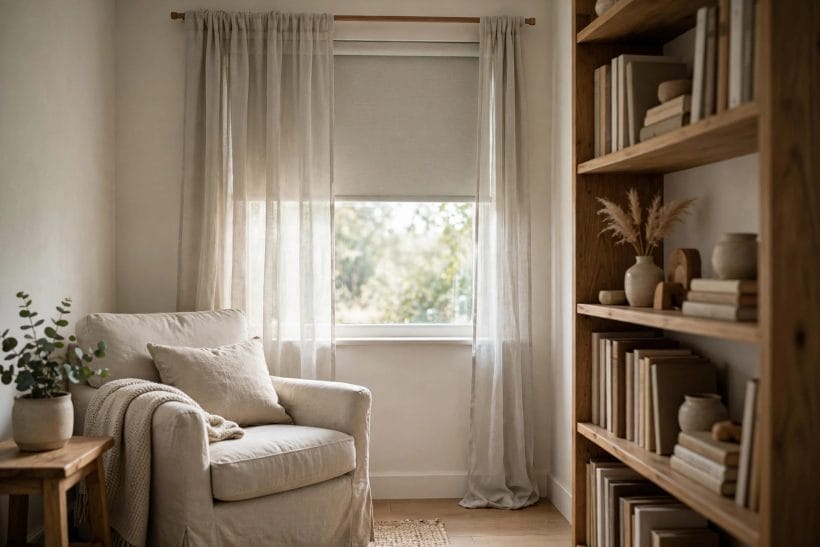
Sheer curtains over a roller blind are one of the most forgiving pairings in home design, and they suit rooms where daylight matters as much as privacy. During the day the sheer curtain hangs as a soft veil, blurring the view inwards while letting sunlight filter through, and the roller blind behind it waits for the moments when stronger shade or fuller privacy is wanted. The result is a window that never looks bare and never feels heavy, even in a room with generous glazing.
This pairing works beautifully in living rooms and dining spaces where people gather through the day. A white or ivory sheer keeps the room bright and lifts darker furniture, while a sheer with a faint woven texture adds interest without competing with patterned cushions or rugs. The blind itself can be a plain neutral that disappears behind the curtain when it is raised, so the eye reads the window as a soft, layered feature rather than a piece of equipment. In the evening, lowering the blind behind the closed sheer gives a room a gentle glow when lamps are lit, and the two layers together feel more finished than either would alone.
Colour is easy here because the sheer does most of the talking. Pale sheers suit almost any wall colour, and they are especially kind to small rooms, where a heavy curtain might crowd the window. A sheer in a warm natural tone brings a touch of warmth to a cool grey room, while a crisp white sheer sharpens a room full of warm wood. The key is contrast of texture rather than contrast of colour: the smooth blind against the softly woven curtain is what makes the pairing feel layered, even when both layers sit in the same quiet palette.
2. Full-Length Drapes Framing Venetian Blinds
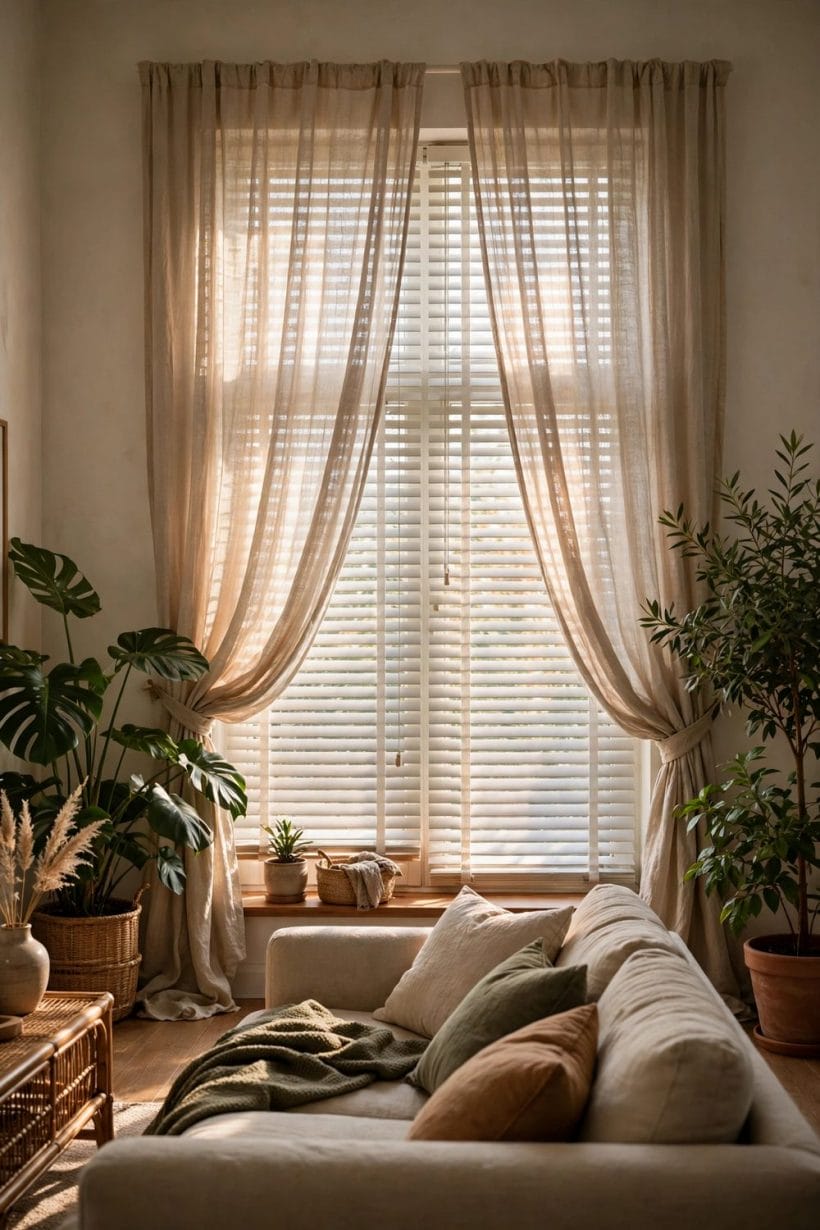
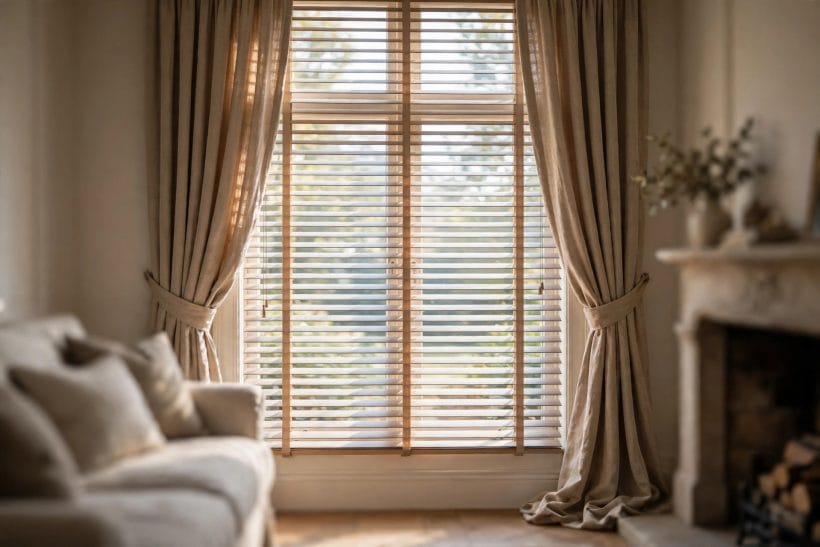
When a window deserves a sense of occasion, full-length drapes framing venetian blinds give it exactly that. The venetian blind brings a tailored, architectural line to the window, with slats that can be tilted to shape the light, while the drapes at each side soften the frame and add the drape and movement that a blind alone cannot offer. Together they make a window feel dressed for the room rather than simply fitted to it, and they suit living rooms and main bedrooms where a little formality is welcome.
The drapes in this pairing are best thought of as a frame. Drawn to the sides for most of the day, they outline the window and add colour and texture at its edges, while the blind does the practical work in the middle. A heavy linen or cotton drape in a solid colour gives the window weight and presence, and it pairs well with the clean horizontal lines of the blind. In a room with a fireplace or a large sofa, the drapes help the window hold its own as a feature, balancing the other large pieces in the room rather than disappearing behind them.
Light control is where this pairing earns its place. The slats can be angled to bounce daylight deeper into the room or to cut glare on a bright afternoon, and the drapes can be drawn across in the evening for a sense of enclosure. Colour choices can be bold here: deep green, warm rust or classic navy drapes against a pale blind create a window that anchors the whole room. For a quieter look, drapes in the same tonal family as the walls keep the window calm and let the blind’s lines provide the detail.
3. Roman Blinds Paired With Side Curtain Panels
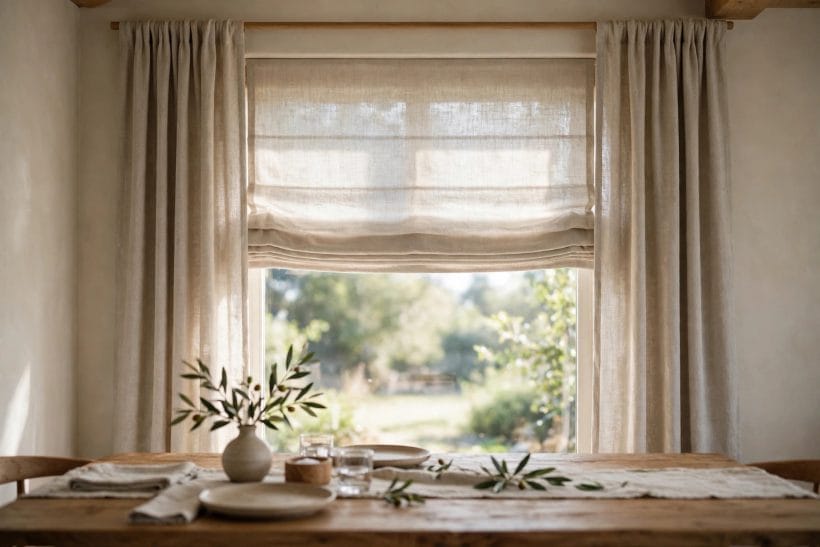
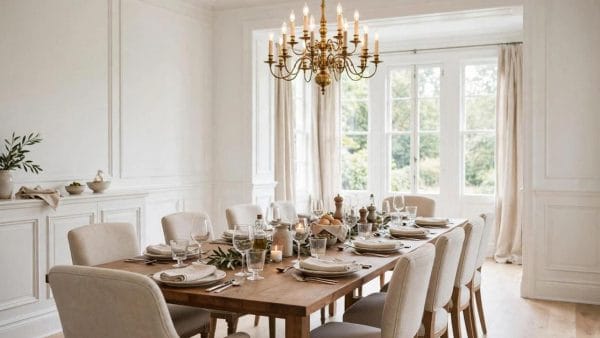
Roman blinds have a soft, tailored fold that sits somewhere between a curtain and a blind, and pairing them with side curtain panels brings out the best of both. The blind covers the window itself with neat horizontal folds, while the panels at the sides add vertical softness and a sense of height. The combination is a favourite in dining rooms and bedrooms, where a window should look finished even when the blind is raised and the panels are simply framing the view.
Fabric choice ties the two layers together. A roman blind in a plain linen or cotton looks calm and tailored, and side panels in the same fabric — or in a closely related tone — make the window read as one considered treatment. A patterned blind with plain panels is another pleasing route: the pattern gets room to show on the flat fall of the blind, while the plain panels keep the overall effect restful. In a small dining room, this pairing is particularly useful, because the panels add softness without the bulk of a full curtain drawn across the window.
This is also a pairing that adapts well to different window shapes. On a tall window, the long fall of the blind and the vertical panels emphasise height. On a wide window, the panels help break the width into pleasing proportions, so the window feels balanced rather than stretched. For rooms that open onto a garden, the panels frame the view like a picture frame, and raising the blind reveals the outdoors without losing the softness at the edges. It is a gentle, grown-up pairing that rarely overwhelms a room.
4. Blackout Curtains Over Light-Filtering Blinds for Bedrooms
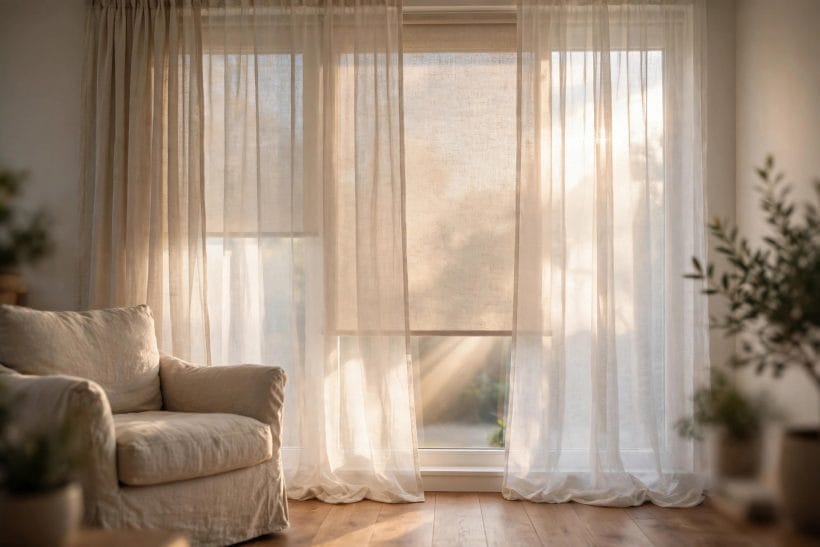
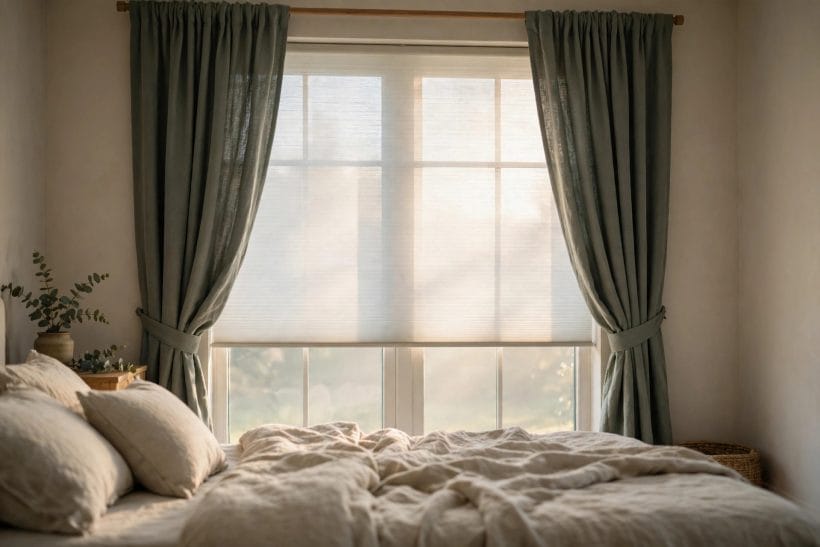
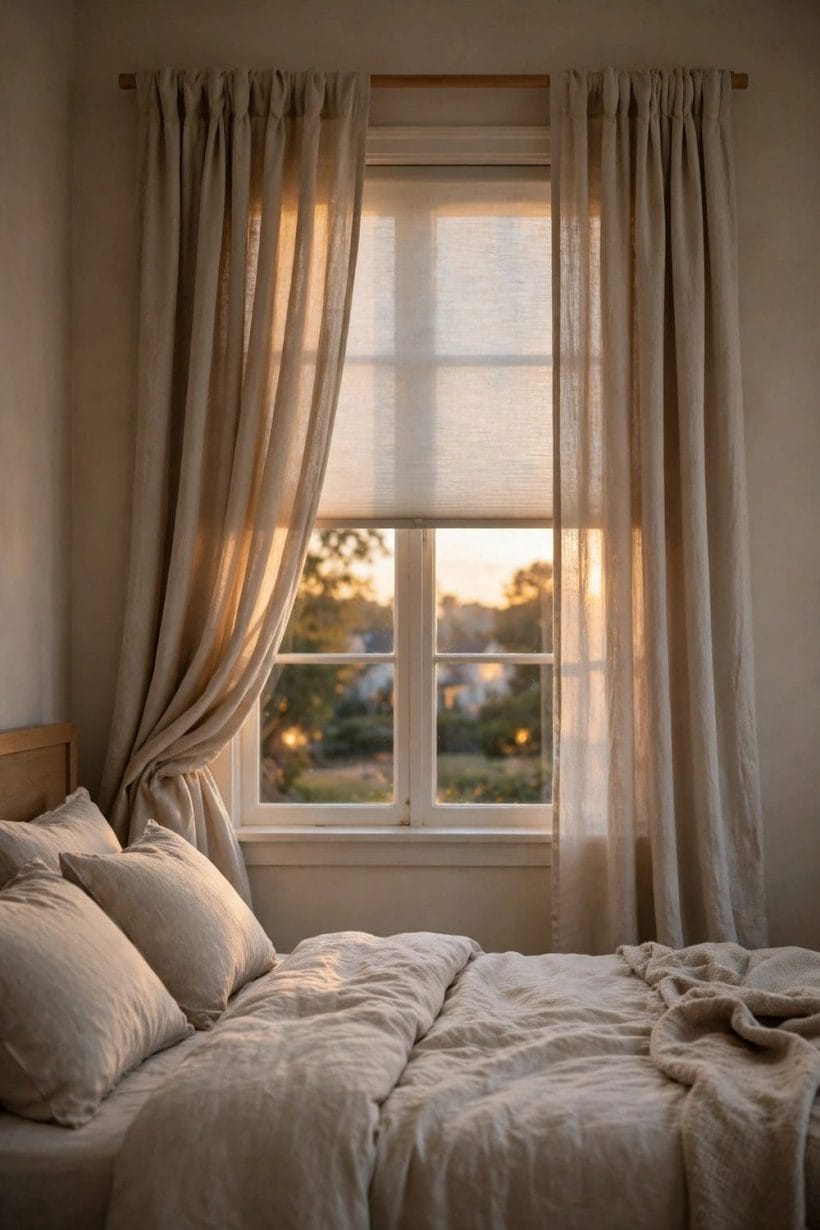
Bedrooms ask more of a window treatment than any other room: soft light in the morning, privacy at night, and darkness for sleep. Blackout curtains over a light-filtering blind answer each of those needs in turn. Through the day the blind filters daylight into a soft glow while keeping the room private, and at night the curtains draw across to darken the room and give it a sense of quiet enclosure. The pairing is practical, but it can also be beautiful, with the curtain fabric adding warmth and colour that a blind alone would not provide.
In a main bedroom, curtains in a deep, restful colour — a soft sage, a muted blue or a warm stone — make the window feel like part of the bedding story, especially when they echo a throw or cushion colour. In a guest room, a lighter curtain keeps the room welcoming while still offering guests the darkness they may want. The blind behind the curtain stays useful even when the curtains are open, giving daytime privacy without shutting out the light, which matters in a bedroom that faces a street or a neighbouring home.
Texture matters as much as colour in this pairing. A curtain with a visible weave or a subtle slub reads as soft and inviting, and it contrasts pleasingly with the smooth surface of the blind. For a calmer look, keep both layers in the same tonal family so the window feels serene; for a little more character, let the curtain carry a quiet pattern while the blind stays plain. Either way, the room gains a window that works hard through the day and feels restful at night. See also our tiny bedroom ideas for more ways to make a small sleeping space feel calm and complete.
5. Café Curtains With Blinds on the Lower Window
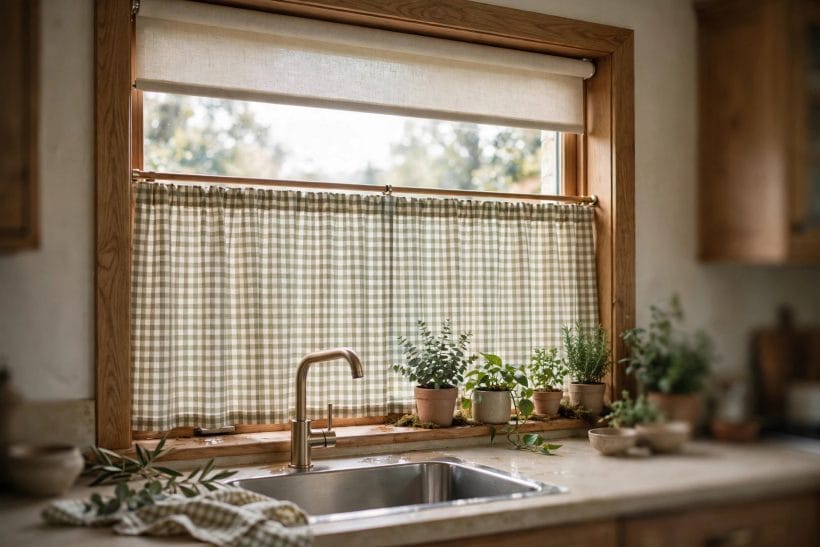
Café curtains with blinds on the lower part of a window bring a relaxed, cottage-like charm to kitchens and breakfast rooms. The café curtain covers the lower portion of the window, giving privacy at eye level while leaving the upper part open to daylight and sky. Behind it, a blind offers fuller coverage when it is wanted, so the window can be open and bright at breakfast and fully private in the evening. The look is informal and friendly, and it suits rooms where people come and go through the day.
This pairing shines in kitchens, where a window above a sink or beside a table often faces a street or a neighbour. A café curtain in a checked, striped or lightly patterned cotton adds a touch of country character, and the blind behind it keeps the arrangement practical rather than purely decorative. The upper part of the window stays clear, so the room keeps its daylight and its view of the sky, and plants on the sill still get the light they need. It is a pairing that feels lived-in rather than staged.
Colour and pattern can be playful here. A soft gingham or a narrow stripe in a kitchen accent colour ties the window to the rest of the room, while a plain linen café curtain keeps the look calm in a more modern kitchen. The blind is best kept simple and neutral, so it recedes behind the curtain and does not compete with the pattern. Together, the two layers give a kitchen window a sense of occasion without making it feel fussy, and they handle the changing light of a working room with ease.
6. Layered Neutrals in One Palette and Two Textures
Not every pairing needs contrast of colour. Layered neutrals — a blind and a curtain in the same palette but different textures — create a window that feels calm, expensive and quietly detailed. The eye notices the difference between a smooth blind and a woven curtain, between a matte fabric and one with a faint sheen, even when both sit in warm white, stone or soft grey. This is the pairing for rooms where the furniture, artwork or view should take the lead and the window should support rather than star.
The trick is to let texture do the work that colour usually does. A linen curtain with a visible weave against a plain blind, or a softly nubby curtain against a smooth blind, gives the window depth without any single element shouting. In a living room with natural wood, stone or rattan, this quiet pairing feels especially at home, because it echoes the natural materials around it. It also ages well: neutrals do not date quickly, and a change of cushions or a throw can refresh the whole room without touching the window at all.
Small rooms benefit most from this approach. A neutral pairing keeps the window light and open, and it avoids breaking the wall into competing blocks of colour. In a compact living space, a sheer or light curtain over a pale blind can make the window feel larger, because the eye travels through the layers to the light beyond rather than stopping at a bold band of colour. For more compact-room inspiration, see our small living room ideas and tiny living room ideas.
7. Bold Colour Pairings That Still Read Calm
Bold colour has a place in a layered window, provided one layer stays calm enough to let the other sing. A richly coloured curtain against a plain neutral blind is the safest route to a striking window: the curtain provides the colour moment, the blind provides the quiet background, and the room gains a focal point without feeling loud. Deep teal, burnt orange, mustard or forest green curtains all work this way, especially when the colour is picked up elsewhere in the room in a cushion, a throw or a piece of art.
The reverse also works. A coloured blind — in a soft sage, a dusty blue or a warm clay — paired with a neutral curtain gives the window a gentle wash of colour that feels considered rather than decorated. This route suits rooms where the curtain fabric is a favourite neutral linen that you want to keep, and the blind becomes the quiet accent. Either way, the rule is the same: let one layer carry the colour and the other carry the calm, and the pairing will read as confident rather than busy.
Pattern follows the same rule. One patterned layer with one plain layer keeps the window lively without tipping into clutter. A floral or geometric curtain over a plain blind brings personality to a living room, while a plain curtain over a subtly textured blind keeps a bedroom restful. If the room already has patterned rugs or upholstery, keep the window pattern small in scale so the layers sit together rather than competing. A bold window should feel like a decision, not an accident, and the calm layer is what makes it feel deliberate.
8. Combined Treatments for Wide and Tall Windows
Wide and tall windows are a gift, but they ask for a pairing that can handle their scale. A single blind on a very wide window can feel stretched, and a single curtain can feel lost. Together, the two layers divide the window into pleasing parts: the blind gives structure across the width, while curtain panels at the sides and sometimes between sections give rhythm and a sense of proportion. The result is a window that feels designed for its size rather than stretched to fit it.
On a tall window, long curtain panels emphasise height and draw the eye upward, while the blind manages light across the full drop. A roman or roller blind that covers the window in one fall keeps the lines clean, and the panels add the softness that a tall expanse of glass needs. On a wide window, panels placed at intervals can break the span into sections that feel like a series of windows, which is far more pleasing than one unbroken stretch of fabric or slats. The pairing also helps with glare: the blind can be adjusted across the sunniest section while the rest of the window stays open.
Rooms with large windows often have a view worth framing, and the pairing should frame it rather than hide it. Keeping the curtain panels drawn to the sides for most of the day preserves the view, while the blind offers shade when the sun is strong. In a room with a garden outlook, this balance matters all day: open to the garden in the morning, shaded at midday, private in the evening. The two layers together give a large window the flexibility that its size demands.
9. Small Rooms Where the Pairing Keeps the Window Open
Small rooms sometimes shy away from layered treatments, for fear that two layers will crowd the window. In practice, the right pairing can make a small room feel larger, because it keeps the window itself open while adding softness at the edges. A light blind with a sheer or fine curtain, both in pale tones, lets daylight through and keeps the wall feeling light. The window becomes a source of brightness rather than a block of fabric, and the room feels airier for it.
The key in a small room is lightness in every sense: light colours, light fabrics and panels that sit at the sides rather than across the glass. A sheer curtain that can stay closed through the day gives privacy without darkness, and the blind behind it is there for the evenings. Avoiding heavy, dark fabrics keeps the window from dominating a small wall, and choosing a curtain that echoes the wall colour helps the window blend into the room rather than cutting it in two. The pairing should feel like a frame for the light, not a barrier to it.
Small homes and compact rooms have their own logic, and a window treatment that respects it will always feel right. A simple blind with a soft curtain layer suits a snug living room, a tiny bedroom or a compact study equally well, because it adds warmth without bulk. For more ideas scaled to compact homes, see our tiny house curtain ideas, where curtains are chosen to suit small windows and smaller rooms.
10. Everyday Living With Curtains and Blinds Together
The best test of any pairing is everyday life. A combination that looks beautiful in a photograph but is awkward to live with will soon be left in one position all day, and much of its flexibility will be wasted. The pairings that last are the ones that fit the rhythms of the household: a blind that can be raised for the morning light and lowered for evening privacy, and a curtain that can be drawn when the room needs softness and left open when it does not. Thinking about those daily moments before choosing helps the pairing earn its place.
Different rooms have different rhythms. A kitchen window needs a pairing that copes with steam, cooking smells and frequent changes of light through the day, so washable, practical fabrics and a simple blind are a good match. A bedroom pairing needs to handle the shift from daytime privacy to night-time darkness. A living room pairing needs to work for both quiet mornings and sociable evenings. In each case, the two layers divide the work: one layer for the everyday, one layer for the moments when more is needed, and together they cover the whole day.
Care is part of everyday living too, and it is worth choosing layers that can be kept fresh without fuss. Smooth blinds can be dusted or wiped, and many curtain fabrics can be laundered or cleaned according to their care labels. A pairing in which both layers are easy to look after will keep looking good far longer than a pairing that demands constant attention. The most successful combined treatments are not the most elaborate ones; they are the ones that quietly suit the room, the light and the people who live with them, day after day.
Final Considerations
Choosing curtains with blinds is less about following a formula and more about noticing what your room already needs. Start with the light: which direction the window faces, when the sun is strongest, and how much privacy the room requires through the day. Then look at the room itself — its colours, its furniture, the mood you want it to have — and let the pairing support that mood rather than fight it. A calm room suits a calm pairing, a colourful room can carry a bolder curtain, and a small room rewards light fabrics and pale tones.
It also helps to think of the two layers as partners rather than rivals. The blind brings structure, light control and privacy; the curtain brings softness, colour and a sense of finish. When each layer is allowed to do what it does best, the window feels complete in a way that neither layer achieves alone. These blinds and curtains together ideas all share that balance, and whichever pairing you choose, the aim is the same: a window that looks considered, feels comfortable, and changes gracefully with the light through the day. For the fitting side, see our guide to hanging curtains over vertical blinds, kept separate from this ideas gallery. For broader window inspiration, explore our interior design ideas collection.



0 Comments