
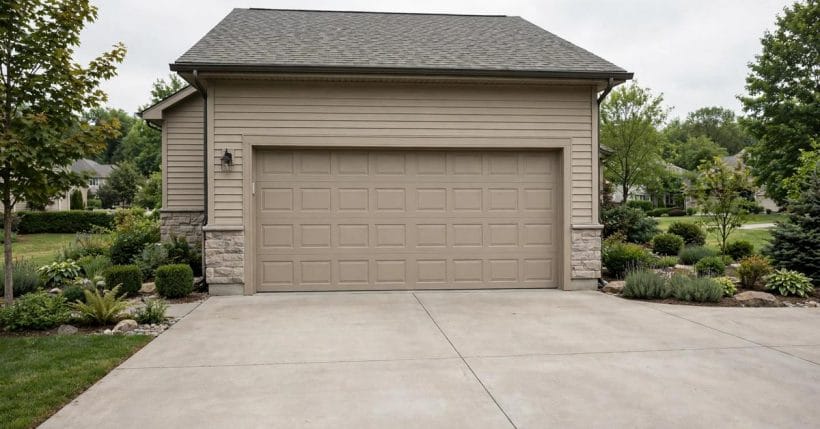
A garage door is one of the largest moving parts of a house, and it is also one of the most visible. It faces the street every day, it opens and closes in all weathers, and it guards everything stored behind it, from a car to tools, bicycles and boxes that have nowhere else to go. Choosing one deserves more than a glance at a picture, because the door that looks right in a photograph may not suit the opening it has to fill, the climate it has to face, or the way the garage itself is used.
This guide works through the checks that matter before an order is placed, in plain terms and without steering toward any particular maker or model. It covers fit, material, construction, insulation, style, windows, hardware, seals, safety features and paperwork, so that the questions asked of a supplier are the right ones. For the mechanism that lifts the door, the garage door opener checks look at drive types, sensors and safety features in more detail, while the garage exterior ideas show how the door sits within the whole front of the house.
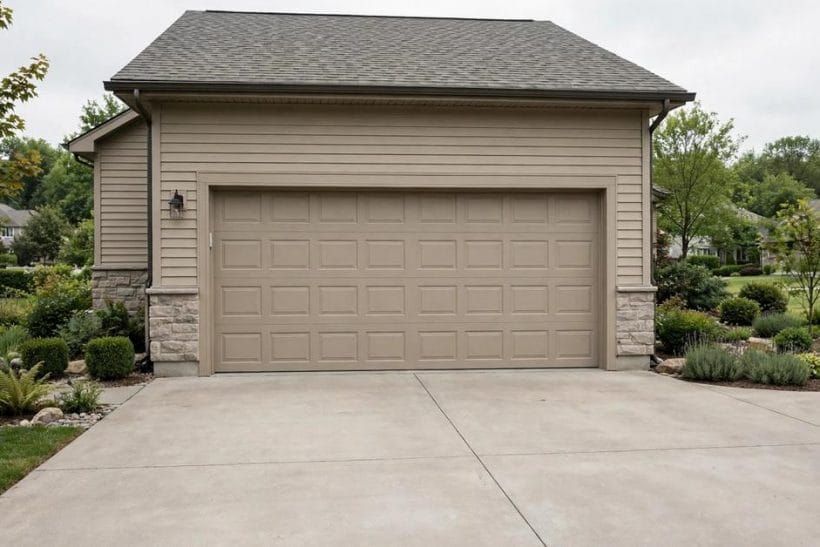
1. Measure the Opening and the Space Around It
Every sound decision starts with the opening itself. The width and height of the gap the door must fill decide which door styles are even possible, and a door ordered to the wrong size is a problem that cannot be talked away once it arrives. Measure the opening in several places, because walls are rarely perfectly square, and note the smallest reading rather than the most convenient one. A supplier will want the opening size, and giving careful readings at the start avoids a door that binds, gaps, or leaves an uneven edge.
Look also at the space around the opening, inside and out. Inside the garage, the door needs room to travel when it opens, whether it lifts in sections that curve back under the ceiling or swings out in a single panel. Pipes, lights, shelving and stored items that crowd the ceiling or the walls beside the opening can all get in the way, and it is far easier to move a shelf before ordering than to discover the clash on fitting day. Outside, check the driveway slope, the path of any gates, and how far a swinging door would reach when open.
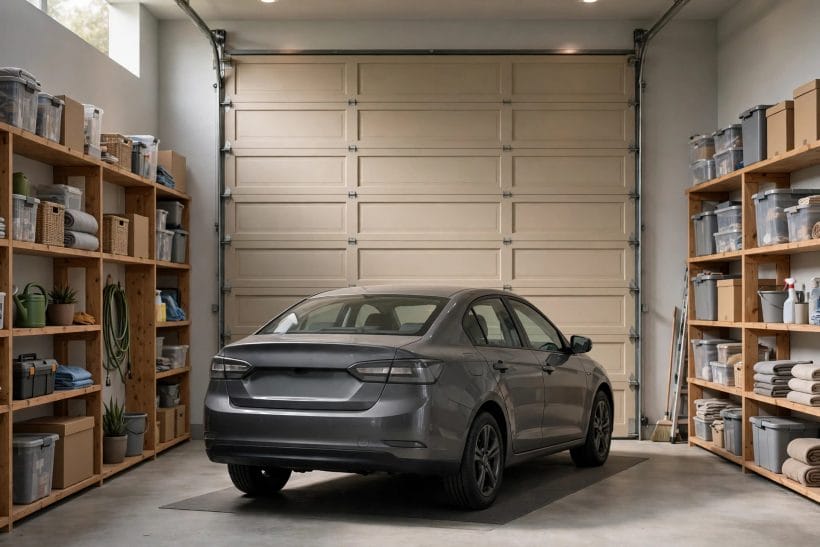
Think about what uses the opening, not just what fills it. A garage that holds a pair of cars side by side needs a different door from a single bay, and a garage that also serves as a workshop or a store needs its door to work around the people and equipment passing through it. The garage storage ideas show how the interior can be zoned so that parking space stays clear, which matters when the door’s travel and the storage layout share the same walls. Get the opening and its surroundings right, and every later choice becomes simpler.
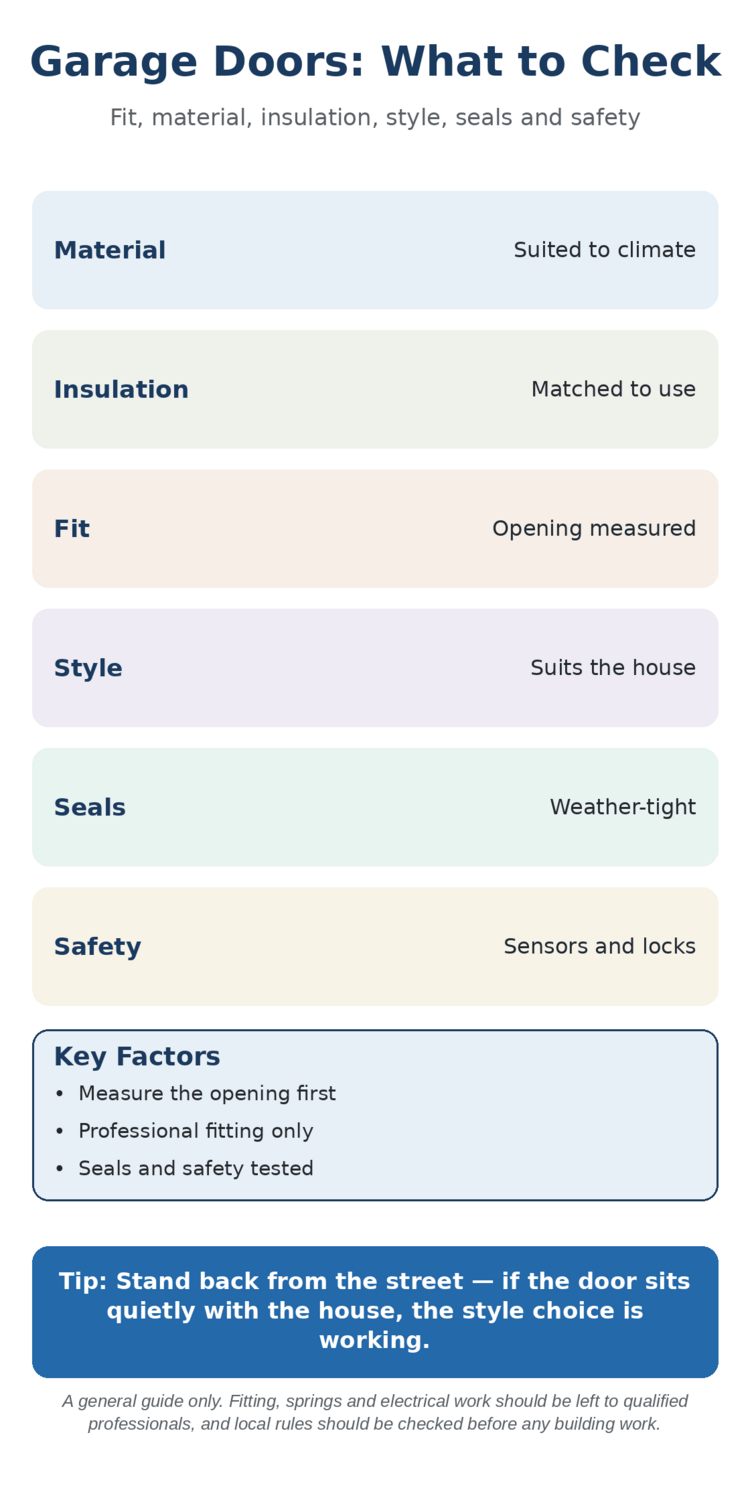
2. Choose a Material for Your Climate and Upkeep
The material of a door shapes how it looks, how it weathers, and how much attention it will ask for over the years. Steel doors are a common sight because they are sturdy and need little more than occasional cleaning, and they can be finished in a wide range of colours and panel patterns. Timber doors carry a warmth and character that suits many older houses, but timber asks for regular care, since paint or stain must be kept in good order to protect it from rain and sun. Aluminium doors are light and resist rust, which suits damp or coastal air, though they can dent more readily than steel.
Other materials sit between these qualities. Composite and fibreglass doors are made to imitate the look of timber while asking for less upkeep, and they can suit a household that wants the timber appearance without the regular refinishing. Glass and aluminium combinations bring a modern, open look and let daylight into the garage, but they offer less privacy and less insulation unless the glazing itself is chosen with care. There is no material that wins on every count; each one trades appearance, weight, upkeep and weather resistance against the others.
Match the material to the weather the door will actually face. A door that stands in driving rain, strong sun, salty air or long frosts needs a finish and a construction that can stand up to those conditions without flaking, warping or corroding. Ask how the finish is protected, how often it needs attention, and what happens when the surface is scratched or chipped. The honest answer to those questions, weighed against how much upkeep the household is willing to do, narrows the material choice more reliably than any photograph.
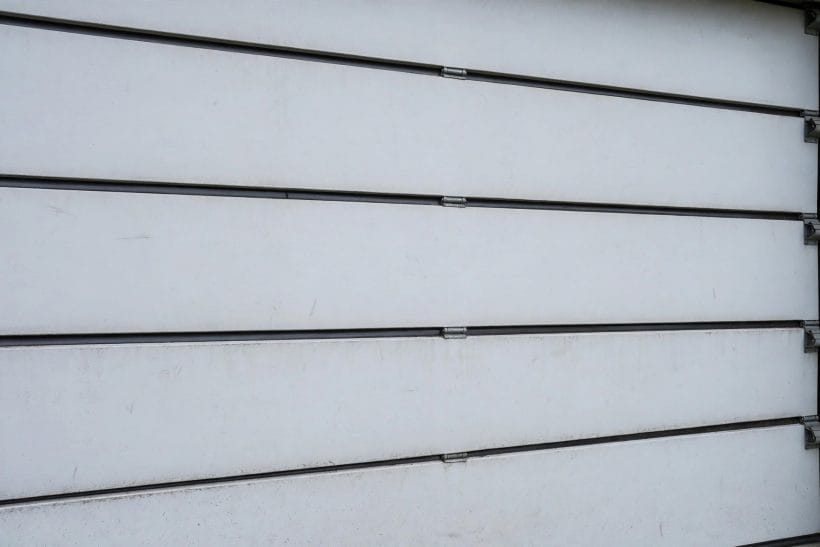
3. Look at How the Door Is Built
Beyond the material, the way a door is put together decides how it moves and how long it keeps moving smoothly. Most modern doors are made in horizontal sections joined by hinges, so that the door curves back under the ceiling as it opens. The sections themselves may be a single skin of material or a layered construction with an inner and outer face, and the layered form generally feels more solid and runs more quietly. Look at the joints between sections, the hinges that join them, and the way the edges meet the frame, since those are the places where draughts, rattles and wear tend to show first.
Older or traditional styles work differently. A single-panel door swings out and up as one piece, which needs clear space in front of the garage and a frame strong enough to carry its weight. Side-hinged doors open like a pair of gates and suit a garage used mainly for storage or as a workshop, since one leaf can be opened alone for a person on foot. Roller doors roll up into a compact bundle above the opening and need little ceiling room, which suits a garage with limited room above the opening. Each form has its own demands on space, frame and fitting, and the right one depends on the garage, not on fashion alone.
Ask about the strength of the door as a whole, not just the beauty of its face. A door that flexes, sags or twists will never seal well, however handsome it looks when new. Check whether the door is braced across its width, how the panels are joined, and whether the construction is suited to a wide opening or a tall one. A supplier should be able to explain, in plain terms, why a particular construction suits the opening in question, and a vague answer is itself useful information.
4. Weigh Insulation and Everyday Comfort
Insulation matters most when the garage is more than a parking space. If the garage joins the house, shares a wall with a living room, or is used as a workshop, a laundry space or a hobby room, then the door is part of the thermal envelope of the home, and a thin, uninsulated door will let warmth out and cold in. Insulated doors carry a layer of insulating material between their faces, and the thicker and better fitted that layer, the steadier the temperature inside tends to stay. For a detached garage used only for parking, insulation may matter less, but it still softens condensation and keeps the space more pleasant to step into on a cold morning.
Insulation is only as good as the seal around it. A well-insulated panel that leaves gaps at the sides, the top or the bottom will still leak air, so the insulation question and the sealing question belong together. Ask how the door is sealed at each edge, whether the seals are part of the door or fitted separately, and how they can be replaced when they wear. A door whose seals are easy to renew will keep its comfort for far longer than one whose seals are an afterthought.
Think about noise as well as temperature. A door that rattles in the wind or thuds as it closes will be heard through the rooms beside the garage, especially early in the morning. Layered construction, well-fitted seals and smooth-running hardware all help a door run quietly, and a door that is asked to open and close many times a day will repay that quietness daily. Comfort, in this sense, is not a luxury extra; it is the difference between a door that is noticed and one that is simply lived with.
5. Pick a Style That Suits the House
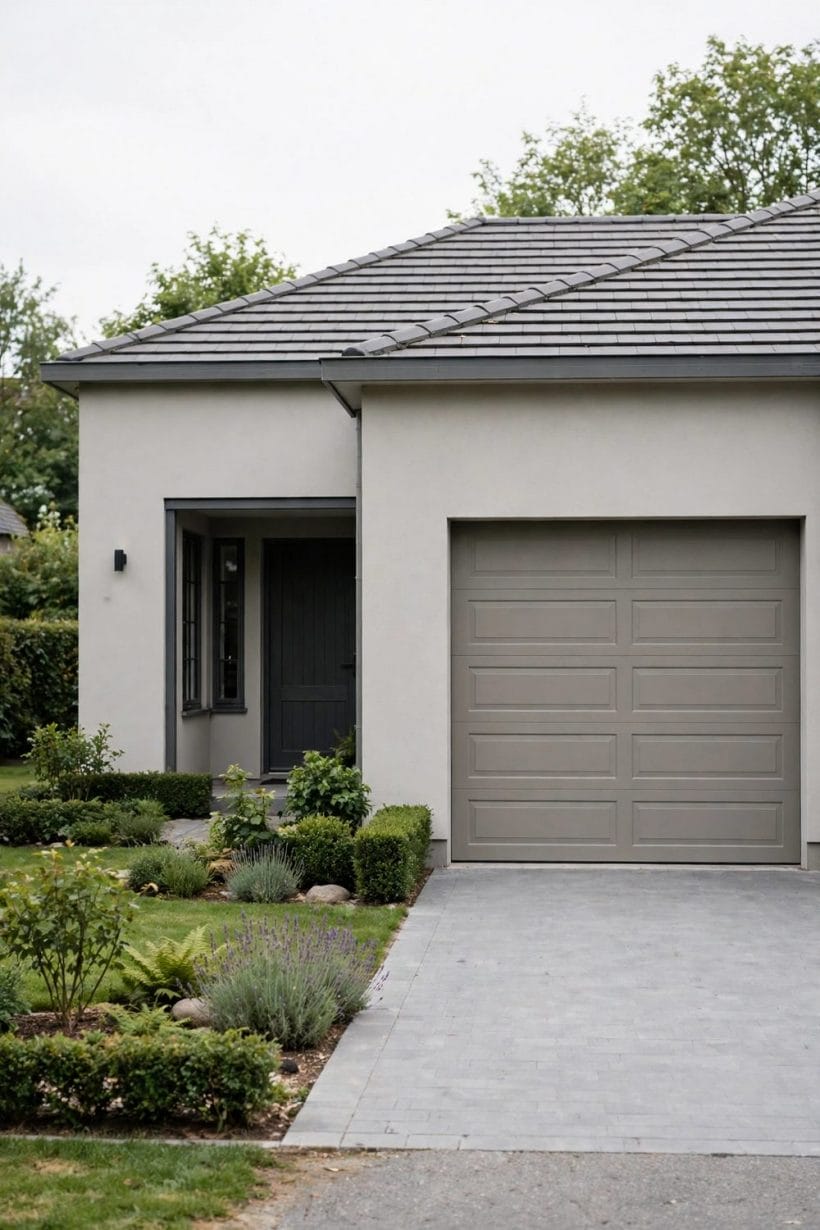
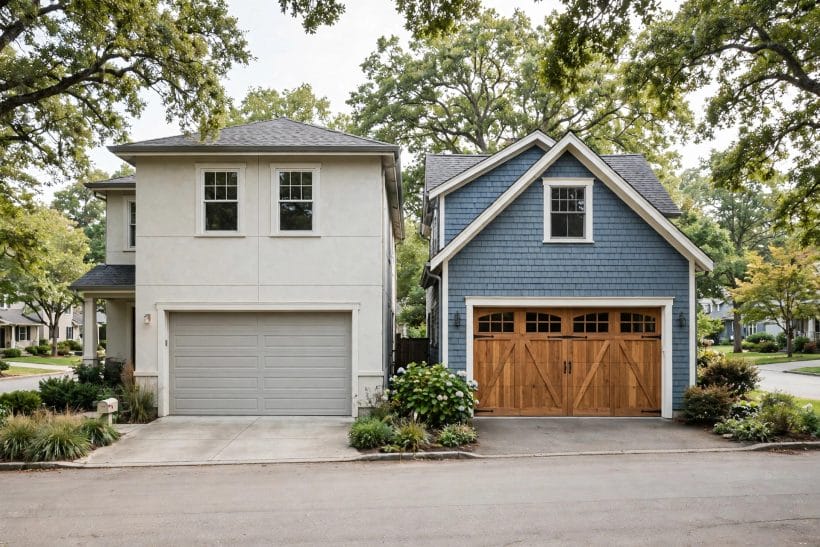
The garage door is often the largest single surface on the front of a house, so its style carries real weight in how the house looks from the street. A plain panelled door sits quietly on most houses and suits a wide range of architecture, while a door with raised panels or a carriage-house look, with cross-bracing and handles that echo old stable doors, suits a traditional or rural house. A flush door, with no raised pattern at all, suits a modern house with clean lines, and a door with long horizontal lines can make a wide opening look lower and broader.
Colour is part of style, and it deserves the same slow thought. A door painted to match the house can make the garage disappear into the frontage, while a contrasting colour turns the door into a feature. Dark colours absorb heat and can show dust and fading more readily, while pale colours show dirt and marks. Whatever colour is chosen, check that it is available as a durable factory finish rather than a coating that will need early attention, and ask how the colour is matched if a panel ever needs replacing.
Hold the style choice against the house as a whole, not against the door alone. The detached garage ideas show how a separate garage building can echo the house in miniature, with its roof, cladding and door working together, and the same principle applies when the garage is part of the house. When door, cladding, roof and driveway are considered together, the result looks settled rather than assembled, and that settled look is what lifts the whole frontage.
6. Check Windows, Light and Privacy
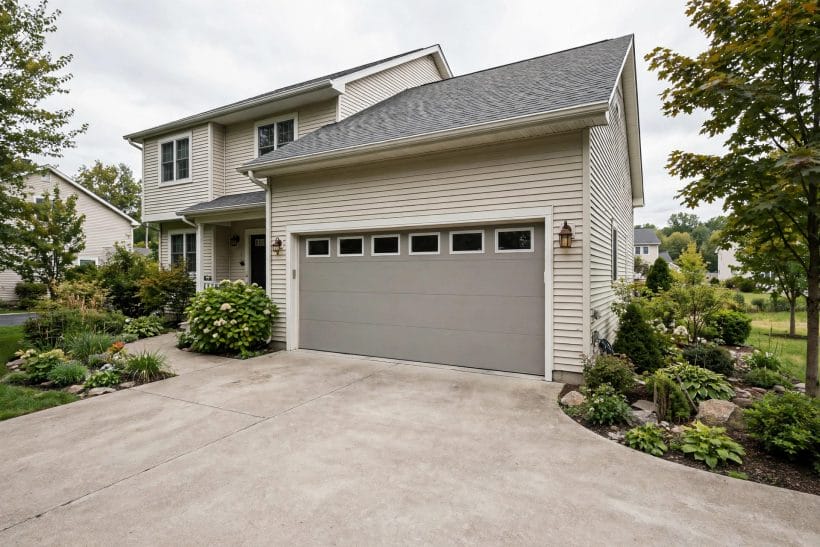
Windows in a garage door change both the look of the door and the feel of the space behind it. A row of small windows across the top section lets daylight into the garage without giving a view in at eye level, which suits a garage used as a workshop or a store. Larger glazed sections bring in far more light and give the door a modern, open character, but they also let passers-by see inside, so they suit a garage where privacy matters less or where the glazing itself is obscured. The position of the windows matters as much as their size: high windows light the space while keeping its contents private, while low windows do the opposite.
Glazing needs the same care as the door around it. Plain single glazing loses warmth and can mist over in cold weather, while double glazing or insulated glazing keeps the garage warmer and quieter. Frosted, tinted or patterned glass offers privacy while still admitting light, and toughened glass is the safer choice for a door that faces a driveway where balls, bicycles and garden tools are in daily use. Ask what glazing is fitted as standard, what alternatives exist, and whether a broken pane can be replaced without replacing the whole section.
Think about light from inside the garage as well. A garage with no other windows depends entirely on its door for daylight, and a glazed door can transform such a space from a dark box into a usable room. If the garage already has side windows or a roof light, the door’s glazing matters less for light and can be chosen mainly for appearance. The window buying checks cover frames, glazing and fit in the same spirit, and the questions there apply just as well to the glass in a garage door.
7. Look at Hardware, Tracks and Springs
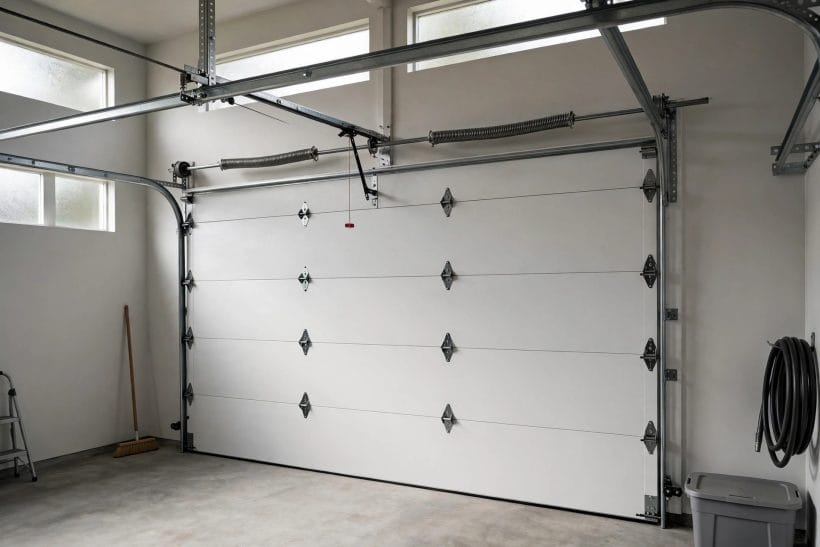
The hardware is the part of the door that works hardest and is seen least. Tracks guide the door as it opens, rollers carry its weight along those tracks, hinges join the sections, and springs balance the weight so that the door can be lifted without strain. When any of these parts wear, the door runs roughly, sticks, sags or grows noisy, and a door that is hard to move by hand is a door whose mechanism needs attention. Look at the quality of the rollers and hinges, ask whether they are sealed against dust and damp, and check that the tracks are straight, firmly fixed and clear of obstruction.
Springs deserve particular respect. The springs that balance a garage door carry a great deal of stored force, and they are not a part for household tinkering. A spring that is worn, damaged or wrongly adjusted can fail suddenly, and adjusting or replacing springs belongs to a qualified professional, with the right tools and training, and to no one else. This guide gives no instructions for touching springs, and any supplier or fitter who suggests otherwise should be treated with caution. The same professional-only rule applies to the whole fitting: a garage door is heavy, its mechanism is under tension, and its fitting is a job for trained hands.
Ask how the hardware can be maintained and replaced over time. Rollers and hinges wear, cables stretch, and seals perish, and a door whose wearing parts are standard and obtainable will be far easier to keep running than one whose parts are unusual or tied to a single source. A supplier who can explain, in plain terms, which parts wear first and how they are replaced is giving a genuinely useful answer, and that answer is worth more than any promise about how long the door will last untouched.
8. Check Seals, Draughts and Weather Protection
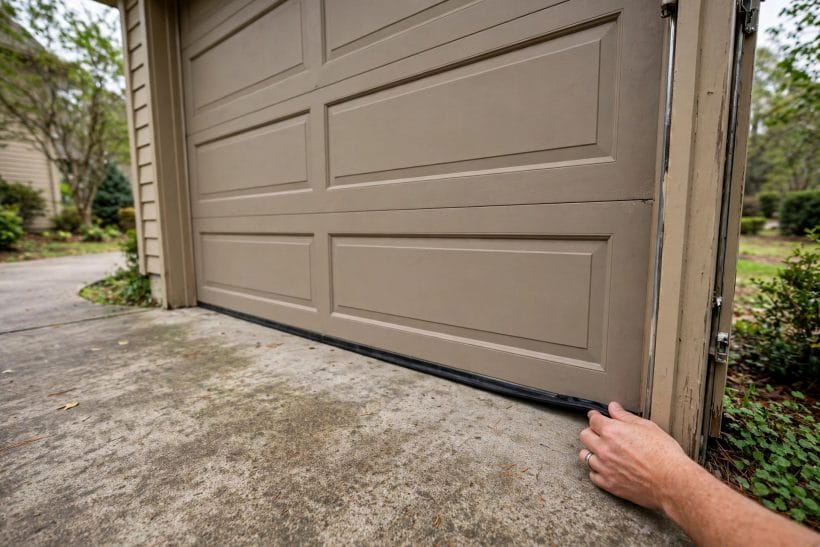
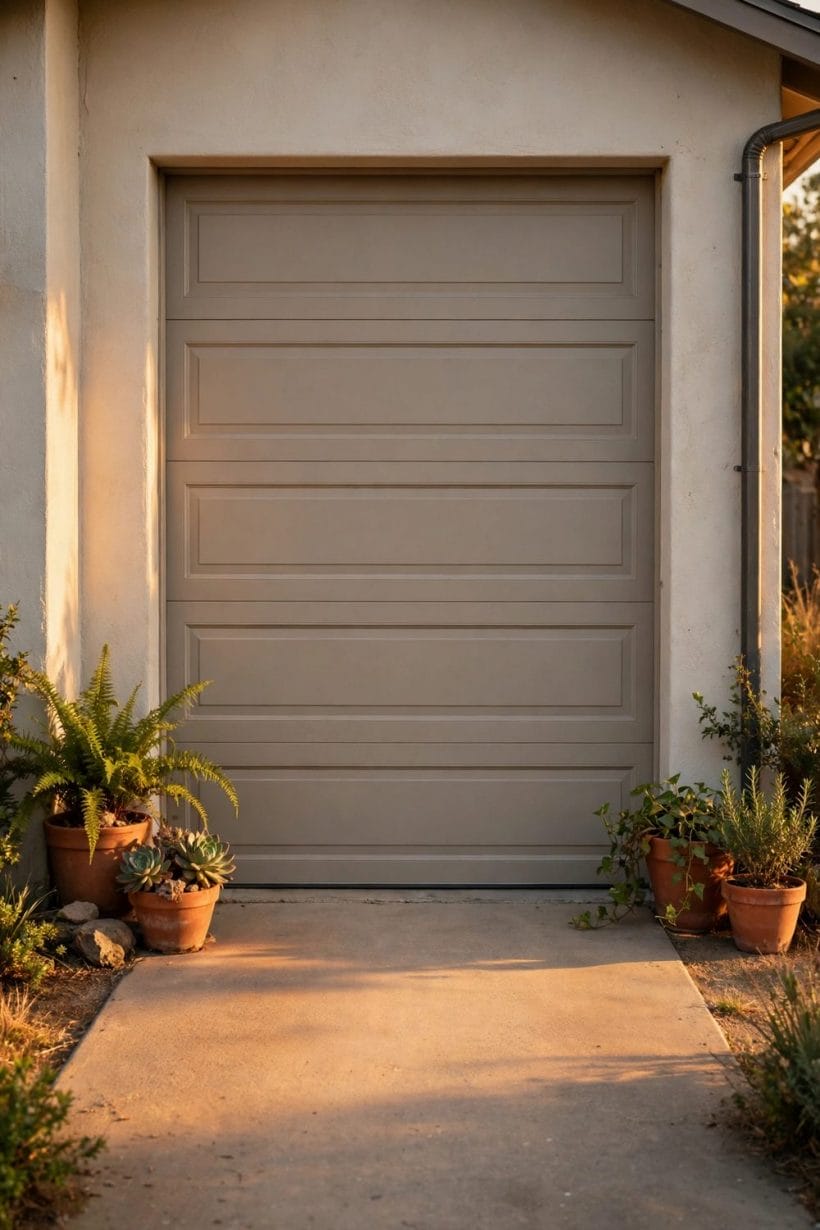
A garage door must keep weather out, and that job falls largely to its seals. The bottom seal meets the floor each time the door closes, and it must stay flexible enough to follow an uneven floor while firm enough to block rain, leaves, dust and draughts. Side and top seals close the remaining gaps between the door and its frame, and together these seals decide whether the garage stays dry and reasonably dust-free or whether wind and rain find their way in around the edges. Stand outside on a windy day, if the chance arises, and watch how an existing door behaves; the places where leaves gather or dust streaks appear are the places where seals have failed.
Weather protection is not only about seals. The finish of the door must resist rain and sun without peeling, the bottom edge must resist the damp that collects where door meets floor, and the frame itself must be protected where it meets masonry or timber. In a climate with driving rain, a small canopy or overhang above the door can shelter the top seal and the upper panels, and a driveway that drains away from the door, rather than toward it, spares the bottom seal a great deal of standing water. These surrounding details are easy to overlook when attention is fixed on the door alone, yet they decide how hard the seals have to work.
Check the seals as a maintenance item, not as a fit-and-forget feature. Seals harden, crack and flatten with age and with exposure to sun and frost, and a seal that no longer meets the floor is a seal that no longer seals. Ask how the seals are fitted, whether they can be renewed without special tools, and how often they should be looked at. A door whose seals are simple to inspect and simple to replace will keep its weather protection for years, while a door whose seals are hidden or bonded in place will quietly lose it.
9. Think About the Opener and Safety Features
Most garage doors today are opened by a motorised opener, and the opener deserves the same careful questions as the door itself. The opener must be matched to the weight and size of the door, and a motor that strains to lift its door will wear quickly and run unreliably. Ask whether the opener is suited to the door in question, how it behaves when the power fails, and whether the door can be released and moved by hand in an emergency. The manual release is a safety feature, not an afterthought, and every adult in the household should know where it is and how it is used, without needing tools or strength beyond the ordinary.
Safety features around the door matter most where children and pets are present. A door that reverses when it meets an obstruction, and sensors that stop the door when something crosses its path, are the features that prevent the most serious accidents, and they should be present, working and tested regularly. Look for sensors mounted low beside the opening, check that they are not easily knocked out of line, and ask how the safety features are tested and what happens when a sensor fails. A door whose safety features are treated as optional extras is a door to walk away from.
Security is the other side of the same question. A garage door is an entrance to the house, and it should resist casual forced entry as firmly as any other door. Ask about the locking arrangement, whether the door locks automatically when closed, and how the emergency release is protected from being reached from outside. Remote controls and keypads should be treated like house keys: spares kept safe, codes changed when the household changes, and lost remotes dealt with promptly. A door that is easy for its owners to use and hard for anyone else to open has struck the right balance.
10. Ask About Fitting, Guarantees and Upkeep
Fitting is where a good door becomes a good installation, or fails to. A garage door should be fitted by qualified professionals, who will set the tracks true, balance the springs, align the seals and test the safety features before handing the door over. Ask what the fitting includes, whether the old door is removed and taken away, and how the fitter will leave the opening, the walls and the driveway. A careful fitter will also show the household how the door works, how its safety features are tested, and what routine attention it needs, rather than simply leaving a new door behind and departing.
Read the guarantee with the same care as the door itself. Guarantees vary in what they cover and for how long: the door panels, the hardware, the finish, the opener and the fitting itself may all carry different terms, and some parts may be covered for a shorter time than others. Ask what is excluded, whether the guarantee depends on regular servicing or on using approved parts, and whether it transfers if the house is sold. Keep the paperwork with the house records, alongside the instructions and the fitter’s details, so that a future question can be answered from the documents rather than from memory.
Finally, weigh the whole cost of ownership, not just the figure on the quotation. A door that needs frequent attention, unusual parts or early refinishing may cost more over its life than a door that asks little beyond occasional cleaning and seal checks. The home renovation planning guide makes the same point for larger projects: scope the work, sequence it sensibly, and keep the record as the project file. For a garage door, that means choosing the door, the opener and the fitter together, as one decision, and then enjoying a door that opens smoothly, seals well and suits the house for years.
Final Considerations
There is no single door that suits every garage, and that is the honest heart of this guide. The right door is the one that fits its opening, suits its climate, matches its house, insulates as its use requires, seals against its weather, and is fitted and kept by people who know the work. A household that checks those points, asks plain questions, and listens carefully to the answers will end up with a door that serves quietly for years, rather than one that demands attention from the first winter onward.
Take time over the decision, and resist pressure to order on the spot. Visit a showroom if one is within reach, open and close the doors on display, listen to how they run, and look closely at the seals, the hinges and the finish. Compare a small number of serious options side by side, with the same questions put to each supplier, and let the answers, not the salesmanship, decide. A garage door is bought rarely and lived with daily, and the extra care taken before ordering is repaid every time it opens.


0 Comments