
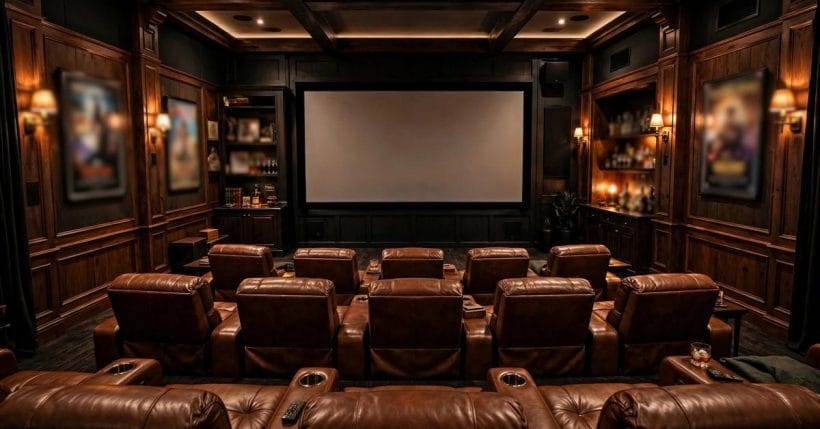
Every house has a room that sighs when its door closes — the one place where the match is always on, the chair is always yours, and nobody tidies your things into a system. That room is built, not found.
These seventy-five man cave ideas cover claiming the space, the screen and seating, the bar corner, games, hobbies, light and character — the full attribute map of the retreat, sized for real rooms and real households.
1. Man Cave Ideas at a Glance
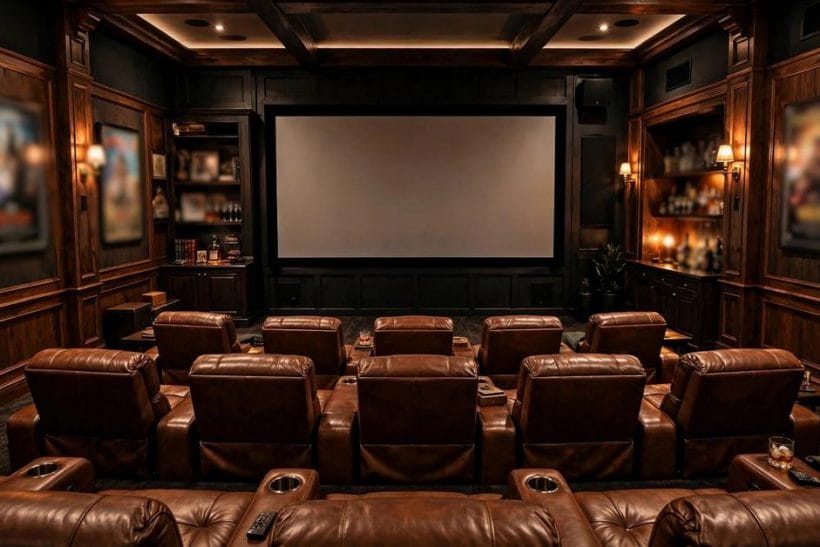
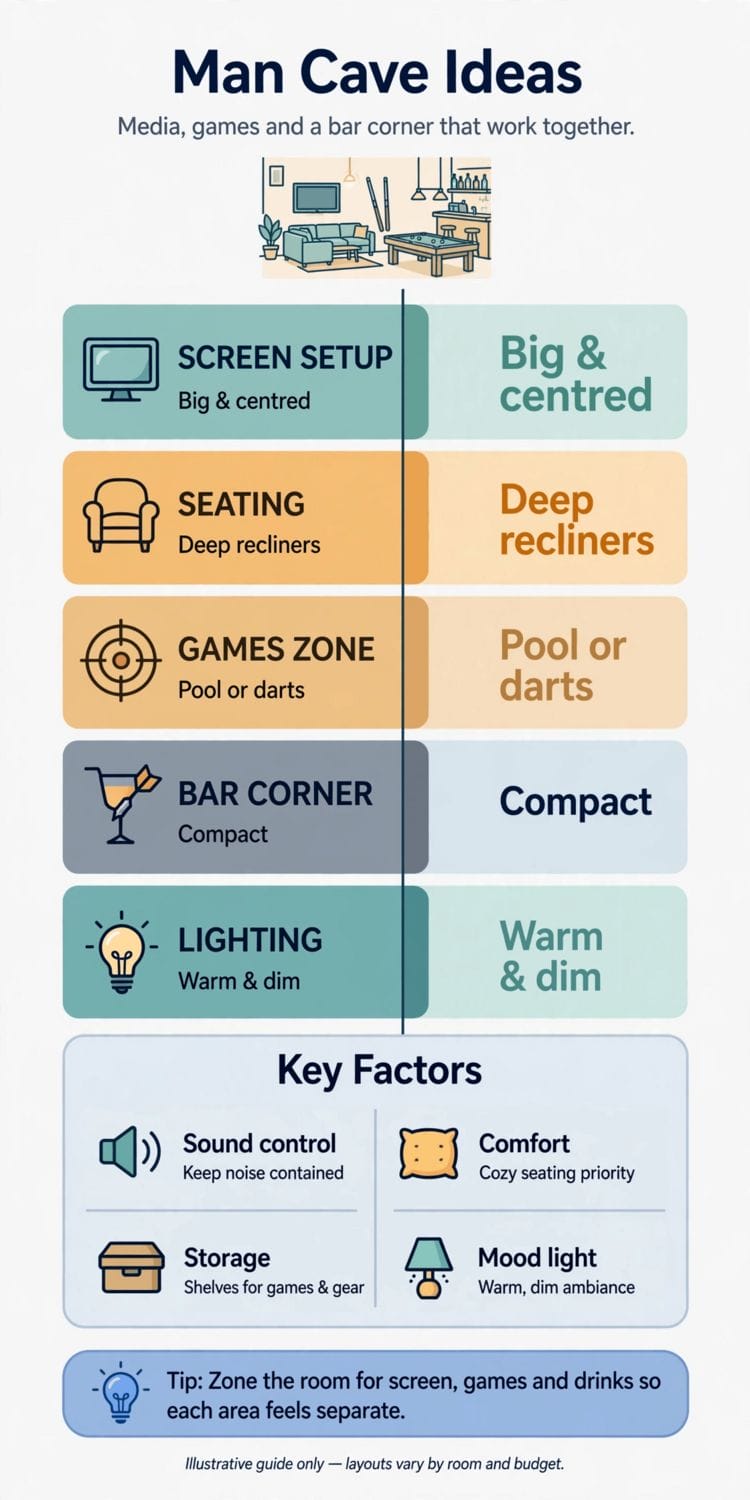
A man cave is a room given over entirely to one person’s leisure: its central entity is the retreat itself, and its attributes are a claimed and comfortable space, a screen-and-seating arrangement for watching, a corner for drinks, provision for games and hobbies, controlled light and sound, and a finish that expresses its owner rather than a catalogue. It sits within the basement-and-leisure family under the site’s home design hub, adjacent to the home theater and home bar pillars but distinct from both — broader than the cinema, lighter than the plumbed bar, and always personal.
| Question | Short answer |
|---|---|
| What is the best room for a man cave? | The household’s most underused one — a spare room, basement corner or garage bay — provided damp, warmth, power and sound can be honestly sorted. Total claim of a modest room beats half of a grand one. |
| How is a man cave different from a home theater? | The theater optimises one activity; the cave hosts several — watching, games, drinks, hobbies — with the screen as first among equals rather than the whole constitution. |
| Does a man cave need a bar? | It needs a drinks station; it rarely needs plumbing. A fitted corner with a small fridge, shelving and a forgiving worktop serves most caves better than a plumbed bar would. |
| How do I keep the noise from annoying the house? | Soft surfaces, a sealed door, sensible speaker placement and headphones for late sessions. Sound control is a design layer, planned with the room, not an apology after it. |
| Can a man cave be bright and modern? | Yes — the retreat is a purpose, not a palette. Pale walls, light timber and one saturated colour make a loft-style cave; the classic dark version is a choice, not a rule. |
| What is the commonest cave mistake? | Filling it. A cave at full capacity stops being a retreat and becomes storage with ambitions. Empty floor, edited display and one clear purpose per zone keep it a place people drift toward. |
2. Choosing and Claiming the Space

Every man cave begins as a negotiation with a spare room, a garage bay, a basement corner or a garden building. The space’s honest limits — light, height, damp, distance from the house’s quiet rooms — decide which cave it can become, and the basement-wide planning in basement ideas is the right foundation wherever the cave goes below ground.
1. Start with the room nobody else is using well
The best cave candidates are the household’s underachievers: the spare room that hosts twice a year, the garage bay storing things nobody remembers.
2. Measure the room against the screen and the table
Two objects dictate cave geometry: the screen wants viewing distance, the games table wants clearance on every side.
3. Sort the damp and the cold before the decorating
Moisture, ventilation and warmth need honest answers first, stated generally and checked for your building — a cave that smells of damp will be visited by exactly one person, once.
4. Keep a route to the house’s bathroom and kitchen
A cave cut off from the house’s plumbing and snacks makes every visit a expedition and every guest night awkward.
5. Claim the space completely or not at all
A half-cave shared with the ironing, the freezer and the children’s overflow satisfies nobody. The room works when its purpose is total — storage evicted, territory clear — because retreat is a state of mind that clutter interrupts.
6. Plan power and connectivity before the furniture lands
Screens, consoles, fridges, chargers and lights all drink electricity, and caves are chronically short of sockets.
7. Think about who hears the cave, and when
A cave beside bedrooms needs its noise planned — soft finishes, a door that seals, headphones for the late sessions — or its social licence will be revoked by the household.
8. Give the cave a door that closes the world out
The threshold matters psychologically: a real door, closing on a real latch, is the line between the house’s demands and the cave’s permission.
9. Leave the room one honest window or a plan for air
Ventilation — a window that opens, a vent, a quiet fan — is the difference between a den and a fug, noticeable by the second hour of any gathering.
10. Decide the cave’s one job before its many hobbies
Sport, film, games, music, making — a cave can host several, but one must be the landlord and the rest tenants.
11. Keep some floor empty on purpose
The temptation is to fill every metre with kit. Resist it: empty floor is where darts land, friends stand, chairs rearrange for the big match and the room breathes.
3. The Screen, the Seating and the Sound
The cave’s altar is the screen, and its congregation is the seating. This is the ground the dedicated basement home theater ideas post covers at cinema depth; here the treatment stays at the cave’s broader balance of watching, hosting and everyday use.
12. Size the screen to the seats, not to the offer
The right screen is the one that fills the view pleasantly from the main seats at their actual distance.
13. Spend on the main seats before the screen’s last inch
Nobody remembers a marginally larger picture; everybody remembers four hours in a bad chair. Two or three genuinely comfortable seats with support, recline and a place for a drink outrank every specification war in the catalogue.
14. Arrange seating in a shallow arc, all facing one way
A cave is not a cinema of rows nor a lounge of conversation corners: a gentle arc or a straight run facing the screen, with every seat a good seat, is the social geometry that works for matches, films and games alike.
15. Add a second row on a low platform only if the room earns it
Raised rear seating needs ceiling height and real depth to work. In an ordinary room, a bar-height counter with stools behind the sofa achieves the same extra capacity without carpentry — and doubles as the snacks station.
16. Treat sound as half the picture and budget it so
A soundbar at minimum, a modest surround set ideally, placed at ear height around the main seats — the cave’s sound should wrap, not shout from one corner.
17. Soften the room so the sound can behave
Bare walls and hard floors bounce sound into mush. A rug, curtains, upholstered seats and one bookshelf of irregular spines calm the room’s echo more cheaply than any acoustic gadget, and they make conversation pleasanter too.
18. Keep blackout control for daytime viewing
The big match rarely waits for dark. Curtains or blinds that genuinely black out the screen’s wall let the cave work at noon as well as midnight — a small fitting that doubles the room’s useful life.
19. Mount remotes, chargers and controls in one dock
The cave’s scattered technology needs a headquarters: one tray or dock where remotes live, devices charge and the room’s small controls gather.
20. Plan the screen wall as the room’s composition
Screen centred, speakers balanced, a low unit beneath holding the kit with air to breathe, nothing dangling — the screen wall is the cave’s portrait and should be composed like one, cables channelled and hidden from the first fitting.
21. Leave headphone hooks for the late sessions
Good headphones on hooks by the main seat are the cave’s peace treaty with the sleeping house.
22. Keep a folding chair or two in reserve, stored flat
Guest nights swell every cave beyond its seating. Two decent folding chairs that live flat behind a unit or in the store corner solve capacity without permanently crowding the room’s daily arrangement.
4. The Bar Corner and the Drinks Station
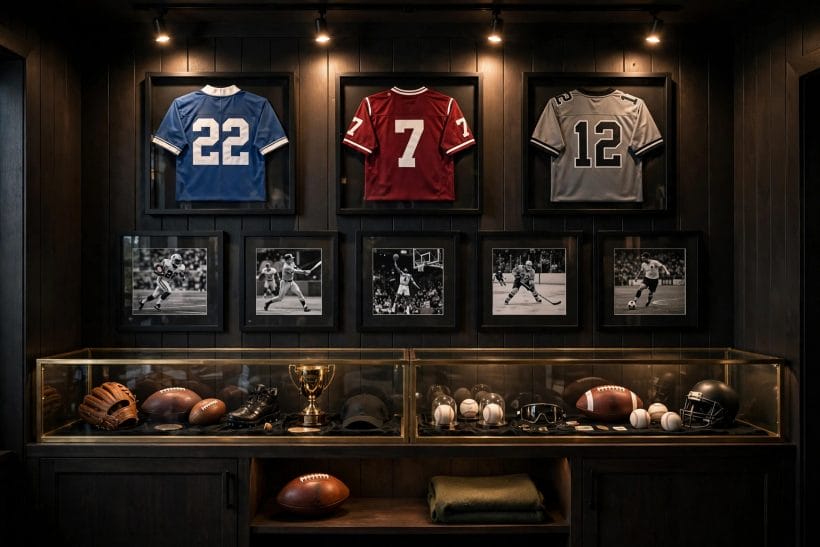
A bar corner is the cave’s hospitality engine: drinks, glassware and a worktop of one’s own. It stays a corner, though — the full sink-and-plumbing version belongs to the basement bar ideas post, and the cave’s version here is the dry, nimble arrangement most rooms actually need.
23. Build the bar as a fitted corner, not a freestanding island
In most caves the bar works best as a run of units along one wall or in the corner: worktop, shelves above, storage below.
24. Fit a small fridge and let it define the corner
Cold drinks without a house expedition are the bar corner’s founding promise. A quiet under-counter fridge — placed where its hum will not fight the film — is the single appliance the cave bar truly requires.
25. Run open shelving for bottles and glassware, edited hard
Open shelving displays beautifully right up to the moment it becomes a dusty archive — edit it as firmly as the spa bathroom edits its bottles.
26. Add a worktop of something that forgives rings and spills
Stone, sealed timber or a good laminate: the bar top lives wet and takes knocks. Choose the surface that shrugs at both, in a tone that hides the evidence between wipe-downs.
27. Keep a sink out of it unless the plumbing is already there
A dry bar with a water jug, a drip tray and a bucket routine serves perfectly well for an evening.
28. Seat two at the bar, no more
A pair of stools at the corner gives the room a second social altitude — perching with a drink while others sprawl at the screen.
29. Light the bar corner warmly and separately
A warm strip under the shelves or a small pendant over the corner switches the bar’s mood on independently of the screen’s light.
30. Stock for the guests you actually host
The cave bar should serve its real congregation: the regulars’ drinks, the mixers, the soft options in genuine variety.
31. Keep glassware sturdy and replaceable
Caves are dark, crowded and relaxed — fine crystal will not survive the fixture list. Handsome, sturdy glassware in a matched set, easily replaced when (not if) one breaks, suits the room’s honest physics.
32. Give the corner a back bar detail worth looking at
A mirror, a run of timber, framed prints of the home team’s history or the family’s own — the bar’s backdrop is seen over every poured drink.
33. Remember the tea and coffee end of hospitality
Not every cave session is an evening one. A kettle, mugs and the means of a proper coffee at the corner serve morning matches, working-from-cave days and the drivers in the party with equal welcome.
5. Games, Tables and Friendly Rivalry
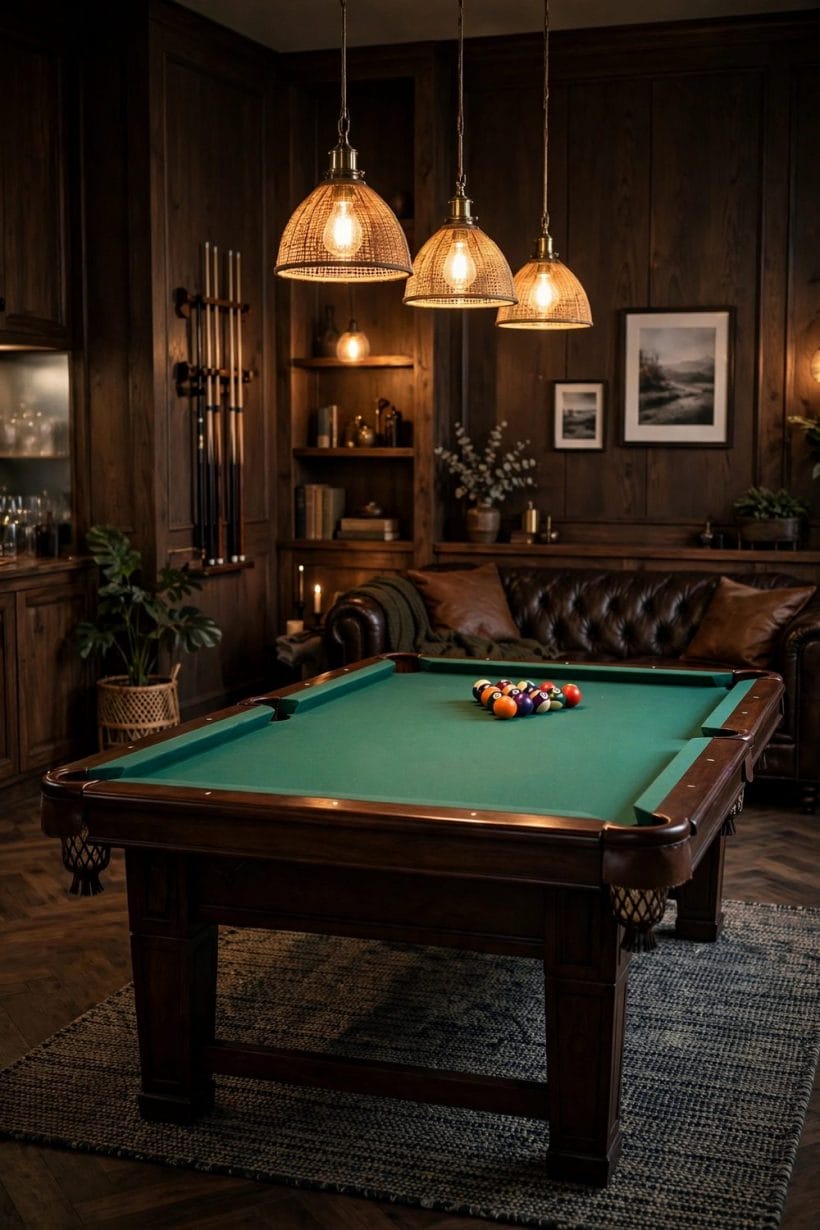
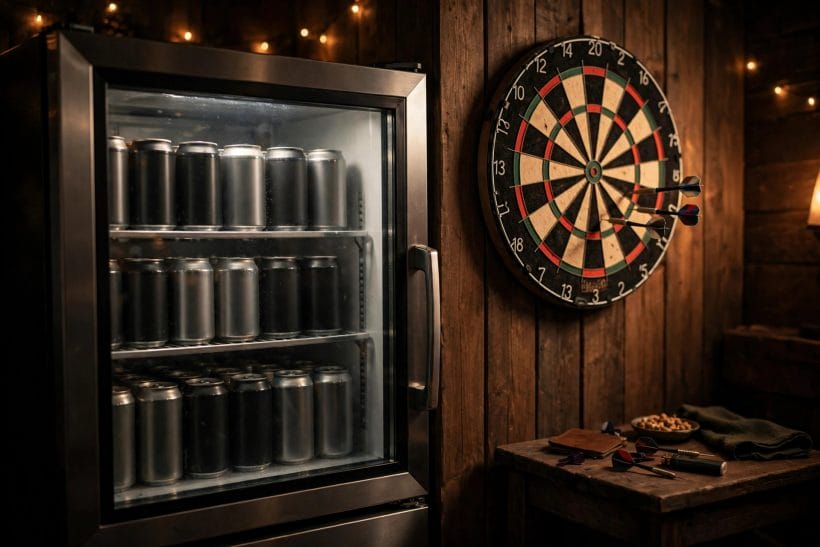
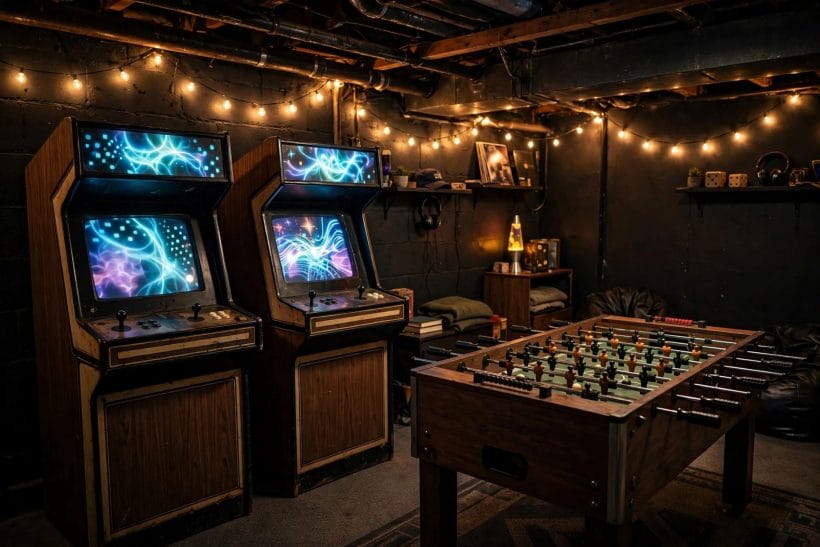
The cave’s second engine is play: a table, a board, a set of darts, a screen for the digital contests. The full room-by-room treatment lives in game room ideas; here the games are fitted into the cave’s shared space without evicting the sofa.
34. Choose one anchor table game and give it its room
Pool, table tennis, foosball, air hockey — each demands real clearance to play properly. One anchor game, correctly accommodated, beats three squeezed into unplayable corners; choose by what the household actually plays, not by what photographs well.
35. Hang a dartboard with its safety thought through
Darts need a clear throwing lane, a backboard that forgives strays and a wall nobody walks behind mid-throw.
36. Keep a proper table for cards and boards
A sturdy table that seats six for cards, chess and board games is the cave’s quiet workhorse.
37. Set the console zone at the screen, with storage beneath
The digital cave runs on the same discipline as the bar: what is used is out, what is not is stored, and nothing lives in a tangle.
38. Build a trophy and memorabilia shelf with a strict border
Signed shirts, programmes, models, the five-a-side trophy — display gives the cave its identity, and a border gives display its dignity.
39. Keep score like you mean it: a board for the ongoing wars
A chalkboard or framed scoreboard for the season’s darts league, the chess ladder, the gaming rivalry — the cave’s memory made visible.
40. Store the small games in one closed unit
Decks, dice, boards and counters breed in open piles. A single cabinet or chest assigned to them keeps the cave’s surfaces clear and the games findable — the difference between a games room and a room containing games.
41. Plan lighting over tables separately from screen light
Zoned circuits over the table let one half of the cave play poker in daylight conditions while a film glows in the other — two rooms’ worth of evening in one space.
42. Keep a house set of everything consumable
Chalk, tips, cards, batteries, a spare cue tip, fresh darts flights — the small consumables whose absence cancels a games night.
43. Let one wall game travel: cornhole, ladder toss, the garden set
Some games belong half outdoors. A set that lives in the cave’s store corner and deploys to the garden in summer extends the cave’s territory seasonally without costing it any floor space in winter.
44. End games night with a reset the room can survive
Scores recorded, glasses to the bar, games back in their unit, cushions straightened — a ten-minute reset keeps the cave ready for its own next invitation and stops the slow slide into the room everyone apologises for.
6. Work, Hobbies and Making Things
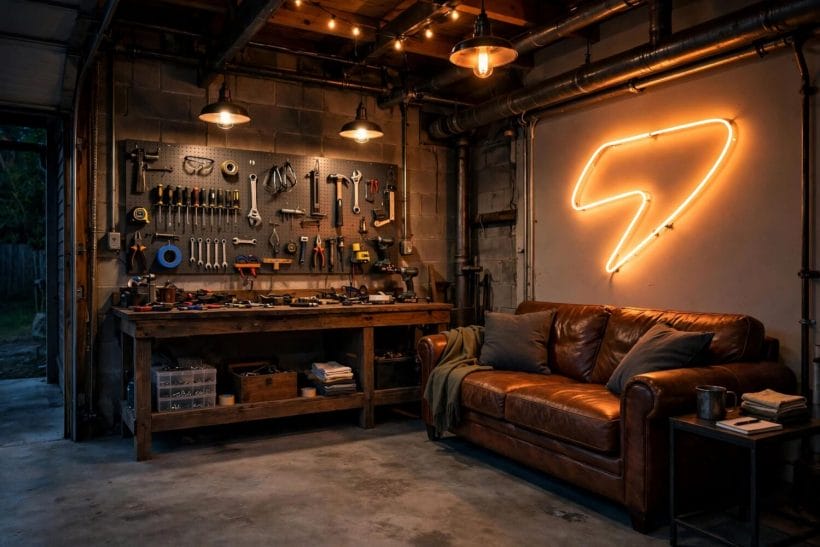
Many caves moonlight: a bench for models and repairs, a desk corner, the instrument wall. Fitted deliberately, the making half deepens the room; fitted accidentally, it becomes the junk that eats the retreat — the workshop thinking in small basement ideas about zoning one room honestly applies here in full.
45. Give the hobby a bench of its own, with light over it
Modelling, tying flies, repairing kit, building electronics — each needs a stable surface, task light at the right angle and storage within arm’s reach.
46. Wall-mount instruments and tools as working display
Guitars, rods, tools and kit on proper wall mounts are the cave’s most honest decoration: beautiful because used.
47. Keep a project shelf, one project deep
The cave hobbyist’s discipline: one project in progress on the bench, its materials on one shelf, everything else stored.
48. Add a desk corner only if it can close away
Working or gaming at a desk suits some caves, but the office must not colonise the retreat.
49. Store hobby chemicals and sharp things with respect
Glues, paints, blades and solvents belong in a closed, ventilated cabinet, out of the guest-and-children traffic pattern.
50. Build the exercise corner honest or skip it
A mat, a rack of weights and a pull-up bar make a real training corner; a clothes-horse treadmill makes a monument to guilt. If fitness is genuinely wanted, the dedicated planning in home gym ideas sizes it properly — in the cave, keep it compact and used.
51. Keep a repair kit for the house at the bench
The cave bench doubles happily as the home’s fixing station: tools, tape, screws and the torch, all in one known place.
52. Let the making half have the window if there is one
Where the cave has one window, give it to the bench and the instruments, and let the screen take the dark wall — each activity in the light it actually wants.
53. Display finished work sparsely and proudly
The completed model, the framed photograph, the restored piece — one or two on show, rotated as new work finishes.
54. Keep hobbies’ noise and dust behind a curtain or door
Sanding, sawing and drilling are the cave’s antisocial arts. A curtain across the bench alcove or work confined to garage hours keeps the retreat’s air clean and its peace with the household intact.
55. Give music a corner of its own
A turntable or a good player, the records or the library, and one chair placed for listening rather than watching — the music corner is the cave’s contemplative wing.
7. Small Caves and Shared Claims: Compromises That Work
Not every cave is a whole spare room. The alcove, the garage’s better half, the landing’s end — small and shared claims can still deliver the retreat, provided the compromises are designed rather than drifted into. The partially-shared lesson rhymes with partly-finished-basement thinking: finish the part you claim, completely, and let the rest wait its turn.
56. Define the territory with a rug, a light change and a line
A change of lighting and a boundary the household can see — a shelf unit, a curtain, the rug’s edge — makes a claim that goodwill can respect without a single locked door.
57. Shrink the screen, keep the seats honest
A small cave’s screen should be sized to its shorter viewing distance, which often means a better picture for less money.
58. Choose folding and stacking pieces where space is borrowed
Chairs that stack, a table that folds, a games surface that converts — in a part-time cave, furniture that can halve its footprint between sessions earns its place twice over.
59. Let one wall do all the work
Screen, shelves, bar and display stacked on a single fitted wall leaves the rest of a small room open and calm.
60. Negotiate the calendar, not just the room
A shared cave works on agreed hours as much as agreed metres: the big-match nights, the games evenings, the quiet Sundays.
61. Keep the cave’s kit in closed storage so the room can moonlight
Where the room must double — guests, homework, the occasional office day — closed storage lets the cave vanish respectably in ten minutes and return in five.
62. Sound-shrink for small spaces: near-field and headphones
In a small or shared claim, speakers close to the seats at low volume give full immersion at a fraction of the room-filling level.
63. Skip the anchor table game; take the wall and table games
Pool tables evict small caves. Darts, cards, boards and a good console deliver the rivalry without the footprint — the games shrink to the claim while the competition stays full-size.
64. Make the mini-bar a trolley or a tray station
A handsome trolley or a fitted tray on a side unit gives the small cave its drinks ritual without a plumbed or fitted corner.
65. Guard the small cave’s one luxury jealously
Every cave, however small, deserves one uncompromised thing: the great chair, the perfect lamp, the screen done right.
8. Light, Sound Control and Finishing Character
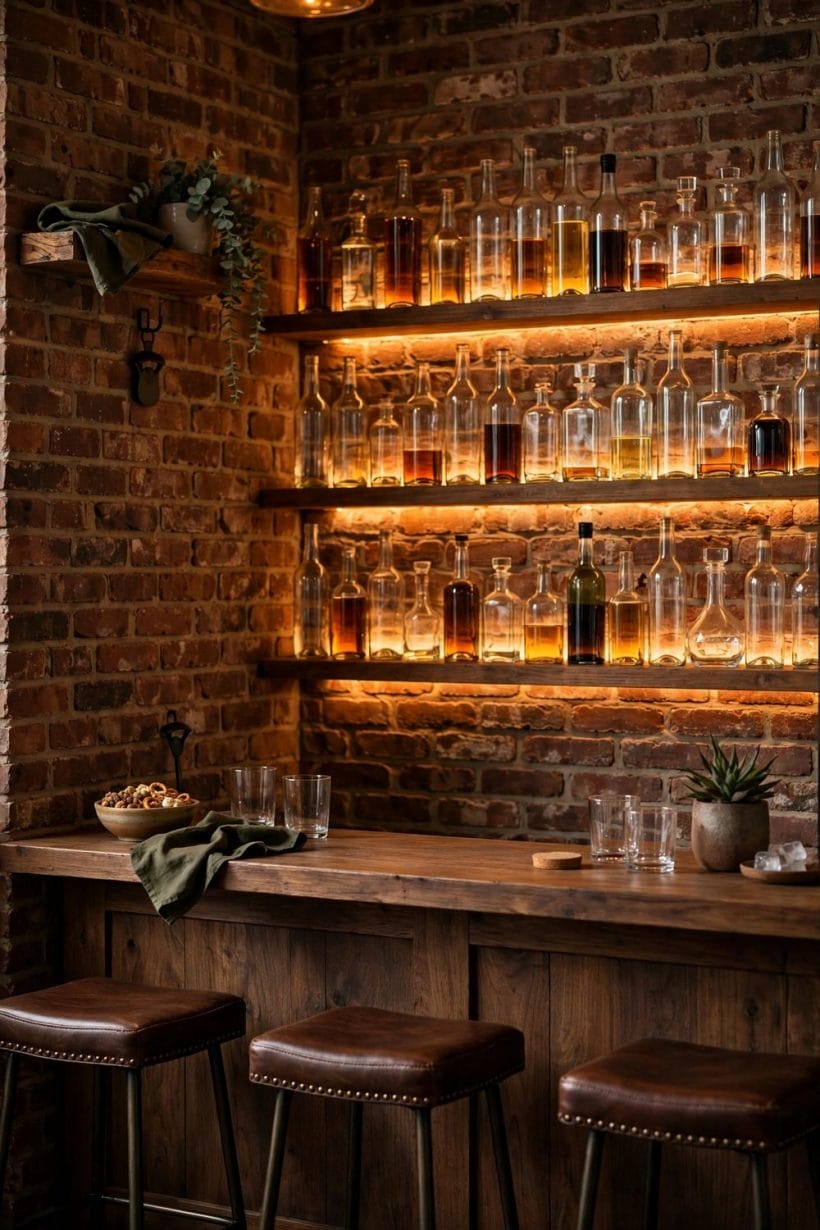
The last layer is atmosphere: light that can sink to a glow, sound that stays where it belongs, and the personal details that make the cave unmistakably one person’s territory rather than a themed rental.
66. Layer the light: dim ambient, task at the bench, glow at the bar
Three light levels, separately switched, let one room host a bright card game, a dark film and a working bench across a single evening.
67. Choose warm bulbs everywhere the cave relaxes
Warm-white light flatters timber, leather and people; cool light belongs to workshops and offices. Keep the cave’s relaxing zones warm, and let the bench’s task light be the one honest exception where colour judgement matters.
68. Seal the door and soften the surfaces for the neighbours’ sake
A door with seals, a rug over hard floors, curtains and upholstered furniture together keep the cave’s joy inside it.
69. Use the ceiling: dark paint can make a cave feel taller
Counter-intuitively, a dark ceiling in a low cave can disappear rather than descend, especially with the walls a shade lighter and the lighting low.
70. Choose a floor that forgives drinks, darts and boots
The cave floor takes the household’s hardest wear in its most relaxed room. Vinyl plank, sealed timber or a dark, patterned carpet tile all forgive the cave’s life; pale carpet accepts a standing invitation to disaster.
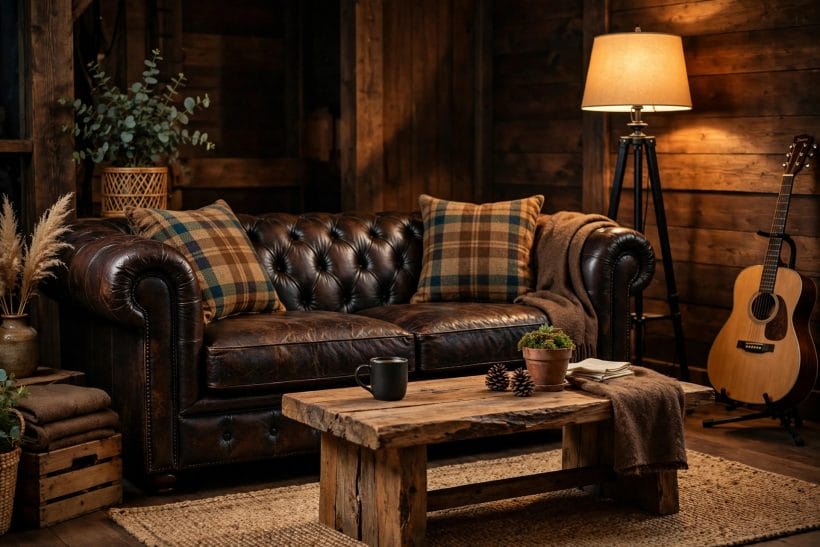
71. Let leather and timber carry the classic cave palette
Brown leather, dark timber, deep green or burgundy paint, brass in small doses — the classic palette endures because it flatters firelight, lamplight and middle-aged complexions alike.
72. Or break the palette deliberately: the bright modern cave
Pale walls, light timber, a single saturated colour on the sofa and good daylight control make a cave that feels like a studio loft.
73. Personalise with the owner’s real map of the world
The framed shirt, the travel photographs, the regiment or club colours, the gig tickets, the family’s own in-jokes made visible — character in a cave is autobiography, not catalogue.
74. Keep plants out, or keep one that thrives on neglect
Most caves are too dark and too irregularly visited for greenery. One snake plant or a good faux stem in the bar corner supplies the note without the casualties; the cave’s living things are its people.
75. Finish with the smell of the place: timber, leather, coffee
Every loved room has a scent, and the cave’s should be its materials and its rituals — wood, leather, coffee, perhaps a candle for the evening.
9. Checks and Mistakes: Before the First Purchase or the First Fitting
Check the building basics before the fantasy: damp, ventilation, heating and the electrical load of everything the cave will run. A qualified electrician for new circuits, and honest answers about moisture, are the cave’s true foundations.
Check the sound’s path to the rest of the house — and to neighbours in attached homes — before the first big night, not after the first complaint. The household’s goodwill is the cave’s planning permission; do not spend it carelessly.
The commonest cave mistake is buying the screen first and measuring later: viewing distance, table clearance and door swings are the room’s constitution, and they are all settled with a tape measure before a single purchase.
The second commonest is the half-claim — the cave that still stores the Christmas decorations, the ironing and the overflow freezer. A retreat shared with storage is a corridor with a sofa; claim the room wholly or choose another.
Keep safety unglamorous and complete: heaters with clear space around them, candles never near the bar’s bottles or the memorabilia, cables off the floor’s traffic lines, and the dartboard’s lane respected by the furniture plan.
Finally, agree the cave’s house rules with the household early — guest nights, noise hours, what migrates in from the rest of the home (nothing). A retreat with understood borders lasts for decades; one that annexes gets reclaimed.
10. Costs and Pulling It Together
Man cave costs gather around the room’s conversion first — warmth, power, floor and door — then the seats, the screen and its sound, the bar corner’s fridge and units, and the anchor game if one is chosen. Stated generally, following the pattern of the site’s other leisure builds such as home bar ideas, the spending that shows is comfort and conversion, while the spending that does not show — shelving, docks, storage for the small things — is what keeps the room civilised between gatherings.
Pulling it together: claim one room completely, fix its climate and power, set the screen and seats by measurement, fit the bar as a corner and the games with clearance, zone the hobbies behind their own discipline, and finish with warm light and the owner’s own story on the walls.
Do that and the cave becomes what it was always meant to be — not an escape from the house, but the room in it where the owner is most entirely at home.
Final Considerations
A man cave succeeds on the same terms as any good room: honest space, comfortable seats, light that behaves, and nothing in it that does not earn its place. The seventy-five ideas above simply apply those terms to the one room in the house allowed to be entirely personal.
Claim the room, measure before you buy, keep the drinks cold and the display edited — and leave a little floor empty. The best seat in the house is waiting to be built.

0 Comments