

The first cupboard you open every day and the last one you close at night deserves better than a pile of coats and a shoe landslide. These seventy-five entryway closet ideas cover layouts for every footprint, honest storage for coats, shoes and small things, and the practical details that keep the busiest square metre of your home calm in all weathers.
1. Start at the Door: At a Glance
| Closet Shape | Best For | Storage Mix | First Fix |
|---|---|---|---|
| Standard reach-in | Most hallways | Rail above, shelves below | Sort ruthlessly, then measure |
| Narrow and deep | Older homes | Single rail, end wall shelves | Better lighting inside |
| Double-width | Families | Zones per person | Label shelves and baskets |
| No closet, just a wall | Compact homes | Hooks, bench and high shelf | One rail or row of hooks |
| Under-stair cupboard | Terraced houses | Low drawers and boxes | Use the deep end for seasons |
Good entryway closet ideas start with an honest audit, not with shopping. Empty the closet completely on a dry day, clean it, and count what genuinely comes through your front door in a normal week: coats per person, shoes per person, bags, hats, dog things, sports kit and the mysterious extras that migrate here from everywhere else in the house. That count, not the size of the cupboard, decides the layout that will actually work for your household.
Measure the inside in three places, because older closets are rarely square, and note which way the door swings and how much of the opening it blocks. The hall itself sets the tone for the whole home, and the calm, edited approach in tiny house living room ideas applies at the door too: fewer things, each with a home, and nothing stored in the walkway. Keep this section’s table beside you as you read, and mark which row matches your space before looking at any fittings.
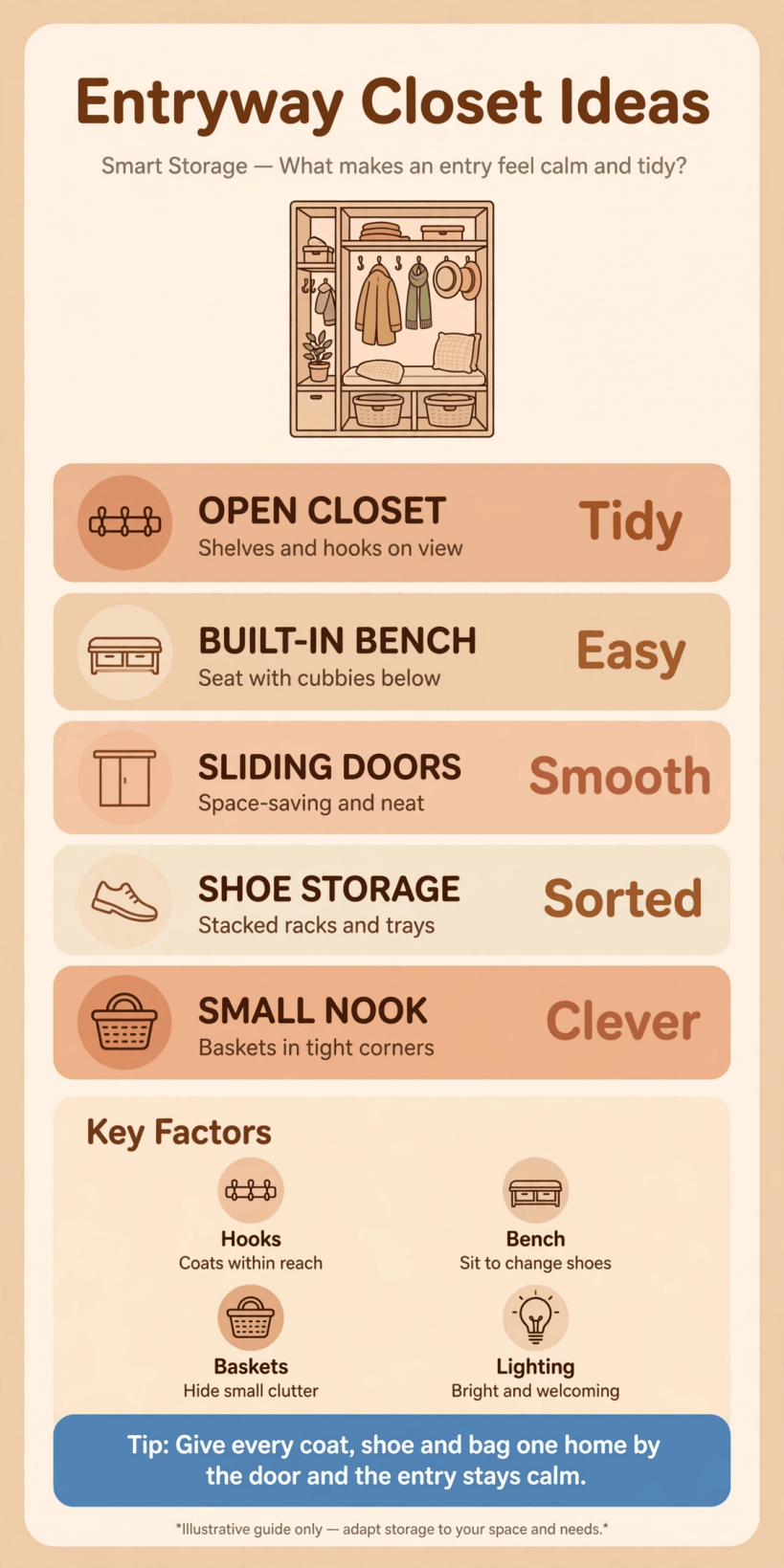
A quick map of the layouts, storage mixes and daily habits covered in this guide.
2. Layouts for Every Footprint
The classic reach-in closet works best with a simple split: a hanging rail across the upper half and shelving or drawers beneath it, because coats are long and shoes are short and the two should stop fighting for the same air. If the closet is wider than one door, divide it into a hanging zone and a shelf zone with a vertical partition, real or implied, and the whole cupboard becomes easier to search in a hurry on a dark morning.
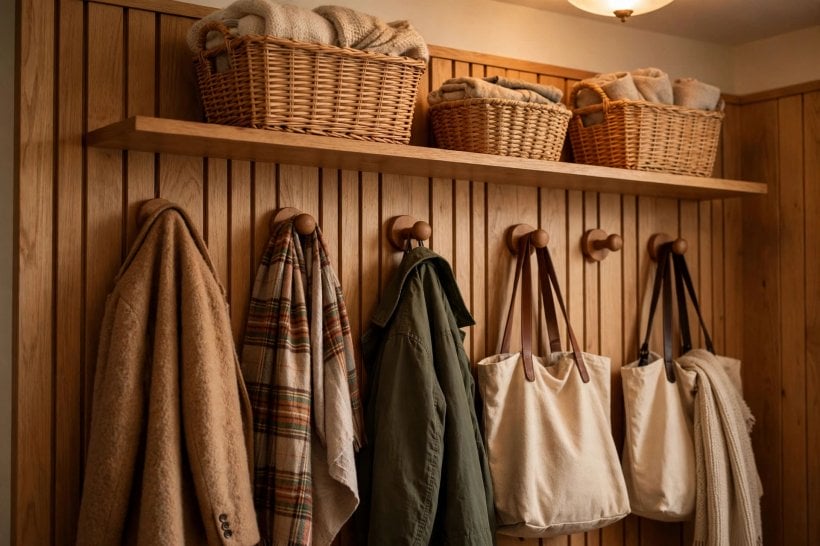
Narrow, deep closets need the opposite treatment: keep the rail short and near the front where you can reach it, and put shelves or stacked boxes at the deep end for things you need rarely, such as off-season hats or guest slippers. Homes without any hall closet can borrow a slice of wall instead, using a shallow cabinet, a covered rail or a bench with storage inside. If you are building or adapting the space yourself, the practical spirit of how to build your own tiny house projects is the right one: work with the footprint you truly have, measure it twice, and make one simple thing well rather than three complicated things badly.
3. Doors: Sliding, Bifold, Hinged or None
Doors decide how much of the closet you can see and reach at once. Standard hinged doors open fully and let you use door-back racks, but they need clear floor to swing, which halls rarely have to spare. Bifold doors halve the swing problem and still open most of the width, making them the quiet favourite for family entryways where two people are trying to leave at the same time in different directions.
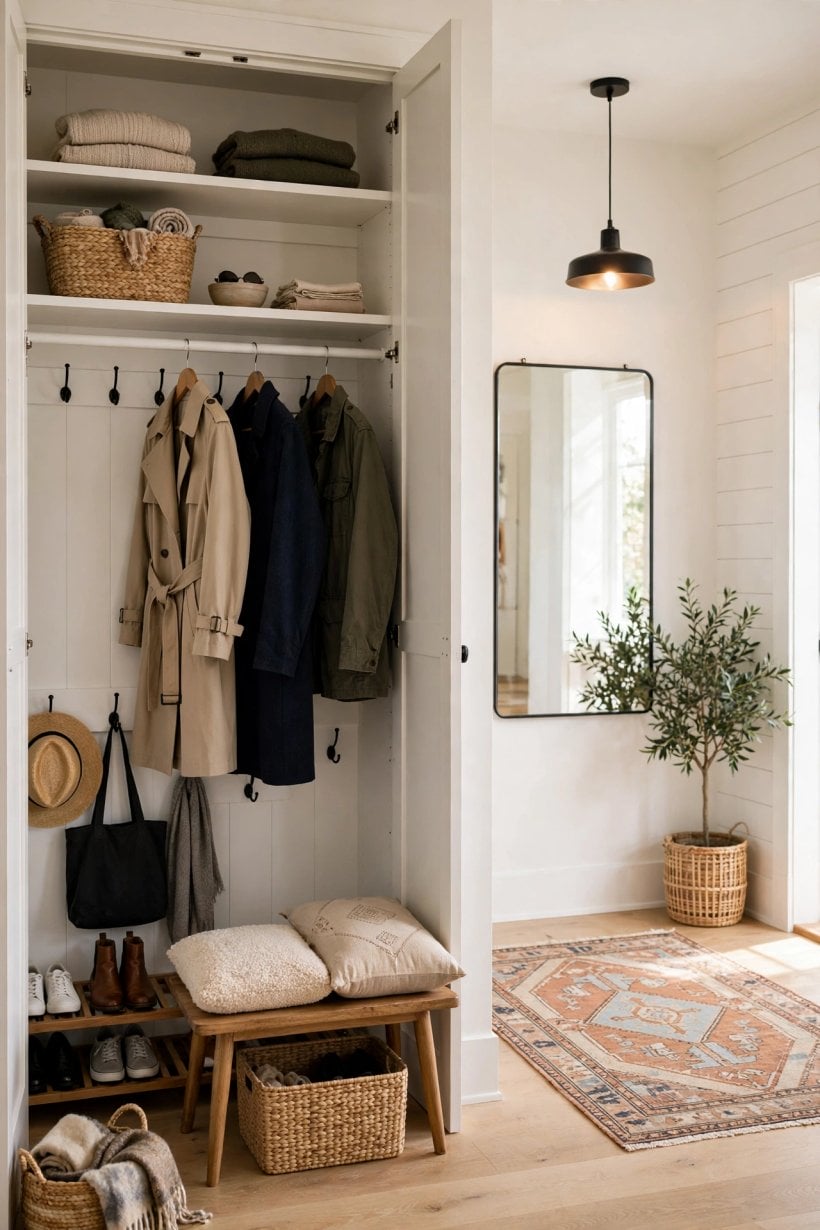
Sliding doors save the most floor but hide half the closet at any moment, which suits simple, two-zone layouts and frustrates complicated ones. Removing doors altogether, or swapping them for a curtain or an open alcove with a bench, works beautifully in compact homes where every swing arc matters and the contents are tidy enough to look at. Whichever you choose, test it with real life: school bags on the floor, a pram in the hall and someone carrying shopping through the door all at once.
4. Coats, Hooks and Hanging Space
Coats are the bullies of the entryway closet: bulky, damp half the year, and always apparently multiplying. Give the rail honest space rather than packing hangers shoulder to shoulder, because coats that can breathe dry faster and come out wearable. Keep everyday coats on the rail and move the rarely worn ones, the interview suit and the wedding outfit, to a bedroom wardrobe where they are not stealing prime space by the door.
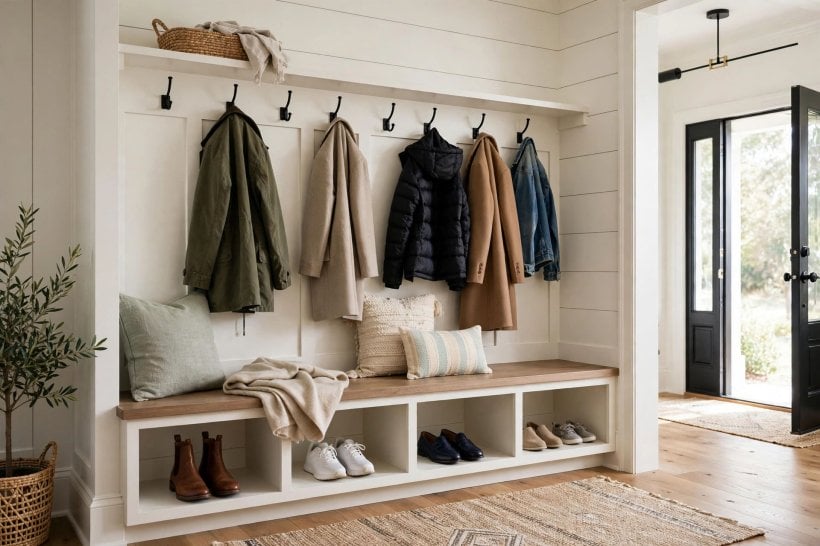
A row of sturdy hooks at child height and another at adult height solves the problem the rail never will, which is the coat worn for ten minutes and dropped on a chair. Hooks also welcome guests without a ceremony. Use hangers that match in size so coats hang at one height, keep bulky winter coats in the widest section, and add one over-door or wall hook near the entrance for the dog lead, the reusable bags and the umbrella, the three things every household swears it will put away properly tomorrow.
5. Shoes and Boots Without the Pile
Shoe storage fails when it ignores how shoes are actually used: kicked off wet, grabbed in a rush, and owned in far greater numbers than anyone admits. A slanted shelf or a simple rack inside the closet keeps pairs visible and aired, while flat shelves suit households that prefer boxes. The golden rule is a strict household count by the door, perhaps two pairs per person, with the rest living in bedrooms where they belong.
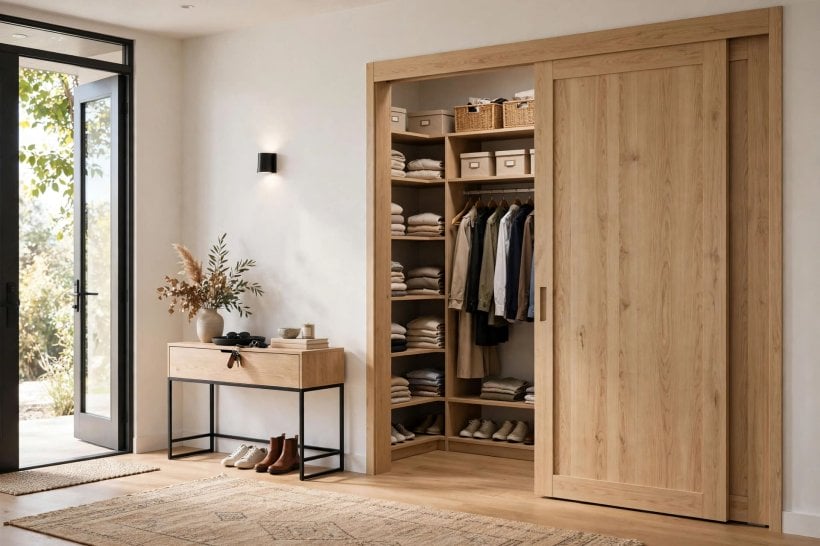
Boots need height and drainage. A tray with a lip, washable and easy to lift out, catches the worst of winter from wellingtons and walking boots and saves the closet floor entirely. In wet seasons, a mat that extends just outside the closet door catches the first, dirtiest steps into the house. Keep shoe care simple and nearby: a brush and a cloth in a small box on a shelf means boots get thirty seconds of attention when they come off, instead of a monthly rescue mission nobody enjoys.
6. Shelves, Baskets and Small Things
Every entryway generates small things at a remarkable rate: gloves, scarves, keys, post, sunglasses, chargers, tape measures and things that belong to other rooms entirely. Adjustable shelves are the backbone here, set close together for baskets and boxes rather than at fixed heights decided by someone who never met your family’s gloves. One basket per person is the system that survives real life, because sorting into your own basket takes two seconds.
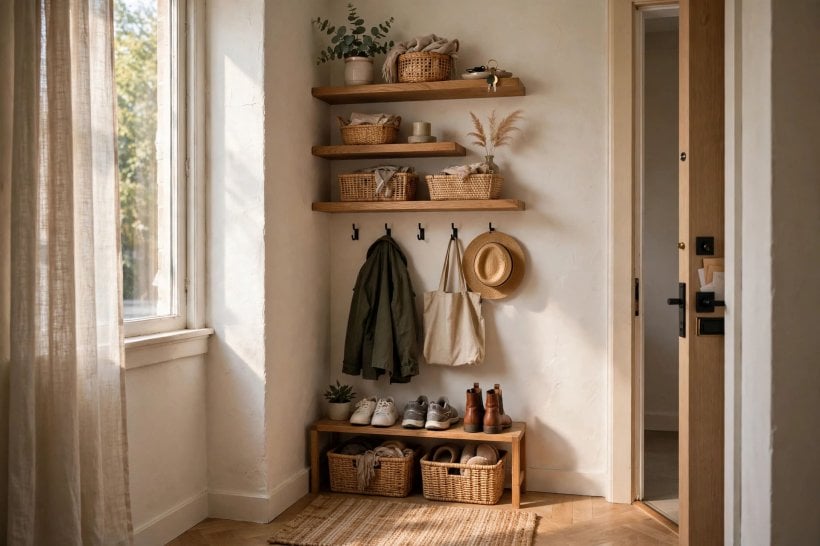
Labels sound fussy until the first dark morning when they save you five minutes. Label shelves and baskets by contents and owner, and keep one deliberately empty catch-all basket for things in transit, emptied every Sunday. A small tray or bowl on the nearest surface handles keys and post without letting them colonise the closet shelves. Transparent boxes suit rarely used things in deep closets, while open baskets suit daily things, because a lid you must lift one-handed, holding a coat, is a lid that stays off forever.
7. A Bench and a Place to Land
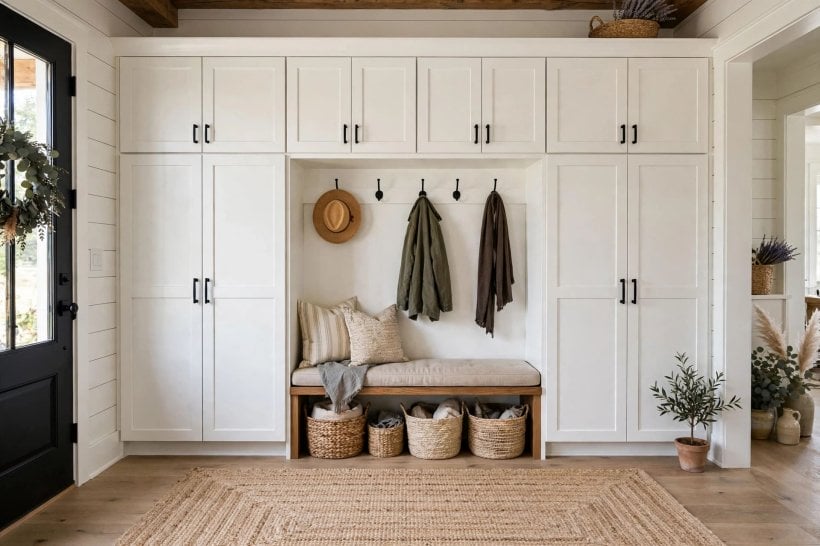
If there is any spare width in or beside the closet, a bench changes the entryway more than any other single addition. Shoes go on sitting down instead of hopping, bags land on the bench instead of the floor, and small children gain a stage for the daily drama of boots. A bench with a lift-up lid or drawers beneath swallows hats and gloves, while a simple open bench with baskets under it stays flexible for changing seasons.
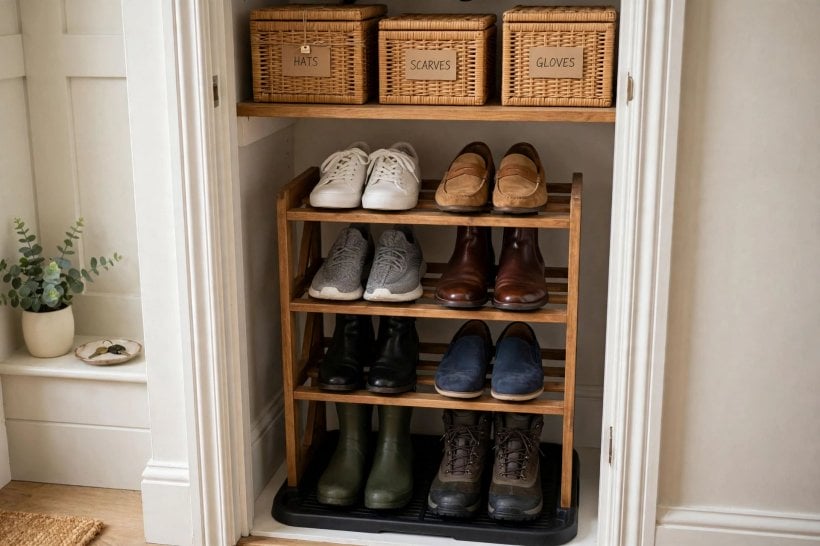
The warm, practical mood of tiny barn house interior schemes suits benches perfectly: solid timber, hooks above, and nothing too precious to sit on in wet trousers. Cushion the top only if the fabric can be washed, and keep the surface mostly clear by habit, because a bench is a magnet for post, parcels and good intentions. A boot jack by the bench leg and a hook for the shoe horn are tiny, unglamorous additions that every household member will quietly bless on wet evenings for years.
8. Guests, Seasons and Overflow
A hall closet lives two lives: the everyday one and the December one, when guests arrive with coats, boots and presents all at once. Plan for the second life on a quiet day. Keep a few spare hangers free all year, reserve one shelf that can be cleared in two minutes, and know where the overflow goes, even if the answer is hooks on the back of a bedroom door for one evening only.
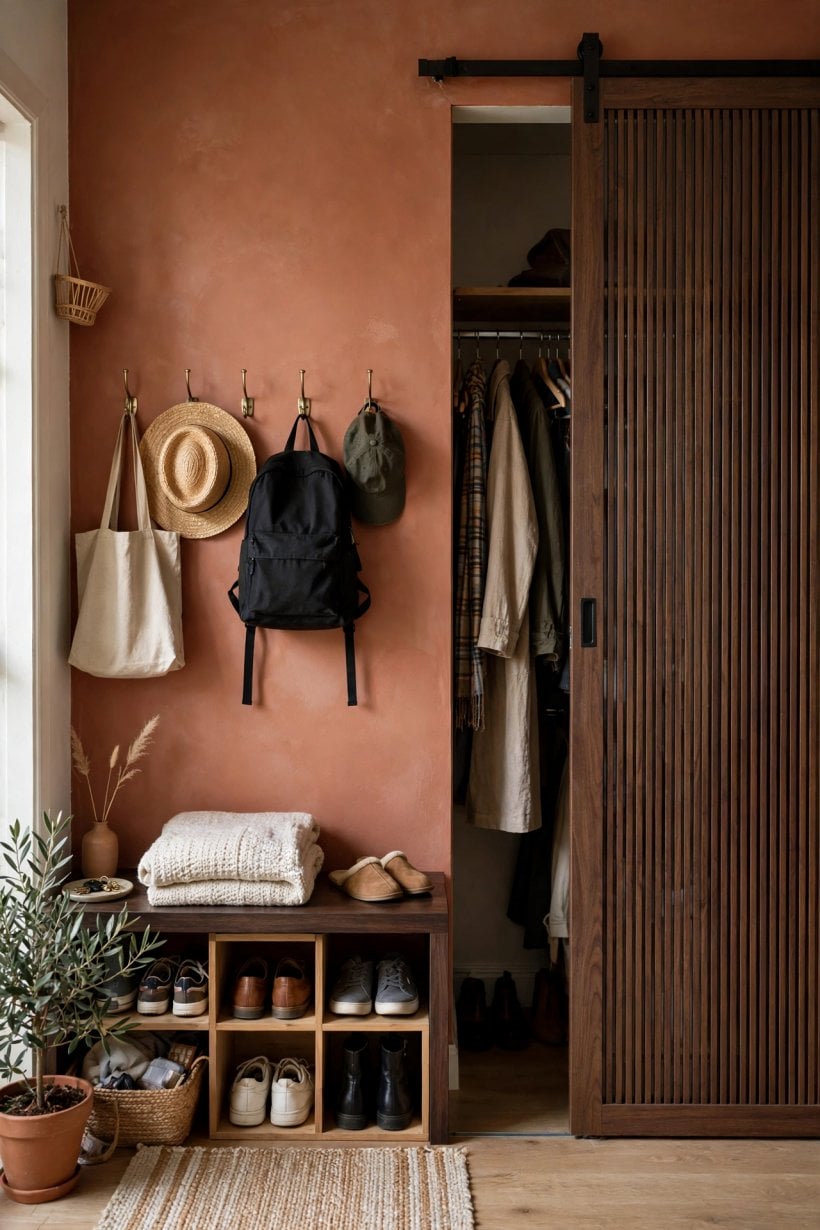
Seasonal rotation is the other half of the system. When spring arrives, washed winter coats, hats and heavy boots move to the deep end, the top shelf or another room entirely, and the closet breathes again. The same rotation serves outdoor gear, and thinking of the hall as the indoor end of the garden helps: the tidy, seasonal approach in tiny house landscaping ideas starts, in practice, with somewhere sensible for muddy boots and gloves to land. Keep a small box for the season that is leaving, so next year’s first cold day is a retrieval, not an archaeological dig.
9. Light, Mirrors and Finishing Touches
Most hall closets are caves, and a cave cannot stay tidy because nobody can see to tidy it. A simple battery light, a strip inside the door frame, or a ceiling light that actually reaches into the closet transforms sorting from archaeology into a ten-second job. Pale paint inside the closet helps more than any product: one coat of washable white on the interior walls makes the whole space feel bigger, cleaner and easier to use.
A mirror on the inside of the door or the wall beside it earns its place twice, for the last check before leaving and for the daylight it bounces into a dark hall. Colour belongs here too, in small brave doses: the confidence in colorful tiny house interior schemes can inspire a painted closet interior or a coloured basket set, cheering up the darkest corner of the
Renters and new-build owners often ask whether any of this is possible without drilling, building or losing a deposit, and the answer is a cheerful yes. Freestanding rails on castors, over-door hooks that pad their contact points, tension rods inside an existing closet and stackable crates used as cubbies all deliver the same zones as fitted storage, and every one of them leaves with you when you do. Command-style adhesive hooks have weight limits worth respecting, so keep them for hats, bags and the dog lead rather than a winter coat soaked through with rain. The layout thinking matters far more than the hardware: a rented closet with clear zones will outperform a fitted one with none, and the photographs in property listings prove it every day, because the tidy small hall always looks larger than the chaotic big one.
Families with prams, scooters and sports kit face a different problem, which is that the entryway closet must share its job with a garage that may not exist. The honest solution is a landing strip: a defined strip beside the door, perhaps a washable runner and a low open crate, where today’s bulky arrivals can live for up to twenty-four hours before being dealt with. Anything still there tomorrow moves to its real home. This small rule protects the closet from becoming a warehouse while accepting that real life arrives in waves. Tall households should also raise one rail and lower another rather than forcing everyone onto one height, and households with a wheelchair user or a frame should guard a completely clear floor zone inside and outside the closet as fiercely as any storage rule in this article.
Last, a word about smell and air, because a closet full of coats and shoes in a warm house can turn stale by February. Leave the door ajar overnight when you can, choose breathable baskets over sealed plastic for anything worn, and give the closet an empty, wiped, aired afternoon twice a year when the seasons swap. A small open box of bicarbonate of soda on a high shelf quietly absorbs odours between those clear-outs. None of this is glamorous, and that is rather the point of this whole guide: the entryway works when its invisible systems work, and the visible calm that visitors compliment is simply what those systems look like from the outside.
house. Finish with one personal thing, a framed print or a plant that tolerates low light, because an entryway that feels cared for tends to stay tidy.
10. The Weekly Reset and the Seasonal Swap
No system survives without a rhythm, and the entryway rhythm is weekly. Five minutes, once a week, returns shoes to pairs, coats to hooks, baskets to shelves and the floor to visibility. Tie it to something that already happens, the Sunday evening reset or the moment the bins go out, and it will happen. Involve everyone who uses the door, because a closet organised by one person for four others is a part-time job nobody applied for.
Twice a year, do the deeper swap described earlier, washing what is being stored and questioning what is being kept. If a coat was not worn last winter, the entryway is not its home, however good it is. The same honest editing keeps bedroom storage working, and the wardrobe thinking in tiny house bedroom ideas pairs naturally with this closet: everyday things by the door, occasion things by the bed, and nothing homeless in between. A tidy hall is rarely about buying storage. It is about small, regular acts of returning things to the homes you have already given them.
Final Considerations
Audit honestly, measure carefully, and give coats air, shoes a tray, small things a basket each and guests a little planned mercy. Of all the entryway closet ideas in this guide, the ones that will matter in a year are the least photogenic: the clear floor, the labelled basket, the spare hangers and the five-minute weekly reset. Build those habits around whatever layout your home allows, and the hardest-working cupboard in the house will quietly start every day, and end every evening, exactly as it should.


0 Comments