

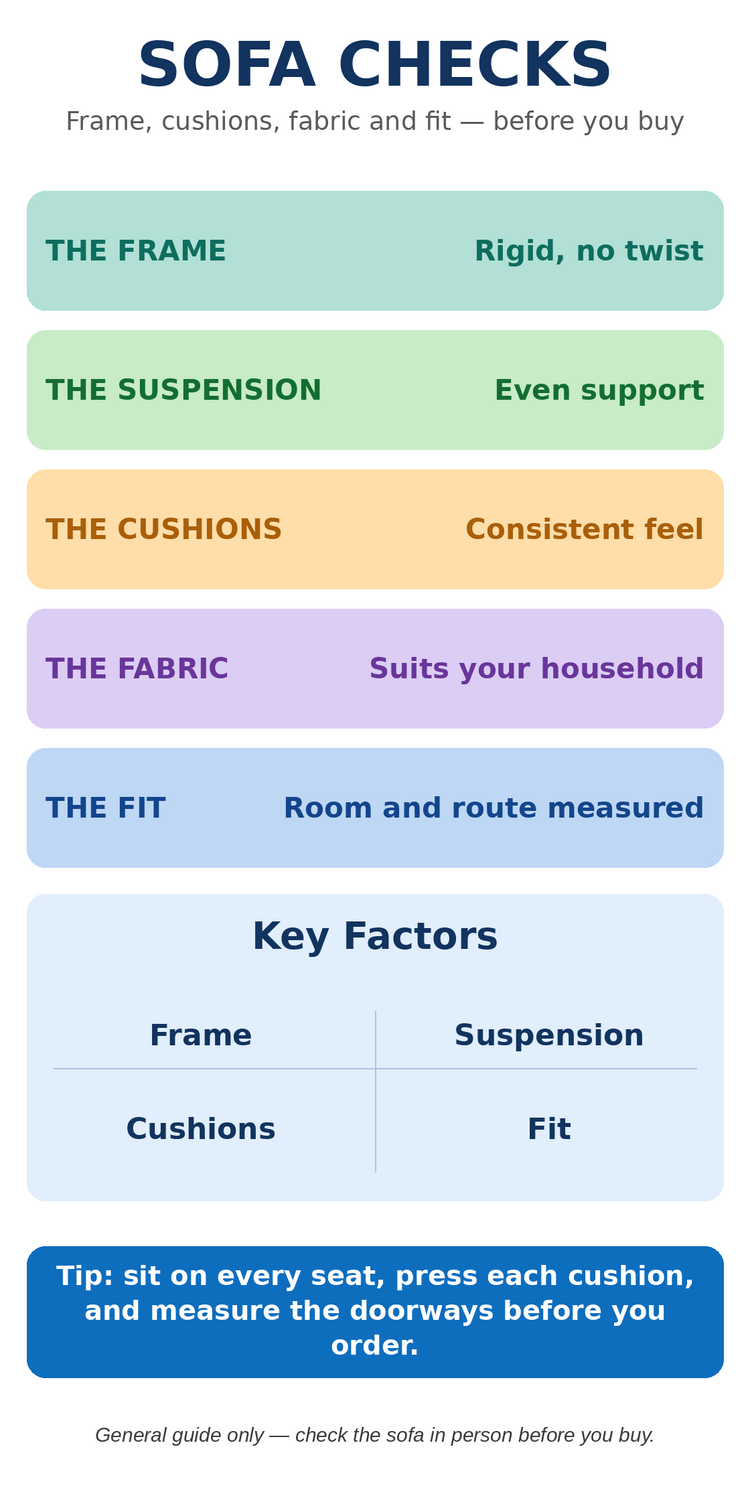
A sofa is one of the few pieces of furniture you use every single day, and it is also one of the hardest to judge in a showroom. It looks comfortable for five minutes under bright lights, but the frame, the cushions and the fabric only reveal themselves over months of ordinary use. This guide sets out the checks that matter before you buy: the structure underneath, the comfort layers on top, the fabric that has to live with your household, and the fit of the whole piece in your room. No single check decides the purchase on its own. Together, they give you a clear picture of what you are bringing home, and they help you compare two sofas that look similar but are built very differently.

1. The Frame
Everything else hangs off the frame, so it is the first thing to ask about. A well-made frame feels rigid when you lift one front corner: the opposite leg should come up with it rather than staying planted while the frame twists. Ask what the frame is made from and how the joints are held together. Solid hardwood and engineered hardwood frames are both common, and the difference that matters most is whether the joints are glued, screwed or blocked as well as stapled. A frame that relies on staples alone will loosen sooner under daily use, especially on a sofa that seats three people.
Check the frame’s warranty language too, because makers often guarantee the frame for far longer than the cushions or fabric. That split tells you where the maker expects the strength to be. If the frame guarantee is short while the price is high, ask why. Sit on the very edge of the seat and lean back firmly: creaks, flexing or a feeling that the sofa is racking sideways are all signs the frame is not as solid as it looks. These checks take a minute in the shop and save years of wobble at home.
2. The Suspension
Under the cushions sits the suspension, the system that carries your weight and gives the seat its spring. The two common families are sinuous springs, which are S-shaped wires running front to back, and elastic webbing, which is woven strapping stretched across the frame. Both can be good or poor depending on how they are fitted and tensioned. Press down firmly in the middle of each seat and then near the edges: the resistance should feel even, and the seat should recover its shape promptly when you stand up rather than holding a dip.
Uneven suspension shows up as a seat that feels supportive on one side and soft on the other, or a middle seat that sags because the springs there are spaced wider. Ask how the suspension is attached to the frame and whether it is covered by the frame guarantee. A sofa whose suspension fails cannot be fixed by new cushions, so this check deserves as much attention as the fabric you can see. If you can, remove the seat cushions and look at the deck underneath: tidy, evenly spaced springs or webbing with no loose ends is a good sign.
3. The Cushions
Cushions decide most of what comfort means day to day, and they are also the part that changes most with use. Foam cushions hold their shape well and need little attention, while fibre-wrapped and feather-blend cushions feel softer but need regular plumping to stay even. Neither is objectively better; the question is which matches how you live. A household that wants a sofa that always looks tailored will be happier with foam, while someone who likes a relaxed, sink-in seat may prefer a softer fill and accept the upkeep.
Press each cushion in the centre and at the front edge, then compare all the seats. They should feel consistent, with no cushion noticeably softer than its neighbours. Check whether the cushion covers are removable and whether the cushions are reversible: reversible cushions last longer because you can rotate them, while fixed cushions need to hold their shape on one side only. Ask about the cushion guarantee separately from the frame, since cushions soften with use and makers treat that differently. Sit for several minutes, not seconds, and notice whether you slide forward or feel supported at the front edge.
4. The Fabric
Fabric has to survive your household, not just look good on the day you buy. Think honestly about pets, children, sunlight and how often the sofa will be used, then judge the fabric against that life rather than against the showroom. Tightly woven fabrics generally resist snagging better than loose weaves, and darker or patterned fabrics hide everyday marks more forgivingly than pale plains. Ask for a fabric sample to take home: check it in your own light, against your walls and floor, and spill-test your cleaning expectations on the sample rather than on the sofa.
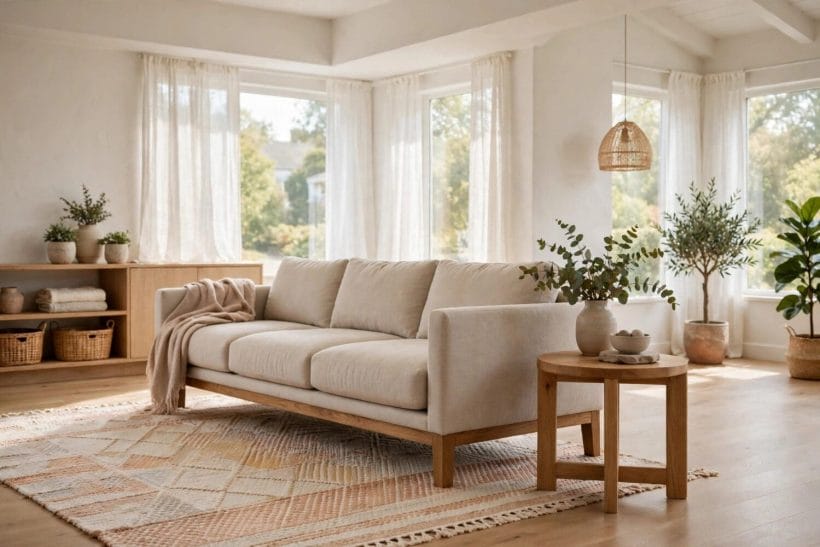
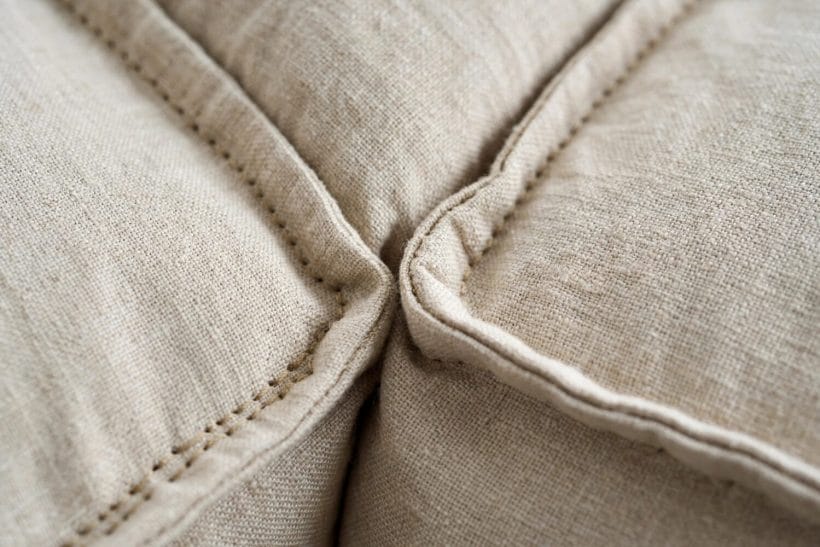
Removable, washable covers are a genuine advantage in a busy household, but check how the covers come off and whether they need professional cleaning despite the promise of easy care. Some covers shrink or change texture after washing, so ask about washing guidance before you rely on it. Also check the fabric on the back and sides of the sofa, not just the front: a sofa that sits in the middle of a room needs to look finished from every angle, and thin or mismatched fabric on the back is a sign of cost-cutting worth knowing about.
5. The Fit
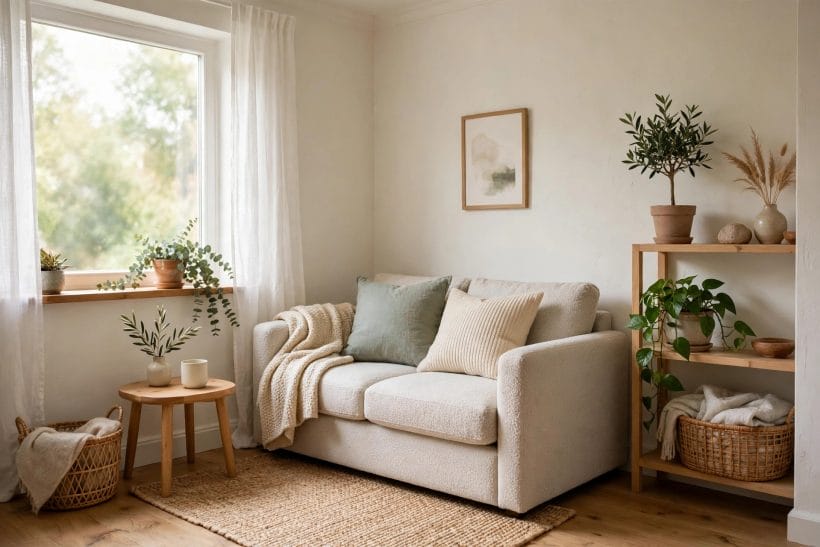
Measure twice, in both the room and the route the sofa must travel. Measure the wall or space where the sofa will sit, the doorways, the hallway turns, the lift if there is one, and the stairwell if the sofa must go upstairs. Compare those numbers with the sofa’s full dimensions, including the height of the back and the depth with the legs on, not just the headline width. A sofa that fits the wall but cannot get through the front door is a common and entirely avoidable disappointment, so check the delivery route before you pay.
Leave sensible walking space around the sofa once it is in place: room to pass in front of it, space for a side table or lamp if you plan one, and clearance for any doors or drawers nearby. A sofa pushed hard against a radiator or blocking a walkway will annoy you daily, however comfortable it is. Tape the footprint on the floor if you are unsure — it takes five minutes and shows immediately whether the sofa will dominate the room or sit comfortably in it. Also check the seat height against your household: a seat that is hard to get out of will suit nobody well, whatever it looks like.
6. The Seat Depth
Seat depth is the measurement most buyers overlook and the one that most affects whether a sofa feels right. A deep seat suits lounging with your feet up and cushions behind you, while a shallower seat suits sitting upright, reading or talking, with your feet flat on the floor. Sit in your normal position and check whether your back reaches the backrest while your knees bend comfortably at the front edge. If you have to perch forward or stuff cushions behind you to sit upright, the depth does not suit how you use the sofa.
Households vary, so a depth that suits one person may not suit another. If several people will use the sofa daily, aim for a depth that works for the shortest regular user sitting upright, since taller users can add a cushion more easily than shorter users can remove depth. Also consider the seat height in combination with depth: a low, deep seat is the hardest combination to rise from, which matters for anyone with stiff knees. Test the exact combination you will live with, not just the depth on its own.
7. The Arms and Back
Arms and back shape how a sofa feels and how much room it takes. Low, narrow arms leave more sitting width in the same overall footprint and suit a small room, while high, wide arms give a place to lean and rest a book or a cup but eat into the seating space. Sit with your arm resting naturally and check whether the arm height supports your elbow without hunching your shoulder. A back that is too low will not support your head when you lean back, while a very high back can dominate a small room and block light or a view.
Check the back cushions separately from the seat: are they fixed or loose, and do they stay in place when you lean on them? Loose back cushions that constantly slide need regular straightening, which is a small daily irritation worth knowing about in advance. Also check whether the back is finished to be seen, since a sofa that floats in a room shows its back to everyone. The arms and back are also where wear shows first, so look at the fabric and stitching there closely for any sign of thinness or pulling.
8. The Legs and Base
Legs look like a detail, but they affect stability, cleaning and the life of the frame. Solid legs attached with bolts or sturdy plates last longer than legs that are simply screwed into a soft base, and they are less likely to work loose when the sofa is moved for cleaning. Check that all legs touch the floor evenly with no rocking, and that the sofa does not flex when you push it gently from the side. If the sofa has castors, check that they lock and that they suit your floor, since hard castors can mark soft floors.
The base underneath matters too: a well-fitted base cloth keeps dust out of the frame and stops the suspension from catching on the floor. Lift the sofa slightly if you can and look underneath for tidy workmanship rather than loose fabric or exposed staples. Also think about cleaning access: a sofa that sits flush on the floor hides dust underneath but cannot be cleaned beneath, while a raised base lets a vacuum pass under. Neither is wrong, but the choice should be deliberate rather than an accident of the design you happened to pick.
9. The Covers and Cleaning
However good the fabric, life will mark it, so the cleaning story matters as much as the colour. Ask exactly how the covers come off, whether they are washable at home or need professional cleaning, and whether the maker guarantees the fabric against fading in sunlight. A sunny window can fade a sofa noticeably over a couple of years, so if the sofa will sit in direct sun, ask about fade resistance and consider whether the colour you love will still be the colour you live with.

Check the care label position and wording before you buy, not after the first stain. Some fabrics tolerate only blotting and professional care, which is fine if you know it but miserable if you expected to wash the covers in a machine. Keep a fabric sample and test your usual cleaning approach on it first. Also ask whether replacement covers are available and at what cost: a sofa whose covers can be replaced gains years of life, while one whose covers cannot will show its age permanently.
10. The Room Test
Before you commit, run the room test at home. Mark the sofa’s footprint on the floor with tape, place a chair or boxes where the arms will be, and live with the outline for a day or two. Walk past it, sit in the space, check the view from the doorway and from the seat itself, and notice whether the television, the window or the fireplace still works from the sitting position. This simple test catches problems that no showroom visit reveals, because your room’s light, proportions and traffic patterns are different from the shop’s.
Also test the sofa against the other furniture it must live with: side tables at a usable height, lamps that reach over the arm, and a coffee table at a distance that lets you sit down without shuffling. If the sofa is part of a larger plan, check that its style, colour and scale sit comfortably with what you already own rather than fighting it. A sofa that passes the room test is one you will still like in a year, which is the real measure of a good purchase. Take the measurements, the sample and the guarantee wording home before you decide, and let the decision sit overnight if you can.
Final Considerations
A good sofa is a balance of frame, suspension, cushions, fabric and fit, and no single feature makes up for weakness elsewhere. Check the frame for rigidity, the suspension for even support, the cushions for consistency, the fabric for your household’s real life, and the fit for both the room and the route in. Take samples home, measure everything twice, and read the guarantee wording for the frame, the suspension and the cushions separately. The checks in this guide take little time and they turn a purchase driven by first impressions into one you can defend years later. A sofa chosen this way is not just comfortable on the day it arrives; it stays comfortable, keeps its shape and still looks like it belongs in your room long after the novelty has worn off. For more on arranging the room around it, see daybed ideas, craftsman living room ideas, bookcase ideas, scandinavian bedroom ideas, tiny house designs and interior design ideas.







0 Comments