
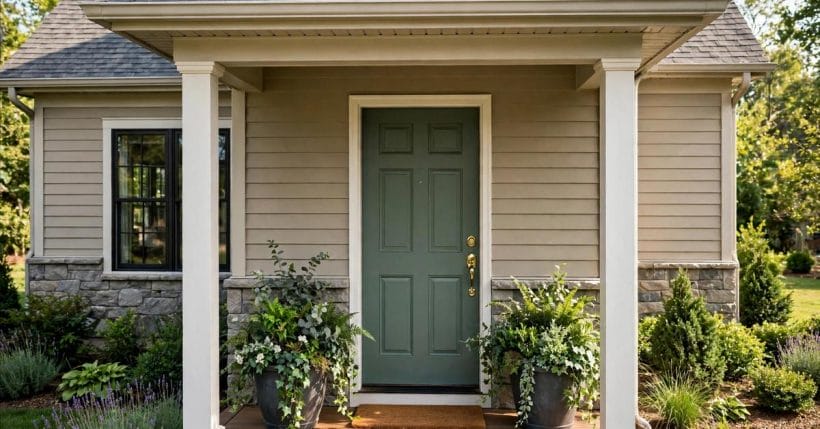
An exterior entryway is the first room of a house that nobody ever sits in, and yet it does more work than most of the rooms inside. It is the approach, the door, the shelter above it and the planting around it, all read together in a few seconds by anyone walking up the path. A good one does not shout. It guides the eye, keeps the weather off the threshold and makes the door easy to find, easy to reach and easy to open with full hands.
This post stays strictly outside the front door. It is about the front-of-house approach, the door surround, the lighting and the weather exposure that shape it. For the hall, the bench, the hooks and everything that happens once you step inside, the general entryway ideas post is the companion piece, and this one links up to it throughout. The two split cleanly: this is the outside, that is the inside, and neither tries to do the other’s job.
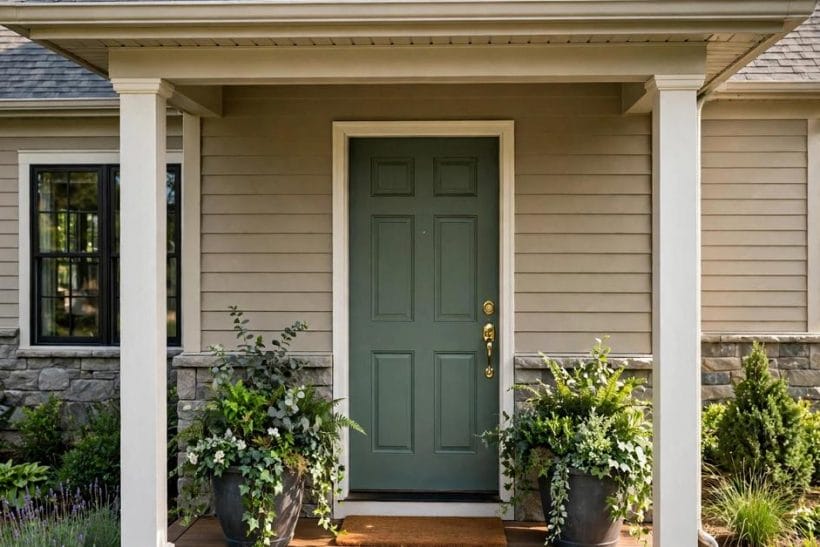
The strongest entries share one quality: they are designed from the street inward. Stand at the kerb and walk the route a visitor walks. Is the path obvious? Is the door visible, or does it hide behind a hedge, a porch column or a parked car? Does the step up feel generous, or does it pinch? Every decision in this post answers one of those questions, and the best entries answer all of them at once.
1. The Approach: Make the Path Obvious
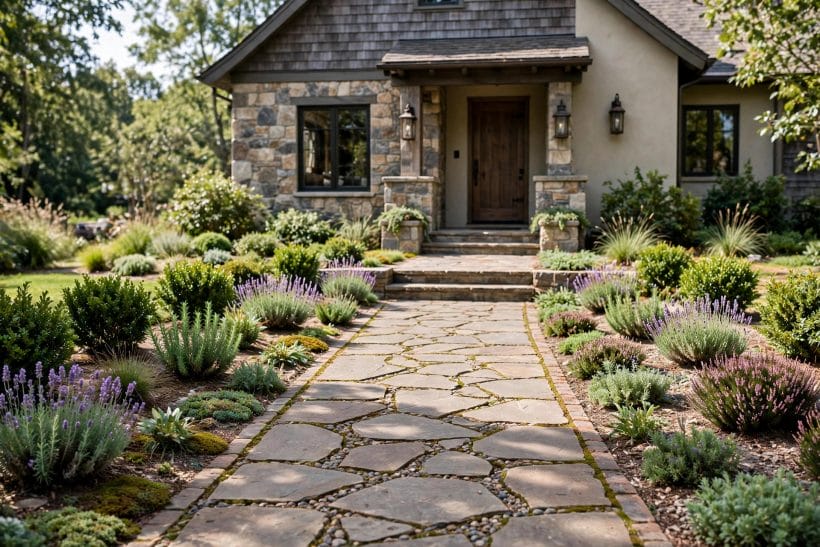
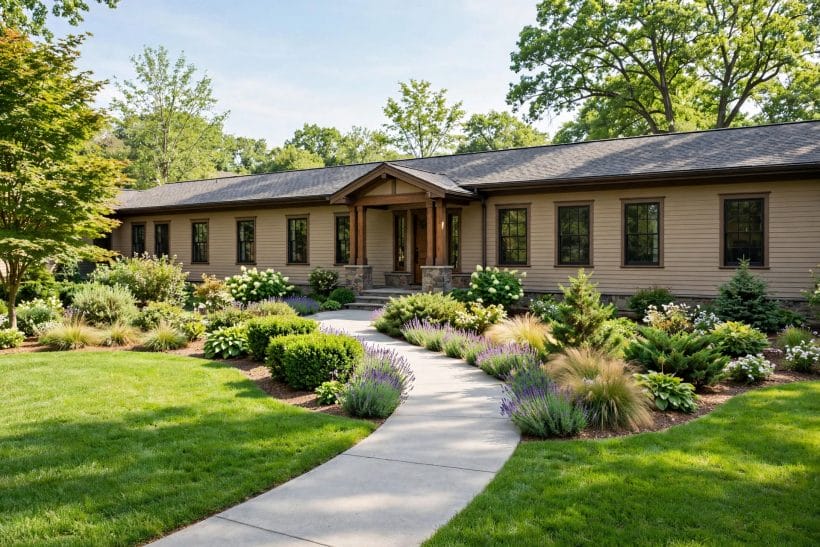
The approach is the entryway’s opening sentence. A path that runs straight and true to the door reads as confident; a path that wanders without reason reads as confused. Curves work when they follow the shape of the garden or dodge a tree worth keeping, not when they exist for their own sake. Keep the line legible from the street, keep the surface even underfoot, and keep the edges clear of planting that spills across the walk in wet weather.
Width matters more than pattern. A path that forces two people to walk single file feels mean, however beautiful its paving. Give it room for a guest and a host to walk side by side, and for a pram or a suitcase to pass without a detour onto the lawn. Where the path meets the drive or the pavement, make the junction clear with a change of material or a low edging, so nobody has to guess where the garden ends and the entry begins.
Think about the approach in bad weather as well as good. A path that puddles at the doorstep fails exactly when guests arrive wettest. A gentle fall away from the house, a drain or a gravel strip at the threshold, and a surface that stays grippy when wet are all quiet virtues. None of them photographs well, and all of them get noticed the first rainy evening they are missing.
2. The Door: The Face of the House
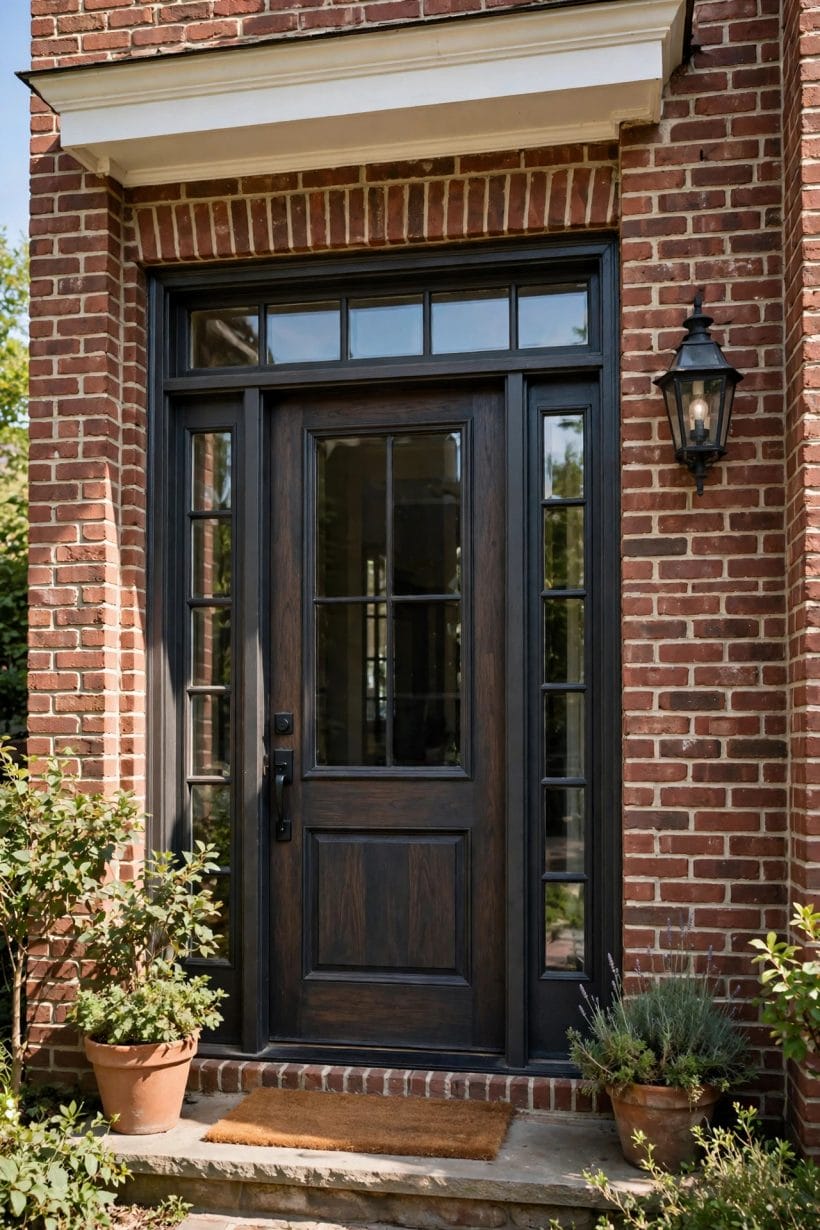
The door is the one element every visitor touches, so it carries the entry’s character. Its colour sets the tone: a deep, quiet shade reads as settled, a bright shade reads as cheerful, and a natural timber finish reads as warm. What matters is not which you choose but that the choice looks deliberate against the house around it. A door colour that fights the brick or the siding makes the whole front feel unsettled.
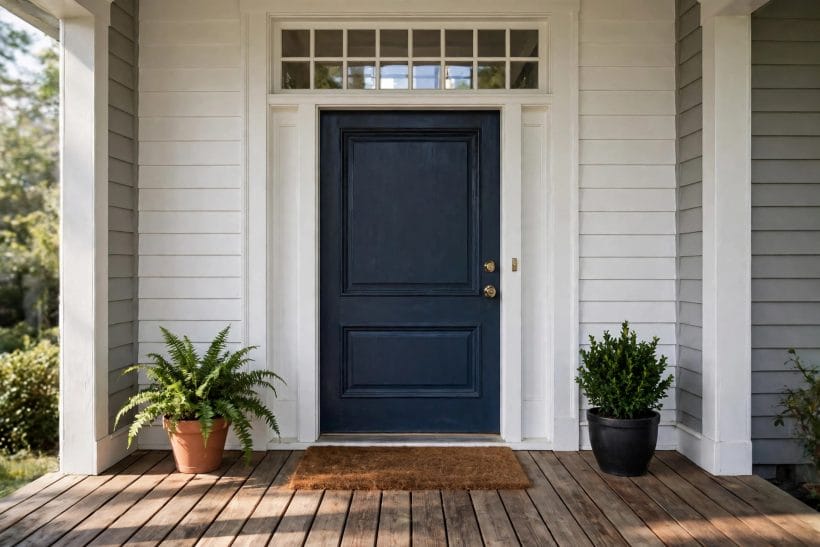
Proportion does the rest. A door that is too small for a tall facade looks apologetic; a door with a generous surround on a modest house looks overdressed. Sidelights and a transom window can give a standard door presence without rebuilding the opening, and they bring daylight into the hall behind. Frosted or textured glass keeps privacy while still doing that job. Hardware follows the same rule: solid, simple and matched, rather than a collection of finishes gathered over the years.
Keep the door’s surroundings calm. One wreath, one pair of planters or one lantern is a welcome; three of each is a jumble. The door should be the loudest thing in the entry, and everything around it should be one step quieter.
3. The Surround: Frame, Porch and Shelter
The surround is everything that frames the door: the trim, the columns, the porch roof and the wall behind. It gives the entry its architecture. A flat door on a flat wall can still look good with a well-proportioned trim and a good colour, but a porch changes the entry’s nature entirely. It turns a doorway into a place, somewhere to pause, shake off rain and find keys without getting soaked.
Porch depth is the detail most often got wrong. A porch too shallow to stand on is decoration, not shelter. If there is room, give the porch enough depth for a person to stand clear of the swing of the door and for a chair or a bench to sit without blocking the way. A porch roof that throws water clear of the steps, rather than dripping onto them, is worth more than any amount of decoration.
Columns and posts should look as though they hold something up, even on a modern house where the structure may be doing the work elsewhere. Chunky, well-based posts read as honest; spindly posts under a heavy roof read as nervous. The same goes for brackets and beams: a few solid members beat a crowd of fussy ones.
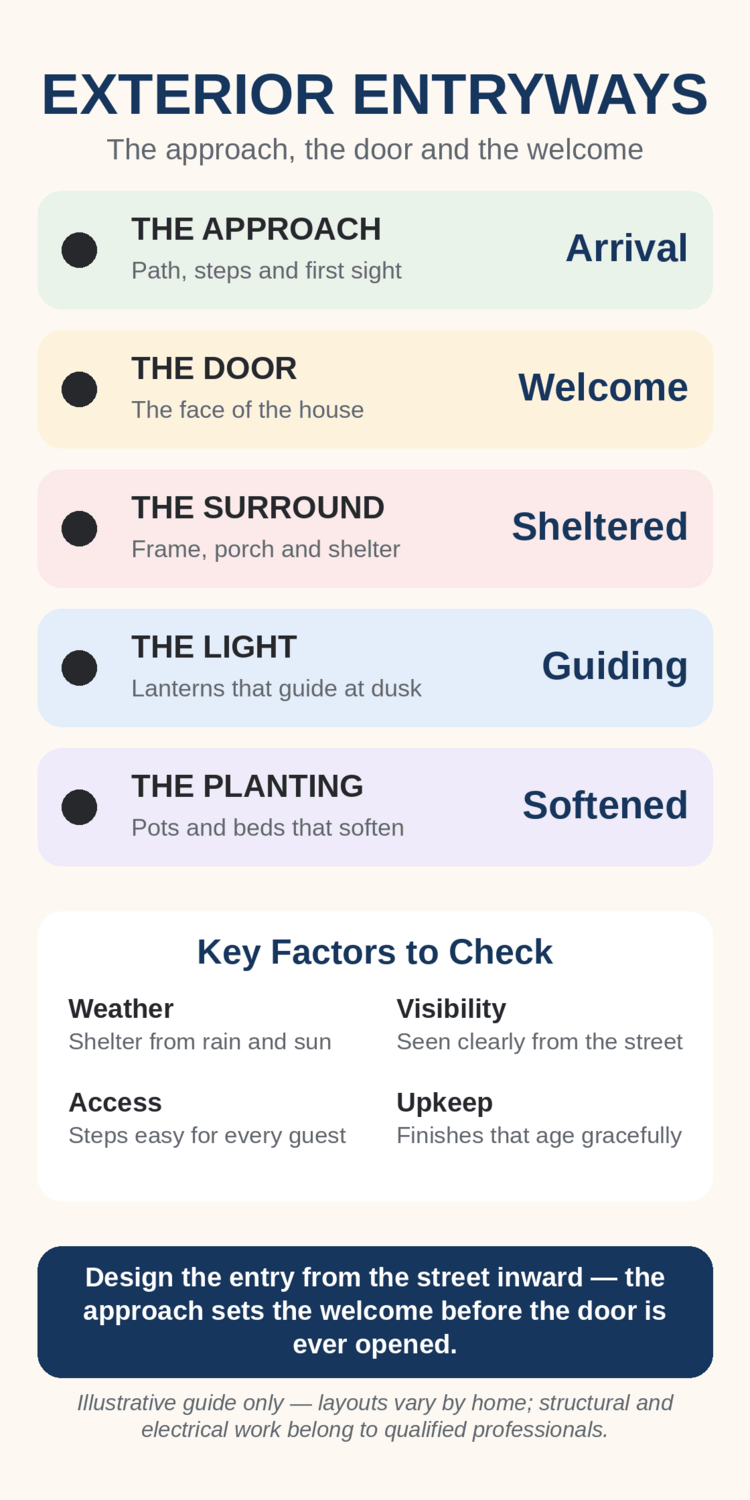
4. Steps and Access: Easy for Every Guest
Steps are where hospitality becomes practical. A single generous step beats two mean ones, and a landing deep enough to stand on while the door opens is not a luxury but a necessity. Where the change in level is larger, a run of even, comfortable steps with a handrail on at least one side serves everyone, from a child to a guest with a walking stick.
Materials should stay grippy in wet weather and in frost. Smooth stone looks elegant and can turn treacherous; a honed or textured finish, or a nosing strip with some bite, keeps the entry safe without looking utilitarian. Keep the edges of the steps visible in low light — a lighter nosing or a wash of light from a wall lantern does the job without any gadgetry.
Access is not an afterthought. A level or gently ramped route to the door, kept clear of planters and bins, makes the entry welcoming to a wheelchair user, a delivery driver with a trolley and a parent with a pram alike. The most gracious entries are the ones nobody has to think about using.
5. Lighting: Lanterns That Guide at Dusk
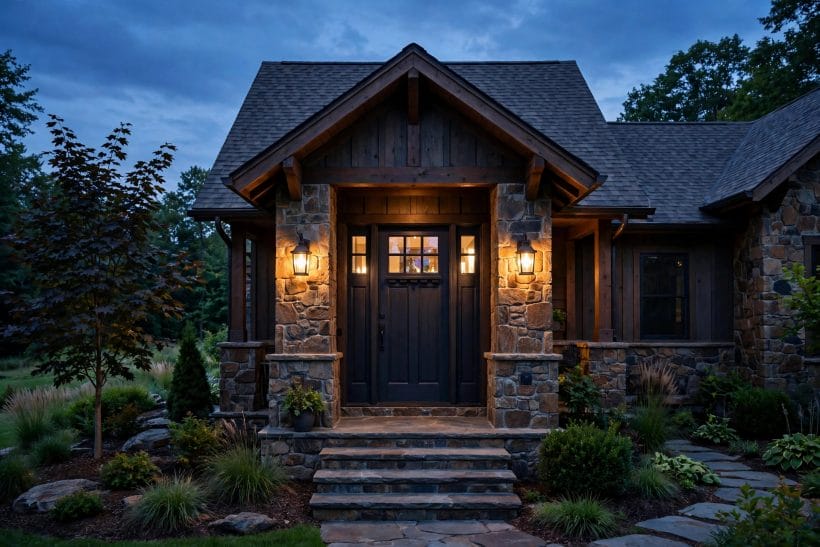
Entry lighting does two jobs: it shows the way, and it shows the house. A pair of lanterns flanking the door is the classic solution because it works — it lights the lock, the step and the visitor’s face at once. A single overhead lantern can do the same on a narrower porch, provided it sits high enough not to glare into the eyes of someone standing below it.
Layer the light rather than relying on one bright source. A soft wash on the path, a lantern at the door and a low glow in the planting give depth, while a single floodlight flattens everything and throws hard shadows. Warm-toned light suits most houses; cool white light can make brick and timber look harsh. Keep the fittings simple and the bulbs easy to change, and consider a sensor or timer so the entry is lit when it is needed and dark when it is not.
Electrical work at the entry, like any outdoor wiring, belongs to a qualified professional, and fittings should be rated for outdoor use. A lantern that is not weather-rated will fail at the first driving rain, and a fitting wired without proper protection is a hazard dressed as decoration.
6. Planting and Pots: Softening the Hard Edges
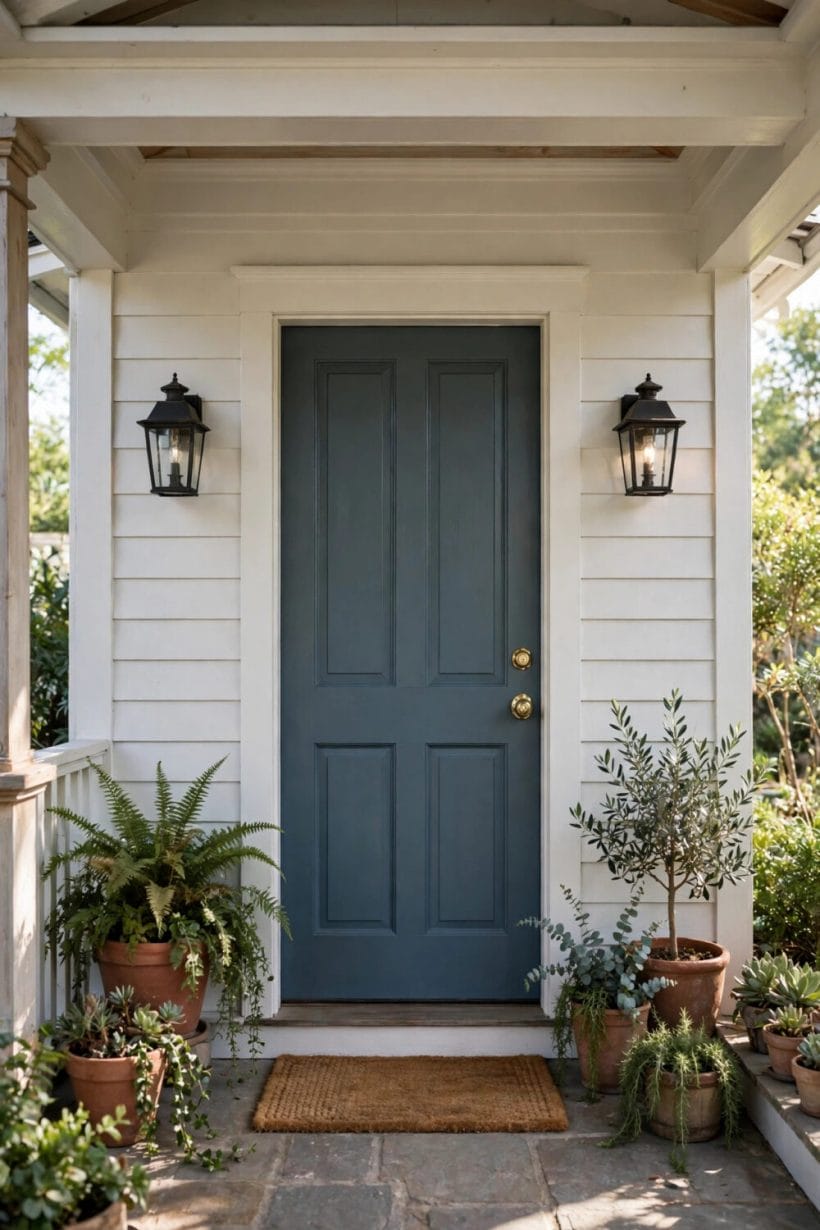
Planting is what turns a doorway into an entry. A pair of planters flanking the door frames it the way a picture frame frames a print, and a bed of low shrubs along the path softens the hard lines of paving and wall. Keep the planting lower than the windowsill and clear of the path’s edge, so it frames rather than swallows the entry.
Choose plants for the conditions at the door, not for the garden centre display. A south-facing entry bakes in summer; a north-facing one stays damp. Evergreen structure — a clipped shrub, a small conifer, a hardy grass — keeps the entry looking intentional through winter, when deciduous planting disappears. Seasonal colour in pots can then be swapped without disturbing the bones.
Pots deserve the same thought as the plants in them. Heavy, frost-proof containers that match each other and suit the house will outlast a collection of mismatched plastic ones, and they will not blow over in the first autumn gale. Raise them slightly off the ground so water drains, and keep them clear of the step’s edge.
7. Colour and Materials: One Palette, Used Well
The entry’s palette should be the house’s palette, edited. Brick, siding, trim, door and path already give you several colours; the entry’s job is to arrange them, not to add more. Pick one accent — the door, the planters or the lanterns — and let everything else support it. Two accents compete; three argue.
Materials should age gracefully at the threshold, because the entry takes more weather and more feet than any other part of the house. Timber needs a finish that can be renewed; stone needs a surface that stays grippy; metal needs a coating that will not rust-streak the wall below it. Ask how a material looks in five years, not just on installation day, and choose the one whose ageing you will still like.
Where the house is brick, a painted trim and a timber door can warm the whole front; where the house is rendered, stone or timber details can ground it. The entry is the place to spend a little more on one good material rather than a little on several indifferent ones.
8. The Porch as a Room: Seating and Shelter
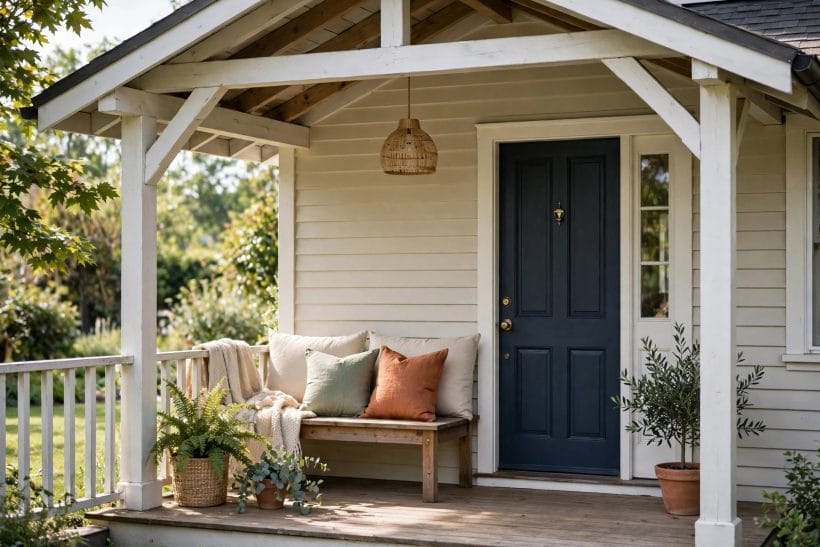
Where the porch has room, a seat turns it from a passage into a place. A bench or a pair of chairs gives a visitor somewhere to wait, a neighbour somewhere to pause, and the household somewhere to sit on a summer evening. Keep the seating to the side of the door’s swing, and keep the route to the door itself completely clear.
Porch furniture should be chosen for weather, not just for looks. Cushions that come inside in rain, or that dry quickly after it, will be used; cushions that stay sodden will be avoided and will soon look neglected. A small table is worth more than a large one on a porch, where room is always tighter than it looks.
Storage belongs near the entry but not in it. A boot tray, a place for parcels and a hook for a dog lead keep the porch tidy without turning it into a hallway. The rule is simple: if it blocks the door, it does not belong on the porch.
9. Seasonal Welcome: Changing With the Year
An entry that looks good in one season and neglected in the next is not finished. Spring is the time for fresh pots and a swept path; summer for watering and trimming back anything that crowds the walk; autumn for clearing leaves from steps and drains; winter for checking lights and keeping the step clear of ice.
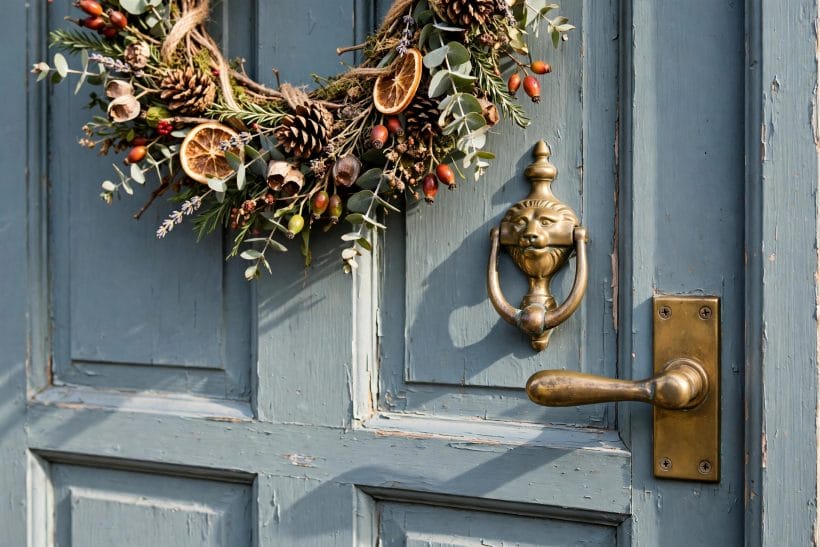
Seasonal decoration works best when it is the only change. A wreath in winter, a pair of lanterns in summer, a pumpkin or two in autumn — one gesture per season, removed when the season passes, keeps the entry feeling cared for rather than dressed up. Decoration that stays up past its season stops being decoration and starts being clutter.
The same rhythm applies to maintenance. A door that is repainted when it first looks tired, a lantern bulb changed before it fails, a path re-sanded before it rocks — small jobs done on time keep the entry from ever looking like a project.
10. Keeping It Looking Good: The Entry’s Upkeep
The entry’s upkeep is mostly small, regular work. Sweep the path, wipe the door furniture, oil a squeaking hinge, touch up a scuffed step. Done monthly, these jobs take minutes; left for a year, they become a weekend. The entry is the part of the house most seen by others, so it repays attention out of proportion to the effort.
Watch for the slow failures: a porch roof that starts to drip onto the step, a planter that stains the wall, a step that rocks underfoot, a lantern that fills with insects. Each is cheap to fix early and expensive to ignore. A quick walk of the entry once a season, with a critical eye, catches all of them.
Finally, remember that the entry is a shared space. It belongs to the household, but it is used by visitors, neighbours and delivery drivers. Keeping it clear, lit and welcoming is a courtesy as much as a design choice, and it is the cheapest form of hospitality a house can offer.
Final Considerations
Design the entry from the street inward, keep the door the loudest thing in it, and let everything else — path, porch, light, planting — support that one note. Keep the approach obvious, the steps easy, the shelter real and the palette edited. For the hall and everything inside the door, see the entryway ideas post, and for the porch as an outdoor room in its own right, the porch ideas post carries the fuller treatment. The dream homes survey shows how these same entry moves play out across house styles, while hot tub patios and brown living room ideas show the approach carried through to the garden and the room beyond. A fireplace wall can give the room just inside the door the same focal point the entry gives the house. Get the outside right, and the welcome starts before the door opens.



0 Comments