
You have seen them guarding temple steps, restaurant doors and garden gates: a pair of fierce, curly-maned stone lions with one paw raised. In the West they picked up an unlikely nickname — the foo dog — and a small crowd of myths came with it.
Here are the seven things worth knowing before you meet a pair up close or bring two home, from what they symbolise to where they should stand.
What Exactly Are They?
The statues are Chinese guardian lions, known in Mandarin as shi, meaning lion. Lions are not native to China; knowledge of them arrived along trade routes from India and Central Asia, filtered through Buddhist art, which is why early carvings blend real lion features with a good deal of imagination. Over the centuries the guardians settled at the thresholds of palaces, temples, government buildings and, eventually, ordinary homes, where a foo dog pair still signals protection, dignity and a warm welcome held in reserve for friends.
The Western nickname is a puzzle of languages. One popular explanation links it to words for Buddha or good fortune in Chinese dialects, adopted and reshaped by English speakers; another notes that the creatures’ faces, with their snub noses and wide grins, reminded collectors of certain Chinese dog breeds. Either way, the name stuck in antique shops and garden centres across Europe and America, and it is still the term most buyers search for today — much as readers browsing tiny house decorating ideas find traditional pieces turning up in very modern rooms.
| Question | At a Glance |
|---|---|
| What are they? | Chinese guardian lions, called shi, placed in pairs at entrances |
| What do they do? | Symbolically guard the building, its people and its prosperity |
| Why two? | One male and one female, balancing strength with nurture |
| Traditional materials | Stone and bronze for outdoors; jade, porcelain and wood for interiors |
| Where do they stand? | Flanking a door or gate, facing outward, male on the left as you face them |
| Are they religious objects? | They carry Buddhist associations for some, and cultural or decorative meaning for many others |
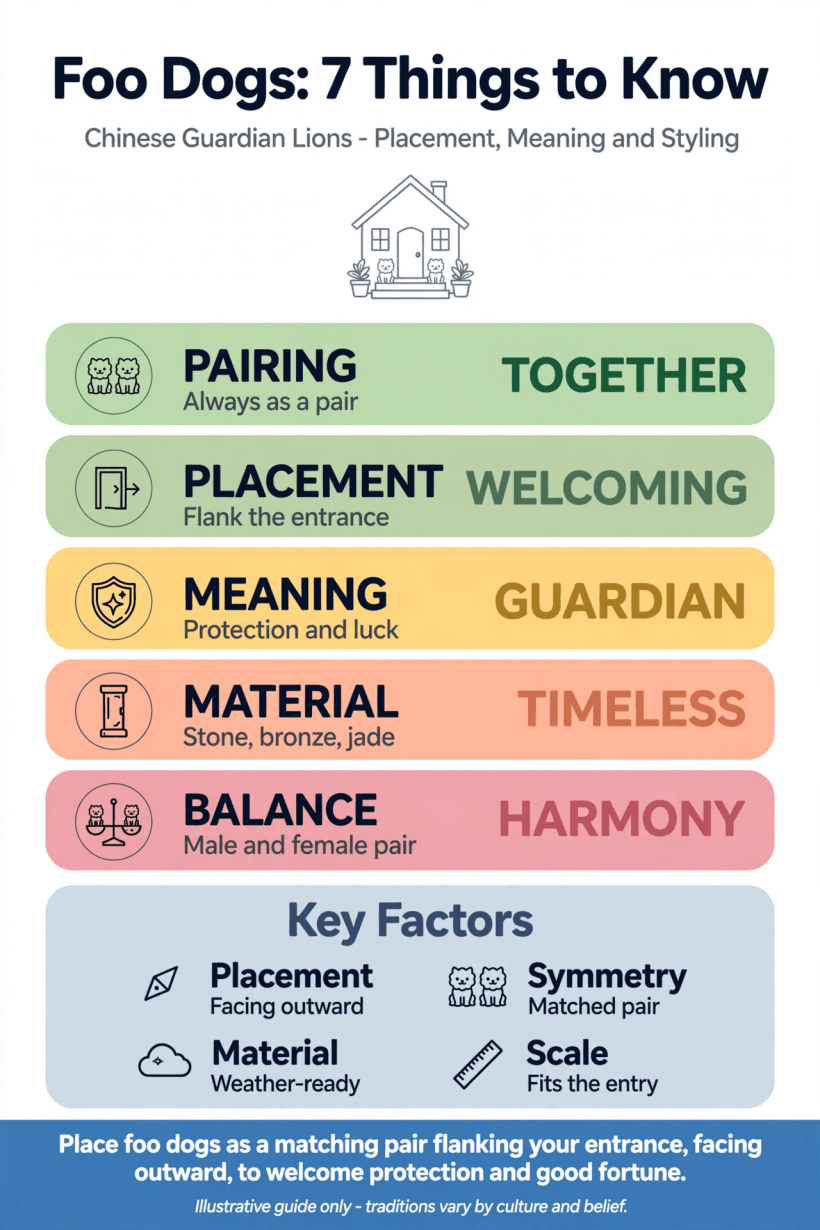
A quick visual guide to the pair: who is who, what sits under each paw, and where the guardians belong.
Understanding a pair takes about a minute once you know what to look for. The seven sections that follow unpack the identity, the pairing, the symbolism under each paw, the rules of placement, the choice of materials, the small carved details that carry meaning, and the practical business of choosing and caring for a set of your own.
Thing 1: They Are Lions, Not Dogs
The first surprise for most people is zoological. Despite the nickname, nothing about these statues is canine. The flowing mane, the powerful chest, the rounded paws and the habit of posing in pairs all belong to the lion of Asian art, a creature Chinese sculptors knew mainly from travellers’ descriptions, imported skins and Buddhist imagery for much of their history. That secondhand knowledge is a gift to the viewer: freed from strict anatomy, carvers leaned into character, giving the lions curling manes, expressive brows and grins that swing between welcoming and warning.
This also explains why no two historical pairs look quite alike. A stern, muscular pair might guard an official building, all muscle and authority, while a temple pair can look almost playful, with cubs scrambling over the female’s paw. Regional styles differ too; northern carvings tend towards the formal and blocky, southern ones towards the ornate. When you shop, that variety is liberating — there is no single correct face, only a correct spirit: alert, dignified and faintly amused. It is the same freedom you find in good tiny house interior design inspiration, where personality matters more than matching a catalogue.

Thing 2: They Always Work in Pairs
A single guardian lion looks, to traditional eyes, like half a sentence. The statues are conceived as a couple — one male, one female — whose contrasting qualities complete each other. Together they express a balance that Chinese philosophy returns to again and again: strength and gentleness, the public world and the home, protection facing outward and harmony kept within. Splitting a pair, or buying one statue because it was cheaper, breaks the symbolism entirely, which is why reputable sellers offer them as a set and why antique pairs are kept together through sales and inheritances.
Telling the two apart is easy once you look at their front paws, covered properly in the next section. A simpler first clue is expression and styling: carvers often give the male a slightly more open, roaring mouth and a mane arranged in neat, even curls, while the female may appear a touch calmer. Treat those as tendencies rather than laws, though; workshops varied, and the paw test below is the reliable one. If you inherit a lone statue, all is not lost — it can still live happily as a decorative sculpture indoors, simply without claiming the full guardian role.
Thing 3: The Ball and the Cub Tell You Who Is Who
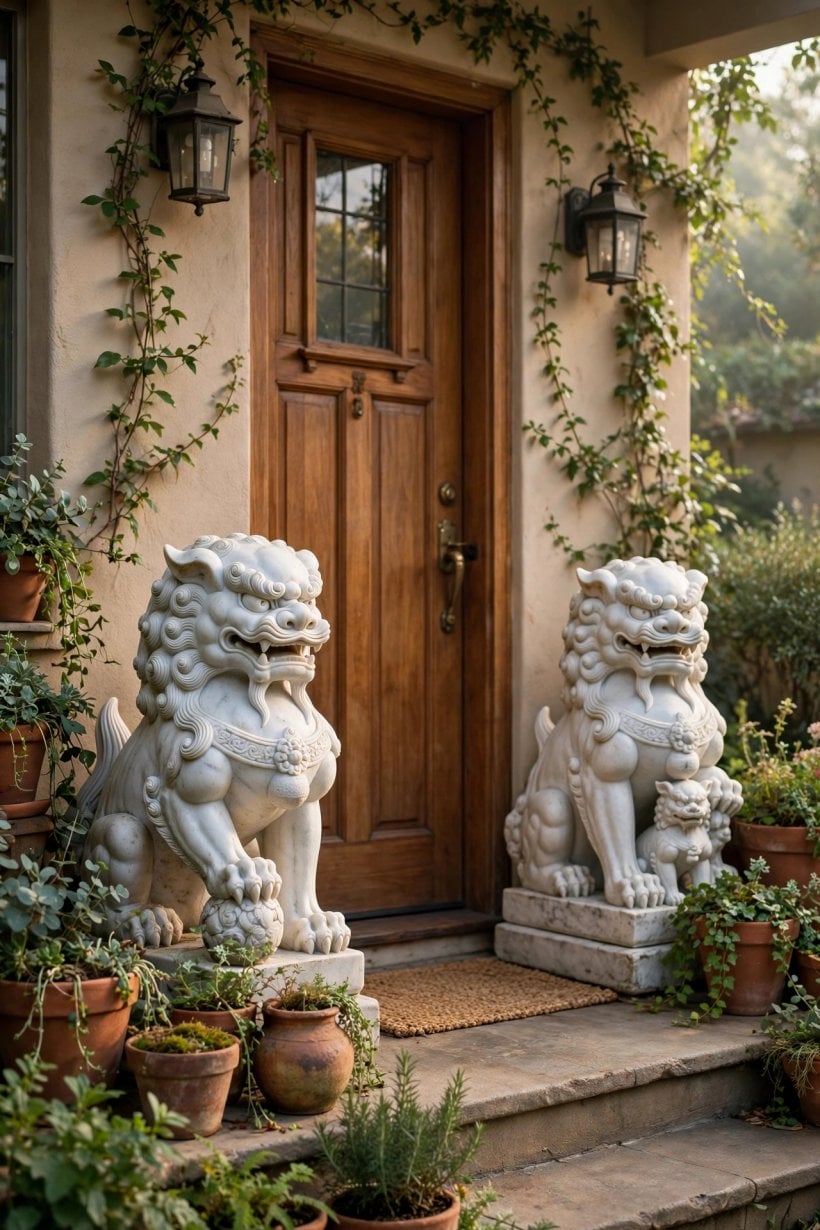
Look under the raised paw. The male rests his on a rounded, often intricately carved ball, sometimes described as an embroidered sphere. The ball is read in several ways: as the world under his watch, as a pearl of wisdom, or as a symbol of unity and the rolling continuity of life. Its surface is frequently carved with a geometric flower-like pattern, and in fine pieces the ball is pierced with fretwork that shows off the sculptor’s skill — a small marvel of patience in stone.
The female’s paw rests gently on a small cub, often shown on its back, playful and trusting. She stands for nurture, family continuity and the protection of the home’s inner life. Together the two paws tell the whole story of the pair: one guards the world outside the door, the other guards the world inside it. When you position a pair, this is also how you check you have them the right way round — ball and cub should both sit towards the centre line of the doorway they protect.
Thing 4: Placement Is Part of the Meaning
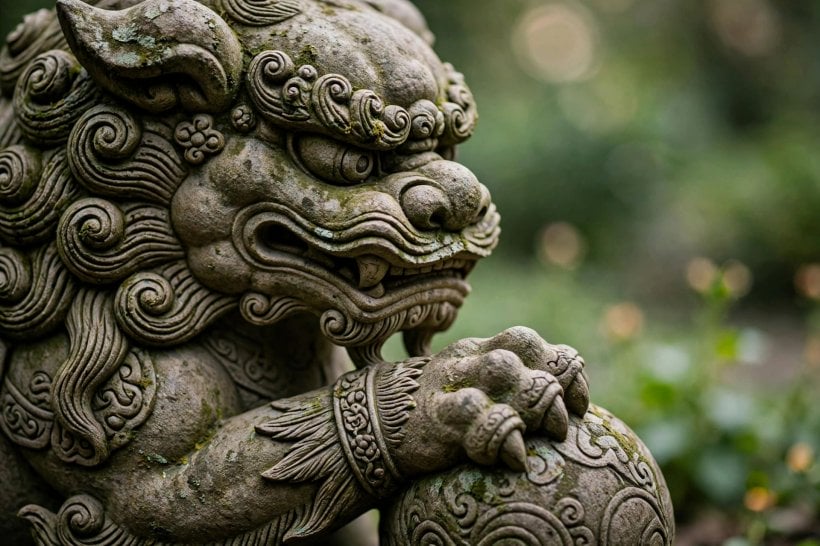
Where the lions stand is not decoration afterthought; it completes their job. Traditionally they flank an entrance at ground level or on low plinths, facing outward towards whoever approaches, so their gaze meets visitors before visitors reach the door. Standing at the threshold, imagine yourself as the approaching guest: the male, with the ball, belongs on your left, the female with the cub on your right. From inside the building looking out, that arrangement appears reversed, which is exactly why the rule is always stated from the visitor’s viewpoint.
Height matters less than presence. The pair should be big enough to read as guardians of that particular door rather than ornaments lost beside it, and they should sit level and stable, ideally where they will not be clipped by car doors, bins or bicycles. In gardens, a gate, a porch step or the end of a path all work well, and the pair can anchor a planting scheme the way the features in these tiny house landscaping ideas anchor a small plot. Indoors, a hallway console, a fireplace hearth or either side of a front door continues the same threshold logic on a smaller scale.
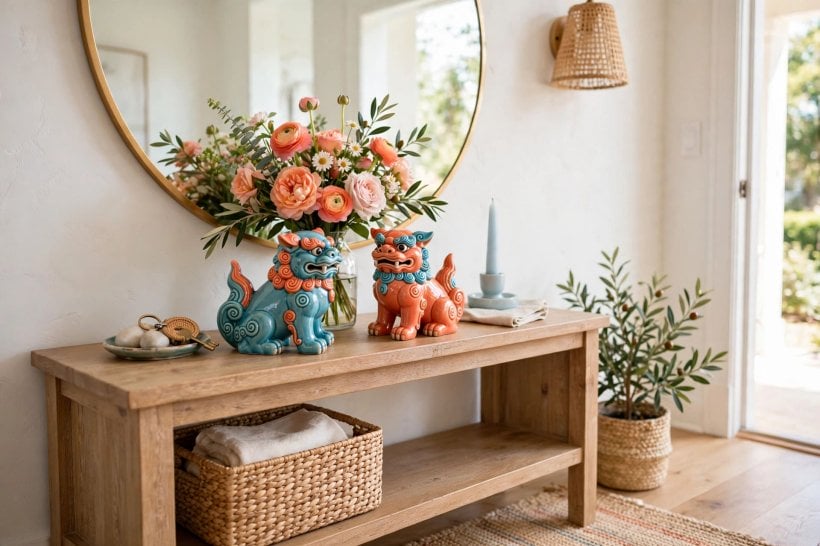
Thing 5: Materials Change the Mood — and the Upkeep
Stone is the classic outdoor choice, and with good reason: granite and marble weather slowly, gather moss and lichen gracefully, and gain presence as the years soften their edges. Cast stone and concrete offer a similar look at a friendlier weight and price, though fine detail tends to be softer. Bronze pairs, dark and gleaming where hands polish them, belong to grander settings and ask for little more than an occasional wash. For interiors the palette widens: porcelain and ceramic in celadon, white or famille colours; carved wood, warm and light; jade and other hardstones for collectors’ pieces that live on shelves and desks.
Match the material to the life the pair will lead. A stone set by a front door in a wet climate needs a stable base and a wash now and then, nothing more dramatic. Porcelain belongs where it will not meet a swinging bag or a boisterous pet. Resin replicas, much lighter and cheaper, suit renters and balconies but can look flat in strong sunlight and will not age like stone. Handle antiques with extra care: old carvings may have hairline cracks or weathered bases, and a reputable dealer will point them out rather than hide them under fresh paint.

Thing 6: The Small Details Carry Big Symbolism
Once you know the code, a pair becomes a short story in stone. The mane’s curls are sometimes linked with the snail-shell curls seen on images of the Buddha, a quiet nod to the lions’ Buddhist associations. A collar with a bell suggests the guardian is attended and honoured, not feral. An open mouth on one statue and a closed mouth on the other is said by some guides to echo the sounds “a” and “um”, the beginning and end of the sacred syllable, so the pair speaks the whole of existence between them — a story also told of guardian figures in Japan, where the lion-dogs took a closely related form.
Other details reward a slow look. Teeth, tongue and gums may be picked out in paint on porcelain pieces; the tail, often curled high over the back, adds the energy that stops the pose becoming static; and the base may carry waves, clouds or coins, each nudging the meaning towards safe journeys or prosperity. None of this requires you to read a pair like a scholar. It simply means the statues repay attention, and that a well-carved set, old or new, tends to show its quality in these small decisions rather than in size alone.

Thing 7: Choosing the Right Pair for Your Home
Start with the doorway, not the catalogue. Measure the space either side of the door or gate and choose a pair whose height feels in proportion — substantial enough to register, small enough to leave the entrance easy to use. Decide on material by exposure: stone or cast stone for weather, porcelain, wood or resin for sheltered and indoor spots. Then look at faces with fresh eyes. You will meet this pair daily, so pick expressions you enjoy; a slightly comic pair suits a family garden, a sterner set a formal frontage.
Buy the pair together from one source so carving style, size and weathering match, and check the practicalities: weight and how they will be moved, whether bases sit flat, and any delivery or installation advice for heavy stone. Set them where the sightline works — visible as you arrive home, not hidden behind the hedge — in the same spirit as the welcoming arrangements in these tiny house living room ideas, where the first view of a room is planned rather than accidental. Finally, treat them with a little ceremony on arrival: a clean plinth, a plant either side, and the pair becomes part of the household rather than a purchase.

Beyond the Doorstep: Guardians in Gardens, Work and Travel
The idea of a protective pair travels well. In gardens, smaller lions mark the turn of a path, flank a bench or watch over a pond, and their grey stone sits comfortably among planting in almost any style, from cottage borders to the rustic schemes in this tiny barn house interior ideas collection, whose love of honest materials translates outdoors easily. On desks and shelves, miniature pairs in porcelain, brass or carved wood serve as bookends and paperweights, a private joke about guarding the paperwork.
Travellers meet the family everywhere: huge imperial pairs before palaces and temples, their paws worn smooth by centuries of respectful touches; fierce cousins at shrine gates in Japan, where they are called komainu; and modern descendants outside banks, hotels and restaurants across Asia and far beyond. Photographing the local variation becomes its own quiet hobby. Notice, each time, how the essentials never change — always two, always at a threshold, always watching the world so the world inside can relax. That consistency across centuries and continents is the strongest proof of how deeply the idea answers something people want from a doorway.
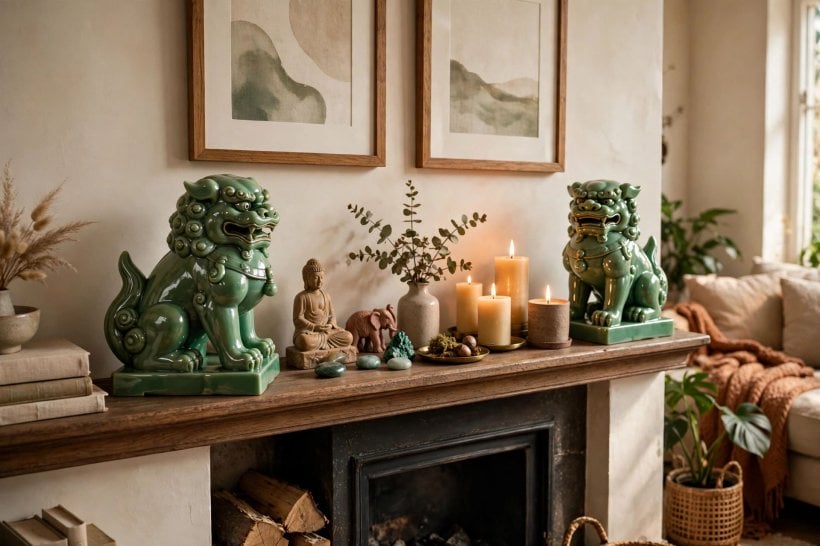
Caring for Stone Guardians, Indoors and Out
Guardians ask for very little. Outdoor stone needs a soft brush and plain water once or twice a year to clear algae from the carving’s recesses; harsh pressure washing can tear softened surfaces and strip the gentle patina that makes stone look at home, so kee
One last thought on authenticity. These guardians have been copied, resized and reimagined for well over a thousand years, in palace stone, temple bronze, export porcelain and garden-centre resin, and the idea has survived every translation because it was never really about zoology. It is about the moment of arrival: the small pause at a threshold where a household silently says, this place is cared for, and the people inside it matter. Two stone lions simply make that pause visible.
That is also why the pair suits houses of every size and style, from a farmhouse porch to the doorway of a compact modern home. Scale the statues to the entrance, keep them together, face them outward and give them a clean, level place to stand. Do those few things well and you are not copying a souvenir; you are taking part, in a modest and good-humoured way, in one of the longest-running conversations in domestic architecture.
p it for the driveway instead. Check occasionally that bases remain level and that water is not pooling where frost can get into cracks. In areas with hard winters, a breathable cover or a move to a sheltered porch keeps delicate porcelain and cast pieces safe. Bronze simply needs dusting and, if you like the shine on the high points, the occasional touch of hands will do the polishing for you.
Indoors, care is mostly placement. Keep pairs away from the swing of doors and the edge of busy shelves, dust with a soft brush that reaches into the mane’s curls, and lift by the base rather than by a paw or tail. If children are fascinated — they usually are — let them look closely and learn the ball-and-cub story; a guardian that is understood gets treated gently. Even a workspace corner benefits from the same orderliness, as the setups in these tiny house home office ideas show: small, deliberate arrangements make small spaces feel intentional. Treat your pair the same way and they will outlast trends, house moves and possibly the house.
Final Considerations
Few ornaments carry this much history in this small a footprint. A pair of guardian lions offers a doorway a sense of ceremony, a garden a focal point, and a household a story that guests genuinely enjoy hearing — lions mistaken for dogs, a ball for the world, a cub for the home, and two watchful figures holding the balance between them.
Choose a pair in a material your climate and rooms can support, place them as a true pair at a threshold, ball on the visitor’s left and cub on the right, and let them settle in. Given time, they stop looking like something you bought and start looking like something that was always meant to be there — which is, more or less, the definition of a guardian.


0 Comments