
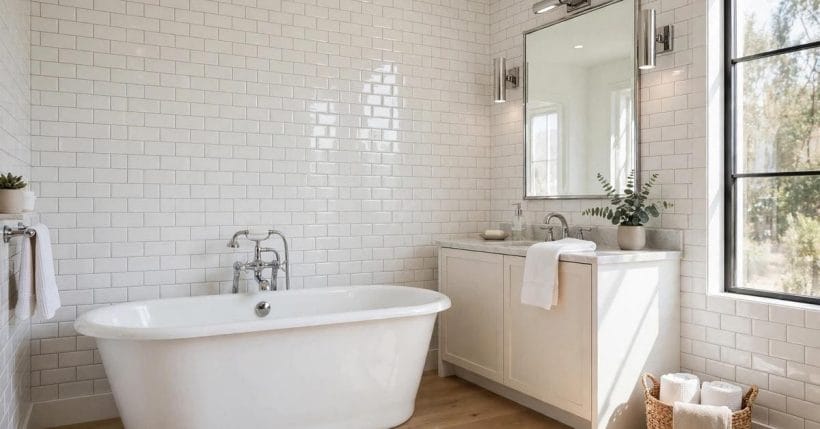
White tile is the bathroom’s oldest promise: a clean, bright room that forgives family life and flatters everything put in front of it. It is also a decision with more range than its reputation suggests — gloss or matt, tiny hexagons or calm large planes, grout that disappears or grout that draws the whole room in dark lines.
This collection gathers 75 ideas for white tile only — its finishes, shapes, layouts and pairings inside a bathroom. Whole-room planning, fixtures and fittings in general live in their own posts. Waterproofing and plumbing are professional work throughout and are discussed here in planning terms only.
1. White Tile Bathrooms at a Glance
White tile falls into five families. The bathroom ideas pillar carries the room generally — layouts, fixtures and storage — while this post stays in one lane only: tile colour and material. Decide the family by the light you have and the mood you want, and the rest of the white-tile choices follow calmly.
| Family | Character | What it means |
|---|---|---|
| Gloss & Shine | Bright, light-catching walls | Luminous |
| Matt & Soft | Calm, low-glare surfaces | Serene |
| Shape & Pattern | Form does the decorating | Characterful |
| Grout Contrast | Lines that draw the grid | Graphic |
| Warm Pairings | Timber, metal and textiles | Welcoming |
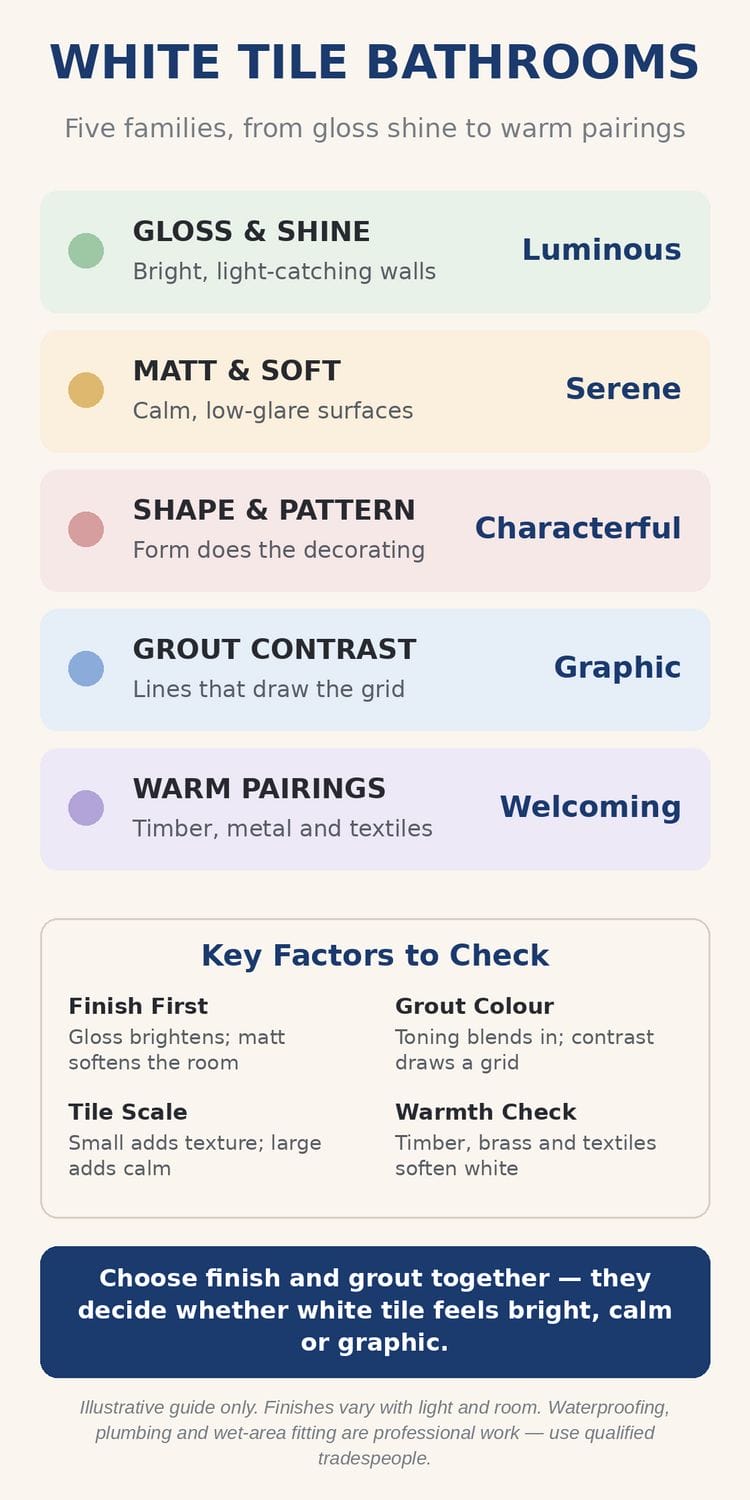
Four factors govern every scheme in this collection: finish, because gloss and matt behave differently under bathroom light; grout, because its colour and quantity decide half the finished look; scale, because small pieces add texture while large planes add calm; and warmth, because white tile needs timber, metal or textiles nearby if the room is to feel welcoming rather than clinical.
A word on the split this post keeps: it does not plan the whole bathroom, choose sanitaryware ranges, or teach tiling. It stays with white tile — on walls, on floors, in showers and behind vanities — and judges every idea by how that one material behaves in a real, steamy, daily-used room.
2. Gloss White Tile: Light and Shine
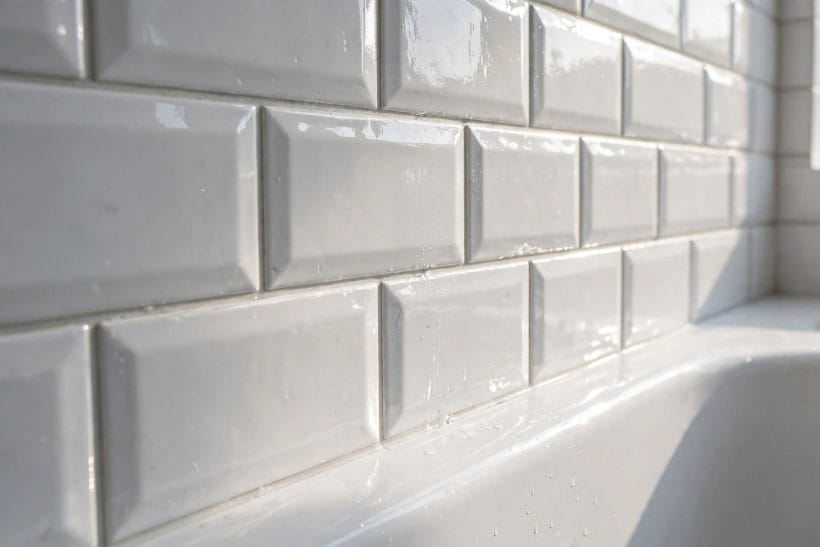
Gloss is white tile’s original finish, and still its brightest. A glazed surface throws window light and lamplight around the room, which is why gloss suits windowless bathrooms and north-facing rooms that need every scrap of brightness they can borrow. The close view in this photograph shows the effect at tile level — a soft sheen running across each piece.
1. Gloss Subway, Running Bond
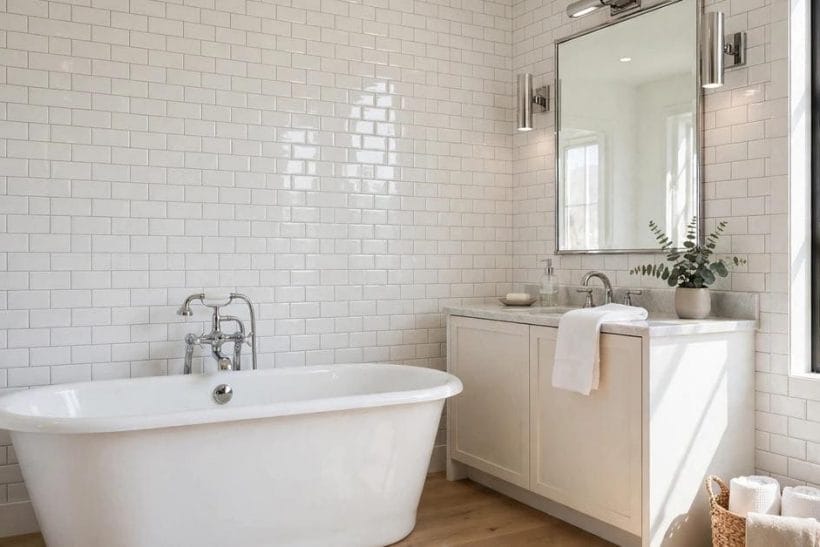
The classic arrangement in the feature photograph: gloss subway tiles staggered in running bond. It suits nearly every bathroom, catches light along each bevel, and makes the bath, the taps and the towels the coloured things in the room.
2. Gloss on the Windowless Wall
In a bathroom with no window, gloss tile is close to a lighting decision. Run it on the walls the light reaches first and the room borrows brightness it does not own — an honest trick, and a lasting one.
3. Gloss to the Ceiling
Taking gloss white tile full height makes the walls one bright, wipeable surface and removes the painted line where steam does its slow damage. The room reads taller, and the shower zone stops having an edge.
4. Bevelled Edges for Shadow Lines
A bevelled gloss tile throws a tiny shadow at every joint, giving a plain white wall a crafted, almost quilted texture. It is decoration made of light and edge alone — no colour, no pattern, nothing to date.
5. Gloss in a Small En Suite
Small en suites are gloss tile’s home ground: one bright surface, bounced light, and a room that feels washed rather than cramped. Keep the floor calmer and matt so the shine stays on the walls where it helps.
6. Gloss Behind the Vanity
The vanity wall is splashed daily and lit for faces, so gloss earns its place there twice over. It wipes clean in seconds and doubles the mirror’s light back at the person who needs it each morning.
7. Mixing Gloss with One Matt Surface
All-gloss can glare. One matt surface — usually the floor — rests the eye and gives the gloss walls something to shine against. The contrast is quiet, but it is the difference between bright and dazzling.
8. Gloss and Chrome, the Cool Pairing
Chrome fittings on gloss white tile is the bathroom’s cool, hotel register: crisp, bright and deliberately chilly. Warm it with towels and timber elsewhere, or own the coolness completely — half-measures look accidental.
3. Matt White Tile and Soft Finishes
Matt white tile trades shine for calm. It drinks a little light, hides droplets and fingerprints with grace, and suits the softer, spa-leaning bathrooms so many homes now favour. The portrait photograph’s large, quiet planes are the family’s promise — a wall that whispers.
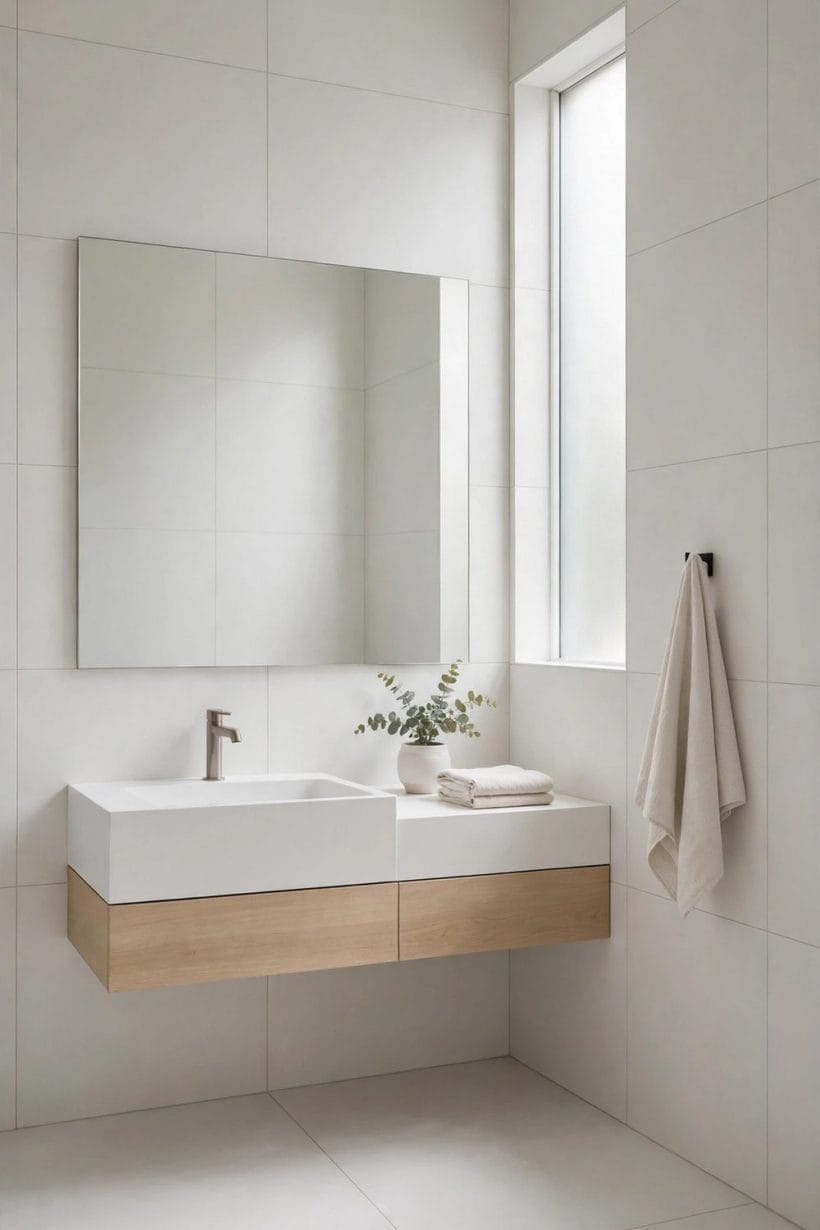
9. Large Matt Planes
Large-format matt tiles make a wall read as one soft surface, with few joints to interrupt it. In white the effect is plaster-like and serene — the bathroom equivalent of a deep breath before the day starts.
10. Matt in Bright Rooms
Where a bathroom is already flooded with daylight, gloss can feel frantic. Matt tile settles a bright room, absorbing the glare and letting the view, the bath and the planting carry the interest instead.
11. Honed, Stone-Look White
A honed finish borrows stone’s softness without stone’s sealing diary. The slate tile bathroom ideas in the neighbouring post make the same point from real stone’s side: a low-sheen surface reads calmer and more expensive than a polished one.
12. Matt Tile, Warm Light
Matt white is honest about light colour: under warm bulbs it turns creamy, under cool ones it turns grey. Choose the lighting temperature with the tile in the room, not from a sample board in a shop.
13. Chalky Handmade-Look Matt
Tiles with a soft, uneven handmade look take matt white away from minimalism and towards craft. Their gentle irregularity suits cottages and older houses, where a machine-perfect wall would feel like a guest.
14. Matt Floor, Gloss Walls
The practical split many bathrooms settle on: matt underfoot, where droplets and glare matter most, gloss on the walls, where brightness helps. Each finish is doing the job it is honestly best at.
15. Matt White with Pale Grout
Toning pale grout with matt white tile gives the seamless, folded-plaster look. Expect the joints to show themselves slightly as the years pass; in this scheme that gentle ageing reads as patina, not failure.
16. The Soft All-White Scheme
Matt white tile, white sanitaryware and pale textiles make the all-white bathroom at its gentlest. Texture is what saves it — a ribbed towel, a plant, a timber stool — because tone alone cannot hold a room.
4. Shapes and Sizes: Subway, Hex and Large Format
White tile’s shape is its vocabulary. The same white glaze becomes classic as a subway brick, playful as a hexagon, tailored as a square and architectural as a large slab. The hexagon floor in this photograph shows how much character a shape alone can carry into an otherwise plain room.
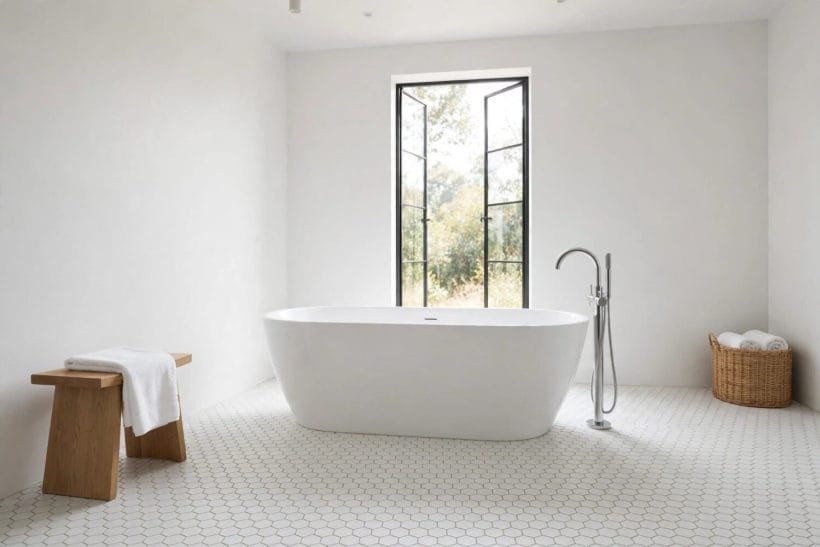
17. Subway, the Default Shape
The small brick shape suits every wall in this collection and forgives uneven rooms, because its many joints absorb irregularity gracefully. If a white-tile scheme has no other idea in it, subway will still carry it.
18. Hexagon Floors in White
White hexagons underfoot, as here, bring a period softness and a great deal of grout — which means texture, grip and a grid the eye enjoys. Keep the walls plainer so the floor’s pattern stays the event.
19. Penny Rounds for Curves
Small round tiles flex around curves, columns and awkward corners where rigid tiles would need cutting into slivers. In white they read as a soft dotted texture, retro without costume, and kind to bare feet.
20. Square Tiles, Honestly Gridded
The plain white square is back in favour, laid in a strict grid with visible joints. It suits modern and utility-leaning rooms, and its honesty — no pattern pretending otherwise — is exactly its charm.
21. Large Format for Few Joints
Big white tiles shrink the grout count and stretch a room visually. They ask for flat walls and a careful tiler, and repay both with the calmest surfaces in this entire collection.
22. Elongated Plank-Like Tiles
Long, narrow white tiles laid horizontally widen a wall; laid vertically, they lift it. The shape borrows timber flooring’s directional energy and gives a plain white room a sense of movement.
23. Mosaic Sheets for Niches
Small white mosaics are the natural lining for niches and curved splash zones, where their sheets bend and their texture catches the light inside a recess. One mosaic moment per room is usually the elegant dose.
24. Mixing Two Shapes, One Colour
White lets you mix shapes safely: hexagons on the floor, subway on the walls, squares in the shower. Because the colour never changes, the shapes read as one family speaking in different accents.
5. Patterns and Layouts in White
Pattern in white tile is pattern without colour: herringbone, stack, basketweave and chequered layouts that decorate by arrangement alone. The herringbone wall in this photograph is the family’s manifesto — a whole feature made from plain tiles and patience.
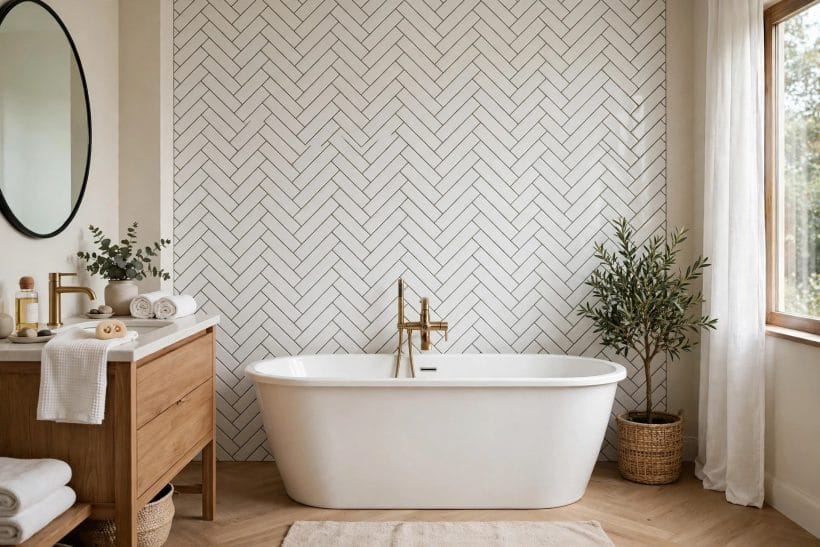
25. Herringbone Behind the Bath
Herringbone, as here, turns the bath wall into the room’s artwork while staying entirely white. It concentrates its labour on one wall, which is where a labour-intensive pattern honestly belongs.
26. Stacked, Not Staggered
Stacking subway tiles in a strict grid instead of staggering them turns the classic modern. The same familiar tile reads as architecture rather than tradition — a layout change, not a shopping change.
27. Vertical Running Bond
Turning the brick upright stretches a low wall visually and suits rooms where the ceiling needs lifting. Around a bath it feels tailored, like the wall was measured for the room rather than tiled by habit.
28. Basketweave on the Floor
Basketweave borrows the floors of grand old bathrooms and gives a new room instant ancestry. In all-white it stays fresh rather than museum-like, and its woven texture hides daily dust gracefully.
29. Chequered White on White
Two whites — gloss and matt squares alternating — make a chequerboard you notice by light rather than colour. It is the subtlest pattern in this collection and the one guests take longest to read.
30. A Patterned Feature Wall Only
One patterned white wall, three plain ones: the balanced formula. The pattern gets a frame of calm, the room keeps its brightness, and the tiling labour goes where the eye actually rests each day.
31. Diagonal Layouts on Floors
Laying square floor tiles on the diagonal makes a small floor feel wider and hides a room’s out-of-square corners with unusual grace. The trick is old, quiet and still completely effective.
32. Border Courses and Pencil Lines
A narrow border tile or a single raised pencil line gives a plain white wall a tailored edge — the tiled equivalent of piping on upholstery. Use it at the top of a half-tiled wall or around a mirror.
6. Grout as a Design Lever
Grout is half a white-tile wall’s surface and most of its character, yet it is usually chosen in the last five minutes. The dark-grouted grid in this photograph shows grout promoted to co-author: the same plain white tile, an entirely different, bolder room.
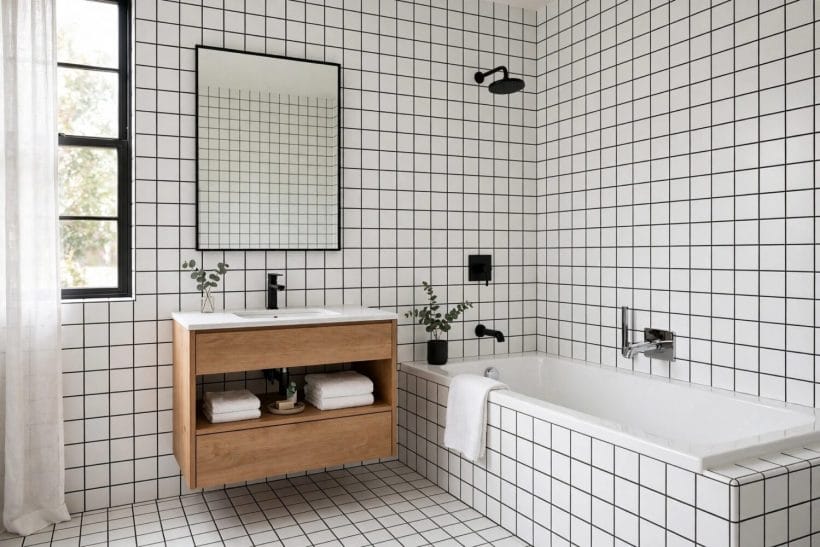
33. Dark Grout, White Tile
The graphic classic in this photograph: white tile drawn in dark lines. It is bold, honest about its joints, and forgiving of the slow darkening that pale grout suffers in a working splash zone.
34. Toning Grout for Seamlessness
Grout matched closely to the tile makes the surface read as one material — the choice for large-format and stone-look schemes where interruption is the enemy. The wall becomes a plane, not a grid.
35. Mid-Grey, the Diplomat
Mid-grey grout forgives the most, clashes with the least, and suits nearly every white tile in this collection. When the grout decision is paralysing the project, grey is the answer that lets it proceed.
36. White Grout, Deliberately Bright
Pure white grout gives the freshest, most coastal grid — and asks the most, in sealing and in wiping habits. Choose it with open eyes in quiet bathrooms; think twice in busy family ones.
37. Coloured Grout as the Colour
White tile with sage, terracotta or navy grout puts the colour in the lines instead of the field. It is reversible in spirit, striking in effect, and the boldest inexpensive trick in this collection.
38. Wide Joints for Handmade Tile
Handmade-look tiles need wider joints to absorb their irregularity, and the joint becomes part of their rustic texture. Fighting for hairline joints with uneven tiles is how calm tiling projects lose their composure.
39. Fine Joints for a Modern Wall
Narrow joints suit large formats and polished looks, demanding flat walls and patience. The result — a wall that reads as folded stone or glass — rewards the rooms whose whole idea is calm.
40. Grout in the Niche, Framed
A contrasting grout inside a niche outlines the recess like a picture frame. It is the smallest possible grout experiment — one recess of boldness — and often the detail visitors remember longest.
41. Sealed Grout in the Splash Zone
Whatever the colour, a white-tile bathroom’s grout lives wet. Sealing it, and renewing the seal as makers advise, is the unglamorous ritual that keeps a pale scheme honest through years of showers.
7. Vanities and Fittings Against White Tile
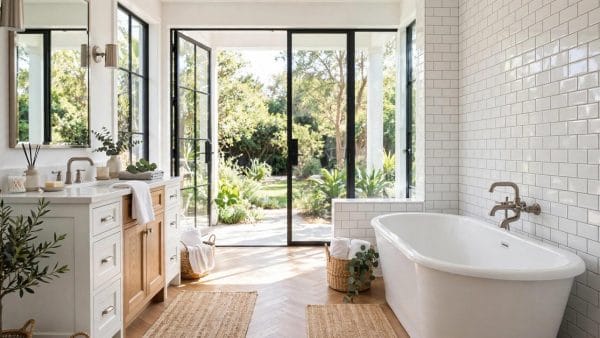
White tile is the best neighbour a vanity can have: it steps back, brightens the mirror zone, and lets timber, colour and metal do the talking. The vanity in this photograph — warm fittings against a calm white wall — shows the arrangement at its most flattering.
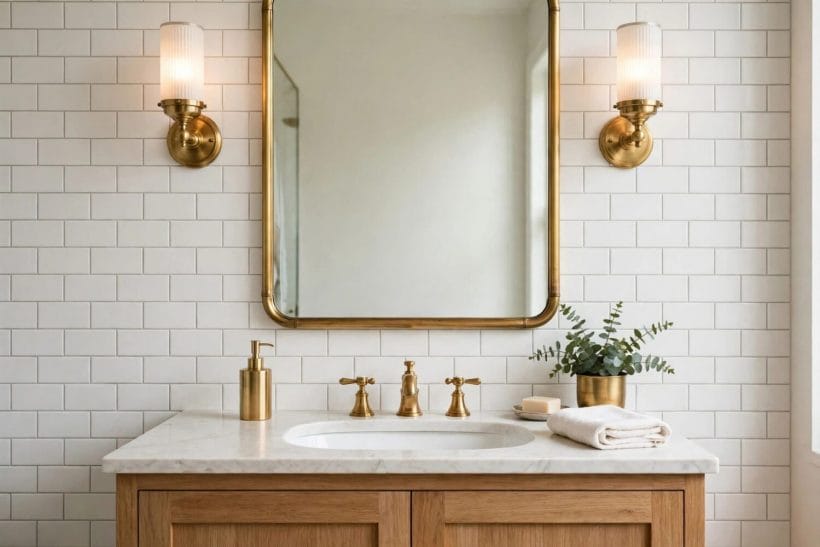
42. Timber Vanity Against White Tile
Warm timber against cool white tile is the pairing modern bathrooms are built on. The tile supplies the brightness, the timber supplies the temperature, and neither has to try harder than that.
43. A Coloured Vanity as the One Event
Where the walls are white tile, a deep green, navy or clay vanity becomes the room’s single colour event. The white cabinets bathroom ideas in the neighbouring post make the reverse arrangement work just as well — one strong note per bathroom is the reliable rule.
44. Brass Fittings on White
Brass against white tile, as in this photograph, flatters both materials: the metal warms, the tile brightens. The brass will soften with use; plan to love it slightly aged rather than fighting for showroom shine.
45. Matt Black for Definition
Black taps, handles and mirror frames draw a white-tiled room’s outline crisply. In hard-water country they ask for a regular wipe; in soft, they ask for almost nothing and give a great deal of structure.
46. Chrome for a Cool, Clean Register
Chrome is white tile’s traditional partner and still its crispest. It suits gloss and subway schemes especially, where its shine answers the glaze and the whole vanity zone reads bright and deliberate.
47. A Floating Vanity on a Tiled Wall
Wall-hung vanities show more of the tiled wall and floor, which is precisely the point in a white-tile scheme: the tile becomes the room’s continuous backdrop and the furniture floats in front of it.
48. Tiling the Splashback Full Height
A token splashback row can look apologetic against a mirror. Taking the white tile to the ceiling behind the vanity turns the whole wall into the splashback — calmer, grander and easier to keep.
49. Mirrors, Sconces and White Tile
Light fitted at face height on a white-tiled wall is doubled by the tile’s brightness without the glare of a fully mirrored wall. It is the flattering arrangement faces actually want at seven in the morning.
8. Baths, Showers and White Tile Wet Zones
White tile earns its keep hardest where the water flies: inside showers, around baths, across wet-room floors. The portrait photograph’s calm white shower shows the family at work — bright, washable and entirely unbothered by steam.
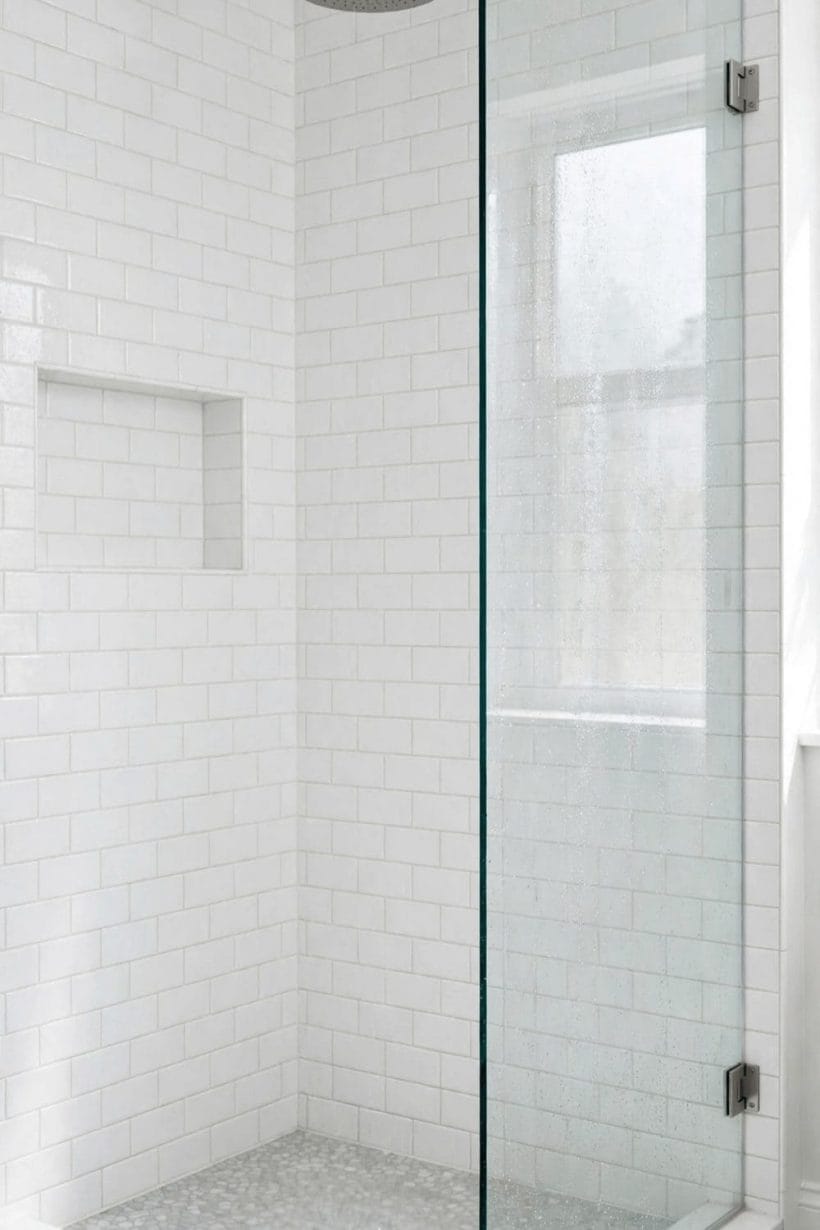
50. White Tile Inside the Shower
A white-tiled shower is bright where brightness matters and honest where honesty helps: every corner is visible, so cleaning is a routine rather than an investigation. Gloss helps the light; matt helps the calm.
51. The Bath Surround in White
For the walls that wrap the bath itself, the bathtub tile ideas collected next door go deep on surrounds; in white, the surround’s job here is simpler — a bright, wipeable backdrop that makes the tub the room’s pale sculpture.
52. Tub and Shower, One White Language
Where bath and shower stand together, one white tile across both zones unifies them. The tub and shower side by side collection treats that paired layout in full; white tile is its calmest common language.
53. Large White Tiles in the Wet Zone
Fewer joints mean fewer lines for water and soap to hunt, which is why large white tiles suit shower walls so well. Their fitting and the waterproof build behind them are professional work, in general terms.
54. Small White Mosaics on Shower Floors
On a shower floor the logic reverses: small white mosaics give many grout lines, and those lines give grip and help the floor’s falls. Texture here is not decoration — it is how the surface behaves wet.
55. A White-Tiled Niche in the Shower
Lining the shower niche in the same white tile keeps it calm; lining it in a contrasting grout or a smaller format gives the shower one crafted moment. Size it from real bottles before any tiling begins.
56. Half-Tiled Walls Around the Bath
Tile to shoulder height around the bath, paint above, is the traditional budget of tiling spent exactly where the splashes land. Finish the tile’s top edge with a trim or border course, never an apology.
57. Wet-Room Floors in White
A fully tiled wet room in white is the brightest version of the idea — and the most professional build in this post, because its falls, drainage and waterproofing are one system. Admire the result; delegate the making.
9. Small Bathrooms in White Tile
White tile is the small bathroom’s standard remedy, and the compact room in this photograph shows why: pale surfaces, few visual interruptions, and a timber note to keep the brightness warm. Small rooms do not need small tiles — they need calm ones.
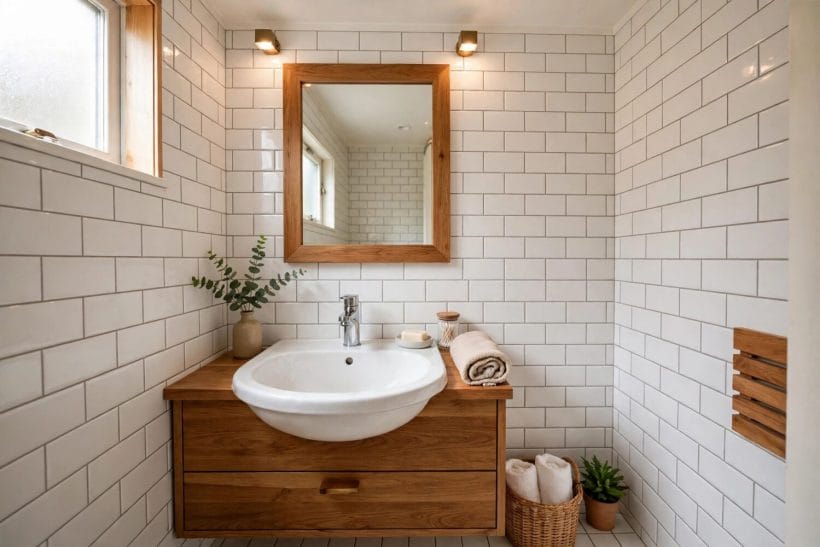
58. Large Tiles in a Small Room
Counterintuitive and reliable: large white tiles make a small bathroom feel bigger, because fewer lines mean less visual noise. The small bathroom ideas collected next door reach for the same trick in room after room.
59. White Tile in a 5×8 Layout
In a 5×8 bathroom layout, white tile keeps the squeezed plan feeling open: one pale material on the walls, the fixtures planned tightly, and the room’s smallness reading as efficiency rather than apology.
60. Tile the Wet Wall, Paint the Rest
A small bathroom on a budget can tile only the shower and bath walls in white and paint the rest in a matching warm white. The eye reads one pale room; the tiling bill reads considerably smaller.
61. Gloss for Borrowed Light
Tiny windowless bathrooms are gloss white tile’s clearest case: bounce every available lumen around the room and let the surfaces do the lighting work. Pair with the warmest bulbs the fittings allow.
62. Continuous Floor-to-Wall White
Running one white tile from floor up the walls removes the skirting line where a small room’s edges announce themselves. The space reads as one folded surface — bigger, calmer and easier to mop.
63. A Timber Note in a Tiny Room
The timber vanity in this photograph is doing temperature work: without it, a small all-white room can feel like a clinic. One warm material, even a stool or a shelf, is enough.
64. Mirrors Over White Tile
A generous mirror on a white-tiled wall doubles both light and apparent depth. In a small bathroom it is the cheapest extra space available — bought once, enjoyed at every single visit.
65. Keep the Palette to Two Notes
Small white-tile rooms stay calm when the palette is disciplined: white plus one other note — timber, black, brass or a single plant green. A third note is where compact rooms start to feel busy.
66. Storage Niches Instead of Cabinets
Where floor space is precious, a tiled niche steals storage from the wall’s thickness instead. It keeps bottles inside the white-tile language of the room and leaves the small floor entirely for feet.
10. Warming White Tile and Caring for It
The closing section answers white tile’s two honest criticisms: that it can feel cold, and that it shows every mark. Both are solved the same way — by what you put against the tile, and by a cleaning routine measured in seconds rather than weekends.
67. Timber Against White Tile
A timber vanity, bench, bath caddy or even a stool is the surest warmth a white-tile bathroom can wear. Keep timber at the drier edges of the room and in finishes sold for steamy spaces.
68. Warm Metals as Jewellery
Brass, copper and warm bronze fittings are a white room’s jewellery: small in area, large in temperature. One warm metal, used consistently across taps, handles and light fittings, warms the whole scheme.
69. Textiles Do the Softening
Towels, a bath mat and a fabric blind are a white-tile room’s soft furnishings, and they carry its colour seasonally — rust in autumn, sage in spring — while the tile stays permanently, calmly white.
70. Plants in a White-Tiled Room
Green is white tile’s oldest friend. Humidity-loving plants on a shelf, a sill or the bath’s edge soften every hard line in the room and thrive in the steamy climate a bathroom provides for free.
71. Warm-White Lighting, Chosen Carefully
White tile amplifies whatever light it is given, so bulb colour is a design decision here. Warm-white light keeps the room welcoming at night; clinical blue-white light is how white bathrooms earn their cold reputation.
72. Daily Care in General Terms
A squeegee pass after showers, ventilation running while the room steams, and drips wiped as they happen: white tile’s care is a habit, not a project. Ten seconds daily outperforms a scrubbing weekend yearly.
73. Grout Care Without Drama
Pale grout asks for its seal renewed as makers advise and for prompt attention to any discolouration at the splash zone’s hardest-working joints. Treated as routine maintenance, it never becomes a renovation.
74. What Drives the Cost
In general terms: the tile’s format and pattern labour, the area tiled, trims and niches, and the professional waterproof build behind wet zones. Plain white field tile itself is rarely the largest line — the making is.
75. Choosing White Tile for the Long Term
White tile’s final virtue is that it does not date the way colours do. Choose the finish for your light, the grout for your honesty about cleaning, and the warmth from timber and textiles — and the room will still look chosen in a decade.
Final Considerations
Let white tile do what it has always done best — brighten honestly, wipe clean, and step back for everything you love in the room — and let professionals own the waterproofing and plumbing beneath its calm. The bathroom ideas pillar carries the wider room from here; this collection’s 75 ideas are its brightest, palest corner.

0 Comments