

No built-in cupboard? No problem. A movable storage cabinet can swallow brooms, mops, the vacuum and every spray bottle you own, then roll or lift away when you move.
Here are nine space-saving ways to use a free standing broom closet well, plus the measuring, organising and styling advice that turns one tall box into the hardest-working corner of your home.
1. Broom Storage at a Glance
Cleaning tools are awkward tenants: tall, drippy, oddly shaped and needed in a hurry. A dedicated cabinet solves all four problems by giving long handles vertical room, bottles a contained shelf, and the whole unsightly collection a door to close. Before the nine ideas, here is the quick decision table most households work through.
| Question | Common answer | Why it matters |
|---|---|---|
| Where will it live? | Kitchen edge, utility corner, hallway or garage wall | Nearness to the mess decides whether it gets used |
| How tall? | Tall enough for your longest handle, plus hand room | Measure the vacuum and mop, not just the broom |
| One door or two? | One for slim spots, two for wide family cabinets | Door swing needs clear floor in front |
| Inside layout | Open tall section plus two or three shelves | Bottles, cloths and handles have different needs |
| Material | Painted board, sealed timber or coated metal | Drips and damp cloths punish raw finishes |
| Mobility | Fixed feet for calm homes, castors for renters | Wheels help cleaning day and house moves |

The essentials on one page: measure your longest handle, plan the inside in zones, and place the cabinet where the mess happens.
Storage thinking like this runs through all good small-space design; our tiny house closet design ideas apply the same zoning logic to wardrobes and clothing.
2. Choosing the Right Spot and Size
Placement decides success. A cabinet that lives two rooms away from the kitchen floor it cleans will be bypassed daily, and its contents will migrate to a corner by the door instead. Walk your cleaning route and note where tools naturally pause: that wall is your answer.

- Measure handles, not hopes. Stand your broom, mop, vacuum and any long-handled tools together and measure the tallest and widest of the set before you shop.
- Check the door swing. Tape the cabinet footprint on the floor and act out opening its door while holding a broom; cramped choreography now means annoyance forever.
- Mind skirting and uneven floors. Adjustable feet or a small wedge keep a tall cabinet steady and its door aligned on older floors.
- Leave breathing room. Damp mops need air; a spot with a little airflow, rather than a sealed damp corner, keeps the inside smelling fresh.
- Think about water. A position near a sink or utility tap makes filling buckets and rinsing cloths part of one tidy routine.
If the only available wall is in the hallway, embrace it: a well-finished cabinet there reads as furniture, and the ideas in section 9 help it earn that status.
3. Ideas 1–3: Slim, Tall and Built to Fit the Gap
The first three ideas suit the homes that need storage most: small kitchens, flats and cottages where every column of floor space is contested. Each one trades width for height or cleverness.

Idea 1: The slimline tower. A narrow, tall cabinet — barely wider than the broom head itself — slides into the dead gap beside a fridge or at the end of a run of kitchen units. Inside, one vertical chamber holds handles stood in a drip tray, while two small shelves above take sprays and cloths. In a small kitchen this single column can replace the mop-in-the-corner, the bottles-under-the-sink jumble and the brush that lives behind the door, all at once.
Idea 2: The double-door family cabinet. Where a utility wall allows more width, a two-door cabinet separates life into halves: cleaning tools on one side, and shelves of bottles, bulbs, batteries and the household’s small repair kit on the other. Families find this format easiest to keep honest, because everything has a visible home and the weekly shop’s bulk supplies can queue on the floor shelf. Add a simple hook rail inside one door for dusters and a dustpan.
Idea 3: The over-the-door companion. Not a cabinet alone, but the partner that makes a small one sufficient: a rack or clear pockets on the inside of the cabinet door for gloves, spare bags, furniture polish and the small items that otherwise colonise the shelves. Door storage works because it uses the one surface most cabinets waste, and it keeps frequently grabbed items at the front, at hand height, exactly where a busy cleaner wants them.
4. Ideas 4–6: Corners, Wheels and Double Duty
The middle three ideas are for awkward architecture and restless households — rentals, multipurpose rooms and homes where the cleaning cupboard must sometimes be somewhere else entirely.
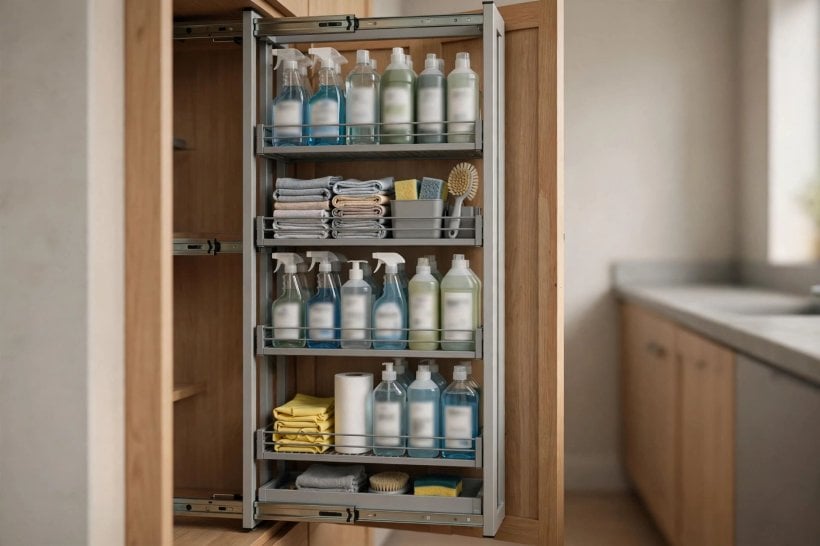
Idea 4: The corner-fit cabinet. Corners are the most wasted volume in utility spaces. A cabinet shaped or simply sized to sit deep into a corner — with its door on the diagonal face or a standard front set at an angle — claims that void for storage. The deeper interior suits bulk: the carpet cleaner, the mop bucket nested inside a basin, and the winter supply of salt or pet food that has no other home.
Idea 5: The rolling cleaning station. Fit sturdy castors and the cabinet becomes a station that travels: parked in the utility room, rolled to the bathroom on deep-clean day, and wheeled aside when the floor beneath needs washing. Renters love this format because it leaves no mark on walls, and people who clean room-by-room love having every tool arrive with them instead of fetching items one trip at a time.
Idea 6: The two-zone laundry partner. Stand the cabinet beside the washer and give its shelves a laundry role: detergents and pegs below, brooms and the ironing board in the tall section, and a small shelf reserved for the sewing kit and stain treatments. Combining cleaning and laundry storage in one furniture group keeps all the household’s wash-day chemistry in one ventilated place, away from food cupboards and curious small hands — use a simple latch if children are in the house.
5. Ideas 7–9: Disguise, Divide and Go Vertical
The last three ideas are about what the cabinet does for the room beyond storage: hiding in plain sight, serving two households zones at once, and using height that most furniture ignores.
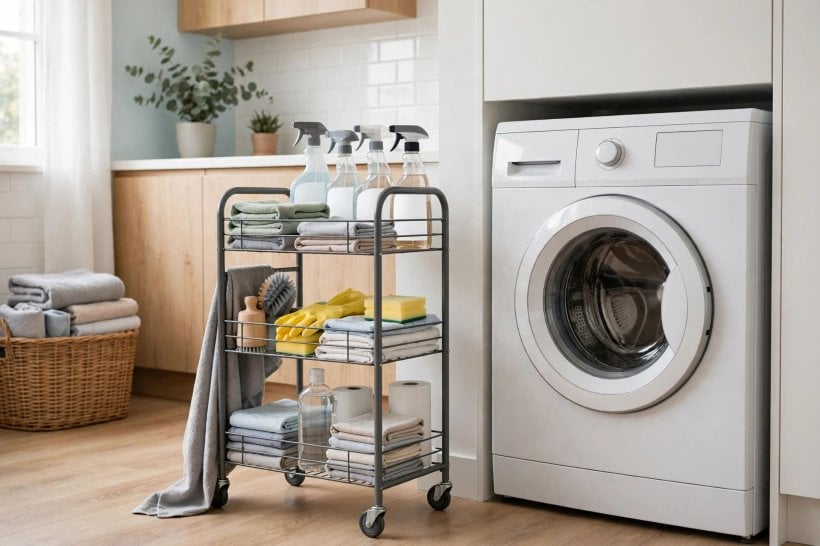
Idea 7: The furniture-look cabinet. Choose or paint a cabinet to match your room’s furniture — same colour as the kitchen units, or a warm timber in a hallway — and it stops reading as utility storage at all. Panelled doors, decent handles and a plant or picture on top complete the disguise. This is the idea for open-plan homes where the cleaning corner is always on show, and it costs little more than honesty about what the piece is.
Idea 8: The room-divider cabinet. In a studio or a big kitchen-diner, a taller cabinet set perpendicular to the wall can edge a zone: cleaning storage on the utility side, and its back panel styled with hooks for coats or a slim picture ledge on the living side. The cabinet earns its floor space twice, and the divided zones help a multipurpose room feel calm rather than chaotic — a trick borrowed from smart tiny house design ideas, where every piece must multitask.
Idea 9: The high-shelf stockroom top. Whatever style you choose, claim the cabinet’s full height: a top shelf or an added matching box above for the rarely used stock — spare mop heads, the good candles, bulk refills decanted into labelled jars. Vertical stock storage keeps daily shelves uncluttered, and a small folding step stored inside the tall section makes the high shelf a pleasure rather than a stretch.
6. What Belongs Inside (and What Does Not)
A cabinet stays tidy when its contents are edited as firmly as its design. The rule is simple: tools and products used for cleaning live here; everything else needs a stronger argument than “there was space”.
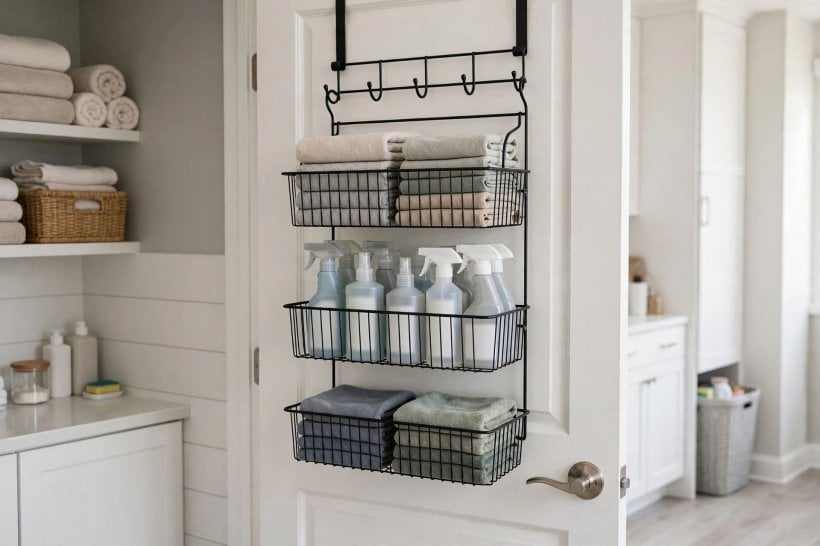
- The tall chamber: brooms, mops, the vacuum, a duster on an extendable pole, and the ironing board if the cabinet is deep enough.
- The shelves: everyday sprays in a caddy, cloths folded or rolled, sponges, gloves, and a small bin for spent batteries and bulbs awaiting recycling.
- The door: light, grabbable items only — dustpan and brush, a lint roller, spare bin liners — so hinges are never strained.
- Keep out: food, medicines, paperwork and anything a child should not reach that a simple cabinet cannot secure; give those their proper homes elsewhere.
- Decant and label: refills poured into sturdy, labelled bottles look calmer and stack better than a crowd of half-used originals.
Review the contents twice a year. Cleaning products multiply quietly, and three nearly-empty bottles of the same thing is a storage problem pretending to be a supply.
7. Organising the Interior Like a Professional
Professionals organise for the grab, not the photograph: the most-used item is nearest the door, handles are held rather than heaped, and nothing has to be moved to reach something else. Borrow their habits wholesale.

- Hang handles on clips or hooks. A rail of spring clips keeps brooms upright, off the floor and instantly visible; heaped handles tangle and shed dirt.
- Use a caddy for daily products. One handled caddy that lifts out with everything for a standard clean turns a cupboard raid into a single motion.
- Zone by room. Bathroom supplies on one shelf, kitchen on another, floors in the tall section — zoning survives busy households better than tidiness pledges.
- Add a drip tray. A washable tray under mop and brush heads catches the drips that otherwise stain the cabinet base and sour the air.
- Label the shelves. Small, plain labels help everyone in the house return things to the right zone, which is where systems usually fail.
The same organise-by-zone logic tidies bedrooms too; see tiny house bedroom ideas for small-room storage habits that transfer directly.
8. Materials, Finishes and Simple Care
Cabinets live a damp, knockabout life, so finishes need to be wipeable and repairable. The good news: utility furniture is the easiest in the house to keep respectable, because a painted surface can always be refreshed in an afternoon.
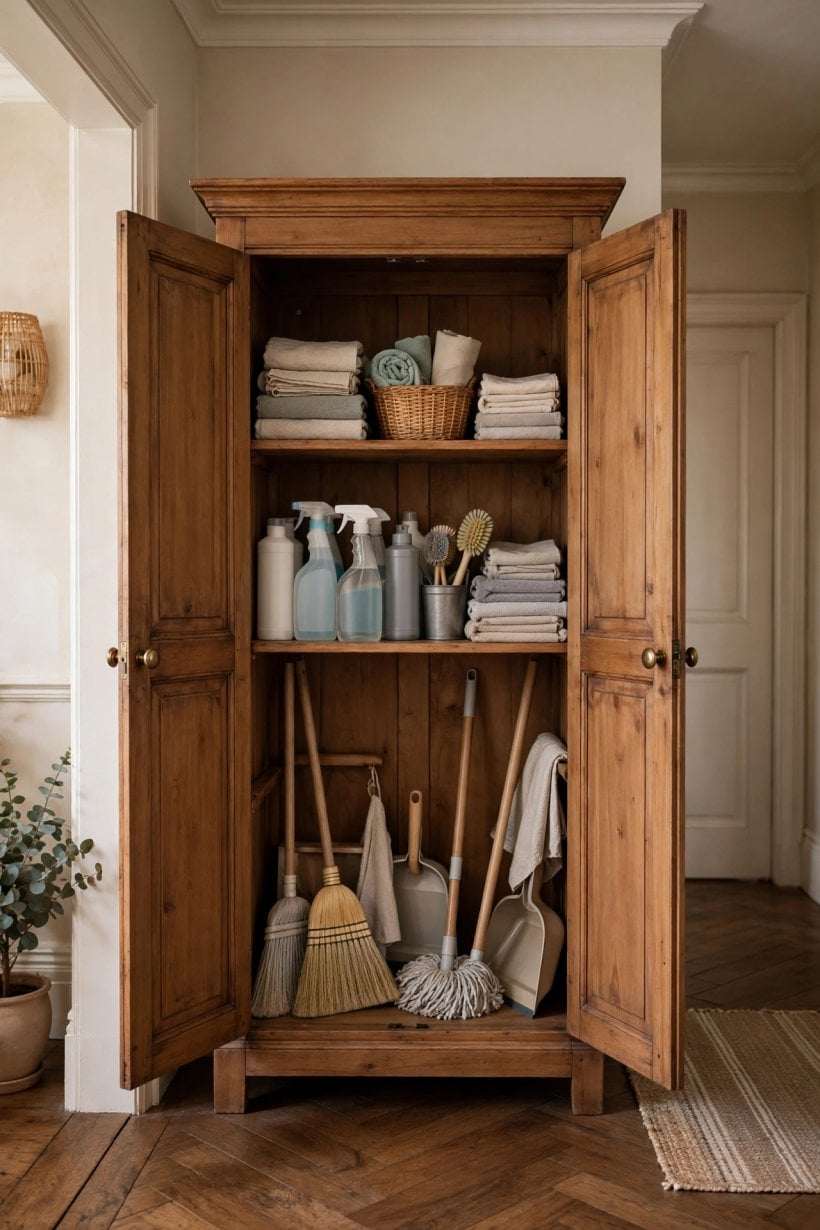
- Painted board is the common, sensible choice: smooth, wipeable and endlessly recolourable when the room changes around it.
- Sealed timber brings warmth and suits hallways and cottage kitchens; choose a finish that tolerates damp cloths hung nearby.
- Coated metal shrugs off knocks and suits garages and workshops, though it can feel cold and noisy with bottles.
- Ventilate the inside. A cabinet with small vents, or a door opened on sunny days, prevents the musty smell that closed damp storage develops.
- Wipe monthly, deep-clean seasonally. Empty, wipe the shelves and tray, wash or replace cloths, and check for leaks from ageing bottles before they spread.
For colour confidence when painting a cabinet to match a scheme, colourful tiny house interior ideas show how one strong furniture colour can lift a whole room.
9. Styling It Into the Room
A cabinet that must live on show deserves the same styling attention as any furniture: considered colour, decent hardware and one or two objects that connect it to the room’s scheme rather than the cleaning aisle.

- Upgrade the handles. Swapping basic knobs for handles that match the room’s other hardware is the cheapest transformation in this entire article.
- Dress the top, lightly. A basket for linens, a sturdy plant or a stack of cookbooks claims the top surface before random clutter does.
- Hang something beside it. A picture, a small mirror or a wall clock on the adjacent wall makes the cabinet part of a composed group.
- Match the skirting line. If you build or trim a cabinet yourself, echoing the room’s skirting profile at its base makes it look almost fitted.
- Keep the front clear. Styling stops at the door: magnets, notes and calendars belong on the fridge, not on your hardest-working furniture.
Homes that blend utility into their style well often take cues from modern tiny house interior ideas, where nothing can hide, so everything is chosen.
10. Buying Checklist and Mistakes to Avoid
Finish with the practical audit. Run through it in the shop or with the listing open, and the cabinet you bring home will fit, work and last instead of becoming next year’s listing.
- Confirm internal height, not just external: shelf supports and fram
One more thought for households on the fence: live with the problem for a week before you buy. Note every time a broom falls, a bottle hides, or a cleaning job gets postponed because the tools are annoying to reach. That small diary tells you which of the nine ideas your home is actually asking for — the slim tower for the gap by the fridge, the roller for the renter, the double-door cabinet for the family whose supplies keep expanding — and it stops you buying a beautiful cabinet that solves a problem you do not have.
And when the cabinet is home, give it a month before you judge it. Organising systems settle: you will move one shelf, swap two zones, and discover that the dustpan wants to live on the door after all. That fine-tuning is not failure; it is the system learning your household. After that month, most people find the surprise is not how much the cabinet holds, but how rarely they now think about cleaning storage at all — which is precisely what good storage is for.
es steal centimetres your longest handle may need.
- Test door hinges and latches for a positive close; a door that drifts open defeats the entire purpose.
- Ask about assembly honestly. Flat-pack is fine if fixings are metal and instructions are clear; wobble at the showroom stage only grows.
- Avoid the too-clever interior. Fixed moulded compartments rarely match real tool collections; plain shelves and your own clips adapt better.
- Do not skip the drip tray or the clips to save a little at the till — they are the difference between a cupboard and a system.
- Plan delivery access. Tall cabinets and tight stair turns are old enemies; measure the route as carefully as the destination.
And the biggest mistake of all: buying before measuring the tools. Ten minutes with a tape measure is the whole secret, and it is why the cabinets in tiny barn house interior schemes always look as if the house grew around them.
Final Considerations
A broom cabinet is humble furniture with an outsized effect: it returns floors, corners and under-sink chaos to the rest of your life. Choose the idea that fits your tightest space, organise the inside for the one-handed grab, and style the outside like it belongs. Do that, and the most ordinary object in the house becomes the one visitors quietly ask about.


0 Comments