

Every furniture buyer now does the same thing before visiting a shop: they read what strangers say about sofas, chairs and tables online — and then they wonder how much of it to believe. Some reviews are gold: specific, dated, written by someone who has lived with the piece. Others are weather vanes in a gale, swung by a delivery delay or a single bad morning.
This guide is the reading method: how to weigh furniture reviews without being misled by them — checking the source, mining the details, spotting the patterns, discounting the bias — and then the in-person checks that settle what no review can. It names no brands and repeats no one’s verdicts; it teaches you to reach your own.

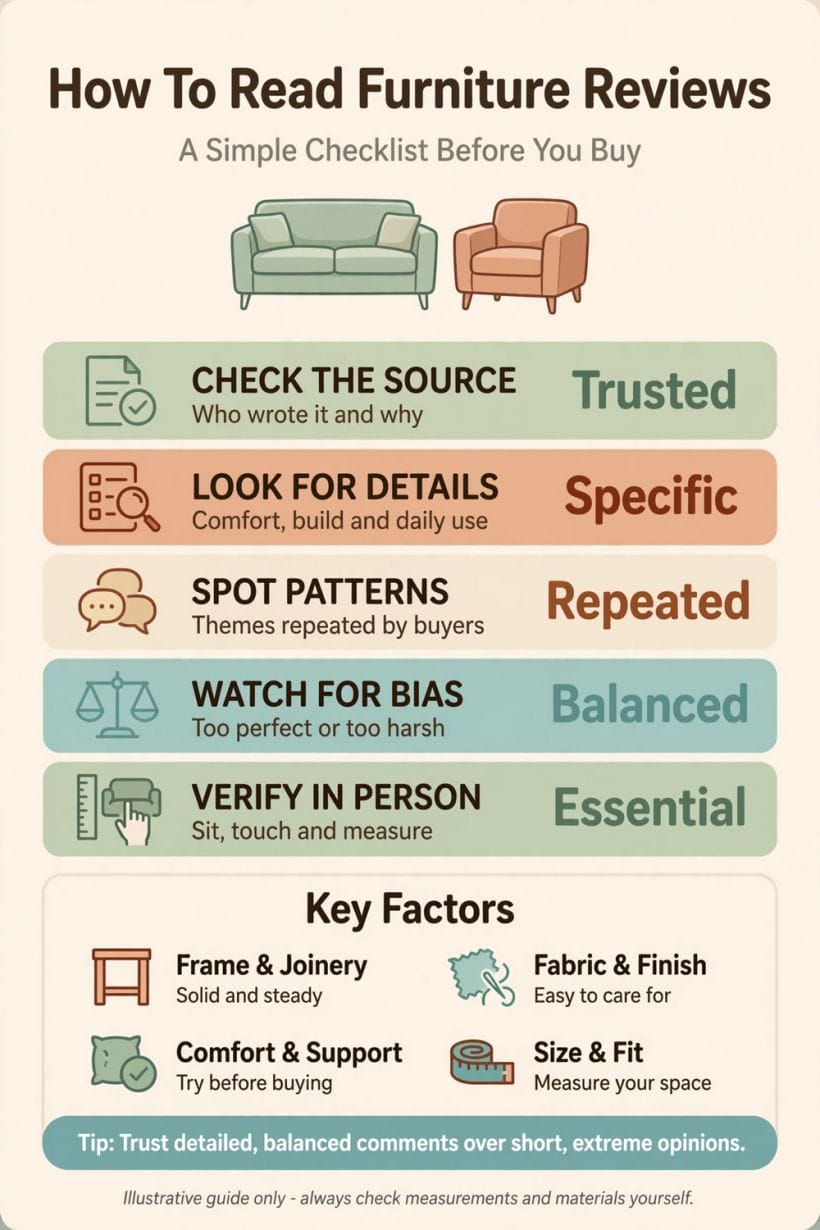
1. Reading Furniture Reviews at a Glance
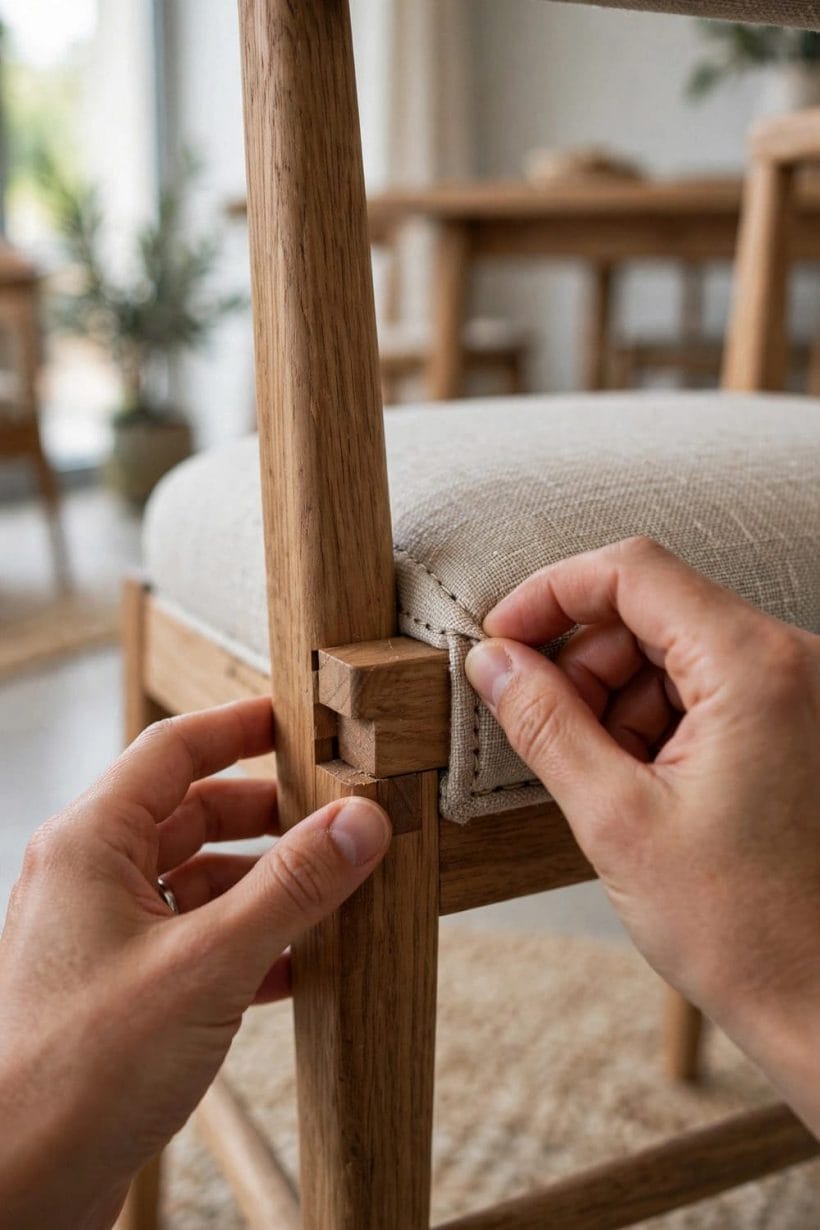
Two furniture guides live side by side in this series, and they split the work cleanly. The companion post, the furniture quality check guide, takes upholstered furniture apart layer by layer — frames, joinery, springs, cushions, fabric — and teaches what quality actually is. This post teaches the evidence: how to read what other buyers report, how to tell a signal from a strop, and how to verify the survivors in person, as the feature photograph shows — hands on the cushion, in the showroom, before any money moves. Neither post reviews a single product. Reviews quoted by nobody, verdicts invented for nobody: the method is the content. The checks below follow the order an experienced buyer works them.
| Review-reading check | What it tells you |
|---|---|
| Check the source | Who wrote it, whether they owned the piece, and what they wanted |
| Look for details | Measurements, months of ownership, room size — specificity is credibility |
| Spot patterns | The same point from many owners is evidence; one loud voice is weather |
| Watch for bias | Extremes cluster at purchase and delivery day, not at year two |
| Verify in person | Sit, press, measure and ask — the review ends where your hands begin |
2. Start With the Room Full of Furniture, Not the Star Count

The gallery’s showroom floor is where every review in the world eventually has to be cashed: a room full of pieces that can be sat on, pressed, opened and measured. A star average cannot do any of that, and it hides the only thing that matters — the spread. Two sofas can share an average and have nothing in common: one mildly liked by everyone, one loved by half its owners and returned by the rest.
1. Read the distribution, not the average
Where a platform shows the shape of its ratings, look at it before the headline number. A cluster at the top with a tail of detailed complaints is a different product from a smooth hill of middling satisfaction — and the complaints’ text, not the tail’s size, tells you whether their problem would be yours.
2. The middle reviews are the honest ones
Three-and-four-star reviews tend to be written by people describing a purchase rather than prosecuting or promoting one. They list what is good, what is not, and what surprised them — which is precisely the information a buyer needs.
3. Sort by time owned, where you can
A review written on delivery day is a review of a delivery. The reviews that matter for furniture — a thing you will own for a decade — are the ones written after months of sitting, spills, moves and seasons. Weight them accordingly.
3. Check the Source

Before weighing what a review says, weigh who is saying it. Ownership, incentives and expectations explain most of what reviews contain, including the furious and the ecstatic. The same discipline applies to second-hand and vintage buying, where the “review” is a seller’s condition description — the method in vintage furniture online is this section’s close cousin.
4. Owners over commentators
A reviewer who describes their room, their household and their previous furniture is giving you the context to translate their verdict into your life. Anonymous one-line judgements, favourable or furious, carry almost no transferable information.
5. Notice what the reviewer wanted
Half of all disappointment is a mismatch of briefs: the buyer who wanted a formal sofa reviewed a slouchy one, the minimalist bought an ornamented chair. When a complaint is really a preference, it may describe exactly the piece you are looking for.
6. Delivery and service are not the furniture
Late vans, damaged boxes and call-centre sagas fill review sections because they are vivid — but they review the retailer’s week, not the sofa’s decade. Read them for the retailer’s sake if you like; do not let them stand in for the piece’s comfort or construction.
4. Look for Details: Comfort, Build and Daily Use

The gallery’s hands pressing a cushion are doing what the best reviews describe: a test. Detail is the currency of credible reviewing — seat depth named, cushion behaviour after a month described, a drawer that sticks, a fabric that pills at the dog’s favourite end. Reviews written in adjectives are weather; reviews written in specifics are climate.
7. Specific beats enthusiastic
“Comfy and great quality” tells you the writer is pleased and nothing else. “Seat is deep enough to sit cross-legged; cushions needed plumping weekly at first, then settled” tells you how the sofa behaves — and lets you decide whether that behaviour suits your household.
8. Comfort reports need a body attached
Comfort is personal geometry: a seat one reviewer calls supportive, a taller one calls a perch. Trust comfort reviews most when the writer gives you their rough size and how they sit — curled, upright, sprawled — and discount verdicts offered without either.
9. Build details are the transferable gold
Reports about construction — a frame that creaks, legs that needed tightening, a finish that marked — transfer between households far better than comfort opinions. When several owners independently describe the same construction detail, treat it as measured fact and check it yourself in the showroom; the construction vocabulary for doing so is the companion guide’s whole subject. Sofa beds compress all of this into one mechanism, which is why the tested picks in sofa beds for tiny houses are best read with the same detail-first method.
5. Spot the Patterns in Fabric and Finish

The swatch fan is where reviews earn their keep, because fabric is where ownership tells the truth over time: pilling, fading in sun, marks that brush out and marks that move in. One owner reporting a fabric fault is an anecdote; the same fault, in the same words, from owners in different towns is a property of the material.
10. Repetition is the signal
Keep a simple tally as you read. A point made once is a possibility; made independently by several owners, it is a pattern — and patterns, good or bad, are the only predictions reviews can honestly make about your ownership.
11. Match the pattern to your household
A fabric that pills under a cat’s kneading may be flawless in a cat-free house; a finish that marks under hot mugs matters to mug-carriers. Patterns tell you what a material does; your household tells you whether it matters.
12. Photographs from owners beat adjectives
Owner photos — the sofa in a real room, in daylight, six months on — are worth pages of prose. They show scale, true colour and how the fabric actually wears, and they cannot be written by a marketing department.
6. Watch for Bias at the Seams

The gallery’s stitched seam is the sort of finishing detail reviews mention when something has gone wrong with it — which is the bias lesson in miniature. Reviews are written at emotional moments: the thrill of arrival, the fury of a fault. The long, level middle of ownership — where furniture spends its life — is chronically under-reviewed.
13. Extremes cluster at the beginning
Five-star reviews written in week one and one-star reviews written on delivery day are both reviewing the honeymoon and the hangover, not the marriage. Neither is worthless — delivery condition matters — but neither says much about year three.
14. The silent majority owns the middle
Most owners of most furniture are quietly content and write nothing. So a review corpus is a self-selected sample of the delighted and the wronged, and the truthful summary of any piece is usually milder than its loudest pages suggest.
15. Faults reported once are questions, not verdicts
A single report of a split seam or a wobbling leg asks a question — did assembly, transport or one weak unit cause it? — that only repetition or your own inspection can answer. Treat lone faults as items for your showroom checklist, not as conclusions.
7. Verify in Person: The Questions and the Sit Test

The gallery scene — two buyers, two armchairs, a salesperson mid-explanation — is where the reading ends. Everything the reviews suggested now gets tested by the only instruments calibrated to your life: your body, your tape measure and your questions. A good retailer expects this examination; it is how furniture has always been sold to people who keep it.
16. Sit the way you live
Shoes off if that is your habit, legs curled if that is your posture, and stay for minutes, not seconds. Showroom sitting is a rehearsal, and the piece that only works for the first thirty seconds will not work for a film, a novel or a nap.
17. Press, lift and open everything
Press the cushions and watch them recover; lift one corner of the sofa and feel whether the frame twists; open every drawer and door. These are the tests the construction guide formalises — in the shop they take ten minutes and answer most of what reviews argued about.
18. Ask the questions reviews cannot answer
What is the frame made from, what does the guarantee actually cover, what arrives assembled and what arrives flat, what does returns cost if the piece is wrong for the room? A seller’s answers — and willingness to give them in writing — are themselves a review of the retailer.
8. Size and Fit: The Review Nobody Writes
Almost no review says “it fits my room beautifully”, because fit is not a property of the furniture — it is a property of the match. The commonest real-world furniture mistake is not buying badly made pieces; it is buying well-made pieces at the wrong scale, through a door they cannot pass, into a room they overwhelm.
19. Measure the room, then the route
The piece must fit the room — and first it must fit the journey: doorways, halls, stairs, the lift. Tape the footprint on the floor and live around it for a day; the number of beloved sofas that failed at a staircase is beyond counting.
20. Scale against what stays
Judge a new piece against the furniture it will live with, not against the showroom’s acreage. The slim console that disappears behind a sofa in a vast shop — the problem worked through in console table behind sofa ideas — is the same problem at domestic scale.
21. Read size complaints as measurement confessions
When reviews call a piece “smaller than expected” or “huge”, they are usually reporting that nobody measured. The dimensions were printed all along. Let other people’s surprises fund your tape measure’s career.
9. After Delivery: The First Month Is Your Review Period

The gallery’s last scene is the destination of the whole method: a sofa at home, dusk outside, its owner plumping the cushions in the daily ritual. The first month of ownership is your own review period — the time to find the faults, test the comfort honestly and use the paperwork while it is still warm.
22. Inspect on day one, properly
Check every seam, leg, drawer and surface before the delivery team leaves, and photograph anything wrong. Faults reported immediately are a retailer’s routine; the same faults reported in month four are an argument.
23. Live with it before judging comfort
New cushions are firmer than the showroom’s much-sat-on display set, and bodies adapt to honest support over a fortnight. Judge comfort at week three, not at hour three — and write your own review then, while the detail is fresh, for the next buyer working this method.
24. Keep the paperwork with the piece
Guarantee terms, care instructions, fabric details and the receipt, filed together: furniture outlives memories and sometimes retailers. The household that can produce the paperwork is the household whose claims get honoured.
10. Putting It Together: A Calm Way to Decide
The method, assembled. Shortlist by pattern, verify in person, and let the paperwork close the deal — in that order, and the reviews of strangers become what they should always have been: a scouting report, not a verdict.
25. Shortlist by patterns, not by stars
Choose two or three candidate pieces whose repeated, detailed owner reports match your household’s life. Discard any piece whose patterns describe your exact fears, whatever its average says.
26. Verify the survivors in person
Visit, sit, press, measure and ask — the full §7 routine — for each finalist. The piece that survives your own hands has earned a kind of confidence no review total can confer or remove.
27. Close with the ordering checks
Distance buying adds its own layer — dimensions in writing, delivery terms, returns windows and the honest total cost — covered in full by buying furniture online and ordering home furnishings online. Read those before the order, the reviews before the shortlist, and your own hands before the payment, and the system is complete.
Final Considerations
Furniture reviews are evidence, and evidence has rules: weigh the source, prize the detail, count the patterns, discount the moment’s bias, and verify with your own body before you buy. This post has deliberately reviewed nothing — no maker praised, none condemned — because the durable skill is not knowing which sofa strangers liked this year. It is knowing how to read what they said, check what they meant, and sit down, at last, on the right one.




0 Comments