

Two sofas can wear the same fabric, copy the same silhouette and sit a showroom apart in price — and almost the whole difference is hidden where you cannot see it: in the frame, the joints and the springs.
This guide is the checklist for those hidden parts. No brand verdicts and no review scores — just the construction checks any buyer can run on any upholstered furniture, in a shop or on a listing, before money changes hands.
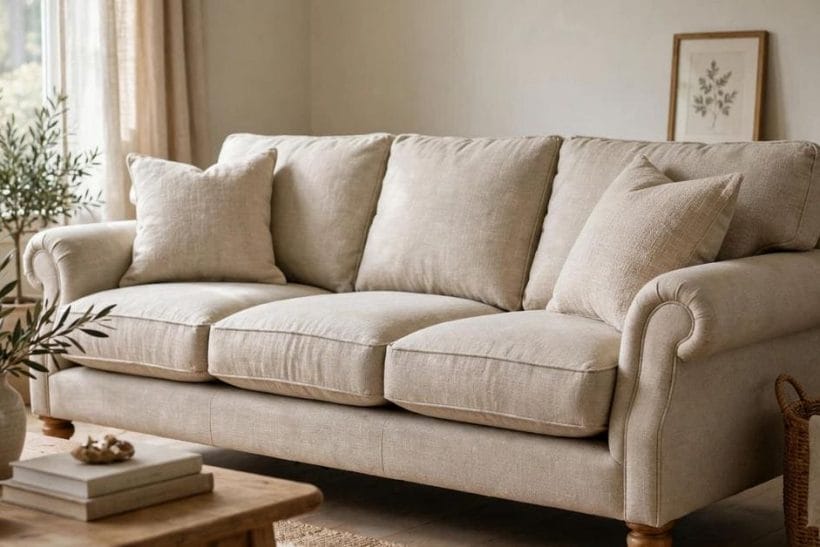
1. Furniture Quality at a Glance
Upholstered furniture quality is not a mystery and it is not a price tag. It is a short list of physical facts: what the frame is made from, how its corners are held together, what suspends the seat, what fills the cushions and how honestly the fabric and stitching are finished. Every one of those facts can be checked — by hand, by eye, or by asking for the construction details in writing. A maker who builds well can always describe the build; vagueness about materials is itself information.
Buyers often start by hunting for reviews of a particular maker, and reviews have their place — for delivery service, for aftercare, for whether cushions matched the photographs. But no review can tell you what a specific chair is made from, because ranges change, factories change and two models from one maker can be built entirely differently. The construction checks travel with you from piece to piece and maker to maker, which is why they outlast any single verdict.
The checks below run in the order the furniture is built, from the skeleton outward. They apply to sofas, armchairs and upholstered beds alike, and they work the same whether the piece is traditional or modern, expensive or modest: the question is never what a chair cost, but whether its construction matches its asking price. Run the frame and spring checks first — those are the parts that decide whether a piece is still comfortable in ten years or sagging in two.
| Check | What good looks like |
|---|---|
| The frame | Solid hardwood or quality plywood rails, heavy in the hand, no flex or creak when lifted by one corner |
| The joinery | Corners dowelled, screwed or blocked — never held by staples and glue alone |
| The suspension | Springs or webbing that feel even and supportive, with no dips, gaps or noise |
| The cushion fill | Resilient foam cores that spring back, wrapped for softness, in removable covers |
| The fabric | A tight, even weave, pattern matched at the seams, honest fibre content on the label |
| The paperwork | Frame and spring warranty in writing, care label present, returns terms clear before purchase |

2. Start With the Frame
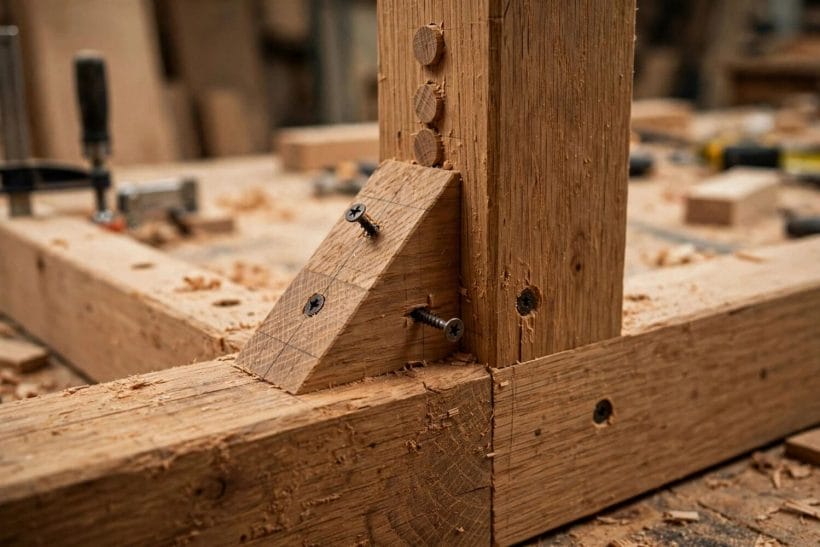
1. Ask what the frame is made from
Kiln-dried hardwood — beech, oak, ash and similar dense timbers — is the traditional frame material because it holds screws and dowels without splitting and resists warping as the moisture leaves it. Quality plywood rails are a respectable second. Softwood, raw chipboard and plastic frames are the economy end: not automatically hopeless, but they should come with an economy price and a shorter expected life.
2. Lift one front corner
The oldest test in the trade: lift the front corner of a sofa a few inches off the floor. The opposite front leg should lift at almost the same moment. If the frame twists so the far leg stays planted, the structure is flexing — and a frame that flexes when empty will work its joints loose under daily use.
3. Feel the weight and the rails
Good frames are heavy for their size, because dense wood and real suspension weigh more than staples and foam. Run a hand along the back and arms: rails should feel thick and continuous, not hollow or drum-like. On space-planned pieces the same logic applies — the frames inside convertible furniture for tiny houses work even harder, folding and unfolding daily, so their hinges and rails deserve the same scrutiny.
3. Joinery: How the Corners Hold
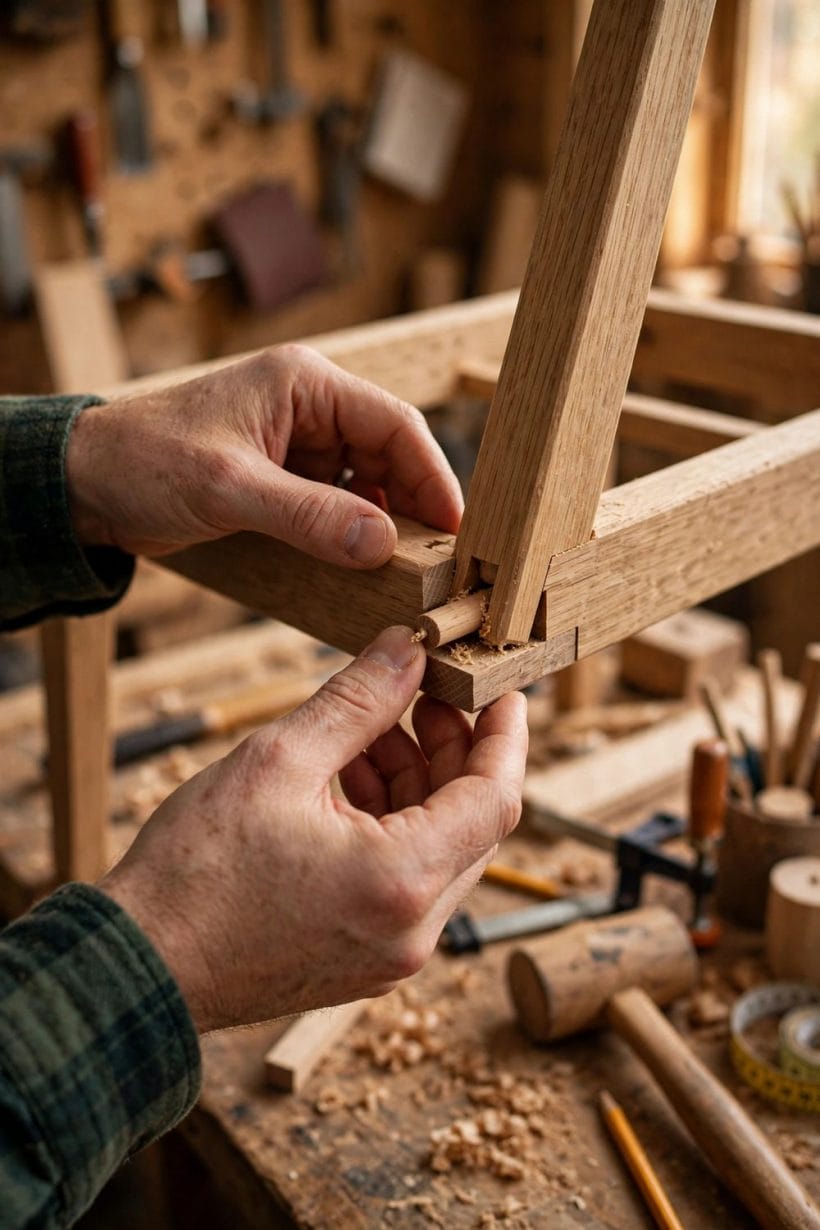
4. Look for corner blocks
Flip your attention to the underside, like the first gallery’s exposed frame corner: the strongest frames carry a shaped block of wood fitted into each corner, glued and screwed to both rails. Corner blocks spread the load every time someone drops into the seat, and they are cheap for a maker to fit — their absence on a pricey piece is a telling economy.
5. Dowels, screws and mortise joints
Traditional joinery — mortise and tenon, double dowels, or screwed and glued rails — locks the corners mechanically, so the joint holds even as glue ages. Staples alone are the warning sign: they are fast to fire, hold briefly, and work out under movement. Ask directly how the corners are joined; “dowelled and blocked” is the answer you want to hear.
6. The same rules govern cabinet work
Joinery honesty is not unique to upholstery — it is the same check you would run on fitted furniture, which is why the guide to replacement cabinet fronts stresses measuring and hinge quality over surface looks. Wood either is joined to last or joined to sell; the corner always tells you which.
4. Springs and Suspension
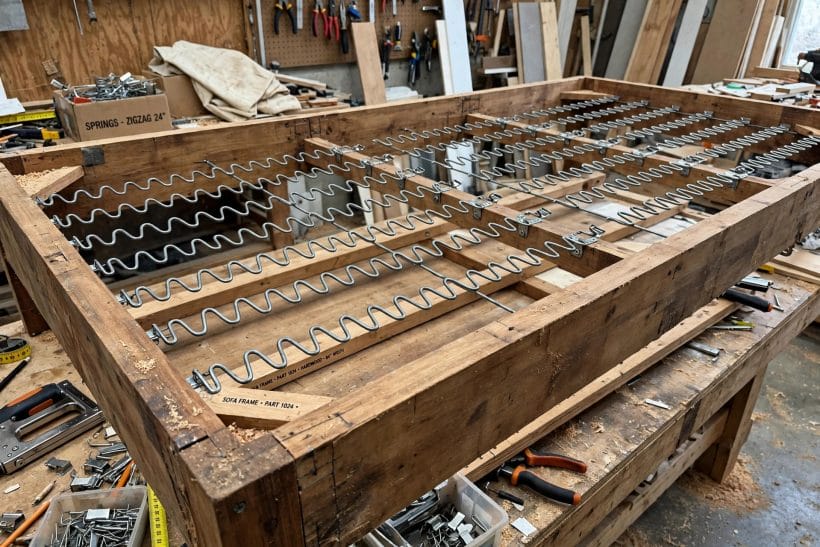
7. Know the three suspension families
Seat suspension comes in three broad families: eight-way hand-tied coil springs, the traditional premium option, labour-heavy and very even; sinuous (zigzag) steel springs, the modern standard, durable and consistent when closely spaced; and elastic webbing, the lightest option, comfortable at first but the quickest to stretch. None is automatically right or wrong — the match between suspension, price and expected use is what you are judging.
8. Press and listen
Press both palms firmly into the seat and work across it. Support should feel even from edge to centre, with no dead spots, no ridges where a spring ends, and no creaks or clicks. Sit down hard, once, without ceremony: suspension should absorb, not bottom out against the frame.
9. Check the back as well as the seat
Backs take quieter punishment: they are leaned into for hours and their springs or webbing are often lighter than the seat’s. Push a flat hand into the back cushions at several heights. A back that feels board-flat and unyielding, or one that gives unevenly, will not age gracefully even if the seat passes every test.
5. Cushion Fill: Foam, Feather and Fibre
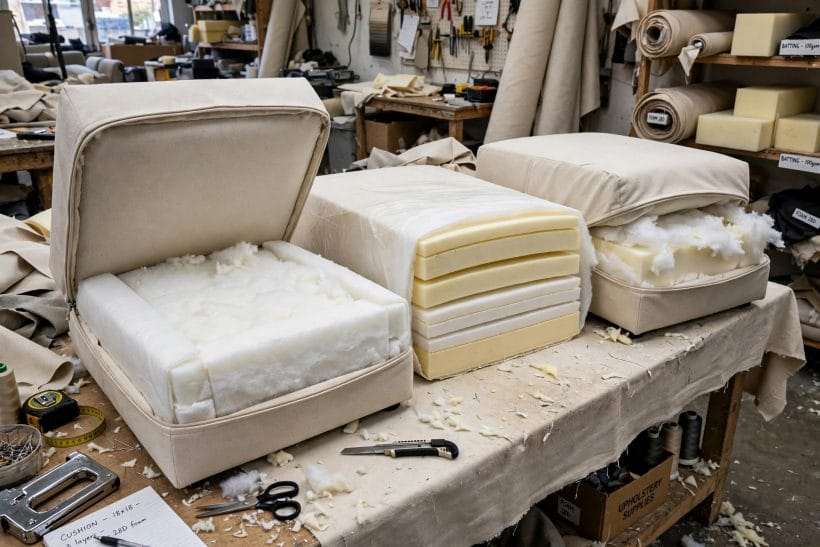
10. Foam grade is the cushion’s honest number
Cushion foam is graded by density, and density — more than initial softness — decides how long a cushion keeps its shape. Higher-density foam costs more and flattens slower; low-density foam feels lovely in the showroom and pancakes within a few seasons. Ask for the grade in writing, the way the third gallery shows the core itself: a maker using good foam is rarely shy about naming it.
11. Understand wraps and blends
Most good cushions are a sandwich: a resilient foam core for support, wrapped in fibre, feather or down blend for surface softness. Pure feather is luxurious and needs daily plumping; pure fibre is light and flattens fastest. The wrap is not a shortcut — it is how a cushion can be both supportive and soft — but the core still does the long-term work.
12. Unzip and look
If the covers unzip, open one. You should find a tidy inner liner, an even fill with no lumps or voids, and foam that springs back instantly when squeezed. The same fill logic decides whether the cushions on sofa beds for tiny houses still sleep flat after a year of folding — thin, cheap fill is always found out by use.
6. Fabric and Leather: Reading the Surface
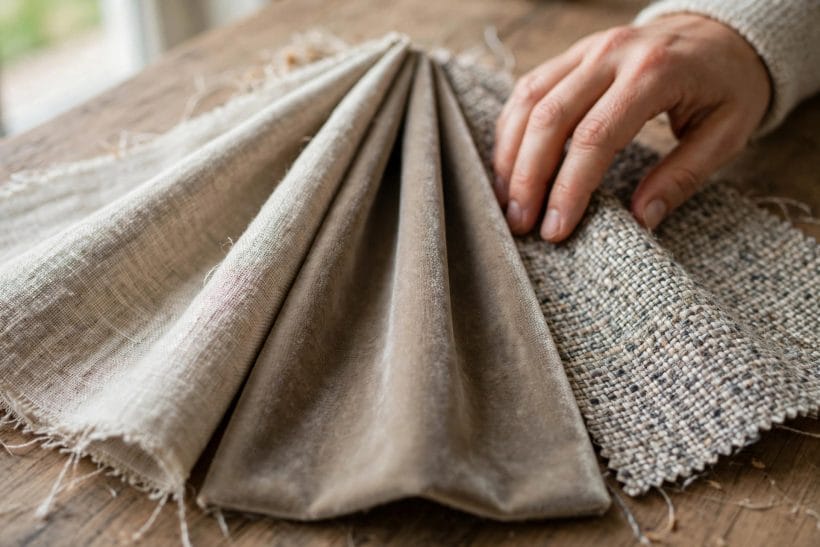
13. Test the weave with a fingernail
Run a fingernail lightly across an upholstery fabric. A tight weave barely stirs; a loose weave ripples and lets threads shift — and loose weaves snag, pill and grin through at the seams first. Hold a swatch to the light: an even, dense surface with no thin patches is what wears well on arms and seat fronts.
14. Ask about rub testing in plain terms
Upholstery fabrics are abrasion-tested, and sellers can usually state whether a cloth is graded for light, general or heavy domestic use. Match the grade to the household honestly: a rarely used guest chair and the family sofa live different lives. You do not need laboratory figures — you need the maker’s stated grade, in writing, matched to your use.
15. Leather: learn the four words
With leather, four terms tell the story: full-grain (the natural surface, ages best), top-grain (lightly corrected, still real hide), split (the lower layer, often coated) and bonded (reconstituted scraps — the economy option, and the shortest-lived). None is a scandal at the right price; all are a problem when a lower grade is described and priced as a higher one.
16. Check pattern matching
On patterned fabric, look where the pattern meets itself: across cushion seams, down the arms, around corners. Careful makers match the pattern so the design flows unbroken; sloppy ones let it jump. Pattern matching wastes fabric and takes time, which is exactly why it is such a reliable honesty signal.
7. Stitching, Seams and the Finishing Details
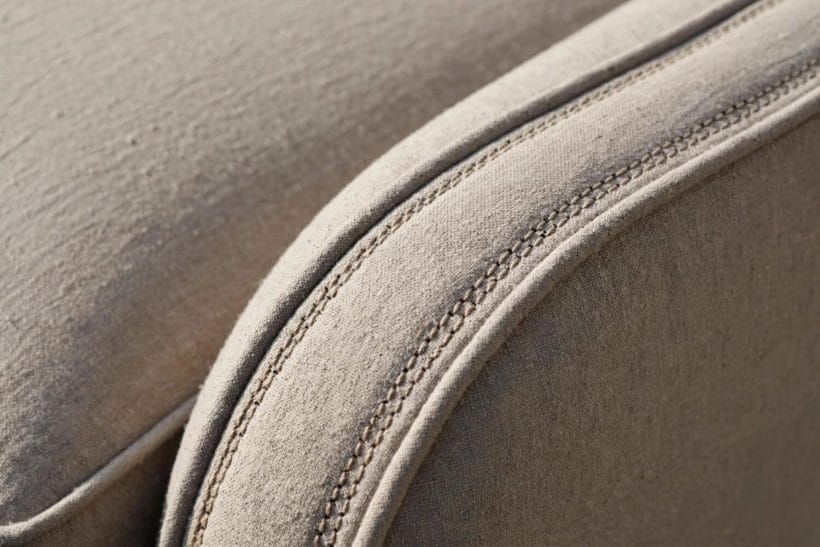
17. Count the stitches by eye
Seams should be dense and even — many small, regular stitches rather than long, widely spaced ones that gape under strain. Tug a cushion seam gently: the stitching should not open or show thread loops. The fifth gallery’s arm shows the standard to look for: two straight rows, evenly spaced, following the curve without wandering.
18. Follow the welt cords and skirts
The piped cord along a cushion edge should run straight and meet itself neatly; a wavy welt means the cover was rushed. On skirted pieces the skirt should hang level with mitred corners; on exposed-leg pieces the legs should be even, firmly fixed and finished on the underside, not left rough where only a mover will see.
19. Open it, look underneath it
Finishing honesty shows where buyers rarely look: the dust cover under the base should be intact and neatly stapled, cushion liners should be clean, and inside seams should be trimmed rather than fraying. It is the same discipline you would expect on a solid console table behind a sofa — the back and underside finished as if they would be seen.
8. The Ten-Minute Showroom Test
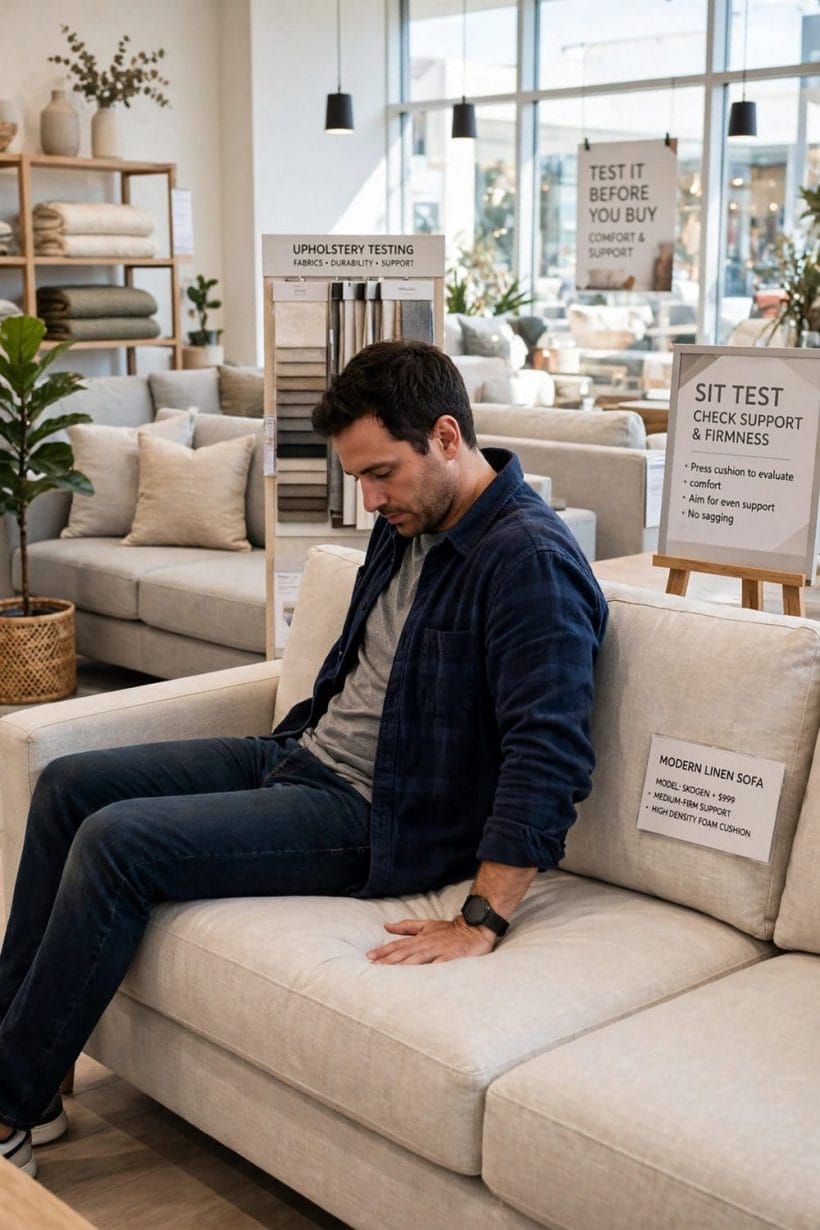
20. Sit the way you actually sit
Do not perch politely on the edge. Sit back, put your feet up if that is your habit, sprawl sideways, and stay there a few minutes. Comfort at minute ten predicts comfort at year five far better than the first thirty seconds, and your lower back will report on the suspension more honestly than any sales description.
21. Run the frame tests in sequence
Lift a front corner and watch the far leg. Rock gently and listen for creaks. Push the arms sideways — they should not wobble. Sit on one arm only if the maker welcomes it; a frame that tolerates the test without complaint is telling you its joints are mechanical, not hopeful.
22. Work the moving parts
On recliners, sofa beds and storage pieces, run the mechanism several times, not once: it should move smoothly, lock positively and show no grinding or slack. Check zips, cushion fit and any removable covers while you are there — everything that moves in the showroom will move ten thousand times at home.
9. Warranties, Labels and Buying Paperwork
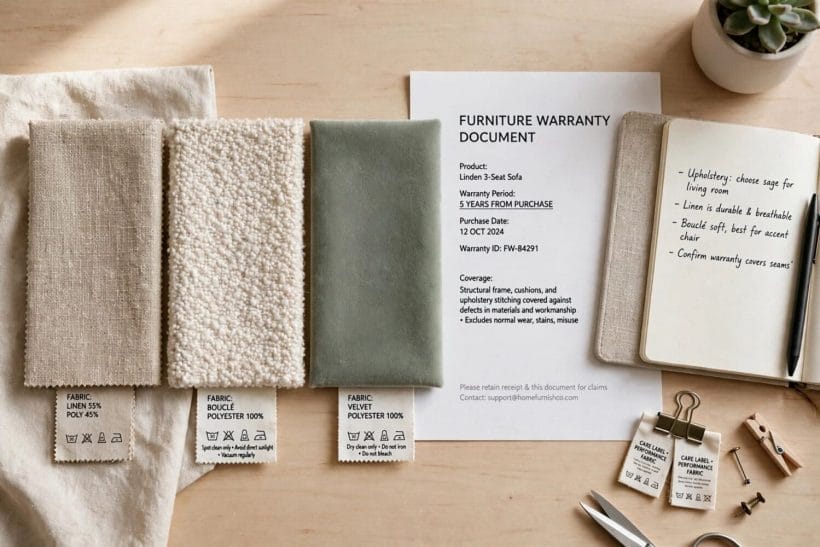
23. Read what the warranty actually covers
A long warranty on the frame and springs, with shorter cover on foam and fabric, is the normal honest pattern — frames should outlast fillings, and fillings are wear items. Be wary of the reverse: a piece warranted briefly on its structure is a maker declining to stand behind the part you cannot inspect.
24. Find the labels
Upholstered furniture carries labels stating its filling materials and care instructions; find them before purchase, photograph them, and check they match what you were told about foam and fabric content. A piece whose labels contradict its description settles the negotiation by itself.
25. Delivery and returns are part of quality
The finest frame is worthless if it arrives damaged and stays that way. Confirm delivery terms, what happens on arrival damage, and the returns window in writing before paying — the same discipline the guide to ordering home furnishings online applies to any large purchase, and the checks in buying furniture online repeat for good reason: paperwork is the part of furniture quality that protects all the others.
10. What the Money Actually Buys
Price in upholstered furniture is mostly the sum of invisible things: dense timber, joined corners, real suspension, high-grade foam, abrasion-tested fabric and the labour to finish all of it neatly. None of those show in a photograph, which is why two near-identical sofas can honestly differ so much in price — and why the checks in this guide, rather than the price tag, are the true measure.
The same checks work beyond the showroom. On second-hand and vintage pieces they are worth even more, because there is no warranty to fall back on: lift the corner, press the suspension, unzip what unzips, and read whatever label survives. A well-built older frame with tired fabric is often the best value in the room — re-covering is a known craft with a known scope, while a failed frame is simply firewood with upholstery on it.
It also means the smart purchase is rarely the cheapest or the dearest. It is the piece whose construction you have verified: frame you have lifted, springs you have pressed, foam grade you have in writing, fabric matched to your household, warranty that covers the skeleton longest. Buy the construction first and the colour second — fabric dates in a decade, but a good frame is re-coverable for a generation.
Final Considerations
Furniture quality is not a brand, a price or a review score; it is joinery, suspension, fill and finishing, all of which any buyer can check in about ten minutes with two hands and the right questions. Run the corner-lift test, press the springs, unzip a cushion, read the label, and get the frame warranty in writing. Do that, and the hidden parts of any sofa stop being hidden — which is the whole point of checking.



0 Comments