

Forget the edible kind for a moment — a real gingerbread house is a full-size Victorian home wearing its carpentry like icing: lacy vergeboards, turned spindles and paint in three colours or more.
These 11 real-life examples show the style at its best, from grand painted ladies to tiny storybook cottages, with the trim, paint and porch details that make each one work.
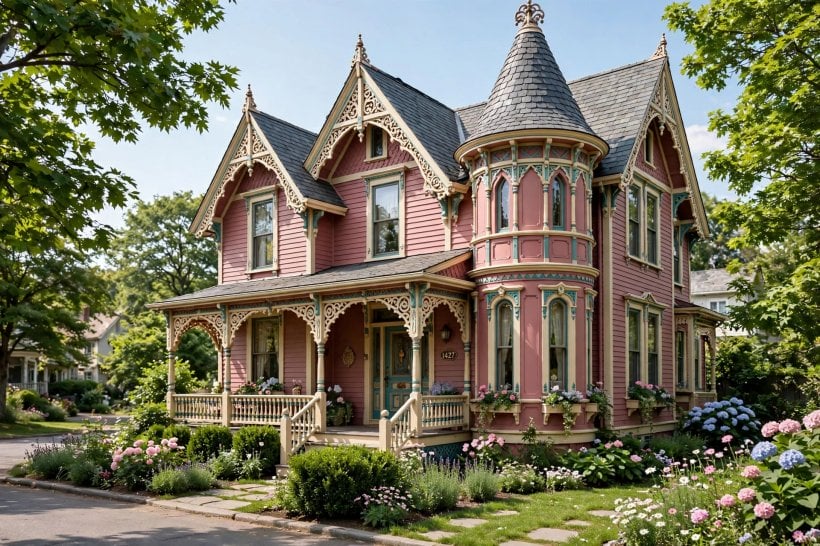
1. Gingerbread Houses at a Glance
A victorian gingerbread house is defined less by its floor plan than by its ornament. The central entity is the trim system — scroll-sawn and lathe-turned wood applied to gables, porches and eaves — supported by polychrome paint and an asymmetrical, picturesque silhouette. Cover those attributes and the house reads as gingerbread whatever its size.
| What is gingerbread trim? | Decorative woodwork — vergeboards, spindles, brackets, finials — cut with scroll saws and lathes and applied to gables, porches and eaves. |
| Which house styles wear it? | Mostly Queen Anne, Stick and late Victorian folk houses; the fanciest examples are the multi-colour “painted ladies”. |
| How many paint colours? | Three is the working minimum — body, trim and accent — and showpieces run to five or six. |
| Does size matter? | No — a small cottage with concentrated trim reads more gingerbread than a mansion with none. |
| Biggest upkeep reality? | Many small painted parts: expect a rolling cycle of inspection, repair and repainting. |
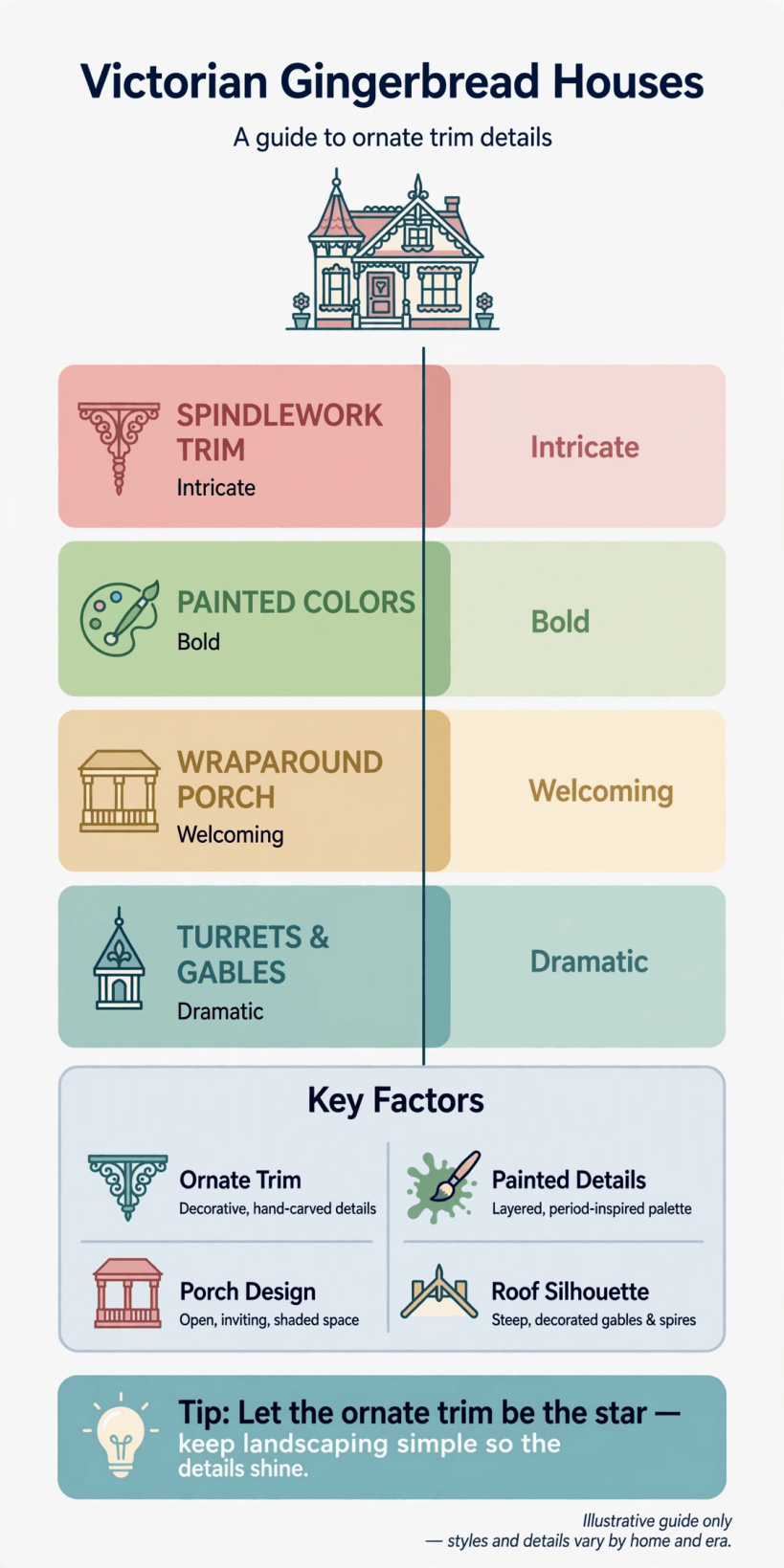
At a glance: gingerbread is a trim system plus brave paint — concentrated ornament, three colours or more, and a porch that does the welcoming.
2. What Makes a House a Gingerbread House
The name came from the resemblance to decorated gingerbread — all that piped-looking woodwork along the roof edges. Steam-powered scroll saws and lathes made the ornament cheap enough for ordinary builders in the late 1800s, and pattern books spread the designs across whole towns. The same hand-worked wood tradition is still prized in Amish-built tiny houses, where visible craft is the entire point.
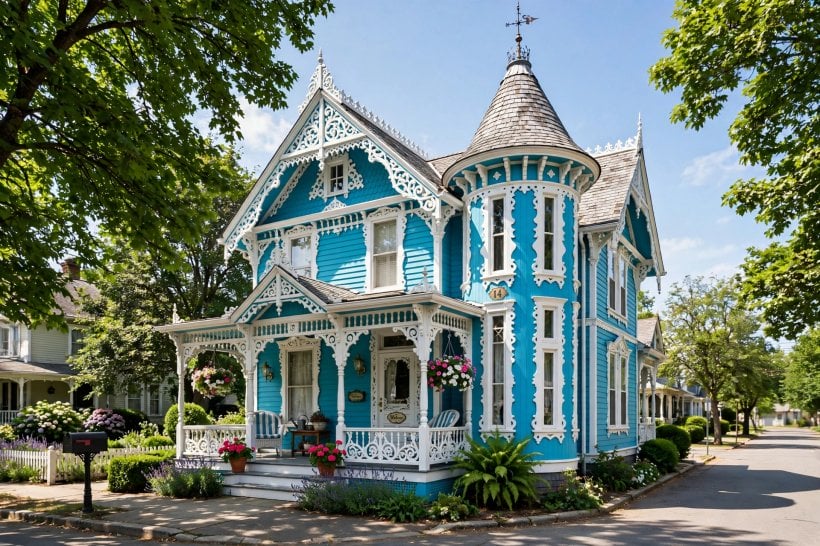
Four attributes do most of the work. Vergeboards (bargeboards) trace the gable edges with pierced or scalloped patterns. Spindlework — rows of small turned spindles — fills porch friezes and gable screens like lace. Brackets and finials punctuate posts, peaks and porch corners. And asymmetry underneath it all: crossing gables, a bay here, a turret there, so the ornament always has a varied surface to climb over. Remove the trim from a gingerbread house and a plain box remains — which is why so many were lost to mid-century “modernising”, and why survivors are treasured.
The style travelled on paper as much as on timber. Nineteenth-century pattern books sold complete house designs by post, ornament included, so the same vergeboard profiles appear in mill towns, seaside resorts and farming counties hundreds of miles apart. Railways carried the milled trim itself, which is why a gingerbread porch in one state may match its cousin three states away piece for piece. That shared vocabulary is what makes the style a system rather than a local accident: once you learn to read the vergeboards, spindles and brackets, you can date and place a gingerbread house the way you would read a dialect. It also means restoration has references — if your gable’s pattern is lost, a surviving twin probably exists in a pattern book or on a house in the next town.
3. Painted Ladies and Polychrome Showpieces
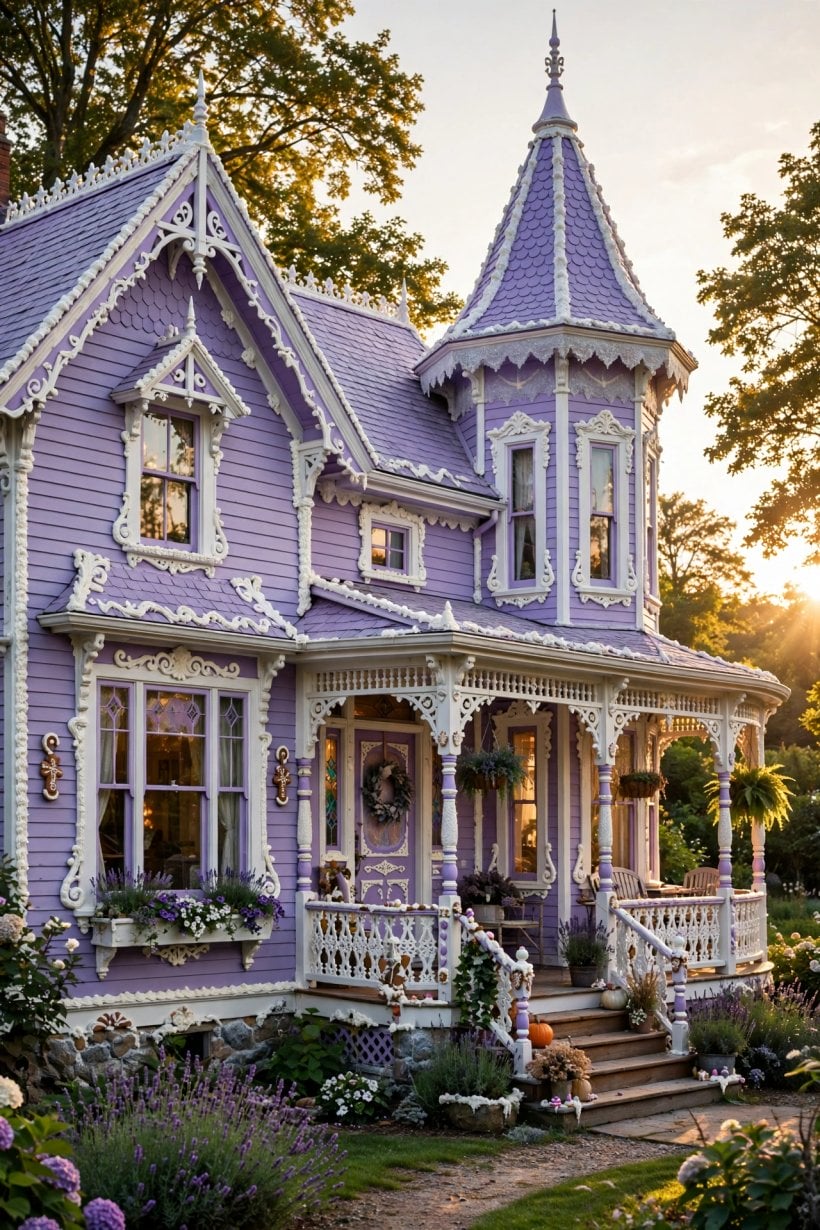
The painted lady is the gingerbread house at full volume: a large Queen Anne home where every layer of trim gets its own colour. These are the houses that stop traffic — and they only work because the architecture underneath has enough ornament to carry the palette.
1. The Row-House Painted Lady
Terraced Victorian rows in cities like San Francisco made the type famous: tall, narrow houses whose bays, cornices and stickwork are picked out in contrasting colours, each house in the row a different scheme from its neighbour. The lesson travels: on a narrow frontage, colour does the decorating.
2. The Seaside Gingerbread Cottage Colony
Resort towns such as Cape May built whole streets of small, exuberant cottages for summer visitors — steep gables, deep porches and trim painted like fairground rides. Small footprints, maximum ornament: proof that gingerbread is about concentration, not scale.
3. The Grand Queen Anne Showpiece
The biggest examples pile on every attribute at once — turret, wraparound porch, patterned shingles, stained glass and five or six paint colours. They were built to advertise a successful owner’s taste, and they still read as celebrations rather than shelters.
4. Porch-First Gingerbread Cottages
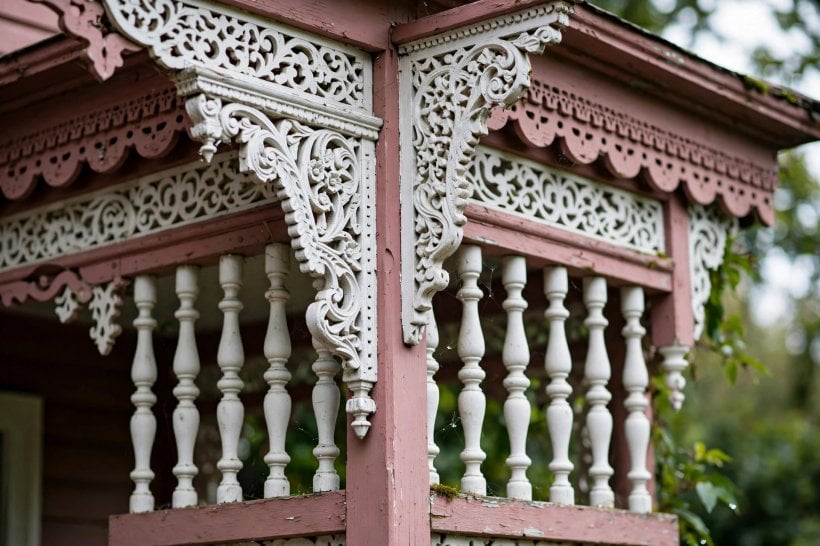
Not every gingerbread house is a showpiece. On modest cottages the ornament budget goes where life happens — the porch — and the rest of the house stays comparatively plain. Compact homes still borrow this trick, as the welcoming fronts in good home design ideas for tiny houses show.
4. The Spindle-Porch Farmhouse
A simple gabled farmhouse transformed by one rich element: a full-width porch with turned posts, a spindle frieze and brackets at every post. Body painted a single quiet colour so the porch lace casts the shadows.
5. The Wraparound Veranda House
Where the porch turns a corner, the gingerbread turns with it — continuous spindlework and a unifying trim colour wrapping two elevations. The veranda becomes outdoor rooms, and the house reads generous far beyond its floor area.
6. The Gingerbread Gable Cottage
Here the investment sits in one spectacular gable: a pierced vergeboard and sunburst panel over a plain, honest cottage. It is the most copyable formula on this list — one rich zone, everything else simple.
5. Towers, Turrets and Queen Anne Drama

The turret is the gingerbread house’s crown — a round or polygonal tower, usually with a conical roof, that turns a corner into a landmark. Houses with turrets tend to collect the full ornament set, because a plain wall under a turret would look unfinished.
7. The Corner-Turret Queen Anne
The classic composition: turret at the front corner, porch sweeping around it, gables crossing behind. Tall narrow windows follow the turret’s curve or facets, and the conical cap gets a finial like a full stop.
8. The Stick-Style Gingerbread
Before full Queen Anne exuberance, the Stick style applied its ornament as flat, angular boards — diagonal braces, grid-like stickwork over the porch and gables. It reads as gingerbread’s graphic, linear cousin, and suits owners who want pattern without lace.
6. Small Storybook Cottages and Tiny Takes
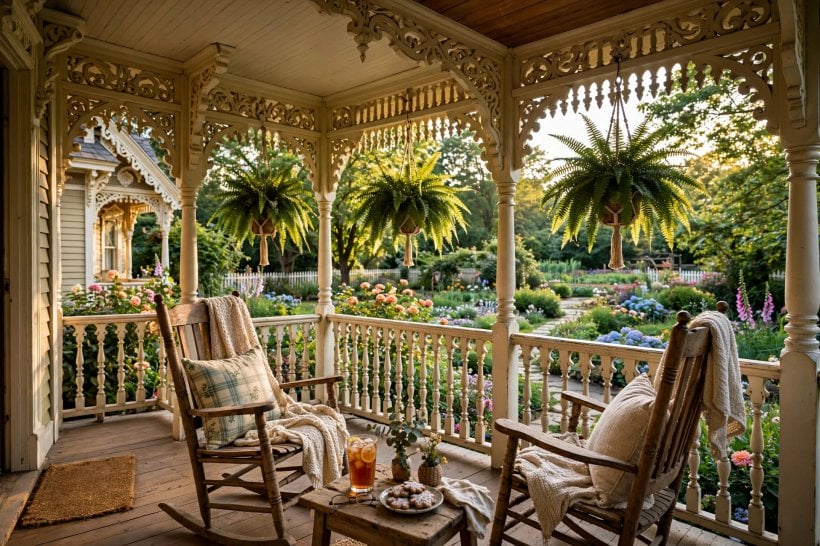
Gingerbread scales down beautifully, because the style was always about applied detail rather than expensive structure. These small examples are the most relevant to tiny-house readers — the ornament budget of a cottage buys a transformation that a big house would need scaffolding to achieve.
9. The Storybook Cottage
Steep roof, tiny porch, one lacy gable and a picket fence: the storybook cottage is the gingerbread idea distilled. Paint does half the work — a coloured door, white trim against a soft body colour — and a climbing rose finishes the picture.
10. The Gingerbread Tiny House on Wheels
Builders of tiny house designs on wheels borrow the vocabulary in miniature: a small vergeboard on the gable end, turned porch posts on a pocket deck, and a two- or three-colour scheme. Kept light and few, the pieces survive road travel and give a tiny home instant character.
11. The Garden Gingerbread Shed and Guest Cottage
The lowest-risk way to own the style: dress a garden studio, shed or guest cottage. Ornament mistakes are cheap at this scale, and a gingerbread garden building makes the main house look calmer by contrast.
7. Paint Colour: The Three-Colour Rule and Braver Schemes
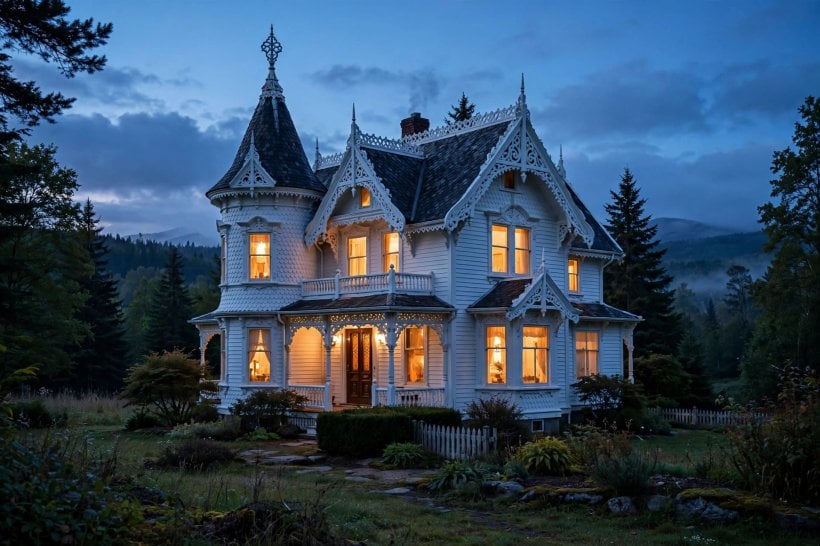
Colour is not decoration added to a gingerbread house; it is how the trim becomes visible. The working rule is a minimum of three: a body colour for the main walls, a trim colour (usually the lightest) for vergeboards, corner boards and window frames, and an accent for spindles, brackets, doors and the porch ceiling’s companions. Showpieces add a fourth and fifth for shingle bands and porch floors.
Two disciplines keep a brave scheme handsome rather than chaotic. First, the trim colour must contrast clearly with the body, or the lace disappears at street distance. Second, the brightest colour goes on the smallest area — a door, a row of spindles — so it sparks rather than shouts. Owners planning a scheme will find the same palette logic in these new home exterior design ideas, where colour is placed to outline architecture instead of covering it.
8. Trim Materials and Restoration Checks
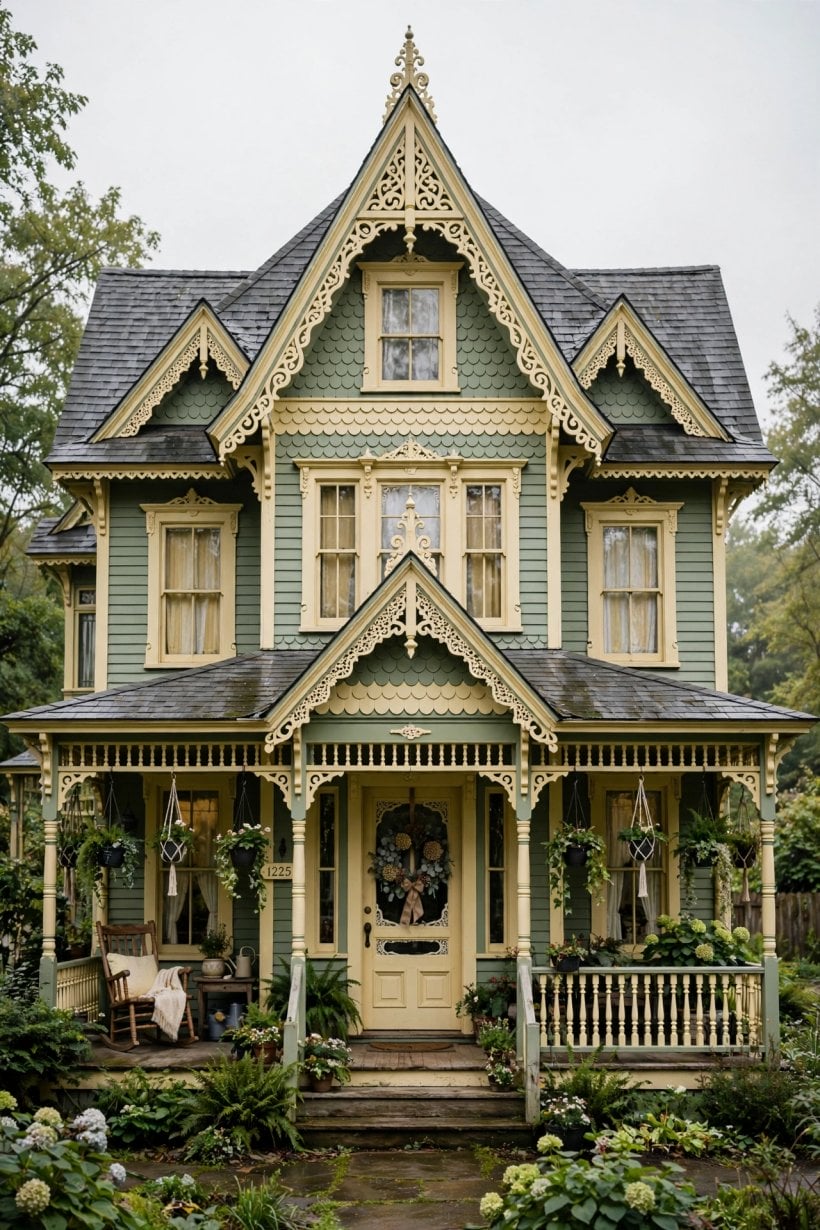
Original gingerbread is wood, and wood at roof edges lives a hard life. Before buying — or before repainting — check the pieces in this order: vergeboard ends and finials (end grain drinks water and rots first), porch post bases, spindle friezes where they trap leaves against the beam, and any place a later owner “repaired” with filler over soft timber. Sound original trim is worth consolidating and keeping; the profiles are rarely matched by modern stock.
Where pieces are beyond saving, replacements can be cut from the surviving pattern by a millwork shop, or substituted with cellular PVC and composite replicas that saw and paint like wood and shrug off the wettest exposures. On the most visible elevations — the street gable, the porch — real wood or faithful replicas matter most; high, distant pieces are where substitutes go unnoticed. The craftsmanship-first approach in constructing a tiny stone cottage makes the same point in another material: original fabric first, honest replacements where needed.
9. Borrowing the Look on a Small or Modern Home
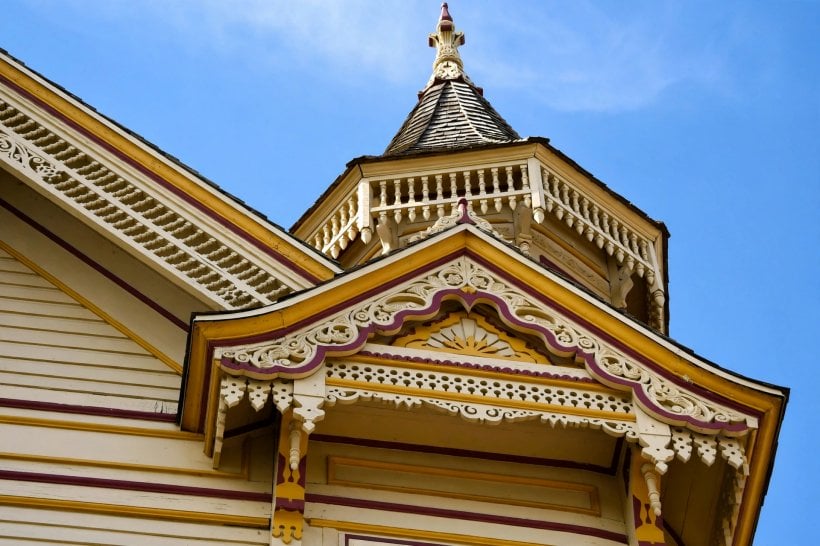
You do not need a Victorian house to borrow from these 11 examples — you need dosage control. One gingerbread element, well made and well painted, reads as charm; five read as costume. The reliable borrowings: a decorated vergeboard on a single gable, turned posts on a new porch, a spindle frieze under a porch beam, or simply the three-colour paint discipline applied to plain trim. Each works on cottages, cabins and tiny homes because each is a surface treatment, not a structure.
What to avoid: mixing gingerbread with competing ornament languages (rustic logs plus lace, or minimalist black steel plus spindles), and scattering small pieces evenly over every wall. The originals concentrated their ornament — gable, porch, eaves — and left plain walls plain. Copy the concentration and even a modest borrowing lands. Readers weighing a full house style will find useful contrast in monster house designs, where scale rather than ornament does the showing off.
10. Costs, Upkeep and What to Check Before Buying One
Gingerbread houses carry their costs in maintenance rather than purchase complexity. The drivers are qualitative: the sheer count of small painted parts, the height and steepness of the gables (access and scaffolding), the condition of the timber under the paint, and how much ornament a previous owner removed or let rot. A plain house is one repaint; a gingerbread house is a hundred small ones, and budgets should assume a rolling programme — one elevation a year is the owner’s classic rhythm.
Upkeep has a rhythm worth learning from long-term owners. Paint fails first on horizontal surfaces and south- and west-facing trim, so inspections start there, ideally every spring: probe finials and vergeboard ends with a screwdriver, clear leaves from spindle friezes before winter, and touch up bare wood within the season rather than the year. Kept on that rhythm, gingerbread maintenance is a series of small, cheap acts. Deferred for a decade, it becomes the scaffolding-and-carpentry project that gives these houses their expensive reputation. The houses on this list that look effortlessly crisp are not lower-maintenance — they are simply maintained little and often.
Before buying, check four things.
Consent rules: many gingerbread streets sit in historic districts that regulate colours, materials and porch changes — confirm before planning. Trim condition per the checks in section 8. Removal history: houses stripped of porches or trim lose both character and value story, and restoring them costs far more than maintaining survivors. Insurance and trades: ornate older homes need insurers and carpenters comfortable with period construction. None of this should scare a willing owner — it should simply be priced into the decision, the way whole-build costs are broken down in the tiny house cost breakdown.
Final Considerations
The 11 houses on this list agree on one thing: gingerbread is a system, not a garnish — concentrated trim, three-colour paint, an asymmetrical silhouette and a porch that welcomes. Get those four attributes working together and any house, from a row-house painted lady to a tiny cottage on wheels, earns the name.
And the style rewards keepers. Most gingerbread was lost to removal, not decay: every stripped vergeboard and boxed-in porch is character that costs ten times more to restore than to maintain. If you own one, paint it bravely and repair it patiently. If you borrow from one, borrow the discipline — one rich zone, honestly made — and the charm comes with it.

0 Comments