
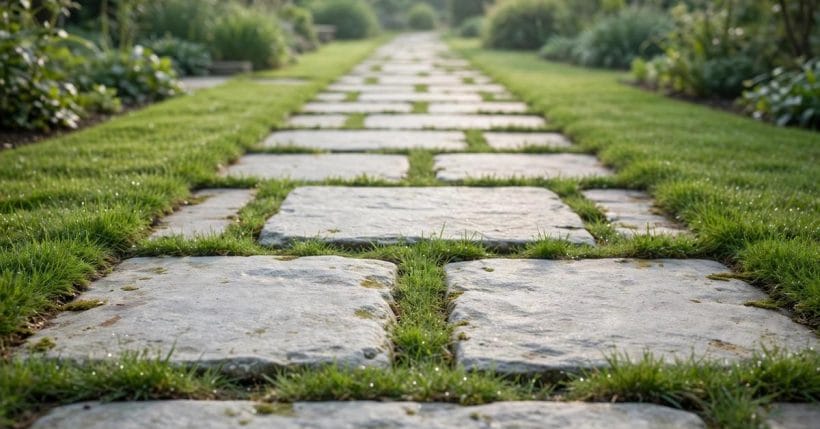
Step off a hard stone path and onto one softened by grass, and the whole garden feels different. The stone stays firm underfoot, but green lines between the slabs turn a plain surface into something alive.
This guide stays with those green lines, the joints themselves, and walks through layouts, colours and everyday care.
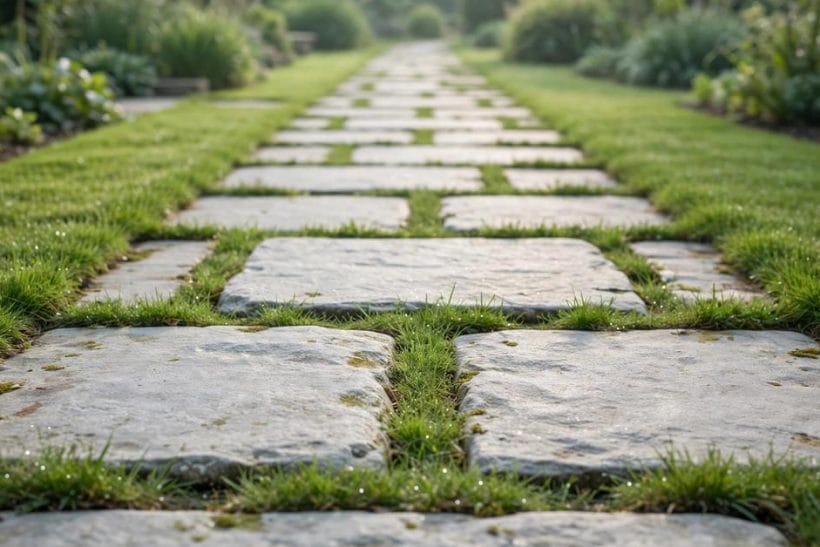
1. Start With the Joint, Not the Stone
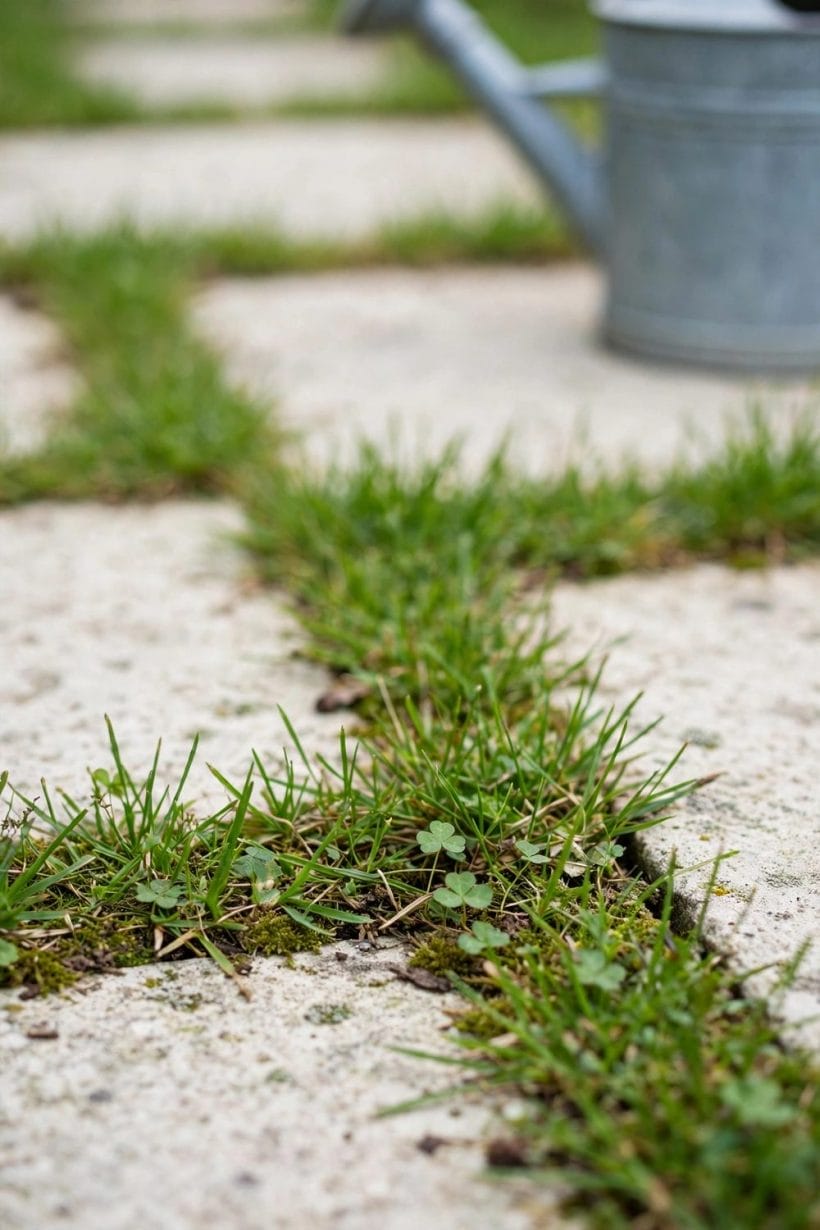
The subject here is grass pavers in one narrow sense: the living joints between stones, rather than the path as a whole. That distinction matters, because a path can be well laid and still look harsh if its joints are bare, dusty or choked with weeds, while a modest path can look generous when its joints are green, even and calm. Everything in this guide therefore looks at the gaps first: how wide they read, how the grass sits in them, how they meet the lawn at the edges, and how they behave through the seasons.
The wider question of walkway form, pattern and layout belongs to its own guide, and readers who want that broader view will find it in the companion post on paver walkway layouts. Here, the stone is treated as the frame and the grass as the subject. Think of each joint as a thin garden bed in its own right, one that happens to be walked on, and many of the choices that follow become easier: choose for the joint, and let the stone support it, rather than choosing a dramatic stone and hoping the joints look after themselves.
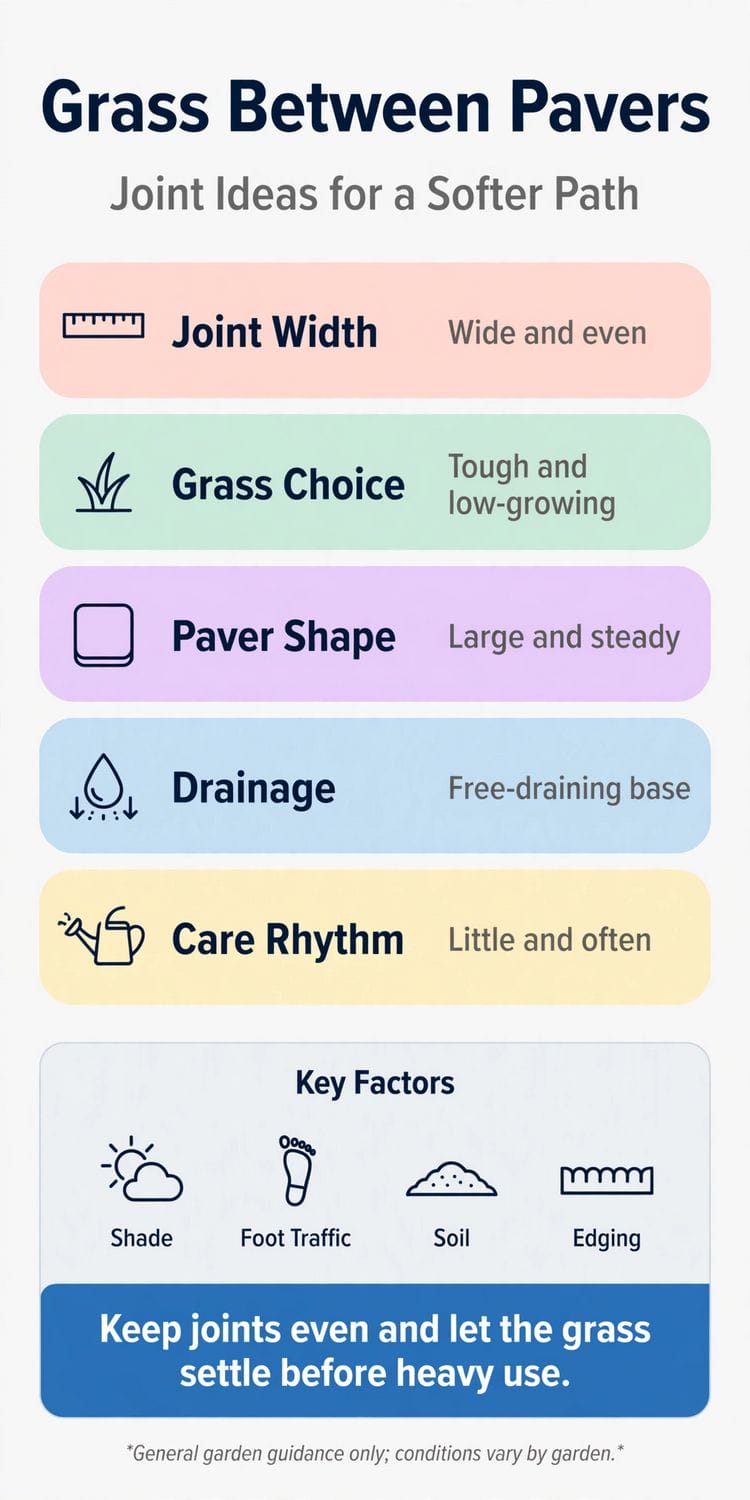
| At a Glance | Grass Joints at a Glance |
|---|---|
| First decision | Joint character before stone pattern |
| Joint feel | Wide and even, or tight and neat |
| Grass role | Soft green lines, not a lawn |
| Colour note | Stone tone against living green |
| Care rhythm | Little and often, by season |
| When unsure | Ask a local garden adviser |
It helps to begin by looking, not by digging. Walk the garden slowly and notice where grass already thrives: the sunny strip by the fence, the cooler corner under the tree, the patch that stays green longest after rain. Those observations say a great deal about where grass joints are likely to settle happily and where they may struggle. A joint that sits in a place where grass already grows well has a natural advantage, while a joint in deep, permanent shade or on a slope that dries fast may need more patience and more regular attention, and may still stay thinner than the rest.
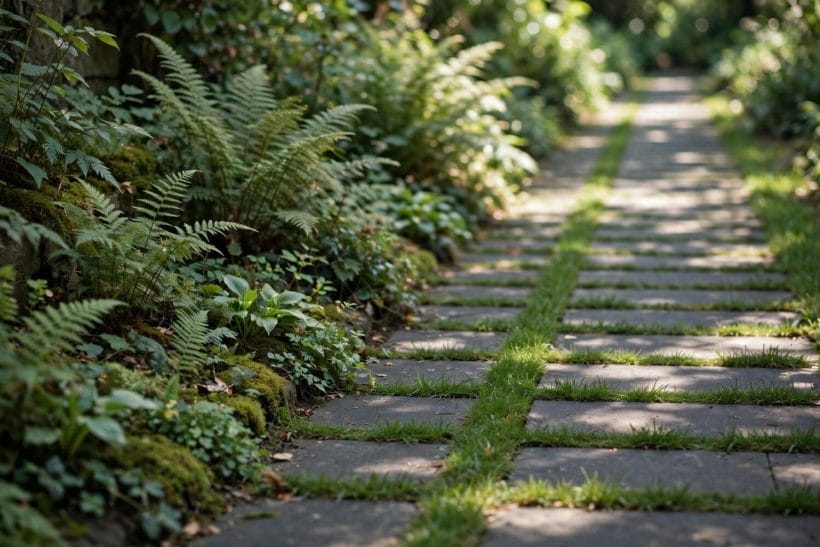
Colour is the second thing to notice before any work begins. Grey stone against fresh green reads cool and quiet. Pale, sandy stone against green reads warm and relaxed. Dark stone makes the green lines look brighter by contrast, almost as if the path were drawn with a green pen. None of these readings is right or wrong; they are moods, and the right one is the one that suits the house and the planting around it. A small sample area, even a few stones laid loosely on the ground with grass left between them, can show the mood far better than any description.
2. Wide, Even Joints for a Calm Look
Wide, even joints give a path its calmest expression. The eye travels along broad green lines rather than jumping from stone to stone, and the whole surface reads as a garden feature instead of a paved area with grass in the cracks. Evenness matters more than width itself: joints of similar character from one end of the path to the other create a rhythm that feels intentional, while joints that vary wildly can make the same path look unfinished, even when the stones are beautifully chosen.
The practical trade-off of a wide joint is that it asks more of the grass. A broad band of green has more surface to dry out in a hot spell, more edge to trim where it meets the stone, and more room for stray seedlings to settle. Gardeners who enjoy that kind of gentle, regular attention often love wide joints for exactly this reason: the path rewards a little care visibly, greening up evenly after rain and holding a soft, consistent line through the growing season. Gardeners who prefer a path that largely looks after itself may find a slightly tighter joint less demanding, and that is a perfectly reasonable preference to honour.
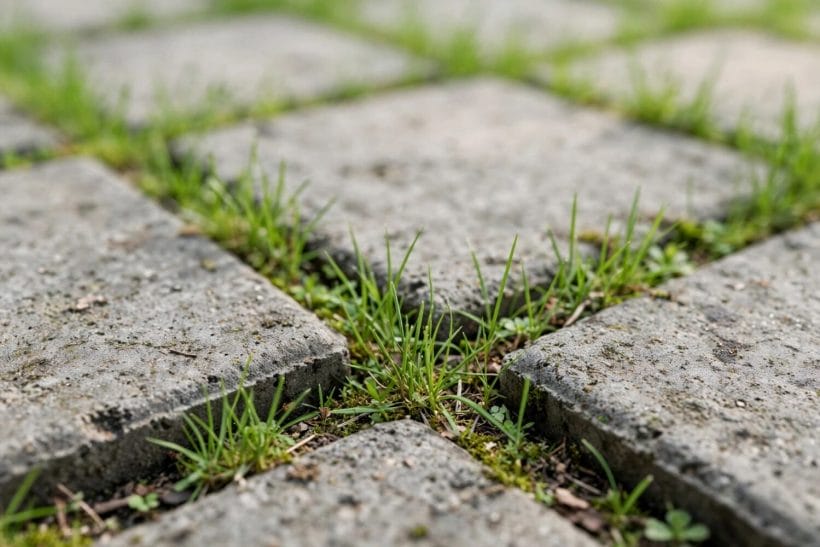
Edging is what makes wide joints succeed. Where the path meets the lawn, a clean, firm edge stops the lawn grass and the joint grass from blurring into one another, and it keeps the green lines readable as lines rather than as a general wash of green. The edge need not be elaborate; a simple, steady boundary in stone, timber or metal, kept clear of overgrowth, does the work. Check the edges when you check the joints, because a tidy edge can rescue a joint that is having a thin season, while a ragged edge can make even healthy joints look neglected.
One more quiet advantage of wide joints is forgiveness. A stone that settles slightly, or a joint that thins in one place, shows less dramatically when the green bands are generous, because the eye reads the overall pattern rather than hunting for faults. That forgiveness is not a substitute for a sound base beneath the stones, which is work for a professional where the ground is uneven or drainage is in question, but it does mean that small seasonal changes need not spoil the effect. Watch the joints across a full year before judging them; a pattern that looks thin in one season may fill in beautifully in the next.
3. Narrow Joints for a Tighter Pattern
Narrow joints offer a different character altogether: tighter, neater, more architectural. Here the stone dominates and the grass appears as a fine green tracery, a detail rather than a feature. This suits gardens where the planting is already lush and the path is meant to be a quiet passage rather than a star, and it suits small gardens especially well, because a tight pattern keeps a compact space feeling ordered instead of busy.
The care of narrow joints is subtler. There is less grass to look at, so any bare patch shows quickly, and trimming needs a lighter hand, since an enthusiastic cut can scalp a thin line of grass down to the soil. On the other hand, narrow joints dry out less visibly and tend to hold their line well under foot traffic, because the stones carry most of the wear and the grass sits protected between them. In a busy passage, such as the route from a gate to a door, that protection can be the deciding factor in favour of a tighter joint.
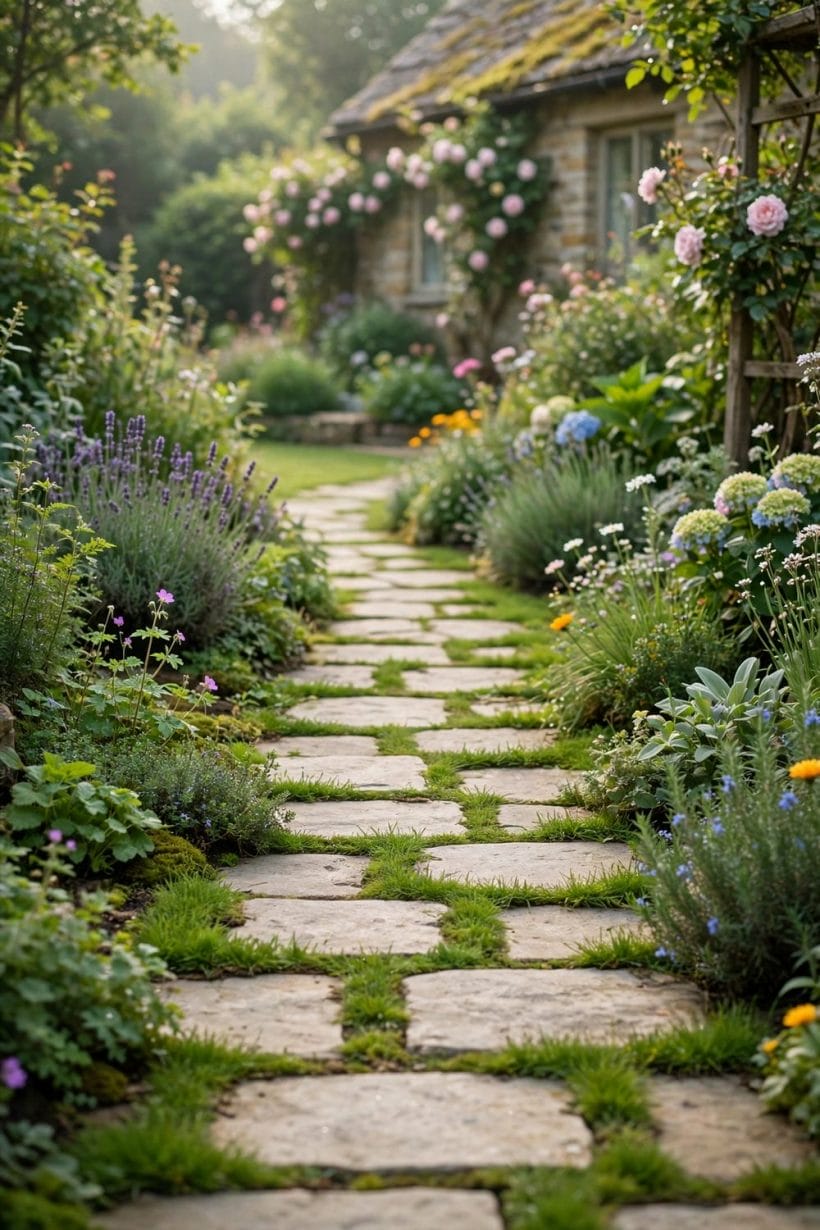
Colour behaves differently at this scale too. With narrow joints, the stone colour leads and the green acts as an accent, so a strongly coloured or richly textured stone can carry the design while the grass quietly softens its edges. With wide joints, the balance reverses and the green leads. Neither balance is better in the abstract; the question is simply which one the garden needs. A garden full of colour and movement may welcome the restraint of narrow joints, while a garden of plain walls and simple planting may come alive with broader green lines.
If you are choosing between wide and narrow, try living with both for a while. Lay a short trial stretch of each, or simply study paths in neighbouring gardens and public spaces, and notice which one your eye returns to. The right joint width is often the one you stop noticing because it feels inevitable, and that feeling is worth more than any rule of thumb. Joints that feel inevitable tend to be the ones that still please years later, when fashions have moved on.
4. Large Slabs With Generous Grass Lines
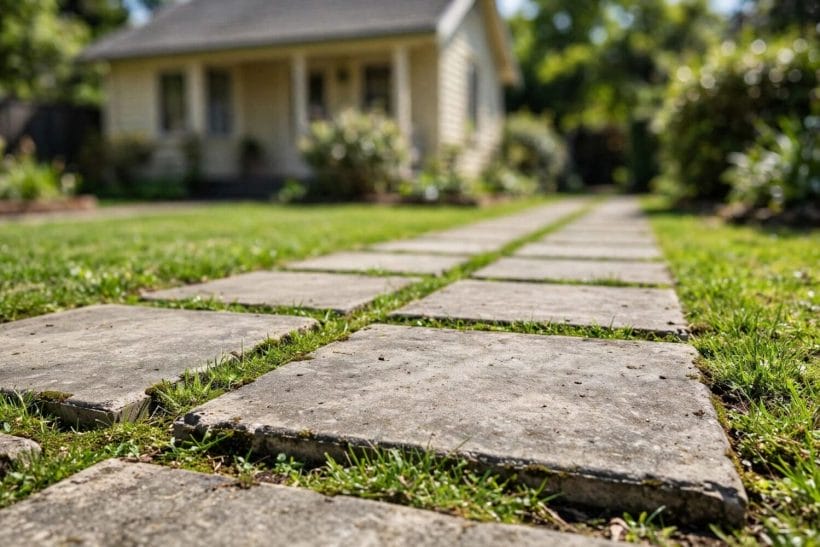
Large slabs paired with generous grass lines create the most relaxed version of this idea. Each stone reads as a solid, calm surface, and the grass lines between them act like the leading in a window, holding the composition together without competing with it. This is the look most people picture when they imagine grass between pavers: unhurried, generous, and quietly confident, with plenty of green to soften the stone.
Scale is the thing to watch. Large slabs suit broad paths and open garden areas, where their size feels proportionate to the space around them. In a narrow passage, the same slabs can feel oversized and the joints can look like an afterthought squeezed between giants. As a rough guide for the eye, though never as a measurement to build to, the joint should look like a deliberate part of the design at a glance, not like a gap that was left by accident. If you have to step back and squint to see whether the green is intentional, the balance probably needs adjusting.
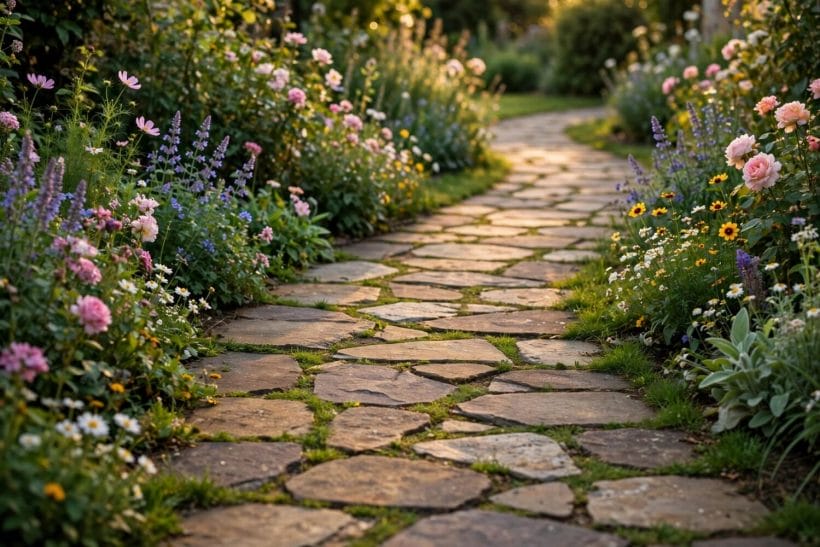
Large slabs also change how the path feels underfoot. The stride settles into a comfortable rhythm, stone, grass, stone, grass, and the walk becomes part of the garden experience rather than a mere route through it. That rhythm is one reason this pattern photographs so well and lingers in the memory: it invites a slower pace. Where the path is used for hurrying, for wheelbarrows or for frequent coming and going, that slower rhythm is still pleasant, but the joints will see more wear, and a little extra patience during the settling period will pay off.
Planting around large-slab paths should stay simple. Low, soft plants that echo the green of the joints will harmonise without competing, while tall or sprawling plants can crowd the path and drop debris into the joints. Keep the borders trimmed back so the full width of the path stays usable, and let the grass lines do the decorative work. Simplicity around a generous pattern is not emptiness; it is what allows the pattern to breathe.
5. Irregular Stones and Soft, Wandering Joints
Irregular stones bring a cottage-garden spirit to grass joints. No two joints are quite alike: some run straight for a stretch, others curve around a stone corner, and the grass follows those wanderings like a stream finding its way. The result feels found rather than made, as though the path grew where people happened to walk, and that informality suits older houses, woodland edges and gardens that favour a natural, unmanicured mood.
The charm of wandering joints comes with a particular care need: they are harder to trim neatly, because the line to follow keeps changing direction. A small, light trimmer used gently, or hand shears for the fiddliest corners, will keep the grass tidy without cutting into the soil. The goal is not a razor edge but a soft, consistent height, so that the grass reads as a cared-for part of the garden rather than as something that escaped from the lawn. A little unevenness is part of the character here and should be enjoyed, not corrected out of existence.
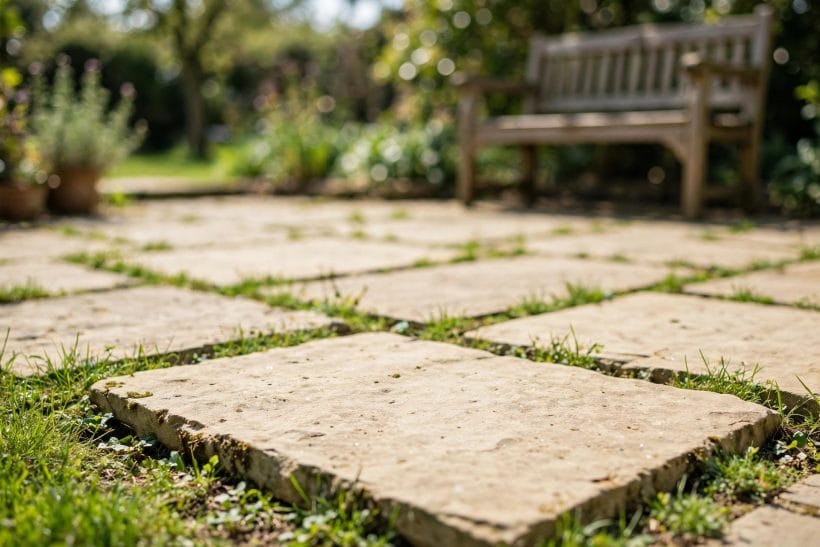
Colour in an irregular-stone path tends to be varied, since natural stone carries its own tones and weather markings, and the grass provides the one consistent colour that ties the whole surface together. That unifying role is worth remembering when choosing surrounding plants: a jumble of competing colours in the borders can fight with the varied stone, while a restrained palette lets the green joints do their quiet work of holding everything together. Greens, soft whites and a single accent colour will usually harmonise better than a riot of hues.
Irregular joints also suit gardens where the ground is not perfectly level, because the wandering pattern disguises small changes in a way that a strict grid cannot. That is an aesthetic advantage, not a structural one: any path that must carry weight, drain properly or stay safe underfoot still needs a properly prepared base, and that preparation belongs to a professional where the ground is soft, sloping or poorly drained. Once the base is sound, the wandering joints on top can be enjoyed for their informality without worry.
6. Stepping Stones With Grass All Around
Stepping stones take the joint idea to its loosest form. Instead of a continuous surface with grass in the gaps, the grass becomes the ground itself and the stones sit within it like islands. This is the most garden-like version of the theme, and it suits lawns, meadow edges and informal routes where the journey matters more than the surface. The eye reads green first and stone second, which reverses the usual hierarchy of a path entirely.
Spacing is everything with stepping stones, and it is best judged by walking, not by measuring. A comfortable stride from stone to stone, tested by several people of different heights, will reveal more than any plan on paper. Stones placed too far apart force an awkward stretch, while stones placed too close together lose their stepping character and start to read as a broken pavement. Walk the route in both directions, and in damp weather too, because a stone that feels secure when dry may feel less certain when wet.
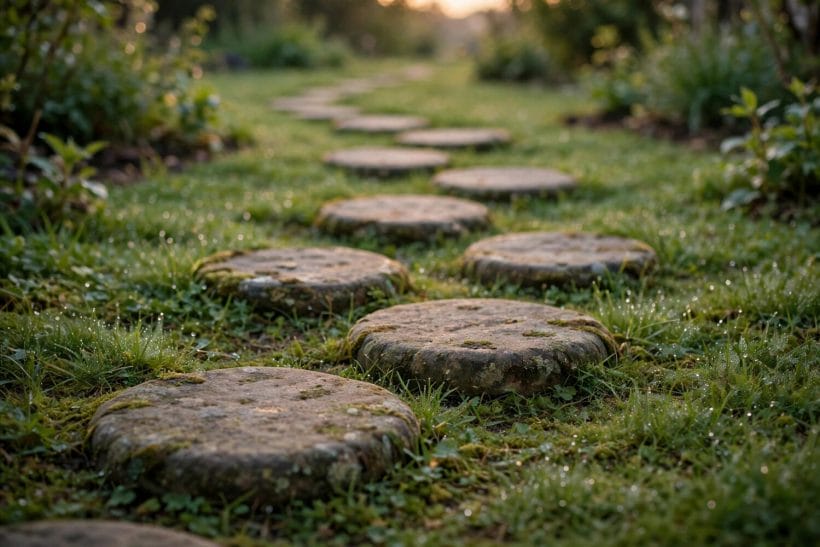
Care for stepping-stone grass is largely the care of the lawn around it, with one extra task: keeping the grass from creeping over the stones. Left unchecked, vigorous grass will gradually bury the edges of each stone, narrowing the usable surface and softening the design until it disappears. A regular trim around each stone, little and often, holds the line. It is a small job, but it is the job that keeps the whole idea legible, so it is worth building into the ordinary garden routine rather than leaving it for an annual blitz.
Stepping stones also offer a gentle way to test the grass-joint idea before committing to a full path. A short run of stones across a lawn shows how grass behaves underfoot in that particular garden, how quickly it recovers after wear, and how the household actually uses the route. If the trial run thrives and still pleases after a full growing season, a larger grass-joint path is a much safer next step than it would have been on enthusiasm alone.
7. Grass Joints Beside Planting
A grass-joint path never stands alone; the planting beside it shapes how the joints look and how they grow. Low shrubs with bold foliage can frame the path beautifully, and a guide to purple-leaf shrubs shows how foliage colour beside a path can deepen the green of the joints by contrast. The principle is simple: planting that echoes or contrasts with the joint grass, without overwhelming it, makes the whole composition feel considered.
Planting also affects the joints physically. Shrubs and perennials drop leaves and petals into the joints, shade them in summer, and compete for water at the edges. None of that is a reason to avoid planting beside a path; it is a reason to choose neighbours thoughtfully and to keep a clear margin between the border and the first joint, so that fallen material can be swept away easily and the edge of the path stays visible. A path that disappears under its borders may look romantic in a photograph, but it is less pleasant to walk on.
Drier planting schemes have their own relationship with grass joints. A cactus garden planting approach nearby, for example, reminds the gardener that not every plant wants the same water as joint grass, and that grouping plants by their needs is kinder than forcing one watering regime on everything. Where a dry bed sits beside a grass-joint path, a clear edging between the two keeps their different needs separate, and the contrast between spiky, dry planting and soft green joints can be very attractive in its own right.
Finally, remember that planting grows. A small shrub beside a new path may, in a few years, overhang the joints, shade them heavily and drop far more debris than it did at planting time. Choosing plants with their mature size in mind, and pruning them back before they swallow the path edge, will protect the joints far more effectively than any amount of later rescue work. The path and its planting are one composition, and they should be planned, and pruned, together.
8. Joints in Sun and Shade
Light is the single greatest influence on how grass joints behave, and it varies more across one garden than most people expect. A south-facing stretch may bake in summer and stay thin no matter how much care it receives, while a shaded stretch under trees may stay lush and cool but grow slowly and recover slowly from wear. Neither condition is a failure; both are information, and the wisest response is often to accept the difference rather than fight it, letting sunny joints read a little paler and shaded joints a little softer.
Shade deserves particular attention, because it changes more than light levels. Tree shade brings leaf fall, root competition and drip lines that keep some joints wetter than others, and the grass under a canopy will rarely match the grass in the open. That patchiness can still be beautiful, especially in a woodland-style garden where variation feels natural, but it will not match the uniform look of a sunny, open path. Setting expectations to the garden you have, rather than to a picture of a garden elsewhere, is the kindest thing a gardener can do for a shaded path.
Plant choice near joints also needs a moment of caution. Before allowing any vigorous spreader to settle beside a path, it is worth reading up on what invasive plant labels mean, because a plant that races across a border will not stop at a path edge, and a joint full of an unwanted guest is far harder to clear than a border full of one. The rule is simple and general: know what you are planting, know how it spreads, and keep anything with a wandering habit well away from the joints unless you are prepared to manage it.
Containers offer a flexible way to dress a grass-joint path without disturbing the joints themselves. A few pots beside the path can add seasonal colour, scent or height, and they can be moved when the light changes or when the path needs attention. Ideas for container garden ideas translate well to path edges, where a pot can mark a turn, frame a step or soften a corner. Keep pots clear of the joints themselves, so that water draining from them does not constantly soak one joint while its neighbours stay dry.
9. Keeping Joints Neat Through the Seasons
Seasonal care for grass joints is best thought of as a rhythm rather than a rescue. Through the growing season, the ordinary tasks are trimming the grass to a soft, consistent height, sweeping fallen leaves and debris out of the joints before they mat down, and watching for thin or worn patches while they are still small. None of these tasks is dramatic, and that is the point: joints kept up little and often rarely need dramatic intervention, while joints ignored for a season can take much longer to recover.
Wear deserves honest attention. Every path has a wear pattern, usually a slightly thinner line where feet naturally fall, and grass joints will show that pattern before the stones do. Rotating nothing, since a path cannot be rotated, the practical responses are patience, allowing rest periods where possible, and accepting a degree of wear as part of a living surface. A joint that wears thin in the busiest spot is not a failed joint; it is a joint telling the truth about how the garden is used, and a path that shows its use honestly often feels more welcoming than one kept pristine at all costs.
Patching thin joints is straightforward in principle: fresh seed or young plants suited to the local area, pressed gently into the joint, watered kindly and protected from heavy use while they settle. For gardeners ordering material for this kind of repair, a guide to ordering seeds and plants online covers the checks worth making before an order, such as confirming suitability for local conditions and reading descriptions carefully. Local nurseries can offer the same advice in person, and their knowledge of what thrives nearby is often the most valuable input of all.
Cost, where it arises, tends to follow a few general drivers rather than any single item: the overall area of the path, the size and character of the stone, the edging chosen, the preparation of the ground beneath, and the ongoing care the joints will need. None of those drivers can be priced honestly in general terms, because every garden differs, so this guide deliberately quotes no figures. A local professional or supplier, shown the actual garden, can give a realistic sense of what a particular project involves, and that conversation is worth having before work begins rather than after. For the wider picture of how a path sits in the garden as a whole, backyard landscaping ideas offer useful context on balancing paths, planting and open space.
10. When Grass Joints May Not Suit Your Garden
Honesty requires saying that grass joints do not suit every garden. A path that carries constant heavy traffic, such as the main route for bins, bikes or a busy household entrance, will wear its joints faster than a quiet garden walk, and the grass may never quite recover between passages. Similarly, a garden in deep, permanent shade, or one where the ground stays waterlogged for long stretches, may support only thin, patchy growth in its joints no matter how carefully they are tended. Recognising those limits early saves disappointment later.
Drainage and ground preparation are the two areas where professional help matters most. If water pools on the path, if the ground feels soft underfoot, or if the site slopes in a way that sends water across the joints, those are questions for a qualified landscaper or drainage professional, not for trial and error. A sound, free-draining base protects both the stones and the grass, and it is far easier to establish before a path is built than to retrofit afterwards. The same applies to any structural work, such as retaining edges or steps: build the structure properly, and the grass joints on top will have a fair chance.
There is also a temperament question, and it is worth asking honestly. Grass joints reward gardeners who enjoy regular, gentle attention and who find pleasure in small seasonal changes. Gardeners who prefer surfaces that can be left entirely alone for long stretches may be happier with a fully paved or gravelled path, and that preference is not a failing; it is useful self-knowledge. A path should fit the life lived around it, not demand a life reorganised around the path.
None of this diminishes the idea. In the right garden, with realistic expectations and a little regular care, grass joints offer something no fully hard surface can: a path that changes with the seasons, softens the hardest lines of a garden, and reminds everyone who walks it that a garden is a living place. The test is not whether the joints look perfect, but whether they still please after a full year of weather, wear and ordinary life.
Final Considerations
Grass between pavers succeeds when the joints are treated as the design, not as an afterthought. Choose a joint character that suits the garden, wide and calm or tight and neat, large slabs or wandering stones, stepping islands or a continuous green line. Match the planting beside the path to the joints, respect sun and shade, keep up the small seasonal tasks, and accept wear as part of a living surface.
Above all, let the garden have the last word. Watch where grass already thrives, ask local advisers about what suits the area, and give a new path a full year before judging it. A path whose joints green up after rain, soften the stone underfoot and still invite a slower walk is doing its job beautifully, and it will keep doing it for as long as the garden around it is loved.


0 Comments