

A good horseshoe court turns an ordinary lawn into the place everyone drifts towards on a summer evening. It asks for little: two pits, two stakes, a level strip of ground and room to gather.
Here are seventy-five ways to lay one out, surface it, style it and keep it playing beautifully, whatever size your backyard happens to be.
1. Horseshoe Pits at a Glance: What a Good Court Needs
Building custom horseshoe pits is mostly a matter of getting a few simple things right: level ground, a forgiving surface inside each pit, stakes that stay put, and enough forgiving space around the court for the people watching. Everything else, from pergolas to planting, is styling layered on top of those basics, which is good news, because it means a modest court plays just as honestly as a grand one.
| Element | Good to Know |
|---|---|
| The basics | Two framed pits facing each other, a firmly set stake in each, and a surface that lets a pitched shoe land softly and stay where it falls. |
| Typical footprint | A long, level strip of yard. In many backyards the two stakes sit roughly forty feet apart as common practice; treat that as typical rather than a rule, and check local club or league guidance if you ever plan formal competition play. |
| Surface choices | Sand, clay, stone dust and blends of them are the usual options, each with its own feel underfoot and its own upkeep rhythm. |
| Safety space | Leave clear room behind and beside each pit for stray bounces, and keep walkways and play areas for small children well away from the line of play. |
| Comfort extras | Seating, shade, a place for drinks and scores, and gentle evening light turn a court into a social corner people actually use. |
| Upkeep | A rake, a level and a few minutes after play keep most courts in good shape; surfaces need topping up now and then. |
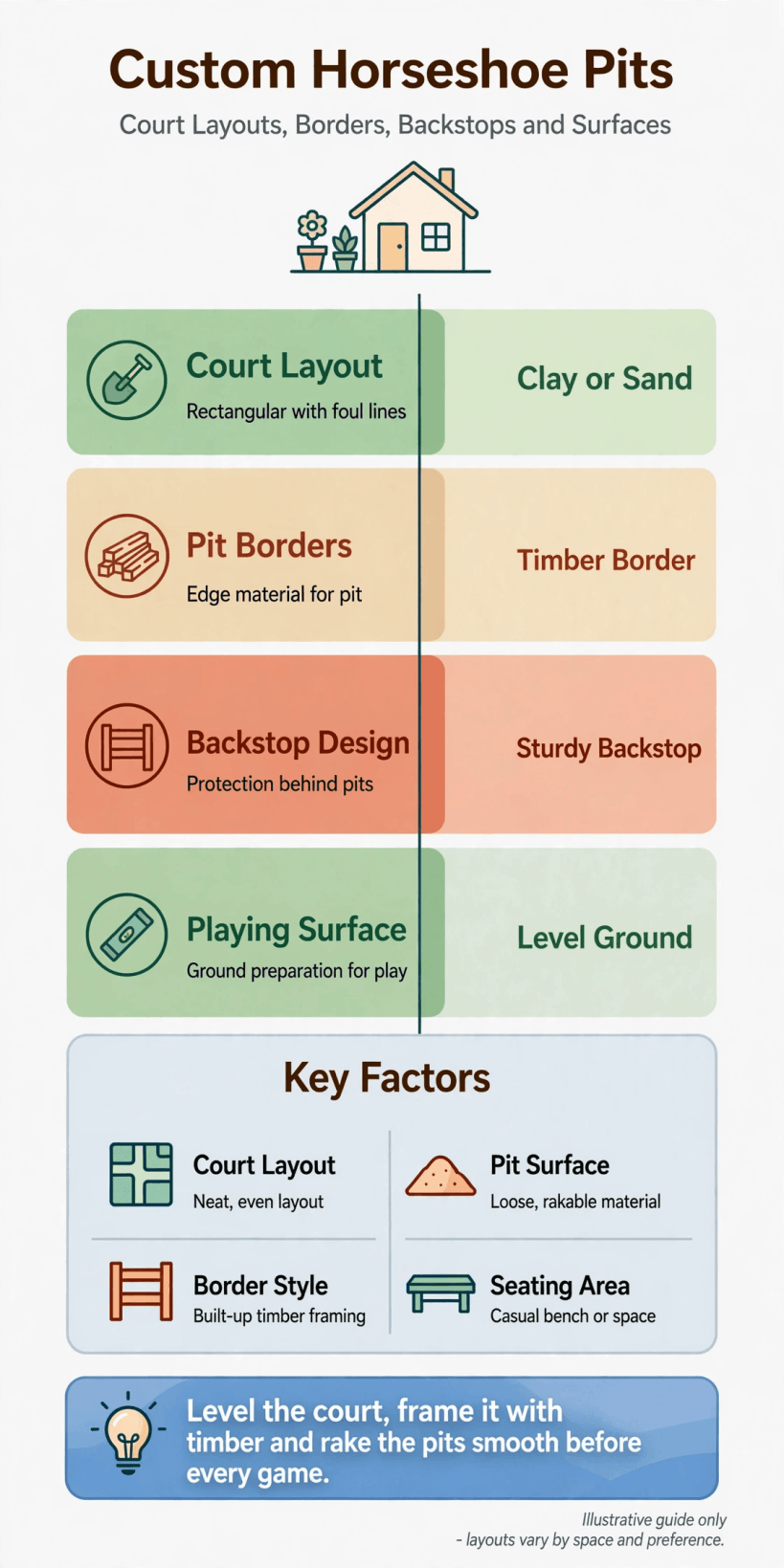
The parts of a backyard court at a glance: pits, stakes, surfacing, surrounds and the comforts that complete it.
Before choosing a layout, walk your yard at the time of day you expect to play. Notice where the sun sits, where water pools after rain, and which corners already collect people. A court that follows those habits will be used weekly; one that fights them becomes garden furniture. For broader outdoor inspiration, these tiny house landscaping ideas show how much atmosphere small, well-planned outdoor spaces can hold.
2. Classic Layouts That Always Work
Start with the shape of the court itself. These nine layouts cover most backyards, from a full twin-pit court on open lawn to a single practice pit tucked along a fence, and each one can wear any surface or styling from the later sections.
1. The Straight Classic Court
Two pits on one level strip of lawn, nothing fancy, everything aligned. It is the layout most players picture first, and it suits any yard long enough to give pitchers and spectators comfortable room at both ends.
2. Side-by-Side Twin Courts
Two courts running parallel, sharing one long seating strip down the middle. Perfect for gatherings and small tournaments, since games finish together and nobody waits long for a turn.
3. The Single Practice Pit
One pit and one stake against a fence or backboard. Ideal for small yards and solo practice, it delivers most of the pleasure of the game in a fraction of the footprint.
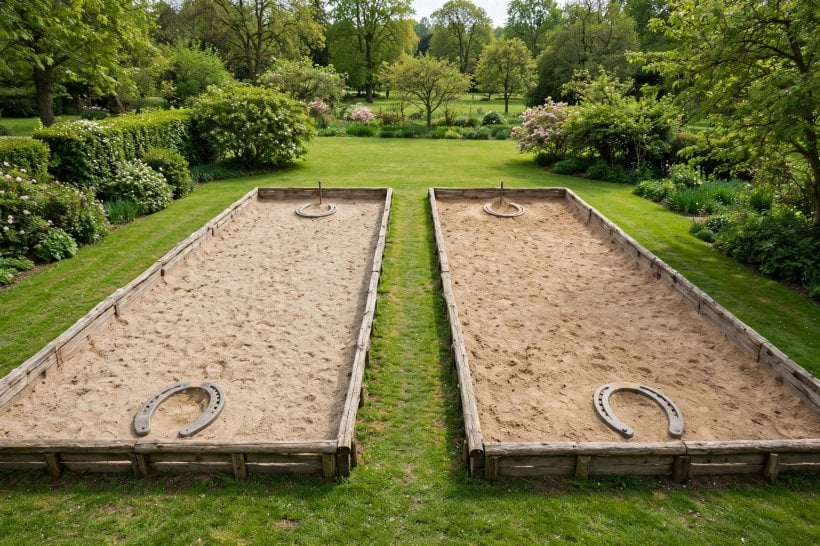
4. The Garden-Edge Court
Run the court along a garden border so planting frames one long side. Players get a green backdrop, and the court borrows the garden’s structure instead of needing its own.
5. The Patio-Side Court
Place the court beside a patio so seating, drinks and the barbecue sit steps away. Games flow naturally into the evening, and non-players stay part of the occasion.
6. The Shady Tree Court
Set the court where mature trees give afternoon shade. Keep pits clear of heavy root zones, expect fallen leaves in autumn, and enjoy the coolest seat in the garden all summer.
7. The Terraced Slope Court
On a sloping yard, cut the court into the hill as a level terrace with a low retaining edge. The level playing strip feels intentional, and the bank behind makes natural spectator seating.
8. The Gravel Meadow Court
Lay the court through a gravel or meadow area rather than lawn. It drains freely, needs no mowing along its length, and suits relaxed, naturalistic gardens beautifully.
9. The Corner Court
Angle the court into an underused corner, with backstops doing double duty against both fences. Corners often sit idle for years; a court gives them a job and a crowd.
3. Pit Boxes, Frames and Edging
The frame is what makes a pit a pit: it holds the surface in, gives the eye a clean rectangle to aim at, and takes the knocks from stray shoes. If you enjoy a weekend building project, our step-by-step guide to how to build your own tiny house shows the same measure-twice habits that make frames come out square and sturdy.

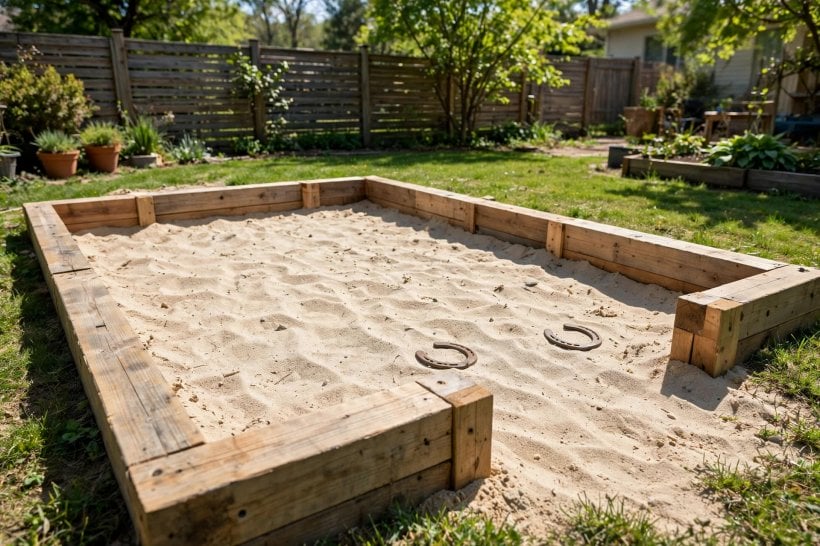
10. Timber-Frame Boxes
Sturdy boards pegged or screwed at the corners make the classic pit frame. Timber is forgiving to build with, easy on bouncing shoes, and simple to repair a board at a time.
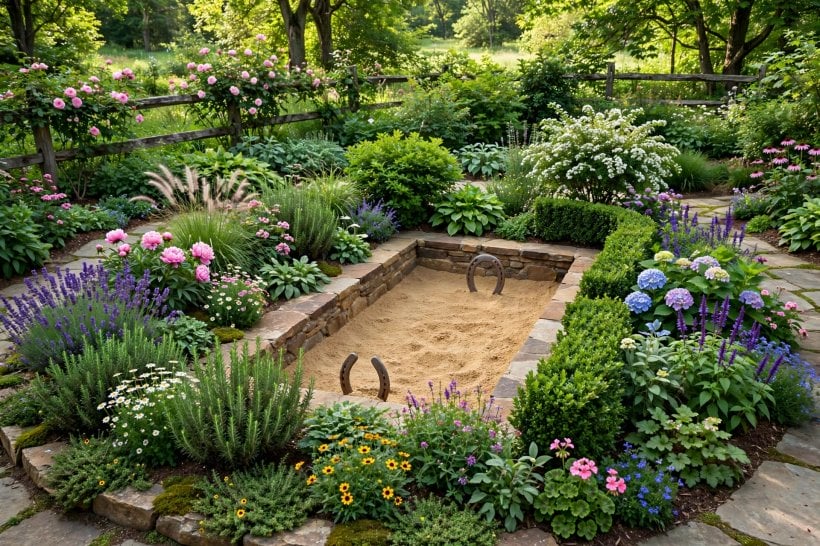
11. Stone-Edged Pits
Low stone blocks or setts give a pit real permanence and a handsome, settled look. They suit cottage and country gardens, and they shrug off weather for decades.
12. Brick-Trimmed Pits
A course of bricks laid flat around the pit ties the court to paths, patios and house brickwork nearby. The crisp line looks especially smart in smaller, more formal yards.
13. Concrete-Collar Pits
A cast or block concrete collar is the low-effort, long-life option. It keeps edges exact, resists heave in winter, and gives the court a clean, almost sporting-venue finish.
14. Reclaimed Sleeper Frames
Chunky reclaimed sleepers make deep, rustic frames with real presence. Their weight keeps them seated, and their weathered faces suit relaxed gardens where new timber would look too sharp.
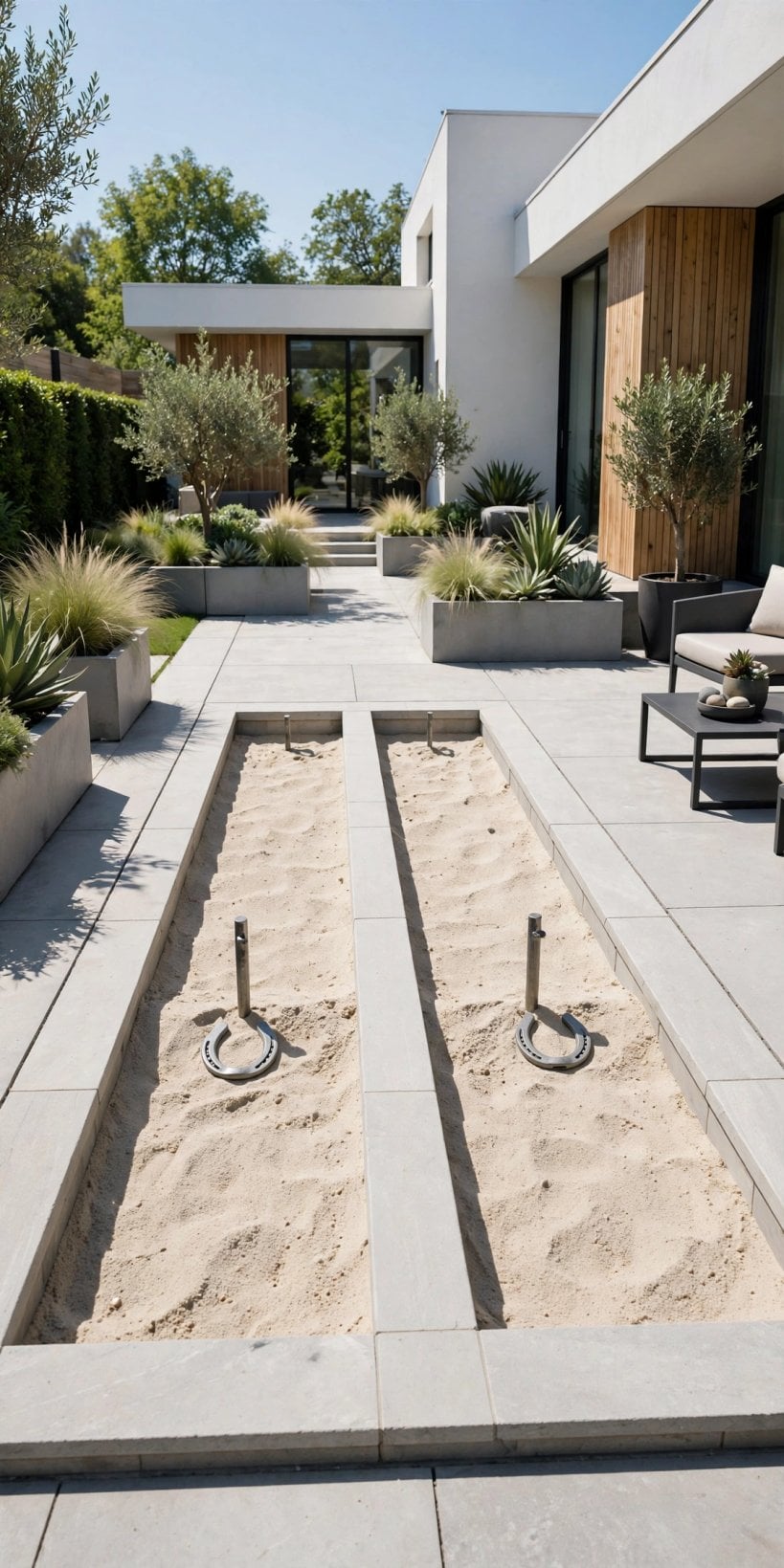
15. Metal-Edged Modern Pits
Slim steel or aluminium edging gives a contemporary court its hairline outline. Pair it with gravel surrounds and simple planting for a quiet, architectural feel.
16. Raised Pits
Lift the pit surface a little above the surrounding ground inside a taller frame. Raised pits drain well, are kinder to players who dislike bending to tidy them, and read clearly in the garden.
17. Flush Ground-Level Pits
Set frames flush so mowers pass and feet never trip. The court all but disappears into the lawn between games, which suits tidy gardens and multi-use family yards.
4. Surfacing Choices Inside the Pit
Surface decides how a shoe behaves when it lands: whether it sticks, skids, bounces or buries. None of these options is the single correct answer; each is a personality, and most players develop a favourite within a few games.
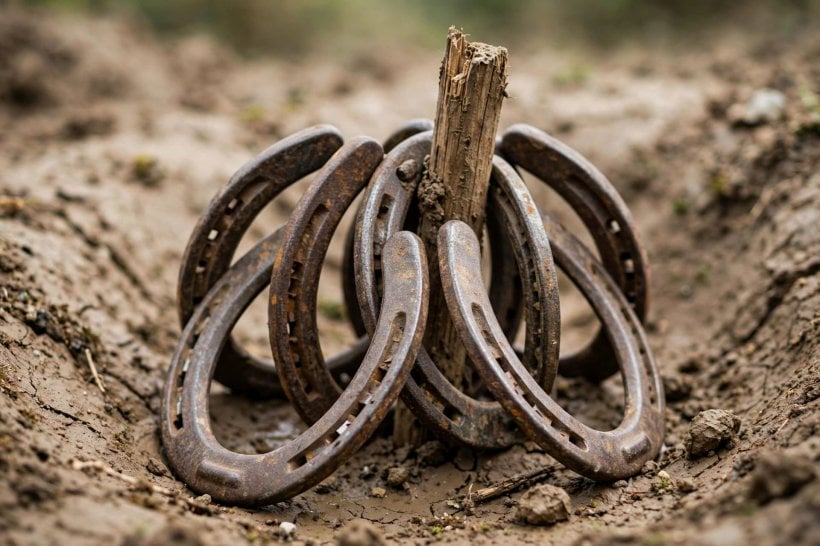
18. Classic Sand
The friendliest all-rounder. Sand catches shoes softly, forgives beginners, rakes smooth in a minute and is easy to top up. Keep it a little damp on very dry, windy days.
19. Packed Clay
Clay plays firm and true, holding a shoe close to where it lands. It needs moisture management to avoid cracking in heat, but devotees love its consistent, grown-up feel.
20. Crushed Stone Dust
Stone dust packs down into a smooth, even bed that drains after rain. It is tidy, pale and handsome, and it resists being scattered by enthusiastic pitching.
21. Decomposed Granite
A warm-toned, natural-looking surface that firms underfoot and blends into gravel gardens. It plays somewhere between sand and clay, which makes it a happy compromise for mixed groups.
22. Fine Gravel Blend
Small, rounded gravel gives a loose, forgiving landing and excellent drainage. Shoes sit visibly on top, which makes close calls easy to judge at a glance.
23. Sand-and-Clay Mix
Blending the two classics borrows sand’s softness and clay’s grip. Many home courts settle here after experimenting, adjusting the mix a barrow at a time until it feels right.
24. Cushioned Crumb Surface
A soft, springy crumb-style surface is gentle on shoes, quiet underfoot and kind in family gardens. Check any product’s suitability for outdoor use before committing to a whole pit.
25. Bare Earth, Traditional Style
The oldest surface of all: cleared, levelled earth, kept smooth by play. It costs nothing, changes with the seasons, and suits a relaxed court where character beats precision.
5. Backstops, Backboards and Safety Sense
Every court needs a plan for the shoe that sails long. Backstops protect fences, planting and ankles, and they keep games flowing by keeping shoes in easy reach. Build them solid and a little wider than feels necessary; the same careful thinking runs through these tiny house building design ideas, where small structures earn their keep for years.
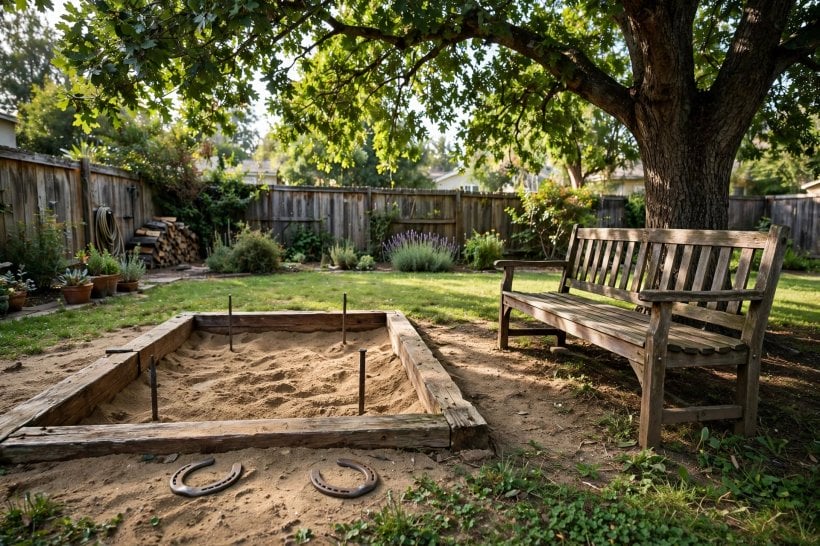
26. Timber Backboards
A low wall of horizontal boards behind each pit is the classic answer. It stops shoes with a satisfying knock and gives the court a finished, deliberate outline.
27. Sleeper Backstop Walls
Stacked sleepers make a heavier, quieter backstop that doubles as a perch for spectators and drinks. Their mass means stray shoes simply give up and drop.
28. Hedge Backstops
A dense hedge behind each pit swallows stray shoes softly and looks better every year. Allow growing room, and expect to fish out the occasional shoe from the foliage.
29. Fence-Line Backstops
Where a pit faces a fence, add a protective board panel at shoe height. The fence survives, the panel takes the dents, and replacing one panel beats replacing a fence.
30. Earth Berm Backstops
A low grassed bank behind the pit stops shoes gently and blends the court into the landscape. Children will claim it as a grandstand within the hour.
31. Catch Netting
For tight yards, a section of sports-style netting behind the pit catches high bounces. It is practical rather than pretty, so plant in front of it and let green soften the engineering.
32. Extra Landing Room
The cheapest backstop is distance: leave a generous clear apron behind each pit so long shots land on grass and stay visible, instead of disappearing into borders.
33. Clear Sight Lines
Keep the corridor between pits free of chairs, toys and crossing paths. Players should always see the whole court, and nobody should ever need to walk through the line of play.
6. Court Surrounds and Landing Zones
What surrounds the pits shapes how the court feels to use. Aprons and pads give pitchers a steady stance, keep mud out of the pits, and draw a polite boundary that tells spectators where the game ends and the garden begins.
34. Paver Aprons
A rectangle of pavers at each end gives pitchers a clean, level stance in all weathers and stops the busiest patch of lawn turning to mud by midsummer.
35. Gravel Landing Pads
Gravel pads echo the court’s materials, drain freely and cost little. Rake them with the pits and the whole court stays looking intentional rather than worn.
36. Stepping-Stone Pitching Pads
Two or three large flat stones at each end mark where pitchers stand. It is the lightest-touch option, lovely in informal gardens where hard landscaping feels too much.
37. Deck-Edge Courts
Let one end of the court meet a deck, so pitchers step straight from boards to pit. The deck becomes seating, score desk and drinks station in one.
38. Bark-Mulch Surrounds
Mulch around the pits softens every bounce, suppresses weeds and suits woodland corners. Top it up yearly and accept its relaxed, slightly wild manners.
39. Simple Lawn Surrounds
Grass right up to the frames is the zero-build option. It asks for tidy mowing and the odd repair to worn patches, and rewards you with the softest landscape of all.
40. Spectator Border Paths
A narrow path along one side gives watchers a place to stand that is close to the action but never in it. Paths also keep feet off wet grass on dewy evenings.
41. Quiet Drainage Thinking
Give the court a whisper of fall or a gravel channel along its low side so rain leaves instead of settling in the pits. Dry courts get played on; soggy ones get walked past.
7. Seating, Shade and Spectator Comfort
Horseshoes is a watching game as much as a playing one, and courts live or die by how pleasant they are to sit beside. Colour helps too; the cheerful schemes in these colorful tiny house interior ideas translate happily outdoors, where painted benches and cushions can echo the colours used inside the house.
42. Side Benches
One long bench along the court’s side seats the audience at the perfect distance. Build it from the same timber as the pit frames and the whole court feels designed, not assembled.
43. A Pergola at One End
A small pergola over the seating end gives dappled shade and a sense of occasion. Train a climber over it and by the second summer it is the best seat in the garden.
44. Shade Sails
A simple triangular sail over the spectators’ corner cools the court without darkening it. Fit it securely, angle it to shed rain, and take it down for winter storms.
45. The Tree-Shade Bank
Where a tree already shades the court’s edge, shape a low bank or a few broad steps beneath it. Natural shade plus a raised view makes a grandstand everyone fights for politely.
46. Folding-Chair Terraces
Keep a flat, firm strip beside the court sized for folding chairs. Flexible seating suits gatherings that swell and shrink, and the strip doubles as a path between games.
47. A Drinks Ledge
A narrow shelf along a fence or bench back, just wide enough for glasses and bottles, saves a hundred small trips indoors. Add it once and wonder how you managed without it.
48. Fire-Pit Pairing, at a Distance
As evenings cool, a fire bowl well away from the line of play keeps spectators warm and the court social. Keep it clearly separate, follow local guidance on outdoor fires, and never let it tempt anyone across the court mid-game.
49. The Storage Bench
A bench with a lift-up seat hides shoes, a rake and a brush between games. Gear that lives at the court gets used; gear stored across the garden quietly ends games early.
8. Lighting, Scorekeeping and Game Extras
Extras are where a court becomes yours. A little light stretches the playing day, a visible scoreboard gives games their friendly tension, and small storage touches mean a match can start within a minute of someone suggesting it.
50. Solar Path Lights
Low solar lights along the court’s edge mark the boundary after dusk and guide feet safely. Choose warm tones so the garden keeps its evening softness.
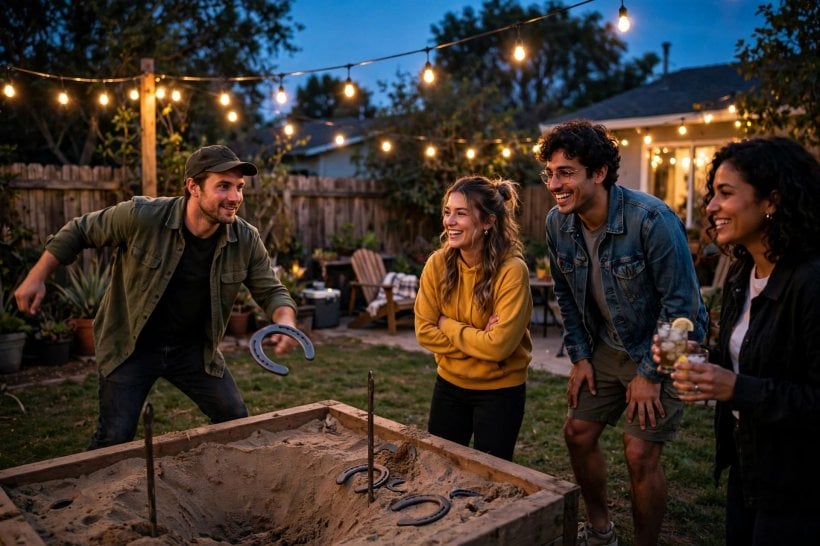
51. Overhead String Lights
Festoon lights strung high above the seating end, never across the line of flight, give the court a festival glow. Evenings stretch, and so does the season.
52. A Chalk Scoreboard
A framed chalkboard on a post or fence keeps score where everyone can argue with it happily. Chalk wipes clean, needs no power and suits the game’s unhurried character.
53. A Peg Score Keeper
A simple wooden score keeper with moving pegs is satisfying to use and easy to build from offcuts. Mount it at the seating end where the audience can officiate.
54. The Court-Side Shoe Box
A weatherproof box at one end keeps the shoe set dry, together and ready. Add a small brush for cleaning the shoes and the surface in the same trip.
55. Post-Top Cup Holders
Short posts with a flat cap beside each pit give pitchers somewhere safe for a drink between throws. It is a tiny luxury that feels surprisingly civilised.
56. A Compact Gear Cabinet
Where courts host other lawn games too, one small outdoor cabinet keeps everything in a single home. Order at the court means games start faster and end tidier.
57. Painted Stakes and Posts
A coat of colour on stakes, posts and the scoreboard ties the court together. Choose a shade that shows clearly against your surface so the target reads at a glance.
9. Planting, Colour and Garden Styling
A court dropped into a garden should look like it belongs there. Planting softens the rectangle, colour links it to the house, and a few styling decisions turn a games strip into one of the prettiest corners of the yard, the same trick that makes these tiny house living room ideas feel pulled together indoors.
58. Low Hedge Borders
A clipped low hedge along one or both sides gives the court green architecture. Keep it below sight-line height so spectators seated behind it still see every throw.
59. Ornamental Grass Backdrops
Clumps of ornamental grass behind the pits move in the breeze and catch evening light beautifully. They also forgive the occasional stray shoe with a rustle rather than a crack.
60. Wildflower Edges
Beyond the backstops, let a strip of meadow planting run a little wild. It feeds bees, hides the court’s working end, and makes the walk to retrieve shoes a pleasure.
61. Herb Beds by the Path
Herbs along the spectator path release scent as people brush past, and sit conveniently near the barbecue. Choose sturdy kinds that forgive being stepped around on busy evenings.
62. Colour-Matched Seating
Paint benches and the scoreboard in one colour drawn from the house or garden scheme. A single repeated colour is the fastest route to a court that looks designed.
63. Seasonal Pots at the Corners
Large pots at the court’s corners mark its territory and change with the seasons. Place them outside the bounce zone, and let them carry the colour when borders rest.
64. Festival Styling
For parties, add bunting along the fence and lanterns at the seating end. The court becomes the evening’s natural stage, then returns to calm the next morning.
65. Rustic Farmhouse Styling
Weathered timber, galvanised buckets for gear, and simple linen cushions give the court a farmhouse ease. It suits older houses and relaxed gardens down to the ground.
10. Small Yards, Budgets and Easy Upkeep
Not every court needs a full-length lawn or a craftsman’s budget. The final ten ideas shrink the game gracefully, build it from what you have, and keep it playing with minutes of care rather than weekends of work. Small-space thinking helps here too, and the layouts in these home interior design ideas for tiny houses and small spaces prove how much fun fits into a modest footprint when it is planned kindly.
66. The Half-Length Practice Court
Shorten the distance between pits to fit the yard you have. Purists may raise an eyebrow, but a shorter court that gets used beats a regulation daydream that never gets built.
67. The Pack-Away Pit
Build one pit as a framed tray you can stand against a wall after play. The lawn returns to the children by day and hosts league-standard arguments by evening.
68. The Multi-Game Strip
Share one level strip between horseshoes and other lawn games, with a small storage cabinet serving them all. One good surface, many evenings of variety.
69. The Reclaimed-Timber Build
Frames, backboards and benches from sound reclaimed timber cut costs and add instant character. Check every piece for nails and rot, and the court will look settled from day one.
70. The Weekend Starter Court
Start with frames, sand and stakes this weekend, then add aprons, seating and planting over the season. A court that grows in stages spreads both cost and effort comfortably.
71. The Five-Minute Rake Routine
Rake and level each pit after play, filling the divots while they are fresh. Five minutes keeps the surface honest and saves a full re-levelling day later in the year.
72. Weed-Smart Edging
A crisp edge or a hand’s-width gravel margin around frames keeps grass and weeds from creeping into the surface. Little and often beats one heroic weeding session every time.
73. Seasonal Cover Habits
In the wettest months, a simple cover over each pit keeps surfaces from washing out and weeds from moving in. Spring then starts with a rake instead of a rebuild.
74. Top-Up Rhythm
Surfaces slowly scatter and settle, so keep a small reserve of your surface material and top up thin spots as you spot them. The court stays level, and games stay fair.
75. A Court That Grows With the Family
Begin with a friendly short court for children, then lengthen it and firm up the backstops as players grow. The court becomes part of the family’s story, one summer at a time.
Final Considerations
The best court is the one that fits your yard, your players and your patience, not the one that imitates a tournament venue. Start with level ground, honest surfacing and safe clearances, then let seating, shade and planting turn those custom horseshoe pits into the corner of the garden where evenings naturally gather.
Build the simple version first, play on it for a few weeks, and upgrade the parts your games actually ask for. A court improved by experience always ends up better loved than one built from a catalogue of good intentions.


0 Comments